
AI tool cost statistics: 60+ figures, each labelled by source
What AI video, voice, coding and automation tools really cost — per clip, per call, per invoice. 60+ figures from our own accounts, each labelled by source.
Contents
What do AI tools actually cost?
Most of the numbers below came off our own account, our own invoice, or our own inspection of the delivered file. The rest are plan rates we read off a vendor’s page, prices an app quoted us before we committed, or dollar figures we derived from those. Every one is labelled, so you can see which is which before you quote it.
That matters because most of the published answers come from companies selling AI video, and they answer it in ranges. Somewhere between $20 and $220 per finished minute. Somewhere between $8 and $35 a month. Both are true and neither helps you budget.
Here is the short version. The subscription is rarely the number that decides your bill. On the tools we metered, what actually drove cost was the per-generation charge, the re-roll rate, and a ceiling that was usually not the one on the pricing page.
| The headline | What we found | Where |
|---|---|---|
| ”From $20/month” (Cursor) | $510.70 across 11 months of real invoices | Cursor review |
| ”$19.99 Pro plan” (Google Veo) | $2.00 per flagship Quality clip, so 10 clips a month | Veo pricing |
| ”Unlimited transcription” (Fireflies) | 400 minutes of storage for the entire team | Fireflies pricing |
| ”3 free imports” (Otter) | “2 of 3 left” after a single upload | Otter review |
| ”10 seconds at 1080p” (Luma) | delivered file measured 720p, twice | Luma review |
| ”$100/month” (Claude Code) | $110 billed once tax collection started | Is Claude Code worth it? |
Six tools, six gaps. None of them is a scandal and none of them is hidden. They are just measured somewhere other than where you were looking.
Key findings
The eight most citable numbers on this page. Most link to the test they came from; two of them (the Fireflies storage cap, and the vendor half of the free-grant mismatch) are figures read off a pricing page.
- A coding plan advertised at $20 totalled $510.70 across eleven months of real invoices. Metered usage was 33% of it, and 97% of that metered spend fell in just three months (Cursor).
- Flagship AI video costs about three times more on Veo than on Kling for output most viewers could not rank blind: roughly $2.00 against $0.66 a clip (Veo, Kling).
- Model choice inside one platform moves cost about tenfold — a finished minute runs $64.00 on Veo Quality against $6.40 on Veo Lite, a bigger lever than switching vendors (Veo pricing). Both assume four generation passes, a rate we did not measure.
- Luma announced a 1080p render and delivered 720p, twice, confirmed by inspecting the file rather than the interface (Luma).
- One 28-node workflow costs 1 execution on n8n or 28 operations on Make. The metered unit, not the sticker price, is what compounds (n8n).
- “Unlimited transcription” came with 400 minutes of storage for an entire team, filled in under three weeks at three meetings a week (Fireflies).
- Four note takers landed close enough that accuracy is not the axis that separates them on the same 80-second clip: Fireflies made one punctuation slip, Otter dropped two digits and a dollar sign, and Granola garbled a line (benchmark).
- Two vendors’ published free grants did not match our accounts: Runway listed 125 credits where ours held 500, and Hailuo advertised 2,000 where ours held 100.
Why is the bill higher than the plan price?
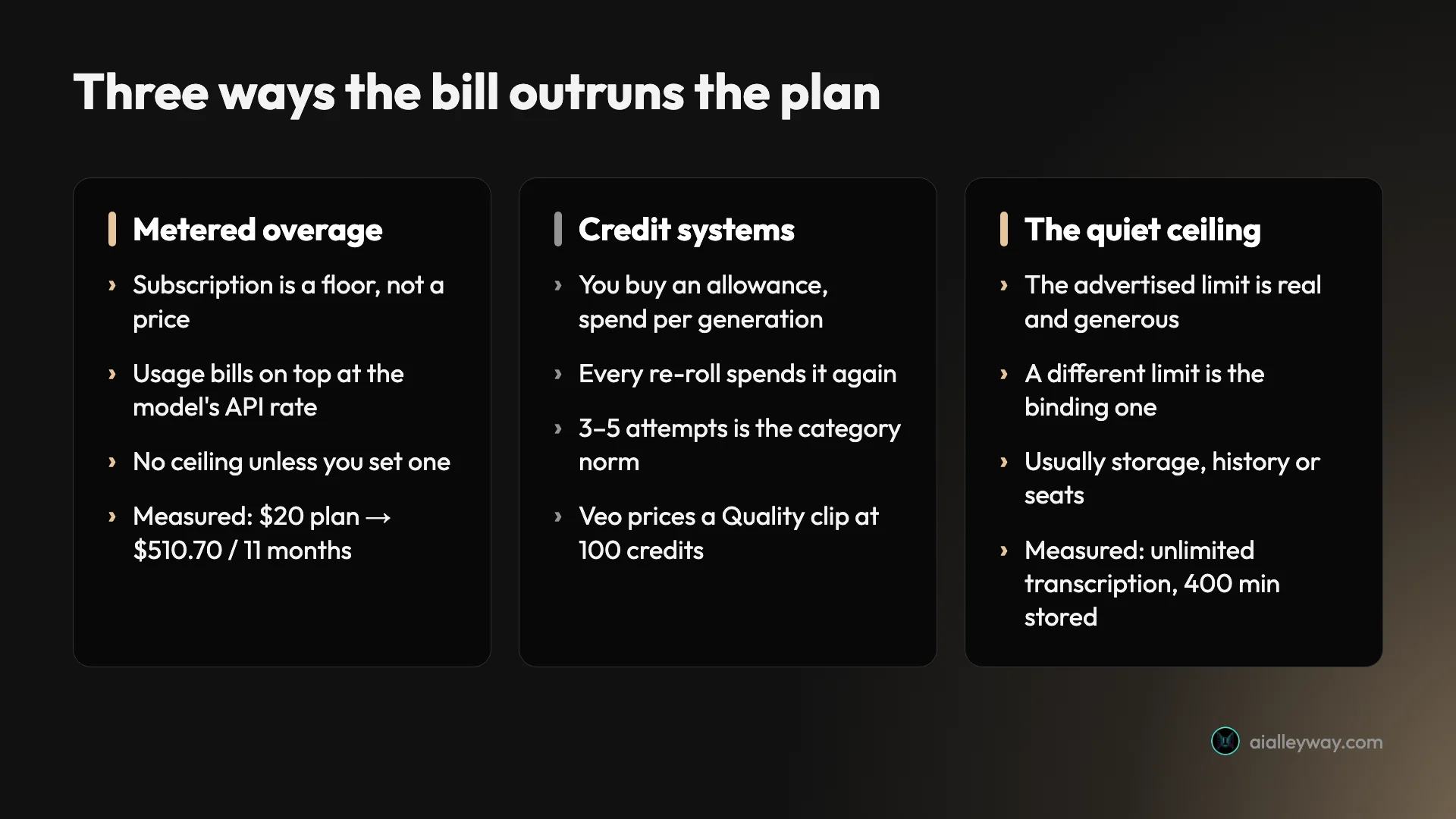
Before the tables, the mental model. Across roughly thirty tools we have paid for and run, the gap between the advertised price and the real bill takes one of three shapes.
Metered overage. The subscription is a floor, and usage bills on top at the model’s API rate. This is the shape that produces the biggest surprises, because it has no ceiling unless you set one.
Credit systems. You buy an allowance and spend it per generation. The trap is not the rate, it is the re-roll: a clip you generate five times costs five clips, and the first attempt is almost never the keeper.
The quiet ceiling. The advertised limit is real, generous, and not the binding one. Unlimited transcription with a storage cap. Unlimited recording with a history wall. The number in the headline is true; the number that stops you is somewhere else.
Everything below sorts into one of those three.
How much does AI video generation cost per clip?
This is the table the ranking pages do not have. Where we could, we generated a clip and read the cost off the account balance before and after; where the platform quotes the price in-app before you commit, we recorded that instead and label it separately. Sources are the Veo, Kling, Runway, Seedance, Luma and Hailuo reviews.
| Tool | Model / output | Credit cost | Cost per clip | Class |
|---|---|---|---|---|
| Google Veo | Quality, 8s | 100 credits | ~$2.00 (Pro) | Panel → Derived |
| Google Veo | Fast, 8s | 20 credits | ~$0.40 (Pro) | Panel → Derived |
| Google Veo | Omni Flash, 8s | 12 credits | ~$0.24 (Pro) | Panel → Derived |
| Google Veo | Lite, 8s | 10 credits | ~$0.20 (Pro) | Panel → Derived |
| Google Veo | Still image | 0 credits | free | Panel |
| Kling | Video 3.0, 5s 1080p + audio | 60 credits | ~$0.66–$0.80 | Measured → Derived |
| Kling | 720p | ~20 credits (approx) | n/a | Panel, approximate |
| Runway | Gen-4 Turbo, 5s image-to-video | 25 credits | ~$0.20–$0.48 | Measured → Derived |
| Runway | Gen-4 text-to-image | 8 credits | n/a | Measured |
| Seedance | 1080p 5s via developer platform | n/a | $0.62 | Measured |
| Seedance | Dreamina 2.0 | 172 credits | n/a | Panel (free tier gated) |
| Seedance | Dreamina 2.0 Mini | 124 credits | n/a | Panel (free tier gated) |
| Luma | Ray 3.2 draft, 5s 540p | ~97 credits (3,000 → 2,903) | ~$0.29 (Plus) | Measured → Derived |
| Hailuo | 6s 768p | 25 credits (100 → 75) | n/a | Measured |
Two footnotes that move these numbers. Kling’s dollar figures use its ~$33 renewal price rather than the $25.99 first-month promo. Where the table marks a rate annual, the derived figure uses it; Veo and Luma are listed at their single published monthly rate. Both traps are worked through under the plan rates below.
Read the class column before you quote a row. Measured means we watched the balance move on our own account. Panel means the app quoted the price in-app before generating and we recorded that quote without running it. Derived means we multiplied a credit cost by the vendor’s published plan rate, so it inherits whatever the vendor’s price is today.
The distinction matters most on Veo. Its Flow panel states every model’s cost before you commit, and that panel is where all four Veo credit figures came from — including the widely-quoted 100 credits for a Quality clip. We generated on Lite, not Quality, and we did not record a balance trace on either, so none of the Veo credit numbers are ours in the way Runway’s, Kling’s, Luma’s and Hailuo’s are.
The spread is the story. A flagship Veo clip and a flagship Kling clip cost roughly $2.00 and $0.70 for output that most viewers could not rank blind. That is a three-to-one gap on the same job.
And you pay it per attempt. That multiplier is the biggest number on this page and it is not ours: three to five tries per usable shot is the rate the category commonly reports, and we have not measured our own. Treat every figure below that uses it as a model, not a measurement.
What does a finished minute of AI video cost?
Per-clip numbers are the honest unit, but nobody briefs a project in clips. So here is the same measured data carried through to the number people actually ask for, using each tool’s own native clip length.
The arithmetic is deliberately visible: native clip length sets how many generations a minute needs, the measured credit cost sets the price of each, and the re-roll rate multiplies it. We show one pass and four passes, four being the midpoint of the three-to-five range the category reports.
| Model | Native clip | Clips per minute | 1 pass | 4 passes |
|---|---|---|---|---|
| Veo Quality | 8s | 8 | $16.00 | $64.00 |
| Veo Fast | 8s | 8 | $3.20 | $12.80 |
| Veo Lite | 8s | 8 | $1.60 | $6.40 |
| Kling Video 3.0 (Pro) | 5s | 12 | $7.92 | $31.68 |
| Seedance 1080p | 5s | 12 | $7.44 | $29.76 |
| Runway Gen-4 Turbo (Pro) | 5s | 12 | $3.72 | $14.88 |
| Luma Ray 3.2 draft (Plus) | 5s | 12 | $3.48 | $13.92 |
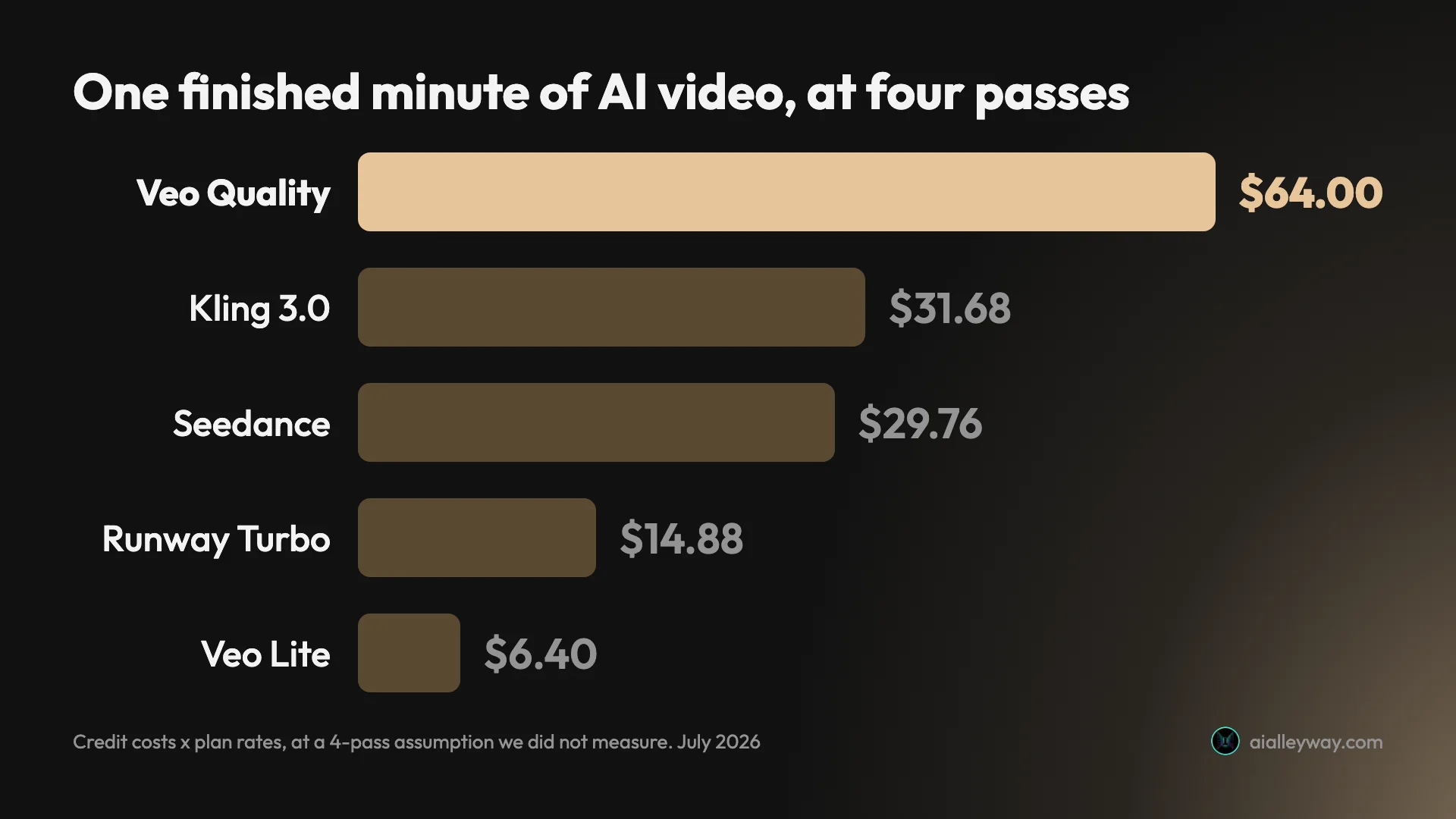
Every figure in that table is derived: a measured credit cost multiplied by a vendor plan price and a re-roll assumption. It inherits all three risks. We publish it anyway because the alternative on offer is a range spanning an order of magnitude.
Two things fall out of it. A flagship minute costs roughly ten times a draft-grade minute on the same platform, which is a far bigger lever than switching vendors. And the cheapest flagship option is about half the most expensive, so model choice within your quality bar matters more than the logo on the invoice.
The plan rates behind the derived figures
Every dollar figure above is a measured credit cost multiplied by a plan rate, so the plan rates belong on the page. Without them you cannot check our arithmetic or update it when pricing moves, and both of those should be possible.
These are vendor-published, read off each pricing page and verified between June and July 2026. They are the least durable numbers here.
| Tool | Plan used in our math | Price | Credits included |
|---|---|---|---|
| Google Veo | Pro | $19.99/mo | 1,000 |
| Google Veo | Plus | $4.99/mo | 200 |
| Kling | Pro | $25.99 first month, renews ~$33 | 3,000 |
| Kling | Standard | $6.99 first month, renews ~$8.80 | 660 |
| Runway | Pro | $28/mo annual, $35 monthly | 2,250 |
| Runway | Standard | $12/mo annual, $15 monthly | 625 |
| Runway | Max | $76/mo annual, $95 monthly | 9,500 |
| Luma | Plus | $30/mo | 10,000 |
| Hailuo | Standard | $7.99/mo annual | 1,000 |
| Pika | Pro | $28/mo annual, $35 monthly | 2,300 |
To recompute any figure, divide the plan price by its credit allowance to get a cost per credit, then multiply by the measured credit cost of the generation you care about. A Veo Quality clip at 100 credits on the Pro plan is 100 × ($19.99 ÷ 1,000), which lands at about $2.00.
Seedance sits outside this table because it is not sold on a subscription in the configuration we tested. Its developer platform bills $2.50 per million video tokens, where tokens are height × width × frames-per-second × duration ÷ 1024, which is why our Seedance figure is a charge rather than a derivation.
Two caveats bite here specifically. Every annual/monthly pair in the table above is exactly 20% apart, and vendors quote the cheaper one as the headline, so a month-to-month buyer should scale the derived figures up by a quarter.
The second is worse, because it is invisible on the pricing page. Every paid Kling figure is a first-subscription promo. Pro is advertised at $25.99 and renews at about $33, Ultra at $127.99 and renews at $159.99, per Kling’s membership page. Our Kling per-clip figures deliberately use the renewal price, not the promo, because the renewal is what you pay in month two and every month after. Recompute Kling with the headline number and you will land about 20% low.
Do AI tools deliver what they advertise?
The costliest findings on this page came from inspecting files rather than interfaces. In four cases the label and the artifact disagreed, and both of the worst offenders turned up in the Luma and Pika reviews.
| Tool | What the interface said | What the file measured |
|---|---|---|
| Luma | ”10 seconds at 1080p” | 720p, and again 720p when the same scene was re-routed through Veo |
| Pika | default labelled 480p | 784 x 470 |
| Pika | no watermark in the in-app player | ”Pika” baked into the download |
| Google Veo | ”Veo” mark visible in the preview interface | no visible watermark on the export |
Two of those cut against the vendor and one cuts in its favour, which is roughly what you would expect from measurement rather than advocacy. Veo’s export was cleaner than its own preview suggested.
Free output differs on more than watermarks, and the differences are not documented consistently anywhere:
| Tool | Free output resolution | Audio | Watermark |
|---|---|---|---|
| Google Veo | 8s, 16:9, full length | native audio | none on export |
| Kling | 5s, 1080p | native audio | ”KlingAI 3.0” |
| Hailuo | ~6s, 768p | silent | ”MINIMAX | Hailuo AI” |
| Seedance | 5s, 1080p | silent | none |
| Pika | ~5s, 784 x 470 | silent | in download only |
| Luma | 5s, 540p draft | n/a | animated “Luma AI” |
| Runway | 5s, 720p | silent | yes |
One provenance note: Runway’s 720p came from the hands-on session rather than from running ffprobe over the file, so it is not file-verified the way the Luma and Pika figures are.
Generation time we only captured on three tools, and the range was wide enough to matter: Veo returned an 8-second clip in about 60 to 70 seconds, Hailuo in about a minute, and Pika made us wait 12 or more minutes on the free queue for a single 480p clip. Treat Veo’s figure as a ceiling rather than a typical time — Flow was showing a standing high-demand banner during that session, and the render was slower than its usual pace.
What does a $20 plan actually cost?
This is the cleanest dataset on this page, because it is not a benchmark. It is eleven months of real card charges for one developer using Cursor as a daily driver.
| Month | Subscription | Metered | Total |
|---|---|---|---|
| Mar–Jul 2025 | $20.00 each | $0.00 | $20.00/mo |
| Aug 2025 | $20.00 | $37.16 | $57.16 |
| Sep 2025 | $20.00 | $2.29 | $22.29 |
| Oct 2025 | $80.00 | $79.22 | $159.22 |
| Nov 2025 | $60.00 | $50.00 | $110.00 |
| Dec 2025 | $60.00 | $1.27 | $61.27 |
| Jan 2026 | $0.00 | $0.76 | $0.76 |
| 11-month total | $340.00 | $170.70 | $510.70 |
Metered usage was 33% of the total. But it was not spread evenly, and that is the part worth citing: $129.22 of the $170.70 came from two months. August accounts for a further $37.16, which leaves just $4.32 spread across the remaining eight months. Three months carry 97% of the metered spend.
That shape matters more than the average. A meter that sits near zero for eight months and then bills $79.22 in one is not an expensive tool, it is an unpredictable one. Nothing malfunctioned in October; the work simply got heavier, and a $60 tier’s allowance ran out in about a week.
The same invoices break down by model. These four rows are the largest by spend, covering $61.46 of the $170.70 metered total, and are as close to a per-call price list as this category gets:
| Model | Calls | Spend | Cost per call |
|---|---|---|---|
| Sonnet 4 | 88 | $2.34 | $0.027 |
| Sonnet 4 thinking | 371 | $17.16 | $0.046 |
| Sonnet 4.5 thinking | 510 | $40.69 | $0.080 |
| Opus 4.5 high-thinking | 15 | $1.27 | $0.085 |
Thinking mode raises the per-call cost by about 70% on the same model family. Moving from Sonnet 4 to Sonnet 4.5 thinking triples it.
By contrast, a flat subscription behaves exactly as advertised. Eight months on Claude Code’s Max 5x plan produced $0 in extra credits. The bill still moved without the price moving: January to March billed a flat $100, and from April every invoice reads $110 because tax collection started, a 10% rise with no pricing announcement. On a working afternoon its dashboard read 7% of the session window used against 56% of the weekly all-models limit, which is the ratio that tells you which limit will actually bite.
Why do automation tools bill so differently?
Automation tools all look similarly priced until you notice they are not counting the same thing. We ran a 28-node render workflow on our own n8n instance in production, then counted what each rival’s pricing model would charge for that same graph. Only the n8n row is a measurement; the other two are counterfactuals applied to a real workflow, not runs on those platforms.
| Billing unit | What one run of our 28-node workflow would cost |
|---|---|
| n8n (per execution) | 1 execution |
| Make (per operation) | 28 operations |
| Zapier (per task) | one task per billable app action |
That is a 28-fold difference in metered units for identical work. Scaled up, a 30-step workflow running 1,000 times a month is 1,000 n8n executions against ~30,000 Make operations and up to 30,000 Zapier tasks — against plan allowances of 2,500, 10,000 and 750 respectively.
Polling makes it worse, and this is the number most people miss. On Make’s 10,000-credit Core plan, a single scenario checking an inbox burns:
| Poll interval | Operations per month | Share of a 10,000-credit plan |
|---|---|---|
| Every 1 minute | ~43,200 | over budget on its own |
| Every 5 minutes | ~8,640 | ~86% |
| Every 15 minutes | ~2,880 | ~29% |
| Every 60 minutes | ~720 | ~7% |
Changing one dropdown from 5 minutes to 30 claws back over 7,000 credits a month. Nothing about the workflow changes.
For reliability, our own production instance ran 10 workflows across roughly 209 nodes, and the last 93 retained executions completed with a 100% success rate at the time we sampled the API.
Credits and caps: voice and meeting tools
Voice tools meter characters, and the number that matters is how fast an allowance moves when you iterate. Three accounts, read directly off the usage page in the ElevenLabs, Cartesia and Descript write-ups:
| Tool | Plan | Meter reading |
|---|---|---|
| ElevenLabs | Creator, mid-month | 14,552 of 131,000 credits spent |
| Cartesia | Free | 20,000 model credits + $1.00 agent balance |
| Descript | Free | 43 of 100 AI credits, 0 of 60 media minutes |
Descript’s two pages disagreed with each other while we were looking at them: the plan page called it “Monthly AI credits: 100” while the usage page called the same number “Lifetime AI credits used: 43/100”. One of those is a renewable allowance and the other is a one-time grant, and they are not the same product.
The quiet ceilings show up most clearly on meeting tools, where the advertised limit is generous and the binding one is elsewhere:
| Tool | What is advertised | What actually stops you |
|---|---|---|
| Fireflies | unlimited transcription, free | 400 minutes storage, whole team; 20 AI credits/mo |
| Otter | 3 lifetime imports | ”2 of 3 left” after one upload |
| Descript | 100 AI credits | one-time grant, not monthly |
| Runway | free tier | flagship model gated; free output silent and watermarked |
At three one-hour meetings a week, a team fills that 400-minute Fireflies cap in under three weeks.
What do three real projects cost?
Abstract per-unit costs are hard to hold in your head, so here are three jobs priced end to end. The video row carries the four-pass assumption, so treat it as a model rather than a measurement.
A 60-second product video, flagship quality. Twelve Kling clips at four passes each puts generation at $31.68. Add a voiceover: a 150-word script runs about 900 characters, which at ElevenLabs Pro rates of roughly 16 cents per generated minute is under a dollar even after a few re-reads. Generation is over 95% of this budget, and the model you pick moves it far more than the plan you are on.
A weekly podcast, voice only. Two hours of finished audio a month on Murf’s $29 Creator plan works out to about $14.50 per audio-hour, or $9.50 at the annual rate. The number that breaks this budget is not length, it is iteration: Creator allows 24 hours a year, about two hours a month, and every regeneration bills against it. Re-read each segment once and a two-hour show generates four hours, double what the plan allows — so the costed row below only holds at zero re-rolls.
A month of meetings, ten hours recorded. Ten hours is 600 minutes, which clears Fireflies’ free 400-minute storage cap in the third week and puts you on a paid seat. Compared like for like on monthly billing, Fireflies Business is $29 a seat against Otter’s $30, so a five-person team lands at $145 versus $150, near-identical. Annual billing does not open a gap either: Fireflies drops to $19 a seat and Otter to $19.99, so five seats run $95 against $99.95. Accuracy, as the benchmark below shows, is not what separates them.
| Project | Metered cost (video = modelled) | Subscription | What dominates |
|---|---|---|---|
| 60s product video (Kling, 4 passes) | $31.68 | $25.99/mo | generation, over 95% |
| Podcast, 2 finished hours/mo (Murf) | ~$14.50/audio-hour | $29/mo | re-reads, not length |
| 10h of meetings, 5 seats (Fireflies) | storage cap hit in week 3 | $95/mo | seats, once free breaks |
The pattern across all three: the metered unit dominates, and the subscription is a rounding error next to it.
Five ways these numbers mislead
Every figure on this page has a way of being read wrong, including by us. These are the five that cost the most.
| The reading | Why it breaks | The evidence |
|---|---|---|
| ”A credit is a minute” | ElevenLabs bills ~1 credit per character, so a plan sold in minutes meters characters | our Creator account read 14,552 of 131,000 credits, never shown as “minutes used" |
| "The free grant is published” | it is the least reliable published number in this category | Runway said 125, ours held 500; Hailuo said 2,000, ours held 100 — per-generation rates were accurate on both |
| ”The allowance is monthly” | a monthly allowance may be a one-time grant | Descript’s plan page said “Monthly AI credits: 100” while its usage page said “Lifetime AI credits used: 43/100" |
| "The label is the output” | interface labels are claims, not measurements | Luma announced 1080p and delivered 720p twice; Pika labels 480p and delivered 784x470 — neither visible without inspecting the file |
| ”The dollar figure is durable” | credit costs outlive the prices attached to them | a 100-credit Veo Quality clip stays 100 credits; the $2.00 only holds while Pro is $19.99 for 1,000 credits |
When you cite this page, the credit costs are the durable half.
How accurate are AI note takers?
Cost is only half the question. In June 2026 we fed the same 80-second, two-speaker scripted meeting to four note takers, with known facts planted in the script so we could grade the output against ground truth rather than against each other.
The script ran roughly 230 words between two synthetic voices, and carried a 5.2% churn figure, an activation jump from 41% to 58%, a price moving from $16 to $19, an instruction to “tag it P1”, and the acronyms SSO and P95.
| Tool | Result on the planted facts |
|---|---|
| Fathom | cleanest transcript of the four. “Q3 churn”, “6.8 in Q2”, “$16 to $19”, “tag it P1” all intact |
| Fireflies | matched it. One slip: “right now” became “right. Now” |
| Otter | ~99% word accuracy, but dropped digits: “Q3” → “Q”, “Q2” → “Q”, “$16” → “16” |
| Granola | garbled one line: “tag it P1” → “tagget P1” |
One caveat matters if you cite this: the four tools did not ingest the clip the same way. Otter and Fireflies took it as a file upload, Granola captured it as a Quick Note, and Fathom recorded it bot-free from device audio. That is how these products work in normal use, so the comparison reflects real conditions rather than a lab rig, but it does mean the audio path differed between them. A file upload skips the capture stage entirely, which is where live recording usually loses words.
The honest reading is that on clean audio these four are close enough that accuracy should not decide your purchase. Where they genuinely diverge is the meeting bot, the storage cap and the price.
Two secondary measurements from the same clip: Otter detected both speakers and held attribution throughout at a 55/45 split, while Fireflies labelled them generically as Speaker 1 and 2 but produced talk-time analytics (44% / 56%, at 191 and 162 words per minute) and a sentiment split of 93% neutral. Fireflies’ AskFred assistant answered a question about the transcript in about 50 seconds.
Methodology, and where our numbers disagree with vendors
A statistics page is only worth citing if you can see how it was made, so here is the method and its limits.
How figures were obtained. Where the class says Measured, credit costs were read off the account balance immediately before and after a single generation. Where it says Panel, the app quoted the cost in-app before generating and we recorded that quote without running it — on Veo because its Flow panel prices every model up front and we generated on Lite, and on Seedance’s Dreamina because its free tier gates generation entirely. Dollar costs marked measured were charged to our own card or developer account. Resolution, audio and watermark claims were verified by inspecting the downloaded file with ffprobe and frame-difference analysis, not by reading the interface. Invoice figures are transcribed from the vendor’s own billing history.
The four classes. Measured is first-party observation, a balance trace or a file inspection. Panel is a price the app stated before we committed, recorded without generating. Vendor is a figure read off a pricing page, where we verified the page and not the behaviour. Derived multiplies a credit cost by a vendor’s published plan price, so it carries the vendor’s pricing risk. The one number that is none of these is the four-pass re-roll rate, a category-reported assumption we did not measure.
Where we disagree with the vendor. We are publishing these rather than resolving them, because a statistics page that hides its disagreements is not one:
| Figure | Vendor says | Our account held |
|---|---|---|
| Runway free credits | 125 one-time | 500 (trace: 500 → 492 → 467) |
| Hailuo trial credits | 2,000 | 100 (trace: 100 → 75) |
Both per-generation rates were solid in each case. It is the free grant we could not confirm, which means every “roughly 80 free clips” figure derived from Hailuo’s 2,000-credit claim should be treated as a vendor number, not ours.
Limits you should carry if you cite this. The accuracy test used clean, scripted, two-speaker synthetic audio with no cross-talk, accents or bad microphones, so treat it as a best case. Video was sampled at one clip per tool per model, not a statistically meaningful run. Runway has no file-verified resolution and no measured render time here. And one internal note: the accuracy clip is described as 80 seconds throughout our reviews except in one table where it reads 60; the 80-second figure is the correct one.
Dates. Video and voice measurements were taken between June and July 2026. The accuracy test ran in June 2026. Cursor invoices span March 2025 to January 2026. Automation figures come from a production instance sampled in June 2026. AI pricing moves monthly, so treat any derived dollar figure as anchored to those dates.
How to use these numbers
If you are budgeting rather than citing, the measurements point at four decisions.
Budget by the re-roll, not the clip. Take the per-clip cost above and multiply by three to five — the rate the category reports, which we have not measured ourselves. That, not the subscription, is your real monthly number.
Check which limit binds before you upgrade. The 7%-session against 56%-weekly reading is the pattern: paying for a higher tier fixes nothing if the ceiling you keep hitting is the other one.
On metered plans, set the spend limit on day one. The tools that produced our largest bills all offered a cap that was off by default. It would not have stopped all of October’s $159.22 — $80 of that was subscription, including a mid-month tier upgrade — but the $79.22 of metered usage on top was exactly what a cap exists to prevent.
Count your billing units before you pick an automation tool. One workflow, 28 nodes, and the metered unit ranges from 1 to 28 depending on vendor. That ratio will not improve as you scale; it compounds.
Skip this page’s video figures entirely if you only need draft-grade output. At Veo Lite’s 10 credits per clip, the cost question mostly stops being a question.
Matched to who you are, the measurements say four different things.
| If you are | Buy on | The number that decides it |
|---|---|---|
| A solo creator publishing weekly | cost per attempt, not tier | $64.00 vs $6.40 a finished minute |
| An agency billing the output | predictability, not unit price | an $80 month that billed $159.22 |
| An engineering team picking automation | billing units, not features | 1 execution vs 28 operations |
| A team buying meeting notes | bot policy and storage cap | 400 minutes for the whole team |
| Spending under ~$20/month | whatever has a free tier | none of them |
Below about $20 a month, none of this is worth optimising — the differences cost less than the hour you would spend on them, and any tool with a usable free tier will do.
Sources for every figure
Each number above was recorded during a full hands-on write-up. These are those write-ups, and they carry the test conditions, dates and screenshots this page summarises.
Video generation
- Google Veo review and Veo 3 pricing: the per-model credit costs, free-tier behaviour and export watermark finding
- Kling AI review and Kling AI pricing: the 60-credit flagship clip and the promo-versus-renewal trap
- Runway review and Runway pricing: the 8- and 25-credit measurements, and the free-credit discrepancy
- Seedance review and Seedance pricing: the $0.62 charge and the Dreamina credit costs
- Luma AI review: the 1080p-versus-720p delivery finding
- Pika review: the 784x470 measurement and the 12-minute free queue
- Hailuo review: the 25-credit rate and the 768p output
Coding and automation
- Cursor review: the full 11-month invoice history and per-model call costs
- Is Claude Code worth it? and Claude Code pricing: the $110 bill and the two usage windows
- n8n review: the production workflow counts and execution success rate
- Make.com pricing and Zapier pricing: the polling burn and the task-tier ladder
Voice and meeting tools
- ElevenLabs pricing: the credit meter reading and per-minute cost
- Murf pricing: the Creator hourly rate and the 24-hours-a-year meter
- Cartesia review and Descript review: the free-tier meters and the monthly-versus-lifetime contradiction
- Best AI note taker: the full accuracy benchmark and its script
- Otter review, Fathom review, Fireflies review, Granola review: per-tool results on that clip
Citing this page
These numbers are free to use with attribution. If you are writing about AI tool costs, please link the specific review the figure came from rather than this summary, since that is where the test conditions are written up.
Suggested citation: AI Alleyway, “AI tool cost statistics”, August 2026, https://aialleyway.com/ai-tool-cost-statistics/
We update the figures when we re-test rather than on a schedule, and the review each number links to carries its own test date. If a vendor’s pricing has moved since the dates above, the measured credit costs will still hold; the derived dollar figures will not.
Corrections are welcome and we publish them. Two of the tables above exist because our first reading was wrong and file inspection caught it.
Frequently asked questions
How much does AI video generation actually cost per clip?
It depends far more on the model than the plan. We recorded the credit cost of one clip on six tools and converted it at each plan's rate: a Google Veo Quality clip runs about $2.00 on the $19.99 Pro plan, a flagship Kling clip about $0.66 to $0.80, a Seedance 1080p clip about $0.62 billed per generation, and a Runway Gen-4 Turbo clip about $0.20 to $0.48 depending on tier.
The spread between the cheapest and most expensive flagship clip is roughly three to one for output most viewers could not rank blind. That gap, not the monthly subscription, is what decides your real bill — because you pay it again on every regeneration, and nobody gets the shot on the first try.
Why is the advertised price of an AI tool different from the bill?
Because most AI tools meter something the pricing page does not lead with. We found three shapes. Metered overage bills the model's API rate on top of the subscription, which is how a plan advertised at $20 produced $510.70 across eleven months in our own invoices. Credit systems charge per generation, so every re-roll spends the allowance again.
The third shape is the quiet ceiling: a limit that is not the one being advertised. Fireflies gives unlimited transcription on its free plan but stores only 400 minutes for the whole team, and Otter's three lifetime imports dropped to 'two of three left' after a single upload. In each case the headline number is true and the binding constraint is somewhere else.
What is the cheapest AI video generator per clip?
Seedance, at about $0.62 for a 1080p five-second clip through a developer platform, with no subscription attached — you pay per generation. That is the platform's own per-generation rate, paid out of our fal balance, rather than a rate-card estimate we assembled ourselves.
Google Veo is cheaper still if you drop below flagship quality: its Lite model is priced at 10 credits per eight-second clip, which is roughly $0.20 on the Pro plan, and it is the only tool in our test whose free tier produced a full-length, watermark-free clip with native audio and no paywall. So the honest answer splits: Seedance for the cheapest usable 1080p, Veo Lite for the cheapest clip of any kind, and Veo's free tier for the cheapest way to get a real clip at all.
How accurate are AI note takers?
On clean two-speaker audio, close to identical, which is the useful finding. We fed the same 80-second scripted meeting to four tools with known planted facts. Fathom kept every specific we checked intact. Fireflies matched it, with one punctuation slip that turned 'right now' into 'right. Now.' Otter measured roughly 99% word accuracy but dropped the digit off 'Q3' and 'Q2'. Granola garbled 'tag it P1' into 'tagget P1'.
Treat that as a best case rather than a guarantee. Our clip was clean, scripted, two-speaker synthetic audio with no cross-talk, no accents and no bad microphones. The differences between these tools on that recording are small enough that accuracy should not be your deciding factor; the meeting bot, the storage caps and the price are where they actually diverge.
Do AI tools deliver the resolution they advertise?
Not always, and we only caught it by inspecting the files rather than the interface. Luma's agent announced a 10-second 1080p render; the delivered file measured 720p, and it did it twice — once on its own Ray model and once when the same scene was routed through Veo. Pika's default output is labelled 480p, and the downloaded file measured 784x470.
Watermarks vary the same way. Pika's mark is baked into the download but absent from the in-app player, so you would not see it until you had the file. Veo's free export carried no visible watermark at all, despite one appearing in the preview interface. The lesson is that the label in the UI is a claim, not a measurement — run ffprobe on the file if the number matters.
Is this data independent?
Yes, and deliberately so. This page carries no affiliate links and recommends no purchase. Every figure marked as measured came from our own account, our own invoice or our own file inspection, and each one links to the review where the full test is written up.
We have also flagged the places our data disagrees with a vendor's published figure rather than quietly picking one. Runway's pricing page lists 125 one-time free credits; the account we tested on held 500. Hailuo advertises a 2,000-credit trial; ours held 100. We report both numbers and label which is which, because a statistics page that hides its disagreements is not a statistics page.
Keep reading

Best AI Image Generator for Realistic Photos: 6 Picks
The best AI image generator for realistic photos: ChatGPT and Nano Banana, tested on portraits, hands and products, plus Midjourney, FLUX, Leonardo and more.
Midjourney Pricing: What $10 to $120 a Month Really Buys
Midjourney pricing runs $10 to $120 a month, $8 to $96 billed yearly. What each plan buys in images, Fast hours and video, plus the refund and expiry traps.
Midjourney Alternatives: 6 Picks, Two Tested Side by Side
The best Midjourney alternatives in 2026: ChatGPT for exact briefs, Nano Banana for free and fast, plus Leonardo, Ideogram, Stable Diffusion and Playground.
Nano Banana vs ChatGPT: 12 Prompts, Two Different Winners
Nano Banana vs ChatGPT, tested with the same 12 prompts: ChatGPT follows a brief exactly, Nano Banana is twice as fast and free. Which one to use, and when.