
ElevenLabs pricing: what the credits really cost
ElevenLabs starts free and most creators pay $22/month — but credits burn faster than the headline minutes. Here's what every plan actually costs.
Contents
The short answer
ElevenLabs is free to try and $22 a month to actually use. The free tier exists to let you hear the quality; the $22 Creator plan is where most individual creators land, and it is the first plan with professional voice cloning. Everything cheaper is for testing or hobby use, everything pricier is for teams and volume.
The one number the pricing page understates is how fast credits disappear. Plans are sold in “minutes” of speech, but you pay per generation, so every re-roll to fix a reading spends the allowance again. Budget one tier above what the headline minutes suggest, and you will not get surprised at the end of the month.
If you only want the verdict on quality rather than cost, that lives in our full ElevenLabs review. This guide is about the bill.
How ElevenLabs pricing works: the credit system
ElevenLabs does not charge per minute or per word. It charges in monthly credits, and everything you generate — speech, cloned voices, dubbing, sound effects — draws from the same balance. Understand the credit, and every plan in the table below sorts itself out.
The conversion is simpler than it looks. On the high-quality Multilingual v2 model, one credit is roughly one character of text, and about 1,000 characters is one minute of speech. So 1,000 credits buys about a minute, and the 121,000 credits on the Creator plan is around 121 minutes of audio.
There is a second model that changes the math. The faster, cheaper Flash model uses about half the credits per character, so the same balance stretches to roughly double the minutes. Flash trades some expressiveness for speed and cost, which makes it the choice for real-time agents and the wrong choice for an audiobook. Pick the model before you judge the plan.
| You generate | Multilingual v2 | Flash v2.5 |
|---|---|---|
| 1 minute of speech (~1,000 characters) | ~1,000 credits | ~500 credits |
| A 1,500-word script (~9,000 characters) | ~9,000 credits | ~4,500 credits |
| One hour of narration (~60,000 characters) | ~60,000 credits | ~30,000 credits |
Which model you pick is a budgeting decision, not just a quality one. Use Flash for real-time agents and high-volume work where the half-price credits matter more than the last 10% of expressiveness. Use Multilingual v2 for narration, audiobooks, and anything a listener will sit with, and plan your credits around its higher draw.
Two more things shape the bill. The credit pool is shared across everything ElevenLabs does, so dubbing, sound effects, the voice changer, and speech-to-text all spend from the same monthly balance as text-to-speech. A month spent dubbing a video series eats directly into the minutes you have left for narration.
And paying annually is cheaper than monthly. ElevenLabs bills month-to-month by default, but the in-app billing toggle reads “Yearly (save 2 months)” — so switching to annual takes two months off the yearly total, a roughly 17% discount on the same plan. If ElevenLabs is already part of your workflow, annual is the cheaper way to hold it.
Credits reset each month and do not roll over. That detail matters more than it sounds, and it gets its own entry under the traps below.
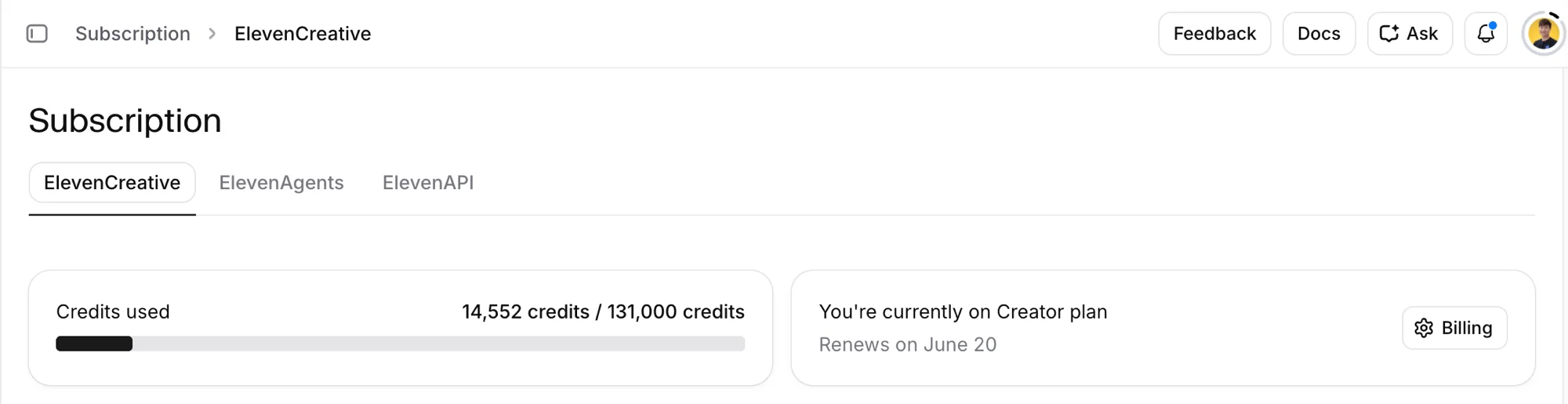
You watch all of it drain against one meter. Here is a Creator account mid-month, 14,552 of 131,000 credits spent — the 121,000 base plus pay-as-you-go top-up credits, which is how you buy headroom without switching plans.
The plans, broken down
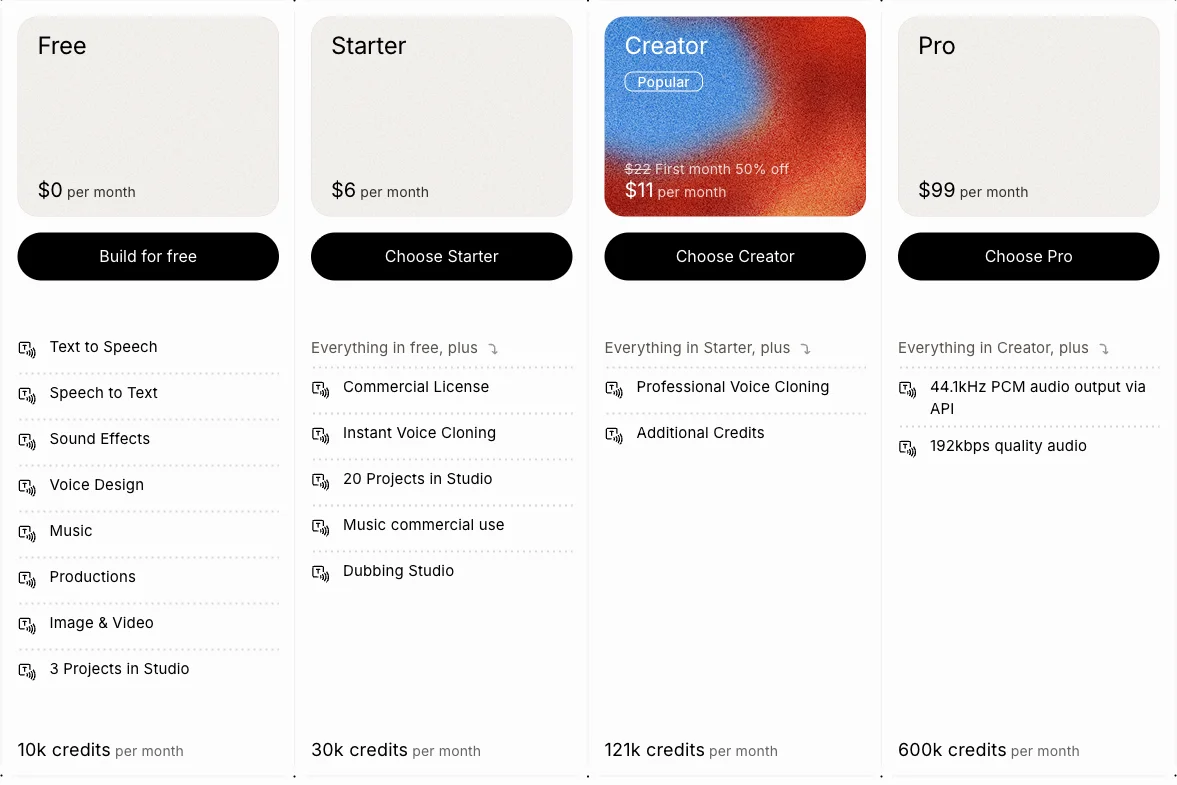
Here is every public plan as of June 2026, taken from the live pricing page. A note before the table: several pricing guides still show Starter at $5 and Business at $1,320 with different credit totals. Those are stale. The current vendor numbers are below.
| Plan | Price / mo | Credits / mo | ~Minutes (v2) | Cloning | Commercial | Seats |
|---|---|---|---|---|---|---|
| Free | $0 | 10,000 | ~10 | None | No | 1 |
| Starter | $6 | 30,000 | ~30 | Instant | Yes | 1 |
| Creator | $22 ($11 first month) | 121,000 | ~121 | Professional | Yes | 1 |
| Pro | $99 | 600,000 | ~600 | Professional | Yes | 1 |
| Scale | $299 | 1.8M | ~1,800 | Professional ×3 | Yes | 3 |
| Business | $990 | 6M | ~6,000 | Professional ×10 | Yes | 10 |
| Enterprise | Custom | Custom | — | Custom | Yes | Custom |
Free is a demo, not a plan. Ten minutes a month with no commercial license means it exists to let you audition voices before paying, which is exactly what you should do with it.
Starter at $6 is the real entry point. It is the cheapest plan that lets you sell what you make, and it adds Instant Voice Cloning, which copies a voice from a short sample in seconds. It also opens the Dubbing Studio and lifts you to 20 projects, so 30 minutes a month and a side project’s worth of organization both fit.
Creator at $22 is the plan most people need, and the first month is half price at $11. The 121,000 credits cover a steady podcast or a weekly channel, and it is the first tier with Professional Voice Cloning, which trains a higher-fidelity model from 30-plus minutes of audio. Creator is also the first plan that lets you buy additional credits when you run dry, instead of being frozen until the monthly reset.
Pro at $99 buys volume and 192 kbps exports, not better base quality. The voices are identical to Creator; you are paying for 600,000 credits and higher-bitrate output. The 44.1 kHz PCM output over the API is the detail audio engineers care about, since it drops into a professional editing chain without a lossy re-encode.
Scale ($299) and Business ($990) are team plans. They add seats (3 and 10), multiple professional voice clones, and millions of credits. Business also advertises low-latency text-to-speech as low as 5 cents a minute, which is an agent-and-app number, not a podcast one.
ElevenLabs also runs a startup grant: qualifying new startups get 12 months free with 33 million characters. If you are pre-launch, it is worth an application before you ever pay.
What about the API and voice agents?
Standard text-to-speech through the API uses the same credits as the web app, so a developer adding voice to an app pays from the plan balance, not a separate meter. Simple integrations stay predictable: a million characters costs the same whether you typed them into Studio or sent them over HTTP.
Voice agents are the exception, and the place most budgets go wrong. Creating an agent is free, but ElevenLabs’ own help docs note the cost of calls depends on whether the agent is voice-only, multimodal, or text-only. On top of that, agents pass through the fees of whatever LLM they call, so your subscription is the floor and the model bill floats on top.
ElevenLabs has been cutting these rates, which is worth knowing if you priced an agent a while ago. The company announced in May 2026 that it lowered API and agent pricing, with text-to-speech up to 55% cheaper and agent costs up to 20% lower. The Business plan also advertises low-latency speech as low as 5 cents a minute, which is a high-volume-agent number, not a creator one.
| Voice-agent cost | How it’s billed |
|---|---|
| Creating the agent | Free |
| Voice output (TTS) | From your plan credits |
| The LLM the agent calls | Pass-through, varies by model |
| Low-latency TTS (Business) | As low as 5¢ per minute |
For narration none of this applies — your credits cover it end to end. For anyone shipping an agent, model the LLM pass-through before you pick a tier, because it can dwarf the subscription.
What your credits really buy
The headline minutes assume you nail every take on the first try. You will not, and that gap is the single most common surprise in the reviews. A 10-minute script you regenerate five times while dialing in stability is closer to 50 minutes of billed audio, because each regeneration spends the credits again.
So the realistic ceiling on any plan is well under its headline number. On a Creator account, the math that matters is not “121 minutes,” it is “121 minutes divided by how many takes I burn per line.” For polished narration that is often three or four passes on the lines that read wrong.
Mapping real projects to the allowance makes the right tier obvious:
| Project | Approx. characters | Credits (v2) | Comfortable on |
|---|---|---|---|
| A 1,500-word blog voiceover | ~9,000 | ~9,000 | Starter and up |
| A weekly 10-minute podcast (×4/month) | ~40,000 | ~40,000 | Creator (room for re-rolls) |
| A 50,000-word audiobook | ~300,000 | ~300,000 | Pro, or Creator plus overage |
Read that audiobook row carefully. A single full-length book runs close to the Creator allowance before you re-record a single chapter, which is why narrators jump to Pro or accept overage charges. For a weekly podcaster, Creator has comfortable headroom; for a book-a-month operation, it does not.
Two more common cases land on either side of that line. A faceless YouTube channel posting five 8-minute videos a week runs around 200,000 characters a month, which overflows Creator and points to Pro. An e-learning course of 20 ten-minute lessons is roughly 120,000 characters, a near-perfect fit for a single month of Creator if you script tightly and re-roll lightly.
It helps to zoom out on what the money actually buys. At Pro, 600,000 credits for $99 works out to about 16 cents per generated minute. The same finished minute from a freelance voice artist runs from a few dollars to north of twenty. Even when re-rolls double your real usage, ElevenLabs comes in an order of magnitude under hiring out, which is the context the “credits burn fast” complaint usually leaves off.
The takeaway is the one the table can’t show: estimate your real monthly characters, double it for re-rolls, then pick the plan that covers the doubled number.
The traps the pricing page soft-pedals
Every point below is something you can verify against a named source, not a vague “users say.” These are the costs that surprise people after they subscribe.
| The trap | What it costs you | How to avoid it |
|---|---|---|
| Free has no commercial license | You can’t sell anything made on Free | Move to Starter ($6) before publishing |
| Credits expire on cancel | Your unused balance disappears | Spend it down before you cancel |
| Re-rolls bill again | 2–5× the headline minutes | Budget one tier up |
| Agents add LLM pass-through | Subscription is the floor, not the cap | Price the LLM call separately |
| Flash vs Multilingual v2 | Half the minutes on the quality model | Plan around v2 credits |
| Running out mid-project | Generation pauses unless Pay As You Go is on | Turn on Auto Top Up before a deadline |
The free tier can’t be used commercially
Free gives you 10,000 credits, but its output carries no commercial license. The pricing page lists “Commercial License” as the first thing Starter adds over Free, so anything you publish or sell has to come from a paid plan. Free is for auditioning quality, full stop.
Unused credits vanish when you cancel
Monthly credits do not roll over, and several Trustpilot reviewers report that remaining credits are stripped on cancellation rather than honored to the end of the period. ElevenLabs sits at 3.2 out of 5 on Trustpilot, and this is the most common complaint behind that score. Spend your balance before you cancel, not after.
Re-rolls multiply the bill
Because you pay per generation, the “minutes” you bought are first-take minutes. A line you regenerate to fix one odd reading costs the credits twice; a take you chase five times costs them five times. This is the gap between the headline number and what you actually get, and it is the reason to budget one tier up.
Conversational AI adds pass-through LLM fees
Standard text-to-speech is covered by your plan’s credits, but the Conversational AI agents are metered differently. An r/ElevenLabs thread on the pricing change spells it out: agents now pass through the underlying LLM fees on top of your subscription, so an agent’s real cost depends on which model it calls. If you are building a voice agent, the subscription price is the floor, not the ceiling.
The cheap minutes assume the Flash model
When a comparison quotes a generous minute count, check which model it used. Flash stretches credits about 2× versus Multilingual v2, so the flattering numbers are usually Flash numbers. For expressive narration you will want v2, and that halves the minutes the marketing math implied.
Running out of credits can stop you, not just bill you
When your plan credits run out, ElevenLabs does not quietly keep generating and bill you later. You draw from a Pay As You Go balance you have to set up first, either by adding funds at a $5 minimum or switching on Auto Top Up. The docs are blunt about the alternative: with Auto Top Up off and your balance at zero, your service pauses immediately. The top-up rate is not published on the pricing page either; it shows when you enable Pay As You Go, and generating in the app costs more per credit than the same text sent through the API. Set this up before a deadline, not in the middle of one.
Which plan should you pick
The plan follows the work, not the other way around. Match your situation to one of these:
- Just testing the quality — stay on Free. Audition voices, then upgrade the moment you need to publish.
- An occasional voiceover or a side project — Starter at $6. Commercial rights and instant cloning, without paying for minutes you won’t use.
- A regular podcast, channel, or narration work — Creator at $22. The default for most individuals, and the first plan with professional cloning. Start here when in doubt.
- High-volume output or broadcast-grade delivery — Pro at $99 for the credits and 192 kbps exports, not for better voices.
- A team, or a voice agent in production — Scale or Business for seats and multiple clones; price the agent’s LLM pass-through separately before you commit.
One reassurance before you commit: you are not locked in. ElevenLabs lets you change plans whenever you want, so the right opening move is to start a tier low and let your own usage decide the rest. Run two or three weeks on Creator, watch how fast the credit meter actually drops once re-rolls are in the mix, and size up only when the numbers say so. The people who feel burned by the pricing are almost always the ones who guessed their tier from the headline minutes instead of measuring a real week of work.
Skip ElevenLabs pricing entirely if voice is a minor, occasional part of your work. A cheaper text-to-speech tool covers the rare voiceover fine, and you only feel the credit system when voice is the product.
If the credits add up: cheaper options
ElevenLabs is the quality leader, and for most people the Creator plan is worth it. But if the credit math doesn’t fit your budget, two directions are worth a look before you commit.
If you want a fixed monthly cap instead of a credit meter, Murf sells an all-in-one studio that meters by the hour of generated audio on a flat plan, so the ceiling never moves the way credits do — the trade is that the voices sit a step below. And if you are building an app or agent where per-character cost is the whole game, Cartesia competes hard on latency and price for developers, at roughly a quarter of the per-character rate; the Cartesia pricing guide does that arithmetic.
For the full field measured against ElevenLabs job by job, our best ElevenLabs alternatives roundup lines up seven tools against the one each actually beats it at. For the same field ranked by cost per finished hour, see best AI voice generator; for the developer-side equivalent, best TTS API.
Final word
ElevenLabs pricing is honest once you translate it. Free to test, $6 to sell, $22 for the plan most creators need, and a jump to Pro or a team tier when volume demands it. The only real trap is treating the headline minutes as the real ceiling — they assume a perfection you won’t hit, so budget for re-rolls and pick the tier that covers your doubled character count.
Start on the free tier, hear the quality against your own script, then move up by your actual monthly minutes rather than the plan name.
Frequently asked questions
How much does ElevenLabs cost per month?
Plans run from free to $990/month. The free tier is $0 (10,000 credits, no commercial use), Starter is $6, Creator is $22, Pro is $99, Scale is $299, and Business is $990. Most individual creators land on the $22 Creator plan, which is half price the first month.
How many minutes is 100,000 credits in ElevenLabs?
On the high-quality Multilingual v2 model, credits map roughly one-to-one to characters, and about 1,000 characters is one minute of speech. So 100,000 credits is roughly 100 minutes — but only if you keep every first take. The cheaper Flash model uses about half the credits per character, which doubles that figure.
How much can I use ElevenLabs for free?
The free tier gives 10,000 credits a month, about 10 minutes of speech. It has no commercial license and no voice cloning, so it is built for testing the quality before you pay, not for publishing.
Do ElevenLabs credits roll over or expire?
Unused monthly credits do not roll over, and several Trustpilot reviewers report that remaining credits are removed when you cancel rather than carrying over. Spend down your balance before you cancel, not after.
Is the ElevenLabs API priced separately from the subscription?
The same account and credits cover the web app and the API for standard text-to-speech. Conversational AI agents are metered differently and can add pass-through LLM fees on top of your plan, which is the cost most people miss.
Keep reading
ElevenLabs vs Cartesia: creator quality vs agent speed
ElevenLabs owns voice quality and catalog; Cartesia owns sub-100ms speed. I tested both, including cloning my own voice in each. Here's which AI voice wins.
ElevenLabs vs Descript: voice engine vs editing suite
ElevenLabs makes the best AI voice; Descript is the editor that even runs ElevenLabs inside it. Here's which you actually need, and when to use both.
ElevenLabs vs Murf: the cheaper one is your script
Murf bills by audio duration, ElevenLabs by characters, so the cheaper voice tool depends on your script's pace, not the price page. I ran the numbers.
ElevenLabs review: the best AI voice, billed by the credit
I ran my own scripts through ElevenLabs: the voices are a clear class above everything else, but the credit pricing punishes heavy use. Here's the verdict.