
ElevenLabs vs Murf: the cheaper one is your script
Murf bills by audio duration, ElevenLabs by characters, so the cheaper voice tool depends on your script's pace, not the price page. I ran the numbers.
Contents
ElevenLabs vs Murf: the verdict at a glance
Most “which is cheaper” comparisons quote two prices and stop. That misses the whole story here, because ElevenLabs and Murf do not bill the same way: Murf charges for the duration of the audio, ElevenLabs for the characters of the text. A pause costs money on one and nothing on the other, so the cheaper tool is a property of your script, not the price page. I keep both subscriptions open, and I ran the numbers to find exactly where the line falls.
| If you want… | Pick |
|---|---|
| The most realistic, expressive voice (narration, audiobooks, characters) | ElevenLabs |
| An all-in-one studio that times voiceover to slides and video, with a team | Murf |
| The cheaper bill on normal, paced, or pause-heavy scripts | ElevenLabs |
| The cheaper bill on dense, fast, wall-to-wall narration | Murf |
ElevenLabs is the best AI voice tool when the voice is the product. Murf is the better buy when the production workflow around the voice is the work. The price tag is a coin flip until you know your own delivery.
The two tools are easy to mistake for direct rivals because both turn text into speech and both clone voices. They part ways on everything else: ElevenLabs pours its effort into the audio, Murf into the studio that surrounds it. That single difference decides the voice quality, the workflow, and even who is cheaper, so the honest comparison is less a scoreboard and more a question of which half of the problem you are actually trying to solve.
The quick comparison
Read this first; the metering section is the part worth your time.
| Axis | ElevenLabs | Murf | Winner |
|---|---|---|---|
| Voice realism / emotion | Industry-leading, expressive | Professional, clear, flatter in narrative | ElevenLabs |
| Voice cloning | From a short sample, high fidelity | Needs longer, cleaner audio | ElevenLabs |
| Billing unit | Characters of input text | Duration of output audio | Depends on script |
| Studio / editor | Generation only | Timeline editor, syncs to slides/video | Murf |
| Video + collaboration | None | Built-in, team-friendly | Murf |
| Voice catalog | Thousands | 130+ across languages | ElevenLabs |
| Languages | 29+ (70+ on V3), dubbing | 20+, script translation | ElevenLabs |
| API / developers | First-class | Pay-as-you-go, secondary | ElevenLabs |
| Free tier | 10,000 credits (~10 min) | Limited free voices/minutes | Split |
| Best fit | The voice is the deliverable | The workflow is the deliverable | Split |
Most rows favor ElevenLabs on voice and Murf on production, which is the real shape of this matchup. The one row that surprises people is “billing unit,” and it deserves its own section.
It is worth saying plainly that this is not a close fight on raw voice. Across the independent tests and our own listening, ElevenLabs wins quality, cloning, catalog, and languages, and it is not particularly close. Murf’s case is never “the voice is better”; it is “the studio around the voice saves my team hours, and the voice is good enough.” Whether that trade is worth it is the entire decision, and the billing twist is what makes the price side of it non-obvious.
ElevenLabs: strengths and gaps
ElevenLabs is the voice you reach for when a human will listen closely. Its full review is here; the short version is that the voices breathe and place emphasis on meaning, and Google’s AI Overview calls it “the industry leader for emotional range and ultra-realistic voice cloning.”
Strengths:
- Realism a clear step above. A 4.5 out of 5 across more than a thousand G2 reviews, with dynamic intonation and breathing that suit audiobooks, characters, and narration. The r/ElevenLabs regulars call it the leader for instant generation, and in my own listening it holds on the first take rather than in a cherry-picked demo, with the quality staying consistent across the catalog instead of living in two or three hero voices. Here is a library voice at default settings:
- Cloning from a short sample. It mimics accents and nuance from minimal audio, where Murf needs longer, cleaner recordings for comparable fidelity. Here is my own voice, cloned:
- A catalog and toolkit you rarely outgrow. Thousands of voices against Murf’s 130+, plus Voice Design to generate a new voice from a sentence, dubbing into dozens of languages, sound effects, a voice isolator, and a first-class API for apps and agents. Matching that range in Murf is not possible; matching it elsewhere means stitching tools together.
Gaps:
- No studio around the voice. ElevenLabs generates audio; you sync it to slides or video in a separate editor. For a team producing presentations, that is a missing room, not a missing feature, and it is the entire reason Murf exists.
- Credit pricing punishes re-rolls. Every regeneration is billed, the headline minutes assume you nail each take, and unused credits vanish on cancellation (3.2 on Trustpilot, mostly over exactly that). Heavy iteration on a script adds up faster than the plan minutes suggest.
- No team workflow. It is a single-creator generation tool at heart; the shared projects and collaboration a marketing department wants live in Murf, not here.
Murf: strengths and gaps

Murf is the studio, not just the voice. Its full review is here; the verdict there was blunt in the title, “the studio sells it, not the voice,” because the editor is the reason to buy and the audio is merely good.
Strengths:
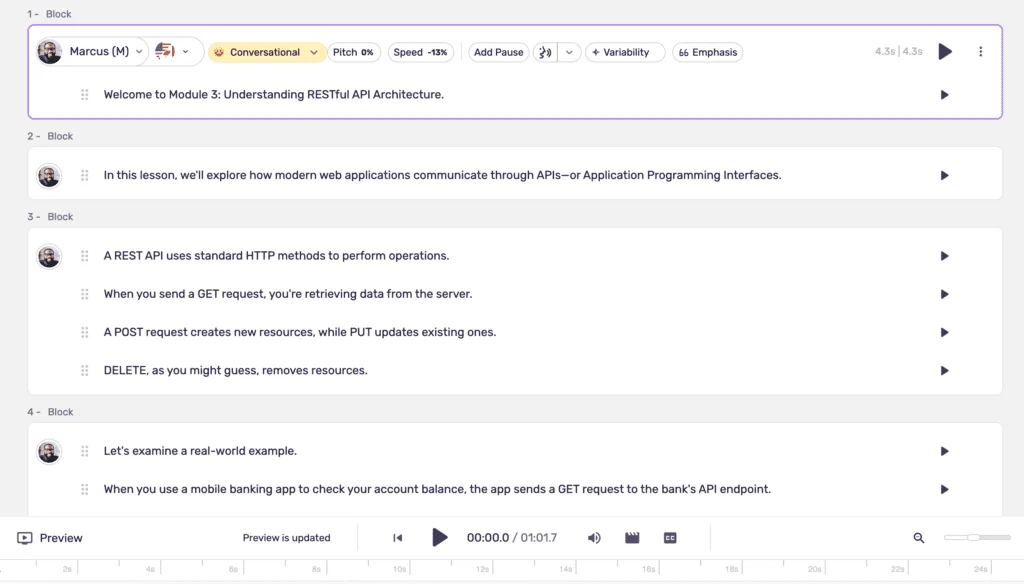
- A real timeline studio. Murf syncs voiceover to slides, video, and background music on an intuitive editor, which is exactly what corporate, e-learning, and marketing teams need and what ElevenLabs does not attempt.
- Professional, consistent voices. 130+ voices that sound clean and businesslike across languages, and the market rewards it: Murf carries a 4.7 out of 5 on G2 across more than 1,400 reviews, driven by teams who value reliable corporate audio. Here is Murf’s Natalie on a business script:
- Built for teams and translation. Script translation, collaboration, and shared projects make it a fit for a marketing department, not just a solo creator.
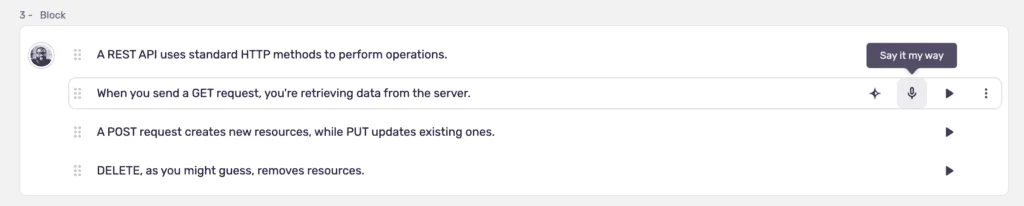
- Pacing controls for e-learning. Features like “Say It My Way” let you tune emphasis and pauses, which is the selling point for training content (and, as the pricing section shows, the thing that quietly costs you).
Gaps:
- The voice is the weak link. Independent testing and our own review agree the voices are “slightly more robotic in narrative contexts” than ElevenLabs, fine for a training module, flatter for a story. For a tool whose competitor is a voice engine, that is the gap that matters most.
- Duration billing taxes silence. Because you pay for audio time, the pauses Murf encourages draw down the same budget, which is the opposite of how ElevenLabs charges, and it bites hardest on the paced e-learning content Murf is sold for.
- Hidden costs and feature locks. Community reviews flag that enterprise features and higher hour limits push the real cost up for serious users, so the headline $29 understates what a team actually pays once it scales.
How they differ on price
This is the section worth reading twice, because the two tools meter on different units and that changes who is cheaper depending on what you generate.
Murf charges for voice generation time: a fixed budget of audio hours per month, drawn down by every second of speech regardless of what is in it. The $29 Creator plan gives 2 hours a month, which works out to about $14.50 per audio-hour (or $9.50 on the $19 annual rate). ElevenLabs charges for characters: 1 credit per character of input text, 121,000 credits a month on the $22 Creator plan. Silence, pauses, and slow delivery cost nothing, because they are not characters.
So the right unit to think in is characters per second of audio (call it cps), how densely you pack text into time. Convert ElevenLabs to the same basis: one audio-hour at a given cps is cps × 3600 characters, so the cost per audio-hour is (cps × 3600 / 121,000) × $22, which is about $0.65 × cps.
| Your delivery | Characters/sec | ElevenLabs $/audio-hour | Murf $/audio-hour | Cheaper |
|---|---|---|---|---|
| Paced e-learning, lots of pauses | ~10 | ~$6.50 | $14.50 | ElevenLabs |
| Normal narration | ~15 | ~$9.80 | $14.50 | ElevenLabs |
| Brisk explainer | ~20 | ~$13.10 | $14.50 | ElevenLabs |
| Dense, fast ad read | ~25 | ~$16.40 | $14.50 | Murf |
The crossover sits near 22 characters per second. Below it, ElevenLabs is cheaper per finished minute; above it, Murf is. And almost all real speech lives below 22 cps, normal conversational pace is roughly 14 to 16, and a measured e-learning read is lower still, so for the vast majority of scripts ElevenLabs is the cheaper way to fill an audio-hour, often by a wide margin.
Make it concrete with a real project. Say you produce a 30-minute e-learning module a month, paced at about 12 cps with the deliberate pauses training content wants. That is 30 minutes of audio either way. On Murf it draws 0.5 hours from your 2-hour Creator budget, fine, but you are paying for a plan priced at $14.50 an audio-hour. On ElevenLabs the same 30 minutes is roughly 12 × 1,800 seconds = 21,600 characters, about $3.90 of a 121,000-credit plan. Same finished module, and the character bill is a fraction of the duration bill, precisely because the pauses you added are free on one side and metered on the other.
Here is the irony that makes this more than a math trick. Murf’s pitch is e-learning and corporate narration, the exact content that uses deliberate pauses and measured pacing, which pushes cps down, into the zone where ElevenLabs wins on cost. The pause controls Murf sells you are the controls that make Murf the pricier choice for that audio. The one place duration billing wins, dense wall-to-wall narration with no breathing room, is the kind of read those same controls exist to avoid.
Two caveats keep this honest. Murf’s per-audio-hour rate assumes you actually fill the 2-hour budget; light users waste it either way. And on annual billing Murf’s rate drops to $9.50, which moves the crossover down to about 14 cps, near normal speech, making it a closer call at a steady pace. The headline holds: paced content favors ElevenLabs, dense content favors Murf, and you cannot know which you have from the price page alone.
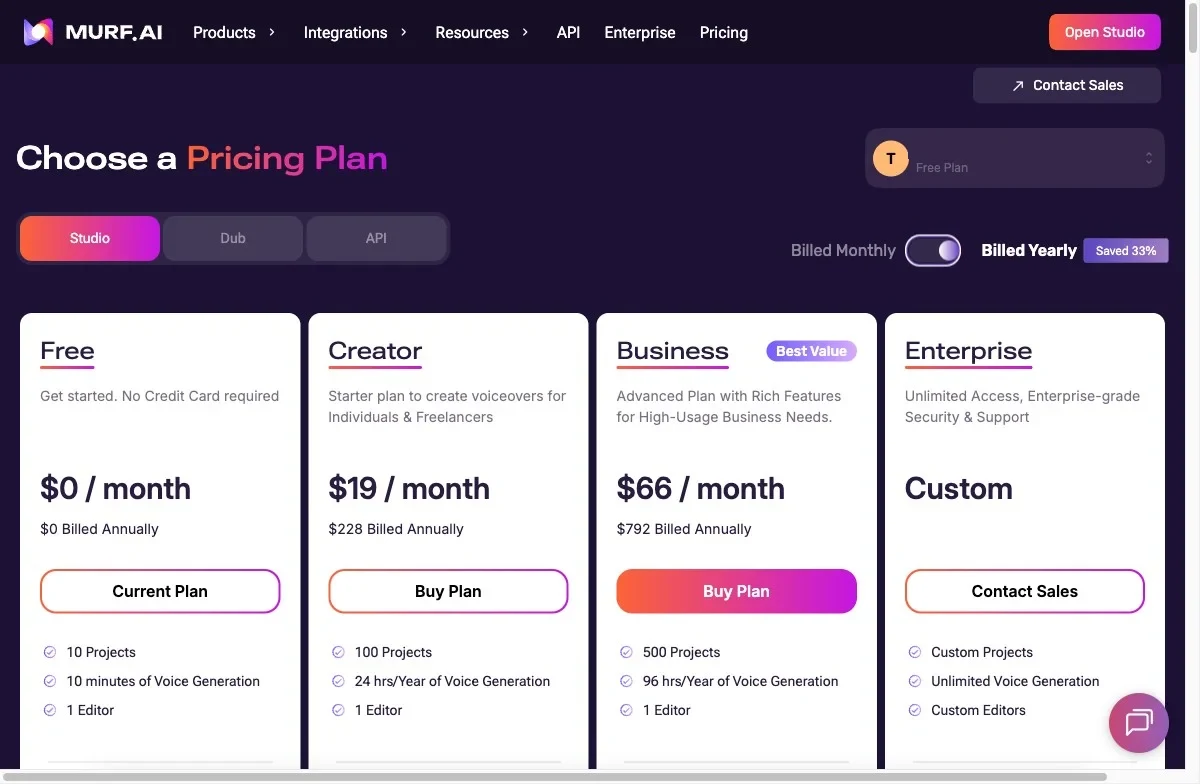
The tiers themselves tell the same story from a different angle. ElevenLabs ladders by characters, Free (10,000 credits, ~10 minutes, no commercial license), Starter at $6 (30,000), Creator at $22 (121,000), Pro at $99 (600,000). Murf ladders by hours and seats, a limited free tier, Creator at $29/mo ($19 annual) for 2 hours, and Business at $99/mo ($66 annual) for more hours plus team features.
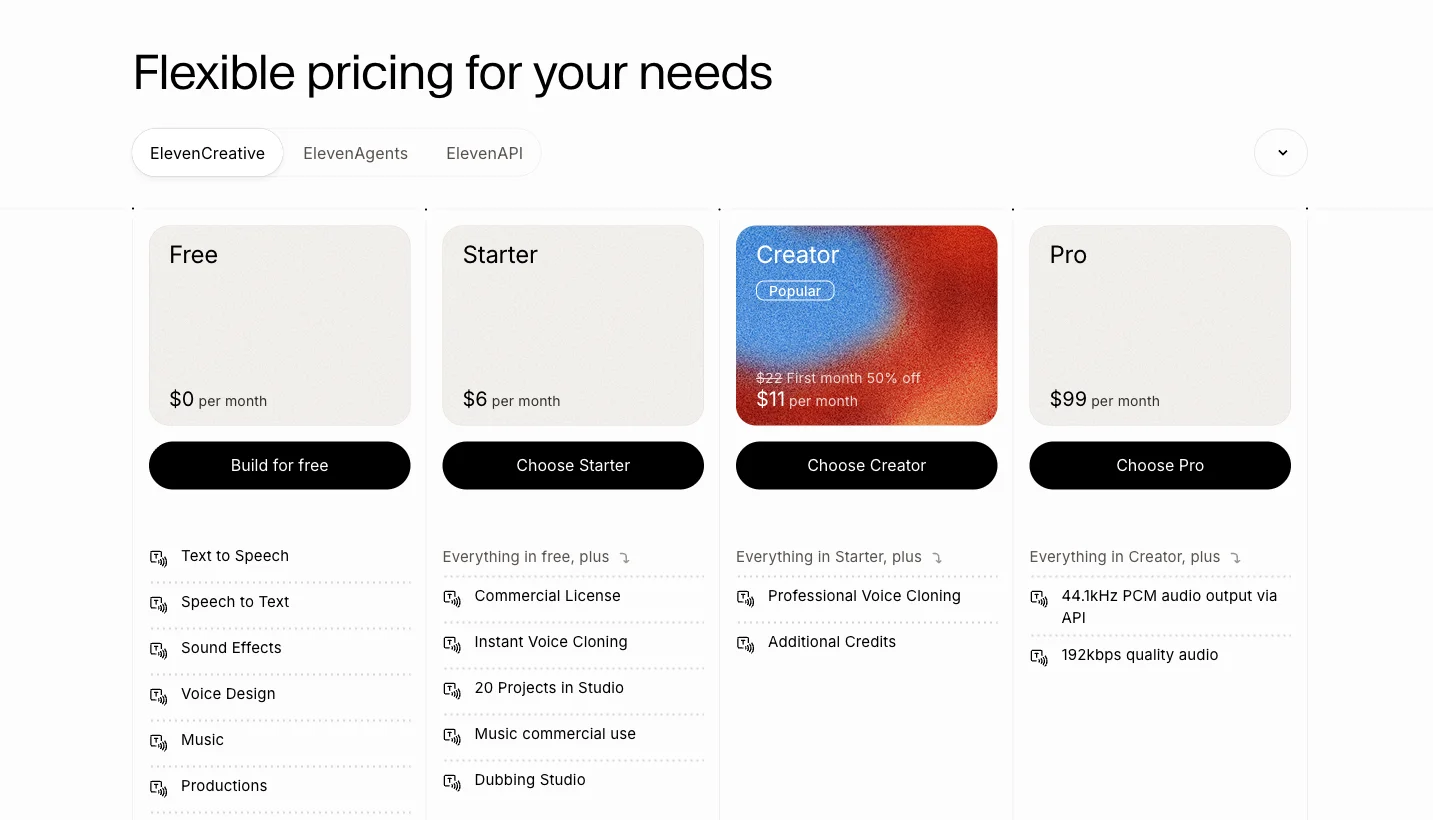
The free tiers reflect the split, too. ElevenLabs gives you 10,000 characters to judge voice quality; Murf gives you a small slice of voice-time to try the studio. Neither lets you ship commercially, so both are auditions, but they audition different things, the voice on one, the workflow on the other. The cheapest plan that includes commercial use is ElevenLabs’ $6 Starter against Murf’s $29 Creator, so for a solo creator who only needs voiceover, ElevenLabs is the cheaper entry by a wide margin before the per-second math even starts.
How they differ on voice quality
Voice quality is the axis ElevenLabs is built to win, and the gap is audible the moment a script asks for feeling.
ElevenLabs has, in the AI Overview’s words, “unrivaled dynamic intonation, breathing, and emotional depth.” Murf’s voices are “highly professional and clear, but can be slightly more robotic in narrative contexts.” That matches our own review: Murf is excellent for a clean corporate read and merely good for storytelling. Here is the same script in each, Murf’s Natalie above and ElevenLabs below, so you can hear the difference rather than take my word:
On a flat, informational line the two are closer than the price gap suggests, and Murf’s consistency is genuinely useful for hours of training content where you want predictable, not dramatic. But add an emotional beat, a rhetorical pause, a line that needs warmth, and ElevenLabs pulls ahead, because that is exactly the range it models and Murf flattens.
The difference shows up most on long-form. Across a 20-minute narration, Murf’s voices stay even and professional but rarely surprise you, which reads as slightly synthetic by the end; ElevenLabs varies its delivery the way a person would, so the same length holds attention better. For a 90-second product explainer nobody will notice the gap. For an audiobook chapter or a story-driven YouTube video, it is the difference between “that’s an AI voice” and “wait, is that AI?”
The control surface differs too. ElevenLabs gives you stability, similarity, and style sliders plus V3 emotional tags that mark a single clause to be read as a whisper, fine-grained direction for a performance. Murf’s controls aim at production polish, pronunciation, emphasis, and pacing for a clean read, rather than coaxing emotion out of a line. Both give real control; one points it at acting, the other at consistency.
Cloning splits the same way. ElevenLabs clones a voice from a short sample and captures accent and nuance; Murf’s cloning needs longer, cleaner audio and still lands a step behind on fidelity. For a branded narrator you will reuse for hours, that gap compounds over a project. There is also a workflow cost: gathering 30 clean minutes of reference audio for Murf is a real chore, where ElevenLabs gets a usable clone from a short clip, so the better result is also the faster one to set up. If the deliverable is the voice itself, this section is the whole decision, and it points one direction.
How they differ on workflow
Workflow is where Murf earns its price and turns the comparison around, because here ElevenLabs is the ingredient and Murf is the kitchen.
Murf is built for the team assembling a finished piece. The timeline editor lines voiceover up against slides, video, and background music; you tweak timing visually, translate the script, and hand it to a colleague to finish. For a marketing or training team producing explainer videos and courses, that one-app workflow is the reason to choose it, and it is a category ElevenLabs simply does not enter.
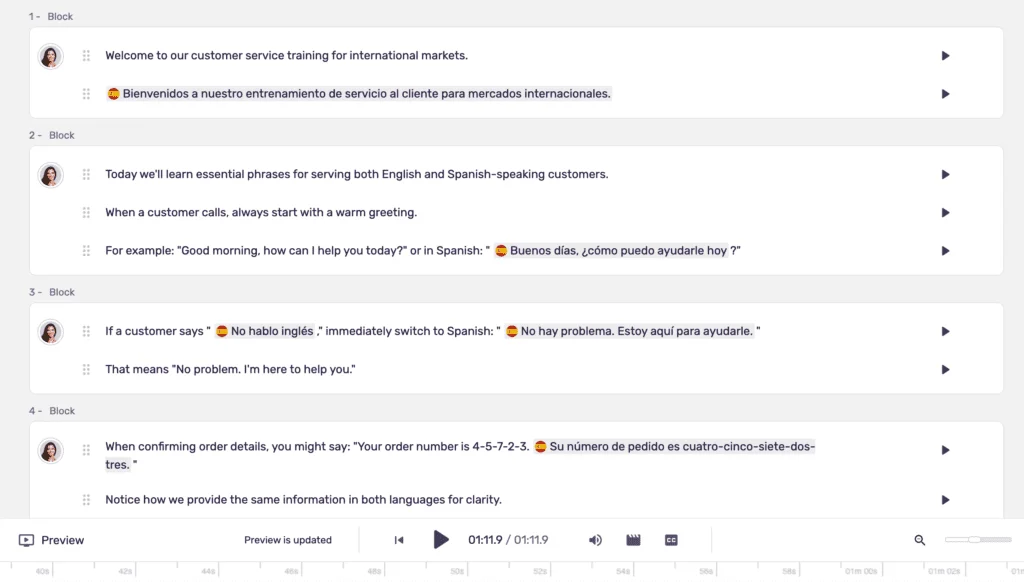
Multilingual production shows the difference in miniature. Murf lets you translate a script and re-voice it on the same timeline for a corporate audience, here is its English-to-Spanish handoff:
The collaboration layer is part of the workflow story, too. Murf is built for a team: shared projects, comments, and a script-translation step mean a marketing department can hand a course between writer, voice, and editor without leaving the tool. That is a different product from a personal voice generator, and it is why Murf lands with businesses rather than solo creators.
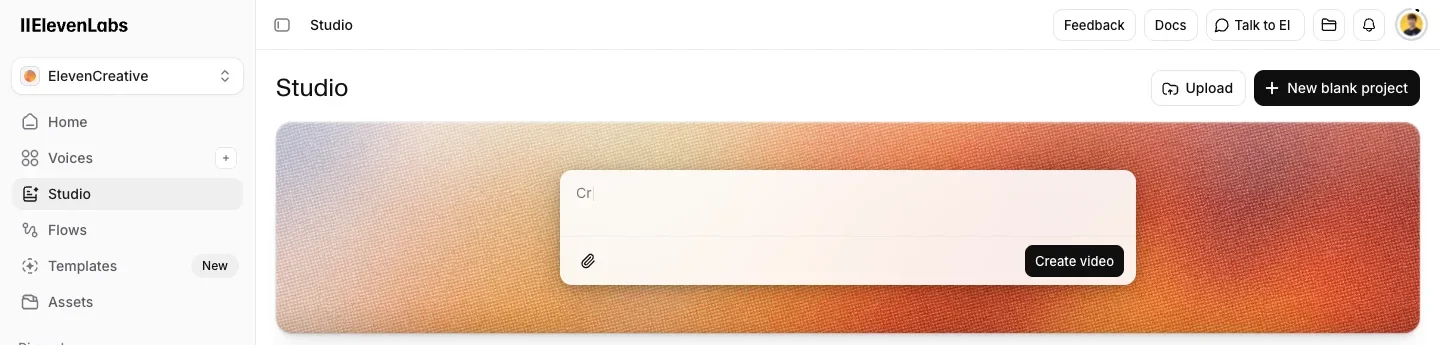
ElevenLabs’ “workflow” is generation and it is excellent at that narrow thing: the Studio editor splits long scripts into regenerable blocks, dubbing re-voices video into dozens of languages, and the API drives the voices in apps. But you do not assemble a slide deck in ElevenLabs; you generate audio and take it into an editor, often the exact handoff Murf removes for its audience.
So the workflow verdict mirrors the quality verdict, in reverse. ElevenLabs owns the voice; Murf owns the room you build around it. A solo narrator weighs the first; a team shipping a course weighs the second, and most people know within a sentence which one they are.
It is also why “use both” is rarer here than in some comparisons. Murf’s whole value is keeping the voice and the production in one place, so bolting ElevenLabs onto it defeats the point, you would just edit ElevenLabs audio in a normal video tool instead. The realistic choice is one or the other: the studio with the good-enough voice, or the great voice plus your own editor.
Who should pick ElevenLabs
- Audiobook, podcast, and YouTube narrators who need the voice to carry hours of listening with real emotional range. The Studio editor handles long scripts block by block, and the realism is what keeps a chapter from sounding synthetic by the end.
- Anyone cloning a branded voice they will reuse across a project, where ElevenLabs’ short-sample fidelity beats Murf’s longer-sample clone and the difference compounds over hours of output.
- Developers and dubbing creators who need an API, official SDKs, a low-latency model, or one upload re-voiced into dozens of languages on a correction timeline. None of that exists in Murf. Start free to hear the quality first.
- Cost-conscious creators on paced scripts. If your delivery sits at a normal or slow pace, which most narration does, the character-based bill is the cheaper way to fill an audio-hour, and the cheapest commercial entry ($6) is far below Murf’s.
- Solo creators, full stop. ElevenLabs is built for one person generating great audio, where Murf’s team features are overhead you will not use.
Who should pick Murf
- Corporate, e-learning, and marketing teams who need to write, voice, time, and assemble a video in one studio, with collaboration and script translation built in. This is the core case, ElevenLabs has no answer to it, and the flatter voice is an acceptable trade for the workflow.
- Presentation and explainer producers who want voiceover synced to slides on a timeline rather than generated, exported, and re-aligned in a separate editor. The time saved is the product.
- Teams that value consistency over drama. Murf’s clean, professional voices are predictable across hours of training content, where you want every module to sound the same rather than each line to act.
- Multilingual corporate publishers who translate one script and re-voice it on the same timeline for many regions, without leaving the tool.
- Heavy, dense narration at scale. If your scripts are wall-to-wall words with little pause, fast ad reads or rapid explainers above roughly 22 characters a second, duration billing can come out ahead, the one place on price where Murf genuinely wins.
The final word
ElevenLabs and Murf look like rivals because both make AI voices, but they are really competing on different things: ElevenLabs on the voice, Murf on the studio around it. Our reviews land the same way, ElevenLabs a Category Leader on quality, Murf a 3.8 where the editor, not the audio, is the selling point.
So pick by what you are actually buying. If the voice is the deliverable, buy ElevenLabs; it sounds better, clones better, and on most paced scripts it is even cheaper per finished minute once you account for the metering. If the production workflow is the deliverable, buy Murf; the timeline studio and team features are worth the flatter voice for corporate and e-learning work.
The one move that always pays is to test your own script, not a demo. Paste a real paragraph into each free tier, generate it, and look at two things: whether the voice carries the way you need, and how your character count stacks against your audio seconds. Those two readings answer the quality question and the price question at once, for your content specifically, which is the only comparison that matters.
Run that test, count your characters against your seconds, and the decision makes itself. Start with ElevenLabs free, and read our Murf review if the studio is what you are really after. If neither fits, our best ElevenLabs alternatives roundup covers the wider field.
Frequently asked questions
Is ElevenLabs or Murf better?
For voice realism, emotion, cloning, and long-form narration, ElevenLabs wins. For an all-in-one studio that syncs voiceover to slides and video with team collaboration, Murf wins. ElevenLabs is the voice; Murf is the production suite around a good-enough voice.
Which is cheaper, ElevenLabs or Murf?
It depends on your script's pace. Murf bills by audio duration (about $14.50 per audio-hour on the $29 Creator plan); ElevenLabs bills by characters ($22 for 121,000). At a normal ~15 characters-per-second delivery, ElevenLabs is cheaper per audio-hour; only very dense, fast reads (above ~22 cps) tip it to Murf.
Does Murf charge for pauses?
Effectively yes. Because Murf meters by the duration of the generated audio, silence and pacing count against your hours. On ElevenLabs, pauses are free, since you are billed for the characters of input text, not the seconds of output.
Which has better voice cloning?
ElevenLabs. Its cloning mimics accents and nuance from a short sample; Murf's cloning needs longer, cleaner audio to reach comparable fidelity, and even then the standard library voices lean a touch more robotic in narrative contexts.
Which should I use for e-learning or corporate video?
Murf, if you want one tool to write, voice, time, and assemble the video with a team. ElevenLabs, if the voice quality is the priority and you will edit elsewhere. Many teams use Murf for the workflow and ElevenLabs when a script needs a more human read.
Keep reading
ElevenLabs vs Cartesia: creator quality vs agent speed
ElevenLabs owns voice quality and catalog; Cartesia owns sub-100ms speed. I tested both, including cloning my own voice in each. Here's which AI voice wins.
ElevenLabs vs Descript: voice engine vs editing suite
ElevenLabs makes the best AI voice; Descript is the editor that even runs ElevenLabs inside it. Here's which you actually need, and when to use both.
ElevenLabs pricing: what the credits really cost
ElevenLabs starts free and most creators pay $22/month — but credits burn faster than the headline minutes. Here's what every plan actually costs.
ElevenLabs review: the best AI voice, billed by the credit
I ran my own scripts through ElevenLabs: the voices are a clear class above everything else, but the credit pricing punishes heavy use. Here's the verdict.