
ElevenLabs vs Cartesia: creator quality vs agent speed
ElevenLabs owns voice quality and catalog; Cartesia owns sub-100ms speed. I tested both, including cloning my own voice in each. Here's which AI voice wins.
Contents
ElevenLabs vs Cartesia: the verdict at a glance
This is the rare comparison where the price tag is the wrong question. ElevenLabs and Cartesia are both excellent, and they barely compete: one is built to make the best-sounding voice, the other to answer fastest. I have run scripts through ElevenLabs for months and spent this week inside Cartesia’s playground, and the split is clean.
| If you want… | Pick |
|---|---|
| The best-sounding voice for content — narration, podcasts, audiobooks, dubbing | ElevenLabs |
| The fastest voice for real-time agents, phone bots, live assistants | Cartesia |
| The cheapest voice at high API volume | Cartesia (~3-4x less per character) |
| The deepest toolkit under one login | ElevenLabs |
ElevenLabs is the best AI voice tool when the voice is the product. Cartesia is the pick when latency is the product. Pick by the job, not the invoice, and you will not regret either.
The quick comparison
Read this table first; the rest of the post is the why behind each row.
| Axis | ElevenLabs | Cartesia | Winner |
|---|---|---|---|
| Built for | Content: narration, dubbing, character work | Real-time voice agents, phone bots | Split |
| Voice realism | Category leader, deep emotional range | Clean and natural, lighter on emotion | ElevenLabs |
| Latency (time-to-first-audio) | Fast Flash model; expressive models lag | sub-90ms Sonic, ~164ms measured | Cartesia |
| Voice catalog | Thousands (4,000+ community voices) | Low hundreds, agent-oriented | ElevenLabs |
| Languages | 30+ (70+ on v3) | 40+ claimed, English clearly strongest | ElevenLabs |
| Voice cloning | Instant + Professional (30+ min) | Instant from ~10s, free tier | Split |
| Cost at API scale | Pricier per character | ~3-4x cheaper per character | Cartesia |
| Long-form workflow | Studio editor, dubbing, sound effects | None | ElevenLabs |
| Developer / real-time stack | Solid API + Flash | API-first, SSM, full voice-agent stack | Cartesia |
| Free tier | 10,000 credits (~10 min) | 20,000 credits (~27 min) | Cartesia |
| Commercial license | From $6 Starter | From the Pro tier | Tie |
Nine of eleven rows have a clear winner, and they point in opposite directions. That is the whole story: there is no single “better” here, only “better for what.” The three sections that follow break down the axes that actually decide a purchase — price, quality, and speed — and the two “who should pick” lists turn that into a one-line answer for your situation.
ElevenLabs: strengths and gaps
ElevenLabs is the tool I reach for when someone will listen to the result for more than a sentence. Its full review lives here; the short version is that the voices breathe and place emphasis on meaning in a way nothing cheaper matches.
Strengths:
- Voice realism is the category benchmark. A 4.5 out of 5 across more than a thousand G2 reviews, and the AI Overview for this very query calls it the “uncontested leader in emotion, realism, and storytelling.” The r/ElevenLabs regulars call it the leader for instant generation, and in my own listening it holds up on the first take rather than in a cherry-picked demo, with the quality staying consistent across the catalog instead of living in two or three hero voices. Here is a library voice reading a neutral line at default settings:
- A catalog you rarely outgrow. Thousands of voices, filterable by accent, age, and use case, plus a 4,000-plus community library and Voice Design to generate a brand-new voice from a sentence of description. In my own use the library plus one designed voice covers a surprising amount of narration, so most creators never touch cloning at all.
- Real long-form tooling. The Studio editor imports a script, splits it into regenerable blocks, and lets me re-roll only the lines that read wrong instead of a whole chapter, which is what keeps hours of narration from drifting in tone. Dubbing re-voices video into dozens of languages on a correction-friendly timeline, so a single upload becomes a multilingual release.
- More than text-to-speech under one login. Sound effects from a prompt, a voice isolator that strips background noise, a speech-to-speech changer that recasts your delivery while keeping your timing, and V3 emotional tags that mark a single clause to be read as a whisper. Matching that range elsewhere means stitching two or three tools together.
Gaps:
- Credit pricing punishes heavy use. Every regeneration is billed, and the headline minutes assume you nail each take on the first try, which you will not. A 10-minute script you re-roll five times while dialing in stability is closer to 50 minutes of billed audio, so the realistic ceiling on Creator is well under 121 minutes. Unused credits also vanish on cancellation, which is the top complaint behind its 3.2 on Trustpilot.
- Latency is not its game. The Flash model is quick, but the expressive models that make ElevenLabs worth buying add processing delay that, in independent tests, “can make live conversations feel slightly clunky.” For pre-rendered narration that is invisible; for a live phone agent it is the whole problem.
- It is the pricier tool per character. None of the quality changes the arithmetic: at API volume you pay several times more than Cartesia for the same number of characters, which is why heavy real-time workloads rarely land here.
Cartesia: strengths and gaps

Cartesia is the tool I reach for when someone will talk to the result in real time. Its full review is here; the short version is that it is the fastest voice platform I have tested, built around the Sonic model and a developer-first playground.
Strengths:
- The lowest latency in the category. Sub-90ms time-to-first-audio advertised, and a public benchmark measured Sonic at a 164ms average that stayed “under 300ms every single time.” For a live agent, that is the line between a conversation and an awkward pause.
- Instant cloning, on the free tier, in seconds. Cartesia clones from about 10 seconds of audio (it advertises as little as 3) and does not gate it behind a paid plan. Here is my own voice, cloned by Cartesia:
- Roughly 3-4x cheaper at scale. A flat 1 credit per character and a granular credit system make it far cheaper for heavy API traffic; one independent comparison pegs it near 73% less than ElevenLabs. For an agent handling thousands of calls a month, the per-character price is the difference between a workable unit economic and a losing one.
- A full voice-agent stack. Sonic for speech, Ink for transcription, Line for agent logic, phone numbers, and a knowledge base under one API, built on state-space models rather than transformers so the low-latency, on-device story is real rather than marketing. Buying speech-to-text and text-to-speech from one vendor removes a whole class of integration glue.
Gaps:
- English leads; other languages lag. A production team on r/artificial praised the English quality but found “Italian support was limited when we tested.” The 40+ language claim is broader on paper than in practice, so test your target language hard before you build on it.
- No creator workflow. No long-form editor that splits a chapter into regenerable blocks, no dubbing studio, no sound-effects generator, and a voice library full of customer-support personas rather than narrators. For content work you hit that wall on day one.
- Smaller catalog and younger ecosystem. A few hundred voices against ElevenLabs’ thousands, fewer community voices to start from, and thinner third-party tutorials and integrations, so you spend more time in the official docs and less borrowing from solved problems.
How they differ on price
Price is where the two tools stop looking similar. Both meter in credits, but the credits mean different things, and that changes who each one is cheap for.
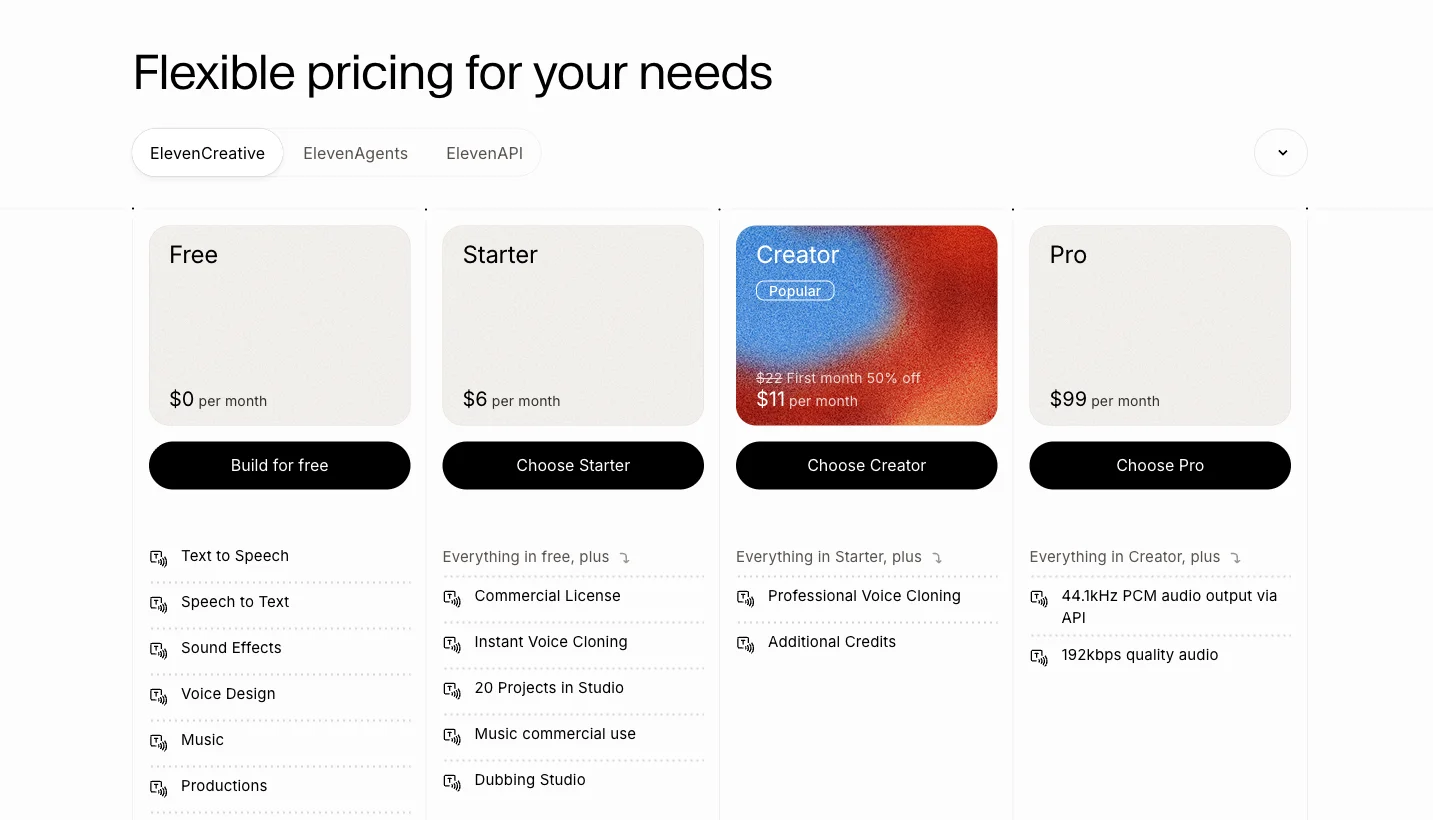
ElevenLabs meters by output: roughly 1,000 credits buys a minute of speech. The tiers run Free (10,000 credits, ~10 minutes, no commercial license), Starter at $6 (30,000), Creator at $22 (121,000 and Professional cloning), and Pro at $99 (600,000). The catch the pricing page soft-pedals is that every regeneration is billed, so the realistic ceiling on Creator is well under the headline 121 minutes.
Cartesia meters by input: a flat 1 credit per character, full stop. Free hands you 20,000 credits (~27 minutes, no commercial license), then Pro at $5 (100,000 credits), Startup at $49 (1.25M, Professional cloning), and Scale at $299 (8M). Each paid plan also includes a prepaid voice-agent balance equal to its price. The monthly figures have not moved, but the discounted rate beside them has gone and no billing-period toggle remains on the pricing page or in the app, so older write-ups quoting $4, $39 and $239 are describing a rate you can no longer buy; the Cartesia pricing guide has the current per-unit maths.
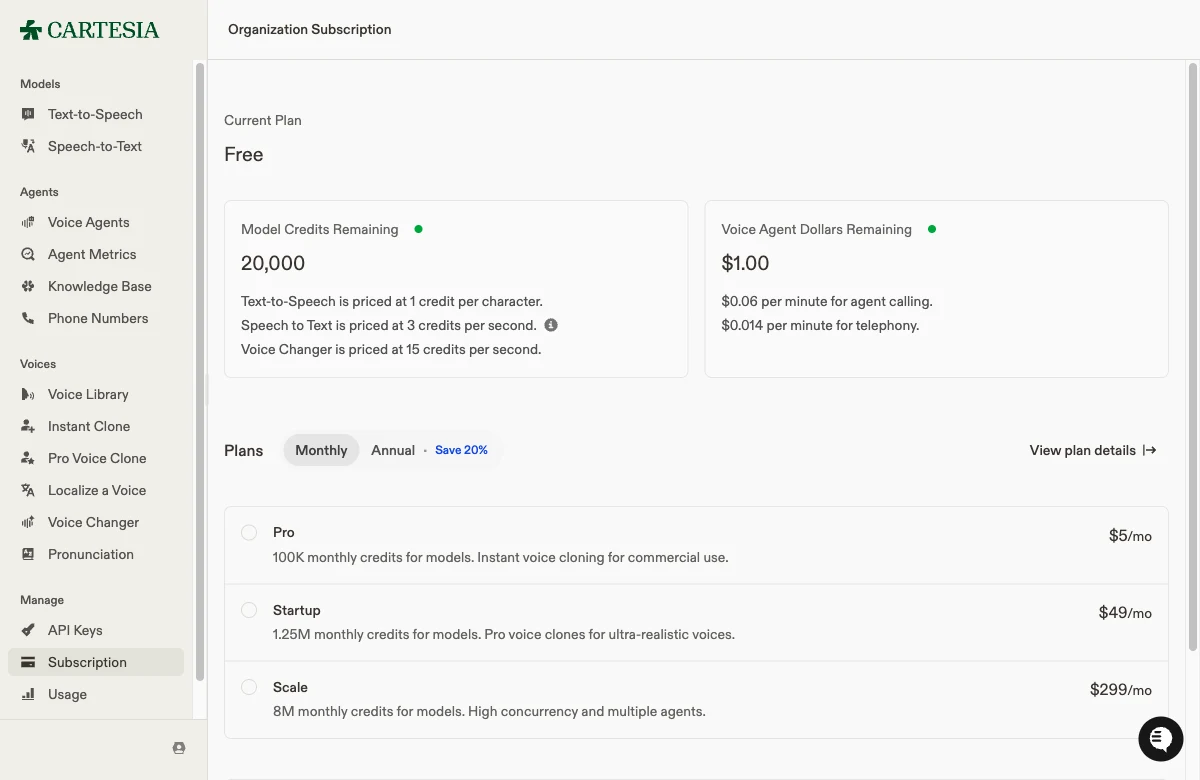
Now the comparison that matters. Put them on the same basis and Cartesia is dramatically cheaper per character: ElevenLabs’ $22 Creator plan buys 121,000 characters, or about 5,500 per dollar, while Cartesia’s $5 Pro plan buys 100,000, or 20,000 per dollar. That is about 3.6 times the characters for your money, and the gap widens at the top of both ladders. Independent reviews land in the same place, citing Cartesia at “roughly 3-4x cheaper” and one at “approximately 73% less expensive.” For an agent fielding thousands of calls, that is the difference between a viable unit economic and a painful one.
The free tiers tilt the same way. ElevenLabs gives 10,000 credits (~10 minutes) with no commercial license; Cartesia gives 20,000 (~27 minutes) plus instant cloning, also without a commercial license. Both are auditions rather than plans you can ship from, but Cartesia’s is the more generous sandbox, and the cheapest plan that includes commercial use is its Pro tier versus ElevenLabs’ $6 Starter.
Cloning costs split too. ElevenLabs’ Professional Voice Cloning rides the $22 Creator plan and wants 30+ minutes of clean audio; Cartesia gates Professional cloning behind its $49 Startup tier but charges nothing to train it, giving you 2 clone slots, with instant cloning available below that. On discounts the two now differ: ElevenLabs still rewards annual billing, while Cartesia removed its annual option, so its monthly price is the only price.
A worked example makes the split concrete. A podcaster scripting 8,000 words a month runs about 48,000 characters; that fits inside ElevenLabs’ $22 Creator allowance with room for re-rolls, and the Studio editor plus the voice quality is what they are paying for, so Cartesia’s lower per-character rate buys them nothing they need. Now flip it: an agent handling 1,000 three-minute calls a month generates millions of characters, and there the per-character price decides whether the product ships at all. Same two price lists, opposite winner, because the unit you are buying is different.
So cheaper per character is not cheaper per outcome for a creator. If you are making a weekly podcast, you are buying voice quality and a Studio editor, not raw characters, and ElevenLabs’ Creator tier is priced for exactly that. The winner on price is Cartesia, decisively, but only when characters-at-scale is what you are actually buying.
How they differ on quality
Quality is closer than the price gap suggests, and it splits along one line: raw naturalness versus emotional range.
On a single, neutral sentence, the two are genuinely hard to separate. Cartesia’s Sonic is clean, crisp, and natural, and one blind-test comparison actually scored it ahead on raw naturalness. Here is each tool’s default library voice on a neutral line, back to back:
The gap opens the moment the script asks for feeling. ElevenLabs is, in the AI Overview’s words, the “uncontested leader in emotion, realism, and storytelling,” favored by YouTubers, podcasters, and dubbing studios for its warmth and varied inflection. Cartesia, by the same source, delivers “steady, clear, and highly functional speech” engineered “for utility and immediate responses than deep narrative storytelling.” A production tester on r/artificial put ElevenLabs’ Italian and prosody “best by far,” and rated Cartesia’s English “good” with weaker non-English coverage.
Language breadth is part of quality, and it is lopsided. ElevenLabs spans 30+ languages on its standard model and 70+ on V3, with a 4,000-plus community voice library that almost guarantees a native-sounding match. Cartesia claims 40+ languages, but the quality is not even across them, and the same r/artificial test that praised its English flagged thin non-English coverage. If your work is monolingual English, the gap narrows; if it is multilingual content, ElevenLabs is not close to a fair fight.
The control surface differs in character, too. ElevenLabs hands a creator stability, similarity, and style sliders plus V3 emotional tags that mark a single clause to be read as a whisper, the kind of fine direction long narration needs. Cartesia’s generation_config leans the other way, toward speed and emotion modulation tuned for an agent that must sound urgent on one turn and calm on the next. Both give real control; they just point it at different jobs.
The clearest test I can offer is my own voice, cloned by each tool from a short sample. Same person, same kind of script, two engines:
Both nail the identity — anyone who knows me would recognize either. The difference is range: ElevenLabs carries more of the rises and falls that make a long read sound human, while Cartesia gets you a faithful, usable clone in seconds for a fraction of the setup. For a one-line agent greeting, that is a wash. For a chapter of an audiobook, ElevenLabs pulls ahead.
The setup cost is the other half of the cloning story. Cartesia’s clone above came from a short sample on the free tier, no payment and no waiting; ElevenLabs’ Instant clone is similar, but the higher-fidelity Professional clone that earns its reputation wants 30+ minutes of clean audio and a Creator subscription. So Cartesia wins cloning on speed and price, ElevenLabs wins it on ceiling, and which matters depends entirely on whether you are voicing a bot or narrating a book. Quality overall goes to ElevenLabs on the axis most content needs, with the honest caveat that Cartesia is closer than its positioning suggests.
How they differ on speed and workflow
Speed is the one axis where Cartesia does not just win, it laps the field, and workflow is where ElevenLabs returns the favor.
Cartesia is engineered for time-to-first-audio. Sonic advertises sub-90ms, independent benchmarks measure roughly 100 to 165ms, and the architecture (state-space models rather than transformers) exists to make that latency possible on-device. AWS’s own marketplace listing calls it “2-3x faster than alternatives” for real-time conversations. ElevenLabs has a Flash model that competes on speed, but the expressive models you actually buy it for add processing delay, which independent tests say can make a live exchange “feel slightly clunky.” If your product is a phone agent, those milliseconds are the entire user experience, and Cartesia wins without argument.
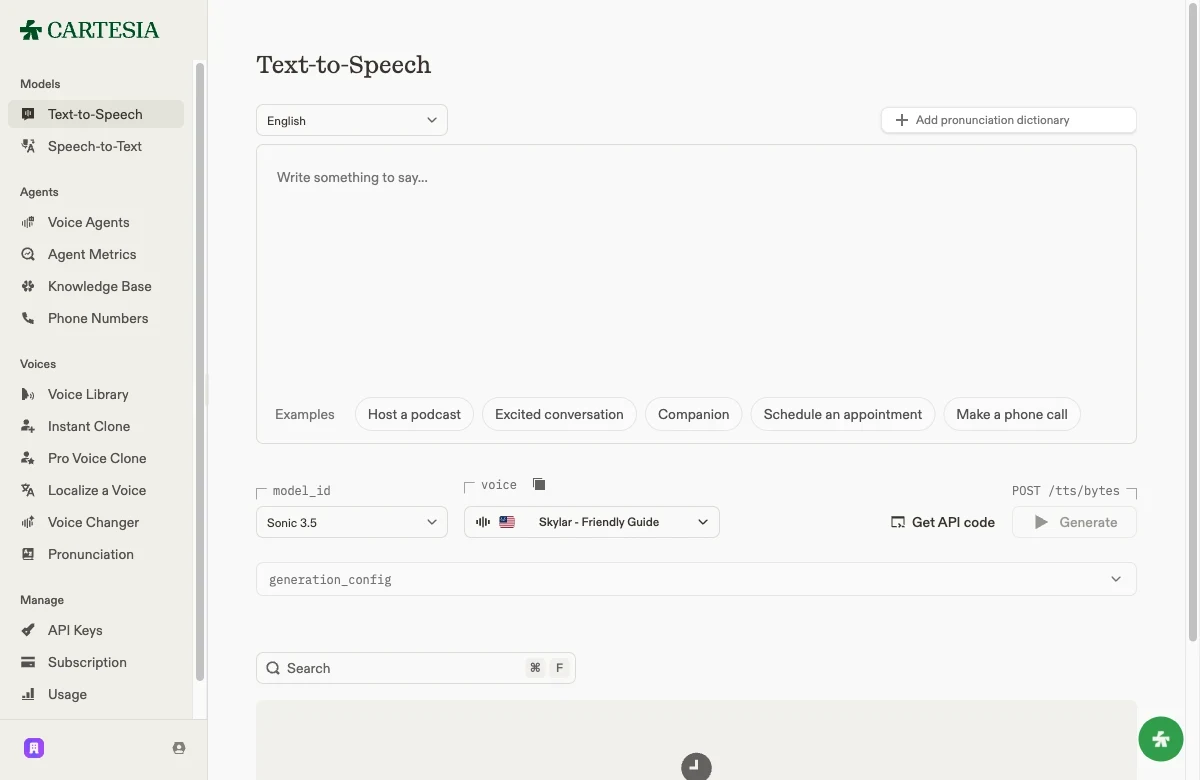
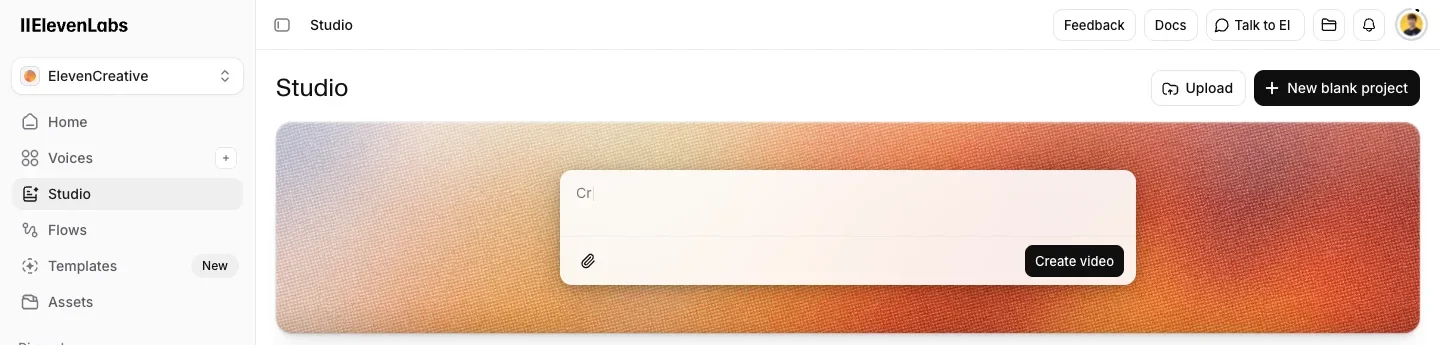
Workflow is the mirror image. ElevenLabs is built for the producer who edits: the Studio editor imports a script, splits it into blocks, and lets you regenerate a single fluffed line instead of re-rolling a chapter, while Dubbing re-voices video on a correction timeline. Cartesia has none of that — it is an API and a playground that assumes you are heading for code, with a “Get API code” button one click from any generation.
For a developer, though, “workflow” means the API, and there the roles flip. Cartesia is API-first by design: streaming is the default, the SDK call mirrors the playground exactly, and the surrounding stack (Ink for transcription, Line for agent logic, phone numbers, a knowledge base) lets you assemble a whole voice agent without stitching three vendors together. ElevenLabs has a capable API and official SDKs, and the same credits drive the web app and code, but it is a creative suite with an API attached rather than an agent platform with a playground attached.
Scale is the last piece, and it favors Cartesia for live traffic. Its plans ladder concurrency deliberately, from a couple of simultaneous requests on Free up to dozens on higher tiers, because running many calls at once is the use case. ElevenLabs prices for creators producing assets, so a chatty agent on a shared credit pool drains a plan faster than the headline minutes imply, and you end up budgeting a tier up. Pre-rendered content never feels this; a live agent feels it on day one.
So the speed-and-workflow verdict is itself a split: Cartesia owns runtime latency, real-time scale, and developer ergonomics, while ElevenLabs owns production workflow. A developer wiring speech into an app weighs the first; a creator assembling a 40-minute episode weighs the second. Neither is wrong, and almost nobody needs both at once.
Who should pick ElevenLabs
- YouTubers and podcasters who need a believable narrator without booking a booth. The library plus the Studio editor covers a weekly show, Creator’s ~121 minutes is the right shape for it, and a fluffed line is a single-block re-roll rather than a re-record.
- Audiobook and course makers who want one cloned narrator across hours of material, with the emotional range that keeps a long read from going flat. This is the Professional Voice Cloning case, so Creator or Pro, with editing time budgeted on top of generation time.
- Multilingual creators who want one upload re-voiced into dozens of languages on the Dubbing timeline, then corrected for transcript and timing before export. The 70+ language reach on V3 has no equal in this comparison.
- Anyone for whom the voice is the deliverable. If a human will sit and listen for more than a sentence, buy the quality. Start free and hear it before you pay.
Who should pick Cartesia
- Developers building real-time voice agents — phone bots, live assistants, interactive kiosks — where a half-second of latency breaks the illusion. This is the core case, nothing else I have tested answers faster, and the concurrency limits ladder up for live call volume rather than asset production.
- Teams optimizing cost at API scale. At ~3-4x cheaper per character, an agent fielding thousands of calls a month is simply viable on Cartesia in a way it is not elsewhere; price the conversation minutes first and the credits second, since the minutes are what grow with traffic.
- Anyone who needs instant cloning on a budget. A faithful clone from about 10 seconds of audio, free on the starting tier, is unmatched for prototyping a branded agent voice before any spend.
- Builders who want one vendor for speech, transcription, and agent logic. Sonic, Ink, and Line under one API key and one credit pool remove a class of integration glue, and the streaming-first SDK mirrors the playground so prototype-to-production is a short hop.
The final word
If you are a creator, this is barely a contest: buy ElevenLabs. The voice quality is a genuine class above, the catalog and Studio editor are built for content, and the cloning is the best most people can buy. The credit pricing stings at volume, but for narration, podcasts, audiobooks, and dubbing, nothing else comes close, and you can start free to confirm it in five minutes.
If you are a developer building something that talks back in real time, buy Cartesia. The sub-90ms latency is the whole product, the per-character price makes high call volume viable, and the instant cloning gets you a usable voice in seconds. It is not for content, and it does not pretend to be.
The mistake is treating this as one purchase. They are different tools for different jobs, and the good news is that knowing which job you have makes the decision obvious. Still weighing the broader field? See our roundup of the best ElevenLabs alternatives.
Frequently asked questions
Is Cartesia better than ElevenLabs?
For real-time voice agents where latency decides the experience, yes. Cartesia's Sonic answers in under 90ms.
For content, ElevenLabs wins on voice quality, emotional range, catalog size, and long-form tooling. They are built for different jobs.
Which is cheaper, ElevenLabs or Cartesia?
Cartesia, by a wide margin at scale. Per character it runs roughly 3-4x cheaper than ElevenLabs (independent tests put it near 73% less), and it meters a flat 1 credit per character versus ElevenLabs' minute-based credits. For light creator use, the gap matters less.
Which is faster, ElevenLabs or Cartesia?
Cartesia. Sonic advertises sub-90ms time-to-first-audio and independent tests measure around 100 to 165ms. ElevenLabs has a fast Flash model, but its higher-quality expressive models add delay that can make live conversation feel clunky.
Can both clone my voice?
Yes. Cartesia clones from about 10 seconds of audio (it advertises as little as 3) and includes it on the free tier. ElevenLabs offers Instant Voice Cloning from a short sample on the $6 Starter plan and higher-fidelity Professional cloning from 30+ minutes of audio on Creator.
Which should I use for audiobooks versus phone agents?
Audiobooks, narration, podcasts, and dubbing: ElevenLabs, for the emotional range and the Studio long-form editor. Phone agents, live assistants, and any real-time product: Cartesia, for the latency. The decision is the use case, not the price.
Keep reading
ElevenLabs vs Descript: voice engine vs editing suite
ElevenLabs makes the best AI voice; Descript is the editor that even runs ElevenLabs inside it. Here's which you actually need, and when to use both.
ElevenLabs vs Murf: the cheaper one is your script
Murf bills by audio duration, ElevenLabs by characters, so the cheaper voice tool depends on your script's pace, not the price page. I ran the numbers.
ElevenLabs pricing: what the credits really cost
ElevenLabs starts free and most creators pay $22/month — but credits burn faster than the headline minutes. Here's what every plan actually costs.
ElevenLabs review: the best AI voice, billed by the credit
I ran my own scripts through ElevenLabs: the voices are a clear class above everything else, but the credit pricing punishes heavy use. Here's the verdict.