
Perplexity alternatives: 7 ranked, 6 tested on one question
The best Perplexity alternatives, tested on one question with a checkable answer. ChatGPT used the newest figure; three free answers began below 2025's rate.
Contents
What is the best Perplexity alternative?
ChatGPT is the best Perplexity alternative if you will pay, Google AI Mode is the best free one, and Brave Search is the best if you do not want to sign in. That ranking comes from one question with a checkable answer, put to the six I could test and to Perplexity on 21 October 2026.
- Best overall: ChatGPT, which used the newest government figure and cited it.
- Best free: Google AI Mode, which gave an honest range and showed its sums.
- Best without an account: Brave Search, quick and private, though its rate was out of date.
- Best for careful working: Claude, with state-by-state context, on a paid plan.
- Best for privacy: DuckDuckGo, whose answer was short and stale.
- Best inside Google’s apps: Gemini, which cited nothing at all on this test.
- Best paid, ad-free search: Kagi, which I did not test.
How I chose these seven
Most lists of Perplexity alternatives are long and untested. I wanted to know which tools do Perplexity’s actual job, a cited answer to a question you will act on, so I asked every one I could the same thing.
The question was: “How much does it cost to run a 1,500-watt space heater for 8 hours at the average US residential electricity rate?” The physics is fixed at 12 kWh, so the only judgement is which rate to use. The US Energy Information Administration publishes that rate monthly, which gave me a right answer to check against.
On the morning of the test, the EIA’s latest data, for July 2026, put the average home rate at 18.31 cents a kWh. The 2026 year-to-date average was 18.19 cents, and 2025’s annual average was 17.30 cents. Then I asked each tool a follow-up: “If I cut it to 4 hours a night, how much do I save over a 30-day month?”
| Tool | Account in my test | What I ran |
|---|---|---|
| ChatGPT | Plus (paid) | Question and follow-up |
| Claude | Max (paid) | Question and follow-up |
| Google AI Mode | Free, signed in | Question and follow-up, same morning |
| Gemini | Free, signed in | Question and follow-up |
| Brave Search | No account | Question, follow-up in Ask Brave |
| DuckDuckGo | No account | Question only |
| Perplexity, for reference | Free, signed in | Question and follow-up, same morning |
| Microsoft Copilot | Asked me to sign in | Not run |
| Kagi | Needs an account | Not run; pricing page only |
I scored each answer on four things a Perplexity user relies on: how current the starting figure was, whether the citation pointed at the organisation that publishes it, whether the follow-up kept its sources, and whether the sums were right. Price and whether you need an account decided the order between tools that answered equally well.
Two caveats matter. ChatGPT ran on a paid Plus account and Claude on a paid Max account, because those are the accounts in my browser; both companies include web search on their free plans, which I did not run. Gemini, Google AI Mode, Brave Search and DuckDuckGo ran free, and Perplexity’s and Google’s answers come from our Perplexity vs Google test the same morning.
Microsoft Copilot asked me to sign in before it would answer, so it is not ranked. Kagi needs an account, so it is described from its pricing page. And Comet is left out because it is Perplexity’s own browser, not an alternative to it.
If you came here for alternatives to Perplexity Computer, the agent rather than the search engine, this list is the wrong shape. The nearest equivalents are ChatGPT’s work agent on its paid plans, the scheduled tasks and Claude in Chrome on Claude’s Pro plan, and Chrome auto browse on Google AI Pro.
The seven alternatives at a glance
| Tool | Rate it used | 8-hour cost | Cited for the rate | Follow-up cited? | Plan in my test | Cheapest paid plan |
|---|---|---|---|---|---|---|
| ChatGPT | 18.31¢ (July 2026) | $2.20 | EIA | No | Plus | Go, $8 a month |
| Google AI Mode | 18.34¢ and 19.6¢ | $2.20 to $2.35 | St. Louis Fed (FRED) | No | Free | Google AI Plus, $4.99 |
| Claude | 18.83¢ (April 2026) | $2.26 | A third-party site | No | Max | Pro, $17 billed annually |
| Brave Search | 16 to 19.4¢ | $1.92 to $2.33 | Two calculator sites | Source icons shown | Free | Search Premium |
| DuckDuckGo | 16¢ | $1.92 | A retailer and an energy firm | Not run | Free | Subscription |
| Gemini | 17¢ | $2.04 | Nothing | No | Free | Google AI Plus, $4.99 |
| Kagi | Not tested | Not tested | Not tested | Not tested | None | Starter, $5 a month |
| Perplexity, for reference | 18.19¢ (2026 to date) | $2.18 | EIA | Yes | Free | Pro, $17 billed annually |
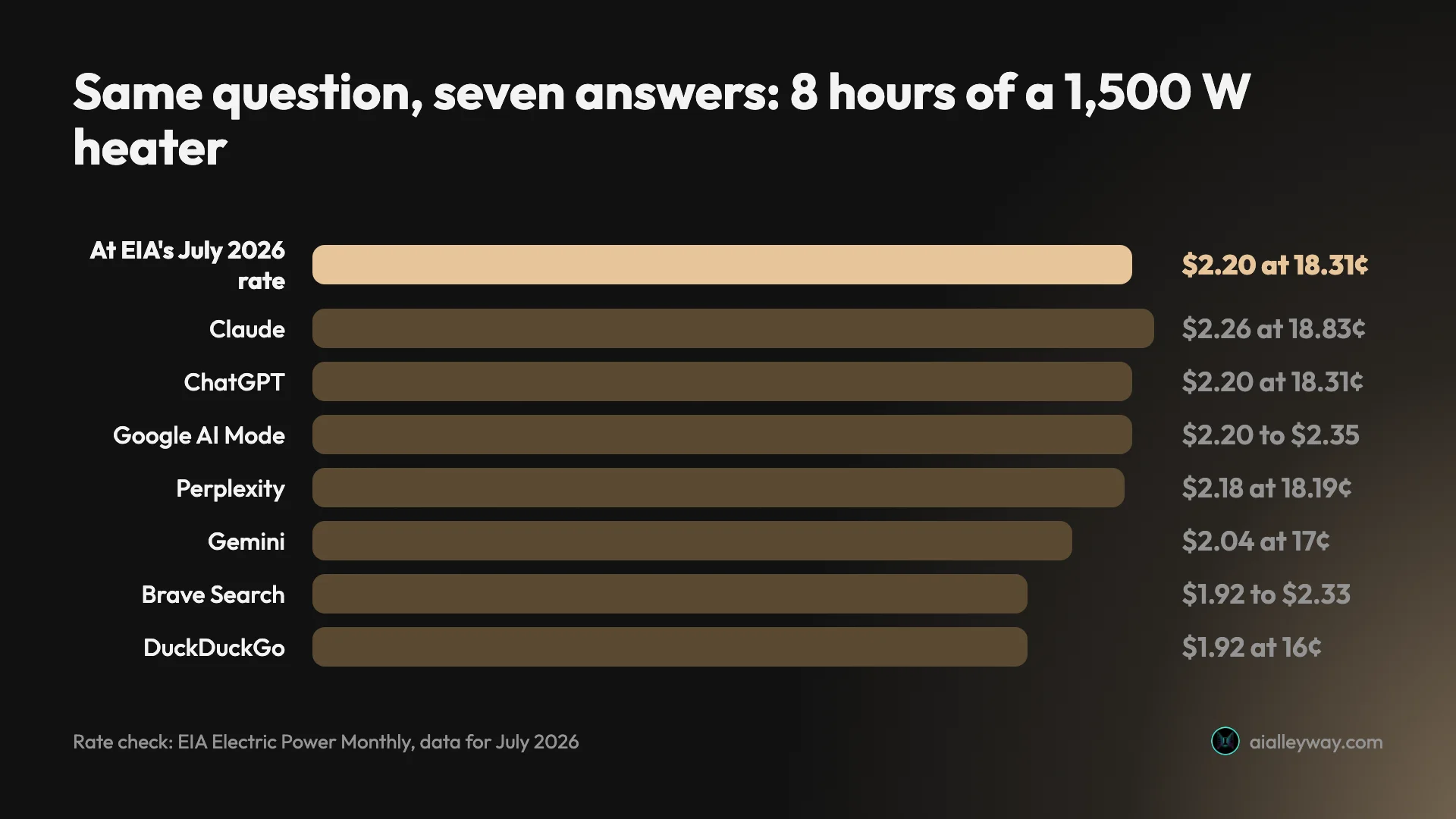
Every tool got the arithmetic right. The differences were all in the starting number and where it came from.
1. ChatGPT — best Perplexity alternative overall

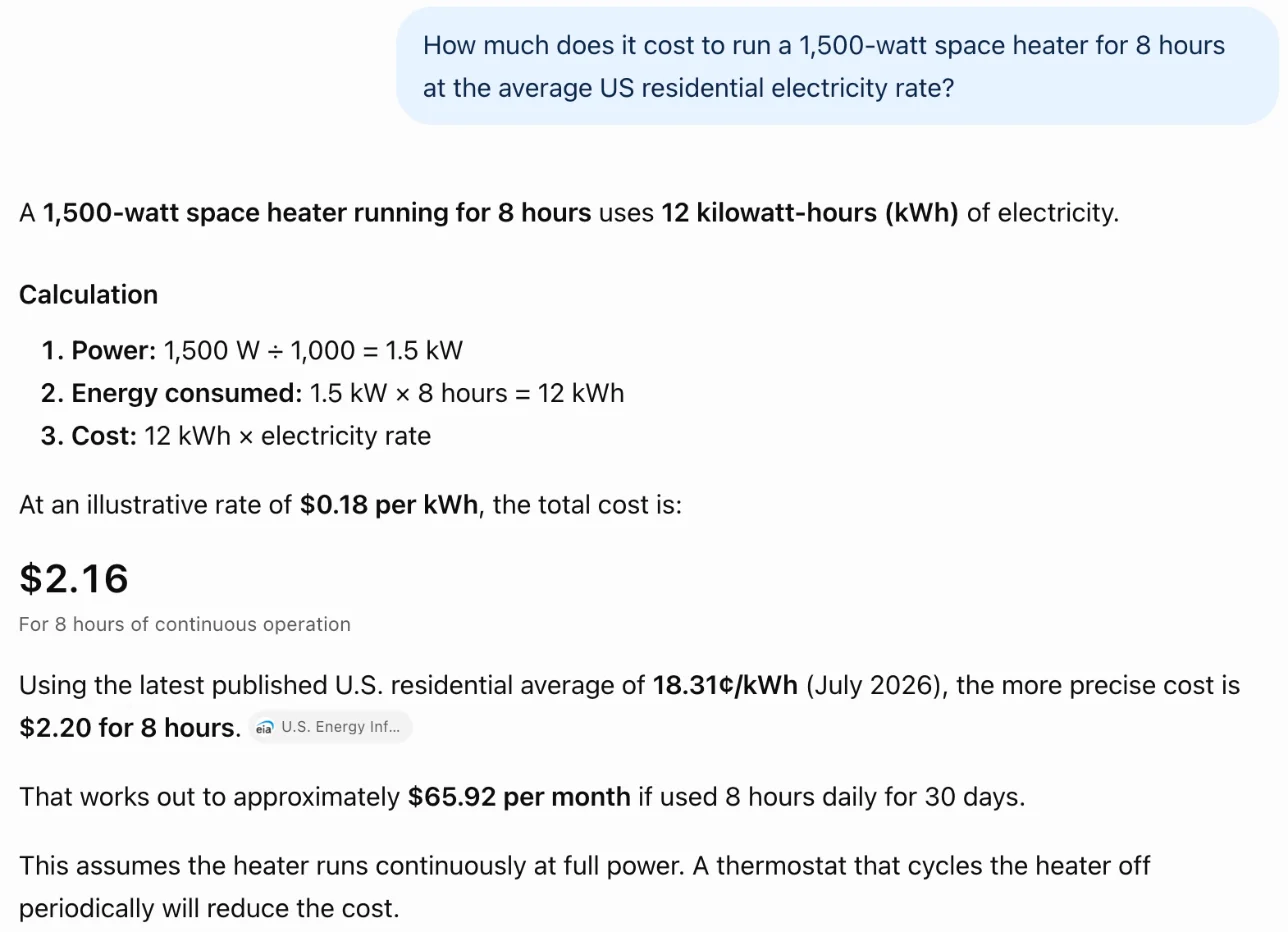
ChatGPT gave the most current answer in the test, Perplexity’s included, and it told me exactly where it came from.
It worked through the energy first, 12 kWh, then gave an illustrative figure at 18 cents before the precise one: “the latest published U.S. residential average of 18.31¢/kWh (July 2026)”, for $2.20 over eight hours, with a chip pointing to the US Energy Information Administration. That is the EIA’s latest monthly figure, and the only answer in this test that used it.
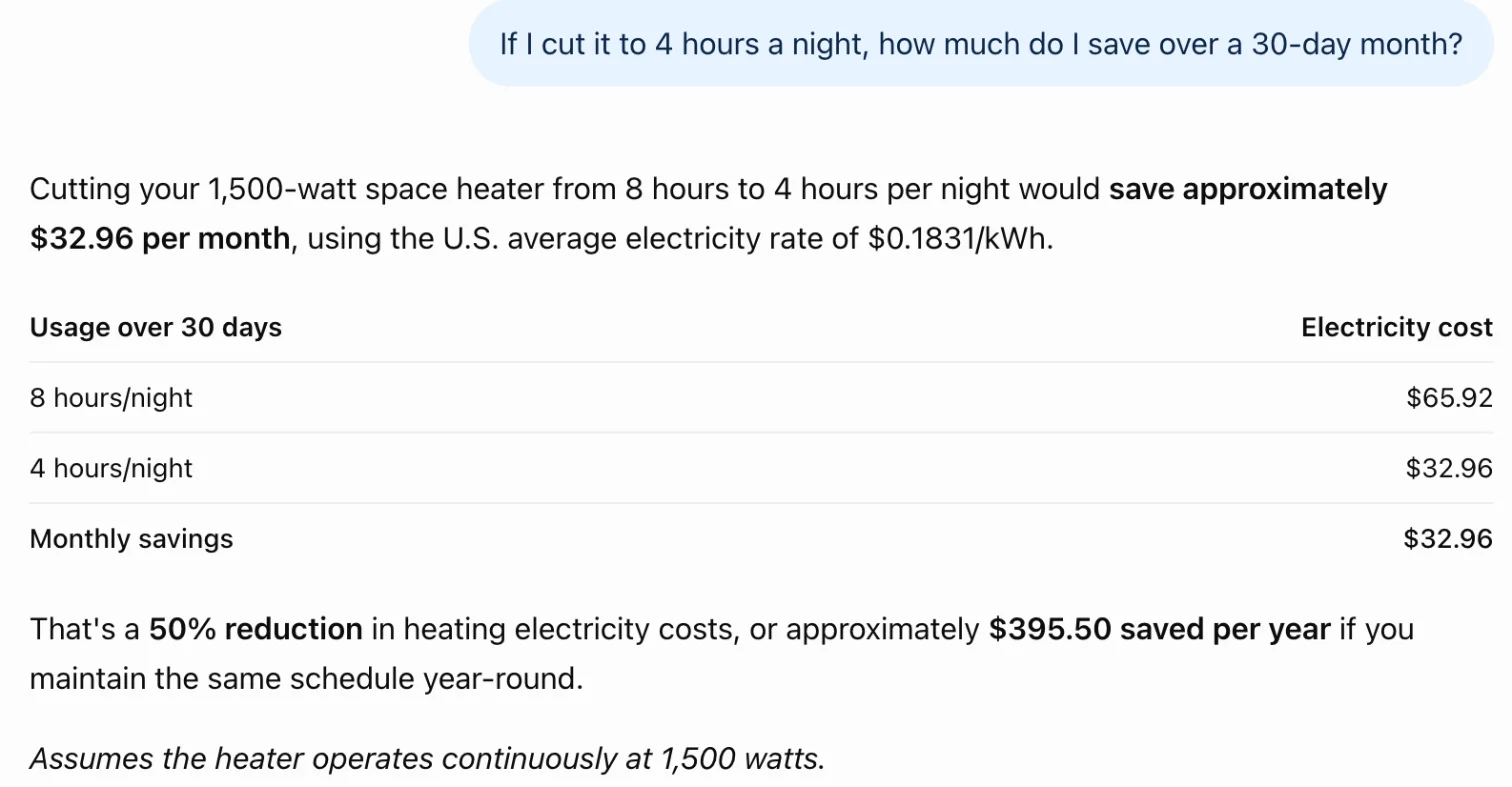
The follow-up was just as clean on the numbers: $32.96 saved over 30 days, in a three-row table. It added $395.50 a year, which is twelve 30-day months, and it carried no source chip. Like Claude and Google AI Mode, it cites the first answer and not the next.
What else it does. Search is one feature in a much bigger product. OpenAI’s pricing page, as our ChatGPT review read it, gives free users unlimited text chats on the core model plus limited uploads, image generation, voice, deep research and memory, with more of each on Plus. If Perplexity was your research tool and ChatGPT your writing tool, this is the one that can be both.
Pricing. Free, Go at $8 a month, Plus at $20 and Pro from $100. My test ran on Plus; OpenAI’s help centre says ads may appear on Free and Go, as our Perplexity vs ChatGPT comparison explains.
Who it is for. Anyone who already pays for ChatGPT and opens Perplexity only to search. You likely have the better-sourced answer one tab away, and our ChatGPT review covers everything else the plan buys.
Where it falls short. It is a chat assistant first, so you get one answer rather than a page of sources to browse.
2. Google AI Mode — best free Perplexity alternative
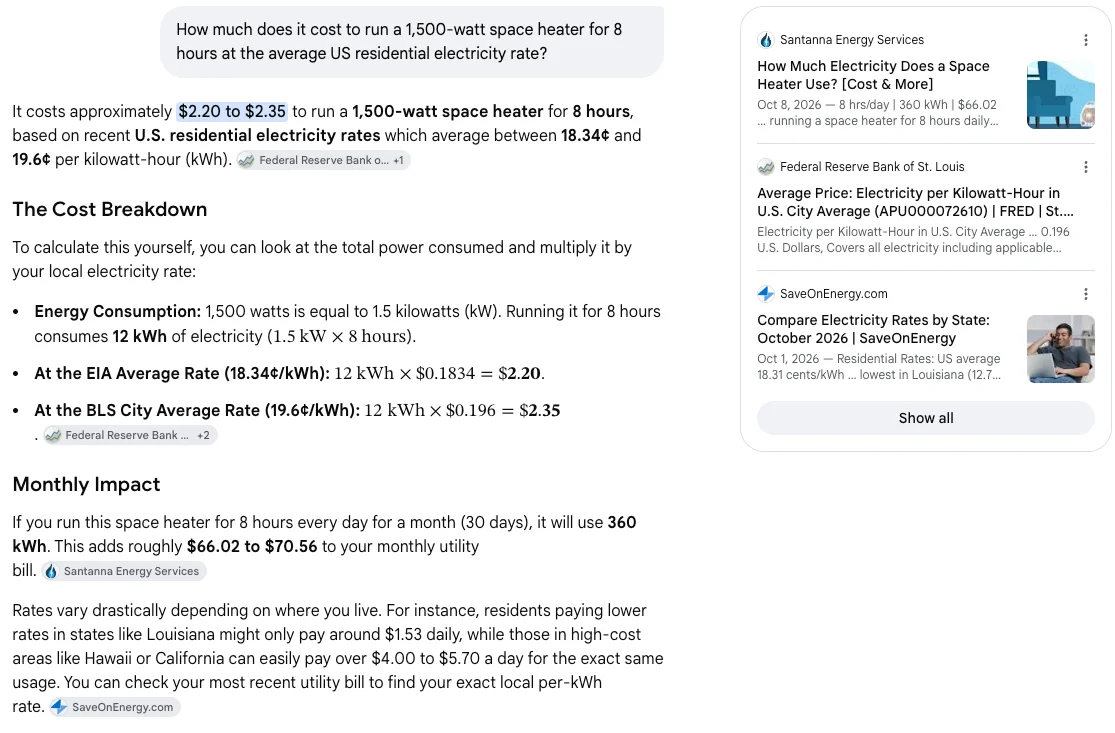
Google AI Mode was the only tool to admit there is more than one “average”, and it is free to everyone with a Google account.
It answered $2.20 to $2.35, using 18.34 cents, which it called the EIA average, and 19.6 cents from the Bureau of Labor Statistics city average. It showed both sums, added $66.02 to $70.56 a month, and gave state examples from Louisiana to Hawaii. The 18.34 cents is EIA’s June figure, a month behind, and the chips on that line pointed to the St. Louis Fed’s FRED database rather than the EIA itself.
Its follow-up kept both rates and answered $33.01 to $35.28 saved, correct but with no source chips at all. Our how to use Google AI Mode guide found the same gap on another question.
What else it does. Google’s help page says the + button in AI Mode’s ask bar adds images and files, including PDFs and Drive files; our guide found Add images, Add files, Create images and Canvas in that menu on a free account. Threads are saved in a sidebar history, and follow-ups keep the context.
Pricing. AI Mode is free. Google AI Plus is $4.99 a month and Google AI Pro, which adds the Gemini 4 Argon model in Search, is $19.99. Google has tested ads inside AI Mode answers in the US since May 2025.
Who it is for. Anyone who wants a Perplexity-style conversation without another account or subscription. It is a tab away from every Google search, and our Google AI Mode review rates it 4.0.
Where it falls short. Its sources tend to be whoever wrote about a fact, not who owns it.
3. Claude — best for careful working, on a paid plan

Claude searched the web on its own, showed the query it used, and gave the most useful context of any answer.
It said it searched “average US residential electricity price cents per kWh 2026 EIA” and answered with EIA’s April 2026 figure, 18.83 cents: “So 12 kWh × $0.1883 comes to about $2.26.” It added a month at about $68 and the extremes, Hawaii at 46.62 cents and North Dakota at 12.35 cents, with the cost of the same eight hours in each.
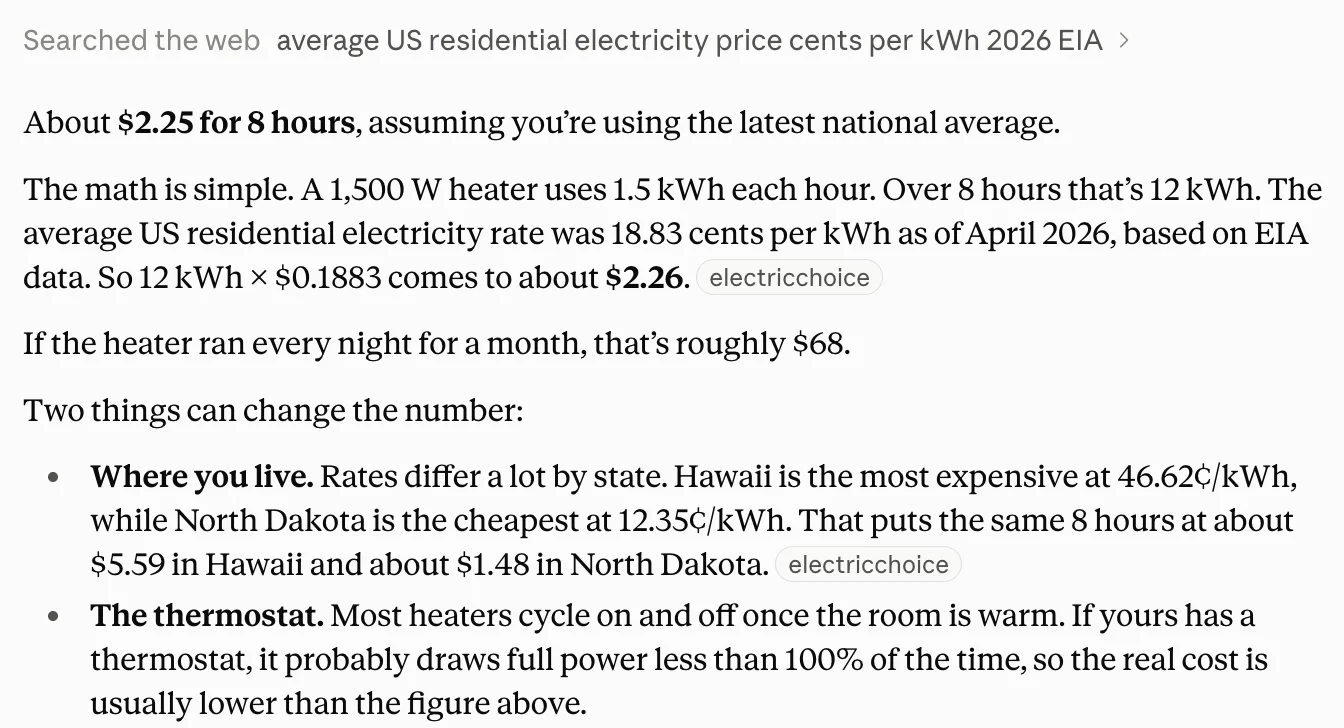
Two small slips. The headline said “About $2.25” while the sum underneath said $2.26, and the chip pointed to a third-party site, ElectricChoice, rather than the EIA. April was also three months behind the latest data. Its follow-up, $33.89 saved, was right, came in a table with an offer to build a spreadsheet, and had no chips.
What else it does. Claude’s pricing page lists, on the free plan, web search, file creation and code execution, memory across conversations, connections to your apps and Artifacts. Pro adds Claude Code, projects, more models, scheduled tasks and Claude in Chrome. For a Perplexity user, the useful part is that it will search unprompted when a question needs current data, and say what it searched for.
Pricing. Claude’s free plan includes web search, per its pricing page. Pro is $17 a month billed annually or $20 monthly, and Max starts at $100. My test ran on Max, so treat this as a paid-plan result.
Who it is for. People who want the reasoning laid out and the edge cases covered, and who may already use Claude for writing. Our Claude review covers the rest of the product.
Where it falls short. It cited a re-publisher of the government figure rather than the government.
4. Brave Search — best without an account

Brave Search answered above its own results, with no account and no sign-in, and it was the surprise of our best AI search engine test in August.
This time it was less sharp. It gave $1.92 to $2.33 a day at “roughly 16 to 19.4 cents per kWh”, plus hourly, monthly and seasonal figures and a state range. Clicking its source icons opened two calculator sites, wattdoes.com and ecoenergycalc.com, not the EIA. The 16-cent end of the range is below even 2025’s average, and its monthly “$57 to $71” stretches past its own top rate, which works out to $69.84.
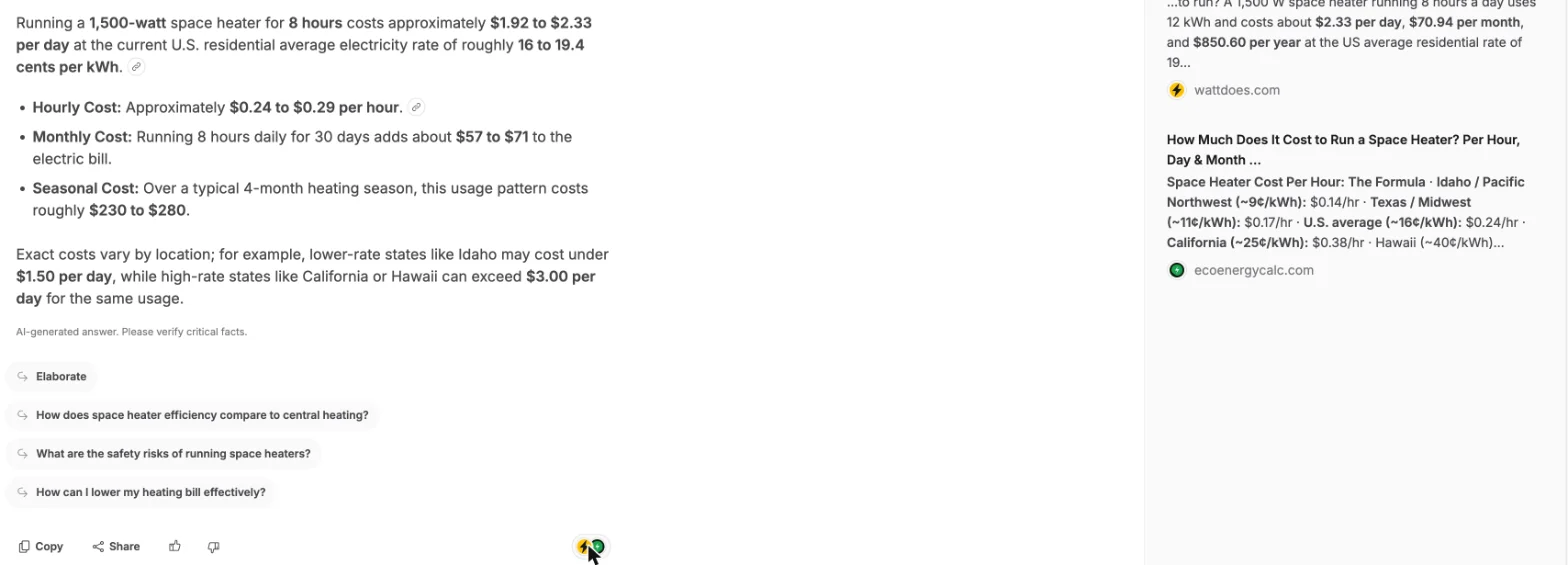
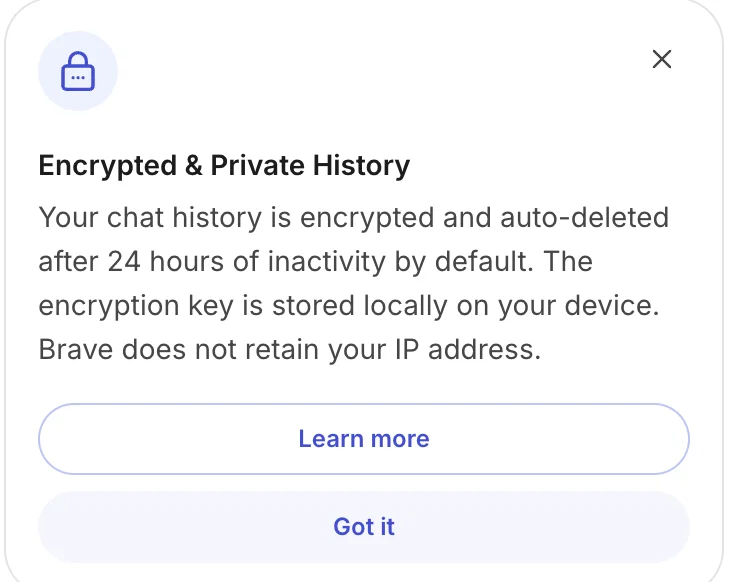
The follow-up moved into Ask Brave, its chat mode, and answered $29 to $35 saved, correctly, with a row of source icons above. Ask Brave also showed a notice worth reading.
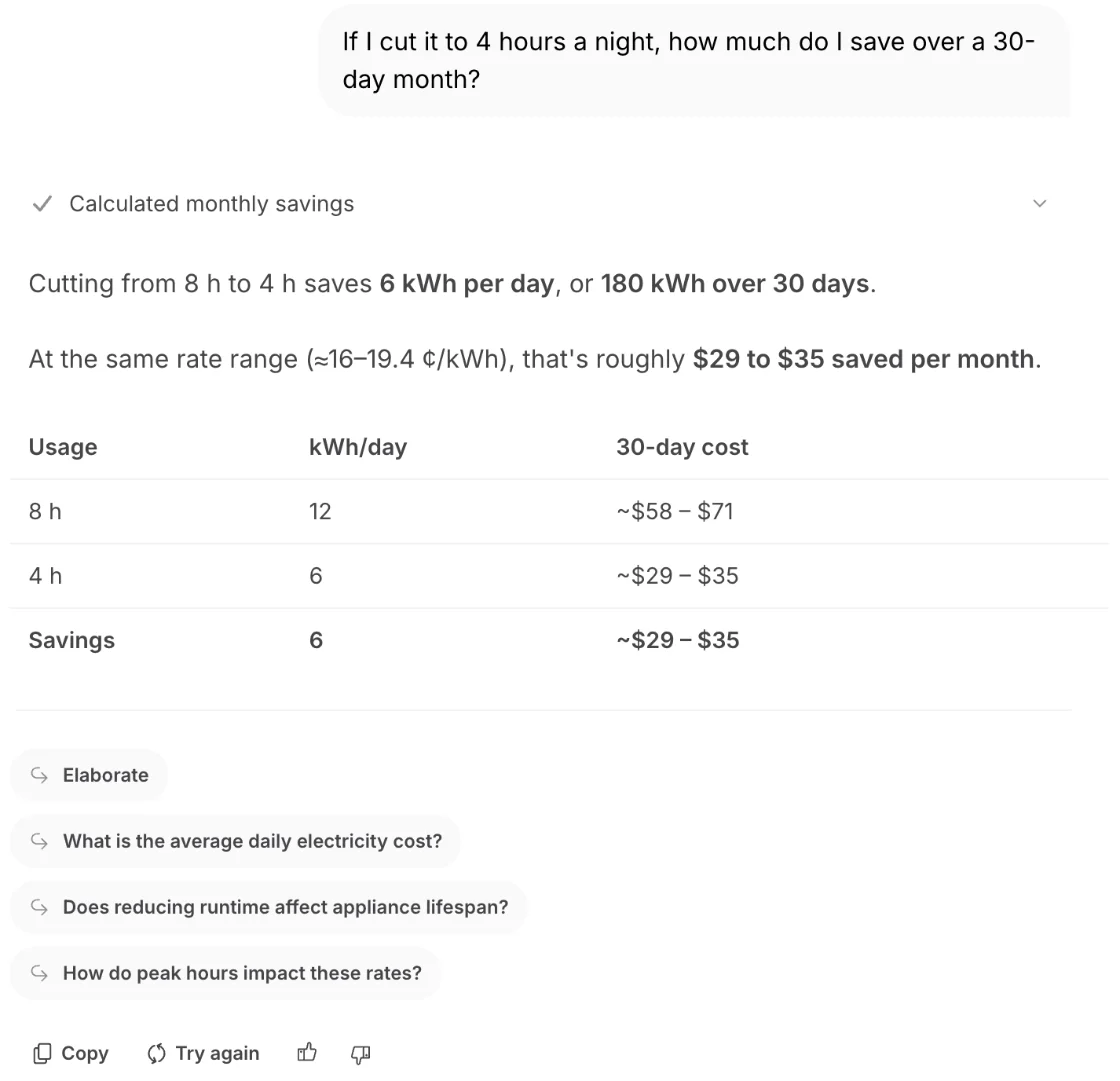
What else it does. Brave runs its own search index rather than renting someone else’s, and in our August test its ordinary results led with the European Commission’s own pages. The tab row also offers Goggles, Brave’s way of re-ranking results with custom rules, alongside the usual Images, News, Videos and Maps.
Pricing. Free. Brave’s help page says results include privacy-preserving ads, and that a paid Brave Search Premium removes them, only in the Brave browser; the page gives no price.
Who it is for. Anyone who wants an AI answer with search results and no account. Its Results panel shows an excerpt from each cited site, so you can see where a figure came from in one click.
Where it falls short. Its sources were calculator sites, and its starting rate was out of date.
5. DuckDuckGo — best for privacy

DuckDuckGo puts a short AI answer, Search Assist, beside ordinary results, and it is the most minimal option here.
Its whole answer was one sentence: “$1.92 to run a 1,500-watt space heater for 8 hours at the average U.S. residential electricity rate of 16 cents per kilowatt-hour.” It cited a retailer, ontimesupplies.com, and Perch Energy, and labelled itself “Auto-generated based on listed sources. May contain inaccuracies.” Ironically, one of the ordinary results below it, posted a day earlier, used 18.44 cents.
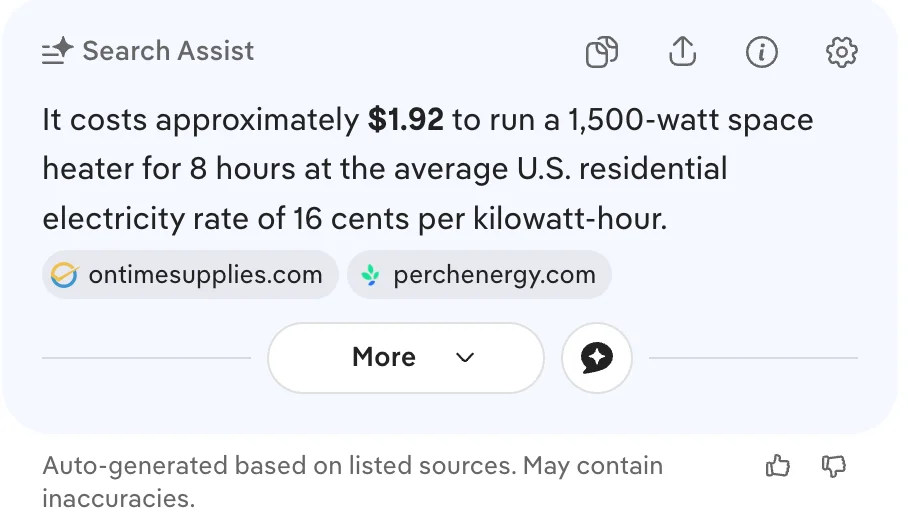
I did not run the follow-up, because DuckDuckGo hands follow-ups to Duck.ai, a separate chat product. DuckDuckGo’s help page says Duck.ai offers several third-party models free, anonymised by DuckDuckGo, and stores recent chats on your device rather than its servers.
What else it does. Duck.ai’s free models, per the same help page, include Anthropic’s Claude 4.5 Haiku, Mistral Small 4 and OpenAI’s GPT-5.4 mini, among others. Recent chats can be deleted one at a time or all at once with the Fire Button, and the AI buttons can be hidden from search results in settings if you would rather not see them.
For a privacy-first user that combination is the point: a plain search engine by default, a summary when one appears, and a chat with a well-known model that DuckDuckGo says it anonymises.
Pricing. Free. A DuckDuckGo subscription adds more advanced models to Duck.ai.
Who it is for. People who want search that does not build a profile, with an AI summary only when it helps.
Where it falls short. One sentence, an old rate and no working shown is a long way from a Perplexity answer.
6. Gemini — best inside Google’s apps
Gemini is Google’s assistant, and on this question it behaved like one: it answered from memory and cited nothing.
On my free account, with the model set to Auto, it said “As of 2026, the average U.S. residential electricity rate is approximately $0.17 per kWh (17 cents)”, worked through $2.04 for eight hours and about $61.20 a month, and added that cycling usually brings it to “$1.50 to $1.80” a night. There was no source chip and no source list.
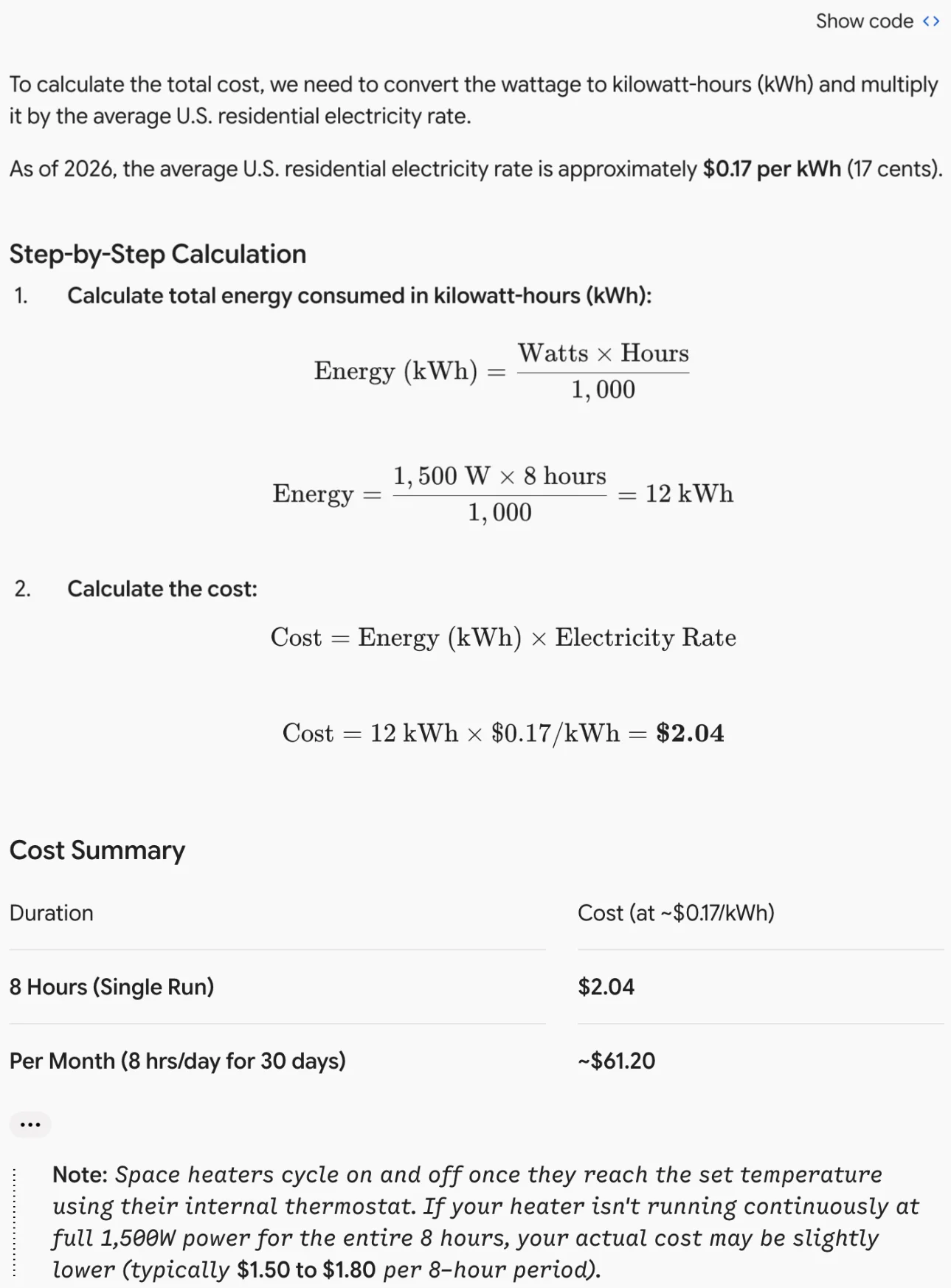
The follow-up, $30.60 saved, was also correct arithmetic on the same 17-cent rate, again uncited. Our Perplexity vs Gemini test found it missed the month’s biggest news and leaned on second-hand sources.
What else it does. Gemini’s free plan is wide. In our Perplexity vs Gemini test the free + menu offered file upload, Drive, image and music creation, Canvas, Deep Research and Guided learning. Its Deep Research read 44 websites on a heat pump question, but neither of two runs finished the report.
So Gemini is a good assistant that can search, rather than a search engine that answers. Ask it to check the web, or use Deep Research, when the answer depends on a current figure.
Pricing. Free, with Google AI Plus at $4.99 a month and Google AI Pro at $19.99, which also bundles 5 TB of storage and Gemini in Gmail and Docs.
Who it is for. People whose work lives in Gmail, Docs and Drive, and who want an assistant there more than a search engine. Our Google Gemini review covers that side.
Where it falls short. For a Perplexity-style question it was the only tool that showed no sources at all.
7. Kagi — best paid search without ads

Kagi is the one tool here that charges for search itself, and I have not used it, so this section is a description, not a verdict.
Pricing. Kagi’s pricing page, checked on 21 October 2026, lists a free trial of 100 searches, Starter at $5 a month for 300 searches, Professional at $10 for unlimited searches and Ultimate at $25. Ultimate adds Kagi Assistant’s Research mode and a long list of flagship models from Anthropic, OpenAI, Google and others, and annual billing takes 10% off.
That shape is the opposite of Perplexity’s. Perplexity’s free tier is funded by upgrades, and Google’s and Brave’s by ads; Kagi asks you to pay and in return promises no ads at all. For someone who already wants several frontier models, Ultimate is one subscription that reaches many of them.
Who it is for. People who would rather pay a few dollars than see ads or wonder why a result ranks where it does.
Where it falls short. I cannot tell you how accurate it is, and a trial needs an account. Our best AI search engine roundup has more on its plans.
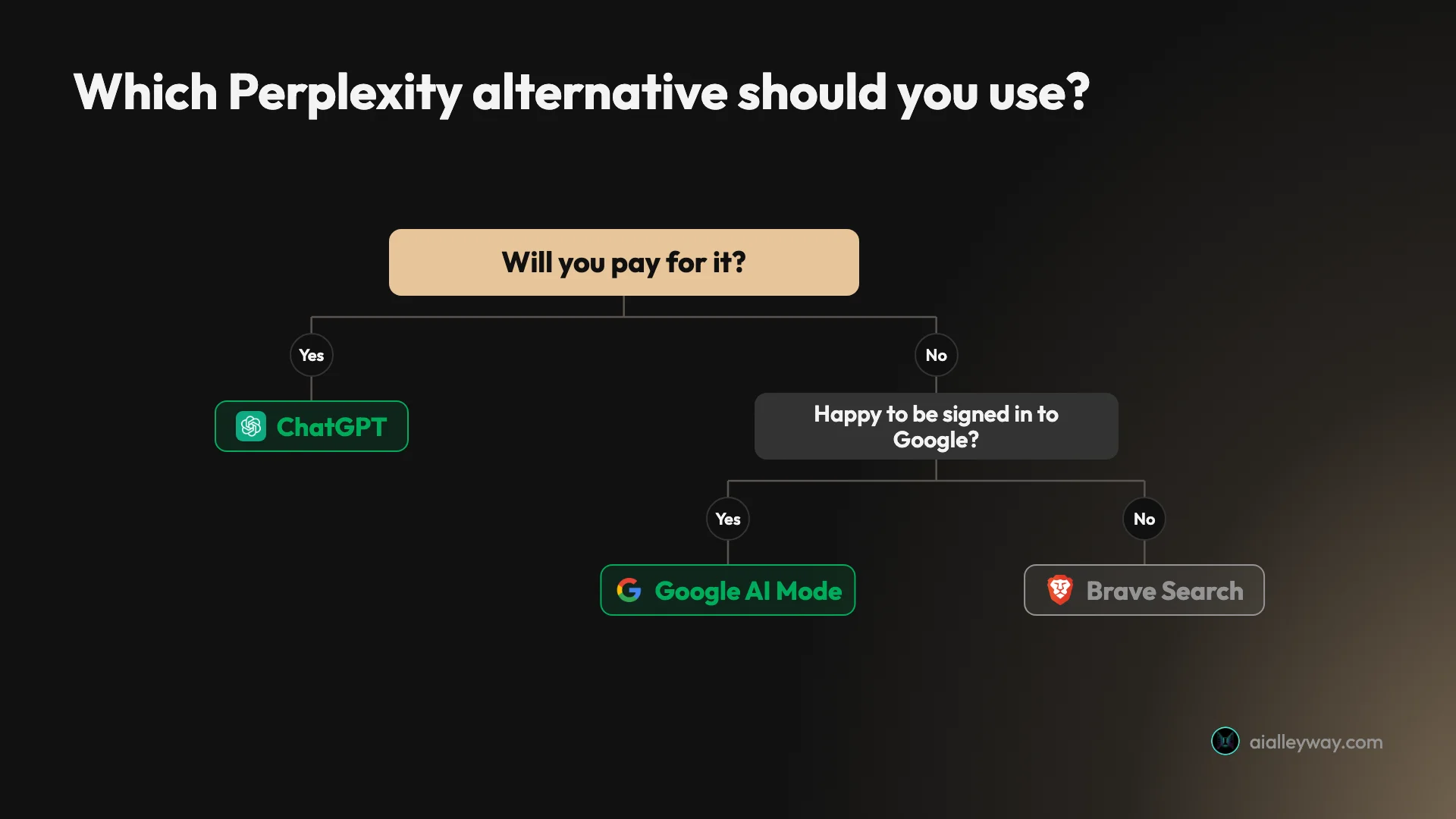
How to pick a Perplexity alternative
Start with what you are willing to pay and where you already work.
- You already pay for ChatGPT: use its search. It gave the most current, best-cited answer in my test.
- You pay for nothing and use Google anyway: use Google AI Mode, and open the sources on anything you will act on.
- You do not want to sign in: use Brave Search, and check the rate or price it starts from.
- You care most about privacy: use DuckDuckGo or Brave, accepting thinner answers.
- You want the working and the edge cases: use Claude, and click through to the original source.
- You live in Gmail and Drive: use Gemini for the work, not for cited facts.
- You will pay to avoid ads: try Kagi’s 100-search trial.
Three habits that fix most of what went wrong
Whichever tool you pick, the failures in this test were the same kind: a starting figure that was out of date, or a citation that pointed at someone repeating the figure. Three habits catch both.
Ask for the date of the number. Adding “use the latest monthly figure and say which month” to a question costs a few words. In this test ChatGPT named its month, July 2026, and was the only tool on the latest figure. Claude named April, so you could see at a glance that its number was three months old; the tools that named no month at all left you nothing to check.
Ask who publishes it. If the chip points at a calculator site, a retailer or a blog, ask the tool for the original publisher, or search for it yourself. For US energy prices that is the EIA; for tax figures, the IRS.
Check the follow-up separately. Four of the six tools whose follow-ups I ran answered without fresh citations, carrying the first answer’s number forward. That is fine for arithmetic, but if the follow-up adds a new fact, it needs its own source.
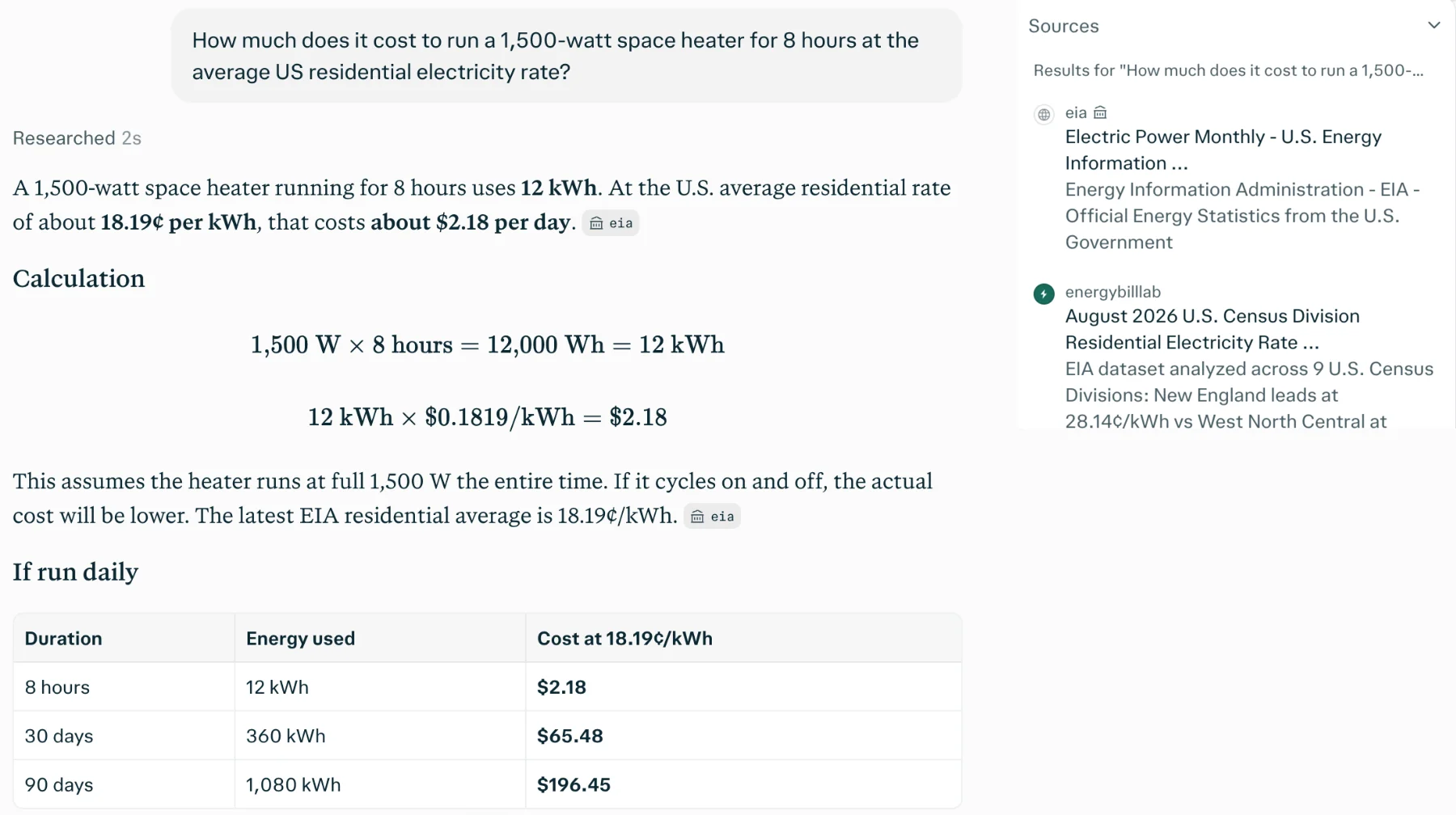
And if none of these beats it for you, Perplexity itself still did well: it cited the EIA on the first answer, and it and Brave’s Ask mode were the only tools to keep citing sources on the follow-up. Our Perplexity review and Perplexity pricing guide cover whether its Pro plan is worth it.
Final word
If you want to leave Perplexity, ChatGPT did its job best in my test and Google AI Mode costs nothing, but every tool did the sums right and three started below even 2025’s average rate, so whichever you choose, check the figure it starts from; our ChatGPT review covers the rest of what Plus buys.
Frequently asked questions
What is the best alternative to Perplexity?
ChatGPT, in my test. Asked what a 1,500-watt heater costs to run for eight hours at the average US electricity rate, it used the newest monthly figure from the US Energy Information Administration, 18.31 cents for July 2026, cited the EIA, and got every sum right.
If you will not pay, Google AI Mode is the strongest free option: it gave a range from two published rates and showed its working, though it cited the St. Louis Fed's database rather than the EIA for one of them. Brave Search is the best choice if you want an AI answer without signing in.
Is there a free alternative to Perplexity?
Yes, several. Google AI Mode, Brave Search, DuckDuckGo's Search Assist and the Gemini app are all free, and ChatGPT and Claude both include web search on their free plans.
The free answers were not equally current, though. In my test, Google AI Mode used 2026 rates, while Brave's range started at 16 cents a kilowatt-hour, and DuckDuckGo and Gemini used 16 and 17 cents, below even the EIA's 2025 average of 17.30 cents. Their sums were right; the number they started from was not.
Is ChatGPT search better than Perplexity?
On my one question, slightly. Both cited the US Energy Information Administration and both got the arithmetic right. ChatGPT used July 2026's monthly rate, 18.31 cents, while Perplexity used 18.19 cents, the 2026 year-to-date average, and called it the latest.
My ChatGPT account was on the paid Plus plan, so this is not a free-versus-free comparison. Perplexity also cited its follow-up answer, which ChatGPT did not. Our Perplexity vs ChatGPT comparison covers the two in more depth.
What is the most private alternative to Perplexity?
Brave Search or DuckDuckGo, by their own descriptions. Brave's Ask mode showed a notice saying chat history is encrypted, auto-deleted after 24 hours of inactivity by default, and that Brave does not retain your IP address. DuckDuckGo says Duck.ai chats are anonymised and stored on your device.
Both gave stale rates in my test, so privacy came at a cost in freshness. Kagi is the paid route: it sells search without ads, from $5 a month for 300 searches. I did not test Kagi.
Why look for a Perplexity alternative at all?
The common reasons are price, upsells and model access. Perplexity's free plan shows upgrade cards under some answers, Pro is $17 a month billed annually, and model choice is a paid feature.
In our Perplexity vs Google test it also used my location twice without being asked. Some people want search inside tools they already pay for, such as ChatGPT or Google's AI plans. If you meant Perplexity Computer, the agent, the closest swaps are ChatGPT's work agent, Claude's scheduled tasks and Gemini in Chrome.
Keep reading
Perplexity vs Google: same right answers, different sources
Perplexity vs Google, tested side by side on five everyday searches: both got every answer right, so the difference is whose sources you can check.
Perplexity vs Gemini: one cites better, one gives more away
Perplexity vs Gemini, tested on both free tiers with the same questions: who found October's news, who got the prices right, and which free plan does more.
Perplexity vs ChatGPT: we asked both the same question
Same question, same day, both free tiers. One got the facts right and cited them; the other was confidently wrong. Plus the price nobody compares properly.
Perplexity pricing: $20 a month, or $17, on the same site
Perplexity pricing is $0, $20 or $200 a month. Its own plan pages show two different headline numbers, and the Enterprise tab quietly switches billing basis.