
Perplexity AI review: the free tier is a showroom
A Perplexity AI review from the free tier: ten models in the picker and every one padlocked, $17 a month to unlock them, and six publishers now suing.
Contents
Is Perplexity AI worth it?

Perplexity is the fastest way I know to get a factual answer with its sources attached, and for research questions it beats opening a search engine and reconciling three tabs. This Perplexity AI review is written from the free tier, because the thing you are really deciding is whether a paid answer engine beats a free search box.
Two things to know before you sign up. The free tier is arranged as a showroom: the model picker lists ten models and padlocks every one. And underneath the product sits an unresolved question about whether summarising other people’s journalism is lawful at all, which at least seven publishers are currently putting to a court.
What does Perplexity actually do?
Perplexity is an answer engine rather than a search engine or an assistant. You ask a question, it searches the live web, and it returns a written answer with numbered citations pointing at the pages it drew from.
That sounds like a small distinction and it changes the whole experience. A search engine hands you ten links and leaves the synthesis to you. A general assistant hands you a synthesis and leaves the verification to you. Perplexity does both halves and shows its working.
The citations are the product
Every claim in an answer carries an inline source you can click. That is the feature, and everything else is arranged around it.
What makes it useful is not that citations exist but that they change your behaviour. Because the sources are one click away, you actually check them, and checking them is where you discover whether the answer is any good. On a general assistant that friction is high enough that most people skip it.
It also fails visibly rather than silently. When Perplexity is working from thin or obscure sources, the citation list tells you so before the prose does.
The other thing citations change is what you can do with an answer afterwards. A sourced paragraph is something you can quote in a document, forward to a colleague, or put in front of an editor, because the provenance travels with it. An unsourced one is something you have to go and re-establish before you can use it for anything that matters.
That is why I think of this as a research tool rather than a chatbot with search bolted on. The output is shaped to be used as evidence, and no other product in this cluster is.
The model picker, and the padlocks
This is the thing that most changed my read on the product. Perplexity does not really train frontier models. It routes your question to somebody else’s.
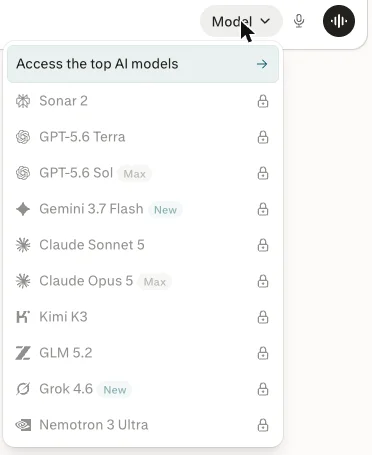
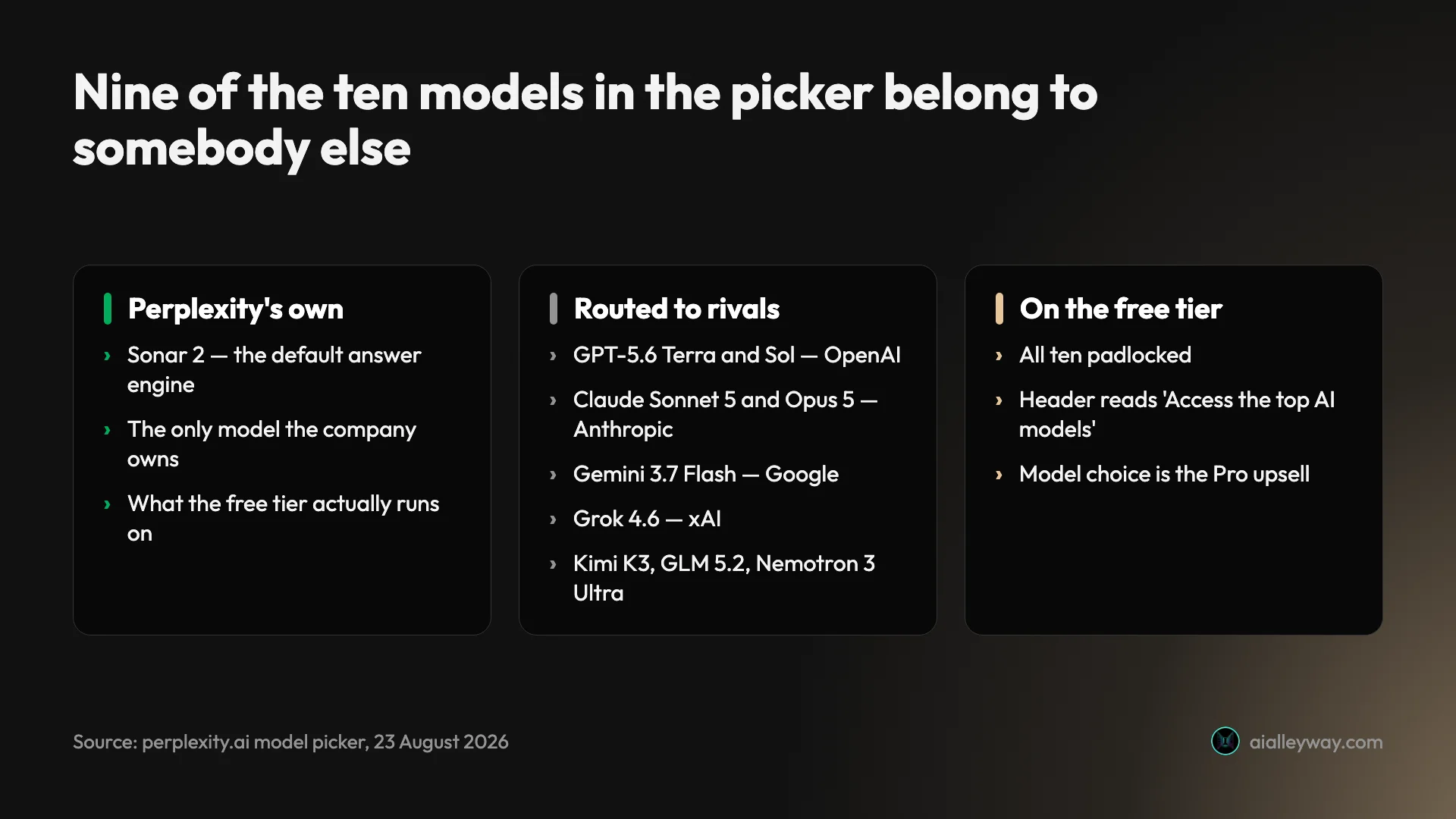
Ten models sit in that list: Sonar 2, which is Perplexity’s own, then GPT-5.6 Terra and Sol from OpenAI, Gemini 3.7 Flash from Google, Claude Sonnet 5 and Opus 5 from Anthropic, Kimi K3, GLM 5.2, Grok 4.6 and Nemotron 3 Ultra.
On the free tier every single one carries a padlock, and the header above them reads “Access the top AI models” with an arrow. That is not a feature list, it is a price tag with a menu attached.
One clarification the padlocks invite you to get wrong, and which matters. They mean you cannot choose a model, not that no model answers you. The free tier works, so something is running: Perplexity’s own Sonar 2 is the obvious candidate, being the one model here it owns, though the interface never tells you which model produced a given answer. What is gated is selection, not service.
That distinction is the honest version of the showroom complaint. You are not being denied a working product. You are being shown a menu where every item is greyed out, including the one you are presumably already eating.
| The padlock means | The padlock does not mean |
|---|---|
| You cannot pick which model answers | No model answers you |
| Model selection is a Pro feature | The free tier is non-functional |
| You are not told which model ran | The answers are degraded on purpose |
Sonar 2, and why Perplexity has its own model at all
Sitting at the top of that locked list is Sonar 2, described on the pricing page as Perplexity’s latest in-house model. It is the only one in the picker the company actually owns.
The reason a router builds its own model is economics rather than ambition. Every question answered by GPT-5.6 or Claude Opus 5 is a bill Perplexity pays to a competitor, so an in-house model that handles the routine majority is the difference between a business and a reseller.
For a buyer the practical read is that an unnamed default answers you and the named models are the upsell. That is not hidden, but it is easy to miss when the marketing is a wall of other companies’ logos.
Focus, Projects and the shape of a research session
Perplexity organises work into sessions rather than chats, which sounds cosmetic and is not. A session is a line of enquiry, and the interface assumes you will come back to it.
Projects sit above sessions and offer, in the product’s own words, to keep files, memory and context together across sessions. That is the same structural idea as Claude’s Projects and ChatGPT’s, and it is becoming the standard shape for this category.
The Customize entry handles how answers come back to you. None of this is remarkable on its own; what it adds up to is a product that expects research to be an ongoing activity rather than a single question.
Here is the whole roster and who owns each one.
| Model in the picker | Whose model it is | Free tier |
|---|---|---|
| Sonar 2 | Perplexity | Not selectable |
| GPT-5.6 Terra | OpenAI | Not selectable |
| GPT-5.6 Sol (Max) | OpenAI | Not selectable |
| Gemini 3.7 Flash | Not selectable | |
| Claude Sonnet 5 | Anthropic | Not selectable |
| Claude Opus 5 (Max) | Anthropic | Not selectable |
| Kimi K3 | Moonshot AI | Not selectable |
| GLM 5.2 | Z.ai | Not selectable |
| Grok 4.6 | xAI | Not selectable |
| Nemotron 3 Ultra | Nvidia | Not selectable |
Nine of the ten belong to somebody else. That is the business: Perplexity is a routing layer with a search index attached, and its pitch is that it will put any of these in front of you rather than tying you to one lab’s roadmap.
It is a genuinely different bet from the one the labs are making. Anthropic and OpenAI are betting that the model is the product. Perplexity is betting that the model is a commodity and the interface around it is the product, which is why its marketing page is a constellation of other companies’ logos rather than a benchmark chart.
Computer, Artifacts and the credit system
Perplexity has grown a second product alongside search. Computer is an agent that builds things: the marketing examples are preparing a tax return, building a portfolio site and generating interview prep. Artifacts holds what it makes.
Computer runs on credits rather than on your subscription allowance, which is a third pricing axis on top of the tier and the model. Pro carries 4,000 bonus credits, Max carries 35,000 bonus plus 10,000 monthly, and both were advertising promotional credit when I looked.
I have not used Computer, so treat everything in this subsection as read rather than run. It does appear in the free sidebar, and Pro’s plan card promises “expanded Computer access” rather than access as such, which implies a free allotment exists underneath.
What I can tell you is structural: the company that sells sourced answers is spending its product energy on an agent that builds artefacts, which is a different business from the one people know it for.
What the free tier actually gives you
Search with citations, session history, and the sidebar surfaces: Computer, Artifacts, Customize and Projects. Projects offers to keep files, memory and context together across sessions.
| Surface | On the free tier | What Pro adds |
|---|---|---|
| Search with citations | Yes | More usage |
| Session history | Yes | Unchanged |
| Projects | Yes | Unchanged |
| Artifacts | Yes | Unchanged |
| Customize | Yes | Unchanged |
| Computer | Present in the sidebar | ”Expanded Computer access” plus credits |
| Model selection | No, all ten padlocked | Select between the top models |
| Deep research | No | Yes |
Deep research and model selection both sit behind Pro. So Free is the answer engine with the model layer removed, which is a coherent product and not the one the homepage describes.
What I could not test
I use the free tier, so everything above the padlocks is documentation rather than experience, and I want to be exact about where that line falls.
I have not used deep research, model selection, or Perplexity Computer beyond seeing where they sit in the interface. I cannot tell you whether GPT-5.6 gives a materially better sourced answer than Sonar 2 inside this product, which is the single question a prospective Pro subscriber most wants answered.
What I can tell you is what the free tier does, what the paid tiers claim, what they cost, and what the company is being sued over. That is a review of the product as a purchase decision rather than a review of Pro. Where I make a claim about a paid feature below, it is sourced to Perplexity’s own description of it and flagged as such.
How much does Perplexity cost?
Perplexity runs a free tier, Pro at $17 a month billed annually, Max at $167 a month billed annually, and an Enterprise tier above that. Model selection and deep research both sit behind Pro, and Perplexity Computer bills separately in credits, which makes this the only product in the category with three pricing axes rather than two.
| Plan | Price | What it adds |
|---|---|---|
| Free | $0 | Search with citations, sessions, Computer, Artifacts, Customize, Projects. No model choice, no deep research |
| Pro | $17/mo billed annually | Expanded Computer access, 4,000 bonus credits, deep research, access to and selection between the top AI models, polished documents and apps, more usage and memory |
| Max | $167/mo billed annually | Maximum Computer usage, 35,000 bonus credits plus 10,000 monthly, expert-level research, frontier models, highest usage and memory, priority access to new features |
| Enterprise | Custom | Team administration and controls |
Perplexity Pro cost: the monthly price is not on the page
Perplexity’s plans page shows Pro at “$17 /month or equivalent, when billed annually” and Max the same way at $167.
There is no monthly-billing figure displayed next to either on that page. Perplexity’s separate pricing hub does publish the monthly rates, $20 and $200, which our Perplexity pricing guide works through — but on the plans page the number you are shown is the discounted one, and what you would pay to avoid a twelve-month commitment is simply absent from the comparison.
That is a common pattern and it is still worth naming, because the annual figure is the one that ends up in every pricing table written about this product, including the one above.
Credits are a third axis
Most subscriptions have two variables: which tier, and how much you use it. Perplexity has three, because Computer bills in credits that sit alongside the plan rather than inside it.
Both paid tiers were advertising promotional credit when I checked, $40 on Pro and $450 on Max, both marked limited time. Promotional credit on a metered product is a discount you cannot budget against, since it tells you nothing about what the meter costs once the promotion ends.
What a year actually costs
Annual-equivalent pricing makes the headline look small, so it is worth converting it back the way I do for every tool in the AI tool cost statistics roundup.
| Plan | Per month, as shown | Over twelve months |
|---|---|---|
| Free | $0 | $0 |
| Pro | $17 | $204 |
| Max | $167 | $2,004 |
Pro at $204 a year is a modest professional tool. Max at $2,004 a year is a serious commitment, and the plan description makes clear what it is for: maximum Computer usage, 10,000 monthly credits, frontier models. That is an agent budget with a search engine attached, not a research subscription.
The gap between the two is the part worth staring at. Max costs roughly ten times Pro, and almost everything it adds is capacity rather than capability. If you cannot articulate which ceiling you are hitting, you are not the customer for it.
Which plan should you buy?
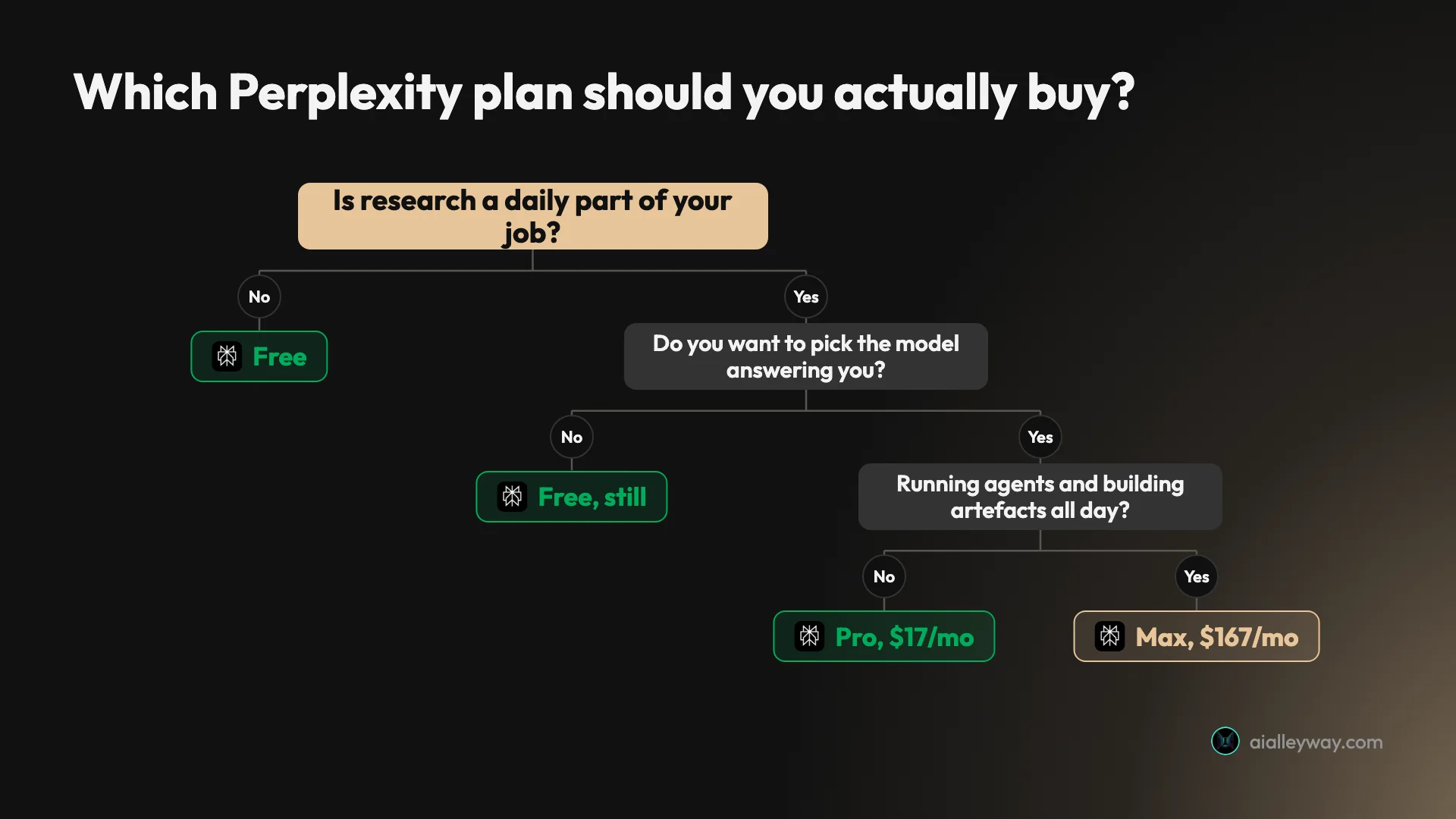
Start on Free and use it for a fortnight as your actual first stop for factual questions. That is the honest test of whether an answer engine fits how you work, and it costs nothing.
Move to Pro if two things are true: research is a daily part of your job, and you specifically want to choose the model answering you. Both halves matter. Plenty of people research daily and would be perfectly served by the default, and my guess is that the commonest way to waste $204 here is paying for a picker you then open twice. If only the first is true, the free tier may already be enough, because the citation behaviour that makes Perplexity valuable is not the part that is gated.
Max at $167 is a different category of purchase and it is mostly about Computer usage rather than about search. Read the plan description carefully and it is an agent budget: maximum Computer usage, 35,000 bonus credits, 10,000 monthly credits, frontier models. Search is almost incidental to it.
If you are reading a review to decide between tiers, you are probably not the Max customer, because Max is priced for people who already know what their credit consumption looks like.
The category question underneath all of this
There is a strategic question sitting under every specific criticism in this review, and a buyer should think about it before subscribing to anything in this space.
Perplexity invented a category and now has to defend it against two directions at once. Above it, general assistants keep adding live search, so the gap between asking ChatGPT and asking an answer engine narrows every quarter. Below it, Google is putting sourced AI answers into the box everyone already uses, free.
A specialist survives that squeeze by being unmistakably better at its speciality. On sourced answers Perplexity still is, and the padlocks and the credit currency read to me like a company that knows the window is finite.
Who is Perplexity for?
- Researchers and analysts. The strongest case. Any job where you need a current answer and have to be able to show where it came from is the job this product was built for, and it does it better than the alternatives.
- Journalists and fact-checkers. The inline citation model matches how the work is actually done. The irony that publishers are suing over exactly this is not lost on me, and it is covered below.
- Students. Sourced answers with clickable references map neatly onto how academic work has to be evidenced, and the free tier is usable for it.
- Anyone who opens five tabs to answer one question. That specific habit is what Perplexity removes, and if you recognise yourself in it the free tier will feel like a real upgrade on day one.
- Anyone comparing model outputs. If putting the same question to two rival models is part of your work, a Pro subscription is the cheapest way to do it, and the reasons why are in the section below.
- People who distrust confident AI answers. If the thing that has kept you away from assistants is that they sound certain regardless of whether they should, an interface built around visible sourcing is the one to try first.
- Not for people who want things made. This is an answer engine. It does not write well at length, it does not generate images, and it is not a coding tool. Ask it to produce rather than to find and you will be disappointed.
- Not for people who want one subscription. Perplexity is a companion to a general assistant, not a replacement for one. Budget for both or pick the other one.
What is Perplexity good at?
Perplexity’s strength is verifiable answers: live web results with inline citations, arranged so that checking a source takes one click rather than a new tab. Against a search engine it collapses three tabs into one sourced paragraph; against the free AI answers now appearing in Google’s own results it offers denser citations and a workflow built around checking them.
It removes the tab-reconciling step
The specific thing Perplexity kills is the habit of opening several sources and mentally merging them. One question, one sourced paragraph, references attached.
For factual lookups this is a real change in how long the task takes rather than a marginal improvement. Three tabs, two of them contradicting each other, and a judgement call about which to believe collapses into something you can read in twenty seconds and check in one click.
It is the reason I keep it in the rotation despite everything in the second half of this review. A tool can have a serious problem attached to it and still be the fastest way to do something you do dozens of times a week.
| Behaviour | Perplexity | A general assistant |
|---|---|---|
| Sources shown | Inline, by default | On request |
| Cost of checking one | One click | Open a new tab and search |
| What thin sourcing looks like | A short citation list | Confident prose |
| Live web by default | Yes | Varies by tool and tier |
Verification is designed in, not bolted on
Every assistant can be asked for sources. Perplexity is the only one where the sources are the default output rather than a follow-up request.
The difference shows in what you catch. Because checking costs one click, you check, and you find the occasional answer built on a weak source. On a tool where checking costs three minutes, you do not check, and you never find out.
That is a claim about behaviour rather than about accuracy, and it is the more useful claim. Every model in this category hallucinates sometimes. The question a buyer should be asking is not which one is wrong least often but which one makes being wrong visible, and this is the only one designed around that question.
The caveat is that a citation proves a source exists, not that the source says what the answer claims. I have seen answers where the link was real and the summary of it was loose, so the click still matters.
The free tier does the core job
The gating is aggressive and it is aimed at the model layer, not at the citations. Search with sources, session history and Projects are all available without paying.
That is a defensible split, and it is worth being precise about because the padlocks make the free tier look thinner than it is. The thing that makes Perplexity worth using is available free. The thing that makes it worth marketing is not.
If your honest use is a dozen factual questions a day, you may genuinely never need Pro, and nothing on the upgrade screen is designed to tell you that.
It answers the question a search engine makes you assemble
The comparison that matters is not against a chatbot, it is against the thing you would otherwise have done: type a query, open the first three results, and reconcile them yourself.
Perplexity removes that step and hands back the reconciliation with its working shown. For a factual question, that is a change in how long the task takes rather than a marginal improvement, and it is the reason the product exists as a category.
Google’s own AI answers are converging on this, which is the competitive story of the next two years. What Google does not yet match is citation density and the assumption that you will click through.
Model choice is a real Pro feature, in a category that offers none
Aggregation gets dismissed as a lack of technology and it is a genuine feature. A Pro subscriber can put the same question to two rival frontier models and compare, inside one interface, without two subscriptions.
No search product offers anything like it. Google gives you Google’s model; Bing gives you Microsoft’s. If which model answered you matters — and for research questions it sometimes does — this is the only tool in the category that lets you decide.
It also insulates you from a single company’s decisions. If a lab ships a model you dislike or changes its limits, a router lets you move without moving your subscription.
It fails loudly
When the underlying sources are thin, the answer looks thin, because the citation list is right there and short. Compared with an assistant that produces confident prose regardless of what it is standing on, this is a meaningful safety property.
It is most valuable on exactly the questions where you are least equipped to judge. On a topic you know well you would catch a bad answer anyway; on one you do not, a two-source citation list is the only warning you are going to get.
Where does Perplexity fall short?
Perplexity’s problems are commercial and legal rather than technical. The free tier displays ten models it will not let you use, the plans page shows only annual-equivalent pricing, a third billing axis runs on credits, and the company is defending at least seven publisher lawsuits over the content-summarising behaviour the product is built from.
The free tier is a showroom, though the comparison cuts both ways
I keep coming back to that padlocked list because I have not seen another product do it quite so plainly. Ten models, ten locks, and an upgrade arrow above them. You are shown the product you did not buy every time you open the composer.
It misrepresents the free tier to the people using it. Someone who opens that picker concludes Perplexity is crippled without Pro, when what they actually have is a working answer engine. There is a more honest and more persuasive design available: show the model you are on, then offer the others.
Weighed against its actual category rival, though, this lands softer than it first appears. Google’s AI answers are free and offer no model choice whatsoever, so a free Perplexity user is not worse off than a Google user on that axis. The padlocks are a presentation failure rather than a capability gap, and I have marked them down as one.
Why is Perplexity being sued? Six publishers, and Reddit, say the core mechanism is theft
This is the part of the review I would want to read before subscribing, and it is largely absent from the other write-ups I could find. Dates and quoted allegations below come from Press Gazette’s running tracker of publisher AI litigation.
| Filed | Who | The allegation, in their words |
|---|---|---|
| Oct 2024 | News Corp (WSJ, New York Post) | “massive freeriding” through copyright and trademark infringement |
| Aug 2025 | Yomiuri Shimbun | 119,467 articles used without permission |
| Sep 2025 | Encyclopaedia Britannica, Merriam-Webster | Perplexity “free rides” on their content and takes their traffic |
| Oct 2025 | ”industrial-scale” bypassing of technical protections | |
| Dec 2025 | New York Times | copying journalism, including from “behind our paywall”, without permission or compensation |
| Dec 2025 | Chicago Tribune | ”unlawfully crawls, scrapes, copies, and distributes” content |
| May 2026 | CNN | copied content after deal talks failed; “Perplexity knew that it was not permitted to access CNN’s content” |
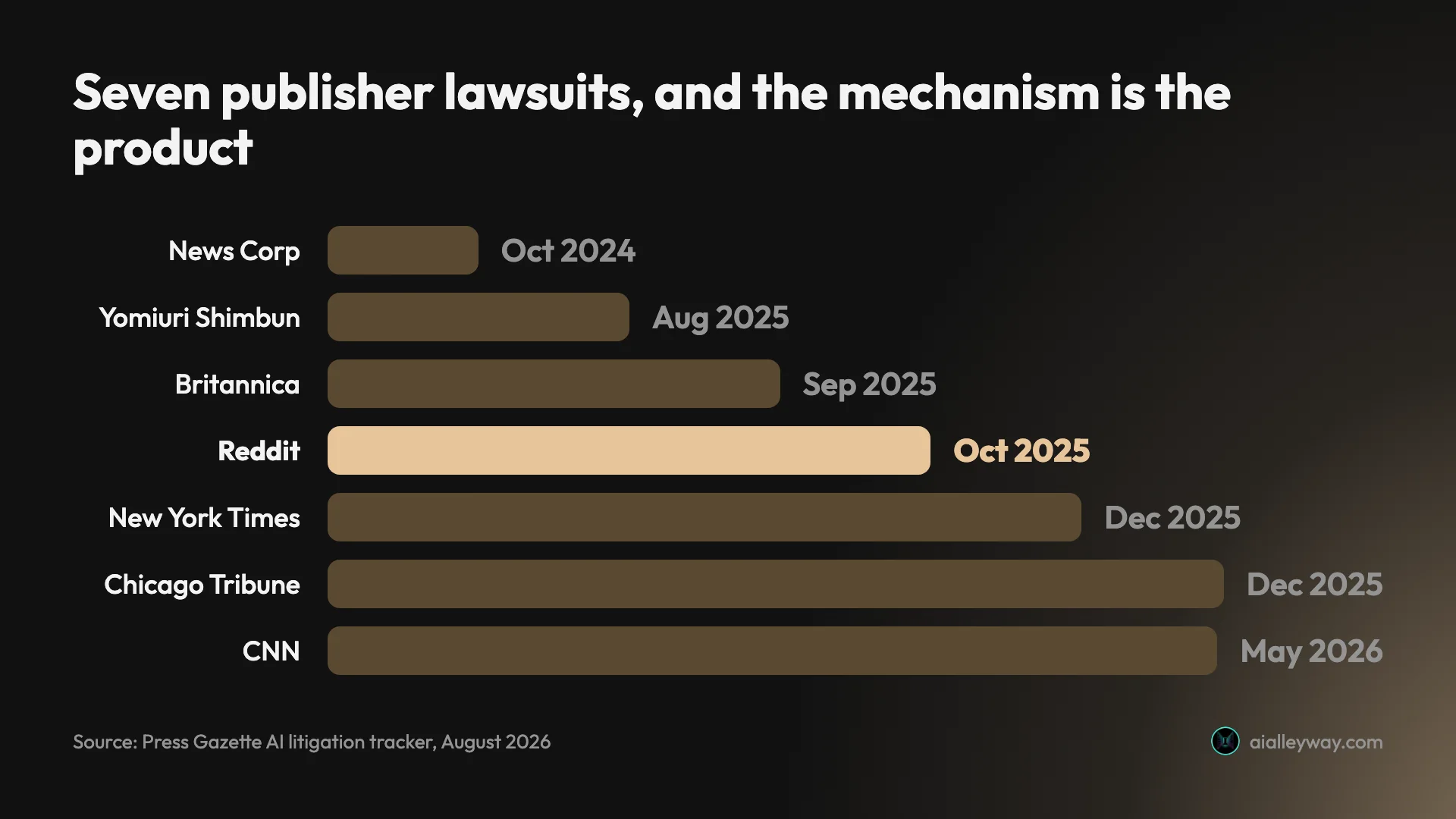
On 31 July 2026 a federal judge largely rejected Perplexity’s motion to dismiss the Reddit case, finding Reddit had plausibly pleaded that Perplexity conspired with at least one data scraper to bypass access controls. That is a procedural ruling rather than a finding of liability, and it means the case proceeds.
We put Perplexity and ChatGPT head to head on one checkable question separately; this section is about the legal backdrop rather than the product.
Perplexity disputes all of it, none of it is settled, and I am not a lawyer. What I can say as a reviewer is that the disputed behaviour is not a side feature. Reading other people’s pages and summarising them is the product.
That matters to a buyer for two practical reasons rather than for moral ones. The first is continuity: a product whose core mechanism is under challenge in this many actions at once is a product whose behaviour could change, and the thing most likely to change is which sources it can reach. An answer engine that loses access to major publishers is a worse answer engine.
The second is that you may simply not want to be part of it. That is a judgement each reader makes for themselves, and the reason I have laid the filings out with dates rather than summarising them as controversy is so you can make it on the facts.
It is also worth being fair about the other side of the argument. Perplexity’s position is that summarising and linking is what search engines have always done, and that citing a source and sending traffic to it is the opposite of theft. That argument has not been tested to judgement yet either.
The pricing has three axes and shows you one
Tier, usage and credits. The plans page leads with the annual-equivalent price, does not show the monthly alternative, and advertises promotional credits that tell you nothing about the underlying rate.
Working out what Perplexity will cost you in a year takes more effort than working out what any of its rivals will, and that is a choice rather than an accident. I keep the running numbers for this category alongside the rest of the cluster.
Compare the three products in this cluster. Claude publishes tier prices and hides the usage limits. ChatGPT publishes tier prices and describes limits in comparatives. Perplexity publishes an annual-equivalent tier price, describes limits in comparatives, and adds a credit currency on top.
None of the three is good at this. Perplexity is the least good, and it is the one whose users are most likely to be researchers who would notice.
| What you want to know | Claude | ChatGPT | Perplexity |
|---|---|---|---|
| Tier prices published | Yes | Yes | Annual-equivalent only |
| Monthly-billing price shown | Yes | Yes | Not on the plans page |
| Usage limits as numbers | No | No | No |
| A separate credit currency | Overage only | Overage only | Yes, for Computer |
| Promotional credit muddying the rate | No | No | Yes, on both paid tiers |
It answers rather than produces, which is a boundary and a cost
Ask Perplexity to draft something substantial, write code, or hold a long creative conversation and it is clearly the wrong tool.
I am not marking that down as a defect. A search product is not supposed to write your report, and Google does not either. It is the shape of the category rather than a failure inside it.
The consequence for your wallet is real all the same. Perplexity is almost always a second subscription rather than a first, so the honest question is never $17 in isolation but $17 on top of whatever assistant you already pay for.
Run that arithmetic before you subscribe. Pro at $17 billed annually is inexpensive on its own and considerably less inexpensive as a line item next to a general assistant you also pay for. The question is not whether Perplexity is worth $17; it is whether sourced answers are worth $17 on top of what you already spend.
For a researcher the answer is usually yes. For someone who asks a factual question twice a week, the free tier already covers it and the second subscription is the mistake.
The public rating is poor, and that says less than it looks
Perplexity scores 1.5 out of 5 on Trustpilot across roughly 750 reviews.
As with every assistant I have looked at, that number does not distinguish anything. ChatGPT sits at 1.6, Claude at 1.5, Gemini at 1.5 and Grok at 1.4 on the same platform. Trustpilot measures who was annoyed enough to post, not who found the product useful.
The more interesting signal is a thread in r/perplexity_ai titled “Perplexity gets last place in AI search review”, which is the kind of criticism that comes from users who chose the tool rather than from people cancelling a subscription.
Alternatives worth considering
The honest comparison for an answer engine is against search first and assistants second, so that is the order here.
| Perplexity | Google AI Mode | ChatGPT | Claude | |
|---|---|---|---|---|
| Best at | Sourced answers on current information | Search you already have | Breadth in one subscription | Writing and long documents |
| Citations by default | Yes | Partial | No | No |
| Model choice | Pro only | No | Paid only | Paid |
| Free tier usable | Yes, without model choice | Yes, and free forever | Yes, strong | Yes |
| Our pick status | Category pick, search | Runner-up, search | Category pick, assistants | Runner-up, assistants |
Google AI Mode is the alternative that actually threatens this one, and the first you should try, because it is free and already inside the box you type into every day.
It is not as good yet. It does not have to be. A slightly worse answer engine that costs nothing and demands no new habit will absorb a large share of the questions a paid one hoped to answer, which is the strategic problem sitting underneath everything else in this review.
Where Perplexity still wins is the density of its citations and the fact that verification is the interface rather than a footnote. Whether that is worth $17 a month is exactly the question this section exists to make you ask, and you can settle it in a fortnight for nothing.
ChatGPT is the one to take if you can only justify a single subscription. Our best AI search engine roundup tests the two against each other on one identical query, alongside three more. It answers factual questions adequately and does everything else far better, and its free tier is the strongest of the general assistants.
The trade you make is verification. ChatGPT will tell you things without showing you where they came from unless you ask, and asking is enough friction that most people stop doing it. For research work specifically, that is the entire difference between the two.
Claude is barely a competitor here, and it is the natural companion. It will not search the way Perplexity does, but for turning what you found into something publishable it is the tool I reach for.
The two pair unusually well: Perplexity finds and sources, Claude writes. The overlap is small enough that neither makes the other redundant, which is an argument for running both rather than choosing between them.
Only one of those three is competing for the same job, and it is the free one. That is the sentence to keep in mind before you subscribe to anything. Our best AI assistant ranking puts Perplexity against the four general assistants, including the detail that its free tier shows ten models and padlocks every one.
Final word
Perplexity does one job better than anything else I use, and I will keep it. The 4.4 reflects a product that is excellent at its actual job, marked down for a legal question hanging over the mechanism rather than for the mechanism itself.
| If this is you | Do this |
|---|---|
| Curious, asks factual questions occasionally | Free, indefinitely |
| Research is a daily job and you want to pick the model | Pro, $17/mo billed annually |
| Running agents and building artefacts all day | Max, and read the credit terms first |
| Only want one AI subscription | Buy a general assistant instead |
| Uneasy about the publisher litigation | Google AI Mode, free, or wait for the rulings |
Use the free tier as your first stop for factual questions for a fortnight. If you find yourself reaching for it daily and wanting to pick the model, Pro at $17 billed annually is a fair price for what it adds. If you only ever wanted sourced answers, you may never need to pay at all, which the padlocks are designed to make you forget.
Two editorial notes, both about how this score was reached.
The first: this review was originally written against ChatGPT and Claude, which was the wrong comparison. Perplexity is our category pick for search, so the question a reader is actually asking is whether it beats a free search box, not whether it beats a chatbot. Rewriting it that way removed one deduction entirely — an answer engine that does not draft your report is not failing, it is staying in its lane — and softened another, since Google’s free AI answers offer no model choice at all. The score moved from 4.2 to 4.4 as a result of the reframe, not to fit anything.
The second: 4.4 still sits below the Category Leader band while we call Perplexity the best in search, and that is deliberate. Our pick means nothing available does this job better. The rating measures the product against an absolute standard rather than against the field, and seven active copyright suits against the mechanism the product runs on are not a minor caveat.
For what it is worth, I do not think the fix is a different pick. Nothing else in the category does sourced answers better, and Google AI Mode is free rather than good. The honest reading is that this is a category where the leader has real problems, and a rating system that assumes the leader must be excellent is the thing that needs adjusting.
If you take one thing from this review, make it the fortnight on the free tier. It costs nothing, it answers the only question that matters about an answer engine, and it is the test the padlocks are designed to stop you running.
Four things to do while you run it:
- Use it as your genuine first stop, not as a novelty alongside your usual search.
- Click the citations. The habit is the whole value, and it is the one most people drop.
- Notice which questions it handles worse than a search engine, because those are the ones that tell you whether it fits your work.
- Check whether you ever actually wanted a different model, or only wanted the padlocks gone.
Everything above comes from that free account, from Perplexity’s own pricing and plan pages, and from court filings, all read on 23 August 2026.
Frequently asked questions
Is Perplexity AI worth it?
For a specific job, yes. If your question is factual and you want the answer with its sources attached, Perplexity gets you there faster than a search engine and with more accountability than a general assistant. That is a real category and it is the one thing it does better than anything else I use.
The free tier is where I would start, but go in knowing what it is. Open the model picker and you see ten models with a padlock beside every one, so the headline feature of the paid plan is visible and unusable. It is an unusually direct piece of upgrade pressure.
Pro costs $17 a month billed annually. That is worth it if research is a daily part of your job rather than an occasional one. I score Perplexity 4.4 out of 5, held below the top band by unresolved litigation over the content it summarises rather than by anything it does badly.
How much does Perplexity Pro cost?
Perplexity's own plans page lists Pro at $17 a month and Max at $167 a month, both described as the price when billed annually. Free sits underneath at no cost, and there is an Enterprise tier above.
One thing worth noticing before you budget: the plans page shows only the annual-equivalent figure. There is no monthly-billing price displayed alongside it, so the number you see is the discounted one and the cost of paying month to month is not on the page.
Both paid tiers also carry promotional credit for Perplexity Computer, the agent product, which was advertised as $40 of free credits on Pro and $450 on Max when I checked. Pro adds 4,000 bonus credits and Max adds 35,000 bonus credits plus 10,000 monthly.
Converted back to a yearly figure, Pro is $204 and Max is $2,004. The gap between them is almost entirely capacity rather than capability, so if you cannot name the ceiling you are hitting, Pro is the answer.
What do you get on the Perplexity free tier?
Search with citations, which is the core of the product and genuinely useful on its own. You also get the sidebar surfaces: Computer, Artifacts, Customize and Projects, plus your session history.
What you do not get is model choice. The picker lists Sonar 2, GPT-5.6 Terra, GPT-5.6 Sol, Gemini 3.7 Flash, Claude Sonnet 5, Claude Opus 5, Kimi K3, GLM 5.2, Grok 4.6 and Nemotron 3 Ultra, and on Free every one of them carries a padlock. The header above the list reads access the top AI models, which is an upgrade prompt rather than a feature.
Deep research and expanded Computer access also sit behind Pro. So the free tier is best understood as the answer engine without the model layer, which is still a useful product but not the one the marketing describes.
Why is Perplexity being sued?
For copying and summarising publishers' content without permission or payment, in six separate publisher actions, alongside a seventh from Reddit over bypassed access controls. News Corp, publisher of the Wall Street Journal and New York Post, filed in October 2024 alleging massive freeriding. Encyclopaedia Britannica and Merriam-Webster filed in September 2025, arguing Perplexity free rides on their content and takes traffic that would otherwise reach them.
The New York Times and the Chicago Tribune both filed on 5 December 2025, the Times over content taken from behind its paywall. CNN filed in May 2026 after deal negotiations failed. Reddit sued in October 2025 over what it called industrial-scale bypassing of technical protections, and on 31 July 2026 a federal judge largely rejected Perplexity's motion to dismiss that case.
None of this is settled law yet, and Perplexity disputes the claims. It is still a live risk attached to the mechanism the product runs on.
Is Perplexity better than ChatGPT?
They are built for different questions, so the comparison only works if you are specific. Perplexity is better when you want a current, sourced answer and you intend to check the sources. The citations are inline, the web results are live, and the whole interface is arranged around verification.
ChatGPT is better at almost everything else. It writes, generates images, holds a conversation, runs a coding agent and covers far more ground on one subscription. Asking it a factual question works, but you are trusting it rather than checking it.
The way I actually use them is that Perplexity answers and ChatGPT does. If I want to know something, I ask Perplexity. If I want something made, I go elsewhere. The ChatGPT review on this site covers the other side of that split in detail.
On price the two are close enough to rarely decide anything: Perplexity Pro is $17 a month billed annually against ChatGPT Plus at $20. Pick on the job, not the bill.
Does Perplexity replace Google?
For a meaningful share of searches, it does, and that is the strongest thing I can say about it. Any question with a factual answer, where you would previously have opened three tabs and reconciled them, comes back as one sourced paragraph.
Where it does not replace Google is anything navigational or local. Finding a specific site, a business's opening hours, a map, a booking page: a search engine still does those better, and an answer engine adds a step rather than removing one.
So it is a partial replacement rather than a total one, and the honest framing is that it takes over the research half of what people currently use Google for while leaving the lookup half alone.
The complication is that Google is now shipping sourced AI answers in its own results, free and already open in your browser. That is the competitive pressure that matters most to Perplexity, and it is worth factoring in before you pay for a specialist.
Keep reading
Perplexity vs ChatGPT: we asked both the same question
Same question, same day, both free tiers. One got the facts right and cited them; the other was confidently wrong. Plus the price nobody compares properly.
Perplexity pricing: $20 a month, or $17, on the same site
Perplexity pricing is $0, $20 or $200 a month. Its own plan pages show two different headline numbers, and the Enterprise tab quietly switches billing basis.
Best AI search engine: one question, three engines
The best AI search engines, tested with one identical question. All three agreed on the facts. One cited EUR-Lex, another a consultancy blog and YouTube.
ChatGPT alternatives: 6 worth switching to, 3 tested
The best ChatGPT alternatives, with the three I use daily scored from real accounts: Claude 4.4 for writing, Gemini 4.3 free, Perplexity 4.4 for citations.