
Perplexity vs ChatGPT: we asked both the same question
Same question, same day, both free tiers. One got the facts right and cited them; the other was confidently wrong. Plus the price nobody compares properly.
Contents
Perplexity or ChatGPT?
Most comparisons of these two answer the question in the abstract. We asked them the same question instead.
On 5 September 2026 we typed one question into both free tiers, minutes apart, in a logged-in browser. It was a question with a checkable answer about a policy that had changed two days earlier — and we knew the answer, because we had spent the week establishing it from the vendor’s own announcement.
| If you want | Pick | Why |
|---|---|---|
| An answer you can check, with sources | Perplexity | It got our 5 Sep test right, with a source on every claim |
| One subscription to do most things | ChatGPT | Broader by a distance; we rate it 4.6 to Perplexity’s 4.4 |
| To spend nothing | Both, but they give away different things | Perplexity gives a narrow tool in full; ChatGPT a broad one in part |

The test: same question, same afternoon
The question was “How many songs can you download on Suno’s free plan, and when did that change?”
We picked it deliberately. Suno changed that policy on 3 September, two days before the test. We had already dug the answer out of Suno’s own announcement and written it up: a free account gets up to seven trial downloads for the lifetime of the account, personal use only, applied retroactively. The announcement does not name a file format; MP3-only is what we found in the product ourselves, exporting from a free account on 3 September.
One qualifier belongs here, in fairness to the tool that got it wrong. The seven applies to accounts that existed before the change: Suno’s footnote says free users “who have joined before September 3, 2026 will have up to 7 trial downloads”, while those who “join on or after September 3, 2026 may occasionally receive trial downloads”. So seven is the right answer for an account like ours, opened earlier. For someone signing up today the honest answer is that Suno does not commit to a number at all — which is not zero either, but it is closer to ChatGPT’s answer than to Perplexity’s.
It is also a question that invites a specific mistake, because Suno’s plan card says “No monthly song downloads”, which reads like zero until you find the announcement that explains the seven. We know it invites that mistake because we walked into it ourselves, which is worth coming back to once you have seen both answers.
Perplexity answered correctly.
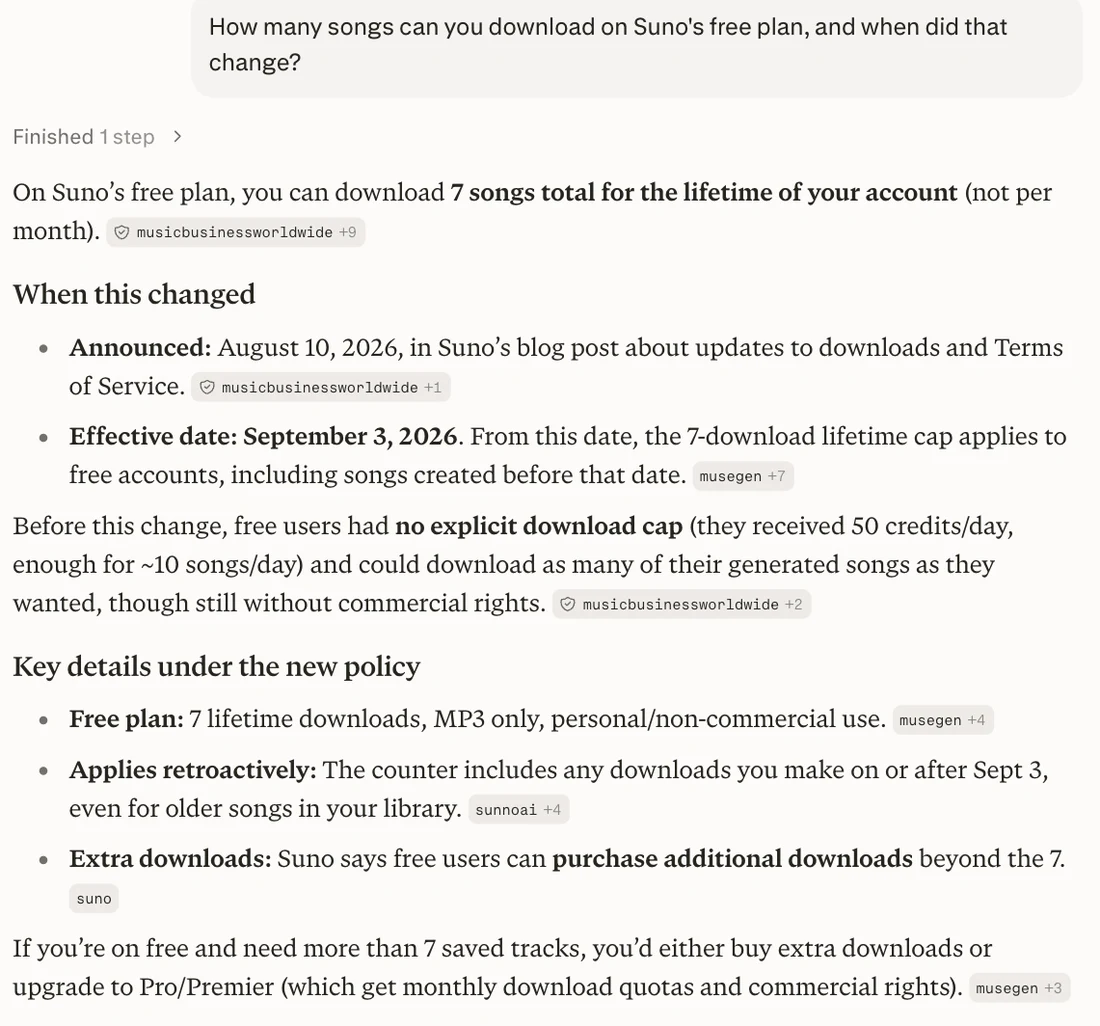
Seven for the lifetime of the account, explicitly “not per month”. Announced 10 August, effective 3 September. Retroactive to songs made before that date. MP3 only, personal and non-commercial. Extra downloads purchasable. Every one of those points matches what we had independently verified.
The attribution is worth a closer look, because a wall of source chips is the kind of thing that signals rigour without being it. Look at where the chips actually point and it is mostly not at Suno. The seven-downloads headline, both dates and the retroactivity all carry third-party music-industry outlets; the only chip reading suno sits on the least load-bearing line, about buying extra downloads. We did not open each one and check it against the sentence it is attached to, so we are not claiming a fidelity audit. What we can say is that the claims we could check were right, even though the trail runs through the trade press rather than the vendor.
ChatGPT did not.
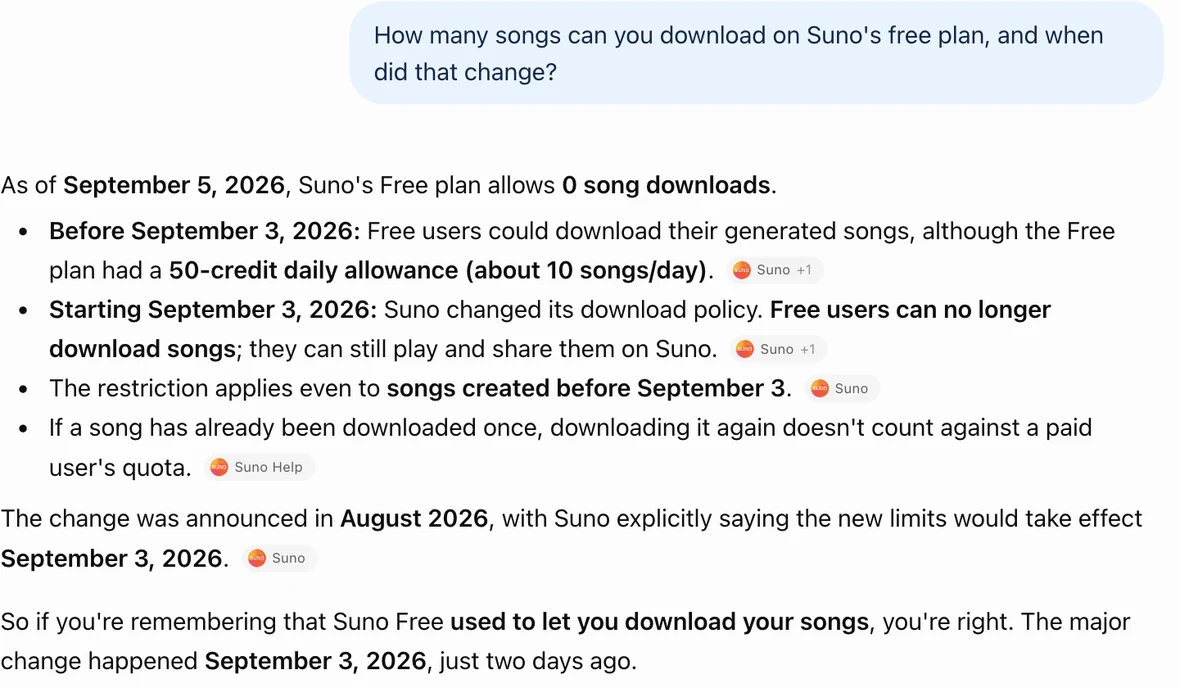
“As of September 5, 2026, Suno’s Free plan allows 0 song downloads.” And below it, “Free users can no longer download songs”.
The interesting part is not that it was wrong. It is how it was wrong. It cited Suno’s own pages. It correctly identified the change date as 3 September and even noted the change had happened “just two days ago”. The retrieval worked; the reading of the retrieved source failed, in the way the plan card invites, and it is the same trap we walked into two days earlier, though we at least noticed we were in it.
One question is not a benchmark. We ran this once, on one afternoon, on two free accounts. It does not establish that Perplexity is more accurate in general, and we are not going to claim that it does. What it establishes is that on a checkable question about a two-day-old fact, one of these tools gave the right number with its sources attached and the other gave a confident wrong one — which is the failure mode you should be pricing in when you choose between them.
The comparison, axis by axis
| Axis | Perplexity | ChatGPT | Winner |
|---|---|---|---|
| Fact-retrieval test, 5 Sep 2026 | Correct, sourced per claim | Wrong: “0 song downloads” | Perplexity |
| Citations by default | Inline, on the answers we saw | Present when it searches | Perplexity |
| Free-tier model choice | None — all ten padlocked | Core model, rate-limited | ChatGPT |
| Deep research on free | Yes, limited | Yes, limited | Tie |
| Breadth of tasks | Search and research | Writing, code, images, agents | ChatGPT |
| Runs its own frontier model | Sonar, plus routing to others’ | Yes, its own stack | ChatGPT |
| Entry price, month to month | $20 | $20 | Tie |
| Entry price, committed annually | $204 a year | $240 a year | Perplexity |
| Cheapest paid rung | Pro, $17–$20 a month | Go at $8 a month, but it carries ads | ChatGPT |
| Pricing transparency | Two pages, two headline rates | Monthly shown, no annual for Plus | Neither |
| Publisher litigation | Around six tracked | Around a dozen against OpenAI | Perplexity |
Four axes to ChatGPT, four to Perplexity, two ties and one where neither comes out well — and the Perplexity wins are the ones that decide the choice for a particular kind of user. That is the shape of this comparison, and it is why a scorecard is the wrong way to read it.
Count the rows and it is level. Weight them by what you are actually going to do on a Tuesday and it stops being level. If most of your questions have a right answer someone could check, Perplexity’s four rows decide it. If they do not, ChatGPT’s four are the whole story. No table resolves that for you, which is why the two sections below are organised by who you are rather than by what the tools do.
Perplexity: what it does well, and where it stops
We rate it 4.4 out of 5, a Power Tool, and the case for it is narrow and real.
- Citations are the product, not a feature. Answers arrive with sources attached, which is why our test was checkable at all. You can disagree with an answer and go read what it was drawn from.
- It got the hard fact right. On a two-day-old policy change with a misleading plan card, it produced the correct number and the correct dates.
- Committed annually, it is the cheaper of the two. $204 a year against ChatGPT’s $240.
- The free tier does the core job. Search with citations, sessions, Computer, Artifacts, Projects. If retrieval is what you want, you can have it for nothing.
Where it stops:
- The free tier gives you no model choice at all. We captured the picker on a free account: ten models, every one padlocked. You get what you are routed to. Deep research is there, but only as a limited allowance.
- It does not run the frontier models it sells access to. Perplexity has its own Sonar model, but paid tiers advertise selection between other companies’ frontier systems — including those of the company that makes ChatGPT. You are buying retrieval and interface around models it licenses.
- A third pricing axis. Computer bills in credits that sit alongside the plan rather than inside it, so the subscription is a floor rather than the cost.
- Around six publisher lawsuits. See below; none of the five comparisons we read mentions them, though OpenAI faces around a dozen, roughly twice Perplexity’s six.
The shape to hold in your head is that Perplexity gives away its core competence and charges for depth. Search with citations — the thing that won our test — is free. Model choice, fuller deep research and heavy agent use are the paid product. That is an unusual way round, and it is generous to anyone whose need is genuinely just “answer this, and show me where it came from”.
ChatGPT: what it does well, and where it stops

We rate it 4.6, a Category Leader, and it keeps that rating despite losing this test, because fact retrieval is a slice of what people actually use an assistant for.
- The free tier is unusually complete. Unlimited text chats on the core model, with uploads, image creation, voice, deep research, memory and Codex all present in limited form. You are rate-limited rather than locked out — the opposite of Perplexity’s approach.
- Breadth nothing here matches. Writing, code, images, agents, custom GPTs. Perplexity does not attempt most of it.
- It runs its own models. Whatever else that means, it is not dependent on a competitor’s roadmap.
- $20 buys a step change, not a bigger allowance: advanced models, agents, expanded memory and projects.
Where it stops:
- It was confidently wrong on the day we tested, on a checkable question, while citing Suno’s own pages. Confidence without accuracy is the specific risk of a tool that does not lead with provenance.
- The $8 tier can carry advertising, and so can Free. OpenAI’s help centre states that “ads may appear for users on the Free and Go plans”, in regions where it is testing them, while “Plus, Pro, Business, Enterprise, and Edu accounts will not have ads”. Normally money removes ads; here the cheapest paid rung still has them, which makes Go a conversion step rather than a value tier. Skip it. Free users who would rather not see ads can switch to an ads-free mode at reduced limits.
- No annual rate for Plus. You pay $240 a year whether you commit or not.
- Citations are conditional. They appear when it searches. Perplexity attaches them by default.
The shape here is the mirror image. ChatGPT gives away a sample of everything and charges for the version that works without hitting a wall. You can evaluate the whole product for nothing and discover which limit annoys you first, which is a better trial than Perplexity offers — you cannot sample model selection on Perplexity’s free tier at all, and you get deep research only as a limited allowance. Those two are precisely what the $17 buys.
Which is actually cheaper?
Not one of the five comparisons we read mentions annual billing at all; each puts these two at $20 and moves on. That is wrong, and the reason is that the companies quote in different units.
Perplexity’s plans page shows Pro at “$17 /month or equivalent, when billed annually” and Max the same way at $167. No monthly figure appears next to either. The monthly rates, $20 and $200, are published on a separate pricing hub, which we broke down in our Perplexity pricing guide.
ChatGPT’s pricing page shows Plus at $20 a month and publishes no annual rate for it at all.
So the headline numbers are not comparable:
| Perplexity Pro | ChatGPT Plus | |
|---|---|---|
| Month to month | $20 | $20 |
| Committed for a year | $17/mo, $204/yr | $20/mo, $240/yr |
| Saving for committing | $36 | none offered |
| Top consumer tier | Max, $167/mo annual or $200 monthly | Pro, from $100 or $200 |
| Cheapest paid rung | Pro | Go, $8 — carries ads |
Month to month they are identical. Prepay a year and Perplexity is $36 cheaper. Perplexity never publishes an annual total on either page: $204 and $2,004 are our arithmetic on its own monthly-equivalent figures, not numbers it quotes. That is not a large sum, and it is not the largest gap on the board either — the $8 Go rung sits further below Perplexity’s cheapest paid tier than $36 a year does. It is, though, the only difference that shows up when you compare the two flagship tiers against each other, which is what most people do, and not one of the five comparisons we read shows an annual figure at all.
Two more rungs matter if you are budgeting rather than just comparing headline tiers.
Perplexity has a third axis. Its agentic surface, Computer, bills in credits that sit alongside the plan rather than inside it. Pro includes a block of bonus credits and Max a larger one, but heavy use is metered separately. So the subscription is a floor, and the invoice is the floor plus whatever the agent consumed. Neither ChatGPT tier works that way at the consumer level.
ChatGPT’s top tier is two products. Pro is quoted from $100 a month at 5× usage or $200 at 20×, which is a different shape from Perplexity’s single Max rung at $167 annually or $200 monthly. If you are comparing the expensive end, compare the multiplier, not the number.
And at the cheap end, the Go tier is the one to be careful of. Its $8 is the US price and OpenAI localises it — the same rung renders in local currency elsewhere, so check your own. It is the cheapest paid rung on either side that carries advertising — OpenAI’s help centre puts ads on “the Free and Go plans” and rules them out on Plus and above. It reads like the budget option and functions as a conversion step; the $12 to Plus buys the advanced models, the agents, custom GPTs and no ads.
There is a second point hiding in that table. Neither company shows you both numbers in one place. Perplexity advertises its annual rate as though it were the price; OpenAI advertises its monthly rate and offers no annual alternative on Plus. Whichever you are comparing, check which unit you are looking at before you write it down.
Is Perplexity independent, and who is suing it?
Google surfaces two related questions on this comparison that no editorial page answers: “Why is Perplexity failing?” and “Who owns Perplexity AI?” We cannot answer the first — it presumes something we have not established. The second is worth addressing, because the honest answer is about dependency rather than ownership.
We are not going to tell you who owns Perplexity, because we could not establish it from a primary source and this is not a question to guess at. What the company does document is the dependency, and that is the part that bears on a subscription. Its paid product advertises selection between frontier models built by other companies, including the one that makes ChatGPT. Its own model, Sonar, sits alongside them. That means a meaningful part of what you would be paying Perplexity for is access to systems it licenses from firms it competes with — which is a strategic position worth understanding, whatever you think of the product.
The litigation is the sharper issue, and it is absent from all five of the comparisons we read. Press Gazette’s running tracker says “around six cases have now been brought against Perplexity”, taken from a tracker rather than from court filings. The consistent thread in the allegations is that Perplexity reproduced or summarised publisher content beyond what citation permits.
One thing to be careful about, because it cuts against the obvious reading: OpenAI is sued more, not less. The same tracker records “around a dozen claims, led by The New York Times” against OpenAI since the end of 2023, roughly double Perplexity’s count. What makes Perplexity’s exposure notable is its size relative to that docket, not the raw number.
We are not going to characterise the merits, and none of this is legal advice.
| For a buyer, the question is | The honest answer |
|---|---|
| Is this peripheral to the product? | No — retrieval and restatement is the product |
| Have we read the filings? | No, we took them from a running tracker |
| Are we judging the merits? | No, and this is not legal advice |
| Does it change the recommendation? | Not on its own; it belongs in the decision |
What is relevant to a purchase is that the risk is structural: Perplexity’s product is retrieving and restating other people’s published work, so litigation about that practice bears on the thing you would be subscribing to, in a way that a lawsuit about some peripheral feature would not.
That is a reason to know, not necessarily a reason to avoid. But it should not be missing from a comparison of where to spend $204 or $240 a year, and on the five pages we checked, it is.
Worth adding that every comparison we read frames this positively, as multi-model access: pay once, reach several frontier models. That is true and genuinely useful. Read from the other direction it is also a description of a company whose premium product resells access to systems built by firms it competes with, one of which is the subject of this comparison.
Nothing about that makes the product worse now. Plenty of durable businesses are built on somebody else’s infrastructure. But it does mean Perplexity’s costs, its capabilities and some of its roadmap are set elsewhere, and a buyer signing up for a year is entitled to know that the thing differentiating the paid tier is not something the vendor makes.
What does each free tier actually give you?
This is where the two products differ most, and where the comparison tables are least useful.
Perplexity gives you a narrow product almost in full. Search with citations — the thing it is best at, the thing that won our test — works on the free tier. What it withholds is choice and depth: when we captured the model picker on a free account, all ten models carried a padlock, and deep research comes as a limited allowance.
ChatGPT gives you a broad product in part. Unlimited text chats on the core model, plus limited uploads, image creation, voice, deep research, memory and Codex. Almost everything is present; almost everything runs out.
| On the free tier | Perplexity | ChatGPT |
|---|---|---|
| Search with citations | full | when it searches |
| Model choice | none, all ten locked | not offered, core model |
| Deep research | present, limited | present, limited |
| Uploads, images, voice | limited | present, limited |
| Memory across sessions | Sessions history | present, limited |
| Code surface | not offered | Codex, limited |
| Advertising | none | may appear, where OpenAI tests it |
| Better as a free product | yes | no |
| Better as a paid trial | no | yes |
The practical consequence is about evaluation. On Perplexity’s free tier you can fully assess whether you like its answers, but not whether model selection or fuller deep research is worth $17 a month billed annually, which are the two things you would actually be buying. On ChatGPT’s free tier you can sample everything and judge whether the limits are what bother you, which is a more useful trial for a purchase decision.
There is a neat irony in that. Perplexity’s free tier is more useful as a product and less useful as a trial; ChatGPT’s is the reverse. If you never intend to pay, Perplexity gives you more. If you are trying to decide whether to pay, ChatGPT tells you more.
It also explains the recommendation most people arrive at independently, which is to run both. The free tiers are complementary rather than overlapping: one is a research tool you can rely on indefinitely, the other is a sampler of a broad assistant. Nothing stops you keeping both open, and for a lot of people that combination is the correct answer to the question this article asks.
Two competitors we checked name a version number for ChatGPT’s free model, and they disagree with each other. We did not verify one ourselves, so we are not repeating either.
Which one gets facts right, and why?
One test proves little on its own. What makes the result worth reporting is that the two tools failed and succeeded in ways that follow from how each is built.
Perplexity is a retrieval product with a model attached. The answer is assembled from sources it fetched, and the citation is not a courtesy — it is the artefact of the process. When it is right, you can see why. When it is wrong, you can see that too, because the source is one click away and you can read it yourself.
ChatGPT is a reasoning product that can search. Retrieval is a capability it invokes, not the substrate it is made of. Today it invoked it, cited Suno’s own pages, dated the change correctly to 3 September, and then produced a summary that contradicted them.
That is the failure worth understanding, because it is not a retrieval failure. Both tools cited Suno’s own material. The difference is what happened next. Suno’s plan card says “No monthly song downloads”, which is literally true and reads like zero. The seven-download allowance lives in a separate announcement. Getting the answer right requires noticing that two documents describe different things — and Perplexity, whose whole job is reconciling sources, noticed. ChatGPT, whose job is producing a fluent answer, produced one.
We know how easy that mistake is because we half-made it. Our Suno review as first published on 3 September, since corrected, and the Suno pricing breakdown that now carries the download maths, printed the plan card’s figure while reporting in the same piece that our own free-account MP3 export had just worked. We said we could not tell you why, and offered two readings: an allowance we had not yet spent, or a rollout trailing the pricing copy. The first was the closer one, though we called it a monthly allowance and it is actually seven for the lifetime of the account. We had simply not found the announcement yet.
On 4 September we did, and corrected three posts. The difference from ChatGPT’s answer is not that we were right and it was wrong — we were also partly wrong. It is that ours carried the contradiction on its face, and a reader could see the two facts failing to reconcile. ChatGPT’s answer offered nothing to catch.
| The question | Ground truth | Perplexity | ChatGPT |
|---|---|---|---|
| How many free downloads? | 7, lifetime, for accounts opened before 3 Sep | 7, “not per month” | 0 |
| When announced? | 10 August 2026 | 10 August 2026 | “August 2026” |
| When effective? | 3 September 2026 | 3 September 2026 | 3 September 2026 |
| Retroactive? | Yes | Yes | Yes |
| Commercial use? | No, personal only | No, personal only | not addressed |
| Sources cited | n/a | a chip on every claim, several sources behind each | Suno’s own pages |
What this test does not show is set out in full further down, under what we did not test. The short version: one question, once, on two free accounts.
What it points at is a difference in failure mode. One run cannot establish one, but it follows from how each tool is built, and failure modes are what you should price. Perplexity’s answers arrive with their evidence attached, so a wrong one is falsifiable in seconds. ChatGPT’s arrive as prose, so a wrong one has to be suspected before it can be checked. If your work punishes being confidently wrong more than it punishes being slow, that asymmetry matters more than any feature in the table above.
What is it actually like to work in each?
Feature lists undersell this, because the two products organise your work differently. Perplexity is built by Perplexity AI; ChatGPT is built by OpenAI. The sidebar details below come from our two reviews rather than from the day of the test, and the dates are marked where they matter. Treat the ChatGPT rows as what the interface offers rather than as what a free account can open: OpenAI lists Projects and scheduled tasks under Plus, so some of these surfaces are visible on free without being usable on it.
Perplexity organises around questions. The sidebar carries Computer, Artifacts, Customize, Projects and a list of Sessions — your past queries, kept as a searchable history. Outside the sidebar, the composer offers a Search mode and a Computer mode, plus a model selector a free account cannot open. The unit of work is a question that leads to more questions, and the follow-up prompts under each answer are the product nudging you down that path.
ChatGPT organises around work. Its sidebar carries New chat, Images, Library, Scheduled, Plugins, Projects, Codex and more beneath. That is a different proposition: a place where things you are making live, with a media library, scheduled runs and a code surface, rather than a record of what you asked.
| Free tier, from our reviews | Perplexity | ChatGPT |
|---|---|---|
| Organised around | Sessions — a history of questions | Projects, Library — things you are making |
| Media surface | Artifacts | Images, Library |
| Code surface | not offered | Codex |
| Scheduling | not offered | Scheduled tasks, listed by OpenAI under Plus |
| Agentic surface | Computer, billed in credits | Plugins; the work agent is Plus-only |
| Personalisation | Customize | Memory across chats |
| Model picker | In the composer, all ten locked (captured 23 Aug) | Not offered; core model, rate-limited |
The practical difference shows up when a task lasts longer than one answer. In Perplexity you continue by asking again, and the session accumulates. In ChatGPT you continue inside a project, with memory carried across chats and artefacts you can return to. Neither is better in the abstract; they suit different shapes of task.
Speed is not the differentiator either way. Neither made us wait long enough for it to matter, but we did not time either one, and we are not going to invent a stopwatch figure to fill a row.
What we did not test
Worth stating, because the test above is small and the rest of this piece is drawn from two separate reviews rather than a single controlled run.
We ran one question. Not a set, not a category, not a repeat. A second question could have gone the other way, and we have no basis for saying how often either tool is wrong.
We tested only the free tiers. Neither Perplexity Pro nor ChatGPT Plus was exercised for this piece, so nothing here tells you whether paying changes the accuracy picture. It plausibly does: model selection and fuller deep research are exactly what Perplexity holds back from free accounts.
Update, 18 October 2026: this comparison first listed Perplexity’s deep research as Pro-only. Perplexity’s help page on Research mode, last modified on 28 August 2026, says “Free users get limited access to Research”, so the scorecard row is now a tie. We have not run deep research on either product.
We did not time anything. Both answered fast enough that a stopwatch would have been theatre, and the one other write-up we found that publishes a timing at all was measuring a completely different task.
We did not evaluate writing, code, images or agents — most of what an assistant gets used for, and the ground on which ChatGPT’s higher rating rests.
The lawsuit count comes from a running tracker, not from court records, and we have not read the filings.
Everything else in this piece traces to our own Perplexity review and ChatGPT review, both hands-on, or to the vendors’ own pricing pages.
Who should pick Perplexity?
- Anyone whose work is checkable. Journalists, analysts, researchers, students — people who need to see where an answer came from and follow it back. Today’s test is the whole argument.
- People asking about things that changed recently. A two-day-old policy is exactly where a retrieval-first tool earns its keep.
- Anyone paying annually who wants the cheaper of the two. $204 against $240.
- Anyone who wants a good free research tool and nothing else. The free tier is the product, minus the choices.
Not for you if you want one subscription to write, code, generate images and run agents. Perplexity does not attempt most of that.
Who should pick ChatGPT?
- Anyone buying one assistant. It is broader by a distance, and the $20 buys a step change rather than a bigger allowance.
- People who make things rather than look things up: drafts, code, images, agents.
- Anyone evaluating before paying. Its free tier samples the whole product; Perplexity’s samples one part of it.
- Anyone who wants the vendor to own its own stack, rather than routing to competitors’ models.
Not for you if the thing you need is a defensible citation on every answer. It will give you one when it searches, and on 5 September it gave us a wrong answer with sources attached.
Skip the $8 Go tier whichever way you go. It carries advertising, and the $12 to Plus buys the models, the agents and not being advertised to.
Final word
If you can only pay for one, pay for ChatGPT and keep Perplexity’s free tier open in another tab. That is not a hedge; it follows from how the two free tiers are built. Perplexity gives away the thing it is best at, so you lose little by not paying. ChatGPT withholds the things that make it a working tool, so the $20 is where it changes character.
| Your situation | Spend the $20 on | Keep free |
|---|---|---|
| One assistant for everything | ChatGPT Plus | Perplexity |
| Work that must be traceable | Perplexity Pro, $204 a year | ChatGPT |
| Not sure yet | neither, for a month | both |
| Tempted by the $8 tier | not that one, it carries ads | n/a |
If your work lives or dies on whether a claim is true and traceable, invert that. Pay Perplexity $204 a year, use ChatGPT free for drafting. Today’s test points that way; it is not the whole argument on its own: on a question with a right answer, one of these tools produced it with a source on every claim and the other produced a confident zero.
And whatever you decide, do not take the $20-versus-$20 line at face value. One of those numbers is annual and the other is monthly, and the companies would rather you did not notice.
One last thing, offered as a habit rather than a verdict. The test in this piece is quick to copy: pick a fact you already know, ask both, check the answers against the source. It cost nothing, it used only free accounts, and it told us more about how these two tools fail than any feature table we read while researching this. Whichever you are weighing up, and whenever you read this, run your own version on something you can verify. The products change faster than the articles about them do — this one included.
Frequently asked questions
Is Perplexity better than ChatGPT?
For questions with a checkable answer, on the one test we ran on 5 September 2026, yes. For everything else, no.
We asked both free tiers the same question on 5 September 2026, about a product policy that had changed two days earlier. Perplexity answered correctly, with the specific number, and attached a source to every claim. ChatGPT answered confidently and got it wrong, and it cited the vendor's own pages while doing so.
That is one question on one afternoon and we are not calling it a benchmark. But it points at the real split: Perplexity is built to retrieve and attribute, ChatGPT is built to reason and produce. We rate ChatGPT 4.6 and Perplexity 4.4, and the higher score goes to the one that lost this particular test, because most of what people do with an assistant is not fact retrieval.
Which is cheaper, Perplexity or ChatGPT?
Month to month they are identical at $20. Committed for a year, Perplexity is $36 cheaper — and not one of the five comparisons we read gets this right.
The reason is that the two companies quote in different units. Perplexity's plans page shows Pro at "$17 /month or equivalent, when billed annually" and never displays a monthly figure next to it; the $20 monthly rate lives on a separate pricing hub. ChatGPT quotes Plus at $20 a month and publishes no annual rate for it at all.
So a table listing "$20 vs $20" is comparing Perplexity's annual rate to ChatGPT's monthly one. Over a year the real figures are $204 against $240 if you prepay Perplexity, and $240 against $240 if you do not.
Does Perplexity use ChatGPT's models?
It routes to them, among others, and that is a dependency worth understanding before you subscribe.
Perplexity runs its own Sonar model, but its paid tiers advertise selection between frontier models from other companies — the same OpenAI, Anthropic and Google systems you could reach directly. What you are buying is the retrieval, the citation layer and the interface around those models, not a frontier model of Perplexity's own.
That is not a criticism by itself; plenty of good products are built this way. It matters because it puts Perplexity's cost base and its roadmap partly in the hands of companies it competes with, one of which is ChatGPT's owner. On the free tier the question is academic: Perplexity's model picker is entirely locked, so you get what you are given.
What models does each free tier give you?
ChatGPT's free tier gives you its core model with limits. Perplexity's free tier gives you no choice at all.
When we captured Perplexity's model picker on a free account, all ten models in the list carried a padlock. Model selection is a Pro feature, so a free user gets whatever Perplexity routes them to, with no way to see or change it. Deep research is available, but only as a limited allowance.
ChatGPT free is more generous in structure: unlimited text chats on the core model, with uploads, image creation, voice, deep research, memory and Codex access all present but limited. You are rate-limited rather than locked out. That difference matters more than any feature table, because it decides what you can actually evaluate before paying.
Has Perplexity been sued by publishers?
Yes, repeatedly, and none of the five comparisons we read mentions it.
Press Gazette's running tracker puts it at around six copyright suits from publishers against the company, and the pattern of the allegations is consistent: that it reproduced or summarised publisher content in ways the publishers say exceed what citation permits. We reported those from a running tracker rather than from court documents, and we are not going to characterise their merits.
What matters for a buying decision is that the risk is structural rather than incidental. Perplexity's product is built on retrieving and restating other people's published work, so litigation about that practice bears directly on the thing you would be paying for. Google's own related questions for this comparison include "Why is Perplexity failing?" and "Who owns Perplexity AI?", which suggests readers are already asking.
Should I use both Perplexity and ChatGPT?
If you can only justify one subscription, buy ChatGPT and use Perplexity's free tier alongside it.
That is not a fence-sit, it is what the price structure implies. Perplexity's free tier does the thing Perplexity is best at — search with citations — locks away model choice, and keeps deep research to a limited allowance. ChatGPT's free tier does a limited version of everything, and the $20 unlocks the models and agents that make it a working tool.
So the free tiers are not equivalent. Perplexity gives away a narrow product in full-ish; ChatGPT gives away a broad product in part. Paying for ChatGPT and running Perplexity free covers more ground than the reverse, which is why we would spend the first $20 there.
Keep reading
Perplexity vs Google: same right answers, different sources
Perplexity vs Google, tested side by side on five everyday searches: both got every answer right, so the difference is whose sources you can check.
Perplexity vs Gemini: one cites better, one gives more away
Perplexity vs Gemini, tested on both free tiers with the same questions: who found October's news, who got the prices right, and which free plan does more.
Perplexity pricing: $20 a month, or $17, on the same site
Perplexity pricing is $0, $20 or $200 a month. Its own plan pages show two different headline numbers, and the Enterprise tab quietly switches billing basis.
Perplexity AI review: the free tier is a showroom
A Perplexity AI review from the free tier: ten models in the picker and every one padlocked, $17 a month to unlock them, and six publishers now suing.