
Perplexity vs Gemini: one cites better, one gives more away
Perplexity vs Gemini, tested on both free tiers with the same questions: who found October's news, who got the prices right, and which free plan does more.
Contents
Perplexity or Gemini?
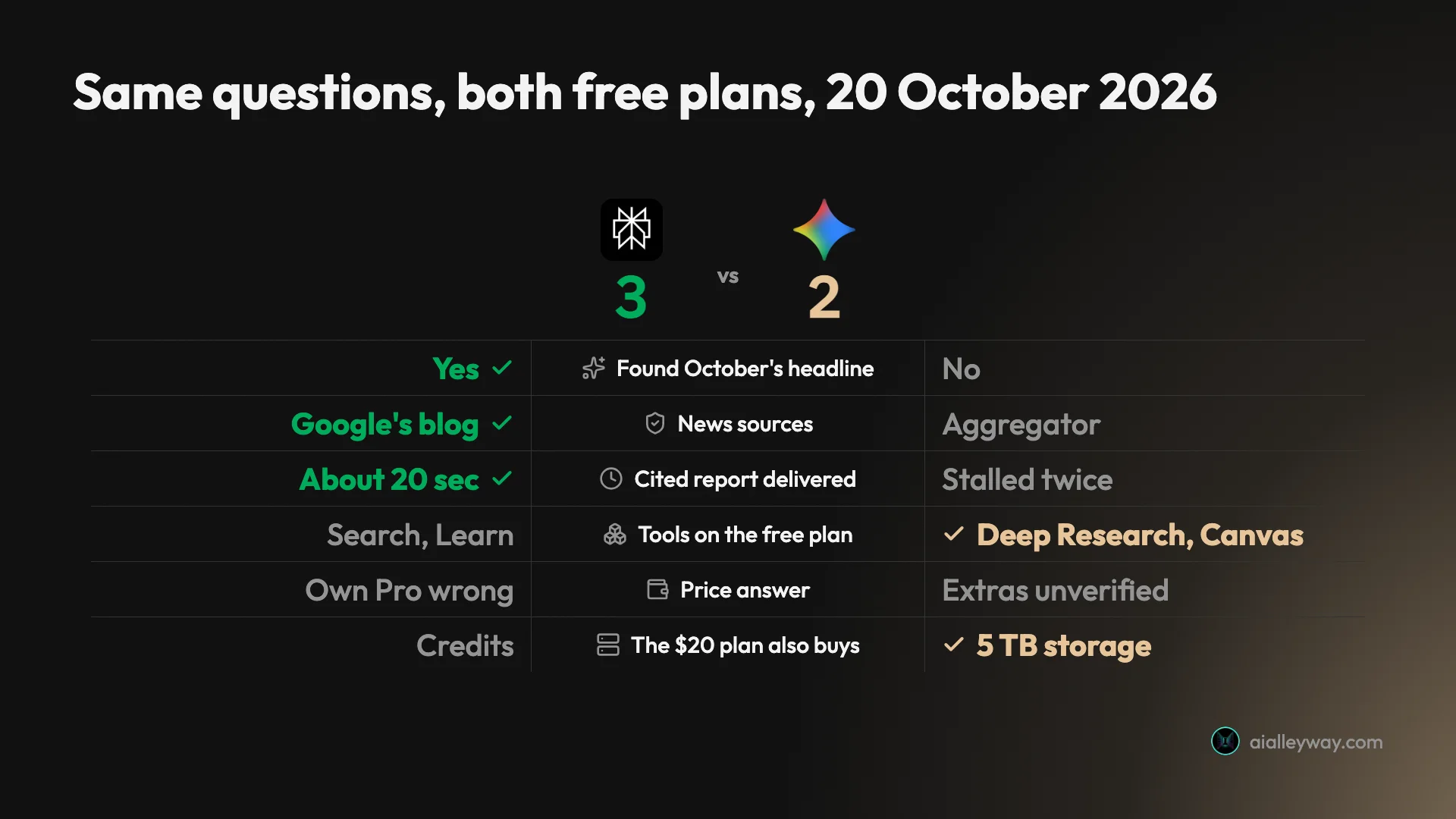
Perplexity is the better search tool and Gemini is the better free assistant. In the same four questions on 20 October 2026, Perplexity found the month’s biggest Google news, cited Google’s own blog for it and wrote a sourced heat pump report in seconds. Gemini missed that news. Its free plan does offer Deep Research, which showed a padlock on my free Perplexity account, but neither of my two Gemini runs finished a report.
| If you want | Pick | Why, from my tests |
|---|---|---|
| Current facts with sources you can check | Perplexity | Found Gemini 4 Argon and cited blog.google; Gemini cited an aggregator |
| The most tools for $0 | Gemini | Deep Research, Canvas, image and music creation on the free plan |
| One subscription for storage plus AI | Gemini (Google AI Pro) | 5 TB, YouTube Premium Lite and Gemini in Gmail for $19.99 |
| A paid plan that is only about research | Perplexity Pro | Model choice, Deep research and Computer for $20 |
Neither got everything right. Both made mistakes on a pricing question, and one of Perplexity’s was about its own Pro plan.
The test: same four questions, same morning
Most Perplexity vs Gemini comparisons describe the two products from their feature pages. I put the same questions to both on one morning instead, so the differences below come from answers rather than brochures.
Both ran on free accounts in Chrome on 20 October 2026. Gemini used the web app with the model picker on Auto; Perplexity used its default Search mode. Every question started a fresh conversation, and I checked each answer against the companies’ own pricing and announcement pages.
Each question tests something a search assistant has to get right. The news question checks freshness and whether the citation is the original announcement. The price question has answers I could check line by line, and it asks each tool about its rival as well as itself. The report question tests depth on a topic neither company owns, and the screenshot question tests reading an image without a label.
| Test | The question | Perplexity | Gemini |
|---|---|---|---|
| 1. News | What Google announced for Gemini and AI Mode in October 2026, with dates and sources | Led with Gemini 4 Argon; cited Google’s blog | Missed Argon; cited a news aggregator and Reddit |
| 2. Prices | Google AI Pro and Perplexity Pro, monthly and annual, and what each adds | Right on Google’s $19.99 and 5 TB; wrong about its own Pro credits | Right on its own price; Perplexity details from blogs |
| 3. Report | A short cited report on heat pumps below -15°C | Free Search, about 20 seconds, ten sources | Free Deep Research read 44 sites; no report after 66 minutes, nor on a retry |
| 4. Image | What an upgrade pop-up wants, from a screenshot | Named the product, then hit an upload limit | Not run (see below) |
The image test only ran on Perplexity. Gemini’s web app opens the computer’s own file picker for uploads, which my test setup could not drive, so there is no image comparison in this post.
Perplexity vs Gemini at a glance
Here is how the two compare on the axes that decided my tests, plus the ones that decide a subscription.
| Perplexity | Gemini | |
|---|---|---|
| What it is | An answer engine that searches and cites | Google’s general assistant, with search inside |
| Free plan | Search with citations; Deep research padlocked on my account | Deep Research, Canvas, image and music creation |
| Model choice | Locked on free; ChatGPT, Gemini, Claude and NVIDIA models on Pro | Auto on free in my account; Gemini 4 Argon on Pro |
| Citations | A chip on most claims, plus a sources list | Chips and a sources list when it searches |
| News test | Found Gemini 4 Argon | Missed it |
| Research mode | Limited on free per its help page, padlocked on my account; extended on Pro | Deep Research on free |
| Paid entry price | Pro $20 a month | Google AI Pro $19.99 a month |
| What the money also buys | Computer access, 4,000 bonus credits | 5 TB storage, YouTube Premium Lite, Home Premium |
| Google apps | Connectors to other apps | Gmail, Docs and Drive on a paid plan |
| Upsell pressure | Banners on two of four answers | An Upgrade button at the top, no banners |
Perplexity: what it does well, and where it stops

Perplexity does one job, looking things up, and on my tests it did that job better.
What it does well
- It found the news. Asked about October 2026, it put Gemini 4 Argon first, dated its broad release to 13 October and cited Google’s blog, which matches Google’s own announcement.
- Its sources were primary. The heat pump answer drew on a national lab paper, energy.gov, Natural Resources Canada, a New York state programme and ASHRAE, among its ten sources.
- It is fast. Every answer was complete within about 20 seconds of my pressing Enter, labelled “Researched” with one to six seconds.
- It recognised its own product. From a screenshot with no logo, it identified Perplexity’s Computer upgrade pop-up and explained the plan rules correctly.
Where it stops
- The free plan rations research. On my account Deep research showed a padlock and Model council a Max badge; Perplexity’s help page says free users get limited access to Research.
- It upsells mid-answer. Two answers carried “This question looks difficult” with an Upgrade to Pro button, and one image upload ended in a file upload limit notice.
- It misdescribed its own Pro plan, giving Pro 10,000 Computer credits a month, an allowance its pricing page gives only to Max.
- It stays in its lane. There is no storage bundle and no reach into your own email or documents beyond connectors.
Gemini: what it does well, and where it stops
Gemini is a general assistant that happens to search, and its free plan is where it pulls ahead.
What it does well
- The free plan is wide. My free account’s + menu offered Upload files, Add from Drive, Create image, Create music, Canvas, Deep research and Guided learning.
- Deep Research is on the free plan. It drafted a plan, waited for Start research, and read 44 websites, from national labs and efficiency bodies to manufacturers, though it never delivered the report.
- It got its own price right, Google AI Pro at $19.99 a month, with Google’s pages as sources.
- The paid plan is a bundle. Google AI Pro adds 5 TB of storage, YouTube Premium Lite and Gemini inside Gmail and Docs, per Google’s US plans page.
Where it stops
- It missed the month’s headline. Both of its draft answers on October’s news left out Gemini 4 Argon, Google’s own biggest Gemini announcement.
- Its news sources were second-hand. Most chips pointed to a news aggregator, and one claim rested on a Reddit thread.
- It interrupted with a survey. The news answer arrived as two side-by-side drafts with “Which response is more helpful?”, leaving me to pick before carrying on.
- Deep Research stalled. Two runs of the same prompt sat on “Creating your report” and “Writing your report”, one still unfinished 66 minutes after it started, against a plan card that said “Ready in a few mins”.
- Its facts about Perplexity came from blogs, including a promise of “unlimited” Pro searches that Perplexity’s current plan card does not make.
Is Perplexity or Gemini cheaper?
At the entry level they cost the same, and the free plans are where the real difference sits. Here are the US prices from each company’s own pages; Google’s and Perplexity’s annual figures were checked on 20 October 2026.
| Plan | Perplexity | |
|---|---|---|
| Free | $0 | $0 |
| Cheapest paid | Pro (no cheaper paid plan) | Google AI Plus, $4.99 a month |
| Main paid tier | Pro, $17 a month billed annually; $20 month to month | Google AI Pro, $19.99 a month |
| Top tier | Max, $167 a month billed annually; $200 month to month | Google AI Ultra, $99.99 or $199.99 a month |
Perplexity’s pricing hub and Pro page both showed Pro at $17 a month “when billed annually” on 20 October, with no monthly figure. The $20 monthly rate is what the hub’s monthly view showed when our Perplexity pricing guide captured it in August; by our arithmetic a year at $17 is $204. Google’s US plans page shows Google AI Pro at $19.99 a month and gives no annual price, so I am not quoting one.
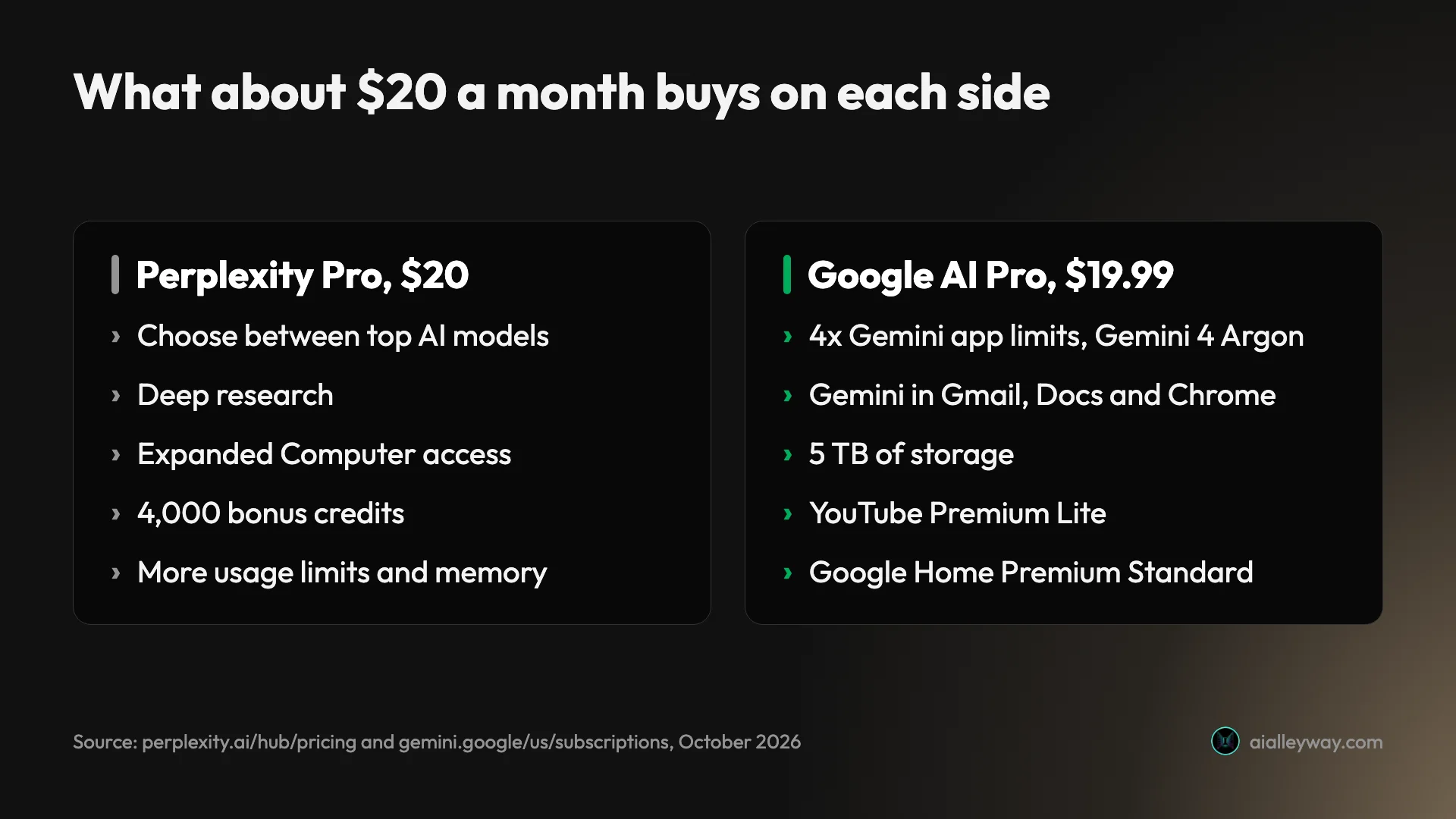
What the money buys is where they part. Perplexity Pro’s card lists expanded Computer access, 4,000 bonus credits, Deep research, access to top AI models and the ability to choose between them. Computer is Perplexity’s agent mode and it spends credits, so Pro is a floor rather than a ceiling if you use it heavily.
Google AI Pro is a storage plan with AI attached. Google’s page lists 4x higher Gemini app limits than free, access to Gemini 4 Argon, Gemini in Gmail and Docs, 5 TB of storage, YouTube Premium Lite and Google Home Premium. Our Google Gemini review makes the case that you are partly buying Drive space.
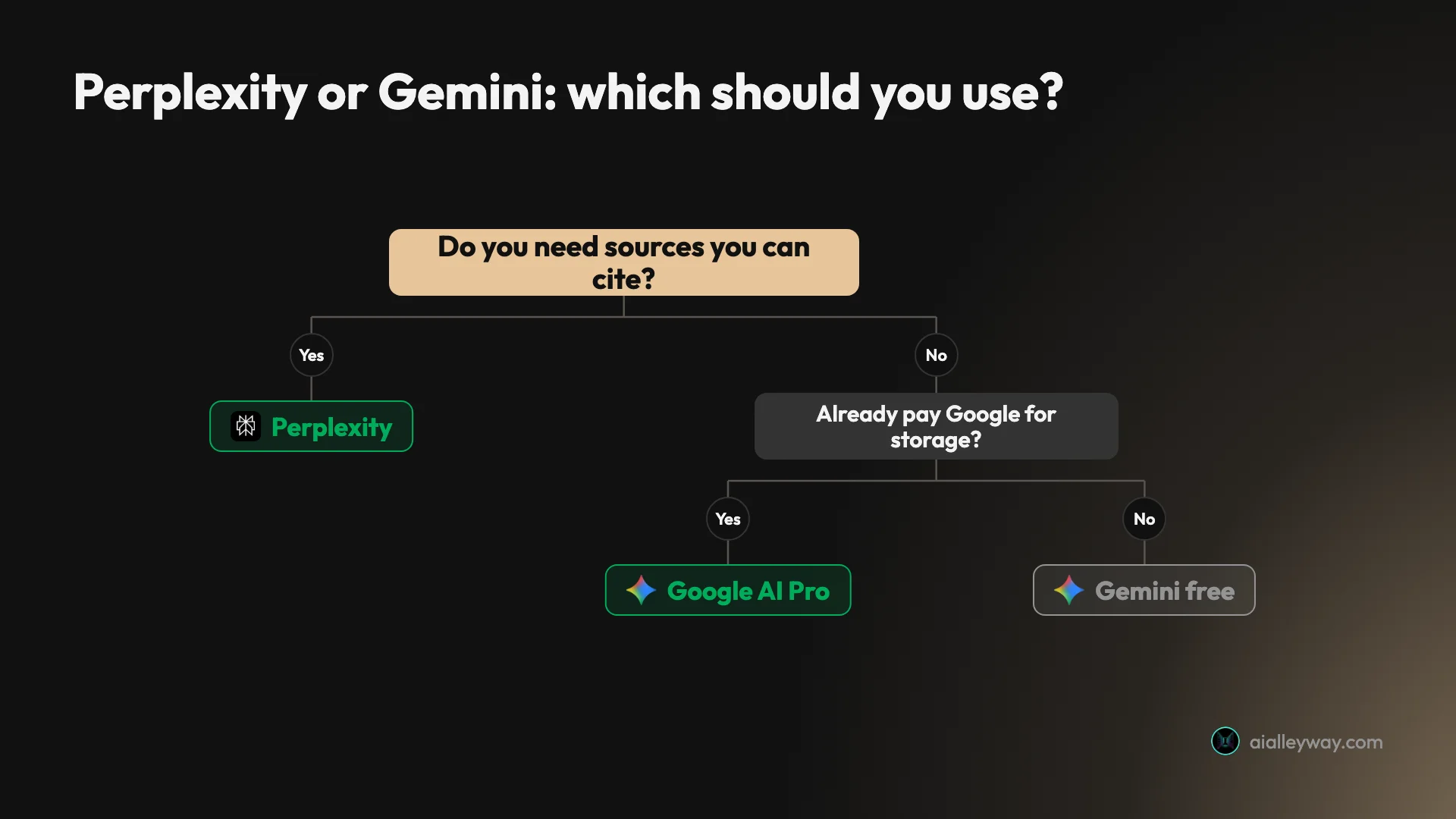
That changes the maths for a lot of households. If you already pay Google for storage, Google AI Pro adds the AI for little extra, and Perplexity Pro is a second subscription. If you pay for nothing today and want one research tool, Perplexity Pro spends all $20 on that job.
At the top, Google has the cheaper big plan. Google AI Ultra starts at $99.99 a month, while Perplexity Max is $200, or $167 billed annually, for maximum Computer use, 10,000 monthly credits and Max-only features.
What a year costs
Put the plans on a 12-month footing and the gap stays small at the entry level and grows at the top. These are our sums from each company’s monthly figures, with Perplexity’s month-to-month rates taken from our August capture.
| A year of | Paid monthly | Paid annually |
|---|---|---|
| Perplexity Pro | $240 | $204 (at $17 a month) |
| Google AI Pro | $239.88 | No annual price on Google’s US page |
| Perplexity Max | $2,400 | $2,004 (at $167 a month) |
| Google AI Ultra, lower tier | $1,199.88 | No annual price on Google’s US page |
Perplexity rewards commitment with $36 off Pro; Google’s US page offers no annual discount to compare. At the top end, a year of Google’s $99.99 Ultra tier costs about $800 less than a prepaid year of Perplexity Max, before you count the storage Google throws in.
What the free plans actually limit
Neither company puts a number on its free plan. Perplexity’s free card says “Good for limited daily usage” and “Access to basic AI models”; Google’s US page lists the free Gemini app with “Access to our Flash-Lite model”, and says Google AI Pro gets “4x higher usage limits than Free” without saying four times what.
So the limits show up as you work. On Perplexity they were visible: a padlocked Deep research, an upgrade banner on two answers, and a file upload limit after one image. On Gemini I hit no limit in four chats, though Deep Research never finished, which may or may not be a limit wearing a different coat.
Our Google Gemini review found four selectable models on a free account in August. On the day of these tests my picker simply read Auto, so check yours before you assume the Pro model is included.
Which one gets facts right?
This is where my tests separated them most, and the answer depends on what kind of fact you need.
October’s news: Perplexity found the headline
I asked both what Google announced for Gemini and AI Mode in October 2026, with dates and sources. Perplexity put Gemini 4 Argon first, listed its global release on 13 October across the API, the Gemini app and AI Mode for paying subscribers, and noted that Gemini 3.5 Flash stayed the default in AI Mode. Both details match Google’s announcements.
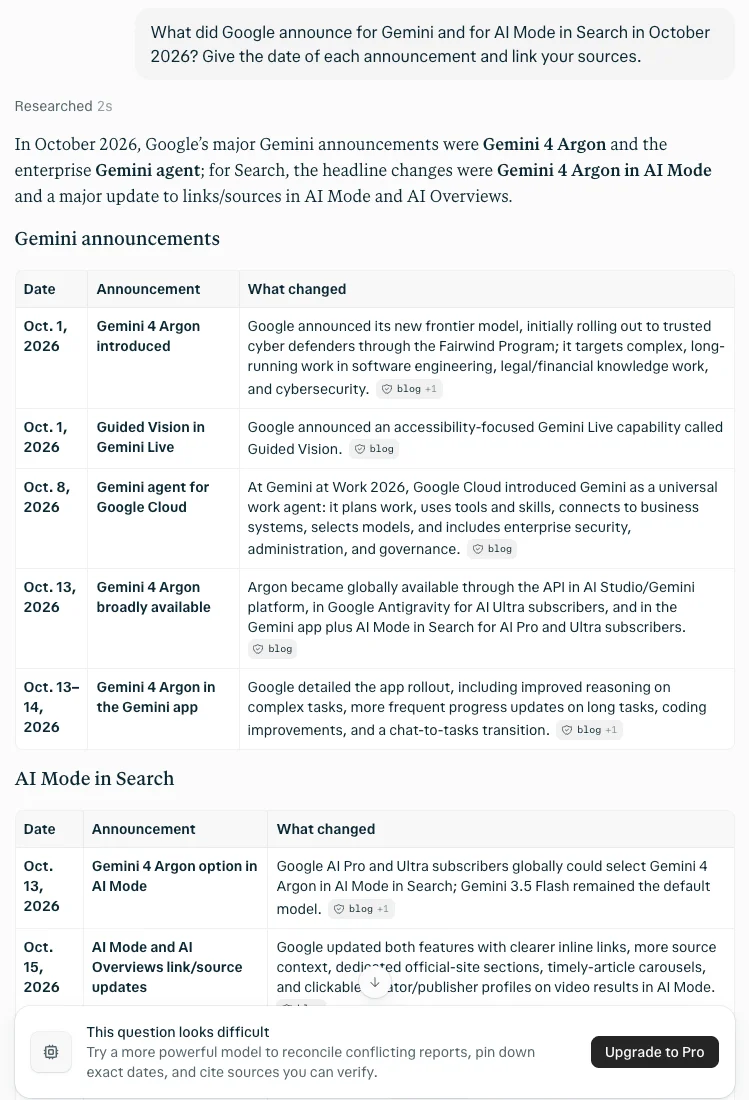
Its AI Mode item, the link changes of 15 October, matches Google’s post too. Its other items, a limited first release of Argon on 1 October, a Gemini Live accessibility feature, the Gemini agent for Google Cloud and a shopping cart launch, I did not check, so I count them as unchecked rather than right.
Gemini’s answer arrived as two drafts side by side. Both covered enterprise news, Gems becoming Skills, the Gemini agent and the 15 October link changes, and neither mentioned Gemini 4 Argon. For an assistant built by the company that made Argon, that is a striking miss.
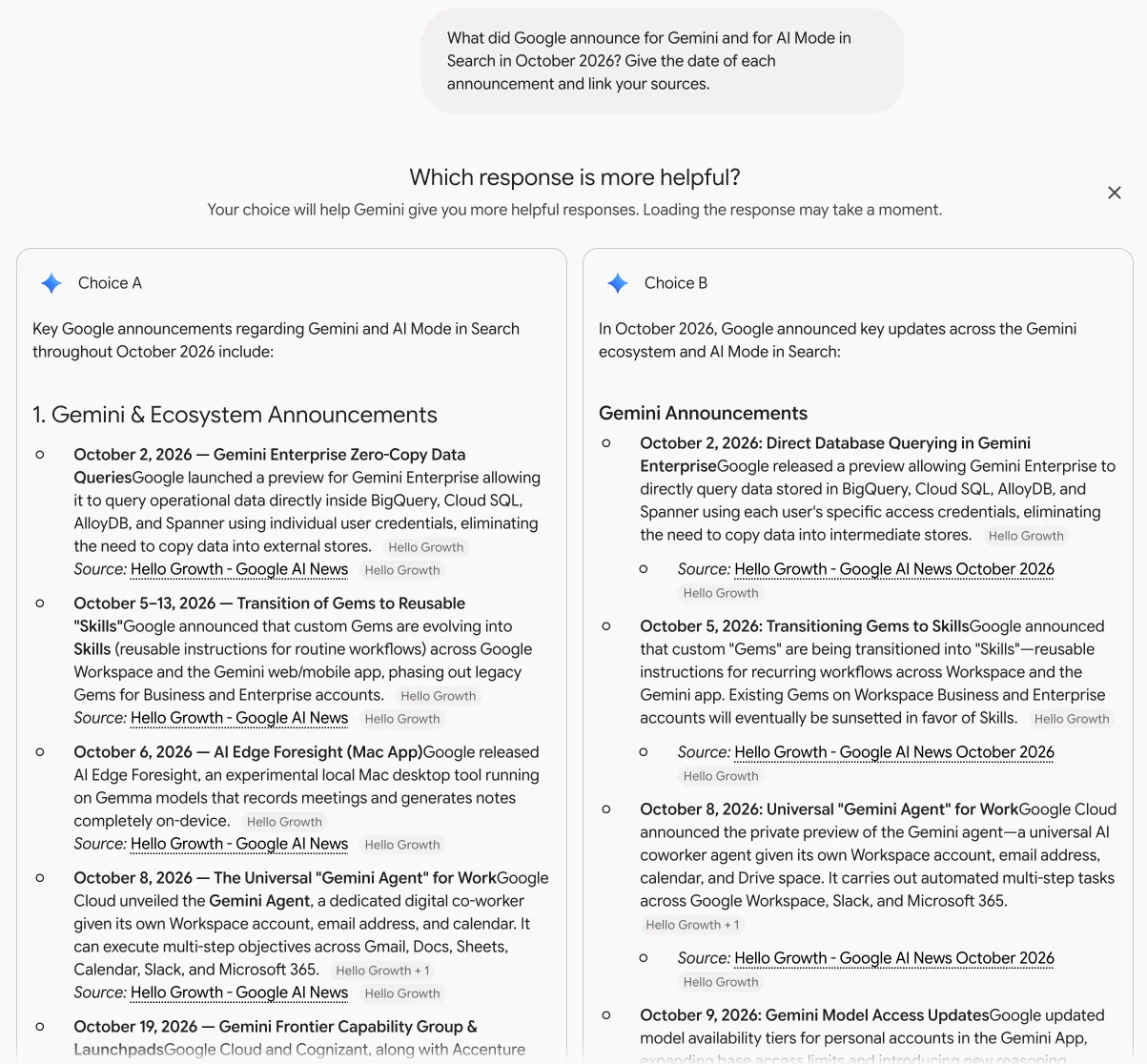
The sourcing explains some of it. Most of Gemini’s chips pointed to one aggregator of Google AI news, one claim rested on a Reddit thread, and neither draft linked Google’s own blog. Perplexity’s chips were mostly that blog.
Prices: both slipped, in different places
The pricing question was a better test of care than of search. Both got Google AI Pro’s $19.99 right and both said 5 TB of storage, which matches Google’s page. Then they drifted.
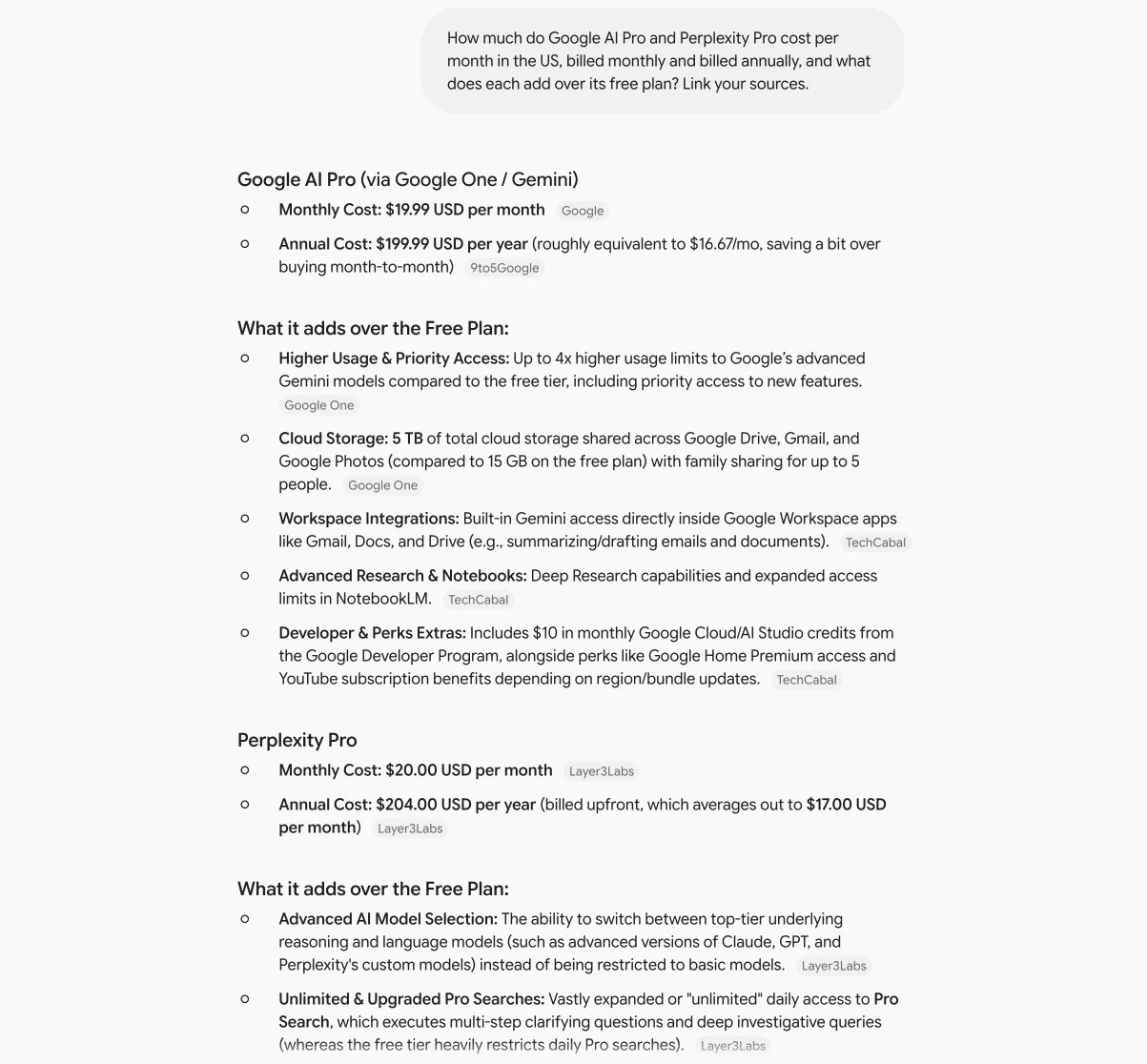
Gemini added a $199.99 annual Google price, sourced to 9to5Google (Perplexity repeated the same figure as what “reports indicate”), and “$10 in monthly Google Cloud/AI Studio credits”; neither appears on Google’s US plans page. On Perplexity it leaned on two third-party blogs and promised “unlimited” Pro searches, which Perplexity’s current plan card does not offer.
Perplexity made the more surprising error. It said Pro includes “Perplexity Computer access, with 10,000 Computer credits per month”, citing its own site. Its pricing page gives Pro 4,000 bonus credits and puts 10,000 a month only on Max. It also gave Pro as $200 a year in a table, then said the pricing page lists $17 a month billed annually, which is $204.
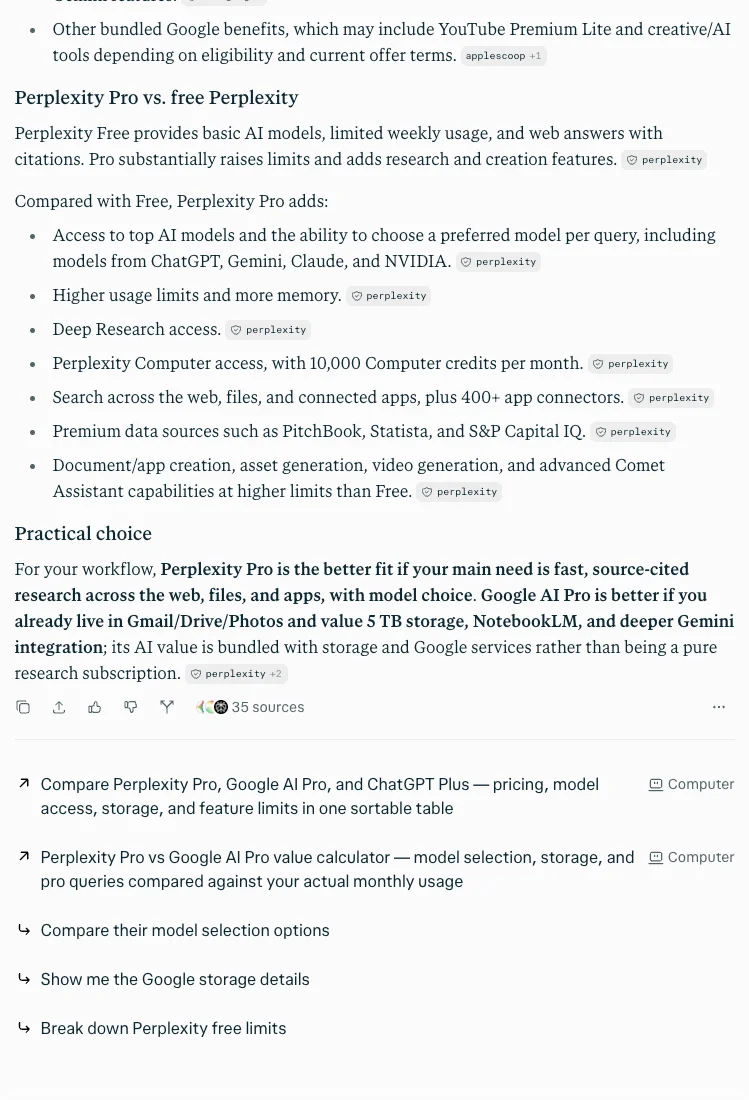
The lesson is the same for both: a price answer is a lead, not a quote. Open the vendor’s page before you pay.
A cited report: Perplexity delivered, Gemini stalled
The third test asked for a short cited report on whether air-source heat pumps work below -15°C (5°F), and what an old house should check first. Perplexity’s free Search answered with efficiency figures from a national lab paper, cold-climate features, and an ordered checklist: air leaks, insulation, a room-by-room load calculation, capacity at 5°F, the electrical panel, outdoor unit placement and backup heat.
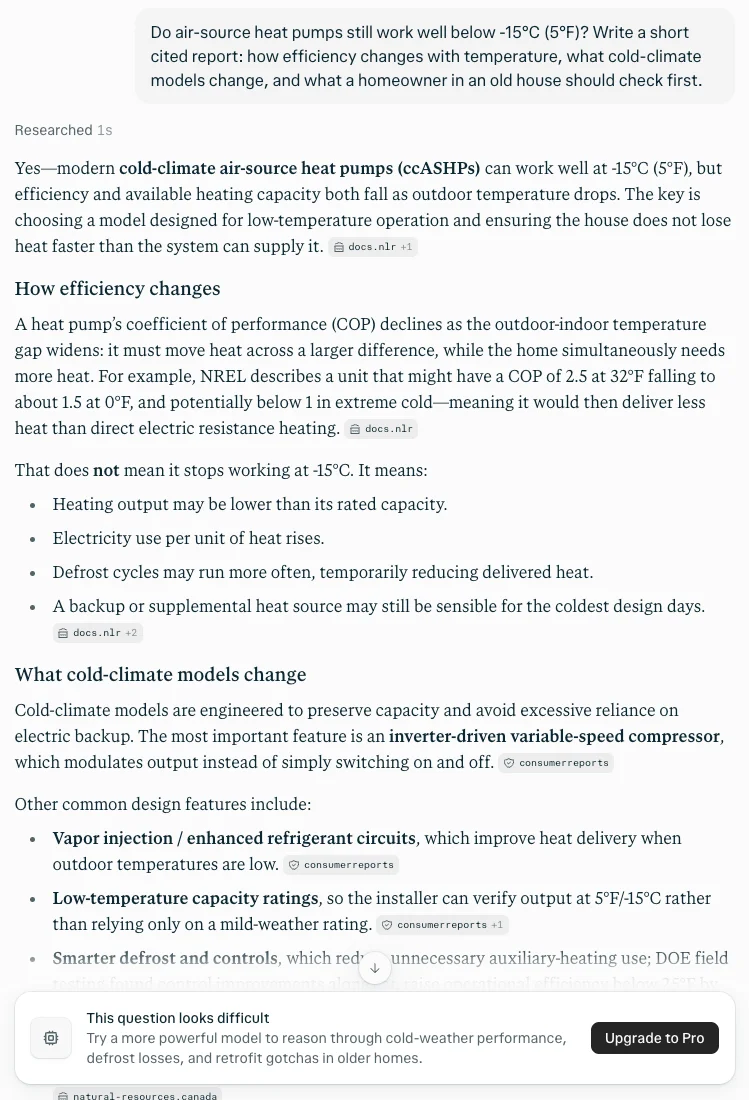
Its ten sources were strong: the national lab paper, energy.gov, Natural Resources Canada, ASHRAE, a New York state programme and a federal lab guide, plus Consumer Reports, EnergySage and two manufacturers. Two figures I checked against the source snippets matched: a minimum operating range of -15°C to -25°C for newer models, from Natural Resources Canada, and a 50% efficiency gain below 25°F from control changes, from energy.gov.
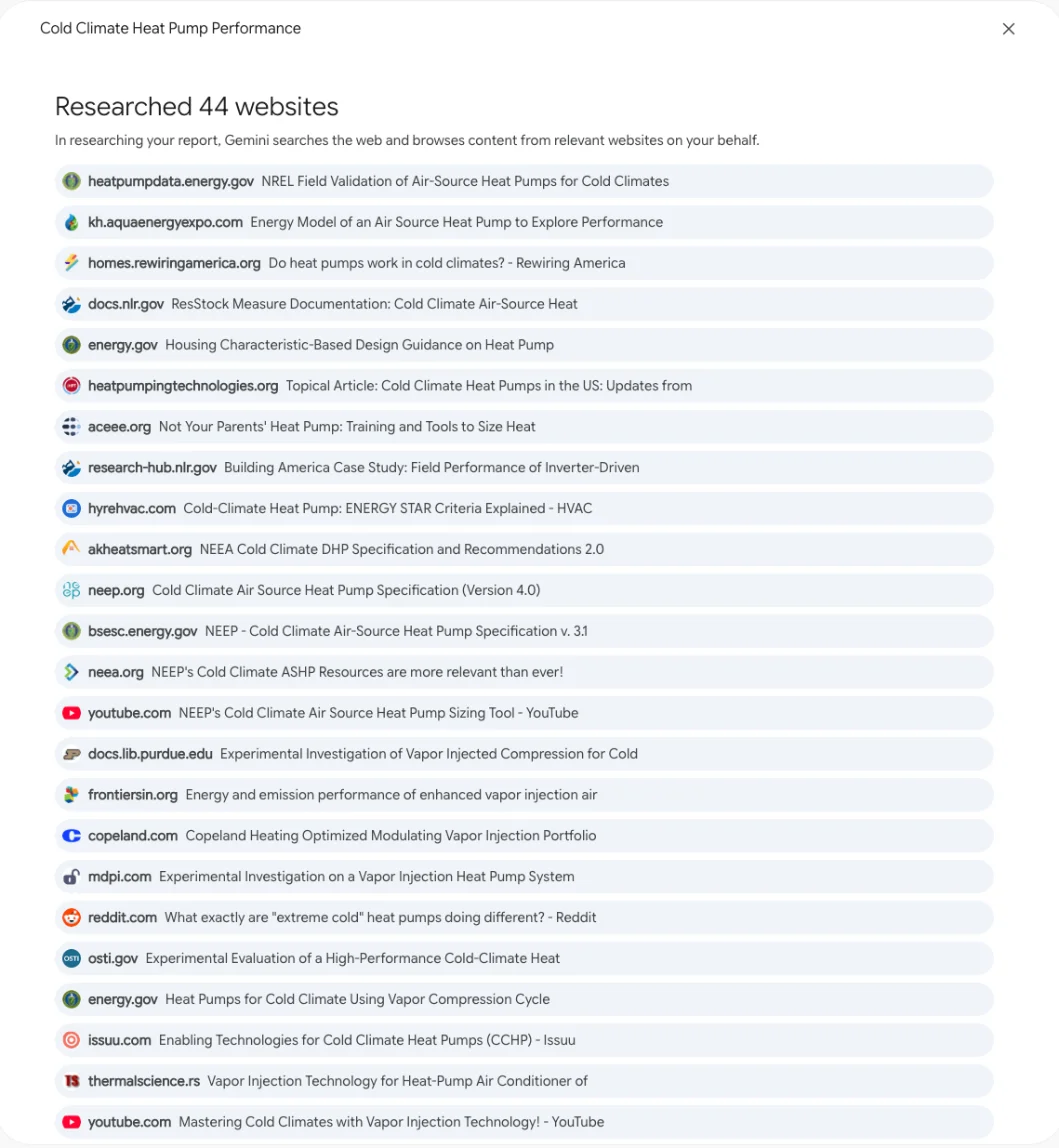
Gemini’s free Deep Research showed a plan, “Cold Climate Heat Pump Performance”, with three steps and “Ready in a few mins”. I pressed Start research at 10:17. Within five minutes its notes were citing field studies, and by about 10:50 it listed 44 websites it had read, mostly national lab, energy.gov and efficiency-programme pages, with a Reddit thread and two YouTube videos among them.
Then it stopped moving. The status said “Creating your report” for over half an hour, and was still there at 11:23, 66 minutes in; reloading the chat changed nothing. I ran the same prompt again in a new chat at 11:04. That run reached “Writing your report” after eight minutes and was still on it when I stopped at 11:23.
So I cannot grade Gemini’s report, because I never got one. What I can say is that its source list was long and mostly primary, that the plan’s “few mins” was badly wrong on this day, and that Perplexity’s free Search had a usable, sourced answer before Gemini’s first run had finished reading. Two stalled runs on one morning are not proof that Deep Research always fails, but they are what a free user may meet.
What happens to your questions
Both companies use what you type to improve their AI unless you say otherwise, and both let you say otherwise. They differ in where the switch is and what off means.
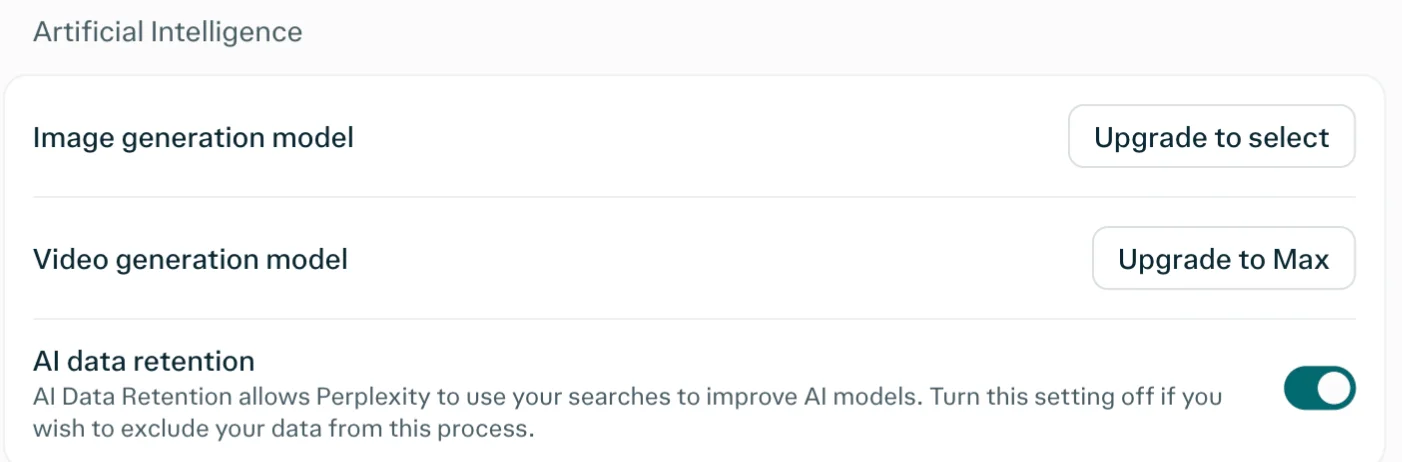
On Perplexity, the switch is in Settings, under Preferences, as “AI data retention”. The description says it “allows Perplexity to use your searches to improve AI models”, and it was on for my free account; I left it alone.
On Gemini, the equivalent is Gemini Apps Activity. Our Gemini review found it on by default, with an auto-delete option, and noted that turning it off still leaves a 72-hour retention floor. Google’s screen is more explicit about what off means; Perplexity’s is one line. Either way, check the setting before you paste anything private.
Who cites the source that decides the fact?
Across the four tests a pattern showed up that matters more than any single answer. Each assistant cited the maker’s own page when the question was about the maker, and reached for second-hand write-ups otherwise.
Gemini cited Google’s pages for Google AI Pro’s price, then two third-party blogs for Perplexity’s. Perplexity cited Google’s blog for Google’s news and its own site for its own plans, even when it got those plans wrong. On the heat pump report, with no vendor involved, Perplexity went to government and research sources; Gemini’s research list leaned the same way, but never became a report.
The practical rule is simple: when an answer is about a company, the chip should point at that company’s page. If it points at a blog, open the company’s page yourself.
How do they differ in speed and workflow?
The two are built for different rhythms. Perplexity answers in seconds and expects you to click through; Gemini will take minutes when you ask it to research, and expects you to read what it made.
Perplexity: fast answers, frequent upsells
Every Perplexity answer in my tests labelled its research time in seconds, and each was complete within about 20 seconds of my pressing Enter. The follow-up box and suggested next questions sit right under the answer, and two of the suggestions offered to run the task in Computer.
The free plan shows its limits as you go. The mode menu lists Search, Deep research with a padlock, Model council with a Max badge and padlock, and Learn step by step.
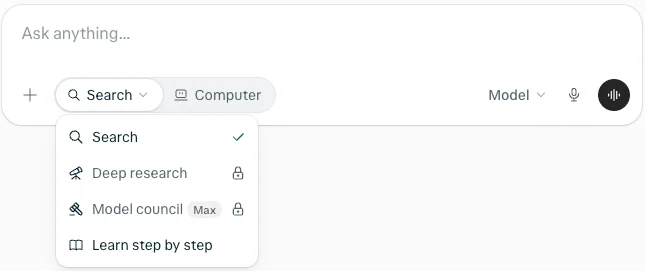
Two of my four answers ended with a “This question looks difficult” banner and an Upgrade to Pro button. Perplexity’s help page, which our Perplexity review cites, says free users get limited access to Research; on this account in October the mode menu showed a padlock instead.
Perplexity reads an image, then hits a limit
I uploaded a screenshot of an upgrade pop-up with no name or logo on it and asked what it wanted. Perplexity said it was “an upgrade prompt for Perplexity Computer”, explained that Computer is for Pro and Max, and noted that you can close the pop-up and keep using free search. That is right, and it is home turf: the pop-up is Perplexity’s own.
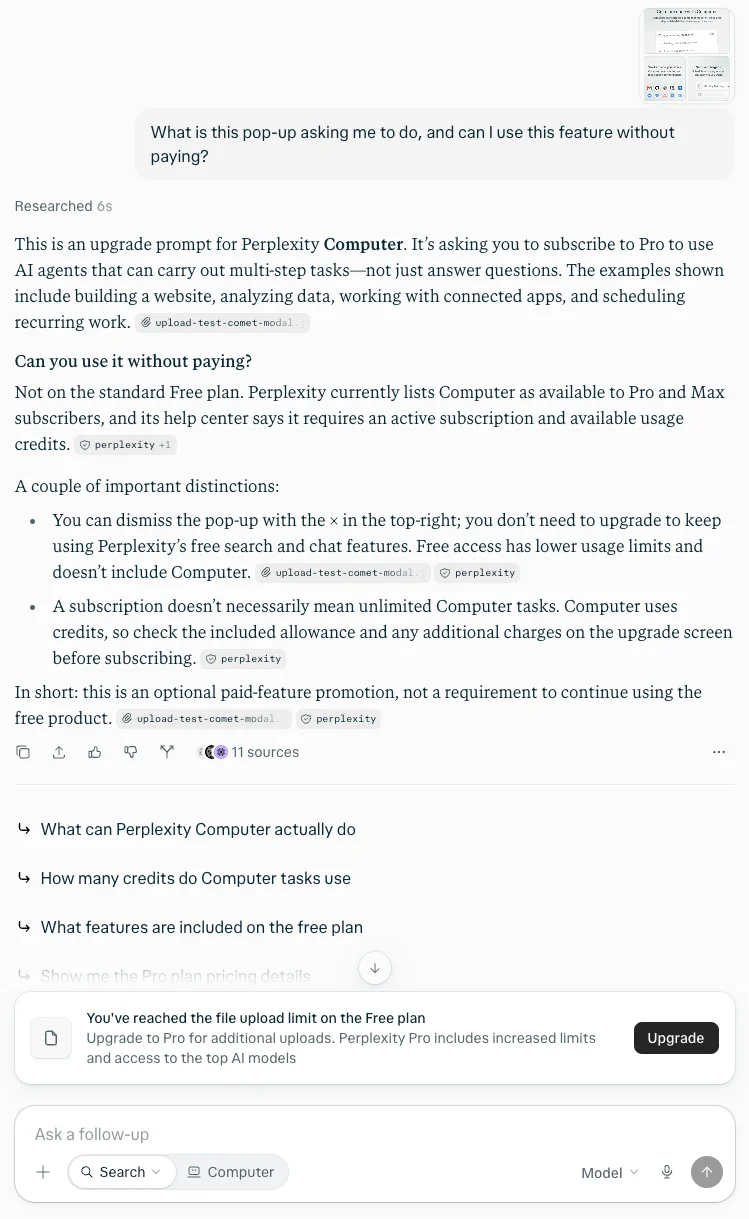
Under the answer, a banner said “You’ve reached the file upload limit on the Free plan.” It was my only upload of the session from that browser; I cannot rule out uploads earlier that day on the same account, but free uploads are clearly rationed.
Gemini: more tools, slower research
Gemini’s free + menu is the widest I have seen on a free plan: files, Drive, image and music creation, Canvas, Deep research and Guided learning, plus a Personal Intelligence switch marked Labs.
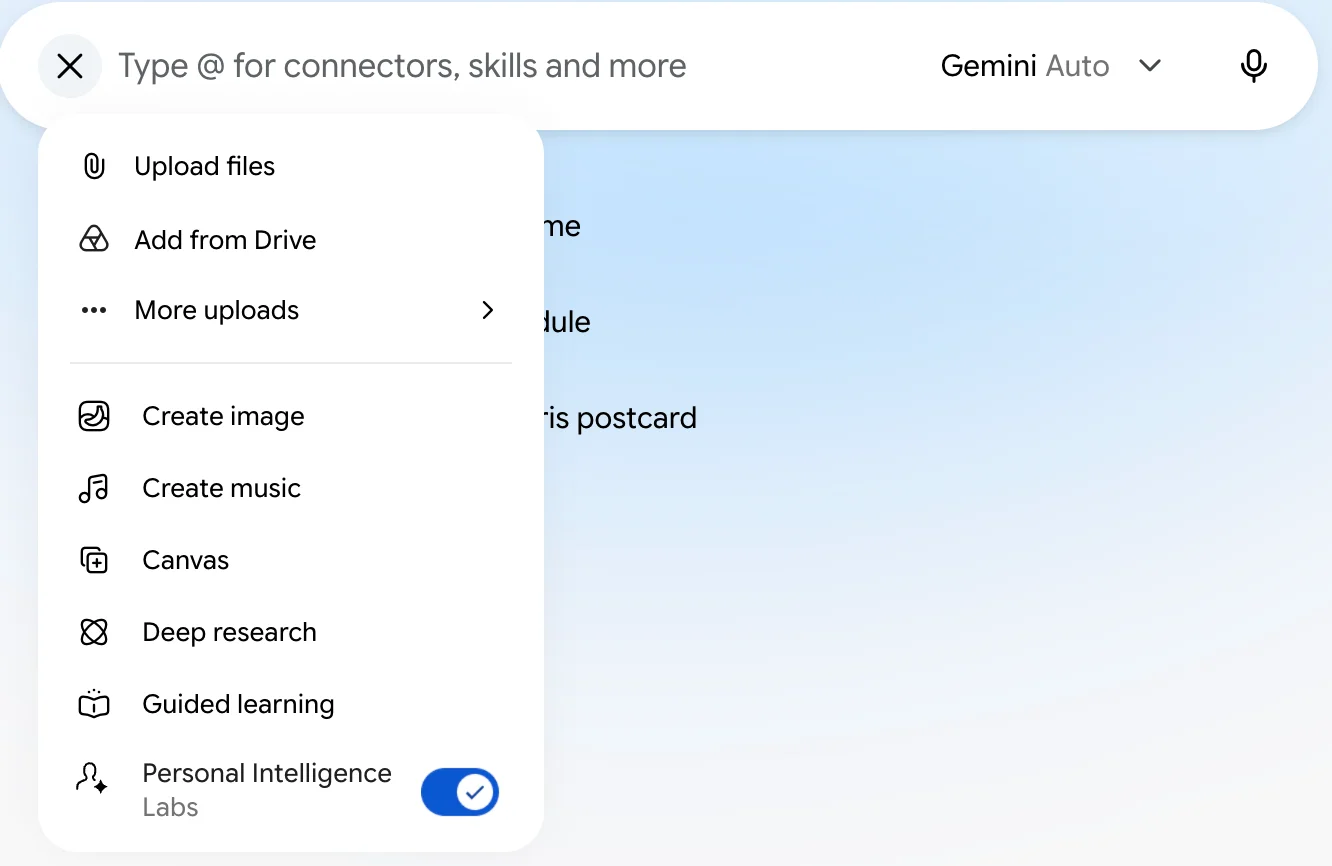
Deep Research changes the pace. It shows a plan first, waits for Start research, and then works in the background; Gemini says you can leave the chat meanwhile. The plan card promised the report “in a few mins”. Neither of my runs got there, so for a quick, cited answer, Gemini’s Deep Research was the slower path by a long way.
Gemini’s quick answers were fast too: both were complete within about 20 seconds of pressing Enter. The friction was elsewhere. The news answer arrived as two drafts with “Which response is more helpful?”, and the side-by-side layout doubled the reading before I could carry on.
Gemini inside Perplexity is not Gemini
Perplexity Pro lets you pick a Gemini model for an answer, alongside ChatGPT, Claude and NVIDIA models, according to Perplexity’s pricing FAQ. That can sound like getting both products for one price. It is not.
Inside Perplexity, a Gemini model answers through Perplexity’s search and citation layer. You do not get Gemini’s own tools: no Deep Research in Google’s form, no Canvas, no music creation, no Gmail or Drive. If what you like about Gemini is the model’s writing, Perplexity Pro covers it; if it is Google’s apps and tools, it does not.
| A Gemini model inside Perplexity Pro | The Gemini app | |
|---|---|---|
| Search and citations | Perplexity’s | Google’s |
| Deep Research | Perplexity’s Deep research | Google’s Deep Research |
| Google’s Canvas and music creation | No | Yes |
| Gmail, Docs and Drive | No | On a paid plan |
| Storage bundle | No | 5 TB on Google AI Pro |
Their browsers: Comet and Gemini in Chrome
Both companies now put their assistant in a browser. Perplexity’s is Comet, which we covered in our Comet browser review: on the free plan its Assistant reads and summarises the page in front of you, but acting on a page through Computer opens the same Upgrade to Pro pop-up I fed to Perplexity in test 4.
Google’s is Gemini in Chrome, and Google’s US plans page lists “Chrome auto browse” as a Google AI Pro feature. I did not test it, so I can only say where each one sits: Perplexity asks you to install a new browser, Google adds to the one most people already use.
Where each one reaches
Perplexity reaches the web, your uploads and, on paid plans, connected apps. Gemini reaches Google: on a paid plan it works inside Gmail, Docs and Drive, and Google’s US plans page adds Gemini in Chrome. I did not test either’s app access, so treat that as the vendors’ description.
Where ChatGPT fits
Many people searching this are really choosing between three: Perplexity, Gemini and ChatGPT. The short version from our tests is that ChatGPT sits nearer Gemini than Perplexity. It is a general assistant first, with search as one feature, and our Perplexity vs ChatGPT test found it answered a fresh policy question confidently and wrongly while Perplexity got it right with sources attached.
Against Gemini, the choice comes down to which free tier you get and whether you live in Google. Our ChatGPT vs Gemini comparison covers that pairing, including what each free plan gives you. If all you want is the best way to look things up, our best AI search engine roundup ran Perplexity, Google AI Mode and Brave Search through the same question, and also covers ChatGPT search and Kagi. If by Google you mean Search rather than the Gemini app, our Perplexity vs Google test covers that pairing.
In that roundup’s single question, Perplexity and Brave Search cited official EU sources while Google AI Mode leaned on secondary write-ups, the same habit Gemini showed in my news test here.
What I did not test
This comparison is the free plans on a computer, on one morning. I did not test either paid plan, Gemini’s handling of images (its upload button opens the computer’s own file picker, which my test setup could not drive), Gmail or Drive access, the mobile apps, voice, or either agent acting on a website. Four questions are a sample, not a benchmark, and both products change monthly.
Who should pick Perplexity?
Perplexity suits people whose work is finding things out and showing where they came from.
- Researchers and students who must cite. Its chips went to the primary source more often than Gemini’s, and the sources list is the product.
- Anyone tracking fast-moving news. It found October’s biggest Google announcement that Gemini missed.
- People who want quick answers, not documents. Twenty seconds to a sourced answer is the core loop.
- Pro buyers who want model choice. Pro lets you pick between ChatGPT, Gemini, Claude and NVIDIA models in one place.
- Skip Perplexity if you want an assistant that writes, plans or makes things. Its free plan is mostly a search box with citations, and its creation tools, document building and Computer agent sit behind Pro.
Who should pick Gemini?
Gemini suits people who want a general assistant and already live in Google.
- Anyone who will not pay. Its free plan includes Deep Research, Canvas and creation tools; on my free Perplexity account, Deep research was padlocked.
- People willing to wait for depth. Deep Research reads far more sources than a quick answer, though in my two runs it never produced the report.
- Households already paying Google for storage. Google AI Pro folds the AI into a 5 TB plan you might buy anyway.
- Gmail and Docs users on a paid plan. Gemini works inside them; Perplexity does not.
- Skip Gemini if you need to quote a source. In my test its news answer leaned on an aggregator, so check its chips before you rely on them.
Final word
For most people the right answer is both free plans, used for different jobs: Perplexity when you need a current fact and its source, Gemini when you want to make something or work inside Google. If you will pay for one, let your Google bill decide. If storage is already on it, Google AI Pro is the better $20; if it is not, Perplexity Pro is the sharper research tool.
Whichever you choose, keep the habit both of them forced on me: open the chip. Perplexity got Gemini’s news right and its own credits wrong, and Gemini got its own price right and Perplexity’s wrong. The assistant is a fast first draft; the vendor’s page is the answer.
On my four questions, Perplexity was the one I would trust with a citation.
Frequently asked questions
Is Perplexity better than Gemini?
For finding and citing current facts, yes, in my tests. Asked what Google announced in October 2026, Perplexity led with Gemini 4 Argon and cited Google's own blog; Gemini's answer left Argon out and leaned on a news aggregator. On a heat pump report, Perplexity's free Search answered in seconds from government and research sources.
For everything around the search, Gemini gives more tools. Its free plan includes Deep Research, Canvas and image and music creation, while Perplexity's free plan shows Deep research behind a padlock. Gemini is also the only one of the two that lives inside Gmail and Drive, on a paid plan.
Its Deep Research read 44 sites in my test but never delivered the report. So pick by the job: Perplexity to look things up, Gemini to make things and work inside Google.
Which is cheaper, Perplexity Pro or Google AI Pro?
Month to month they cost about the same: Perplexity Pro has been $20 a month and Google AI Pro is $19.99. Perplexity's pricing pages now show Pro at $17 a month when billed annually, which works out to $204 a year by our arithmetic; Google's US plans page shows no annual price.
The value differs more than the price. Google AI Pro bundles 5 TB of storage, YouTube Premium Lite, Google Home Premium and Gemini in Gmail and Docs. Perplexity Pro buys model choice, Deep research, expanded Computer access and 4,000 one-time bonus credits. If you would pay for Google storage anyway, Google AI Pro is the better deal; if you only want research, Perplexity Pro is the more focused one.
Can you use Gemini Deep Research for free?
It is on the free plan, but it did not finish for me. Google's US plans page lists Deep Research under Free, and on a free account on 20 October 2026 it showed a plan, read 44 websites, and was still on Creating your report 66 minutes after I started it; a second run stalled on Writing your report.
Perplexity's free plan works the other way. Free users get standard Search, which answered my report question in about 20 seconds with ten sources. On my free account the mode menu showed Deep research with a padlock, alongside Model council marked Max, though Perplexity's help page says free users get limited access to Research.
What are the disadvantages of Perplexity?
Three showed up in my tests. On my free account Deep research carried a padlock, and our August review found every model in the picker padlocked too. It also nags: two answers carried a banner saying the question looks difficult, with an Upgrade to Pro button. After one image upload it also said I had reached the free plan's file upload limit.
It can also get its own plans wrong. Asked what Perplexity Pro adds, it listed 10,000 Computer credits a month, citing its own site, when its pricing page gives that allowance only to Max and gives Pro 4,000 bonus credits. And it is a search tool first: it does not reach into your email or documents the way Gemini can on a paid plan.
What is the difference between Perplexity and Perplexity Computer?
Perplexity is the answer engine: you ask, it searches and replies with citations, and the free plan covers that. Perplexity Computer is its agent mode, which carries out multi-step work such as building documents, analysing data or running scheduled tasks across connected apps.
Computer is a paid feature. Perplexity's pricing page gives Pro expanded Computer access and 4,000 bonus credits, and Max 10,000 credits a month, and its help pages say Computer spends credits. When I uploaded a screenshot of Computer's upgrade pop-up, free Perplexity recognised it and said the feature is not on the free plan.
Can Perplexity use Gemini models?
Yes, on a paid plan. Perplexity's pricing FAQ names Google Gemini among the model families Pro users can choose from, alongside ChatGPT, Claude and NVIDIA models. On the free plan the model picker is locked, per our August review, so you get Perplexity's default.
That is not the same as using Gemini itself. Inside Perplexity a Gemini model answers through Perplexity's search and citation layer, without Gemini's own tools such as Deep Research, Canvas, Gmail and Drive access, or Google's storage bundle.
Keep reading
Perplexity vs Google: same right answers, different sources
Perplexity vs Google, tested side by side on five everyday searches: both got every answer right, so the difference is whose sources you can check.
Perplexity pricing: $20 a month, or $17, on the same site
Perplexity pricing is $0, $20 or $200 a month. Its own plan pages show two different headline numbers, and the Enterprise tab quietly switches billing basis.
Perplexity AI review: the free tier is a showroom
A Perplexity AI review from the free tier: ten models in the picker and every one padlocked, $17 a month to unlock them, and six publishers now suing.
Perplexity vs ChatGPT: we asked both the same question
Same question, same day, both free tiers. One got the facts right and cited them; the other was confidently wrong. Plus the price nobody compares properly.