
ChatGPT vs Gemini: the free tier decides this one
ChatGPT vs Gemini, both tested on free accounts. One hands a non-paying user its advanced reasoning model; the other will not let you pick a model at all.
Contents
ChatGPT vs Gemini: the verdict at a glance
Most ChatGPT vs Gemini comparisons argue about which model is smarter. That is the wrong argument, because the two products diverge far more sharply on what they hand you before you pay than on anything a benchmark measures.
Here is the short version.
| If you are | Pick | Because |
|---|---|---|
| Not paying anything | Gemini | It gives free users its advanced reasoning model; ChatGPT gives free users no model choice at all |
| Paying for one assistant | ChatGPT | Broader product, better prose, and it holds instructions in long documents |
| Living in Gmail and Docs | Gemini | Native access to Google’s apps is ownership, not integration |
I tested both on free accounts, which is also how most people actually use them.
How do ChatGPT and Gemini compare, axis by axis?
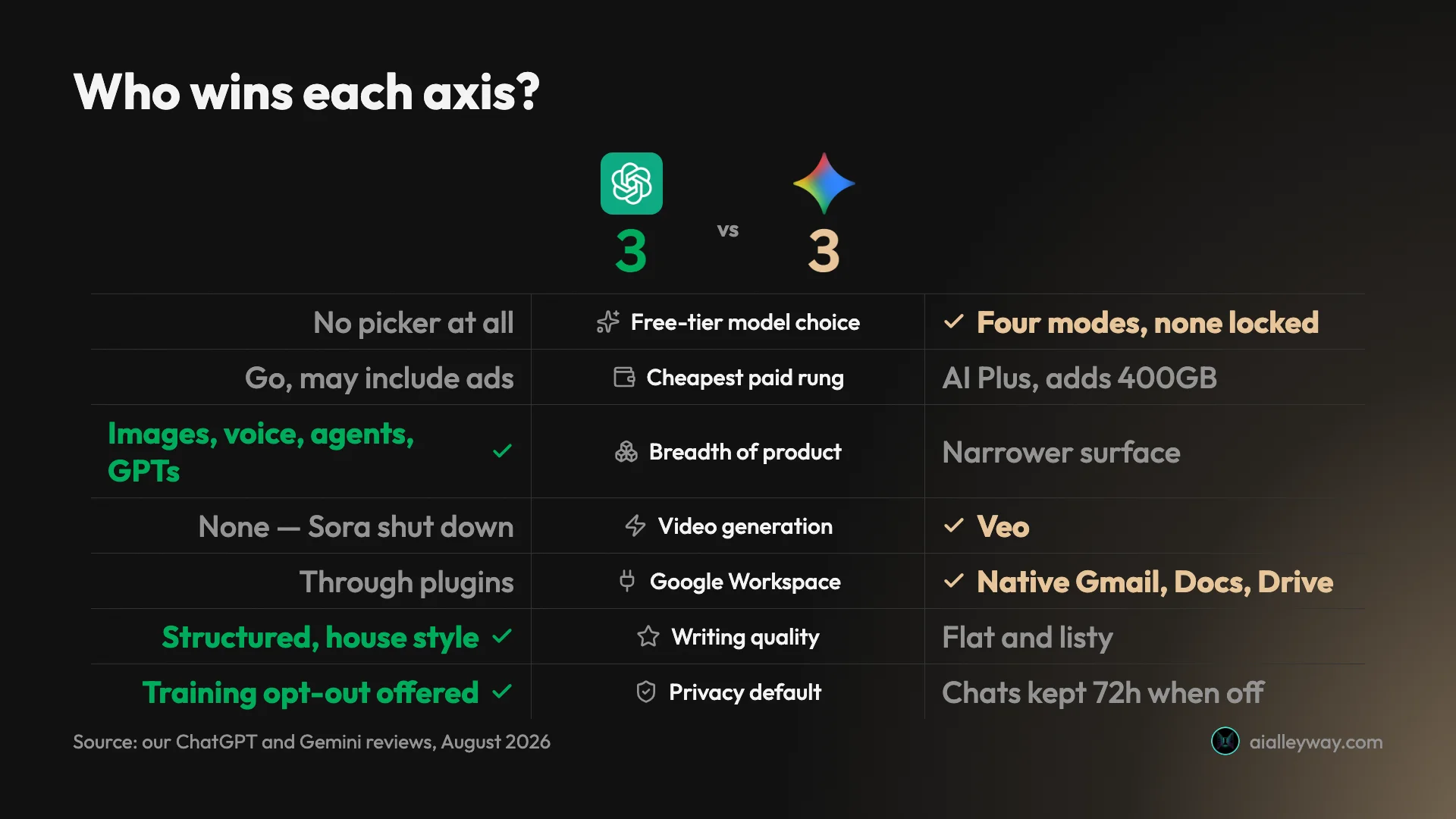
It comes out three each, with the cheapest-rung row a genuine tie, and the split is more useful than the score. Gemini’s three are about what you get before you pay. ChatGPT’s three — breadth, prose and the privacy default — are what a paying user lives with every day. That is why the recommendation below turns on whether money is changing hands rather than on any tally.
| Axis | ChatGPT | Gemini |
|---|---|---|
| Free-tier model choice | No picker at all | Four modes, none locked |
| Free-tier flagship reasoning | Behind Plus | Included free |
| Cheapest paid rung | Go, may include ads | Google One AI Plus, adds 400GB |
| What the paid tier is | An assistant subscription | A cloud storage plan |
| Image generation | Yes, limited when free | Yes |
| Video generation | None — Sora shut down April 2026 | Veo |
| Coding agent | Codex, on the plan | Antigravity, via the Google AI plan |
| Google Workspace | Through plugins | Native, on paid tiers |
| Free context window | 27K tokens, about 12 pages | Not published |
| Writing quality | Structured, drifts to house style | Flat and listy on long pieces |
| Privacy default | Training opt-out offered | Chats kept 72 hours when off |
Two rows on that table deserve flagging, because they are where the standard account of these two is currently wrong.
The video row is the blunt one. Plenty of widely-cited comparisons still frame Sora against Veo as a live contest. It has not been one since April 2026, and you can check in one click.
The coding agent row is subtler. Both bundle one, but Google’s does not arrive with a Gemini subscription, because there is no Gemini subscription — it arrives with a Google One storage plan. This site’s Antigravity vs Claude Code comparison found the same thing from the other direction.
What does ChatGPT do well, and what did it quietly lose?
It is the broader product, and breadth is a real feature. One ChatGPT account covers text, image generation, voice, web search, deep research, a coding agent in Codex and a directory of custom GPTs. Gemini’s surface is narrower. If you want one tab rather than four, this matters more than a benchmark point.
It holds instructions better in long documents. This is the finding I trust most, because it survived the longest testing. Give both a style guide with prohibitions and read the last third of the output. ChatGPT keeps the rules. Its failure mode is reverting to its own structure of headers and bullets, which is a formatting problem rather than a compliance one.
Its free tier is complete rather than capable. Everything is present and everything is rationed. OpenAI’s pricing page lists free as unlimited text chats with GPT-5.6 Luna, then marks images, uploads, voice, deep research, memory and Codex all as limited.
Image generation is present but rationed when free. OpenAI’s pricing page describes free image creation as limited and slower, upgrades Plus to more complex and accurate image creation, and reserves unlimited and faster generation for Pro. That is an unusually candid ladder, and it tells you what the free tier is for: trying the feature rather than working with it. In practice the throttle arrives quickly enough that I stopped reaching for ChatGPT when I wanted several variations of an image.
Codex comes with the subscription rather than beside it. ChatGPT’s coding agent is on the same plan as everything else, listed as limited on free and expanded from Plus upward. For anyone whose work mixes writing and code, not having to reason about a second product or a second bill is worth more than it sounds. Gemini’s coding agent exists too, but reaching it means understanding Google’s plan structure first.
It lost video generation entirely. OpenAI discontinued the consumer Sora app in April 2026. Visit sora.com now and you land on a sunset page offering to export your old generations. This is a straightforward capability the product used to have and no longer does, and it is the axis where Gemini’s win is cleanest.
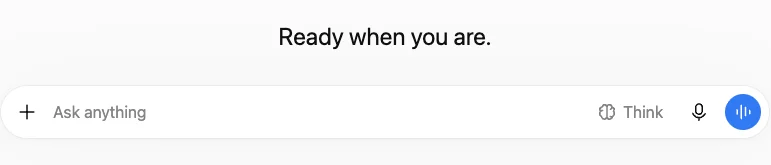
Free users cannot choose a model. There is no picker in the composer — only a Think toggle. Whatever OpenAI has decided a free user should run is what a free user runs. Set against the four modes Gemini opens up to a free account, this is the starkest difference between the two products.
Our full ChatGPT review scored it 4.6, and the breadth is why.
What does Gemini do well, and where does it disappoint?
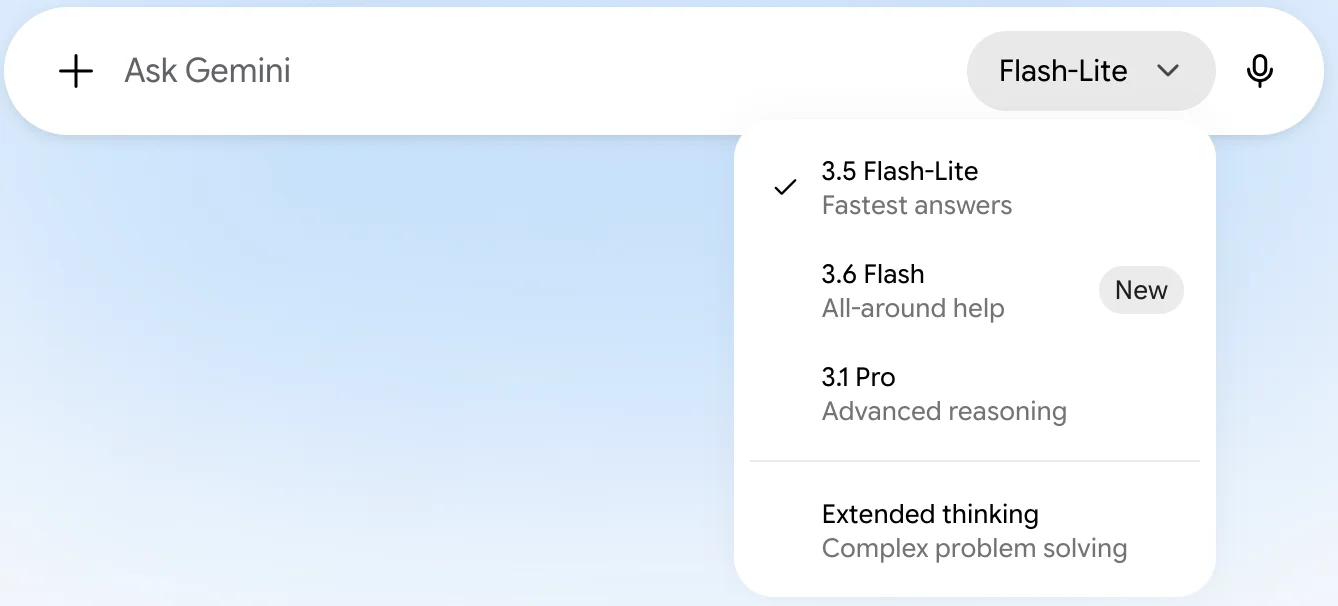
It gives away its reasoning model. The picker on my free account lists 3.5 Flash-Lite, 3.6 Flash, 3.1 Pro described as advanced reasoning, and Extended thinking for complex problems. Nothing is padlocked. No competitor at this scale is that generous below the paywall, and it is the reason to start here.
Native Google access is a structural advantage. Google owns Gmail, Docs, Drive and Calendar. Gemini reads them directly rather than through a connector you authorise. ChatGPT cannot engineer its way out of that, though the access is tiered and a free account reaches none of it.
Video is a genuine win. Veo is available through Gemini and is the model this site rates highest in our video generator roundup. ChatGPT has nothing to put against it.
Image generation is not rationed the same way. Images have their own entry in the Gemini sidebar on a free account rather than sitting behind a meter that stops you after a couple of tries, and Google has been notably more willing to give image generation away than OpenAI has. If you generate images casually and occasionally, this is a real quality-of-life difference between the two free tiers.
Deep research works on the free tier. Both products ship a research mode that goes away, reads a stack of sources and returns a report, and both meter it. The distinction is the same one that runs through this whole comparison: on Gemini a free user can point the more capable reasoning mode at the task, while on ChatGPT the research runs on whatever model a free account is given.
The writing is the weak spot. Gemini is competent and undistinctive, sliding toward a flat, listy register on anything long. When the output carries a byline, it is the one I reach for last.
The privacy default is the worst of the two. On the Gemini Apps Activity screen, Google’s own wording says it still saves chats for 72 hours when the setting is switched off — our Google Gemini review has the screenshot. That is a deliberate design decision, not a bug, and it is worth knowing before you paste anything sensitive.
Nothing is called a Gemini subscription. Paying means buying a Google One storage plan. We scored it 4.3, and this packaging is most of the gap.
Is ChatGPT or Gemini cheaper?
This is where I have to be careful about what I actually know, because both vendors geo-locked my account.
Neither chatgpt.com nor Google’s AI plans page would show me US dollar pricing. Both rendered local-currency figures. So rather than repeat dollar amounts I could not confirm, here is how the prices the two vendors displayed to the same account on the same day compare — which has the accidental benefit of being a true apples-to-apples comparison in a single currency.
ChatGPT’s pricing page lists four individual rungs: Free, Go, Plus and Pro. Google’s AI plans page lists three paid tiers: AI Plus with 400GB of storage, AI Pro with 5TB, and AI Ultra with 20TB, described as roughly two, four and twenty times the standard Gemini usage limits.
The bottom rung is the interesting one. On my account, in its local currency, ChatGPT Go and Google AI Plus showed precisely the same price. US list prices for the two are reported to differ. For that identical local amount, one plan carries a footnote on OpenAI’s own pricing page stating that it may include ads, and the other includes 400GB of Drive storage alongside doubled Gemini limits.
That comparison alone reframes the category. ChatGPT’s cheap tier is a cheaper assistant with advertising attached. Google’s cheap tier is a storage plan that happens to raise your AI limits, which means you are buying something with a floor of value even in a month you barely use the assistant.
It also matters what each rung gates rather than what it costs. On ChatGPT the meaningful jump is Free to Plus, because Plus is where advanced reasoning with GPT-5.6, Projects, scheduled tasks and custom GPTs all arrive at once. Go sits between them as a cheaper messages-and-uploads bump that leaves the structural features locked. On Google’s side the ladder does something different: each tier multiplies your Gemini usage limits, roughly two, four and twenty times, and adds storage, rather than switching capabilities on. You are buying more of the same thing rather than a different product.
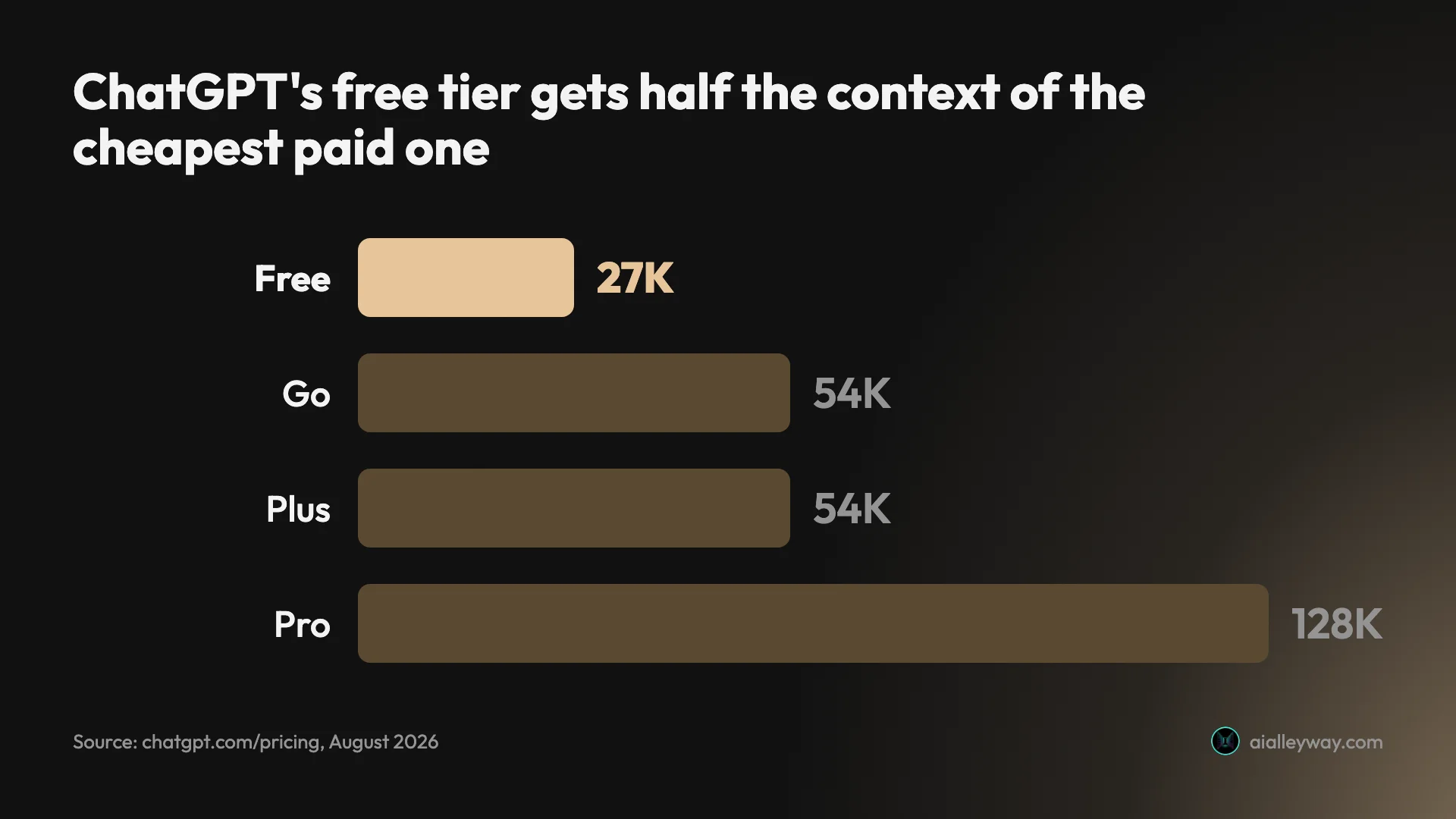
The other number worth knowing is the one OpenAI publishes and Google does not. ChatGPT’s pricing page states the context window per tier: 27K tokens on free, about twelve pages of text, rising to 54K on Go and Plus and 128K on Pro. Google publishes no equivalent figure for the Gemini app at all.
I am not going to pretend that asymmetry favours Google. A published limit you dislike is more useful than an unpublished one, and OpenAI deserves credit for stating it. But 27K is genuinely small, and it is the ceiling a free ChatGPT user hits first — usually without being told that is what happened.
Which one is more accurate?
Accuracy is the axis everyone leads with and the one that separates these two least, so it is worth being precise about where a real difference shows up.
On general factual questions, both are strong and both still fabricate under pressure. I have not found a category of everyday question where one is reliably right and the other reliably wrong, and I would distrust any comparison claiming otherwise without a published methodology.
The difference appears in instruction compliance over length, which people experience as accuracy even though it is not quite the same thing. The test is simple enough to run yourself on both free tiers. Write a brief with prohibitions in it — words not to use, a structure not to follow, a claim not to make — then ask for something long, and read the final third.
ChatGPT holds the prohibitions further into the document. Gemini starts drifting earlier, and the drift is consistent: it reaches for lists and headers, flattening argument into bullets. That flattening is why prose written by Gemini reads as competent and generic, and why I would not hand it a piece with someone’s name on it.
Where Gemini pulls ahead is reasoning on the free tier, and this is not really a model-quality claim about the underlying systems. It is an access claim. A free Gemini user can select 3.1 Pro or Extended thinking. A free ChatGPT user cannot select anything. So for the large population of people who will never pay, the accurate statement is that Gemini gives them a better reasoning model, whatever the benchmarks say about the flagships.
Two narrower accuracy notes are worth having. On anything requiring current information, both search the web and both cite, and I have not found a consistent winner — the failure I see most often in either is a confident summary of a source that says something slightly different, which is why the citation links matter more than the summary. On code, both are usable, and neither is the strongest option available when code is the main job; this site’s best AI for coding roundup covers that comparison properly.
| The compliance test | ChatGPT | Gemini |
|---|---|---|
| Positive instructions (“use this structure”) | Followed | Followed |
| Prohibitions, first third of a draft | Held | Held |
| Prohibitions, final third | Held | Started to slip |
| Failure mode under load | Reverts to headers and bullets | Flattens argument into lists |
If you want the sharper version of the writing comparison, neither of these two is the best writer available — Claude is, which is the argument in our ChatGPT vs Claude comparison and the reason Claude’s review leads on prose.
Living with each one, day to day
Both are fast, both are stable, and neither will frustrate you on a short task. The differences accumulate over a working week rather than announcing themselves in a first session.
ChatGPT feels like an application. Projects, custom GPTs, scheduled tasks, a plugin directory, a desktop app that reaches into your other software. On a paid tier it becomes a workspace with state, and things you build persist and compound. On the free tier you see the shape of that workspace with most of it greyed out, which is a slightly deflating experience — the upgrade prompts are never far away, and the account badge in the corner reads Free.
Gemini feels like a feature of Google. That sounds dismissive but it is mostly a compliment, because Google is where a lot of work already lives. Asking about a document you are already looking at, without uploading it anywhere, removes a step that ChatGPT can only automate rather than eliminate. The catch is the tiering: on a free account Gemini reaches none of your Google apps, so the single best argument for it is invisible until you pay.
The model picker changes the day more than I expected. Being able to move a hard question from Flash-Lite up to 3.1 Pro or Extended thinking, then drop back down for quick lookups, turns model selection into an ordinary part of working. ChatGPT free has one setting and a Think toggle. That is simpler, and simplicity is defensible, but it means every question gets the same treatment whether it deserves it or not.
Voice and mobile pull in opposite directions. ChatGPT’s voice mode is the more polished conversational experience and is available, limited, even without paying. Gemini’s advantage on a phone is not its voice mode but its position: it is wired into an Android device and into the Google apps already on it, so the assistant is somewhere you already are rather than an app you deliberately open. Which of those matters more is genuinely a matter of which phone is in your pocket.
| What you touch daily | ChatGPT | Gemini |
|---|---|---|
| Choosing a model | Not possible when free | Four modes in the composer |
| Reaching your documents | Upload, or authorise a plugin | Already there, on paid tiers |
| How the free tier feels | A workspace with most of it greyed out | A full picker with usage limits |
Neither has a real friction problem. If you are choosing on daily feel alone, choose on where your work already lives: documents in Drive point to Gemini, everything else points to ChatGPT.
Who should pick ChatGPT over Gemini?
Anyone paying for exactly one AI subscription who does varied work. Images, voice, research, a coding agent and custom GPTs on one plan is genuine range, and no single Gemini tier assembles the same spread.
People whose output is prose other people read. Newsletters, reports, documentation, anything with a byline. ChatGPT holds a brief further into a long draft, and that is the difference between editing and rewriting.
Anyone who builds reusable tooling. Custom GPTs reward the effort of setting them up, and they are a paid feature, so they are an argument for subscribing rather than for the free tier.
Anyone who wants a published limit. OpenAI states the context window per tier. If knowing your ceiling matters, that transparency is worth something.
Who should pick Gemini over ChatGPT?
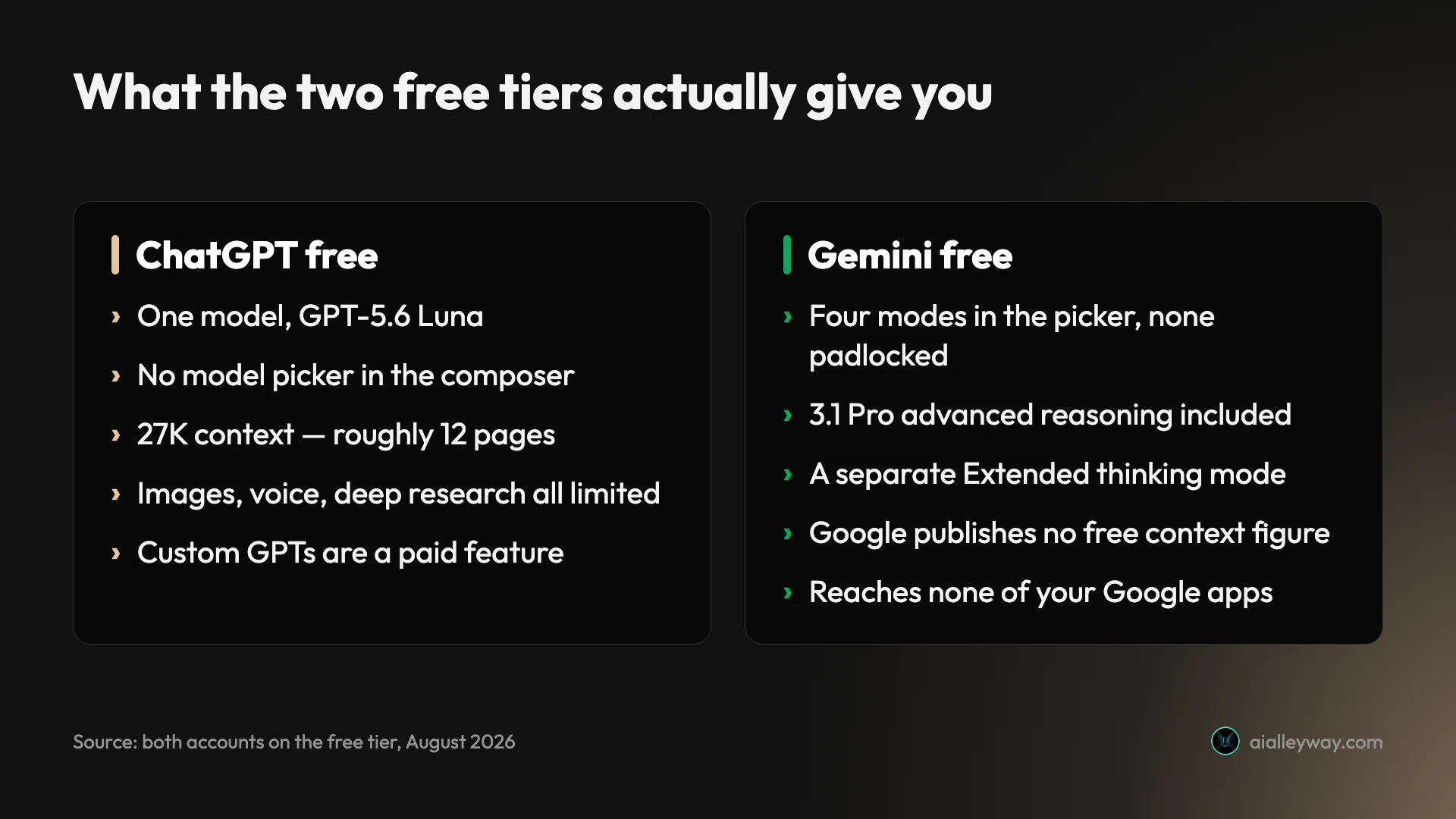
Everyone who is not going to pay. This is the largest group and the clearest recommendation in the post. Four selectable modes including advanced reasoning beats one model and a Think toggle. Start here.
Anyone whose working day happens inside Google Workspace. Native access to Gmail, Docs and Drive is not something a competitor can negotiate its way into. Budget for a paid tier, though, because free reaches none of it.
Anyone who needs video. Veo through Gemini against nothing at all is not a close call since Sora shut down.
Students, and anyone learning rather than producing. This is the group the free-tier argument serves best. Study work is mostly reasoning over material you already have — working through a problem set, checking an explanation, summarising a paper — and that is exactly the workload where being able to select a reasoning mode beats having a broader product with the reasoning locked away. Add the fact that student notes and documents often already live in Drive, and the case is straightforward.
Anyone who would buy cloud storage anyway. If 400GB or 5TB of Drive is something you were going to pay for, the AI access attached to it is close to free, and that is a genuinely different value calculation from a pure assistant subscription.
Final word
For the typical buyer, the honest recommendation depends on one question, and it is not which model is smarter.
If you are not paying, use Gemini. Google hands non-paying users its advanced reasoning model and a real choice of modes, while OpenAI hands them one model and no picker. On the free tier, which is where most of this category actually lives, that is decisive.
If you are paying for one assistant, use ChatGPT. It is the broader product, it writes better, and it holds a brief. Our reviews score it 4.6 against Gemini’s 4.3, and that gap is about product depth rather than raw intelligence. If Gemini is the one you are leaving, Gemini alternatives covers where else to go.
The thing worth carrying away is that these two are not converging on the same product. OpenAI is selling an assistant, with a cheap ad-supported rung below the real one. Google is selling storage with an assistant attached, and giving away more at the bottom to get you into the ecosystem. Whichever you pick, you are picking a business model as much as a model.
If Claude belongs in your shortlist too — and for writing it does — our three-way comparison covers all of them together.
Frequently asked questions
Is ChatGPT or Gemini better?
It splits cleanly along whether you are paying, which is why the usual answer of "ChatGPT for writing, Gemini for Google" is less useful than it sounds.
On free accounts Gemini is the better tool, and it is not close. Its model picker offers four modes, including 3.1 Pro advanced reasoning and a separate Extended thinking mode, none of them locked. ChatGPT's free tier has no model picker at all. You get one model and a Think toggle.
Once you pay, the ranking inverts. ChatGPT is the broader product, covering image generation, voice, a coding agent and custom GPTs from one subscription, and it holds instructions better in long documents.
So: not paying, start on Gemini. Paying for one assistant and doing varied work, ChatGPT. Living inside Gmail and Docs all day, Gemini regardless of tier.
Is Gemini's free tier better than ChatGPT's?
Yes, on the measure that decides most real work: which model you are allowed to run.
Open the picker on a free Gemini account and there are four entries. 3.5 Flash-Lite is the default, 3.6 Flash sits above it, 3.1 Pro is described as advanced reasoning, and Extended thinking is listed separately for complex problems. None carries a padlock. Google gives a non-paying user its reasoning model.
ChatGPT's free tier does not work that way. OpenAI's own pricing page lists it as unlimited text chats with GPT-5.6 Luna, with images, uploads, voice, deep research, memory and Codex all marked limited. In the app there is no model selector.
ChatGPT free is the more complete product, in that more features are present, but almost all of them are rationed. Gemini free is the more capable one, and capability is the thing you notice first.
How much do ChatGPT and Gemini cost?
Both vendors geo-locked my account to local-currency pricing, so I will report how the plans they showed me compare rather than repeat US figures I could not confirm.
ChatGPT lists four individual rungs: Free, Go, Plus and Pro. The Go tier carries a footnote on the pricing page saying the plan may include ads.
Google does not sell a Gemini subscription. Its paid tiers are Google One AI plans, sold on storage: AI Plus with 400GB, AI Pro with 5TB, and AI Ultra with 20TB, offering roughly two, four and twenty times the Gemini usage limits.
The striking part is the bottom rung. In the same market on the same day, ChatGPT Go and Google AI Plus cost exactly the same. One may show you ads; the other includes 400GB of Drive.
Can ChatGPT still generate video?
No. This is the single most out-of-date claim in circulation about ChatGPT, and it is easy to check yourself.
Visit sora.com today and it redirects to a page on OpenAI's own domain reading "Sora is no longer available", with an Export button for pulling out your old generations. OpenAI discontinued the consumer Sora app in April 2026. There is no video generation inside ChatGPT.
Gemini has no such gap. Google's Veo models are available through Gemini, and Veo is the tool this site currently rates highest in the video generation category.
Several well-known write-ups still list a Sora versus Veo axis as though it were a live contest. It has not been one since April. If video matters to you at all, this axis is not close, and it is worth verifying before you subscribe to anything.
Which is better for writing, ChatGPT or Gemini?
ChatGPT, and the gap widens the longer the document gets.
The test that separates them is not a clever prompt. Give both a style guide that contains prohibitions, then read the final third of a long draft rather than the opening paragraphs. Anything follows positive instructions. Holding a rule about what not to do, several thousand words in, is the hard part.
ChatGPT drifts toward its own house structure of headers and bullet lists once material gets complicated, but it holds the actual constraints. Gemini is competent and undistinctive, sliding into a flat, listy register on longer pieces, and it is the one I reach for last when the output carries someone's name.
Neither matches Claude here, which is a different comparison. Between these two, ChatGPT wins on prose and you can confirm it on both free tiers in about ten minutes.
Should I use ChatGPT or Gemini for Google Workspace?
Gemini, and the reason is ownership rather than engineering quality.
Google owns Gmail, Docs, Drive and Calendar, so Gemini reads and acts on them natively instead of through a connector you have to authorise and maintain. Nothing ChatGPT does can close that gap, because the gap is not technical.
Two caveats matter before you decide on this basis alone. The access is tiered rather than free, arriving in stages as you climb the Google One AI plans, so a free Gemini account reaches none of your Google apps. And Gemini's privacy default is worse: on the Gemini Apps Activity screen, Google's own wording says it still saves chats for 72 hours when you have switched the setting off.
ChatGPT reaches Google's apps through its plugin directory, which is wide and available free, but it is still negotiated from outside.
Keep reading
ChatGPT Plus vs Pro: there are now three prices, not two
ChatGPT Plus costs $20; Pro is $100 or $200. OpenAI publishes the 5x and 20x multipliers but never the base they multiply, and only one tier is a discount.
ChatGPT review: the free tier is the story, not the $20 one
A ChatGPT review from a year on the free tier plus one month of Plus. Five rungs from $0 to $200, and ads now run on both the Free and $8 Go tiers.
ChatGPT vs Grok: 4 prompts, both free tiers, a clear tie
I ran four prompts through ChatGPT free and Grok free. They tied on all four. The real gaps: Plus $20 vs SuperGrok $30, and five free models against none.
ChatGPT vs Claude: one writes, one does everything else
ChatGPT vs Claude, from a paid Claude account and a year on ChatGPT free. Both $20, but the free tiers differ far more — and only one generates images.