
ChatGPT vs Grok: 4 prompts, both free tiers, a clear tie
I ran four prompts through ChatGPT free and Grok free. They tied on all four. The real gaps: Plus $20 vs SuperGrok $30, and five free models against none.
Contents
The short version, after four prompts each
Google’s AI Overview for ChatGPT vs Grok says ChatGPT is best for structured work and polished writing while Grok wins on real-time data and speed. I gave both free tiers the same four prompts on the same afternoon. On every axis I could actually score, they tied.
| Verdict | ChatGPT | Grok |
|---|---|---|
| Best for | Anything above the free tier, because the ladder exists | Getting the most out of paying nothing |
| Best free tier | No model choice at all | Five-mode picker, including a reasoning mode |
| Best overall value | Plus at $20, a third less than Grok’s entry plan | SuperGrok at $300 a year, the only annual discount here |
Two factual questions and one arithmetic problem, all answered correctly by both. One writing task with four explicit rules, all four obeyed by both. The differences that survived the test are structural: what a free account can reach, and whether you can pay for a year at a discount.
How I tested this, and why this one is a fair fight
Four prompts, run once each through both tools, in live logged-in sessions on 27 August 2026. Every screenshot below is from those runs.
The important thing about this comparison is that both tools ran on free accounts in their default mode. Grok on Fast, which is Grok 4.5 and what a new account gets. ChatGPT on its free default, with the Think toggle left alone. Nobody was handed an advantage.
That matters because it is not what I could do last time. Our Claude vs Grok comparison pitted free Grok against a paid Claude Max account, and I flagged the asymmetry there rather than pretending it was a clean match. This one is clean, and the results are more interesting for it.
Two limits worth stating up front. Each prompt ran once, so this is an anecdote with receipts rather than a benchmark, and I would not extrapolate to a general claim about which model is smarter. And I tested no paid tier of either product, so nothing below describes what SuperGrok or ChatGPT Plus output looks like.
One more piece of housekeeping. Grok’s answers to prompts one and three are the same runs that appear in the Claude comparison, because it was the same free account on the same day with the same prompts. I have not re-run them to make this post look busier.
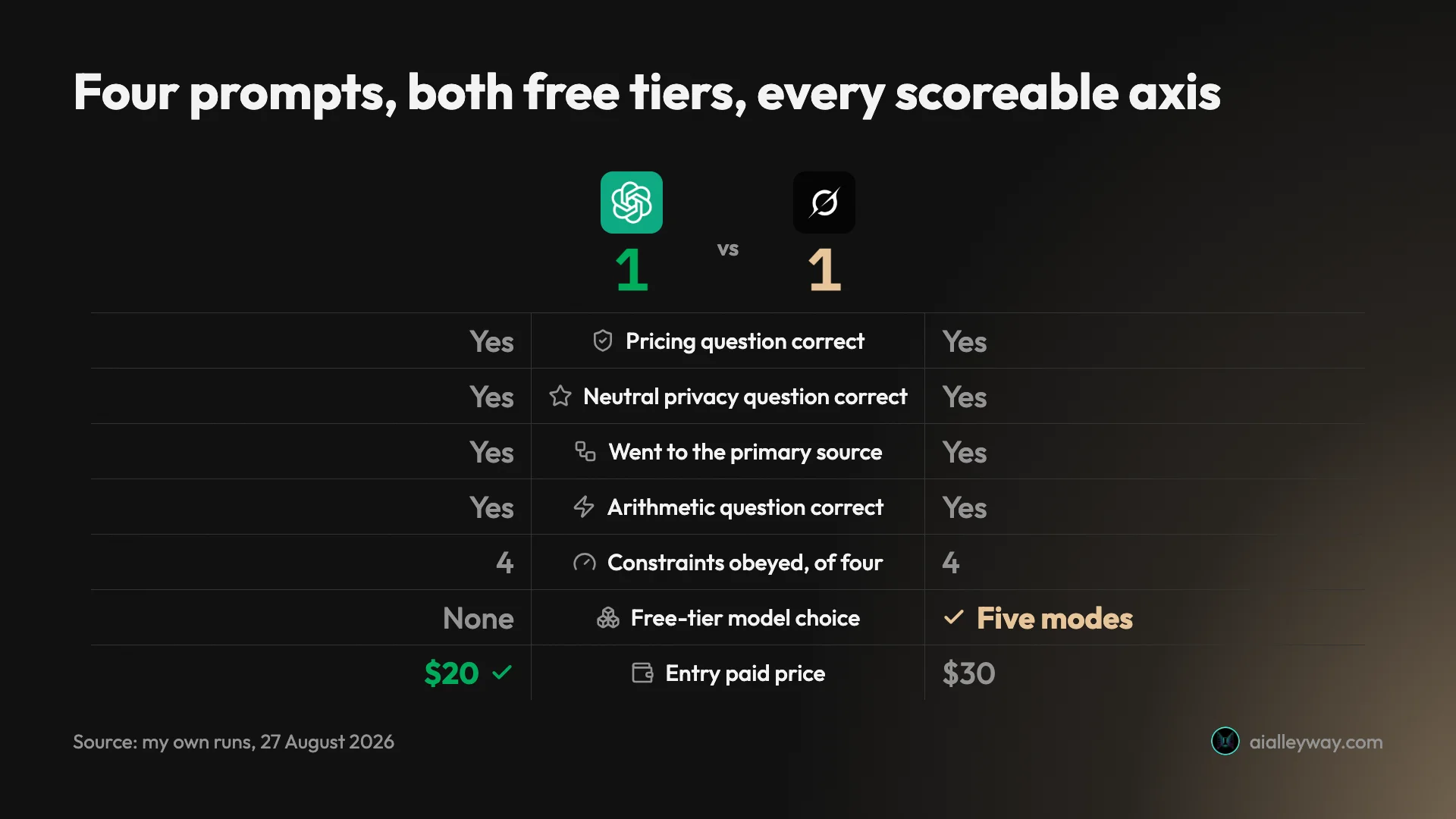
Every axis I could actually check, in one table
| Axis | ChatGPT | Grok |
|---|---|---|
| Free tier | Yes | Yes |
| Free model choice | None, one Think toggle | Five modes: Fast, Build, Auto, Expert, Heavy |
| Age confirmation to start | No | Yes, birth year |
| Entry paid plan | Plus, $20/mo | SuperGrok, $30/mo |
| Annual billing | Not offered on any individual plan | Yes, $300/yr |
| Tiers above the entry plan | Pro at $100 and $200 | None |
| Public pricing page | Yes | No, 404s |
| Correct on the pricing question | Yes | Yes |
| Correct on the neutral privacy question | Yes | Yes |
| Correct on the arithmetic question | Yes | Yes |
| Constraints obeyed, out of four | 4 | 4 |
| Word count on a 150-word ask | 158 | 140 |
Four of those rows are ties on the things people argue about. The interesting rows are the ones about the plan.
Test one: a pricing question most of the web gets wrong
How much does ChatGPT Pro cost, and how many Pro tiers are there?
This is a trap for stale sources. ChatGPT Pro is now two prices, $100 and $200, and a lot of page one still describes a single $200 plan. I know the right answer because I read OpenAI’s help centre at source when writing our ChatGPT Plus vs Pro guide.
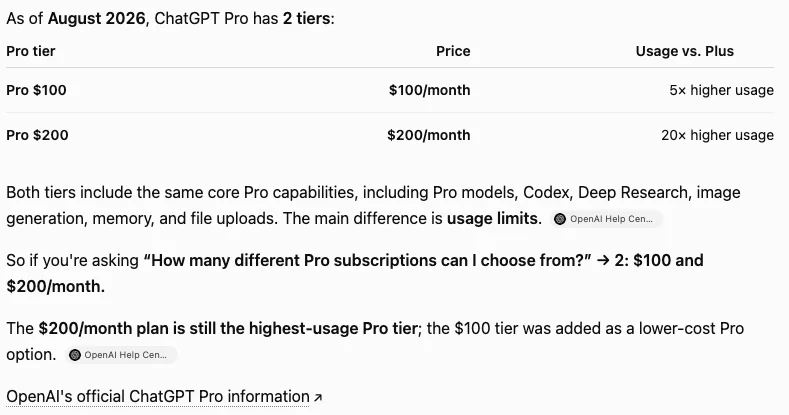
ChatGPT got it right, in a clean two-row table, and cited OpenAI’s help centre.
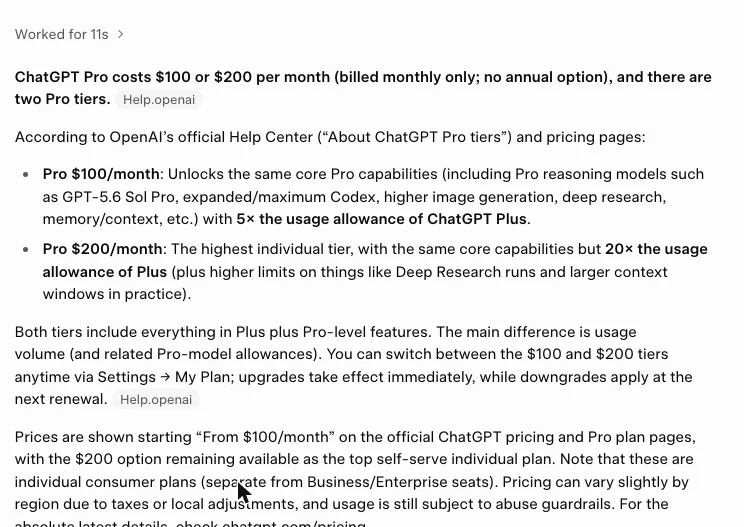
Grok got it right too, in 11 seconds, having opened OpenAI’s help-centre article and two pages on chatgpt.com directly.
Now the caveat that makes this test weaker than it looks. This is a question about ChatGPT, answered by ChatGPT. Getting your own pricing right is home turf, and it proves considerably less than the same answer from a rival does. I include it because it is the question that exposed how stale the third-party coverage is, not because it separates the two products. It does not.
The two answers were not identical, though, and the differences say something about how each one works. ChatGPT gave me a two-column table and a closing line noting that the $100 tier “was added as a lower-cost Pro option”, which is a piece of product history rather than a price. Grok gave prose, then volunteered three things ChatGPT did not: that billing is monthly only with no annual option, that the pricing page shows Pro as “From $100/month”, and that prices vary by region because of tax. All three are correct and all three are things a buyer would want.
That difference in completeness is the one thing separating them here, and it is worth noting which direction it runs in. On a question about OpenAI’s own product, the answer from OpenAI’s own assistant was the less complete of the two.
That is why the second test exists.
Test two: the same question about somebody else’s product
If I turn off Gemini Apps Activity in Google Gemini, does Google still keep my chats, and for how long?
Neither vendor owns this answer, which makes it the fair version of test one. The correct answer is 72 hours, and I know it first-hand: I found it on Google’s own settings screen and screenshotted it for our Gemini review.
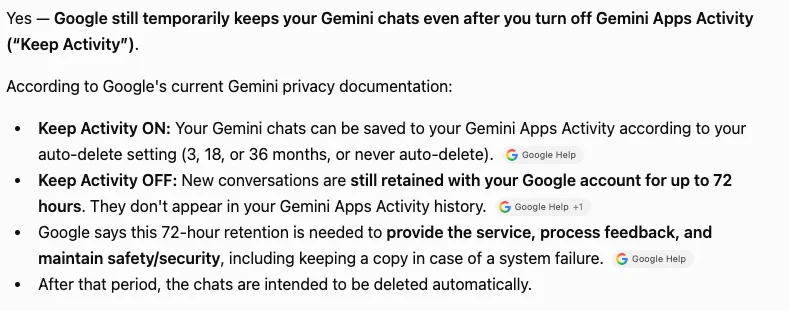
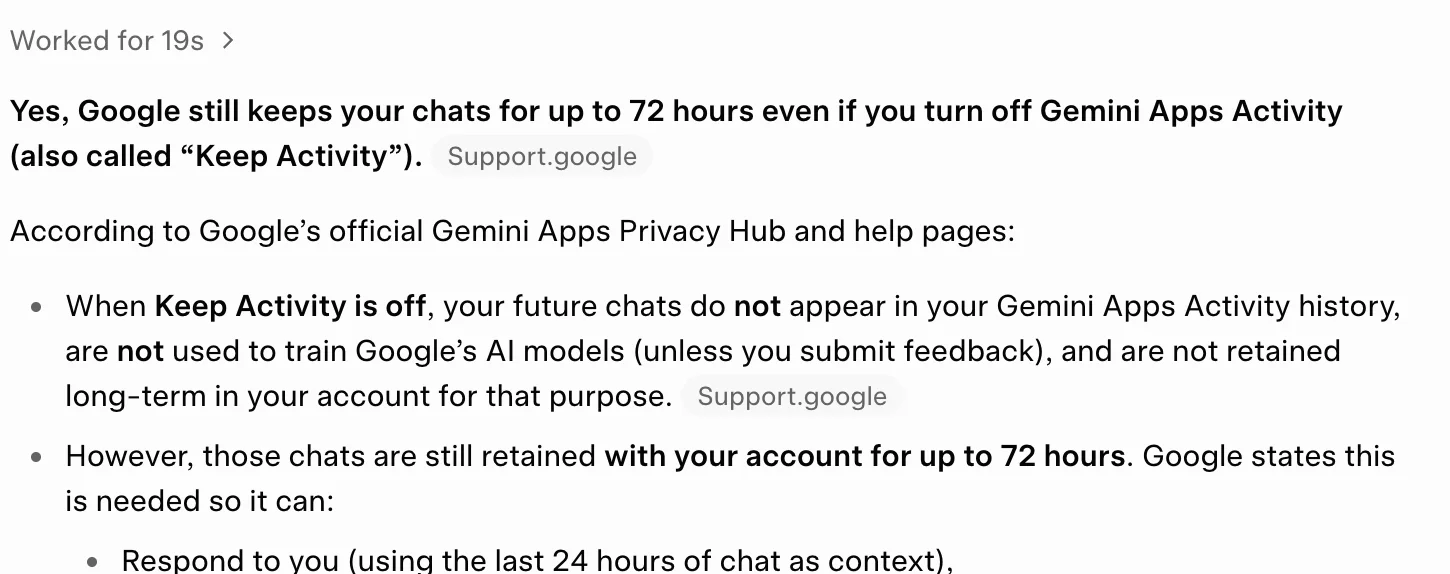
Both correct. Both at 72 hours. And both went to Google’s own documentation rather than to articles about Google — ChatGPT with citation chips reading Google Help, Grok by opening support.google.com/gemini/answer/13594961 and a second support page, across three searches and 27 sources in 19 seconds.
This result is worth sitting with, because it revises something. In the Claude vs Grok comparison, Grok’s habit of opening primary sources looked like Grok’s distinguishing feature, because Claude reached the same answer through third-party pricing roundups instead. Running the same shape of test against ChatGPT shows that primary-source retrieval is not a Grok superpower. ChatGPT’s free tier does it too. The gap I found last time was specific to Claude, not general to Grok.
Both went further than the number, too, and in the same direction. ChatGPT added a section headed “One important privacy detail” explaining that switching activity off does not mean Google never processes the conversations, and that human review can occur in some circumstances. Grok covered the same ground from Google’s Privacy Hub, listing why Google says the 72 hours are needed: to respond using recent chat as context, to process feedback, and to maintain safety and security.
Neither stopped at the reassuring half of the answer, which is the failure mode I was watching for. A tool that says “no, turning it off means off” would have been wrong in a way that matters, and neither did.
That is the sort of correction a second test buys you, and it is why one comparison is never enough. Our ChatGPT vs Gemini comparison covers the product this question was about, from accounts on both.
Test three: four writing rules, and the commas Grok deleted
Write 150 words on why a small team might pick a cheaper AI assistant. Rules: no bullet points, no em dashes, no sentence starting with “But”, and the last word must be “budget”.
Four constraints, all objectively checkable, no judgement call about whose prose is nicer.
| Rule | ChatGPT | Grok |
|---|---|---|
| No bullet points | Pass | Pass |
| No em dashes | Pass | Pass |
| No sentence starting with “But” | Pass | Pass |
| Last word is “budget” | Pass | Pass |
| Words delivered against 150 | 158 | 140 |
| Commas used | 12 | 0 |
Both scored four out of four. Neither broke a stated rule.
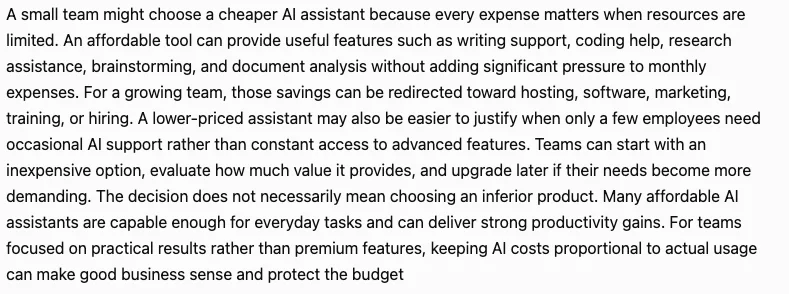
ChatGPT came in eight words over the brief and wrote normally punctuated prose.
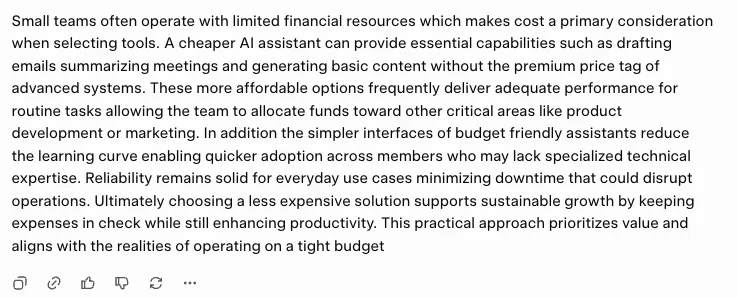
Grok came in ten words under, and did something peculiar: 140 words containing not one comma. Nothing in the prompt banned commas. The likeliest explanation is that it generalised the em-dash prohibition into avoiding punctuation broadly, which is a reasonable instinct applied too widely.
The output technically complies and reads breathlessly. If you are shipping the text to a reader rather than skimming it yourself, that is an editing pass ChatGPT’s version does not cost you. It is also the only quality difference I found across four prompts, and it is a tic rather than a capability gap.
Test four: is Grok better at maths than ChatGPT?
Google’s AI Overview credits Grok with “math tasks” as a core strength, so the fourth prompt tests exactly that, using numbers from this comparison:
A team pays $30 per seat per month for 7 seats. They switch to an annual plan costing $300 per seat per year. How much do they save or lose per year, and what is the percentage change? Show the arithmetic.
I can check this one exactly. Seven seats at $30 a month is $210 a month, or $2,520 a year. Seven annual seats at $300 is $2,100. The saving is $420, and $420 divided by $2,520 is one sixth, or 16.67 percent.
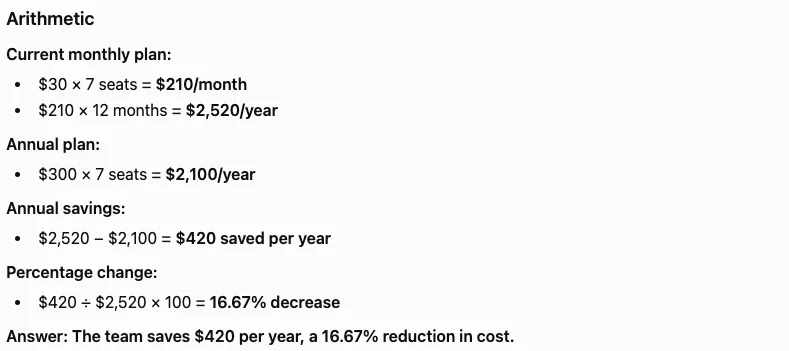
ChatGPT laid it out in plain arithmetic, step by step, and landed on $420 and a 16.67% decrease. Correct.
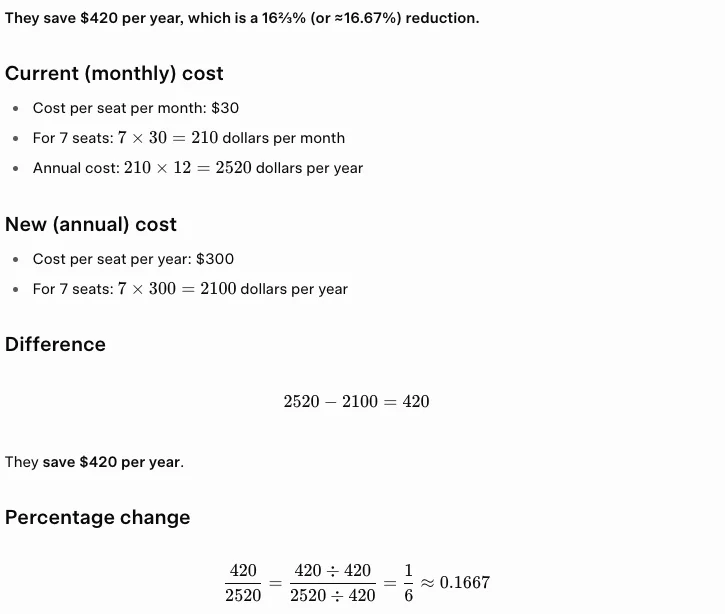
Grok landed on the same $420, expressed as “16⅔% (or ≈16.67%)”. Also correct, and its derivation is arguably the more elegant of the two: rather than dividing straight through, it reduced 420/2520 to 1/6 and converted from there.
So that is four out of four ties, and the reputation for Grok being the maths one did not produce a gap either. What it did produce is a presentation difference. Grok renders its working as typeset mathematics; ChatGPT writes it as plain text with bold. Which you prefer is genuinely a matter of taste, though the typeset version takes a beat longer to paint on screen, and mid-render it briefly showed unrendered markup before settling.
That last detail is worth one sentence of caution for anyone judging these tools quickly: I nearly recorded that flicker as a rendering bug. It was not. It was me looking before the answer had finished.
Which free tier gives you more, ChatGPT or Grok?
This is where the two genuinely diverge, and the result runs against the usual framing.

Grok’s free tier hands you a five-mode model picker: Fast on Grok 4.5, Build on Grok 4.6 marked beta, Auto which chooses between Fast and Expert, Expert which thinks harder, and Heavy, described as a team of experts.

ChatGPT’s free tier hands you no model choice at all. The composer has a Think toggle and nothing else. Our ChatGPT review documents the same thing from a year on that tier.
Two caveats on Grok’s side of that, because a picker is not an allowance. The presence of a mode does not prove unmetered access to it, and Grok’s own upgrade screen sells “smarter answers in Expert mode” as a paid benefit, which implies the free Expert is capped in some way the interface does not spell out. Grok also made me confirm my birth year before it would answer anything, a gate ChatGPT did not impose.
| Around the chat box, free tier | ChatGPT | Grok |
|---|---|---|
| Model choice | None | Five modes |
| Saved workspaces | Projects | Projects |
| Generated images | Images | Imagine |
| Kept outputs | Library | Not a sidebar entry |
| Runs on a schedule | Scheduled | Automations |
| Reaches other tools | Plugins | Skills and Connectors |
| Developer surface | Codex | Build mode in the picker |
The surfaces around the chat box differ too, and both sidebars are worth reading as statements of intent. ChatGPT’s carries Images, Library, Scheduled, Plugins, Projects and Codex — a product organising what you make and connecting to developer tooling. Grok’s carries Search, Imagine, Automations, Skills and Connectors, and Projects — a product reaching toward doing things in other applications, which is also what its paid pitch describes.
I did not test any of those surfaces, so read that as a description of two menus rather than a verdict on what sits behind them.
And one caveat on ChatGPT’s side that is not about models. Immediately after the writing answer, the free tier surfaced an inline panel offering to improve accuracy for writing and career work by upgrading. Grok’s upgrade prompts sat in the corner and stayed there.
ChatGPT vs Grok on price: two shapes, not two numbers
Two different shapes, and which is cheaper depends entirely on where on the ladder you stand.
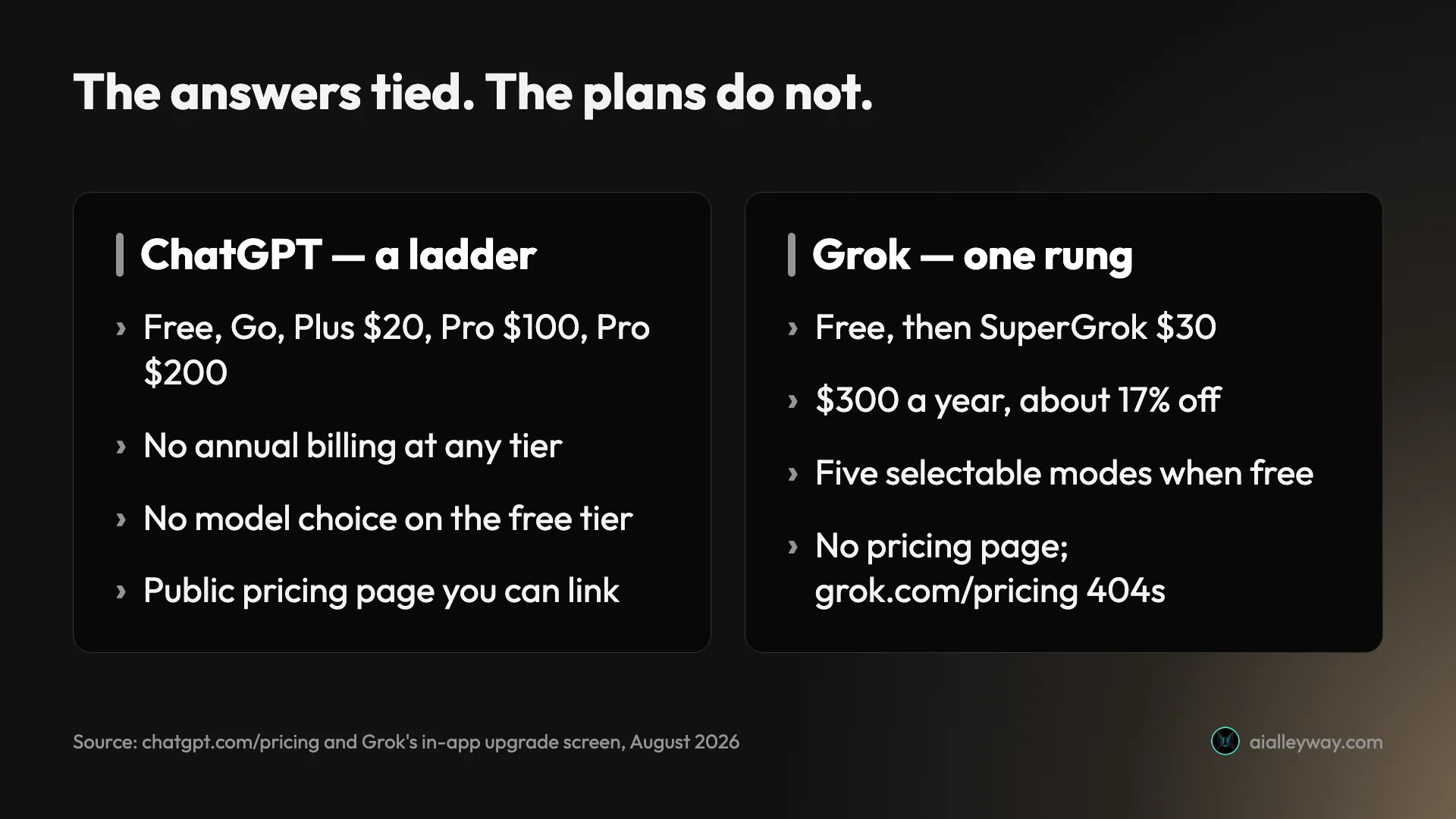
ChatGPT Plus is $20 a month. SuperGrok is $30 a month, or $300 a year. At the entry paid rung SuperGrok costs half again as much as ChatGPT Plus. That $10 gap is the single biggest number in this comparison and the one most likely to decide it.
Grok wins the discount, though. $300 a year against $30 a month saves $60 across twelve months, a reduction of 16.67 percent. That is the same one sixth as the seat arithmetic above, which is not a coincidence, because it is the same discount. ChatGPT offers no annual billing on any individual plan — not Go, not Plus, not Pro — so a year of Plus costs exactly twelve times $20 with no lever to pull. Our ChatGPT Plus vs Pro guide covers what that ladder looks like further up, including the $100 tier most comparisons still miss.
Above $30 the two stop being comparable. ChatGPT keeps going to Pro at $100 and $200 a month. Grok has nothing above SuperGrok for an individual, so if your usage outgrows one plan there is nowhere to go.
There is also a difference in how findable any of this is. ChatGPT has a public pricing page. grok.com/pricing returns a 404, and SuperGrok’s price lives behind the in-app upgrade screen, which is why the figures above come from a screenshot rather than a URL I can send you.
One observation offered as an observation. Grok showed me its prices in US dollars. ChatGPT’s pricing page, opened from the same machine on the same day, geo-locked to my local currency and never showed a dollar figure at all. I am not converting anything or calling one approach better; it is simply worth knowing the price you see depends on the vendor’s choice as much as on the plan.
Is Grok actually faster than ChatGPT?
Grok reported 11 seconds on the pricing question and 19 on the Gemini one. ChatGPT does not surface a timer, so I have no comparable figure for it, and I am not going to estimate one from a stopwatch.
What I can say is that no answer in eight runs made me wait in a way that would change how I work. The “Grok is dramatically faster” framing did not show up as anything I noticed.
Where the two differ visibly is in what they show you while they work. Grok prints a browsing trace: searches run, pages opened by URL, a note about what it is confirming. You can audit the sources before you read the conclusion. ChatGPT shows citation chips attached to claims after the fact, which tells you what backed a sentence but not what it looked at and rejected.
For checking a fact, the browsing trace is the more useful of the two, and it is the clearest practical win Grok posted across the whole test.
The case for ChatGPT
You want a plan above $30. This is the strongest case and it is structural. ChatGPT has rungs at $20, $100 and $200; Grok stops at $30. If your usage grows, only one of these products has somewhere to put you.
You want the cheaper paid entry. $20 against $30 is a third less for the tier most people actually buy.
Your output goes straight to a reader. Not because ChatGPT is smarter, but because it did not strip the commas out of its prose.
You want your working files and outputs organised. Library, Projects and Scheduled are all on the free tier, and the product is visibly built around keeping what you make rather than only answering and moving on.
Skip it if what you want is model choice without paying. On that specific measure the free tier is the weaker of the two, and it is not close.
Skip it also if you were expecting the reputation to translate into better answers than Grok’s. Across four prompts it did not, and paying $20 buys you a ladder and a tidier product rather than a smarter one at the free tier.
The case for Grok
You are not going to pay. The five-mode free picker is the most generous thing either product does for a non-paying account, and it is the clearest reason to open Grok.
You want to see the sources before the answer. The browsing trace is genuinely better than citation chips for checking work.
You want to commit for a year. $300 annually is the only discount on the table, and ChatGPT has no equivalent at any tier.
You want the more complete answer on vendor questions. On the one prompt where the two answers differed in substance rather than style, Grok volunteered the billing constraint, the “From” presentation and the regional variation, and ChatGPT did not.
Skip it if you expect to outgrow $30 a month. There is no tier above SuperGrok for an individual, and no public pricing page to plan against.
Skip it also if you need to justify the spend to somebody else. A plan with no public pricing page is genuinely harder to put in front of a finance team than one you can link to, and that is a real friction rather than a quibble.
Final word
The consensus framing for this comparison is that ChatGPT is the polished generalist and Grok is the fast one with the live data. Across four prompts on two free accounts, I could not make either half of that stick. Both got a stale-source pricing question right. Both got a neutral privacy question about a third product right, and both went to that vendor’s own documentation to do it. Both did the arithmetic correctly. Both followed four writing constraints exactly.
When the answers tie, you are not choosing between intelligences. You are choosing between plans. On that basis: ChatGPT Plus at $20 for anyone who is going to pay, because it is a third cheaper at the entry rung and it is the only one of the two with anywhere to go above $30. Grok’s free tier for anyone who is not, because five selectable modes beats no model choice at all.
The one thing I would not choose on is the reputation gap. It did not survive the test.
For the third assistant in this conversation, Claude vs Grok runs two of these same prompts against Claude and finds a genuine difference in sourcing, and ChatGPT vs Claude covers the two $20 plans most people are actually deciding between.
Frequently asked questions
Is Grok better than ChatGPT?
On the four prompts I ran through both free tiers, neither was better. They tied on everything I could score.
Both answered a pricing question correctly that most of page one of Google still gets wrong. Both answered a privacy question about a third product correctly, and both cited that vendor's own support pages rather than articles about it. Both obeyed all four rules on a constrained writing task.
That is a genuinely boring result and it is the honest one. Four prompts run once each cannot separate two products that are this close on output quality.
Where they do differ is structural rather than intellectual. Grok's free tier hands you a five-mode model picker; ChatGPT's gives you no model choice at all. Grok's paid plan can be billed annually; none of ChatGPT's individual plans can. Those differences are stable and checkable, which is more than most comparisons of these two can say.
Which is cheaper, ChatGPT or Grok?
ChatGPT, at the entry paid tier, and it is not close. ChatGPT Plus is $20 a month against SuperGrok at $30, so Grok's cheapest paid plan costs half again as much as ChatGPT's.
Grok wins the shape of the discount, though. SuperGrok bills at $300 a year against $30 a month, which saves $60 across twelve months, a reduction of 16.67 percent. ChatGPT offers no annual billing on Go, Plus or Pro at all, so a year of Plus costs exactly twelve times $20.
Above the entry rung the comparison stops being like-for-like. ChatGPT keeps climbing to Pro at $100 and $200 a month, which our ChatGPT Plus vs Pro guide untangles. Grok has no consumer tier above SuperGrok.
So: cheaper to start on ChatGPT, cheaper to commit on Grok, and only ChatGPT sells you anything above $30.
Does Grok or ChatGPT have a better free tier?
Grok, on the specific measure of what you can choose, and it surprised me.
A free Grok account opens a model picker with five entries: Fast on Grok 4.5, Build on Grok 4.6 in beta, Auto, Expert on Grok 4.5, and Heavy. A free ChatGPT account has no model picker whatsoever. The composer offers a Think toggle and nothing else.
That is a real difference in what a non-paying user can reach, and it runs against the usual framing where ChatGPT is the generous default and Grok is the upstart.
Two caveats. The presence of a mode in Grok's picker is not proof of unlimited use of it, since Grok's own upgrade screen sells smarter Expert answers as a paid benefit. And Grok made me confirm my birth year before it would answer anything, which ChatGPT did not.
Which is better for writing, ChatGPT or Grok?
Neither broke a rule, so the honest scoreboard is a tie, and the difference is in what I did not ask for.
I gave both free tiers 150 words with four constraints: no bullet points, no em dashes, no sentence starting with the word But, and a mandatory final word. Both obeyed all four.
On length, ChatGPT was closer to the brief at 158 words against Grok's 140. On punctuation, something odd happened to Grok. Its 140 words contained no commas at all, where ChatGPT's contained twelve. Nothing in the prompt banned commas, so the likeliest reading is that Grok generalised the em-dash rule into avoiding punctuation broadly.
The result is prose that technically complies and reads breathlessly. If you are handing the output straight to a reader, that artefact costs you an editing pass that ChatGPT's version does not.
Is Grok's real-time data an advantage over ChatGPT?
Less than the marketing implies, on what I observed, because ChatGPT did the same thing.
I asked both a question about a third product: whether Google keeps your Gemini chats after you switch activity history off. Grok ran three searches and opened Google's own support pages. ChatGPT also answered from Google's help documentation, with citation chips pointing there.
Both returned the correct answer, which is 72 hours, and I know it is correct because I verified it first-hand against Google's own settings screen when writing our Gemini review.
So on a neutral factual question, both went to the primary source and both got it right. Grok's advantage on live data is real in the sense that it retrieves and shows its work clearly. It is not the differentiator that comparison articles make it, at least not against ChatGPT.
Can ChatGPT's free tier search the web?
Yes. On both factual prompts I gave it, the free tier retrieved and cited rather than answering from memory alone.
Asked about ChatGPT Pro pricing it cited OpenAI's help centre. Asked about Gemini's retention behaviour it cited Google Help, with several separate citation chips through the answer.
Worth flagging the first of those two as a weak test. A question about ChatGPT's own pricing is home turf for ChatGPT, and answering it correctly proves less than it looks like it does. The Gemini question is the fairer one because neither vendor owns the answer, and ChatGPT handled it just as well.
What the free tier does not give you is model choice. Retrieval works, the Think toggle is there, and the model behind it is whatever OpenAI has decided a free account gets that day.
Keep reading
ChatGPT Plus vs Pro: there are now three prices, not two
ChatGPT Plus costs $20; Pro is $100 or $200. OpenAI publishes the 5x and 20x multipliers but never the base they multiply, and only one tier is a discount.
ChatGPT review: the free tier is the story, not the $20 one
A ChatGPT review from a year on the free tier plus one month of Plus. Five rungs from $0 to $200, and ads now run on both the Free and $8 Go tiers.
ChatGPT vs Gemini: the free tier decides this one
ChatGPT vs Gemini, both tested on free accounts. One hands a non-paying user its advanced reasoning model; the other will not let you pick a model at all.
ChatGPT vs Claude: one writes, one does everything else
ChatGPT vs Claude, from a paid Claude account and a year on ChatGPT free. Both $20, but the free tiers differ far more — and only one generates images.