
ChatGPT vs Claude: one writes, one does everything else
ChatGPT vs Claude, from a paid Claude account and a year on ChatGPT free. Both $20, but the free tiers differ far more — and only one generates images.
Contents
ChatGPT vs Claude: the verdict at a glance
| Winner | Why | |
|---|---|---|
| Best for writing | Claude | Holds a negative instruction to the end of a long document, where ChatGPT reverts to a bulleted house style |
| Best for everything else | ChatGPT | Images, voice, a coding agent, a work agent, deep research and custom GPTs on one $20 plan |
| Best overall value | ChatGPT | The strongest free tier in the category, and the broadest paid one at the same $20 as Claude Pro |
Both cost $20 at the tier most people buy. The difference is not price, it is shape: ChatGPT is a wide product with a good writer inside it, and Claude is an excellent writer with a narrow product around it.
That framing does more work than any feature table, because it predicts the answer for most people without needing one. I reached it by reviewing both separately first, at length: the ChatGPT review and the Claude AI review carry the evidence this comparison rests on. If your week contains several different kinds of task, breadth wins. If your week is one task done well, the specialist wins.
It also explains why so many people end up with both, and why that is less irrational than $40 a month sounds. The overlap between them is smaller than their marketing implies.
One note on how people search for this. Claude vs ChatGPT and ChatGPT vs Claude are the same question asked from opposite starting points, and the order usually reveals which one you already use. If you arrived here from Claude wondering what you are missing, the answer is images, voice and breadth. If you arrived from ChatGPT, it is prose.
How do ChatGPT and Claude compare, axis by axis?
| Axis | ChatGPT | Claude |
|---|---|---|
| Entry paid tier | $20/mo Plus | $20/mo Pro, or $17 billed annually |
| Cheapest paid rung | $8 Go (US price), carries advertising | None below Pro |
| Free tier | Unlimited text chats, everything else metered | Assistant only; no Projects, no model choice |
| Free model choice | None, core model only | None |
| Paid model choice | Advanced models on Plus | Four models plus a five-step effort dial |
| Image generation | ✓ | ✗ |
| Voice mode | ✓ | ✗ |
| Coding agent included | ✓ Codex | ✓ Claude Code |
| Usage limits published | ✗ comparatives only | ✗ percentages only, but a live meter |
| Overflow when you run out | Wait, or upgrade | Buy credits at standard API rates |
| Writing quality | Competent, drifts to a house style | The best available |
| Ads in a paid tier | Yes, on Go | No |
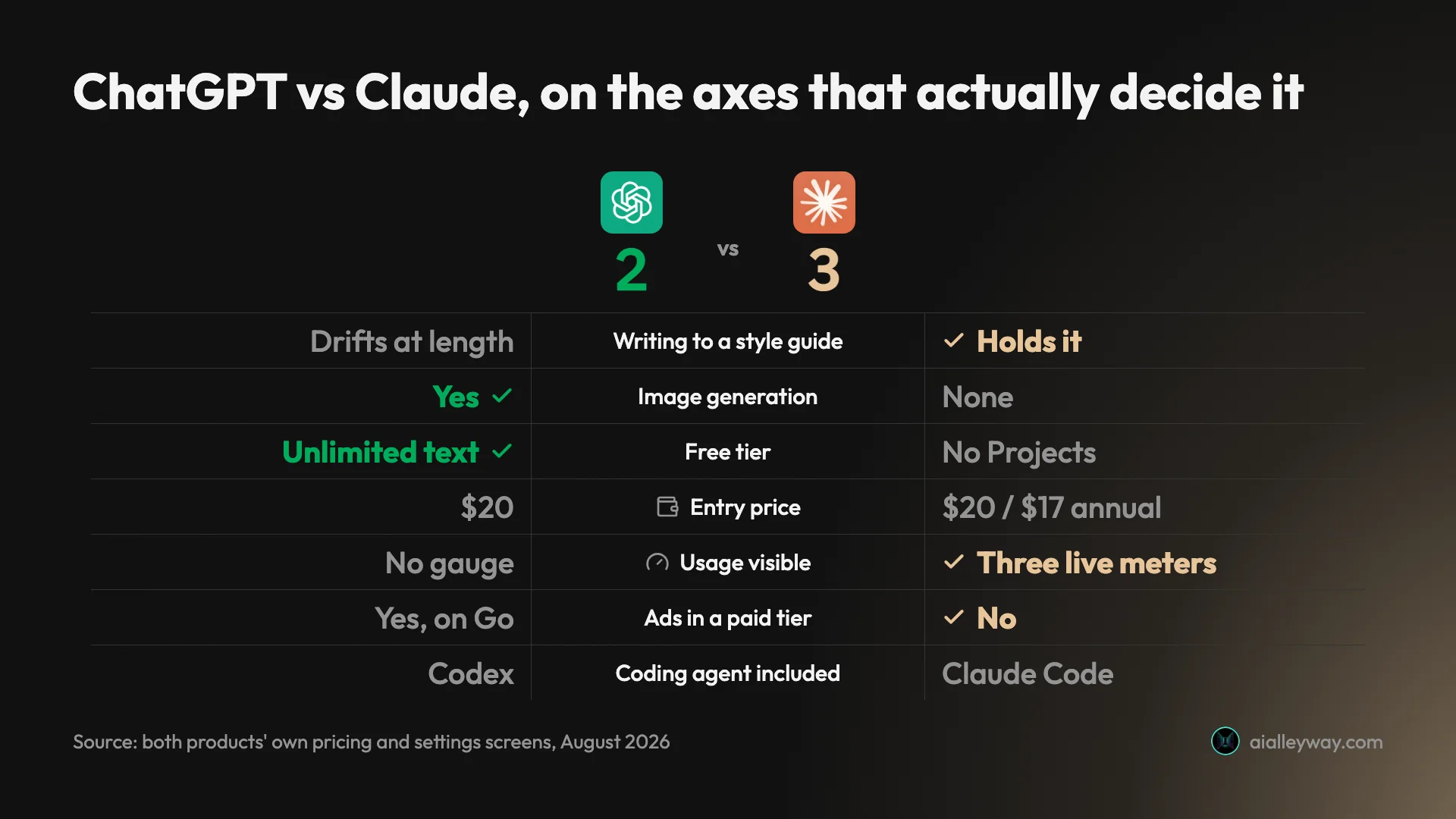
Two rows in that table decide most purchases. Image generation, which Claude does not do at all, and writing quality, which Claude does better than anything else I use. Almost everyone lands on one side or the other of those two.
Everything else on that list is a tiebreaker rather than a decider. The pricing is near-identical, both bundle a coding agent, and neither will tell you what your usage limits actually are. If you find yourself weighing the annual discount or the effort dial, you have probably already decided on capability and are looking for permission.
The one row I would not skip past is the last. Advertising inside a paid tier is a small thing today and a direction of travel, and it is worth knowing that only one of these two companies has started down it.
What is ChatGPT good at, and where does it fall short?
ChatGPT’s strength is coverage: images, voice, a coding agent, a work agent, deep research and custom GPTs on one $20 plan, over the strongest free tier in the category. Its weaknesses are prose that drifts to a house style at length, a five-rung ladder described only in comparatives, and advertising on the $8 tier.
Strengths
- Breadth nothing else matches at $20. Image generation, voice, the Codex coding agent, a work agent for multi-step tasks, deep research and custom GPTs, all on Plus. Assembling that from best-of-breed tools would be three subscriptions.
- The best free tier of the two by a distance. OpenAI describes free text chats as unlimited subject to abuse guardrails, and meters the expensive things around them rather than removing them.
- Everyone already knows how to use it. Familiarity is a real feature that reviews undervalue: a custom GPT is something you can hand to a colleague who has never configured an AI tool.
- The widest integration surface. The plugin directory reaches Gmail, GitHub, Drive, Calendar, Notion, Slack, Linear and more, and it is available on the free tier.
Gaps
- The prose is serviceable, not publishable. It lands on a recognisable structure — headers, bullets, a faintly eager register — and negative instructions lapse once the material gets difficult.
- Five rungs, described in comparatives. Free, Go, Plus, Pro at two multipliers, Business. More messages, longer memory, expanded memory, maximum memory. None of those is a quantity.
- Advertising at $8 (US). Go is the only tier in either product where you pay and still see ads, which is a direction worth watching rather than a detail.
- No model choice on the tier most people use. Free runs the core model with no picker, so most people’s impression of ChatGPT is formed on the model OpenAI gives away.
I went through all of this in detail in the ChatGPT review.
What is Claude good at, and where does it fall short?
Claude’s strength is writing that holds a brief, backed by a model picker with a thinking-budget dial, Projects caching that takes work off the meter, and the only live usage gauge of the two. Its weaknesses are no image or video generation at all, no published limits, and an overflow priced at API rates.
Strengths
- The best writing available. It holds a style guide with prohibitions in it deep into a long draft, which is the specific thing every rival loses. The difference shows up as editing time rather than as a demo.
- A model picker with a thinking-budget dial. You choose both which model answers and how hard it thinks, and Anthropic tells you plainly that the second choice consumes your limits faster. ChatGPT gives you a Think toggle and no such warning.
- Projects caching genuinely buys headroom. Content stored in a Project is cached and does not count against your limits when reused, which is the only documented way to take work off the meter.
- A live usage meter. Three bars showing a rolling session, a weekly all-models cap and a separate weekly cap for the top model. ChatGPT gives you no equivalent gauge.
Gaps
- No image generation and no video. The largest single capability gap between the two, and the reason Claude is often a second subscription rather than a first.
- No numeric limits anywhere. Anthropic’s own help centre lists seven factors that consume your allowance and states not one message count or token budget for any plan.
- Overflow priced at API rates. Exhaust a plan and you can buy credits to keep going, on a meter rather than a flat fee. The price section below works through what that costs.
- The sticker is not the bill. Every figure on Anthropic’s pricing page is pre-tax, so the number you are quoted is not the number that reaches your card. There is a receipt in the price section.
The full write-up is in the Claude AI review.
ChatGPT vs Claude pricing: where does the $20 actually differ?
At the tier most people buy, they cost the same. ChatGPT Plus is $20 a month; Claude Pro is $20 a month. That is where the symmetry ends.
Claude is cheaper if you commit for a year. Pro drops to an effective $17 a month, billed as $200 up front, saving $40 against twelve months at $20. ChatGPT has no equivalent discount on Plus, so an annual buyer pays $240 for the year.
ChatGPT has a rung below that Claude does not: Go, at $8 a month in the US. I would not buy it. It carries advertising, which OpenAI frames as what keeps ChatGPT available at free and affordable price points, and it still runs the core model rather than the advanced ones. It solves volume without solving capability, and the $12 gap to Plus buys both the better models and the absence of ads.
Above that the two converge again. ChatGPT Pro starts at $100 with a $200 tier; Claude Max runs $100 for 5x and $200 for 20x.
Over a year the gap at the standard tier is small and real. ChatGPT Plus at $20 a month is $240. Claude Pro billed annually is $200. Claude Pro billed monthly is also $240. So the only way either product is cheaper than the other at this tier is if you commit to Claude for twelve months, and the saving is $40.
That is not enough to decide anything, which is the point worth making. People choose between these two on capability, and the pricing pages are close enough to be noise.
| Tier | ChatGPT | Claude |
|---|---|---|
| Free | $0 | $0 |
| Cheapest paid | $8 Go (US price), with ads | Not offered |
| Standard | $20 Plus | $20 Pro, or $17 annual |
| Heavy | From $100 Pro | $100 Max 5x |
| Heaviest | $200 | $200 Max 20x |
The two costs that are not on the pricing page
Two costs sit outside every one of those numbers, and they fall differently on each product.
The first is tax. Claude’s pricing page is pre-tax and says so in small print, which is how a $100 Max plan arrives as a $111.11 invoice. That is not unique to Anthropic, but it is the one I have a receipt for.
The second is overflow, and here the products genuinely diverge. Run out on ChatGPT and you wait or upgrade. Run out on Claude and you can buy usage credits billed at standard API rates — $5 per million input tokens and $25 per million output on Opus 5. That is a different pricing world bolted onto a consumer subscription, with a monthly cap you set yourself and a $2,000 daily redemption ceiling.
What $20 of overflow credit buys
Here is what $20 of credit actually buys, so the comparison is concrete rather than abstract.
| Claude model | Output per million tokens | What $20 of credits buys |
|---|---|---|
| Fable 5 | $50 | 400,000 output tokens |
| Opus 5 | $25 | 800,000 output tokens |
| Sonnet 5 | $10 | 2,000,000 output tokens |
| Haiku 4.5 | $5 | 4,000,000 output tokens |
At Anthropic’s own rule of thumb of roughly 0.75 words per token, $20 on Opus 5 is somewhere near 600,000 words of output. That is not bad value in isolation. The point is that it arrives per token on a product you bought for a flat monthly fee, and ChatGPT has no equivalent mechanism at all: run out there and you wait.
Whether that is a feature or a trap depends entirely on whether you notice it is happening. I keep the running figures for the whole category in the AI tool cost statistics.
Where does the quality gap between ChatGPT and Claude show up?
This is the axis people actually argue about, and the honest answer is that it splits cleanly by task.
On writing, Claude wins and the margin is not close enough to argue about. The test that separates them is not a prompt, it is a constraint: give both a style guide with prohibitions in it — banned words, a punctuation cap, no unsolicited bullet lists — and see which one still respects it in the fourth section of a long draft. Claude does. ChatGPT complies for a while, then reverts to its house structure once the material gets complicated.
That failure mode matters more than it sounds because it is invisible in a demo. Both produce good first paragraphs. The difference appears at length, which is exactly where a short comparison test would miss it — and where most published comparisons of these two stop looking.
I ran a compressed version of exactly that test against Grok as well, with four explicit constraints instead of three, and Claude and Grok both obeyed all four. The write-up is in Claude vs Grok, along with the sourcing difference that turned out to matter more than the rule-following.
If you want to run the test yourself it takes ten minutes and no subscription. Write three prohibitions you actually care about: a word you never want to see, a structure you dislike, and a tone. Give both free tiers the same 1,200-word brief with those rules attached. Read the last third of each draft, not the first.
Positive instructions are easy for any model, which is why demos favour whichever one you are being sold. Prohibitions are the hard part, because respecting them requires holding something in view while doing something else. That is the axis these two genuinely separate on.
| Task | Better | How much better |
|---|---|---|
| Long-form writing to a style guide | Claude | Clearly, and it widens with length |
| Drafting something short and factual | Either | Not worth choosing on |
| Reasoning through a hard problem | Either | Close; both expose a thinking control |
| Working across a long document | Claude | Projects plus the caching exemption |
| Making an image | ChatGPT | Claude cannot do it at all |
| Holding a spoken conversation | ChatGPT | Claude has no voice mode |
| Multi-file code in an existing repo | Claude | Claude Code is the stronger agent |
| Quick scripting and debugging | ChatGPT | Codex is fine and arrives free with Plus |
Where breadth beats writing quality
On breadth of capability, ChatGPT wins by default, because a large part of what it does Claude does not attempt at all. Image generation, voice conversation, a work agent for multi-step tasks. You cannot compare quality on a feature one product does not have.
On reasoning the two are close enough that I would not choose between them on it, and both expose controls for it: ChatGPT has a Think toggle, Claude has a five-step effort dial from Low to Max.
Claude’s is the more informative of the two, because the interface tells you what the setting costs you in usage. ChatGPT lets you ask for more thinking without saying what it spends, which on a metered free tier means adjusting a dial with no gauge attached.
There is a second-order effect worth naming. Because ChatGPT’s free tier has no model picker at all, most people’s impression of what these tools can do is formed on whatever OpenAI serves by default. Claude’s free tier has no picker either, so the same applies — but Claude’s free tier is a smaller product to begin with, so fewer people form their impression there.
What the public ratings do and do not tell you
The public ratings are worth mentioning only to dismiss them. On Trustpilot, chatgpt.com scores 1.6 and claude.ai scores 1.5. Every major assistant sits in that band — Gemini 1.5, Perplexity 1.5, Grok 1.4 — which tells you the score measures self-selected complaint traffic rather than the products. Software directories tell the opposite story, with ChatGPT around 4.7. Neither number distinguishes these two from each other.
Claude vs ChatGPT day to day: which is nicer to live with?
The daily experience diverges most in two places: what you can control, and what you can see.
Control favours Claude on paid plans. You can tune what answers you and how deeply, and Projects hold files and instructions across conversations with the caching exemption attached. ChatGPT Plus gives you advanced models and custom GPTs, which is a different kind of control — configuration rather than tuning.
On the free tier the positions reverse. ChatGPT free is a fuller product: the plugin directory, Images, Library and Projects are all reachable, with usage metered rather than features removed. Claude free is the assistant without Projects, Claude Code, Cowork, Design, Science or Research.
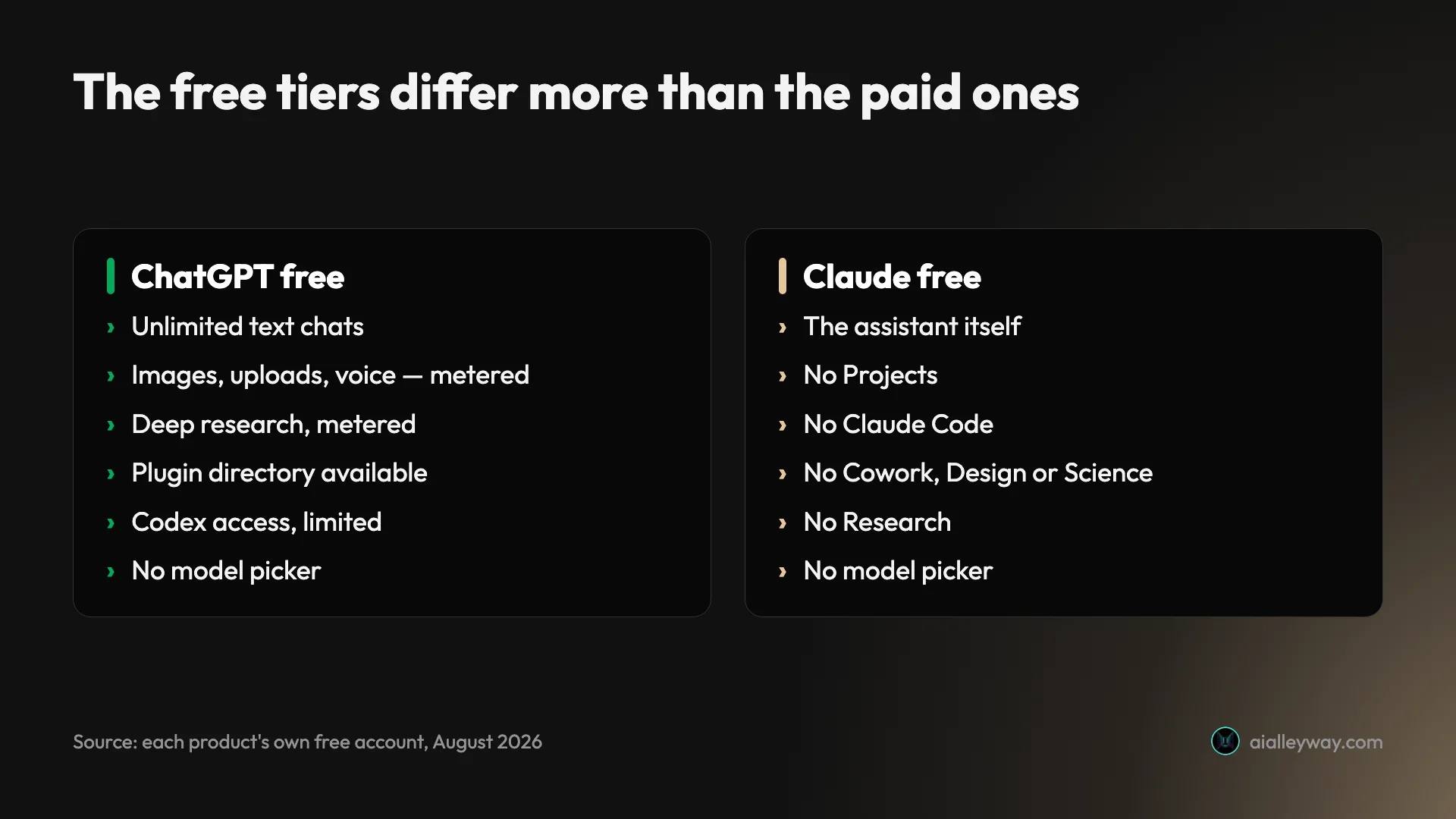
The practical consequence is that the two free tiers teach you different things. ChatGPT’s teaches you what the product does, because most of it is reachable. Claude’s teaches you how the model writes, because that is nearly all of what you get.
Neither is wrong, and if you are evaluating both, that difference should shape how you spend the fortnight: use ChatGPT free to test breadth and Claude free to test prose.
Visibility favours Claude everywhere. Its usage screen shows three live bars: a rolling session that resets on its own clock, a weekly cap across all models, and a separate weekly cap for the top model. You can see that you are at 5% of a session and 22% of a week at the same moment, which is exactly the difference between planning your week and guessing at it.
ChatGPT has no equivalent gauge. You find your ceiling by colliding with it mid-task, which is the single most irritating thing about the product and the easiest for OpenAI to fix.
Memory, and one unusually aggressive feature
Both remember you across conversations, and Claude ships one control ChatGPT does not: an option to import memory from another AI provider, generating a prompt you run inside a rival’s account to pull your context across.
Switching costs are the only real defence either company has, and that feature exists to demolish somebody else’s. For a buyer it removes the honest objection to trying Claude, which is that your current assistant already knows you.
What each does with your data
The two disclose differently, and both are worth two minutes on day one.
| ChatGPT | Claude | |
|---|---|---|
| Training toggle | Yes, single switch | Yes, single switch |
| Retention if training on | Not stated in-product | Five years |
| Retention if declined | Not stated in-product | 30 days |
| Data export | Yes | Yes, see note |
One note on that last row, because the two cells do not have equal backing. ChatGPT’s export is documented in its review; Claude’s is not. I saw an Export data control on Claude’s Privacy screen while researching that piece and it never made it into the write-up, so treat the Claude cell as my observation rather than as something you can check against the linked review.
Claude’s numbers are the more specific, which cuts both ways: five years is a long window, and at least you are told. ChatGPT’s Data controls screen is the more complete surface, with per-app sharing, archive and delete-all, and a set of safety controls including parental ones that I have not seen an equivalent of on Claude’s privacy screen.
Both include a coding agent
One workflow fact applies to both and surprises people: each bundles a coding agent into the same subscription. Codex arrives with ChatGPT, Claude Code arrives with Claude Pro and above. If you write code as part of a broader job, both $20 plans are denser than they look, and I compared the agents themselves in best AI for coding.
Who should pick ChatGPT?
- Anyone buying exactly one AI subscription. Breadth beats a narrow edge when you cannot justify a second tool, and ChatGPT covers writing adequately while covering everything else well.
- People who need to make images. This decides it on its own. Claude does not generate images, so any workflow that includes producing them makes ChatGPT the only single-subscription answer.
- Anyone who has not paid for an assistant yet. The free tier is the best trial in the category because it is not a trial: no countdown, no card, and a real product underneath.
- Teams sharing workflows. Custom GPTs are shareable by link and land with people who have never configured an AI tool, which nothing on Claude’s side matches.
- Students and researchers on no budget. Deep research and file uploads are both present on the free tier, metered rather than withheld, which makes it the cheapest serious research assistant available.
- Not for you if prose quality is the output. ChatGPT will get you 80% of the way and the last 20% is the part that takes the time.
Who should pick Claude?
- Anyone whose output is read by other people. If prose carries your name, the writing gap is the whole decision and it repays the subscription in editing time.
- People working with long documents. Contracts, research papers, transcripts. Put the document in a Project and the caching exemption stops it costing you allowance on every follow-up question.
- Developers who want the stronger agent. Claude Code is the tool I reach for on multi-file work in an existing repository, and it comes with the same $20 plan — I put that to a fortnight of real work in is Claude Code worth it.
- Anyone who wants to see their usage. If being able to plan around a limit matters more to you than having more features, Claude is the only one of the two that shows you the meter.
- People switching from another assistant. The memory import is aimed squarely at you, and it removes the main reason people stay somewhere they have outgrown.
- Not for you if your work includes making images, or if a per-token overflow bill on a flat subscription is something you would rather not have available at all.
Final word
For most people, ChatGPT. It is the broader product at the same price, its free tier is genuinely the best in the category, and the writing gap only matters if writing is what you are buying rather than something you do on the way to something else.
For anyone who writes for a living, Claude, and the gap is large enough that I would pay the $20 even as a second subscription. That is the arrangement a lot of people quietly end up in, and I do not think it is a failure of decision-making.
The reason is that the two products are drifting apart rather than converging. ChatGPT keeps adding surfaces — a coding agent, image models, a marketplace of custom assistants — while Anthropic keeps refining the thing it is already best at. Two years ago these were near-identical chat boxes. They are not any more, and the trend says they will overlap less next year, not more.
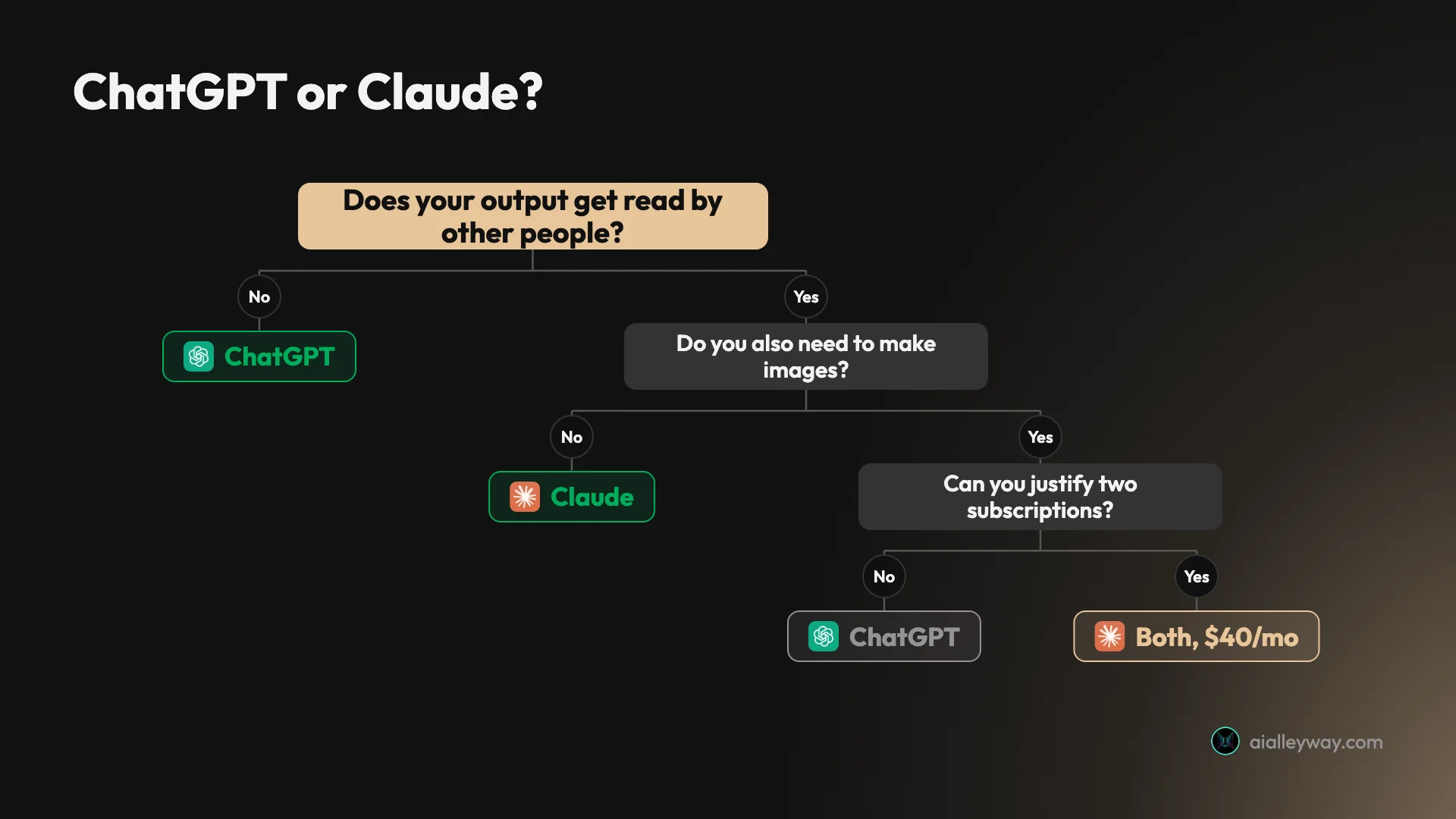
If you are undecided, the cheapest way to settle it costs nothing. Run ChatGPT’s free tier as your daily assistant for a fortnight and Claude’s free tier alongside it for the writing specifically. If neither settles it, the other two assistants I have reviewed at length are Gemini and Perplexity.
Three things to watch while you do it:
- Which ceiling you hit first on ChatGPT. If it is images or uploads rather than text, that tells you what you would actually be buying with Plus.
- Whether Claude’s drafts come back needing structural notes or a rewrite. That is the difference the whole writing argument rests on.
- Whether you reach for one of them without thinking. Habit is a better signal than any feature comparison, and it forms inside two weeks.
The free tiers differ more than the paid ones do, so you will learn more from that fortnight than from any comparison table, including this one.
Frequently asked questions
Is ChatGPT or Claude better?
Neither wins outright, and the split is clean enough to be useful. Claude is the better writer: it holds a negative instruction, like a banned-word list, deep into a long document where ChatGPT drifts back to a bulleted house style. If your output goes in front of readers, that is the whole argument.
ChatGPT is the better product. One $20 subscription covers image generation, voice, a coding agent, a work agent, deep research and custom GPTs, and the free tier underneath it is the strongest in the category. Claude generates no images and no video at all.
The practical answer for most people is ChatGPT, because breadth beats a narrow edge when you can only justify one subscription. The practical answer for anyone who writes for a living is Claude, and the honest answer is that plenty of people end up paying for both.
Which is cheaper, ChatGPT or Claude?
At the tier most people buy they are the same price: ChatGPT Plus and Claude Pro are both $20 a month. Claude is cheaper annually, at $17 a month billed as $200 up front, where ChatGPT has no equivalent discount on Plus.
Below that, ChatGPT has a rung Claude does not: Go at $8 a month in the US. I would skip it. It carries advertising, which makes it the only tier in either product where you pay money and still see ads, and it still runs the core model rather than the advanced ones.
Above that, both reach $100 and $200 for their heaviest tiers, ChatGPT Pro and Claude Max. Claude's overflow is the difference: exhaust a Claude plan and you can buy usage credits billed at standard API rates, which is a per-token bill arriving on a flat-fee subscription.
Which has the better free tier, ChatGPT or Claude?
ChatGPT, by a wide margin, and it is the clearest difference between the two products. OpenAI describes free text chats as unlimited subject to abuse guardrails, and meters everything expensive around them: image generation, uploads, voice, deep research and Codex access are all present but limited.
Claude's free tier is more restricted in kind rather than degree. It gives you the assistant, but Projects, Claude Code, Cowork, Design, Science and Research all sit behind Pro, and there is no model choice.
So the free comparison is not close. If you want to try one properly without paying, start with ChatGPT and expect to hit ceilings on images and uploads long before you hit one on text.
There is a reason to run Claude's free tier anyway, though: it is enough to judge the writing, which is the one axis where Claude clearly wins. Use ChatGPT free to test breadth and Claude free to test prose.
Does Claude or ChatGPT have clearer usage limits?
Neither publishes a number, and both should. Anthropic's help centre confirms that allowances differ by plan and lists seven factors that consume them, without stating a single message count or token budget for Free, Pro, Max 5x or Max 20x. OpenAI describes its tiers in comparatives: more messages, longer memory, expanded memory, maximum memory.
Claude is the more transparent of the two in one specific way. It shows you a live meter in Settings with three bars — a rolling session, a weekly all-models cap and a separate weekly cap for its top model — so you can at least see where you stand as a percentage.
ChatGPT gives you no equivalent gauge. You discover your ceiling by hitting it. Both approaches make a plan impossible to compare rationally, which is a category habit rather than one company's failing.
Can Claude generate images like ChatGPT?
No. Claude has no image generation and no video generation, and this is the single largest capability gap between the two. It reads images you upload and reasons about them well, but it will not produce one.
What Claude does instead is Artifacts, which renders working HTML, SVG and charts in a pane beside the conversation. For a diagram, a data visualisation or a small web page, that is often the better outcome, because you get a functioning thing rather than a picture of one.
For anyone whose work includes making imagery, this decides the question on its own. It is also why Claude is frequently a second subscription rather than a first, and why the honest cost comparison is sometimes Claude plus an image tool against ChatGPT by itself.
The gap is not only images. Claude generates no video either, so any workflow involving moving pictures needs a tool outside this comparison regardless of which one you pick.
Should I pay for both ChatGPT and Claude?
A lot of people do, and it is more defensible than it sounds at $40 a month combined. The two overlap less than their marketing suggests: one is a broad product with a coding agent and an image model attached, the other is a narrow one that writes better than anything else available.
The test I would apply is whether writing quality is load-bearing in your work. If your output is internal, factual or throwaway, one subscription is enough and it should be ChatGPT. If your output carries your name and gets read by other people, the second subscription pays for itself in editing time you do not spend.
If you are going to run both, run Claude free alongside ChatGPT Plus first. Claude's free tier is enough to tell you whether the writing difference is real for your work before you commit another $20.
Keep reading
ChatGPT Plus vs Pro: there are now three prices, not two
ChatGPT Plus costs $20; Pro is $100 or $200. OpenAI publishes the 5x and 20x multipliers but never the base they multiply, and only one tier is a discount.
ChatGPT review: the free tier is the story, not the $20 one
A ChatGPT review from a year on the free tier plus one month of Plus. Five rungs from $0 to $200, and ads now run on both the Free and $8 Go tiers.
ChatGPT vs Gemini: the free tier decides this one
ChatGPT vs Gemini, both tested on free accounts. One hands a non-paying user its advanced reasoning model; the other will not let you pick a model at all.
ChatGPT vs Grok: 4 prompts, both free tiers, a clear tie
I ran four prompts through ChatGPT free and Grok free. They tied on all four. The real gaps: Plus $20 vs SuperGrok $30, and five free models against none.