
Claude vs ChatGPT vs Gemini: they don't all cost $20
Claude vs ChatGPT vs Gemini, after reviewing all three separately. Two cost $20, one is a storage plan — and the free tiers differ far more than the paid.
Contents
Claude vs ChatGPT vs Gemini: the verdict at a glance
| Winner | Why | |
|---|---|---|
| Best writer | Claude | Holds a style guide’s prohibitions to the end of a long draft, where both rivals drift |
| Broadest product | ChatGPT | Images, voice, a coding agent, a work agent and custom GPTs on one plan |
| Best free tier | Gemini | The only one handing a non-paying user its advanced reasoning model |
| Best if you live in Google | Gemini | Native access to Gmail, Docs and Drive that neither rival can engineer around |
The received wisdom on Claude vs ChatGPT vs Gemini is that they all cost about $20 and differ only in personality. Half of that is wrong. Two of them cost $20; the third is not sold as an AI subscription at all.
I reached these conclusions by reviewing each one on its own first, which is where the evidence and the screenshots live: the Claude AI review, the ChatGPT review and the Google Gemini review.
How do the three compare, side by side?
| Axis | Claude | ChatGPT | Gemini |
|---|---|---|---|
| Standard paid tier | $20/mo, $17 annual | $20/mo Plus | A Google One storage plan |
| Cheapest paid rung | None below Pro | $8 Go (US), with ads | 400 GB tier |
| Free model choice | None | None | Four, including the Pro model |
| Image generation | ✗ | ✓ | ✓ |
| Voice mode | ✗ | ✓ | ✓ |
| Video understanding | ✗ | ✗ | ✓ |
| Native Gmail/Docs access | ✗ | ✗ | ✓, on paid tiers |
| Coding agent bundled | ✓ Claude Code | ✓ Codex | ✓ Antigravity, via the Google AI plan |
| Usage limits published | ✗ | ✗ | ✗ |
| Live usage meter | ✓ three bars | ✗ | ✗ |
| Writing quality | Best of the three | Competent | Weakest of the three |
Three rows carry most of the decision: writing quality, image generation, and native Google access. Each is won by a different product, which is why this comparison has no single answer and why anyone who gives you one is simplifying.
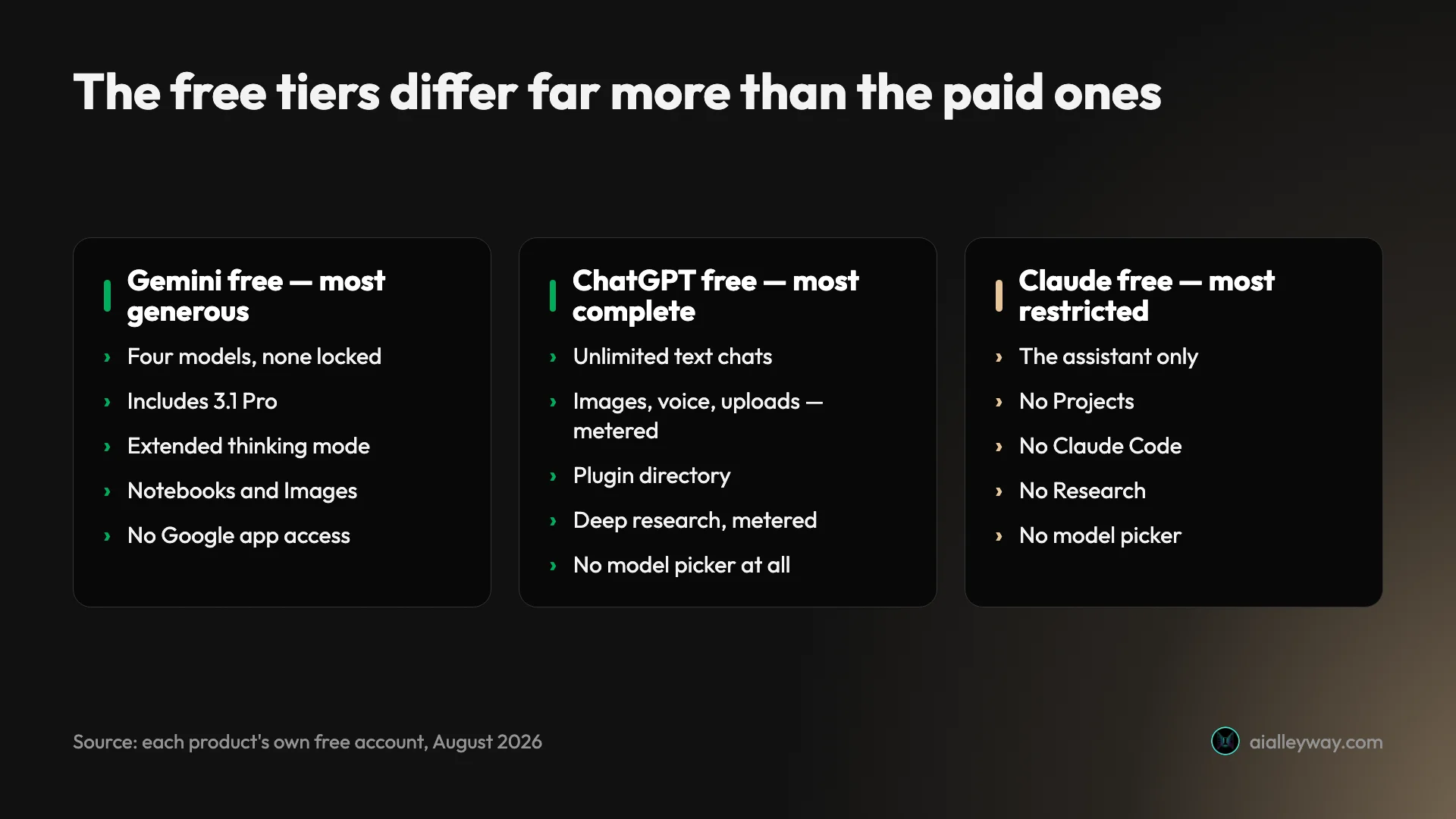
The row that surprises people is free model choice. Two of the three give a non-paying user no say in which model answers them at all, and the third hands over its advanced reasoning model without asking for a card. That is a strategic choice rather than generosity, and the reason becomes obvious once you look at what Google is actually selling.
The row nobody thinks to check is the live usage meter, because you only care about it after you have hit a limit mid-task. One of the three shows you where you stand; the other two let you find out by collision.
Where does Claude win against both, and where does it lose?
Claude’s case is narrow and strong. It writes better than the other two, it is the only one that shows you your usage as a live meter, and its Projects caching is the only documented way in this group to take work off the limit entirely. Its gaps are equally clear: no images, no video, and the most restricted free tier of the three.
Strengths
- The writing, which is the whole argument. It holds a negative instruction — a banned-word list, a punctuation cap — into the fourth section of a long draft, where both rivals revert to a house style.
- Two dials rather than one. Model and thinking depth are separate choices here, and Anthropic is unusually direct about the second one costing you allowance. Neither rival exposes that trade.
- The only visible meter in this group. Three live bars covering a rolling session and two weekly caps, so you can plan around a limit instead of colliding with it.
- Projects caching. Content stored in a Project is cached and does not count against your limits when reused.
Gaps
- No image or video generation at all. The largest capability gap in this group, and the reason Claude is so often a second subscription.
- The most restricted free tier. Projects, Claude Code, Cowork, Design, Science and Research all sit behind Pro.
- The only per-token overflow in this group. Hit the ceiling and you can keep working on a metered bill instead of waiting. Neither rival offers that, for better and worse.
- Quoted pre-tax. What Anthropic advertises is not what lands on the card, which caught me out on my own Max invoice.
There is far more detail, including the usage screens, in the Claude AI review.
ChatGPT’s coverage, and what it costs in prose quality
ChatGPT’s case is coverage. One $20 plan does more than either rival’s, and the free tier underneath it is the most complete of the three as a product. Its gaps are prose that drifts at length, a five-rung ladder described only in comparatives, and advertising on its cheapest paid tier.
Strengths
- Breadth nothing else matches at the price. Images, voice, the Codex coding agent, a work agent, deep research and custom GPTs, all on Plus.
- The most complete free tier. Unlimited text chats subject to abuse guardrails, with the expensive things metered rather than removed.
- The widest integration surface. A plugin directory reaching Gmail, GitHub, Drive, Calendar, Notion, Slack and Linear, available without paying.
- Everyone already knows how to use it. A custom GPT is shareable by link and lands with people who have never configured an AI tool.
Gaps
- Serviceable prose, not publishable. Headers, bullets, a faintly eager register, and negative instructions that lapse once the material gets difficult.
- No model choice on the free tier. You take the core model, and cannot tell whether a weak answer would have survived a better one.
- Advertising at $8. Go is framed by OpenAI as what keeps ChatGPT available at affordable price points. It is the only ad-supported tier in this group.
- Five rungs, all described in comparatives. More messages, longer memory, expanded memory, maximum memory. None of those is a quantity.
The full write-up is in the ChatGPT review.
What is Gemini good at, and where does it fall short?
Gemini’s case is reach. It gives away more than either rival, it is inside the applications the other two are trying to reach from outside, and its paid tiers bundle the assistant with cloud storage you may want anyway. Its gaps are the weakest writing of the three and a pricing structure that makes the AI impossible to value.
Strengths
- The most generous free tier in the category. A working model picker with 3.5 Flash-Lite, 3.6 Flash, 3.1 Pro and an Extended thinking mode, none padlocked. The only one of the three giving away its advanced reasoning model.
- Native Google Workspace access. Gmail, Docs, Drive and Calendar, read directly rather than through a connector, because Google owns both ends.
- Video understanding. The one input type neither rival handles.
- NotebookLM in the sidebar. A document-grounded research workspace folded into the free assistant, which most users never realise they got.
Gaps
- The weakest writing of the three. Competent and undistinctive, drifting to a flat listy register on longer pieces.
- The paid tiers are storage plans. Google AI Plus, Pro and Ultra are Google One tiers at 400 GB, 5 TB and 20 TB with Gemini attached, which makes the AI impossible to price against a rival.
- Google would not show me a US price. Every Google surface served my account’s local currency. Only Google’s own blog states dollar figures, and only for Ultra: $100 a month with 20 TB, and a $200 top tier reduced from $250.
- The headline integration is partly paid. Gemini in Gmail arrives with Plus, Docs with Pro, more apps with Ultra.
The full write-up is in the Google Gemini review.
What I could and could not test, on which plan
I have reviewed all three separately over the past week, and the register differs by product, so it is worth stating plainly before the price section.
Claude I use daily on a paid Max 5x plan. ChatGPT I use on the free tier, with a one-month Plus trial in May 2026 behind me that I did not renew. Gemini I use on the free tier only.
That means the free-tier comparisons here are all first-hand, and the paid-tier claims are documentation rather than experience for two of the three. Where a paid feature is described below it comes from the vendor’s own pages, not from me having run it — with one exception, the Antigravity coding agent, which comes from a colleague’s hands-on comparison on this site and is attributed as such.
Claude vs ChatGPT vs Gemini pricing: how do the three ladders differ?
This is where the consensus breaks down, and it is worth being precise because almost every comparison of these three repeats the same wrong summary.
Claude and ChatGPT genuinely are $20 at the tier most people buy. Claude Pro is $20 monthly or $17 billed annually at $200 up front; ChatGPT Plus is $20 with no annual discount. Over a year that is $200 against $240, a $40 gap that decides nothing.
Gemini is not priced as an AI product. Google sells Google One AI plans, and what defines each tier is cloud storage: 400 GB for Plus, 5 TB for Pro, 20 TB for Ultra. The Gemini benefits are listed underneath. Ultra also bundles a YouTube Premium plan, which tells you what kind of product this actually is.
The practical consequence is that you cannot answer “is Gemini worth $20 against Claude” at all, because part of what you would be buying is 5 TB of Drive. If you needed the storage anyway, the AI is nearly free at the margin. If you did not, you are paying for storage to get an assistant.
There is a second consequence that catches people out. If you already subscribe to Google One for storage, you may already have AI benefits attached and never have noticed. Check before adding a third subscription, because nobody thinks of their Drive plan as an AI plan and Google has little reason to remind them.
A third wrinkle, and the reason I cannot give you a clean table: Google localises this pricing and would not display US figures to my account at all. Every Google surface I tried served my own currency. That makes this the only product of the three whose US price I am reporting second-hand.
| Claude | ChatGPT | Gemini | |
|---|---|---|---|
| Free | $0 | $0 | $0 |
| Cheapest paid | $20 Pro | $8 Go (US), with ads | The 400 GB tier |
| Standard | $20, or $17 annual | $20 Plus | The 5 TB tier |
| Heavy | $100 Max 5x | From $100 Pro | From $100 Ultra, 20 TB |
| What defines the tier | Usage multiple | Usage and capability | Cloud storage |
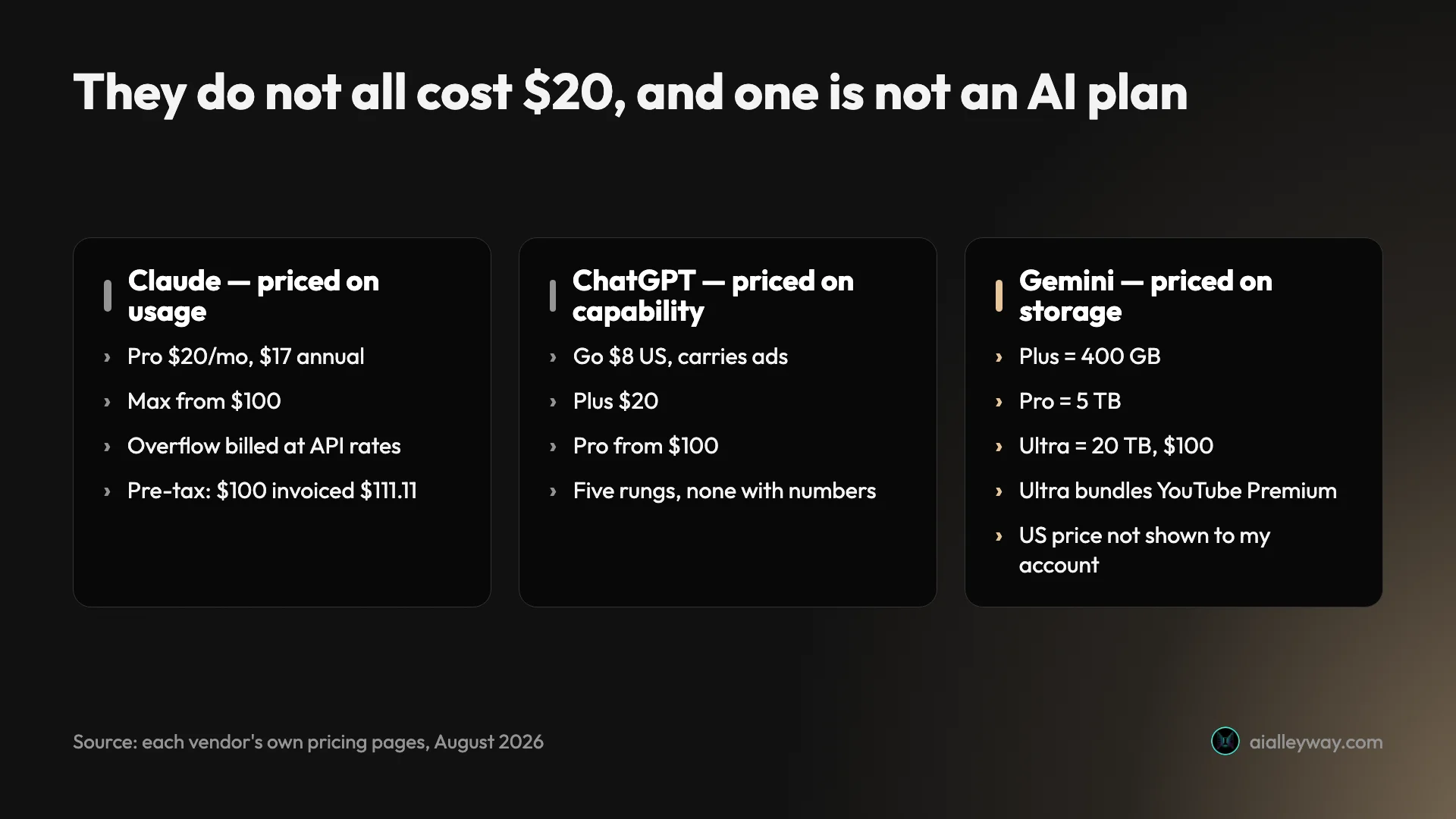
Two more costs sit outside all of that. Claude’s overflow can be bought as usage credits billed at standard API rates, a per-token bill on a flat-fee subscription that neither rival offers. And ChatGPT’s Go tier carries advertising, which is the only place in this group where paying does not remove ads.
Category-wide figures, updated as prices move, live in the AI tool cost statistics.
Where does the quality gap between the three show up?
Quality splits by task so cleanly that arguing about which model is “best” is close to meaningless.
Writing is the one axis with an unambiguous order, and it runs Claude, then ChatGPT, then Gemini. Hand all three the same style guide with prohibitions in it and read the closing third rather than the opening: Claude is still obeying the rules, ChatGPT has drifted back to headers and bullets, and Gemini has flattened into a list.
On breadth, ChatGPT wins by default, because much of what it does the other two do not attempt. A feature one product lacks entirely is not an axis you can score.
| Task | Claude | ChatGPT | Gemini |
|---|---|---|---|
| Long-form writing to a style guide | Best | Competent | Weakest |
| Short factual answers | Any of the three | Any | Any |
| Reasoning on a hard problem | Close | Close | Close, and free |
| Working across a long document | Best | Good | Good |
| Making an image | Cannot | Yes | Yes |
| Understanding a video | Cannot | Cannot | Yes |
| Acting inside Gmail or Docs | Cannot | Via connectors | Native, paid tiers |
On free-tier capability, Gemini wins outright. It is the only one of the three that lets a non-paying user select an advanced reasoning model, which means the quality ceiling of free AI, for most people, is currently set by Google.
On reasoning the three are close enough that I would not choose between them on it. All three expose some control over it — Claude a five-step effort dial, ChatGPT a Think toggle, Gemini an Extended thinking mode — and only Claude tells you what the setting costs you in usage.
Public ratings deserve one paragraph and no more. All three cluster at the bottom of Trustpilot — claude.ai 1.5, chatgpt.com 1.6, gemini.google.com 1.5 — and so does every rival outside this group. A score that cannot separate three products this different is measuring the platform’s complaint population, not the software.
ChatGPT vs Claude vs Gemini day to day: which is nicer to live with?
The daily experience separates on two things: what you can see, and where the tool already is.
Visibility favours Claude alone. Its usage screen shows three live bars, so you can tell that you are at 5% of a session and 22% of a week at the same moment. Neither rival shows you anything, and you discover your ceiling by colliding with it.
Location favours Gemini decisively. Every other assistant is reaching toward Google’s applications from outside, through connectors and permission scopes you grant. Gemini starts inside them. That is not something a competitor can out-engineer, and for anyone whose work lives in Workspace it outweighs a lot of feature comparison.
The qualification, which the marketing skips, is that this access is tiered — the Gemini section above sets out which app arrives with which plan. On a free account it reaches none of them. So the advantage is real and it is not free.
| Workflow property | Claude | ChatGPT | Gemini |
|---|---|---|---|
| Can you see your usage | Three live bars | No | No |
| Already where you work | No | No | Yes, inside Google |
| Shareable configurations | Projects | Custom GPTs, by link | Notebooks |
| Persistent project context | Yes, and cached off the meter | Yes | Not established |
| Memory import from a rival | Yes | No | No |
That last row is worth a sentence. Claude ships a control that generates a prompt you run inside a rival assistant’s account to pull your context across. Switching costs are the only real defence any of these companies has, and only one of the three has built a tool to demolish somebody else’s.
Configuration favours ChatGPT. Custom GPTs are shareable by link, the plugin directory is the widest of the three, and both are reachable without paying. If your workflow involves other people, that matters more than a model benchmark.
Habit is the axis nobody measures and everybody experiences. Gemini is already in the browser tab you had open; ChatGPT is the one your colleagues will have heard of; Claude is the one you have to decide to go to. Over a fortnight that shapes usage more than any feature list does, and it is worth noticing which one you reach for without thinking.
All three bundle a coding agent, and the way Google does it is the clearest illustration of this post’s whole argument. Claude Code arrives with Claude Pro and Codex with ChatGPT Plus, both at $20, both plainly part of an AI subscription.
Google’s agent, Antigravity, arrives through the same Google One AI plans that carry expanded Gemini access — this site’s Antigravity vs Claude Code comparison found that paid access is not an Antigravity subscription at all but a Google AI plan. So the storage tier you buy for Drive space is also the thing that upgrades your assistant and your coding agent at once.
That is a genuinely different commercial shape rather than a missing feature, and the agents themselves are ranked in best AI for coding.
Who should pick which?
Pick Claude if your output is words that other people read, you work across long documents, or being able to see your usage matters more to you than having more features. Not if your work includes making images.
Pick ChatGPT if you are buying exactly one AI subscription and your week contains several different kinds of task, if you need to make images, or if you are sharing workflows with people who have never configured an AI tool. Not if prose quality is the output.
Pick Gemini if your working day already happens inside Gmail, Docs and Drive, if you were going to buy cloud storage anyway, or if your budget for AI is zero and you still want an advanced reasoning model. Not if you write for a living.
Pick more than one if the tasks genuinely diverge. Running Claude for drafting alongside ChatGPT for everything else is the most common paid pairing I see, and at $40 combined it is more defensible than it sounds, because the overlap between them is smaller than their marketing suggests.
Pick none of them yet if you have not run the free tiers. That is not a cop-out. All three give away enough to answer the question for you, and the differences between the free tiers are larger and more decisive than the differences between the paid ones. Two weeks of real use will tell you more than any table on this page, including the ones I built.
Final word
For most people buying one subscription, ChatGPT. It covers the most ground at the same price as Claude, and its free tier is the most complete of the three.
For anyone who writes for a living, Claude, and the gap is large enough to justify it as a second subscription rather than a first.
For anyone not paying at all, Gemini, without much hesitation. It gives away more than either rival, and if your budget is zero it sets a higher ceiling than the other two free tiers do.
That last recommendation is the one I would most want people to act on, because it is the one the marketing works against. The quality ceiling of free AI is currently set by whichever company is most willing to give its good model away, and right now that is Google — which means a lot of people are forming their impression of what these tools can do on a weaker model than they could be using for nothing.
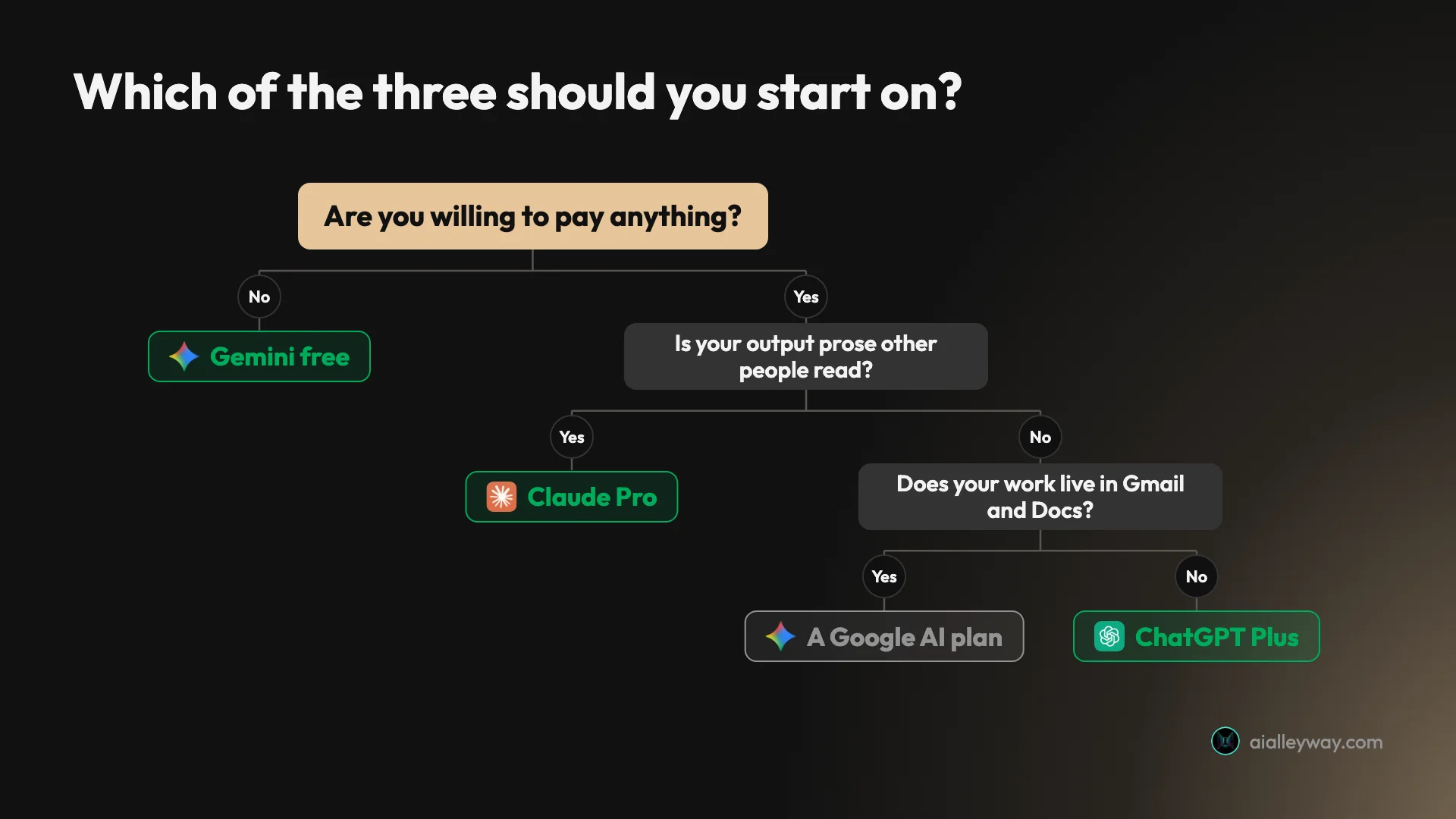
| If this is you | Start with |
|---|---|
| Buying exactly one subscription | ChatGPT Plus |
| Writing for other people to read | Claude Pro |
| Living in Gmail, Docs and Drive | A Google AI plan |
| Budget of zero | Gemini free |
| Already paying for Google One | Check what you already have |
Three things to do before you spend anything:
- Run all three free tiers for a fortnight on your real work, not test questions.
- Note which ceiling you hit first in each. That tells you what a subscription would actually buy you.
- Check whether you already pay for Google One. If you do, you may already have Gemini benefits attached and not know it.
If you want the two-way version of the closest call in this group, I put ChatGPT vs Claude on its own, where the writing-versus-breadth trade gets more room than a three-way allows.
Everything above comes from reviewing all three separately over the past week: Claude on a paid Max plan, ChatGPT and Gemini on their free tiers with a lapsed ChatGPT Plus month behind me. The individual reviews carry the evidence and the screenshots, including the model pickers and usage screens the claims above rest on.
Frequently asked questions
Which is best, Claude, ChatGPT or Gemini?
None of them wins outright, and the split is clean enough to act on. Claude is the best writer, holding a style guide's prohibitions deep into a long draft where the other two drift. ChatGPT is the broadest product, covering images, voice, a coding agent and custom GPTs on one plan. Gemini has the most generous free tier and the only native access to Gmail, Docs and Drive.
If you can only run one and you do varied work, take ChatGPT. If your output is prose that other people read, take Claude. If your working day already happens inside Google Workspace, Gemini is reaching into it in a way neither rival can.
The more useful question is which free tier to start on, because they differ far more than the paid ones do. Gemini's is the most generous, ChatGPT's is the most complete, and Claude's is the most restricted.
Do Claude, ChatGPT and Gemini all cost $20 a month?
No, and this is the most repeated error about these three. Claude Pro is $20 a month, or $17 billed annually. ChatGPT Plus is $20. So far the consensus holds.
Gemini breaks it. Google does not sell a Gemini subscription at all — the paid tiers are Google One AI plans, priced on cloud storage at 400 GB, 5 TB and 20 TB with Gemini access attached. Google's own blog puts AI Ultra at $100 a month with a $200 top tier above it, and Google would not display US pricing for the lower tiers to my account at all.
ChatGPT also has a rung below $20 that the others do not: Go, at $8 in the US, which carries advertising. So the honest summary is two products at $20, one product that is a storage plan, and one advertising-supported tier nobody mentions.
Which has the best free tier, Claude, ChatGPT or Gemini?
Gemini, on the measure that matters most. Open the model picker on a free Gemini account and you get 3.5 Flash-Lite, 3.6 Flash, 3.1 Pro and a separate Extended thinking mode, none of them padlocked. It is the only one of the three that hands a non-paying user its advanced reasoning model.
ChatGPT's is the most complete product rather than the most capable model. OpenAI describes free text chats as unlimited subject to abuse guardrails and meters everything expensive around them, so images, uploads, voice and deep research are all present but limited. There is no model picker at all.
Claude's is the most restricted of the three. You get the assistant, but Projects, Claude Code, Cowork, Design, Science and Research all sit behind Pro. Start on Gemini or ChatGPT if you are not paying.
Which one is best for writing?
Claude, and it is the clearest single-axis result across the three. The test that separates them is not a prompt but a constraint: give all three a style guide with prohibitions in it, then read the last third of a long draft rather than the first.
Claude still respects the rules there. ChatGPT complies for a while and reverts to its house structure of headers and bullets once the material gets complicated. Gemini is competent and undistinctive, drifting to a flat listy register on longer pieces, and it is the one I would reach for last when the output carries someone's name.
Positive instructions are easy for any model, which is why demos favour whichever one you are being sold. Prohibitions are the hard part, and that is where the gap opens.
You can run that test yourself on all three free tiers in about ten minutes, which is cheaper than trusting anyone's ranking, including mine.
Which one is best for Google Workspace?
Gemini, and nothing else is close, because the obstacle for its rivals is ownership rather than engineering. Google owns Gmail, Docs, Drive and Calendar, so Gemini reads and acts on them directly instead of through a connector you authorise.
The important caveat is that this access is tiered rather than free, and it arrives in stages as you move up the storage plans rather than all at once. So the capability everyone cites as Gemini's headline advantage is partly a paid feature, and on a free account it reaches none of your Google apps.
ChatGPT reaches Google's apps through its plugin directory, which is genuinely wide and available on the free tier, but it is still an integration negotiated from outside rather than native access.
Claude does not compete here at all. If Workspace integration is your deciding factor, the comparison is really Gemini against ChatGPT's connectors, and Gemini wins it.
Can I just use the free tiers of all three?
Yes, and for a lot of people that is the right answer rather than a compromise. All three free tiers are real products with no countdown and no card required, and between them they cover most of what the paid plans do.
A workable split costs nothing: Gemini free for reasoning and anything touching a long document, ChatGPT free for images, voice and general breadth, Claude free for drafting anything that has to read well. You are trading the friction of three tabs for roughly $40 a month.
The ceilings arrive at different places, which is what makes the combination work. You will hit ChatGPT's on images and uploads, Gemini's on usage volume, and Claude's on the features that are simply absent below Pro.
The cost is context switching rather than money. Three tools means three sets of history and no shared memory, which is a real friction and the main argument for consolidating onto one paid plan eventually.
Keep reading
Claude AI review: brilliant at words, strange about limits
A Claude AI review from a paying Max account. My $100 Max 5x plan invoiced at $111.11, three usage meters run at once, and overflow is billed at API rates.
Claude vs Grok: I ran both on a question Google gets wrong
Claude vs Grok, both run on the same two prompts. Both got the hard question right, but Grok opened 3 vendor pages while Claude cited 9 third-party posts.
Claude Max plan: the 5x is per session, not per month
The Claude Max plan costs $100 or $200 a month. The multiplier everyone quotes describes a five-hour window, and the limit that actually stops you is weekly.
Claude alternatives: which Claude are you replacing?
Anthropic sells the chat assistant plus five named products called Claude, and page one answers four different questions. Work out which you mean first.