
Claude Max plan: the 5x is per session, not per month
The Claude Max plan costs $100 or $200 a month. The multiplier everyone quotes describes a five-hour window, and the limit that actually stops you is weekly.
Contents
What does the Claude Max plan cost, and what do you get?

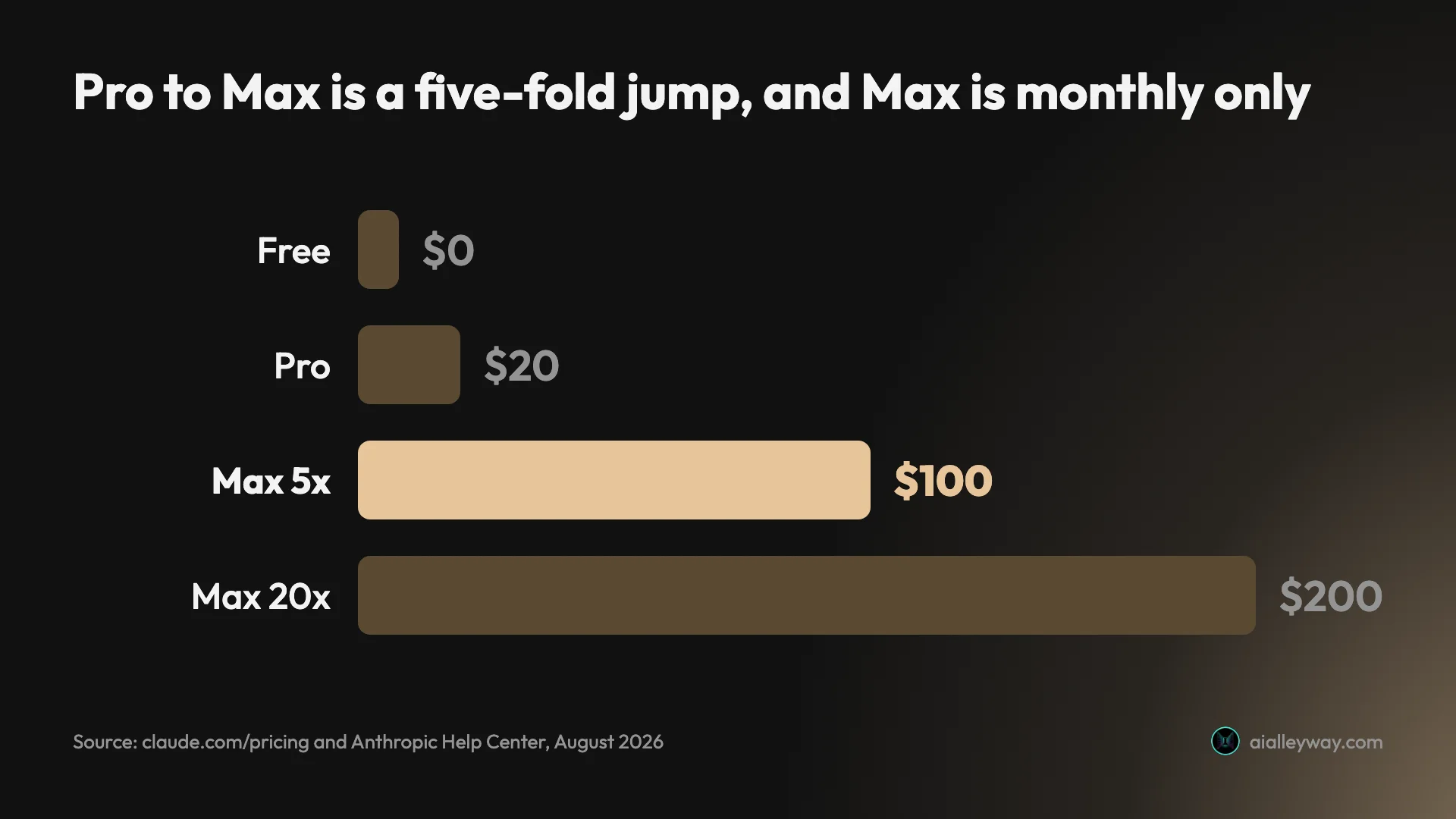
Max 5x is $100 a month and Max 20x is $200, monthly only — there is no annual discount on Max the way there is on Pro. What you are buying is capacity, not features: every product on Max is already on Pro.
| Plan | Price | What it is for |
|---|---|---|
| Free | $0 | More capable than people assume — extended thinking, memory, web search, connectors |
| Pro | $20/mo, or $17 billed annually | Regular use. Includes Claude Code, Cowork, Design and Science |
| Max 5x | $100/mo | Five times Pro’s usage per five-hour session. The daily-driver tier |
| Max 20x | $200/mo | Twenty times Pro’s usage per session. Long autonomous agent runs |
I have been on Max 5x for months, so the plan itself and the usage-bar workflow below are first-hand. Max 20x I have not run, and I have flagged every claim about it as documentation rather than experience.
How Claude’s usage limits actually work
This is the part worth understanding before you look at any price, because almost every write-up about Max gets the shape of it wrong.
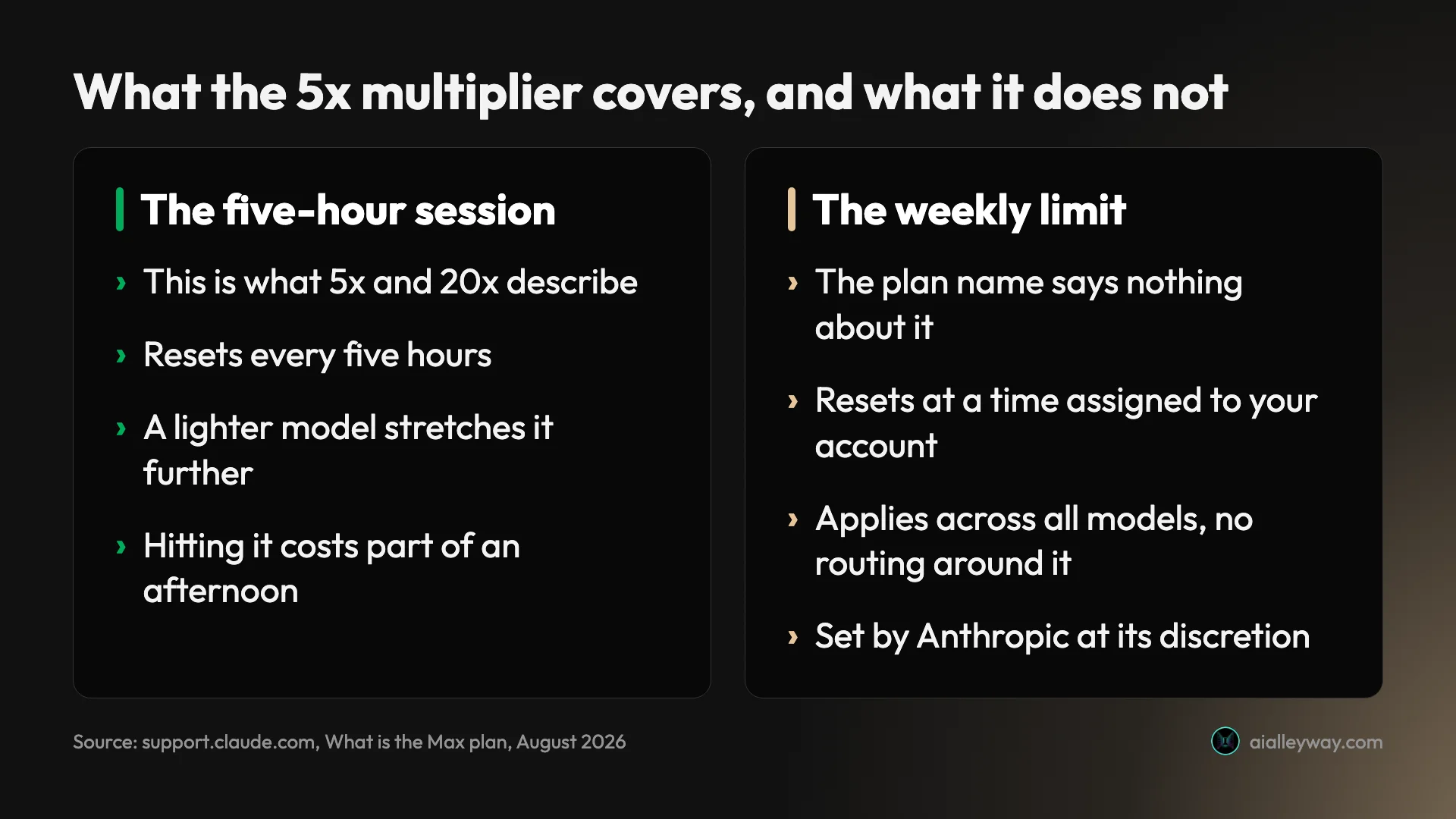
There are two limits running at once, not one. The first is a session limit that resets every five hours. The second is a weekly limit that applies across all models and resets at a fixed time each week that Anthropic assigns to your account, rather than a time you pick.
The number in the plan name only describes the first one. Anthropic’s help centre is precise about this: Max 5x provides “five times more usage per session than the Pro plan”, and Max 20x provides “20 times more usage per session”. Per session. Not per month.
It also helps to know what sits underneath, because the Max decision only makes sense against the tiers you are leaving. Free is no longer a crippled demo: Claude’s pricing page lists extended thinking, memory across conversations, web search, file creation, code execution and connectors through remote MCP on the free tier. Pro at $20 adds the products — Claude Code, Cowork, Design, Science, Research, unlimited projects and Claude for Microsoft 365 — plus more usage and more models.
That shape is unusual and worth saying plainly: Anthropic gates capability at the $20 line and capacity above it. Almost everything a person could want to do with Claude is available for $20. Everything above that price is about how much of it you can do.
So the mental model is a tank and a monthly allowance. The multiplier makes your tank bigger, which means you can go harder in one sitting without stopping. The weekly cap governs how many full tanks you get. Buying Max 20x instead of Max 5x quadruples the tank; it does not straightforwardly quadruple your month.
What fills the tank matters as much as its size, and this is the lever most people never pull. Anthropic publishes the list of what actually burns your allowance: message length, file attachment size, current conversation length, tool use such as Research and web search, model choice, effort level, and artifact creation. Note what dominates that list — it is the size of what you are carrying, not the number of times you press enter.
The most useful line in that document is one almost nobody quotes: “Content in projects is cached and doesn’t count against your limits when reused.” If you keep re-pasting the same brief, the same style guide or the same schema into fresh chats, you are paying for it every time; put it in a project instead and the reuse is free. Anthropic also notes that frequently repeated prompts are partially cached, and recommends batching related questions into one message rather than dribbling them out across several.
That is the difference between buying a bigger tank and having a smaller leak, and it is worth trying for a fortnight before you spend $80 a month more.
You can see both. On any paid plan, Settings then Usage shows progress bars for your five-hour session and your weekly limit — our Claude review has a shot of that screen if you want to know what you are looking for before you go hunting. That screen is the single most useful thing in this post: it turns the upgrade question from a guess into a measurement.
Claude Max 5x vs Max 20x: what actually differs?
The honest answer is that the difference is capacity and nothing else. Both tiers carry the same features, the same models and the same products. Anthropic frames it as one Max plan where you choose a multiplier, which is a more accurate description than treating them as two separate products, and there is no capability withheld at 5x that appears at 20x.
| Max 5x | Max 20x | |
|---|---|---|
| Price | $100/mo | $200/mo |
| Usage per five-hour session | 5x Pro | 20x Pro |
| Features, models, products | Identical | Identical |
| Billing | Monthly only | Monthly only |
| Built for | Chat-shaped work, heavy | Long autonomous agent runs |
That makes the decision unusually clean. You are not weighing feature sets against each other. You are asking one question: does my work regularly exhaust a five-hour session?
For chat-shaped work — research, drafting, analysis, long document work — 5x is more headroom than most people reach, even working all day. I have hit my session bar on Max 5x, but rarely, and almost always because I was running something agentic rather than because I was typing a lot.
For long autonomous agent runs, usually through Claude Code, the calculation changes. An agent working through a codebase on its own consumes capacity at a rate no human typing can match, and a single ambitious task can take a meaningful bite out of a session by itself. That is the use case 20x exists for, and it is documentation rather than experience on my part — is Claude Code worth it weighs the tool itself rather than the plan behind it.
The practical advice: start at 5x. Upgrading is immediate, so there is no penalty for being wrong in the cheaper direction, and there is a real penalty for being wrong in the expensive one.
What does Max add beyond more usage?
Three things, and they are smaller than the price gap suggests.
Higher output limits for all tasks. Anthropic lists this separately from usage, and it is the most overlooked line on the pricing page. It governs how long a single response can be, which matters if you routinely ask for long documents and have watched Claude stop mid-structure.
Priority access at high traffic times. Worth something during a busy period, and worth nothing at 6am. Hard to value honestly in advance, and I would not upgrade for it alone.
Early access to advanced features. New models and products land on Max first. If you write about this category, or you want a coding agent’s newest capabilities the week they ship rather than a month later, this is a genuine benefit. For most people it is a nice-to-have.
| Pro, $20 | Max, $100 or $200 | |
|---|---|---|
| Claude Code, Cowork, Design, Science | Included | Included |
| Unlimited projects, Research | Included | Included |
| Usage per five-hour session | Standard | 5x or 20x |
| Output length ceiling | Standard | Higher for all tasks |
| Priority at busy times | No | Yes |
| New models and features first | No | Yes |
It is worth being concrete about who those three benefits are actually for. If you write to a deadline during US working hours, priority access is the one you will notice, because that is when contention happens. If you routinely ask for a 3,000-word document in one response, the output limit is the one you will notice. And if neither of those describes you, the honest answer is that Max’s non-capacity benefits are marginal and you are buying the capacity alone.
What Max does not add is any product you did not already have. Claude Code, Cowork, Design, Science, Research, unlimited projects and Claude for Microsoft 365 are all included from Pro. If you are considering Max because you think it is what opens up the coding agent, you are about to pay $80 a month extra for something $20 already buys.
What does the weekly limit actually cost you?
Here is where a plan stops being a price and starts being a constraint you live with.
The session limit is forgiving in a specific way: it resets every five hours, so hitting it costs you part of an afternoon at worst. You go and do something else, and it comes back. In practice this is the limit I meet, and it is annoying rather than damaging.
The weekly limit is a different kind of wall. It applies across all models, which means switching to a lighter one does not hand you a separate allowance to draw down: everything you spend comes out of the same pool. And because it resets at a fixed time assigned to your account, you do not get to align it with your working week. If your reset lands on a Wednesday and you exhaust it on a Monday, that is most of a week without your primary tool.
This is the risk the plan name obscures. A reader who buys Max 20x expecting twenty times as much work per month has misread what they bought: they bought the ability to work twenty times as intensely in a five-hour window, bounded by a weekly ceiling Anthropic sets and can adjust.
Anthropic is at least explicit that the ceiling is discretionary, describing weekly caps on model and feature usage as applying “at our discretion”. That is more candid than most vendors manage, and it is also a genuine limit on what you can plan around.
| Session limit | Weekly limit | |
|---|---|---|
| Resets | Every five hours | A fixed time each week, assigned to your account |
| Scales with 5x / 20x | Yes — this is what the multiplier buys | Not what the plan name describes |
| Can you stretch it by working differently? | Yes — caching, batching, model choice | Only by spending less overall |
| Cost of hitting it | Part of an afternoon | Potentially most of a week |
The escape hatch is usage credits, and it is worth knowing before you need it rather than during a deadline. Pro, Max 5x and Max 20x subscribers can enable credits to keep working past their included usage, billed at standard API rates as a separate charge. They are not on by default — you turn them on under Settings then Usage — which is a considerate default, because it means an unprepared user stops rather than silently spending. Anthropic supports monthly spending caps, auto-reload and alerts, and applies a $2,000 daily redemption limit.
Set the cap when you enable credits. Not afterwards.
What should you watch out for?
The sticker price is not the charge. Sales tax is applied on top of the plan price, and the gap is not trivial at $100 or $200 a month. This site’s Claude Code pricing guide documented a $100 Max 5x plan billing at $110 under a 10% rate. Budget the plan plus your local tax.
Max is monthly only. Pro offers $17 a month billed annually against $20 monthly. Max has no equivalent, so the annual-discount instinct people bring from other subscriptions does not apply, and there is no lock-in either. You can leave after a month.
Credits are billed at API rates, not subscription rates. The whole argument for a subscription is that it is cheaper than metered access for steady use. Credits are metered access. Used occasionally they are a sensible overflow valve; used routinely they are a signal you should be on a higher tier or the API directly.
Limits have moved, and older comparisons are stale. Anthropic doubled Claude Code’s five-hour rate limits on 6 May 2026 for Pro, Max, Team and seat-based Enterprise plans, and removed the peak-hour limit reduction for Pro and Max. Any article written before that date describes a stingier product than the one you would buy today — worth checking the date on anything you read about Claude limits, including this.
| What the sticker hides | What it means |
|---|---|
| Sales tax on top | A $100 plan bills higher; the rate is yours, not Anthropic’s |
| Monthly billing only | No annual discount on Max, and no lock-in either |
| Usage credits at API rates | Off by default, billed separately, capped at $2,000 a day |
| A weekly ceiling set at Anthropic’s discretion | Not something you can plan a quarter around |
A Team seat can beat Max 5x outright. This is the comparison neither product page invites you to make. Anthropic’s Team plan sells Premium seats at $125 per member monthly, or $100 billed annually, and a Premium seat carries “6.25x more usage per session than the Pro plan”. Max 5x is $100 for 5x. So at the same annual price per person, a Team Premium seat gives you more session capacity than Max 5x does — and Team requires a minimum of only two members, not five as is often repeated. If there are two of you, price this route first.
The weekly reset time is assigned, not chosen. Find out when yours falls before you plan a heavy week around it. This is the one limit you cannot plan around by working differently, only by knowing the date.
Which tier do your usage bars say you need?
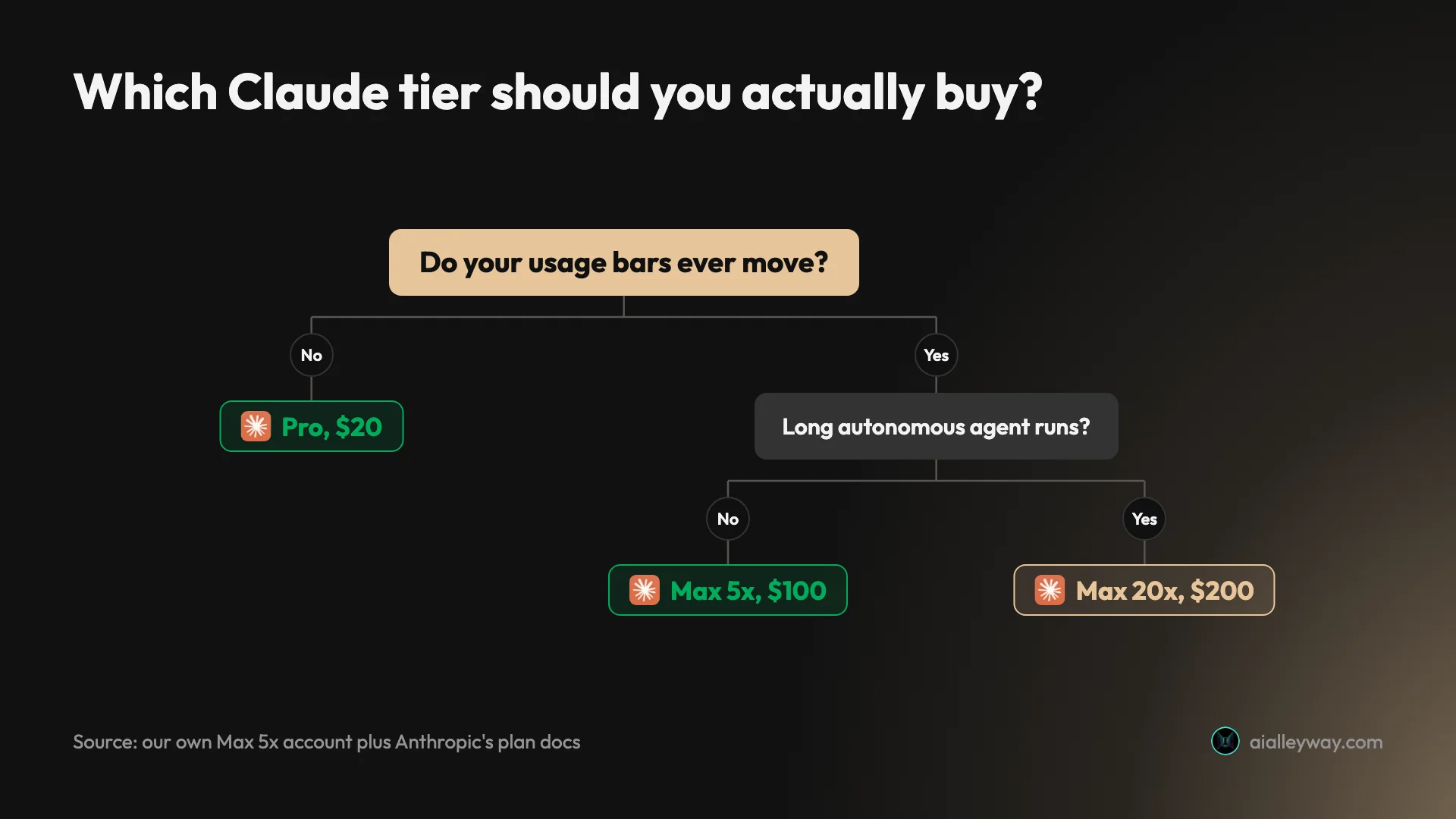
Buy Pro if you have never seen your usage bars move. Most people who suspect they need Max have not looked. Pro includes every product Max does, so unless you are meeting a ceiling you would be paying $80 a month for priority queuing.
Buy Max 5x if you regularly end sessions against the session bar. This is the daily-driver tier for people whose main tool is Claude, and it is the one I am on. A five-fold price rise for a five-fold session allowance is a fair trade rather than a deal.
Buy Max 20x if you run long autonomous agent sessions. Sustained Claude Code work on a real codebase is the use case that justifies $200, and it is the one where a single task can eat a session on its own.
Skip Max entirely if your usage is spiky rather than steady. A month of heavy work followed by three quiet ones is exactly the shape the API and usage credits serve better than a recurring $100.
Measure before you upgrade. One billing cycle watching those two bars answers this better than any guide, this one included — they are the only evidence that is about your workload rather than a reviewer’s. If both are still mostly empty after a month, you have saved $960 a year.
Cheaper ways to get the same headroom
If $100 a month is the wrong shape for your work, three routes are worth knowing.
Stay on Pro and enable usage credits. You keep the $20 base and pay API rates only in the weeks you overflow. For spiky usage this is usually cheaper than Max, and it is the option most people skip because credits are off by default and easy to miss.
Use the API directly. If your usage is genuinely occasional, or you need per-project cost attribution, metered access beats a subscription. Our subscription-versus-API breakdown works through that comparison in detail for the coding case.
| Route | Annual cost per person | Session capacity vs Pro |
|---|---|---|
| Pro + usage credits | $204 plus overflow at API rates | Standard, then metered |
| Team Premium seat | $1,200, minimum two people | 6.25x |
| Max 5x | $1,200, monthly only | 5x |
| Max 20x | $2,400, monthly only | 20x |
Split a Team plan instead. The route described above: more session capacity per person than Max 5x for the same annual outlay, minimum two people, admin controls included, and usage credits still available on the seat.
Check whether you qualify for free Max 20x. Anthropic’s Claude for Open Source programme gives eligible maintainers six months of Max 20x at no cost, then reverts you to whatever you were on before. That is $1,200 of access for one application, and the bar is specific rather than vague. You qualify on any one of:
- Packages with 500+ dependent repos, 100+ dependent packages, or 200,000+ monthly downloads
- A listed committer or maintainer role on a recognised foundation or language project
- 100+ pull requests merged into repos you do not own in the last twelve months
- A repo with 20+ unique external contributors in the last twelve months
- A project scoring 0.4 or above on the OpenSSF criticality score
Final word
The Claude Max plan is priced honestly and described confusingly. $100 and $200 buy exactly what Anthropic says they buy — five or twenty times Pro’s per-session capacity, higher output limits, priority access and early features — but the number in the name refers to a five-hour window, and the constraint most heavy users actually meet is a weekly cap that the name says nothing about.
If your work is chat-shaped, Max 5x is the tier, and Pro is probably enough until your usage bars tell you otherwise. If you run agents against a codebase all day, 20x exists for you. And whichever you pick, open Settings then Usage in the first week and find out where your ceilings actually sit, because that screen will tell you more about which plan you need than any amount of reading.
If the plan is not the problem and you are considering leaving, Claude alternatives is worth reading first, because Anthropic now sells five separately named products under the Claude name and the replacement depends on which one you mean. For where Claude sits against its rivals at the same price, ChatGPT vs Claude covers the $20 tier head to head, and the three-way against Gemini adds the tier that is not priced like the other two at all. And if the thing burning your allowance is Claude Code, Claude Code tips covers the session habits that decide how fast you spend it.
Frequently asked questions
How much does the Claude Max plan cost?
Max 5x is $100 a month and Max 20x is $200 a month. Anthropic's help centre states that Max is currently available as a monthly subscription only, so unlike Pro there is no annual discount to reach for.
Pro sits below it at $20 a month, or $17 a month if you pay for the year up front. Free is genuinely free and more capable than most people assume.
Two things are missing from that sticker price. Sales tax is added on top, so the amount that leaves your account is higher than the plan price depending on your rate. And if you exhaust your included usage you can enable usage credits, billed separately at standard API rates, which is real money spent above the subscription.
Budget the plan price plus your local tax, and treat credits as optional overflow rather than part of the base cost.
What does 5x actually mean on the Claude Max plan?
It means five times the Pro plan's usage within a five-hour session window, not five times as much use per month. Anthropic's wording is specific: Max 5x provides five times more usage per session than Pro, and Max 20x provides twenty times more usage per session.
That distinction matters because the session is not the only limit. Max plans also carry a weekly usage limit that applies across all models, and it resets at a fixed time each week that is assigned to your account rather than at a time you choose.
So the multiplier describes how hard you can go in one sitting. The weekly cap describes how many of those sittings you get. Heavy users tend to meet the weekly ceiling rather than the session one, which is exactly the limit the marketing number says nothing about.
Is Claude Max worth it over Pro?
It depends on whether you are hitting Pro's ceiling, and there is a precise way to find out rather than guess. Settings then Usage shows progress bars for both your five-hour session and your weekly limit on any paid plan.
If you regularly finish a working session against the session bar, Max 5x is the upgrade that removes that friction, and at $100 it is a five-fold price increase for a five-fold session increase. That is a fair trade rather than a bargain.
If you never approach either bar, Max buys you almost nothing beyond priority access at busy times and earlier access to new features. Stay on Pro.
The honest test is one billing cycle of watching those two bars before upgrading. Most people who think they need Max need better session habits instead.
What is the difference between Max 5x and Max 20x?
Capacity, and nothing else that matters. Both tiers unlock the same features, the same models and the same products. Max 20x is $200 against Max 5x's $100, and it multiplies your per-session allowance by twenty rather than five.
Anthropic presents this as a single Max plan where you choose the multiplier, which is a more honest framing than treating them as two products. There is no feature you get at 20x that is withheld at 5x.
The practical rule is that 20x is for people running long autonomous agent sessions, typically through Claude Code, where a single task can consume a session's worth of capacity on its own. For chat-shaped work, even heavy chat-shaped work, 5x is usually more headroom than you will reach.
Start at 5x. Moving up is one click and takes effect immediately.
Does the Claude Max plan include Claude Code?
Yes, and it is included on Pro as well, which surprises people who assume the coding agent needs the expensive tier. Anthropic's pricing page lists Claude Code, Cowork, Design and Science as included from Pro upward.
What Max buys is not access but room. Claude Code is the fastest way to exhaust a session allowance, because an agent working autonomously through a codebase consumes far more than a person typing questions. That is why the plan is marketed at developers even though the entry tier already includes the tool.
One useful piece of history: Anthropic doubled Claude Code's five-hour rate limits on 6 May 2026 for Pro, Max, Team and seat-based Enterprise plans, and removed the peak-hours limit reduction for Pro and Max accounts. Any comparison written before that date understates what your plan now does.
What happens when you hit the Claude usage limit?
You wait, or you pay. When you reach a session limit, access resets on the five-hour cycle. When you reach the weekly limit, you wait for your account's assigned weekly reset, which is a considerably longer wall to hit.
The escape hatch is usage credits, available to Pro, Max 5x and Max 20x subscribers. They let you keep working past your included usage, and they are billed at standard API rates as a separate charge from your subscription.
The detail worth knowing is that credits are not automatic. You enable them yourself under Settings then Usage, which means an unprepared user simply stops working mid-task rather than silently overspending. Anthropic also provides monthly spending caps, auto-reload and usage alerts, and applies a daily redemption limit of $2,000.
Set the cap when you enable credits, not after.
Keep reading
Claude AI review: brilliant at words, strange about limits
A Claude AI review from a paying Max account. My $100 Max 5x plan invoiced at $111.11, three usage meters run at once, and overflow is billed at API rates.

Claude vs Grok: I ran both on a question Google gets wrong
Claude vs Grok, both run on the same two prompts. Both got the hard question right, but Grok opened 3 vendor pages while Claude cited 9 third-party posts.
Claude vs ChatGPT vs Gemini: they don't all cost $20
Claude vs ChatGPT vs Gemini, after reviewing all three separately. Two cost $20, one is a storage plan — and the free tiers differ far more than the paid.
Claude alternatives: which Claude are you replacing?
Anthropic sells the chat assistant plus five named products called Claude, and page one answers four different questions. Work out which you mean first.