
Claude alternatives: which Claude are you replacing?
Anthropic sells the chat assistant plus five named products called Claude, and page one answers four different questions. Work out which you mean first.
Contents
Alternatives to which Claude?
Anthropic sells the chat assistant plus five separately named products under the Claude name. Its own pricing page lists Claude Code, Claude Cowork, Claude Design and Claude Science on the Pro plan, and adds Claude Security on Enterprise. They arrive in one subscription, which is convenient to buy and confusing to replace.
Security is Enterprise-only and out of scope here, which leaves five lanes a normal buyer might be shopping in.
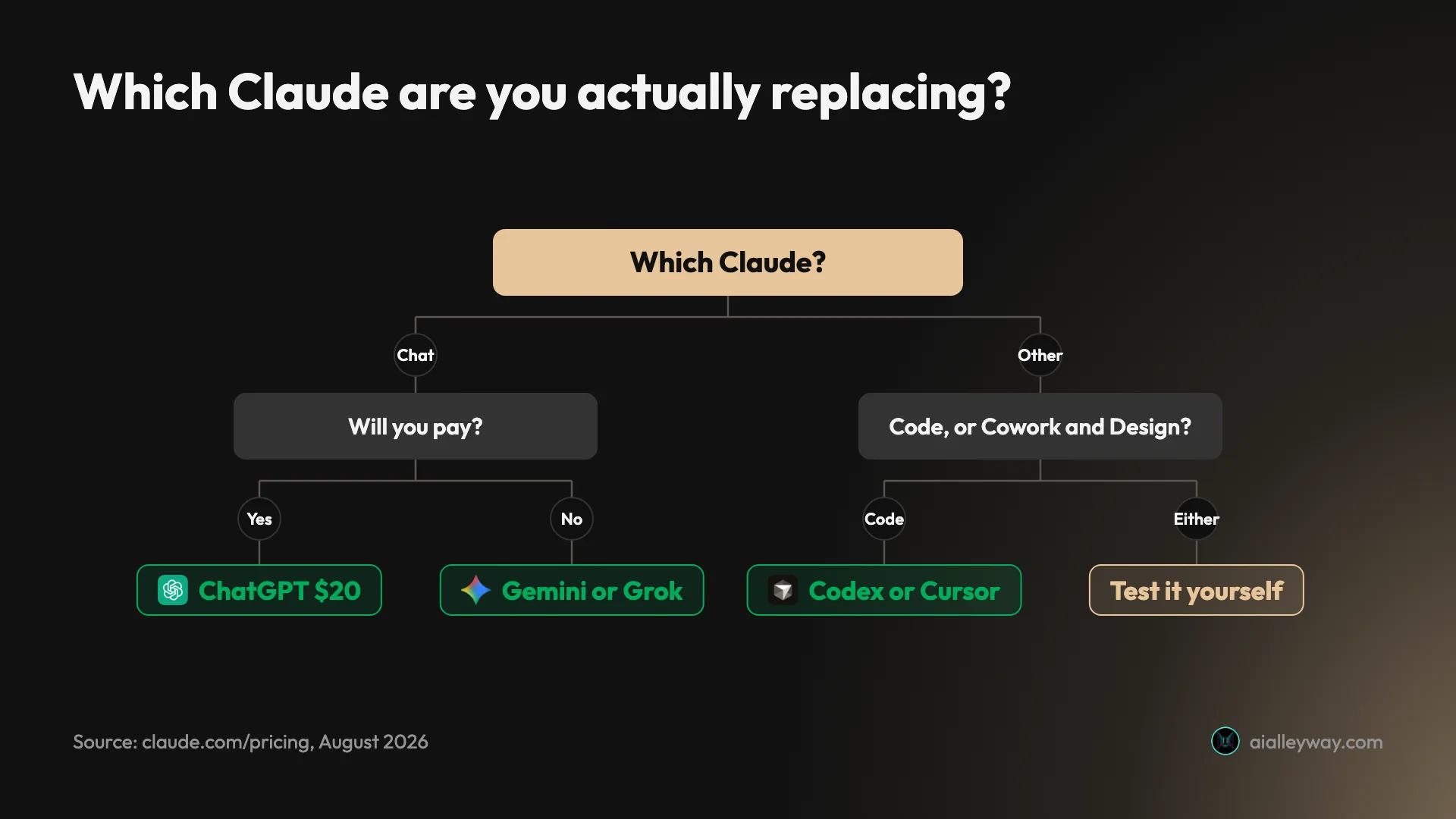
So before any list is useful, answer one question: which one are you actually trying to leave?
| If you mean | The replacement question is | Where to go |
|---|---|---|
| Claude the chat assistant | Which assistant writes best for the money? | The chat lane below |
| Claude Code | Which agentic coding tool, at what running cost? | Our Claude Code alternatives roundup |
| Claude Cowork | Which agent actually does the task? | An unsettled field, below, untested |
| Claude Design | Which AI design tool exports to my workflow? | A crowded field, below, untested |
| Claude Science | Nobody has answered this yet | Genuinely uncovered |
That is five lanes with almost no overlap between their shortlists. Nothing that replaces the chat assistant will replace the coding agent, and nothing in either lane touches Design.
Why this query is a mess, and how you can check that yourself
Run the search and look at what Google actually returns, because it makes the point better than any argument.
Checked on 28 August 2026: the first organic result was UX Pilot’s, on Claude Design alternatives, and the second was Gumloop’s, on Claude Cowork. Neither is about the assistant most people picture when they hear “Claude”. Below them sat a couple of pages on Claude Code, from Verdent and Lorka, then two on the chat product, then one narrowly about writing.
Four different products across one results page, counting writing as a niche within the chat product rather than a fifth thing, and no page-one result that stops to say so.
The longest of those pages runs past six thousand words and ranks twelve tools in a single list that puts ChatGPT and Gemini next to Cursor, Aider and Cline, as though a browser chat assistant and a terminal coding agent were substitutes for one another. They are not. Someone arriving from that list with a Claude Code bill to cut will read four entries that cannot help them, and someone who wanted a better writing assistant will read eight.
This is not incompetence on anyone’s part. It is what happens when a company ships five named products alongside its assistant, under one brand, faster than the internet can re-file its listicles.
You can watch the same confusion inside individual pages. One ranking page opens by talking about Claude the assistant, spends its middle third on terminal coding agents, and closes with a recommendation that only makes sense for developers. Another is titled for Claude Code but its H1 promises alternatives to Claude generally. A third covers Claude Cowork exclusively while ranking for the unqualified term. Each of them is a reasonable article attached to the wrong query.
The practical cost lands on the reader. Search once, get four different definitions of what you asked, and the only way to tell which applies to you is to already know the answer.
| What ranks on page one | Which Claude it is about |
|---|---|
| The first organic result | Claude Design |
| The second | Claude Cowork |
| Two in the middle | Claude Code |
| Two more | The chat assistant |
| One | Claude for writing specifically |
There is a second-order effect worth naming, because it explains why this will not fix itself quickly. Ranking pages get updated by adding tools, not by narrowing scope. A page that ranks for an ambiguous term has every incentive to cover more products rather than fewer, which makes it a worse answer for each individual reader and a better match for the keyword. That is how you end up with a six-thousand-word list nobody can act on.
What I can speak to, and what I cannot
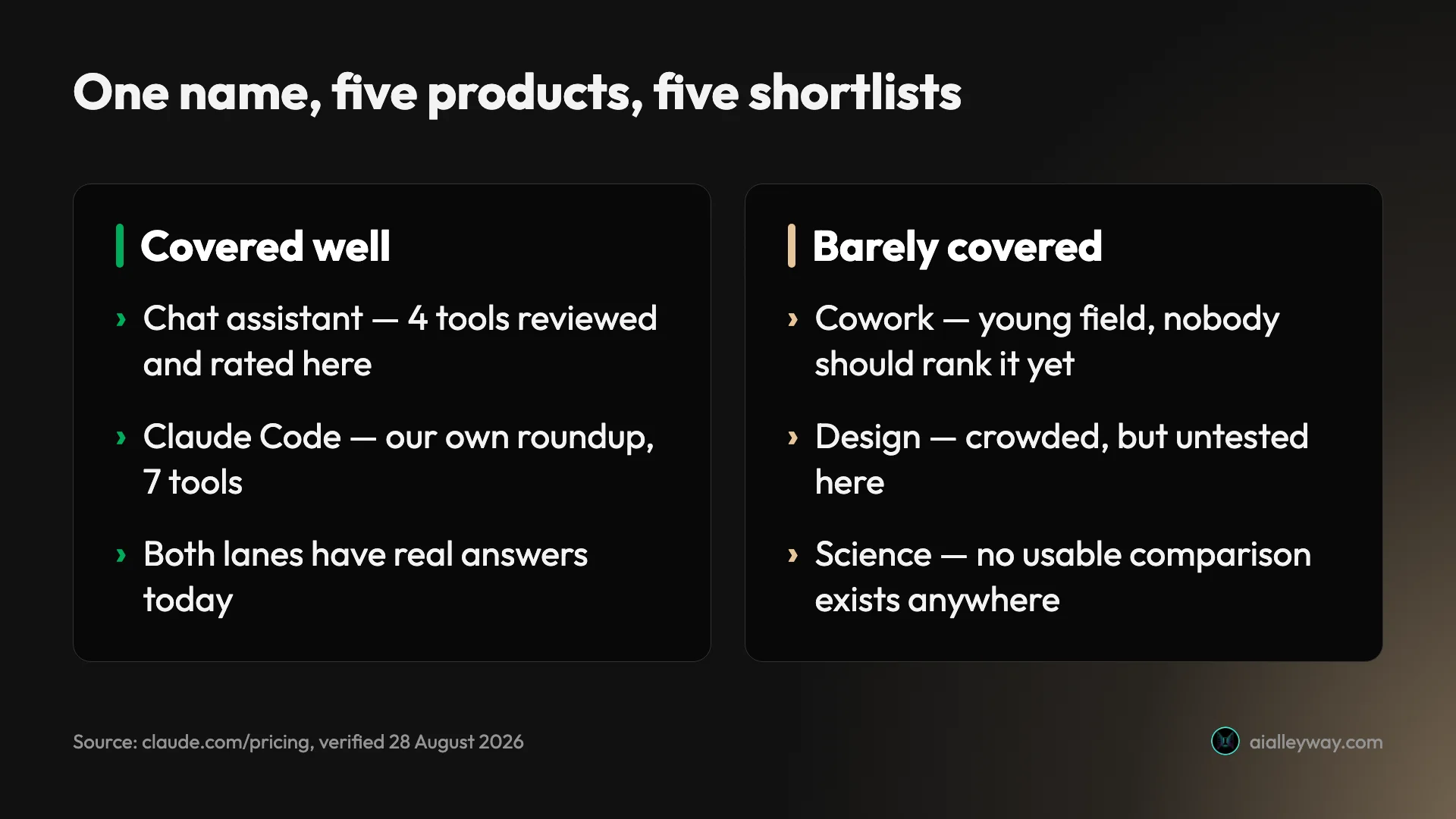
The lanes below are not equally researched, and pretending otherwise would be the easiest way to make this post useless.
| Lane | Basis for what you read |
|---|---|
| Chat assistants | Reviewed here from real accounts, rated |
| Claude Code | Covered in our own roundup, linked rather than repeated |
| Cowork | Vendor documentation only, unranked |
| Design | Vendor documentation only, unranked |
| Science | No usable coverage anywhere, including here |
The chat lane is the one this site can speak to properly. We hold rated reviews of ChatGPT at 4.6, Perplexity at 4.4 and Gemini at 4.3, and I ran Grok’s free tier through a set of prompts on 27 August, written up in Claude vs Grok.
The Cowork and Design lanes I have not used at all. What follows for them is read off vendor pages in August 2026 and presented as documentation, not as a ranking. I would rather give you a shorter honest answer than a longer invented one.
The chat lane: replacing Claude the assistant
This is the lane most people mean, and the one with real answers.
ChatGPT, the broadest replacement

| ChatGPT at a glance | |
|---|---|
| Alley Rating | 4.6 — Category pick, reviewed here |
| Free tier | Yes, no model picker |
| Paid | Plus $20, Pro $100 or $200, monthly only |
| Best at | Breadth in one subscription |
If you want one product that covers the most ground, this is it. Images, voice, a wide integration surface, and a paid ladder that keeps going after $20. That matters, because Claude’s Max tiers and ChatGPT’s Pro tiers are the two places this category gets expensive. Our ChatGPT Plus vs Pro guide untangles that ladder, including the $100 tier most comparisons still miss.
What you give up is the thing Claude is genuinely best at. On long prose held to a style guide, Claude still wins, and our ChatGPT vs Claude head-to-head found the gap appears in the last third of a draft rather than the first. If your output carries a byline, that trade is real.
Two structural details matter if you are pricing a switch rather than trying one. ChatGPT sells no annual billing on any individual plan, so a year costs exactly twelve times the monthly rate with no lever to pull, where Claude Pro discounts to $17 a month paid annually. And ChatGPT’s free tier gives you no model picker at all, which is worth knowing if you were planning to trial before paying.
The upgrade path is the strongest argument. Claude’s consumer ladder runs $20, then $100, then $200. ChatGPT’s runs $20, then $100, then $200 as well, but with a Go tier underneath and a Business tier alongside, so there are more places to land as usage changes.
Google Gemini, the strongest free tier

| Gemini at a glance | |
|---|---|
| Alley Rating | 4.3 — Runner-up, reviewed here |
| Free tier | Four selectable modes, none padlocked |
| Paid | Via Google One AI plans |
| Best at | Free capability, and Workspace adjacency |
The free tier is the argument. Four selectable modes including advanced reasoning, where Claude’s free tier gives you the assistant and no model choice at all. If your reason for leaving Claude is that you do not want to pay, this is the strongest landing spot.
The four modes are a real selection rather than a menu with three padlocks on it, which is the pattern elsewhere in this category. Perplexity’s free tier, by contrast, shows ten models with a padlock on every one.
The caveat we documented with a screenshot: Google’s own activity screen states chats are retained for 72 hours even with history switched off. Our Gemini alternatives roundup covers who that should and should not bother, and the short version is that it matters if you paste client material and does not if you are drafting blog posts.
The second caveat is adjacency. Gemini’s headline advantage is that it reaches Gmail, Docs, Drive and Calendar natively, and that advantage is tiered, so a free account reaches none of it. If Workspace integration is why you are moving, budget for a Google One plan rather than assuming the free tier delivers it.
Perplexity, if you wanted sourced answers rather than drafting

| Perplexity at a glance | |
|---|---|
| Alley Rating | 4.4 — Category pick, search, reviewed here |
| Free tier | Yes, ten models with a padlock on each |
| Paid | Pro $20, Max $200 |
| Best at | Answers you can check |
This is a different product rather than a cheaper Claude. It answers with citations attached and does not really draft. Most people who move here keep something else for writing, which makes it an addition to a stack rather than a substitution in one. Its pricing is also unusually confusing, and our Perplexity pricing guide works out why its own pages quote two different numbers.
Grok, the most generous free model picker

| Grok at a glance | |
|---|---|
| Alley Rating | Not rated here — tested on the free tier only |
| Free tier | Five selectable modes |
| Paid | SuperGrok $30 a month, or $300 a year |
| Best at | Showing its sources before the answer |
I ran Grok’s free tier against Claude on 27 August. Both got a hard factual question right; the difference was that Grok opened the vendor’s own documentation while Claude reached the same answer through third-party articles. The full write-up is in Claude vs Grok.
Two honest caveats. It is the only assistant here that made me confirm my age before it would answer anything, and as of 28 August 2026 grok.com/pricing returns a 404, so the price above comes from the in-app upgrade screen rather than a page you can send a colleague.
Cheaper chat options worth knowing
Two more belong in this lane without earning a full section, because we have not reviewed them.
DeepSeek offers free chat on current models and API rates far below the Western labs, with the caveat that its published position on training with consumer conversations is less clear than its rivals’. Mistral Vibe, previously Le Chat, has a free tier and a paid plan at $14.99, and is the European option if data residency is the reason you are shopping. Both are covered in more depth in our ChatGPT alternatives roundup.
One scoping note before the code lane. ChatGPT, Gemini, Perplexity and Grok are the same four our ChatGPT alternatives roundup covers, because the field of general assistants is small and the same names recur. The difference is the question each post answers: that one ranks them for someone leaving ChatGPT, this one for someone leaving Claude, and the verdicts differ because what you are giving up differs.
The code lane: this is a different purchase entirely
If what you are replacing is Claude Code, almost nothing above applies.
The tools are different, the pricing model is different, and the failure modes are different. A browser chat assistant does not compete with an agent that edits files in your repository, and the fact that so many lists put them in one ranking is the clearest sign those lists were written to the keyword rather than to the question.
We already covered this lane properly, so rather than re-rank it here: our Claude Code alternatives roundup works through Codex, Cursor, Antigravity CLI, OpenCode, Aider, Cline and GitHub Copilot, and covers what switching actually costs once you account for the model bill underneath the tool.
The one number worth carrying over is the reason people shop at all. Heavy agentic use pushes you toward Claude’s Max tiers at $100 or $200 a month, and our Claude Max plan guide explains why the multiplier in the name describes a five-hour session rather than a month. That misunderstanding is behind a lot of surprise bills.
It is also why the coding lane produces more alternatives content than the other four combined. A $20 assistant that annoys you is an irritation. A $200 agent that runs out mid-task is a budget line someone has to defend, and budget lines are what send people searching.
The Cowork lane: young, unsettled, and untested here
Claude Cowork is the agentic assistant that takes a task and comes back with it done. The alternatives are real products, and I have not used any of them.
What I can tell you is what the field looks like from vendor documentation, read in August 2026:
| Tool | What it is, per its own pages |
|---|---|
| Gumloop | Visual workflow builder for chaining AI steps into automations |
| Relay.app | Automation with human-in-the-loop approval steps |
| Lindy | Agent builder aimed at email, calendar and CRM tasks |
| Notion AI | Agent features inside a workspace you may already pay for |
I am not ranking these and I am not telling you which is best, because I would be making it up. What I will say is structural and checkable: this is the least settled of the five lanes, the products differ enormously in shape, and a tool that automates a workflow is not the same purchase as one that completes a one-off task on request.
If Cowork is what you are replacing, treat any confident ranking you find, including a longer version of this section, with suspicion. The category is too new for confident rankings to be honest.
The design lane: a crowded field, also untested here
Claude Design generates interfaces and visual layouts. This lane is the most established of the two I have not tested, and the alternatives predate Claude’s entry into it by years.
| Tool | What it is, per its own pages |
|---|---|
| Figma Make | AI generation inside the design tool most product teams already use |
| UX Pilot | AI UX flows with Figma export |
| Visily | Wireframing aimed at non-designers |
| Uizard | Collaborative AI UI design |
| Relume | AI site planning and wireframing |
| Framer | Turning generated designs into live sites |
| Google Stitch | Google’s free-tier AI interface generator |
| Canva | The general design tool, with AI layered on |
Same disclosure as above: read from vendor pages, not used. The one thing I would point out is that the question in this lane is usually not “which generates the prettiest screen” but “which exports into the workflow I already have”, and that is a question about Figma, your codebase and your team rather than about the AI.
The science lane, where the answer is nobody knows
Claude Science is on Anthropic’s pricing page alongside the others. Search for alternatives to it and you will find essentially nothing useful.
That is worth saying plainly rather than inventing a shortlist. If Claude Science is the product you are trying to replace, the honest state of the internet in August 2026 is that this comparison has not been written by anyone, us included, and the tools that would populate it are mostly domain-specific research software rather than general assistants.
I would rather leave a visible gap here than fill it with names I cannot stand behind.
The case for not switching at all
A roundup that only lists exits is doing half the job, and there are three reasons the honest answer here is sometimes “stay”.
The thing Claude is best at has no clean substitute. On prose that has to hold a set of rules across length, it still wins — that is the finding our Claude review rates 4.4 on — and our head-to-head found the gap appears in the last third of a long draft rather than anywhere a quick trial would show it. If you test a replacement with three short prompts, you will not see what you are giving up.
You may be shopping for a tier rather than a product. A large share of “Claude is too expensive” is really “Claude Max is too expensive”, and that is a different problem. Our Claude Max plan guide works through where the money actually goes, and for many people a change in session habits costs less than a migration and solves the same complaint.
Nothing moves your history. None of the tools here imports your Claude conversations, saved instructions or accumulated context. That loss is invisible on day one and obvious in week three, when you notice yourself re-explaining things you had already taught the old tool. It is the strongest argument for adding a second assistant rather than replacing the first.
| Before you switch | Why it matters |
|---|---|
| Test with a long draft, not three prompts | The prose gap appears in the last third |
| Check whether it is the product or the tier | “Claude is expensive” often means “Max is expensive” |
| Accept that no history moves | Nothing here imports your conversations or instructions |
| Consider adding rather than replacing | Two tools for two jobs often beats one compromise |
The switch that usually works is narrower than the one people plan. Move the specific job that annoys you, keep the one that works, and accept paying for two things if the two things are genuinely different.
Naming the product, then the shortlist
Name the product first. Not “Claude” but Claude Code, or Cowork, or the chat assistant. Half the confusion in this category dissolves at that step, and every list you read afterwards becomes easier to judge.
If it is the chat assistant and you will pay: ChatGPT at $20, for breadth and a ladder that goes further.
If it is the chat assistant and you will not pay: Gemini or Grok, both of which give a free account more model choice than Claude’s free tier does.
If it is Claude Code: go to our Claude Code alternatives roundup and ignore everything in the chat lane.
If it is Cowork or Design: shortlist from the tables above, then test two of them yourself, because nobody’s ranking is trustworthy yet including this one.
Skip the switch entirely if what you actually want is a cheaper Claude rather than a different one. The Claude Max plan guide covers where the money goes, and a session-habit change is cheaper than a migration.
Final word
The reason “Claude alternatives” returns such a strange set of results is that it is not one question. Anthropic ships an assistant plus five named products under a single brand and a single subscription, and the internet is still writing lists as though there were one thing to replace.
Work out which Claude you mean and the decision gets much smaller. For the assistant, ChatGPT is the broadest replacement and Gemini is the strongest free one. For the coding agent, the field is entirely different and we have covered it separately. For Cowork and Design, the honest answer today is a shortlist and a recommendation to test rather than a ranking. For Science, there is no answer yet.
If you want the assistant comparison at the tier most people actually buy, ChatGPT vs Claude puts the two $20 plans side by side, and Claude vs ChatGPT vs Gemini adds the tier that is not priced like the other two at all.
Frequently asked questions
What is the best alternative to Claude?
There is no single answer, and that is the useful thing to know before you start shopping.
Anthropic sells the chat assistant plus five separately named products. Its own pricing page lists Claude Code, Claude Cowork, Claude Design and Claude Science, and adds Claude Security on Enterprise. Replacing the chat assistant, the coding agent and the design tool are three unrelated purchases with three unrelated shortlists.
If you mean the chat assistant, ChatGPT is the broadest replacement and the one we rate highest at 4.6. If you mean Claude Code, the field is Codex, Cursor and a strong open-source bench, which our Claude Code alternatives roundup covers properly.
If you mean Cowork or Design, the honest answer is that the alternatives are young, the category is unsettled, and nobody including us has tested them enough to rank them with confidence.
Start by naming the product, not the company.
Is there a free alternative to Claude?
Several, and two of them give a non-paying account more model choice than Claude's own free tier does.
Grok's free tier opens a picker with five entries, and Gemini's offers four selectable modes including advanced reasoning. Claude's free tier gives you the assistant and no model choice at all, which we verified when testing it.
ChatGPT's free tier is the most complete free product of the four, though it offers no model picker either.
For coding specifically the free options are different and better: GitHub Copilot has a free tier, and OpenCode, Aider and Cline are open source, so the running cost is whatever model you point them at.
The catch worth naming is that free tiers are where vendors move fastest. Every figure here was checked in August 2026 and none of it is a commitment.
What is the difference between Claude and Claude Code?
They are different products sold under one subscription, which is exactly why this query is so muddled.
Claude is the chat assistant you use in a browser. Claude Code is an agentic coding tool that works against your codebase from a terminal. Anthropic's pricing page lists them as separate line items, alongside Claude Cowork, Claude Design and Claude Science.
The practical consequence is that they have almost nothing in common when you go shopping. A replacement for the chat assistant is ChatGPT or Gemini. A replacement for Claude Code is Codex or Cursor or an open-source agent. Nobody sells one product that replaces both well.
Our Claude Code alternatives roundup handles the coding side in detail, because the tools, the pricing model and the failure modes are all different from the chat side. It is also the lane where switching has a running cost underneath the subscription, since most of the open-source options bill you for whichever model you point them at.
Why is everyone writing about Claude Code alternatives?
Because that is where the money and the frustration both are, and the search results show it plainly.
Run the query and the first page mixes at least four different products. The top two organic results are about Claude Design and Claude Cowork rather than the assistant. A couple more cover Claude Code. Two address the chat product that most people picturing Claude have in mind.
The coding lane dominates because agentic coding is the most expensive way to use Claude. Heavy users reach for Max at $100 or $200 a month, which is a real bill and a real reason to shop around.
That is also why a general Claude alternatives list is a strange artefact. The longest one on page one runs past six thousand words and mixes chat assistants with terminal coding agents in a single ranking, as though they were substitutes.
Is ChatGPT a good replacement for Claude?
For the chat assistant, yes, and it is the replacement we would pick first.
We rate ChatGPT 4.6 against Claude's 4.4, and the case is breadth: images, voice, a wider integration surface, and a ladder of paid tiers that runs from $20 to $200 if your usage grows. Claude's ladder is shorter.
What you give up is the thing Claude is genuinely best at. On long prose that has to hold a style guide to the final paragraph, Claude still wins, and our head-to-head found the gap shows up in the last third of a draft rather than the first.
For Claude Code specifically, ChatGPT is the wrong shape and Codex is the comparison to run instead.
One more thing worth weighing before you move. Nothing here imports your Claude history, saved instructions or accumulated context, so the first fortnight on a replacement is spent re-teaching it things the old tool already knew.
So: ChatGPT for the assistant, something else entirely for the coding agent.
What are the alternatives to Claude Cowork and Claude Design?
Young products, mostly, and this is the part of the query where honest coverage runs out fastest.
For Cowork, the agentic work assistant, the names that recur are Gumloop, Relay.app, Lindy and Notion's agent features, alongside the general assistants adding similar capabilities. For Design, the field is more established: Figma Make, UX Pilot, Visily, Uizard, Relume, Framer and Google Stitch.
We have not tested any of them, and this post does not rank them. Everything here about those two lanes comes from vendor pages read in August 2026, and it is labelled that way in the sections below.
Claude Science has essentially no alternatives coverage anywhere, which is worth knowing if that is the product you were asking about. It is the one lane where the search results have nothing useful to offer yet.
Keep reading
Claude vs ChatGPT vs Gemini: they don't all cost $20
Claude vs ChatGPT vs Gemini, after reviewing all three separately. Two cost $20, one is a storage plan — and the free tiers differ far more than the paid.
Claude vs Grok: I ran both on a question Google gets wrong
Claude vs Grok, both run on the same two prompts. Both got the hard question right, but Grok opened 3 vendor pages while Claude cited 9 third-party posts.
Claude AI review: brilliant at words, strange about limits
A Claude AI review from a paying Max account. My $100 Max 5x plan invoiced at $111.11, three usage meters run at once, and overflow is billed at API rates.
Claude Max plan: the 5x is per session, not per month
The Claude Max plan costs $100 or $200 a month. The multiplier everyone quotes describes a five-hour window, and the limit that actually stops you is weekly.