
Perplexity pricing: $20 a month, or $17, on the same site
Perplexity pricing is $0, $20 or $200 a month. Its own plan pages show two different headline numbers, and the Enterprise tab quietly switches billing basis.
Contents
Which Perplexity price is the real one?

Three individual plans, and the number you see depends on which of Perplexity’s own pages you open.
| Plan | On the pricing hub | On the Pro page | What it is |
|---|---|---|---|
| Free | $0/month | Not shown on that page | Search with citations, basic models only |
| Pro | $20/month | $17/month billed annually | Model selection, deep research, Computer |
| Max | $200/month | $167/month billed annually | Max-only: Model Council, Brain, 10,000 credits |
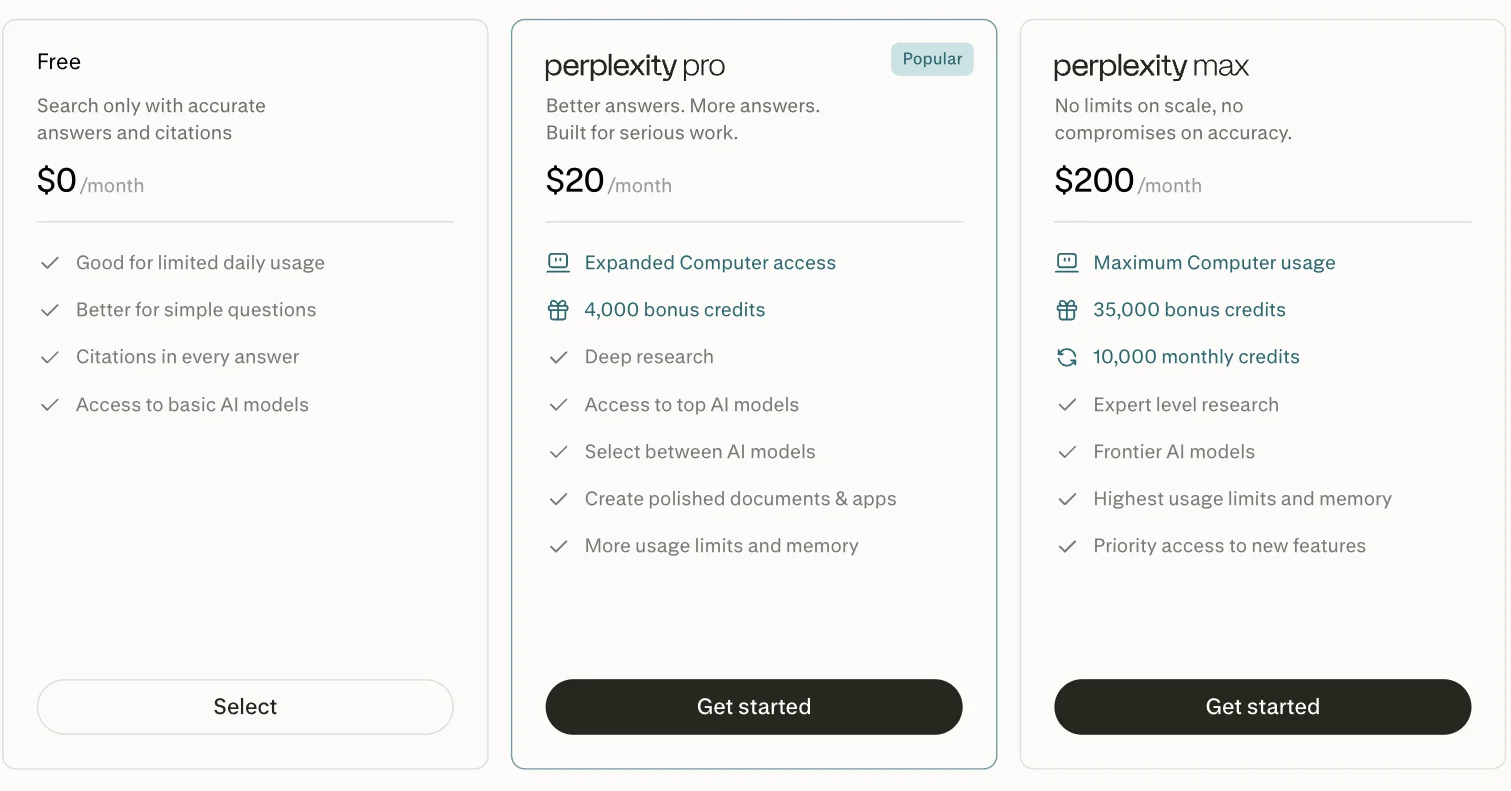
Both figures are current, both are official, and both were captured on the same day from Perplexity’s own site. Neither page shows the other’s number anywhere on it.
I use Perplexity on the free tier and have never paid for it, so everything below about Pro, Max and Enterprise comes from Perplexity’s own pages rather than from my account.
Why Perplexity shows two different prices
This is the thing to understand before comparing Perplexity to anything else, because it makes every comparison you read slightly wrong.
Perplexity’s pricing hub lists the individual plans at their monthly rate: $0, $20, $200. Perplexity’s separate Pro page lists the same two paid plans at $17 and $167, described on the card as “per month or equivalent, when billed annually”.
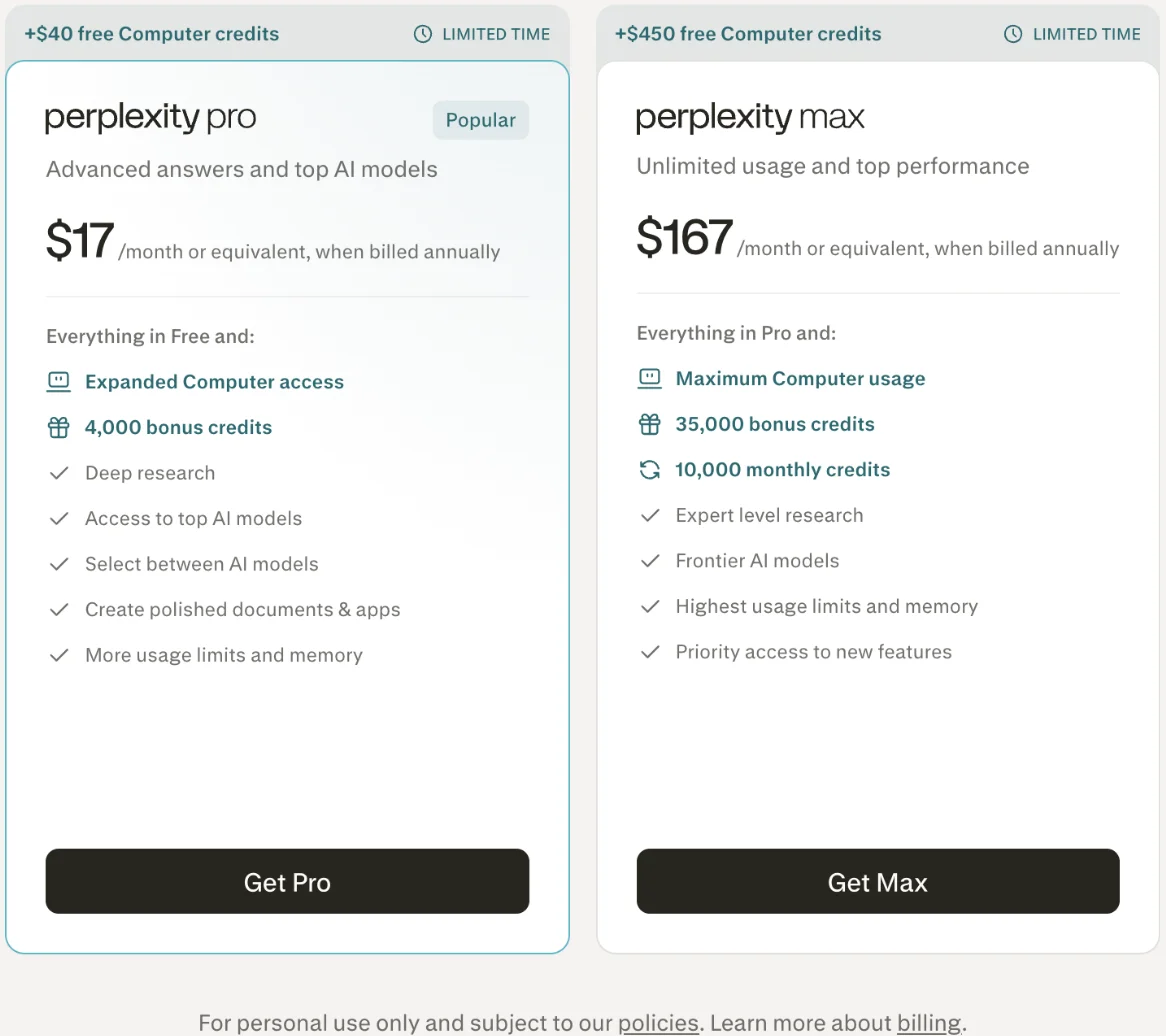
Neither page is lying. They are quoting different billing bases, and each omits the other. Our review of Perplexity made the same observation from the Pro page’s side, noting that the monthly figure is not shown there. The hub is where it turns up. The practical gap is $3 a month on Pro and $33 a month on Max — about 15% and 16.5%.
What makes this worth a section rather than a footnote is that most write-ups about Perplexity quote whichever number they landed on, so you will find confident articles saying Perplexity Pro is $17 and equally confident ones saying $20. Both authors read an official page.
The rule for a reader is simple: budget from the monthly number. $20 and $200 are what leaves your account if you are not committing to a year up front, and the annual-equivalent is only real if you pay for twelve months at once.
There is a second wrinkle on the Pro page worth noticing while it lasts. Both paid cards currently carry a promotional banner — ”+$40 free Computer credits” on Pro and ”+$450 free Computer credits” on Max — each marked LIMITED TIME. Promotional credits are not part of the price, and they will not be there forever.
What does $0 actually buy you?
More than a trial and less than the product, which is a distinction Perplexity is refreshingly direct about.
Its own description of Free reads: search only with accurate answers and citations, good for limited daily usage, better for simple questions, citations in every answer, and access to basic AI models.
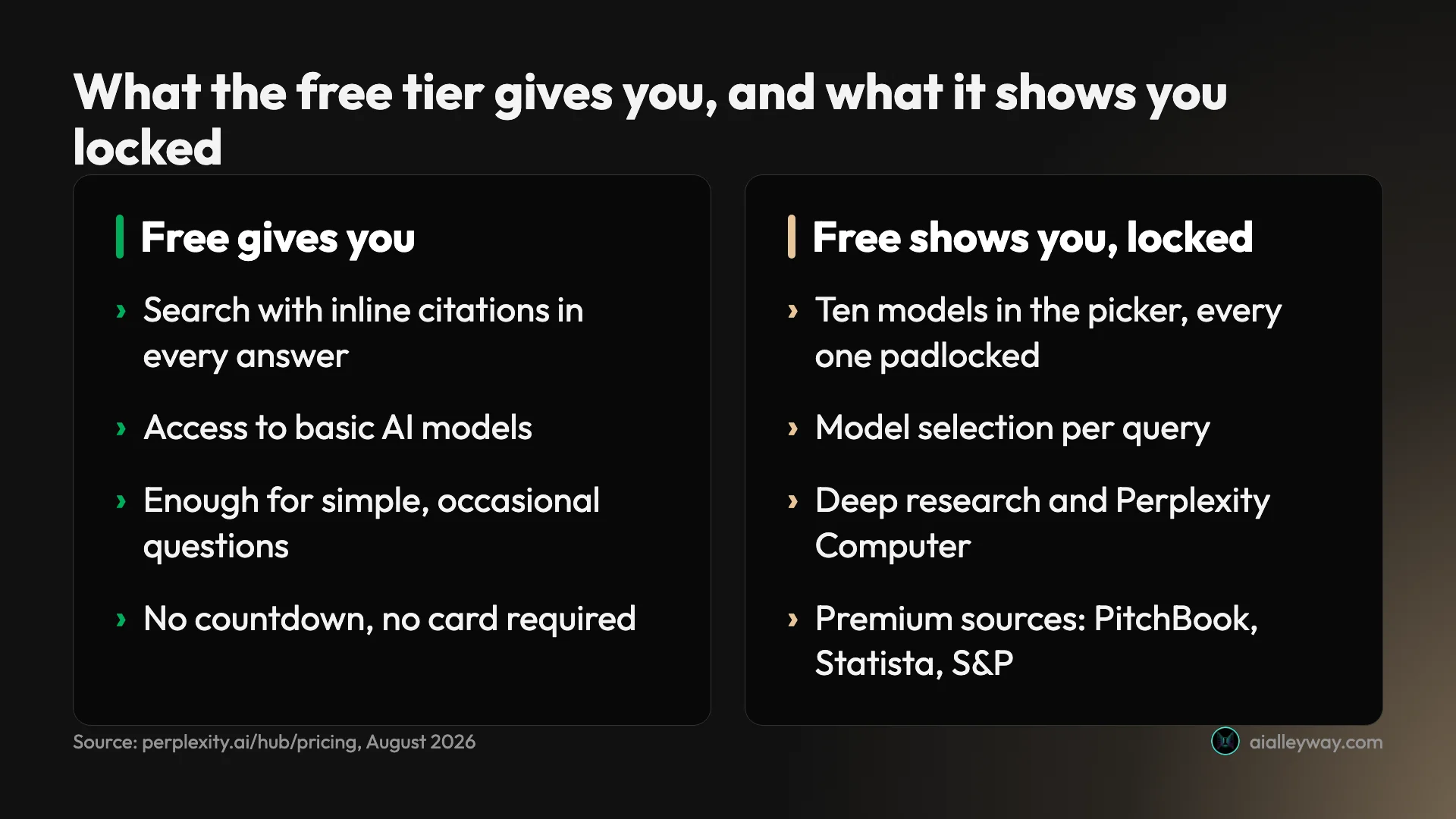
That last line is the one doing the work. Basic models, not top models. On a free account the model picker shows ten models with a padlock on every one, which our hands-on look at the free tier covers in detail with the screenshot. You can see the whole menu and order nothing from it.
That is a deliberate and reasonably honest design. The upgrade prompt is the product’s own interface rather than a nag screen, and you are never confused about what you are missing. It is also, if you are not going to pay, a slightly deflating way to use software.
What free does genuinely well is the core job. Ask a factual question, get an answer with inline citations you can click through and verify. For checking a claim, finding a source, or getting oriented in an unfamiliar topic, the free tier is a real tool and not a demo. If that is the shape of your need, you can stop reading here and not pay anything.
Where free stops is depth and repetition. Limited daily usage means a research session will meet a wall, and the absence of model selection means you cannot push a hard question at a stronger model.
What comes with Pro that free does not?
Per Perplexity’s plan card, Pro adds expanded Computer access, 4,000 bonus credits, deep research, access to top AI models, the ability to select between AI models, the creation of polished documents and apps, and more usage limits and memory.
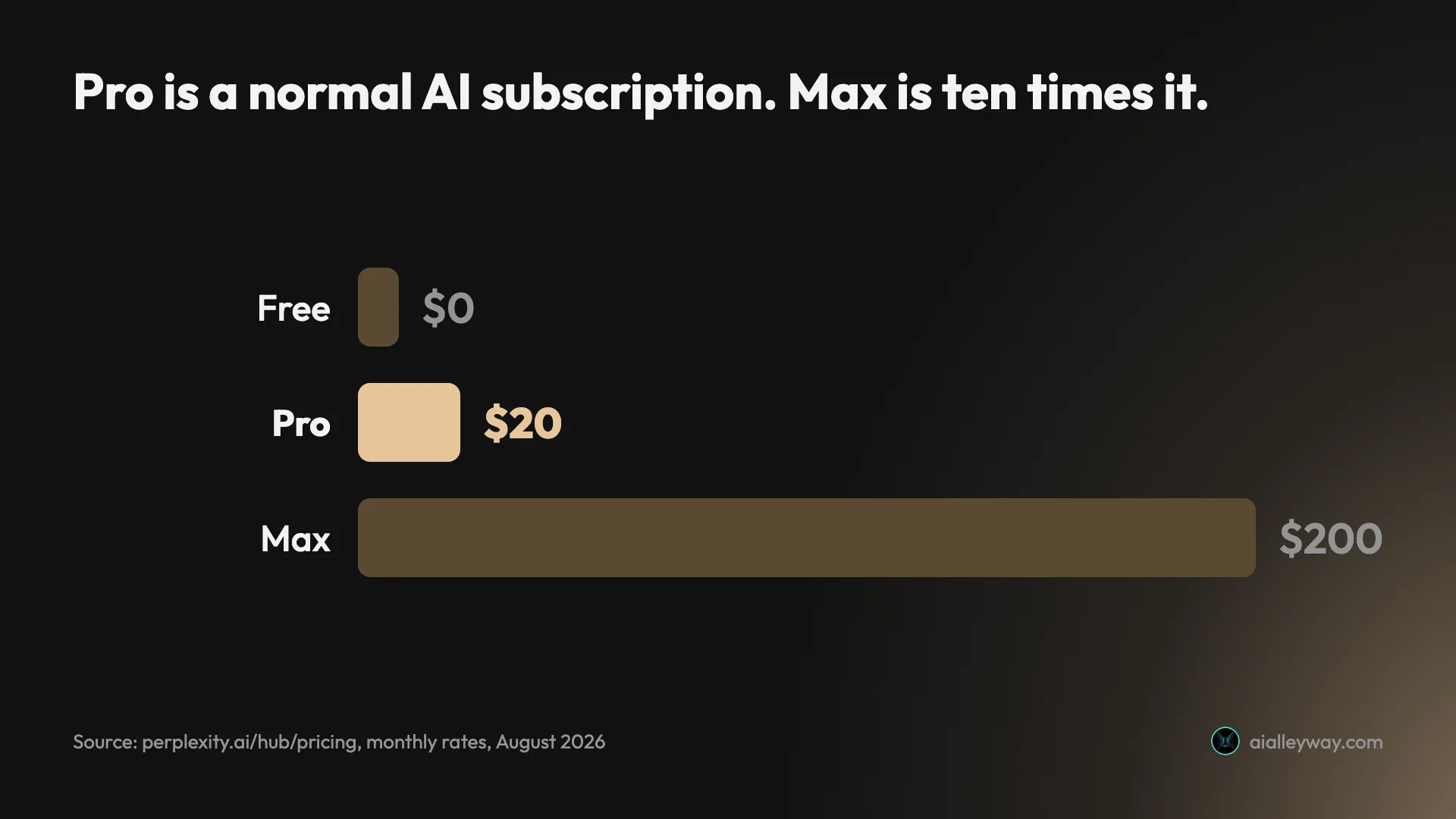
Ranked by how much they actually change the product, that list is shorter than it looks.
Model selection is the real purchase. Free shows you a picker you cannot use. Pro makes it functional. Perplexity orchestrates several frontier models and its pricing FAQ names ChatGPT, Google Gemini, Anthropic Claude and NVIDIA Nemotron, with Pro and Max both able to set a preferred model per query. If you have a view about which model answers your kind of question best, that is what $20 buys.
Premium data sources matter if your work is financial. Perplexity’s own FAQ lists PitchBook, Statista and S&P Capital IQ as premium sources available on the paid tiers. For market research or competitive analysis, licensed data behind an answer engine is a genuinely different product from a web search with citations. For everyone else it is inert.
Deep research and Computer are the growth areas. Computer is Perplexity’s agentic surface — it builds documents, apps and tools rather than just answering — and it is metered in credits rather than included flatly, which is why the plan cards lead with credit counts.
| What Pro adds | What it actually changes |
|---|---|
| Select between AI models | The free picker becomes usable rather than decorative |
| Premium sources | PitchBook, Statista and S&P Capital IQ behind answers |
| Deep research and Computer | Metered in credits, not included flatly |
| More usage limits and memory | The ceiling that sent you here in the first place |
Credits are the unit nobody explains. This is a pattern across the category rather than a Perplexity quirk. Our Claude Max plan guide found the same shape there: a headline multiplier that describes one window, while a different and much less advertised limit does the real constraining. Every paid card leads with a credit number — 4,000 bonus on Pro, 35,000 bonus plus 10,000 monthly on Max, 500 monthly per seat on Enterprise Pro — and Perplexity does not publish what one credit actually buys. There is no table anywhere on the pricing pages converting a credit into a Computer action, a document, or a minute of agent time.
That matters more than it sounds, because credits are how the expensive part of the product is metered. If Computer is the reason you are upgrading, you are buying a quantity of something whose exchange rate is undisclosed, and the only way to learn the rate is to spend and watch. Compare that to the API, where every rate is published to four decimal places, and the asymmetry is striking: Perplexity is precise with developers and vague with consumers.
The practical implication is to treat the bonus grants as a trial rather than an allowance. Four thousand credits sounds like a lot until you learn what a credit is, and you will only learn that by using it.
Higher limits are the quiet main event. “More usage limits and memory” is vague, and Perplexity does not publish the numbers, but for anyone who hit the free ceiling this is the line that removes the friction.
The honest framing: $20 makes the picker work and lifts the ceiling. Whether that is worth it depends entirely on whether search-with-sources is a tool you reach for daily or occasionally.
Does Max justify ten times the Pro price?
Ten times the price of Pro is a serious claim, so it is worth being precise about what actually changes.
Max adds maximum Computer usage, 35,000 bonus credits, 10,000 monthly credits, expert-level research, frontier AI models, the highest usage limits and memory, and priority access to new features.
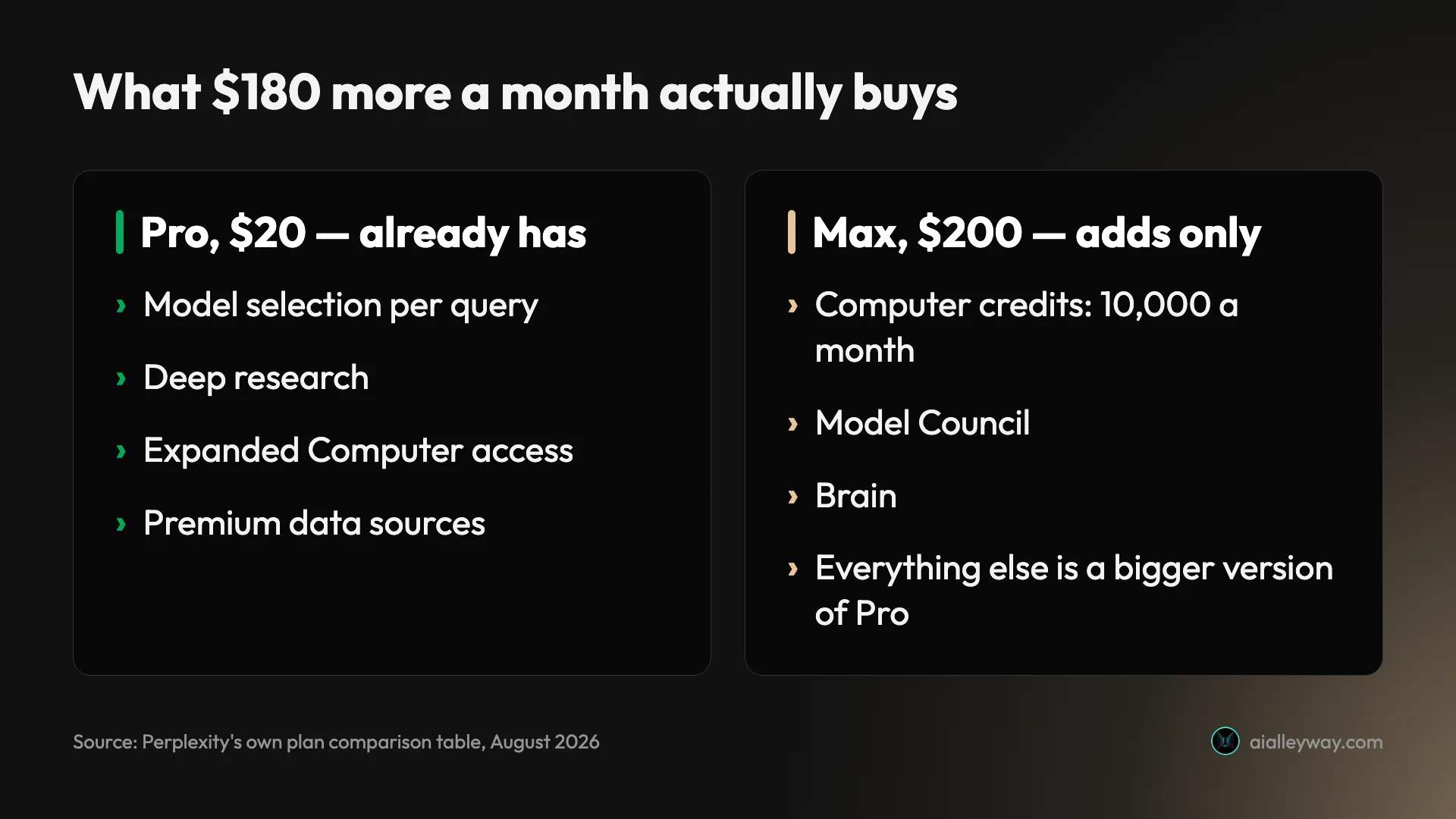
Most of that is a limits increase. The plan comparison table further down Perplexity’s pricing hub is more informative than the cards, because it shows what is genuinely absent below Max rather than merely smaller. Three rows are Max-only: Computer credits at 10,000 a month, Model Council, and Brain.
Those three are the actual $180-a-month difference. Everything else on the Max card is a bigger version of something Pro already has.
Model Council — comparing responses across several models on the same question — is the one with an obvious use case, and it is also the clearest expression of what Perplexity is: an orchestration layer over other companies’ models rather than a model of its own.
For whom does $200 make sense? Someone running sustained agentic work through Computer, where credits are the binding constraint rather than a curiosity. That is a narrow group, and it is not the person searching for “Perplexity pricing”.
For everyone else, the answer is that Pro is the ceiling worth paying, and if Pro’s limits are not enough, the question to ask is whether an answer engine is the right tool for that job at all rather than whether to spend ten times more on the same one.
What does a Perplexity Enterprise seat include?
Here the presentation flips, and it is worth flagging because it makes the tiers hard to compare.
Switch the pricing hub from Individual to Enterprise and the numbers are $34 per seat per month for Enterprise Pro and $271 per seat per month for Enterprise Max — both “when billed annually”. A third tier, covering additional security and governance, is custom-priced.
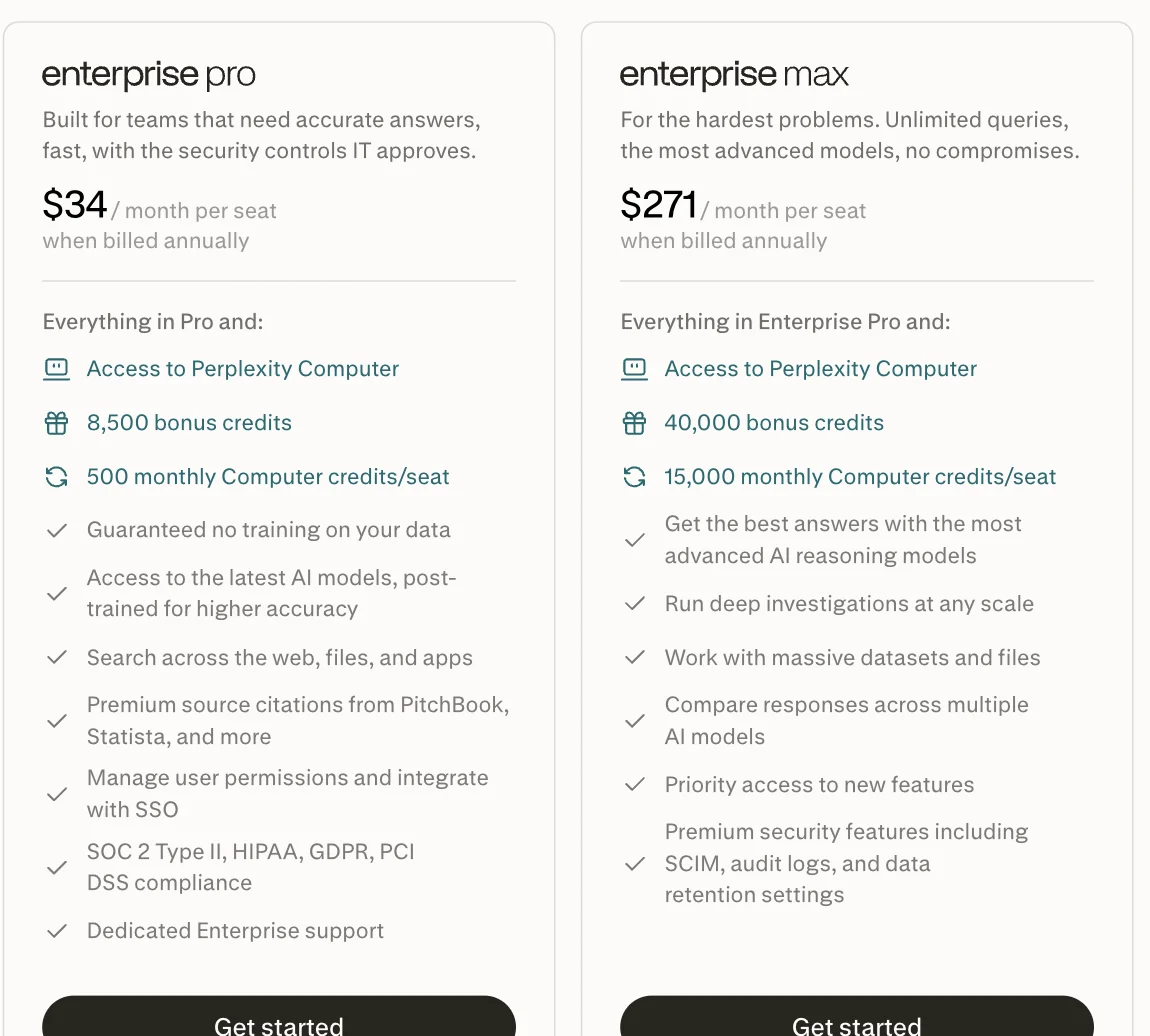
So on one page, behind one toggle, individual plans are quoted monthly and enterprise plans are quoted at their annual-equivalent. Comparing “$20 Pro” against “$34 Enterprise Pro” is not comparing like with like, because the first is a monthly price and the second is not.
What the enterprise tiers add is mostly governance rather than capability. Enterprise Pro carries a guarantee of no training on your data, SSO and user permission management, SOC 2 Type II, HIPAA, GDPR and PCI DSS compliance, dedicated support, and 500 monthly Computer credits per seat on top of 8,500 bonus credits. Enterprise Max raises credits to 15,000 monthly per seat, adds SCIM, audit logs and data retention settings, and opens up the multi-model comparison and large-dataset work.
There is also a structural point in how those tiers are drawn. Enterprise Pro is described as everything in Pro plus governance; Enterprise Max as everything in Enterprise Pro plus scale. So the enterprise ladder is not a different product, it is the individual product with compliance and administration bolted on.
Comparing the price honestly requires care, for the reason this whole post exists. Enterprise Pro’s $34 is an annual-equivalent figure, so the only fair comparison is against individual Pro’s annual-equivalent $17 rather than its $20 monthly rate. On that like-for-like basis Enterprise Pro is exactly double individual Pro, per seat. Set it against the $20 monthly figure instead and you get a misleadingly modest 70%, which is the kind of error the page’s own presentation invites.
What that doubling buys is not capability but assurance — who can see the data, where the audit logs go, what happens to your content, and whether a compliance officer will sign it off. Those are the right things to pay for at a team level, and they are worth nothing at all to an individual.
The no-training-on-your-data guarantee is the line worth noticing. It is stated at the Enterprise tier, which implies something about the individual tiers that a business user should think through before pasting anything confidential into a $20 account.
Perplexity API pricing, per token and per request
The API is a separate product with separate billing, which puts Perplexity in the same shape as most of the category — see our AI tool cost statistics for how subscription and metered pricing compare across tools.
The core point is simple. Paying for Pro does not give you API credit, and this is the single most common misunderstanding about Perplexity’s pricing.
Rates come straight from Perplexity’s API pricing docs.
| Sonar model | Input / 1M tokens | Output / 1M tokens |
|---|---|---|
| Sonar | $1 | $1 |
| Sonar Reasoning Pro | $2 | $8 |
| Sonar Deep Research | $2 | $8 |
| Sonar Pro | $3 | $15 |
Sonar Deep Research bills three further meters on top: $2 per million citation tokens, $3 per million reasoning tokens, and $5 per thousand search queries. That is the model to watch, because a “single” deep research call is four charges rather than one.
Beyond the chat models, two flat-rate products are simpler to budget. The Search API is $5 per 1,000 requests. The Agent API bills per tool invocation: $0.0025 for a web search, $0.0005 to fetch a URL, and $0.005 each for people search and finance search. Sandbox sessions run $0.03 per session on a twenty-minute billing window.
Worked through, those rates are lower than they look for ordinary use and higher than they look for research. A typical Sonar Pro call of roughly 2,000 input and 1,000 output tokens costs about $0.021 — two cents. A thousand of those is $21, which means you would need to make around 950 API calls in a month before matching the $20 you would have spent on a Pro subscription. For occasional programmatic use, the API is the cheaper instrument by a wide margin.
Deep Research inverts that. Because it bills citation tokens, reasoning tokens and search queries on top of input and output, a single call fans out into four meters at once, and the $5-per-thousand search charge alone can dominate a research-heavy workload. If you are budgeting for Deep Research, model the searches rather than the tokens.
The Search API is the easiest of all to reason about: half a cent per request, flat, no token accounting. For a product that just needs web results with citations, that is often the whole integration.
One correction worth making explicitly, because it is currently being repeated elsewhere: Google’s AI Overview states Sonar costs $0.25 per million input tokens and $2.50 per million output. Perplexity’s own documentation says $1 and $1. Take the docs.
What should you watch before you pay?
Credits are a second currency, and the cards lead with them. Pro advertises 4,000 bonus credits, Max 35,000 bonus plus 10,000 monthly. Bonus credits are a one-off grant; monthly credits refresh. Only Max lists a recurring monthly allowance on the individual tiers, which tells you Computer is metered rather than included, and that a heavy Computer user on Pro will run out of the one-off grant and stop.
A subscription is not API credit. This trips up more people than anything else here. Pro and Max are consumer products; the Sonar and Search APIs are billed per token and per request against a separate account. If you are building something, your subscription buys you nothing on the developer side.
The no-training guarantee sits at the Enterprise tier. Perplexity states “guaranteed no training on your data” on Enterprise Pro. It does not make that statement on the $20 individual card. That is worth reading twice before pasting client material into a personal account, and it is the strongest argument for a team moving up rather than buying individual seats.
The promotional credits are not part of the price. Both paid cards currently carry a LIMITED TIME banner offering $40 and $450 of free Computer credits. Promotions end. If the credits are what makes the maths work for you, the maths does not work.
Perplexity is being sued by publishers, and that is a pricing risk. Our Perplexity review counted seven publisher lawsuits against the company, beginning with News Corp in October 2024. The product’s whole value is answers built on other people’s journalism with citations attached, and the people whose journalism it is have gone to court. You are not buying a stable content supply the way you are with a model that generates rather than retrieves — that is a real consideration on an annual commitment.
| What is not in the sticker price | Why it matters |
|---|---|
| Bonus credits are a one-off | Pro’s 4,000 do not refresh; only Max lists a monthly allowance |
| API usage | Billed separately per token; a subscription grants none |
| The no-training guarantee | Stated on Enterprise Pro, not on the $20 individual card |
| Promotional Computer credits | LIMITED TIME banners, not part of what you are buying |
| Annual commitment | The only discount, and the only lock-in |
Annual billing is the only discount, and it is the only lock-in. There is no monthly discount to find. Committing for a year saves 15% on Pro and 16.5% on Max, and it is the one decision here you cannot reverse cheaply.
How Perplexity’s price compares at the same tier
$20 a month is the standard price of an AI subscription in 2026, which makes Perplexity Pro easy to compare and hard to justify on price alone.
At exactly the same $20, ChatGPT Plus — which we put head to head with Perplexity on one checkable question — covers image generation, voice, a coding agent, custom GPTs and web search; Claude Pro covers Claude Code, Cowork, Design, Science and unlimited projects. Both are general assistants that also search. Perplexity Pro is an answer engine that does one job and does it with better citation discipline than either.
That is the trade, and it is a genuine one rather than a loss. If what you want is a sourced answer to a factual question, Perplexity’s output is shaped for verification in a way a general assistant’s is not — the citations are the product, not a footnote. Our head-to-head on the two $20 assistants covers those two against each other, and ChatGPT vs Gemini covers the free tiers, which is where the cheapest useful answer usually lives.
| At $20 a month | What you get |
|---|---|
| Perplexity Pro | An answer engine: sourced answers, model selection, premium data |
| ChatGPT Plus | A general assistant: images, voice, coding agent, custom GPTs |
| Claude Pro | A general assistant: Claude Code, Cowork, Design, unlimited projects |
The free-tier comparison is the one that matters most here, because it is where the three diverge sharply. Gemini gives a non-paying user its advanced reasoning model and a working picker. ChatGPT gives a free user one model and no picker. Perplexity shows a free user ten models with a padlock on every one. Three different answers to the same question about what a non-paying user deserves.
If you are choosing where to spend a single $20, the honest sequence is: try all three free tiers for a fortnight, notice which one you keep opening, and pay for that. Perplexity wins that test for people whose questions are factual and current. It loses it for people who mostly need something written.
Is there a Perplexity student discount?
This is one of the most common follow-up questions about Perplexity’s pricing, and the honest answer requires more care than most pages give it.
Perplexity’s main pricing hub lists three individual tiers — Free, Pro and Max — and no education tier appears alongside them. A discounted education price is widely cited elsewhere at $10 a month, but I could not find that figure on the pricing hub itself today, which is why it does not appear in the tables above. Treat any specific number you read, including that one, as needing confirmation against your own account.
What is worth knowing is the shape rather than the figure. Perplexity’s education access has historically been gated behind third-party student verification rather than a university email address, which means eligibility is checked before any price applies. Perplexity has also run campus-wide access arrangements with individual universities, so the relevant question may not be “is there a discount” but “has my institution already bought this”.
The practical sequence for a student is therefore: start on the free tier, which costs nothing and requires no verification; check whether your university already provides access; and only then look for an education price from inside a logged-in account. Do not assume a discount will be available at the moment you need it.
Which tier fits which kind of work?
| Your situation | Plan | Monthly |
|---|---|---|
| Checking facts, occasionally | Free | $0 |
| Sourced answers are a daily tool | Pro | $20 |
| Sustained agentic Computer work | Max | $200 |
| A team, and the data guarantee is the point | Enterprise Pro | $34/seat, annual |
| You mostly need things written | Something else | — |
Stay free if your use is checking facts. The free tier answers factual questions with citations and costs nothing. Most people searching this query should try a fortnight of free use before paying, because the ceiling tells you more than any guide can.
Pro at $20 if search-with-sources is a daily tool. It makes the model picker work and lifts the limits, and $20 is the normal price of an AI subscription. Commit to a year only once you know you use it.
Max at $200 only for sustained Computer work. If Model Council, Brain, or 10,000 monthly credits are things you can name a use for, it is aimed at you. If you cannot, it is not.
Enterprise if the data guarantee is the point. The reason to move a team onto Enterprise Pro is no-training-on-your-data, SSO and compliance, not the credits.
Go straight to annual only if you already know. The 15% saving on Pro is real, and so is the twelve-month commitment behind it. Perplexity is a product whose usefulness depends heavily on whether your questions are factual and current, and that is something a fortnight on the free tier answers cheaply. Pay monthly first; convert to annual in month three if you are still opening it daily.
Skip Perplexity entirely if you want a general assistant. It is an answer engine, and it is our current pick in that category, but at the same $20 a general assistant does more. Our ChatGPT vs Claude comparison covers that side, and the Claude review covers the tool I draft in.
Final word
Perplexity’s pricing is not expensive and it is not deceptive, but it is presented in a way that makes it hard to hold in your head: $20 or $17 depending on the page, monthly for individuals and annual-equivalent for enterprise behind the same toggle, promotional credits that are not part of the price, and a separate API rate card that has nothing to do with your subscription.
The version to remember is short. Free is real and does the core job. Pro is $20 a month, or $17 if you commit for a year, and what it actually buys is a model picker that works. Max is $200 and is for people running agents rather than asking questions. The API is billed separately, per token.
If you are deciding, the free tier is an unusually good guide to whether you should pay, because it shows you exactly which doors are locked. Spend two weeks there before spending anything else. For the wider verdict on whether the product earns its price at all, our 4.4 verdict on Perplexity explains where it falls short.
Frequently asked questions
How much does Perplexity cost per month?
Perplexity's own pricing hub lists three individual plans: Free at $0 a month, Pro at $20 a month, and Max at $200 a month.
Open Perplexity's separate Pro page, though, and the same two paid plans are labelled $17 and $167. That is not a discount you have to find. It is the annual-equivalent price, described on the card as "per month or equivalent, when billed annually", and the monthly figure does not appear on that page at all.
So both numbers are real and both are official. Which one you see depends on which Perplexity page you happened to land on. The gap is $3 a month on Pro and $33 a month on Max, or roughly 15% and 16.5% respectively.
Budget from the monthly figure unless you are certain you will commit for a year.
Is Perplexity Pro worth $20 a month?
It depends on whether you want an answer engine or an assistant, and the free tier answers that question for you at no cost.
What $20 buys, per Perplexity's plan card, is expanded access to Perplexity Computer, 4,000 bonus credits, deep research, access to top AI models, the ability to select between models, document and app creation, and higher usage limits and memory.
The single most valuable item there is model selection. On a free account the picker lists models you cannot choose, so the headline feature of the product is visible but locked. Paying is what makes the picker functional rather than decorative.
If your work is genuinely search-shaped — factual questions where you want sources attached — Pro is reasonable. If you want a general assistant for drafting and reasoning, $20 buys more elsewhere.
What is the difference between Perplexity Pro and Max?
Scale, plus three features Pro does not have at all. Pro is $20 a month and Max is $200, a ten-fold jump for what Perplexity describes as maximum Computer usage, 35,000 bonus credits, 10,000 monthly credits, expert-level research, frontier AI models, the highest usage limits and memory, and priority access to new features.
The plan comparison table on Perplexity's pricing hub is more revealing than the cards. Three rows are Max-only: Computer credits at 10,000 a month, Model Council, and Brain. Those are the things you genuinely cannot get at $20.
A ten-times price for what is mostly a limits increase is a steep ask, and Max is aimed at people running sustained agentic work rather than at anyone asking questions. For everyone else the honest answer is that Pro is the ceiling worth paying, and that if Pro's limits genuinely are not enough, the better question is whether an answer engine is the right tool for that job at all.
Does Perplexity have a free plan?
Yes, and it is a real plan rather than a trial. There is no countdown and no card required.
Perplexity's own description of it is unusually restrained: search only, with accurate answers and citations, good for limited daily usage, better for simple questions, citations in every answer, and access to basic AI models.
Note the last item. Basic models, not the top ones. On a free account the model picker displays ten models and every one carries a padlock, so you can see precisely what you are not getting. It is an effective upgrade prompt and a slightly deflating experience.
What free does well is the core job: ask a factual question, get an answer with inline citations you can check. If that is all you need, the free tier genuinely serves it and there is no reason to pay.
How much does the Perplexity API cost?
It is metered separately from the subscriptions and priced per token or per request, and the rates are published rather than quote-only.
On the Sonar models, Perplexity's docs list Sonar at $1 per million input and $1 per million output tokens; Sonar Pro at $3 and $15; Sonar Reasoning Pro at $2 and $8; and Sonar Deep Research at $2 and $8, plus $2 per million citation tokens, $3 per million reasoning tokens, and $5 per thousand search queries.
The Search API is a flat $5 per 1,000 requests. Agent API tools are billed per invocation: $0.0025 for a web search, $0.0005 to fetch a URL, and $0.005 each for people search and finance search.
A subscription and an API key are different products, billed to different accounts. Paying $20 for Pro does not give you a cent of API credit, and this is the most common misunderstanding about how Perplexity charges.
Is there a Perplexity student discount?
Perplexity has offered discounted education access, but it is not listed on the main pricing hub alongside Free, Pro and Max, so treat any specific figure you read as needing verification against your own account.
The pattern worth knowing is that education pricing at Perplexity has historically required third-party student verification rather than simply using a university email address, which means eligibility is checked before the price applies.
If you are a student, the practical route is to start on the free tier, which costs nothing and requires no verification, and check the current education offer from inside a logged-in account before committing. Perplexity has also run campus-wide access promotions with universities, so it is worth checking whether your institution already provides it.
Do not assume a discount exists at the moment you need it. Verify first.
Keep reading
Perplexity AI review: the free tier is a showroom
A Perplexity AI review from the free tier: ten models in the picker and every one padlocked, $17 a month to unlock them, and six publishers now suing.
Perplexity vs ChatGPT: we asked both the same question
Same question, same day, both free tiers. One got the facts right and cited them; the other was confidently wrong. Plus the price nobody compares properly.
Best AI search engine: one question, three engines
The best AI search engines, tested with one identical question. All three agreed on the facts. One cited EUR-Lex, another a consultancy blog and YouTube.
ChatGPT alternatives: 6 worth switching to, 3 tested
The best ChatGPT alternatives, with the three I use daily scored from real accounts: Claude 4.4 for writing, Gemini 4.3 free, Perplexity 4.4 for citations.