
Best AI search engine: one question, three engines
The best AI search engines, tested with one identical question. All three agreed on the facts. One cited EUR-Lex, another a consultancy blog and YouTube.
Contents
The best AI search engines, and what actually separates them
I ran one identical question through three AI search engines within the same hour: what changed in the EU AI Act in 2026. It is a good test because the answer is factual, recent, and checkable against a primary source.
They agreed on the facts almost entirely. Where they parted company, and parted company badly, was on what counts as evidence for those facts.
| Engine | Best for | Price | What it cited on my test query |
|---|---|---|---|
| Perplexity | Research you have to defend | Free, or $20 | European Commission domains, 10 sources |
| Brave Search | The best free answer | Free, no account | EUR-Lex, per its own citation |
| Google AI Mode | Speed, inside the search box | Free | A consultancy, two AI-explainer sites, YouTube, the Commission |
| ChatGPT search | The one you already have | Free, or $20 | Not run in this test |
| Kagi | Paying to remove ads | From $5 | Not tested |
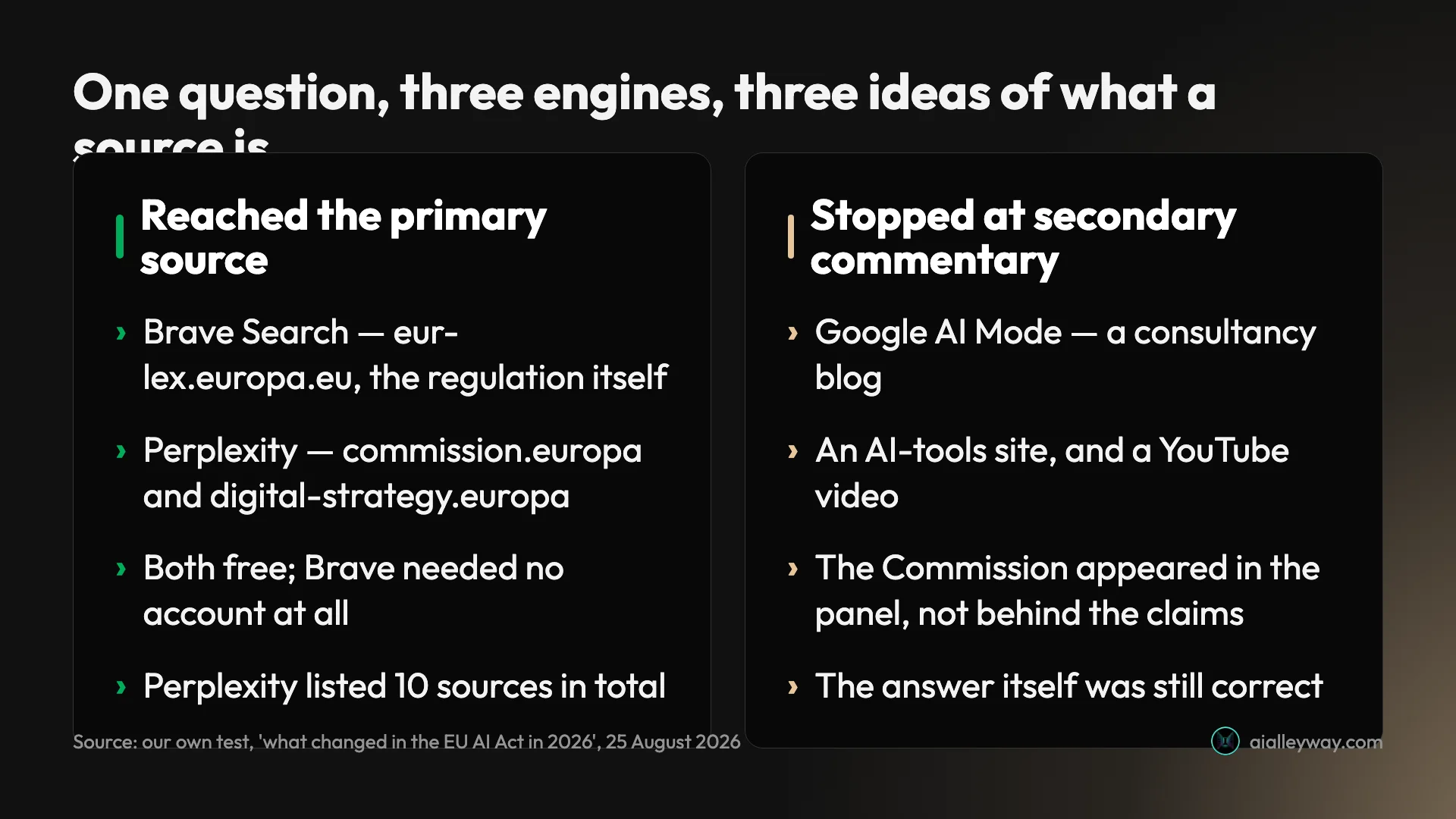
That last column is the whole post. Three engines, one question, three very different ideas of what a source is.
How I tested, and what I did not
One query, run through each engine within the same hour on 25 August 2026, with the answers screenshotted as they came back. The question was what changed in the EU AI Act in 2026 — chosen because it is recent enough to require live retrieval, specific enough to have a right answer, and legally consequential enough that a primary source exists to check against.
| Engine | Run first-hand? | On which tier |
|---|---|---|
| Perplexity | Yes, 25 Aug 2026 | Free |
| Google AI Mode | Yes, same day | Free |
| Brave Search | Yes, same day | Free, no account |
| ChatGPT search | Covered from the free tier, not run in this test | Free |
| Kagi | No — vendor pages only | — |
Perplexity, Google AI Mode and Brave Search were all run first-hand and all three screenshots are below. Perplexity was on its free tier. ChatGPT’s search is covered from the free tier, which includes it, but I did not run it on this particular query, and the table above says so rather than implying otherwise.
Kagi I have not used at all. Everything below about it comes from its own pricing page, read the same day, and it is written throughout as documentation rather than as a verdict I am entitled to give.
One engine that appears on most competing lists is missing: Consensus, the academic-paper search tool. Its site returns 403 to every automated request, so I could not verify a single current claim about it. Describing it from memory would have been worse than leaving it out.
A single query is not a benchmark, and I am not presenting it as one. A larger sample would tell you which engine is more often correct, and that is a genuinely useful thing to know that this test cannot answer. What one carefully chosen query is good for is exposing a difference that feature tables hide completely — not whether an engine is right, but whether it can show you why it thinks so.
What separates an AI search engine from a chatbot?
The category has a definition problem, and it matters because half the tools people recommend for this are not really search engines.
An AI search engine retrieves first and writes second; a chatbot with web access does the reverse, composing an answer and reaching for the web when it decides it needs to. Our Perplexity review works that distinction through properly, because it is the thing that product is built around.
There is a practical test. Ask a question about the last month, then look at whether every load-bearing sentence carries its own citation, or whether the sources are gathered politely at the end. The first is a search engine. The second is a chatbot that searched.
Both are useful. But if you are choosing a tool because you need to verify things, that distinction is the one that decides it — and it is the reason ChatGPT appears fourth on this list rather than first, despite being the product most readers already have open.
Are AI search engines accurate enough to rely on?
On the evidence of this test, more than the discourse suggests — with one important caveat about what accuracy means.
All three engines I ran got the substance right. Nobody invented a regulation, nobody hallucinated a deadline, and the two dates that mattered came back identical across three independent systems. For a question about legislation that changed weeks earlier, that is a good result, and it is a noticeably better one than this category would have produced eighteen months ago.
The caveat is that agreeing is not the same as being right, and three engines drawing on overlapping sources can be consistently wrong together. The only defence against that is the citations, which is why the sourcing difference below is not a side issue, and why our ChatGPT review treats verifiability as a scoring axis rather than a footnote. An answer you can trace to a government domain is checkable. An answer traced to a consultancy’s summary of a government domain is one remove further away, and the remove is invisible in the output.
So: accurate enough to use, not accurate enough to skip reading the sources. That is a fair description of the whole category right now.
1. Perplexity — best for research you have to defend

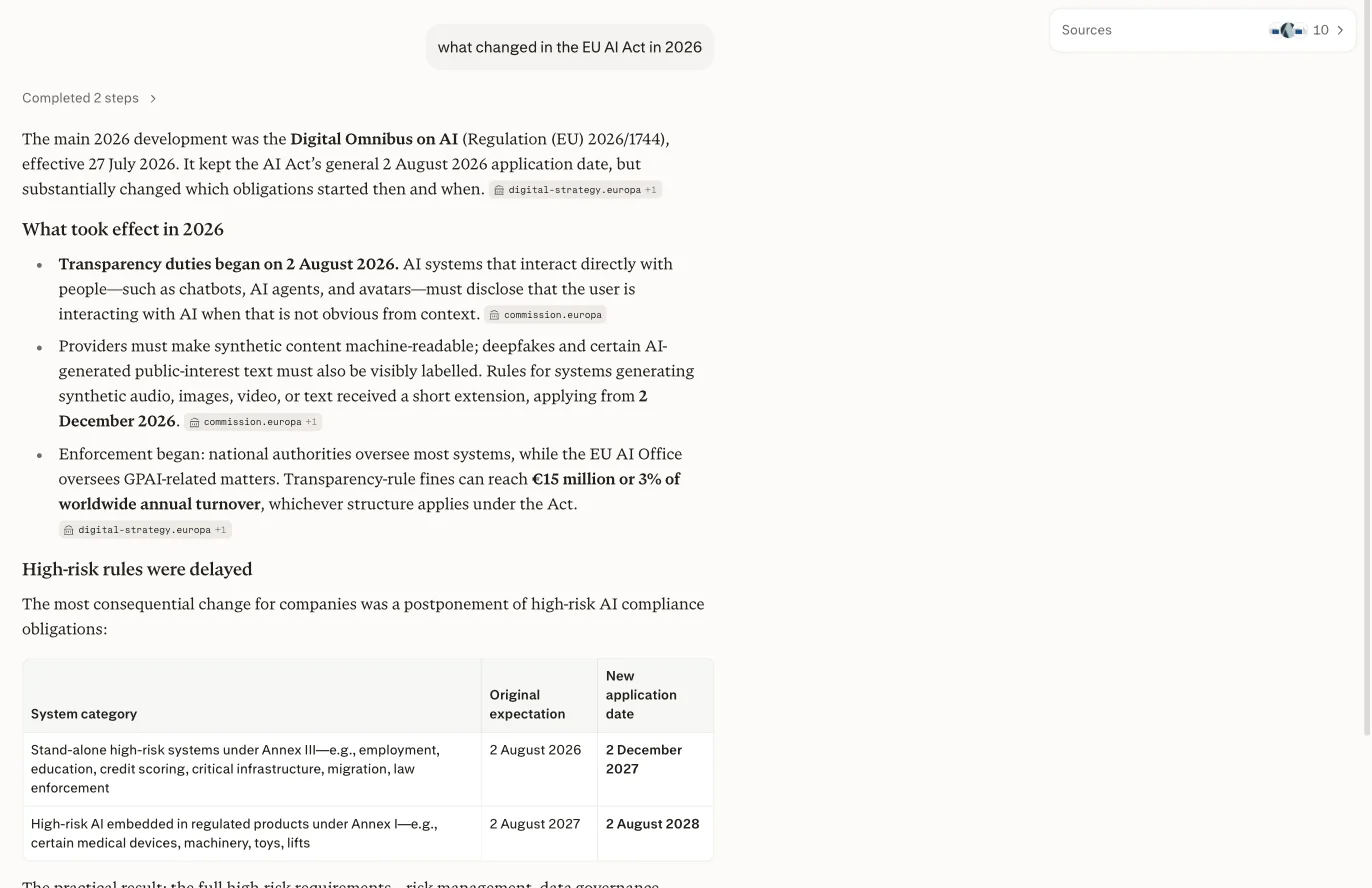
Perplexity gave the most complete answer of the three by a clear margin, and it did it on a free account.
It named the amending instrument, the Digital Omnibus on AI (Regulation (EU) 2026/1744), gave its effective date, then laid out what actually changed in a table: stand-alone high-risk systems moved from 2 August 2026 to 2 December 2027, embedded high-risk AI from 2 August 2027 to 2 August 2028. It added the transparency duties that began on schedule, a separate December 2026 extension for synthetic-content labelling, and the fine ceiling of €15 million or 3% of worldwide annual turnover.
Its citations were European Commission domains — commission.europa.eu and the Commission’s own AI Act policy pages on digital-strategy.ec.europa.eu — with ten sources in total.
Pricing. Free, Pro at $20 a month, Max at $200. Our Perplexity pricing guide covers a wrinkle worth knowing: the pricing hub and the Pro page quote different headline numbers for the same plans.
Where it falls short. The free model picker shows ten models with a padlock on every one. It answers rather than produces, so it is the wrong tool for drafting. And the company is defending seven publisher lawsuits over the mechanism that makes it work, which our full Perplexity review covers in detail. It scored 4.4.
What the test showed about its shape. The structured table was the detail that separated it. Asked what changed, it did not just list the new dates — it showed the old ones beside them, which is the difference between telling you a fact and letting you see the change. That is a research habit built into the output, and it is the clearest illustration of why this is the tool for work somebody will interrogate.
Who it is for. Anyone whose answer gets checked by somebody else: analysts, journalists, students, anyone writing something with a citation list at the end.
2. Brave Search — the best free answer, and the biggest surprise

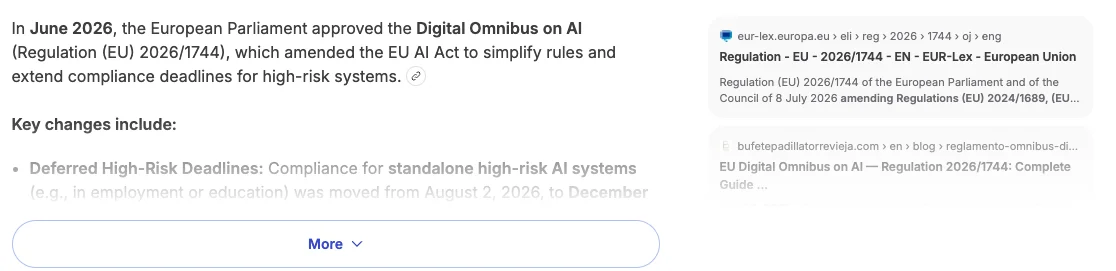
This is the result I did not expect, and it is the reason this post exists in this shape.
Brave returned its AI summary with no account, no login and no paid tier, and the source it cited was eur-lex.europa.eu, which it presented as Regulation (EU) 2026/1744, dated 8 July 2026. That is a pointer at the primary legal instrument rather than at anybody’s description of it — though see the sourcing audit below, because the address itself did not resolve to a document when I followed it. Neither of the two better-known engines pointed at the instrument at all.
The summary was shorter than Perplexity’s and correctly identified the substance: the Digital Omnibus amended the AI Act to extend compliance deadlines for high-risk systems. Its organic results underneath led with the European Commission’s own pages, which is a separate point in Brave’s favour — the index is doing real work, not just the summariser.
Pricing. Free. There is no account requirement for the summary, which among AI search tools is close to unique.
Where it falls short. The summary is brief where Perplexity is thorough, and there is no research workspace, no collections, no way to organise anything you find. It is a better search engine than it is a research tool.
Why this result matters beyond Brave. The engine with the smallest budget and no account wall reached the primary source, while two far larger products did not. Whatever else that says, it means citation quality is a choice each product makes rather than a function of how much compute it has. That is worth knowing when you read a comparison that ranks these tools by model capability.
Who it is for. Anyone who wants a well-sourced answer without signing up for anything, and anyone who cares about not being tracked while searching. It is also the one to recommend to somebody who does not want another account.
3. Google AI Mode — best for speed, weakest on provenance
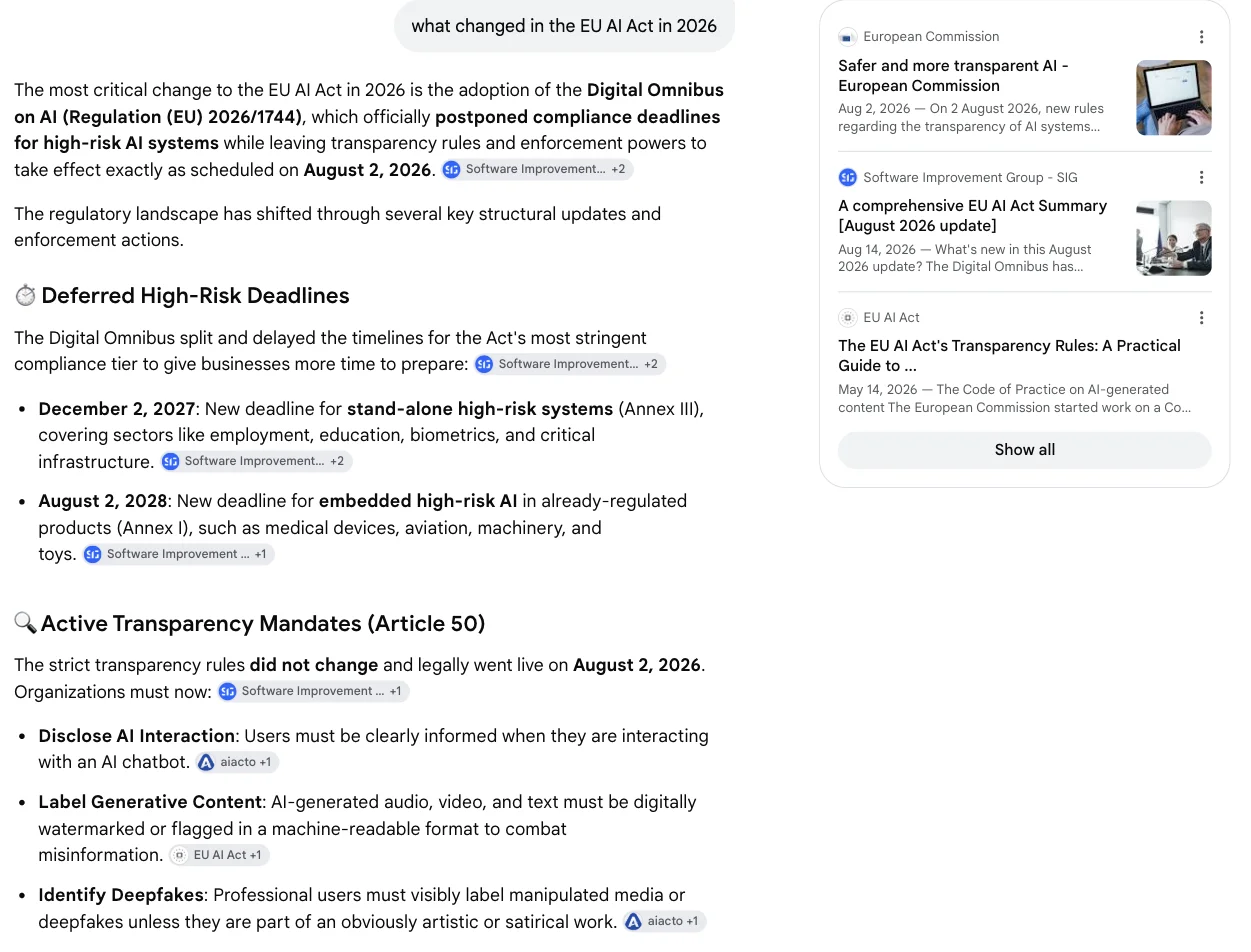
Google’s advantage is that there is nothing to adopt. AI Mode is a tab beside All, Images and Videos, so the friction of using it is zero.
The answer it gave was correct on the substance and agreed with the other two on both deadline dates. It was well structured, with headed sections and inline attribution chips, and a sources panel on the right.
The provenance is where it disappointed. Five sources appeared: a software consultancy, two sites that explain the AI Act rather than publish it, a YouTube video, and the European Commission. The Commission was in the sources panel; the attribution chips on the load-bearing sentences pointed at the secondary write-ups. Two competitors answering the same question reached the regulation and the Commission directly.
Pricing. Free, and it comes with the search box you already use. Google’s paid Gemini tiers are Google One storage plans, which our Gemini review works through.
Where it falls short. Provenance, on this evidence. It is also the engine with the least incentive to send you anywhere, since answering in place is the point.
One structural note worth holding on to: AI Mode is a tab, not a replacement. Google has kept the ranked list of results one click away under All, and when I checked it, that list led with the European Commission’s own pages — the primary sources its AI answer did not lean on. The engine had them. The summariser chose otherwise.
Who it is for. Everyone, for the large majority of questions where you want an answer rather than a citation. Just do not treat it as a research tool, and click through to All when the answer looks thin.
4. ChatGPT search — the one you probably already have

| Answer engine | Assistant that searches | |
|---|---|---|
| Order of work | Retrieves, then writes | Writes, then retrieves if needed |
| Where citations sit | On each claim | Gathered at the end |
| Best for | Verifying | Producing |
| On this list | Perplexity, Brave, Google AI Mode | ChatGPT |
The reason to consider ChatGPT here is not that it is the best AI search engine. It is that if you already use ChatGPT, its search is a tab away and costs nothing extra.
The free tier includes web search, alongside the model you get without a picker, and for a factual question it will retrieve and cite. If your alternative is opening a new product and learning it, the honest advice is to try the search you already have before adopting another.
Pricing. Free tier includes search; Plus is $20 a month. Our ChatGPT review scored it 4.6, and it remains our overall assistant pick.
Where it falls short. It is an assistant that searches rather than a search engine, and the difference shows in how the answer is shaped: prose first, sources second. For work where the citation is the deliverable, that ordering is backwards.
There is also a real argument for consolidation that this category tends to talk people out of. Every additional tool is another history, another set of saved context, another tab. If ChatGPT’s search is good enough for the questions you actually ask, using it is not a compromise — it is one fewer thing to manage, and the cost of switching is genuinely higher than the comparison tables imply.
Who it is for. Existing ChatGPT users who want to stop paying attention to this category. That is a legitimate position, and for the majority of everyday questions it is the right one.
5. Kagi — the one that sells you the absence of advertising

Kagi is the odd entry here and the only one I have not used, so treat this as a description rather than a verdict.
Its proposition, per Kagi’s own pricing page, is unusual: you pay, and in exchange there are no ads and no advertising business model behind the ranking. Everything else in this roundup is free because something else is paying for it.
| Kagi plan | Price | What it includes |
|---|---|---|
| Trial | Free | 100 searches |
| Starter | $5/month | 300 searches, Assistant with Quick mode |
| Professional | $10/month | Unlimited searches, larger Assistant allowance |
| Ultimate | $25/month | Research mode, flagship models, unlimited searches |
The Ultimate tier is the interesting one for this category: Kagi’s pricing page says it includes Assistant with Research mode and flagship models from Claude, GPT and Gemini. That makes it a way to reach several frontier models through one paid search product, which is a different shape from anything else here.
Where it falls short. I cannot tell you how good it is, because I have not run it. The free trial is 100 searches, which is enough to find out for yourself.
The pricing shape is worth reading carefully because it is not what you would expect from this category. At $5 the entry tier undercuts every paid AI assistant on the market, and the ladder climbs by usage allowance rather than by capability — Starter caps at 300 searches, Professional lifts that to unlimited — until Ultimate adds the research mode. That is closer to how a utility prices than how an AI product usually does.
Who it is for. People who have concluded that ad-funded search is the problem and are willing to pay to leave it. That is a smaller group than the internet’s opinion pages suggest, but it is not a niche of one.
What the test actually showed
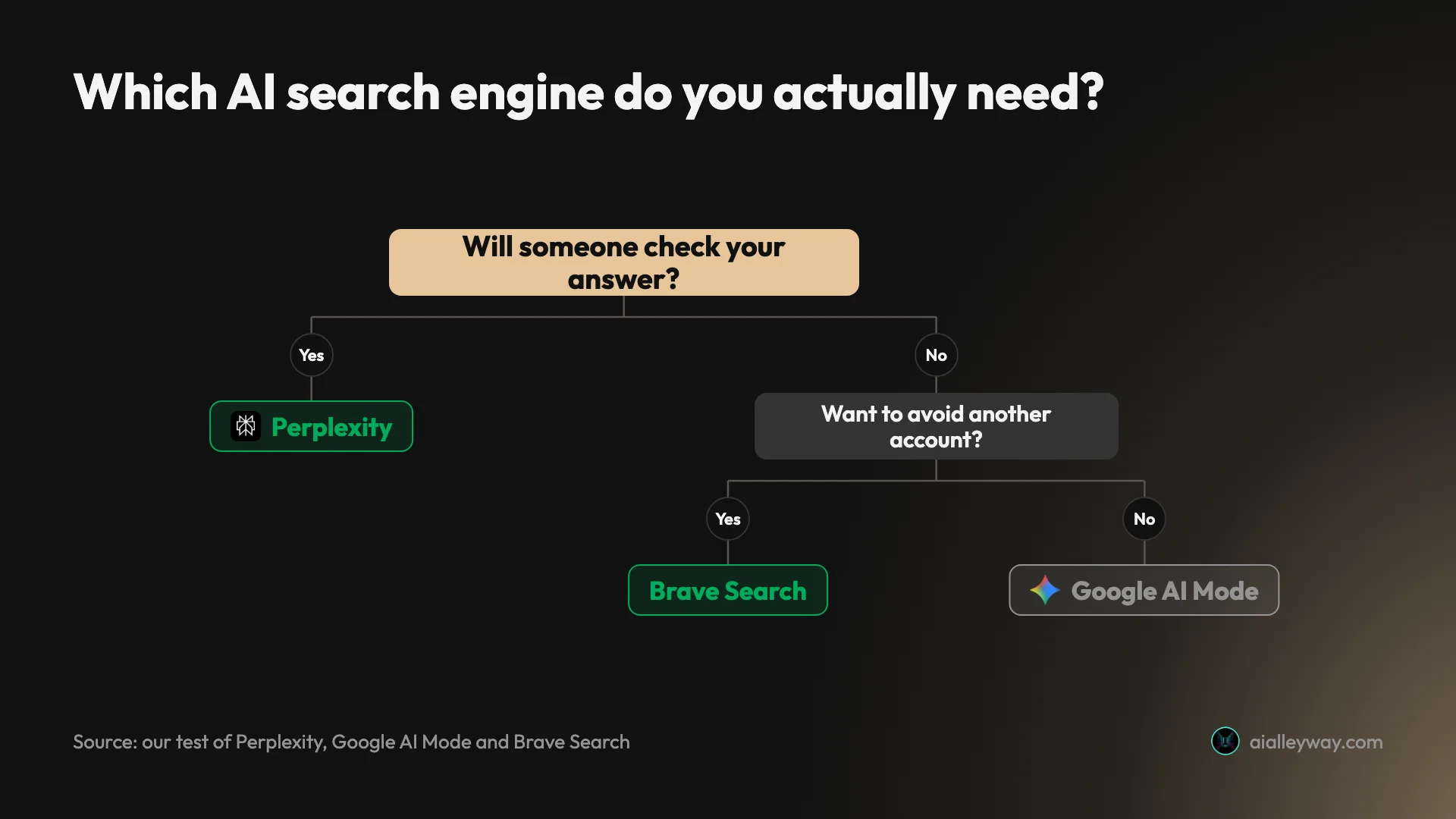
Three findings, in order of how much they surprised me.
They agreed on the facts. All three engines identified the same amending regulation and the same two deferred deadlines. Nobody hallucinated a date. That is worth saying plainly, because it was not reliably true of this category a year ago — though as the table below records, one of the cited addresses did not resolve for me when I followed it, which is a different failure from inventing a fact and a real one all the same.
Though this post should hold itself to its own standard, so here is where it falls short of one.
| Claim in this post | How well sourced |
|---|---|
| High-risk deadline moved to December 2027 | Corroborated on the Commission’s own AI Act page |
| The AI Act is Regulation (EU) 2024/1689 | Stated on that same Commission page |
| The amending instrument is Regulation (EU) 2026/1744 | Only from the engines. Two of three named it; I have not read it |
| The EUR-Lex address Brave cited | Did not resolve to a document when I followed it |
Two engines agreeing is better evidence than one, and it is still not a primary source. I have left the identifier in because it is what the test returned and the test is the point, but it is the one number here I would not defend without checking first. On a question with a clear answer, current AI search is reliable enough that the accuracy anxiety in most articles about this category feels out of date.
They disagreed completely about sourcing. One cited the legal instrument, one cited the government department, one leaned on a consultancy and two explainer sites. Those are three different standards of proof presented in an identical format, and nothing in the interface tells you which you are getting. You have to look.
The free ones were not the worst. Brave, free and account-less, produced the best-sourced answer of the three. That inverts the assumption the paid tiers rely on.
There is a fourth observation that only shows up when you run the same query rather than reading feature tables, and it is the one I would want if I were choosing. The three engines produced answers of very different lengths — Perplexity’s was several times Brave’s — and length tracked completeness rather than padding. Perplexity told me what the deadlines had been before they moved; Brave told me they had moved; Google told me where they landed. All three were true. Only one of them let me see the size of the change.
That is not a quality ranking so much as a shape difference, and it maps onto the job you are doing. Reporting a change needs the before and after. Complying with a rule needs the after. Deciding whether to care needs a sentence. The engines are optimised for different points on that line, and no feature comparison will tell you which one you are on.
The takeaway I would carry out of this: the summary is the least useful part of an AI search result. What sits underneath it is. Read those first, and an engine that keeps handing you primary sources is worth more than one that writes a slightly better paragraph.
What this looks like from the other side
One thing worth saying plainly, because this site is one of the pages these engines cite: the sourcing differences above are not an abstract quality question. They are a distribution question for everyone who publishes.
An engine that cites the primary source sends its traffic to the primary source. An engine that cites a consultancy’s summary sends it to the consultancy. On the test query, the same information routed to three different destinations depending on which product the reader happened to open, and none of those readers saw a ranked list of ten options to choose from.
That has two consequences worth holding at once. For a reader, it means the engine you pick quietly decides whose account of a topic you get, and the interface gives you almost no signal that a choice was made. For anyone publishing, it means being the source an answer engine reaches for is now a distinct problem from ranking, with its own rules.
I am not going to pretend to be neutral about that second point. But it cuts in a useful direction for a reader too: when an engine cites the thing itself rather than somebody’s write-up of the thing, that is the version with the fewest hands on it, and it is the one to prefer.
How to pick
- You have to defend the answer to someone else → Perplexity. Most complete, best organised, real citations.
- You want a good answer with zero commitment → Brave Search. No account, well sourced, and it does not track you.
- You want the answer in the box you are already typing in → Google AI Mode. Fastest by a distance; check the sources before you rely on it.
- You already pay for ChatGPT → use its search first before adopting anything else.
- You object to ad-funded ranking on principle → Kagi, starting at $5, with 100 free searches to test the premise.
- You want an assistant rather than an answer engine → none of these. Our ChatGPT alternatives roundup covers that category properly.
- You are researching something legal, medical or financial → Perplexity or Brave, and then click through to the source before you act on any of it. On this test both reached official domains while the fastest option did not, and in those three fields the difference between a government page and a summary of one is the whole point.
- You are comparing what exists rather than answering a question → use ordinary search. Every tool here is optimised to collapse ten results into one answer, which is exactly wrong when the ten results were what you wanted.
Final word
The interesting thing about AI search in 2026 is not that the answers are getting better. On the evidence of this test they are already good, and broadly consistent across engines.
What varies, and varies enormously, is what each product considers adequate proof — and that variation is invisible unless you click. An answer built on the actual regulation and an answer built on a summary of a summary look identical when they arrive in the same clean typeface.
So the engine to pick is the one whose citations you trust, and the habit to build is checking them. That habit costs about five seconds per answer and it is the only thing standing between a well-formatted paragraph and a fact you can rely on. If you want the full assessment of the tool I would hand most people, our Perplexity review explains where it is genuinely strong and where the legal risk sits.
Frequently asked questions
What is the best AI search engine?
Perplexity, for most people, and the reason is not answer quality. When I ran one identical question through three engines they agreed almost entirely on the facts. What separated them was what each was willing to show me as proof.
Perplexity cited commission.europa.eu and digital-strategy.ec.europa.eu, both primary EU government sources, and listed ten in total. Google's AI Mode answered the same question from five sources: a consultancy, two sites that explain the Act rather than publish it, a YouTube video, and the Commission in its panel rather than behind the claims. Brave pointed at eur-lex.europa.eu for the regulation itself, though that address did not resolve for me.
So the ranking depends on what you need. Perplexity gives the most complete sourced answer. Brave gives the best-sourced short one, free and without an account. Google AI Mode is fastest if you are already typing into Google.
If you cannot check an answer, it is not research — it is a rumour in a nice typeface.
Is there a free AI search engine that is actually good?
Yes, and the best free one is probably not the one you expect.
Brave Search returns an AI summary with no account, no login and no paid tier required, and in my test it pointed at eur-lex.europa.eu for the regulation rather than at a secondary write-up, though that address did not resolve when I followed it. For a free tool with no sign-up friction, that is a strong result.
Google AI Mode is also free and sits inside a search box you already use, which makes it the lowest-effort option by a distance.
Perplexity's free tier answers with citations too, though its model picker shows ten models with a padlock on every one.
ChatGPT's free tier includes search as well. Between them there is no reason to pay for AI search until you know which one you actually reach for, and a fortnight of using two of them costs nothing but the tab space.
Which gave the better-sourced answer, Perplexity or Google AI Mode?
Perplexity, on this test, and the gap was in provenance rather than correctness. Both got the substance right and agreed on the two deadline dates that mattered.
Perplexity cited European Commission domains across ten sources, and it gave more of the picture: the original deadlines it was comparing against, the effective date of the amending regulation, the extension for synthetic-content labelling, and the fine ceiling, laid out in a table.
Google AI Mode drew on five sources for a shorter answer, and the attribution behind its load-bearing sentences pointed at a consultancy and two explainer sites rather than at the Commission, which sat in its sources panel instead.
One query is not a benchmark. But if you need to show somebody where a figure came from, that difference is the one that decides it.
Which AI search engine has the best citations?
Brave surprised me here, and it is the finding I would not have predicted.
Asked what changed in the EU AI Act in 2026, Brave's summary pointed at eur-lex.europa.eu, presenting it as Regulation (EU) 2026/1744 — an attempt at the primary source rather than at anyone's description of it, though that address did not resolve for me. Perplexity cited European Commission domains, which is one step removed but still official. Google AI Mode drew on five sources, and the ones behind its load-bearing sentences were a consultancy and two explainer sites rather than the Commission.
All three reached broadly the same conclusion, which is reassuring about the answers and revealing about the sourcing.
The practical lesson is to read the citations rather than the summary. An answer engine that hands you a government source has told you something one citing a blog has not, even when the summaries match. The interface gives you no signal that a choice was made for you.
Should I pay for an AI search engine?
Probably not, and that is unusual advice in this category.
Four of the five engines here have a genuinely usable free tier, and in my one-query test the free tiers of Brave and Google AI Mode produced answers that were correct and, in Brave's case, better sourced than some paid output.
The case for paying is narrower than the marketing suggests. Perplexity Pro at $20 buys higher limits and a working model picker. Kagi is the interesting outlier: it starts at $5 a month and sells the absence of advertising rather than a smarter model, which is a different proposition from everything else here.
Start free. Pay only when you can name the specific limit you keep hitting, and be suspicious of any upgrade pitch that cannot tell you which limit that is. In this category the free tiers are unusually good, and the paid ones mostly sell volume rather than a better answer.
Does Google AI Mode replace normal Google search?
No, and Google has not positioned it that way. AI Mode sits as a tab alongside All, Images, Videos and News rather than replacing the default results page.
What it does is answer the question directly, with a sources panel to the right and inline attribution chips through the text, instead of handing you ten links to read yourself. For a question with a factual answer that is genuinely faster.
What it does not do is show you the ranked list of pages that traditional search gives you, which is still the better tool when you want to survey what exists rather than get one answer.
In practice I use both, on the same query, more often than I expected to — the AI tab for the answer, the All tab when the answer looks thin or when the citations underneath it do not inspire much confidence.
Keep reading
Perplexity AI review: the free tier is a showroom
A Perplexity AI review from the free tier: ten models in the picker and every one padlocked, $17 a month to unlock them, and six publishers now suing.
Perplexity vs ChatGPT: we asked both the same question
Same question, same day, both free tiers. One got the facts right and cited them; the other was confidently wrong. Plus the price nobody compares properly.
Perplexity pricing: $20 a month, or $17, on the same site
Perplexity pricing is $0, $20 or $200 a month. Its own plan pages show two different headline numbers, and the Enterprise tab quietly switches billing basis.
ChatGPT alternatives: 6 worth switching to, 3 tested
The best ChatGPT alternatives, with the three I use daily scored from real accounts: Claude 4.4 for writing, Gemini 4.3 free, Perplexity 4.4 for citations.