
Suno pricing: the number that isn't credits
Suno sells credits, but caps something else: downloads. Seven for the lifetime of a free account, 20 a month on Pro, 60 on Premier. What each plan really costs.
Contents
What Suno costs, in one table

| Plan | Monthly | Annual | Credits | Songs you can download |
|---|---|---|---|---|
| Free | $0 | $0 | 50 a day | 7, lifetime |
| Pro | $10 | $8 ($96/yr) | 2,500 a month | 20 a month |
| Premier | $30 | $24 ($288/yr) | 10,000 a month | 60 a month |
Read off Suno’s own pricing page on 3 September 2026, signed in, with both billing cycles toggled.
Most guides to this stop at the credit column. That is the wrong column. Suno sells you credits, prices them consistently at roughly five a song across every tier, and hands you far more of them than you will use. Then it caps something else entirely, in smaller type: how many of those songs you are allowed to download.
Price the plans by that number instead of by credits and they stop looking like a ladder. Pro works out at 50 cents per downloadable song monthly, 40 cents annually, and Premier lands on the same figures at its listed cap — except Premier’s cap dissolves entirely if you use Suno Studio, which Suno says carries no download limit at all. For most people that makes Pro at $8 a month billed annually the plan to buy, and you would need to be exporting more than twenty finished songs a month before Premier buys you anything at all. The exceptions are Suno Studio, which is locked on Pro as well as Free, and a third stem separation type.
How the credit system works
Suno AI pricing is unusually easy to follow, and the company deserves credit for that. Every tier prices at the same rate and the page does the conversion for you: 50 credits for about 10 songs on Free, 2,500 for about 500 on Pro, 10,000 for about 2,000 on Premier. Five credits a song, everywhere, no tier-dependent maths.
Two rules sit underneath it, both in the footnote below the plans. Subscription credits do not carry over from day to day or month to month, so an unspent allowance evaporates. Purchased top-up credits do not expire, but Suno’s own wording is that they “require an active subscription to use” — cancel and anything you bought is stranded.
There is also a soft floor that nobody mentions. Suno’s FAQ says that a subscriber who burns through a monthly allowance gets 50 bonus credits per day until the billing cycle renews, on top of being able to buy more. That is the same daily number a free account gets, so running dry on Pro does not stop your work, it drops you back to free-tier pace.
The plans, broken down
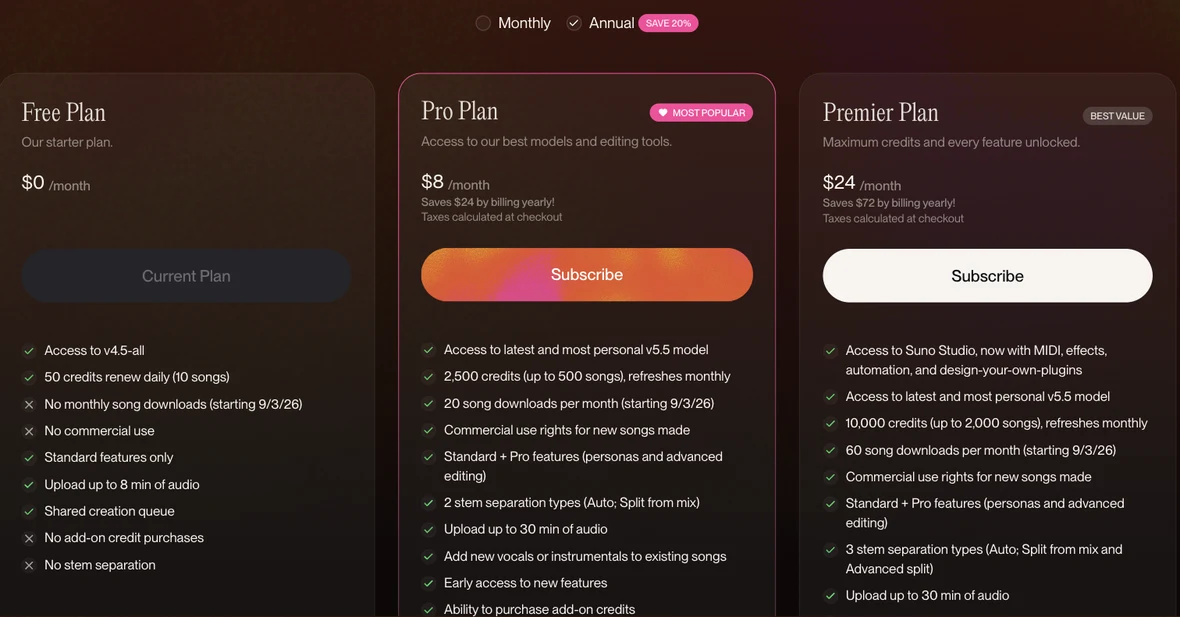
The three Suno pricing plans break down like this.
Free runs the v4.5-all model and nothing newer, renews 50 credits daily, lets you upload up to 8 minutes of audio, and puts you in a shared queue with up to 4 songs generating at once. It carries no commercial rights, no stem separation, and no ability to buy add-on credits. The plan card also lists “No monthly song downloads (starting 9/3/26)”, which is literal: Suno’s announcement puts the free allowance at 7 trial downloads for the lifetime of the account.
Pro at $10, or $8 a month billed annually, is where the product changes shape. It opens the advanced model lineup — v4, v4.5, v4.5+, v5 and v5.5 — raises uploads to 30 minutes, moves you into a priority queue of 10 concurrent songs, adds two stem separation types, personas and advanced editing, and grants commercial use rights for new songs made.
Premier at $30, or $24 annually, quadruples the credits to 10,000, adds a third stem separation type, and is the only plan with Suno Studio.
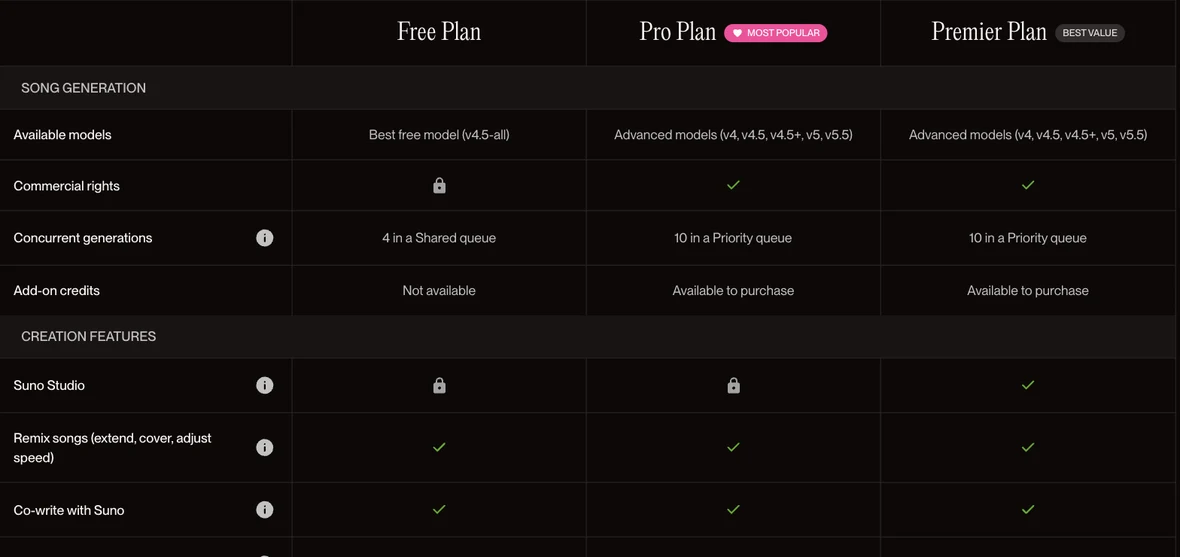
That comparison table is worth a slow look, because it settles Suno Studio pricing, which the plan cards leave ambiguous. Studio is padlocked on Pro as well as Free. If Studio is why you are here, the entry price is not $10, it is $30 — or $24 a month if you commit to a year.
The free plan and the paid plans meter differently
Worth noticing, because it changes how each one runs out. Free is a daily allowance with no monthly ceiling: 50 credits, renewed every morning, indefinitely. Use it every day for a month and you have had 1,500 credits, which is three-fifths of what Pro grants.
Paid plans invert that. Pro’s 2,500 and Premier’s 10,000 are monthly pools with no daily limit, so you can spend the lot in an afternoon and then wait. The bonus-credit rule softens the landing, but the shape is different: Free rations you by the day and never runs out, paid hands you the month up front and lets you burn it.
For anyone working in bursts — a weekend of scoring, then nothing for a fortnight — that difference matters more than the headline totals. Free simply cannot support a burst. Pro is built for one.
What the paid tiers add that isn’t credits
Strip out the credit allowances and there is still a real feature gap between free and paid, and it is not where the plan cards put the emphasis.
Two lines in the table below are worth more than the rest.
The queue is the one nobody prices. Free generates 4 songs at once in a shared queue; paid gives you 10 in a priority one. On a tool where finding a keeper means generating repeatedly, firing ten attempts and picking is a bigger practical change than any credit allowance.
Stem separation is the one that decides your tier if you work in a DAW. Free has none at all. Pro gets two types, Auto and Split from mix. Premier adds a third, Advanced split — one of the few places Premier buys a capability rather than just volume.
| Feature | Free | Pro | Premier |
|---|---|---|---|
| Models | v4.5-all only | v4 to v5.5 | v4 to v5.5 |
| Concurrent generations | 4, shared queue | 10, priority | 10, priority |
| Audio upload | 8 minutes | 30 minutes | 30 minutes |
| Stem separation | none | 2 types | 3 types |
| Editing | basic: crop and fade | advanced: replace or add section | advanced: replace or add section |
| Suno Studio | locked | locked | included |
| Add-on credits | not available | purchasable | purchasable |
| Commercial rights | no | yes | yes |
Read that Studio row again. It is the single most expensive line on the page: the feature is not a Pro upgrade, it is a Premier one, and it triples your entry price.
What your credits really buy
Five credits a song is the advertised rate. It is not the rate at which you finish anything.
A generation is a roll, not a result. Our single test prompt returned two playable tracks of 3:17 and 1:20 — same prompt, same model, same run — and Suno’s free interface has no field for requesting a duration. If you need something to fit a 60-second cut, the only mechanism is to generate again and pick the one that lands closest.
Allow three or four attempts per track you would actually use, which the length variance alone justifies, and a finished piece of music costs roughly 15 to 20 credits. That changes every number on the pricing page:
| Plan | Credits | Songs, as advertised | Finished tracks, realistically |
|---|---|---|---|
| Free | 50 a day | ~10 a day | 2 to 3 a day |
| Pro | 2,500 a month | ~500 a month | 125 to 167 a month |
| Premier | 10,000 a month | ~2,000 a month | 500 to 667 a month |
Anchor that to real work and the credits stop looking like a constraint at all. A short-form channel posting three clips a week needs about thirteen finished tracks a month, which Pro clears without noticing. A weekly podcast wanting a fresh intro each episode needs four or five. Even a small agency scoring a video a day, five days a week, lands near twenty-two — still inside Pro’s realistic 125.
A hundred and twenty-five finished tracks a month is more music than almost any of those people will ever use. Which raises the obvious question: if credits are not the constraint on a $10 plan, what is?
The number Suno doesn’t put in the credit column
Downloads.
Printed in small type on every paid plan card, dated 9/3/26: 20 song downloads per month on Pro, 60 on Premier. The plan cards say Free gets no monthly downloads, which is true but incomplete — Suno’s own announcement gives free accounts up to 7 lifetime trial downloads, a one-time allowance that never resets, and says they carry no commercial rights.
That is the ceiling that binds, and it inverts how the plans read. One caveat before the arithmetic: we only drove a free account, so we have not watched a paid cap stop anyone.
Run the division. Pro gives you 2,500 credits and permits 20 downloads, which is 125 credits for every song you are allowed to keep. Premier is more lopsided still, at just over 166. On Pro, call it around 25 generations per permitted download at the advertised rate, or six to eight finished tracks per download at the realistic one. You will hit twenty downloads long before you trouble two and a half thousand credits.
Now price it per song you can actually take away, rather than per credit:
| Plan | Cost per downloadable song, monthly | Billed annually |
|---|---|---|
| Pro | $10 ÷ 20 = $0.50 | $8 ÷ 20 = $0.40 |
| Premier, at its listed cap | $30 ÷ 60 = $0.50 | $24 ÷ 60 = $0.40 |
| Premier, using Studio | no stated limit | no stated limit |
On the listed caps the two are identical: Premier is three times the volume at exactly the same unit price, and the credit column, where Premier looks like four times the value, is measuring something you were never going to run out of.
The exception is the one that decides the upgrade. Suno’s announcement says Premier subscribers who use Suno Studio have no download limits, so the moment a Premier user works in Studio the 60 stops applying and the per-song price falls with every export. Moving from Pro to Premier is therefore worth it if you need more than twenty exports a month, and worth considerably more than the headline suggests if Studio is where you work.
The traps the pricing page soft-pedals
| The trap | What it costs you | How to avoid it |
|---|---|---|
| Downloads, not credits, are the cap | 20 exports on a plan advertising 500 songs | Budget by finished songs, not credits |
| Free’s downloads are lifetime, not monthly | 7 exports total, ever, and no commercial rights | Treat them as samples, not a workflow |
| Free has no commercial rights | Nothing you make free can be sold | Subscribe before you publish, not after |
| Rights attach to new songs only | A free back catalogue may stay unlicensed | Regenerate what you will sell, or ask Suno |
| Credits do not roll over | An unspent month is simply gone | Spend down before renewal |
| Top-ups need a live subscription | Bought credits stranded if you cancel | Use them before you cancel |
| Half a free generation is an advert | Two of four results are locked previews | Judge the free tier on two, not four |
| Free runs a model you would not be buying | You are auditioning v4.5-all, not v5.5 | Discount your free-tier impression |
The free tier shows you results you cannot play
One prompt on a free account returned four tracks. Two were playable. The other two came from v5.5, a model a free account cannot play in full, and each carried an upgrade button where the play control should have been. Suno spends part of your free allowance demonstrating the model you have not bought. It is an effective piece of merchandising, and it is invisible to anyone writing about the plans without running one.
You are evaluating a model you would not be paying for
The comparison table lists Free as “Best free model (v4.5-all)” against “Advanced models (v4, v4.5, v4.5+, v5, v5.5)” on both paid tiers. Five paid models sit above the one you get. Suno has also said new models are coming and that all prior models will be retired when they launch, so this particular gap has a stated expiry. Whatever you conclude from the free plan is a conclusion about a model several versions behind the one your subscription would buy.
Commercial rights are not retroactive
The plan cards say “commercial use rights for new songs made”, and Suno’s FAQ confirms free plans carry none. The plain reading of that wording is that the grant covers what you create while subscribed, which would leave a free-tier library unlicensed. Suno’s FAQ says only that Pro and Premier subscribers can use their songs commercially and does not address a back catalogue either way, so if that is your situation, ask before you publish rather than assuming.
Nobody publishes the add-on credit price, including Suno
Every paid plan advertises the “ability to purchase add-on credits”, and the comparison table marks them “Available to purchase” on Pro and Premier and “Not available” on Free. What no surface states is what a pack costs. The pricing page names no figure, the FAQ says only that a subscriber “can buy extra credits anytime”, and a free account cannot open the purchase flow to look.
The independent guides to Suno’s pricing do not have a figure either — the ones that raise add-ons at all tell readers to go and look inside their own account. So this is not an oversight in our reporting, it is a gap in what Suno publishes. Budget for the subscription and treat top-ups as an unknown until you are inside a paid account.
The billing complaints are the loudest ones
Suno’s Trustpilot page averages 1.6 out of 5 across roughly 767 reviews, with about 70 percent at one star, and the complaints cluster heavily on billing and account handling rather than on the product. We are reporting that pattern rather than confirming it, and a low Trustpilot score is a weak signal in a category where happy users rarely post. It is still the thing to read before you hand over a card.
What the free download allowance actually is
Suno dates the change on every plan card: 9/3/26. In US format that is 3 September 2026, the day we ran this test, so we had an accidental chance to watch it land.
Both MP3s came off the free account. No upgrade prompt, no error, nothing to suggest the plan card’s “No monthly song downloads” applied to us. WAV, stems and video stayed gated behind Pro badges, so the gating mechanism plainly worked — it simply did not stop plain MP3.
| What we exported | Duration | Sample rate | Bitrate | Size |
|---|---|---|---|---|
| Track 1 | 3:17.5 | 48 kHz stereo | ~190 kbps | 4.7 MB |
| Track 2 | 1:20.0 | 48 kHz stereo | ~186 kbps | 1.9 MB |
Forty-eight kilohertz is the video standard, so the files drop into a timeline without resampling. The bitrate sits under the 320 kbps convention, which is a checkable file fact to hold against whatever your delivery needs.
The plan card and the product were not in conflict, as we first read it. They describe different things, and Suno’s own announcement has the mechanism: free accounts get up to 7 trial downloads for the lifetime of the account. Suno’s footnote limits that to accounts joined before 3 September 2026; free users who join on or after that date “may occasionally receive trial downloads” rather than a guaranteed seven. They are a one-time allowance that never resets, which is why the card can truthfully say there are no monthly downloads while an export still succeeds. We were spending trial downloads without knowing it.
Three things follow, and none of them are on the pricing page:
- Seven is the total, forever. Not seven a month. Once they are gone, downloading means paying or buying more.
- Trial downloads carry no commercial rights. Suno is explicit that commercial use attaches to songs downloaded on a paid plan. A track you pulled on the free allowance is for personal use.
- Suno says the limits are retroactive. They apply to everything you download from 3 September, including songs you generated long before it. Your library stays playable and shareable on any plan; it is only export that is metered.
So the honest read of the free tier is that it is unlimited for making music and almost immediately limited for keeping it. If you are evaluating Suno, spend those seven deliberately.
Which plan should you pick
| You are | Plan | Yearly cost | The reason |
|---|---|---|---|
| Trying it out, or making music for yourself | Free | $0 | Renews daily, forever, no monthly ceiling |
| Publishing under 20 songs a month | Pro, annual | $96 | Commercial rights and current models |
| Publishing more than 20 songs a month | Premier, annual | $288 | The cap triples, and Studio removes it entirely |
| Taking stems into a DAW | Pro at minimum | $96 | Free has no stem separation at all |
| After Suno Studio | Premier | $288 | Studio is locked on Pro as well as Free |
| After tempo or length control | Neither | — | Suno’s free interface has no such field |
Free, if you are deciding whether AI music is any use to you at all. Fifty credits a day with no monthly ceiling is enough to form a real opinion, provided you remember you are judging the old model and that half of each result is an advertisement.
Pro at $8 annually, for almost everyone who publishes. It is the tier that grants commercial rights, opens the current models, and gives twenty exports a month — which is more finished music than most creators ship. At $96 for the year it is the obvious default.
Premier at $24 annually, only for two people: anyone who needs to export more than twenty songs a month, and anyone who wants Suno Studio, since Studio is locked on Pro. Do not upgrade for the credits. Per downloadable song at the listed caps, Premier costs exactly what Pro costs — the exception is Studio, which Suno says carries no download limit at all.
A word on annual billing. The 20 percent discount is real and consistent: $96 a year against $120 on Pro, $288 against $360 on Premier. But annual is a bet that you will still want this in nine months, and Suno’s credits expire monthly regardless of how you pay, so paying yearly buys no extra runway — only a lower rate. Given that the loudest complaints about the company concern billing and cancellation, the monthly price is a defensible thing to pay for a month or two before committing to a year.
Nobody at all, if you are making music for yourself. This is the case the pricing page will never make to you. A free account renews fifty credits every morning, forever, with no monthly ceiling — two or three finished tracks a day, indefinitely, at no cost. If you are scoring home videos, making things for friends, or learning what the tool does, the free tier is not a trial that runs out. It is a permanent allowance, and the only thing you give up is commercial rights, the newer models, and export beyond seven files.
Neither, if what you need is control rather than volume. Suno has no tempo field, no duration control and no negative prompt at any point in the free interface. Its closest rival gives you a song-length slider free, with tempo and a negative prompt on paid, and we ran both on the same brief the same day — that comparison is in Udio vs Suno, and the full test of this one is in our Suno review. Our running figures for what the whole category charges live in what AI tools actually cost.
Final word
Suno’s pricing page is clearer than most. It converts credits to songs for you, it discounts annual billing honestly at 20 percent, and it tells you in its own FAQ that running out mid-month drops you to 50 credits a day rather than to nothing.
For how Suno’s pricing compares with the rest of the category, the best AI music generator roundup puts eleven tools side by side on cost and licence.
What it does not do is put the binding number in the column you read. You will not run out of credits on a $10 plan. On the page’s own terms you run out of downloads, at twenty a month, and the moment you price the plans by that number the tiers stop looking like a ladder and start looking like the same deal in two sizes, until Studio takes Premier’s cap off altogether.
Buy Pro if you publish. Buy Premier if you need Studio or more than twenty exports. And whichever you pick, spend the credits before the month turns, because they do not carry over.
Frequently asked questions
How much does Suno cost?
Three tiers, at $0, $10 and $30 a month, though the number that decides your bill is not on any of those price tags.
Free gives 50 credits a day and just seven downloads for the life of the account. Pro is $10 monthly or $8 billed annually, for 2,500 credits and 20 monthly downloads. Premier is $30 or $24 annually, for 10,000 credits, 60 downloads and Suno Studio. Paying yearly saves $24 on Pro and $72 on Premier, a consistent 20 percent.
Divide by the download cap rather than the credit total and the two paid tiers land on the same figure at their listed caps: 50 cents a download monthly, 40 cents annually. The exception is Suno Studio, which Premier includes and which Suno says has no download limit, so a Premier user working in Studio pays less per song the more they export.
Is Suno free to use?
Yes, and the free plan is genuinely generous, with one large caveat about getting your music out.
Free gives you 50 credits a day, which Suno translates as about 10 songs. It renews daily with no monthly ceiling, so a fortnight of daily use is 700 credits, which is more than most people will get through. You can upload up to 8 minutes of audio, and you sit in a shared creation queue with up to 4 songs generating at once.
The limits are the model, the licence and the export. Free runs v4.5-all and nothing newer. It carries no commercial rights. And export is capped: the plan card's No monthly song downloads from 9/3/26 is literal, because Suno's announcement gives free accounts up to 7 trial downloads for the life of the account, one-time, never resetting and personal use only.
What do Suno credits actually buy?
About five credits a song at the advertised rate, and roughly three to four times that per song you actually keep.
Suno prices consistently across tiers: 50 credits for about 10 songs on Free, 2,500 for about 500 on Pro, 10,000 for about 2,000 on Premier. That is five credits per generation everywhere.
A generation is not a finished track. Our single prompt returned durations of 3:17 and 1:20 from the same run, and Suno's free interface has no field to ask for a specific length, so hitting a target means generating again and picking. Allowing three or four attempts per keeper puts a finished piece of music at roughly 15 to 20 credits. That makes Free about two or three finished tracks a day rather than ten, and Pro about 125 to 167 a month rather than 500.
Can you download songs from Suno on the free plan?
Yes, but only seven times, and only ever seven.
The plan card says Free gets no monthly song downloads from 9/3/26, which is accurate but easy to misread. Suno's own announcement of the change sets the free allowance at up to 7 trial downloads for the lifetime of the account. They do not reset monthly. Once they are spent, downloading means upgrading or buying additional downloads.
That is why our test worked. On 3 September 2026 we exported both playable tracks from a free account as MP3s with no prompt and no error, because we were spending trial downloads rather than hitting a block. WAV, stems and video are separately gated and carry Pro badges. One more thing worth knowing before you spend them: Suno says trial downloads are for personal use only, so commercial rights attach to songs downloaded on a paid plan, not to these.
Does Suno allow commercial use?
Paid plans only, and the grant is written around songs you make while subscribed.
Suno's own pricing FAQ puts it plainly: free plans do not include commercial rights, and Pro or Premier subscribers can use their songs commercially provided they follow the rules of whatever platform they publish on. Its announcement of the September terms is more precise still, tying the grant to songs downloaded on a paid plan and excluding free trial downloads from commercial use entirely. The plan cards phrase the grant as commercial use rights for new songs made, which is the wording to pay attention to. On the plainest reading it attaches to what you create on the plan; Suno's FAQ does not say whether a free back catalogue is covered, so ask before you publish one.
Suno also places responsibility for third-party terms on you. If you are publishing to a streaming platform, its AI policy is a separate question from your Suno licence, and the licence does not answer it.
What happens when you run out of Suno credits?
On a paid plan, you can buy more, and you also drop to a daily allowance until your billing cycle renews.
Suno's pricing FAQ states that a subscriber who exhausts their monthly credits can buy extra credits at any time, and will automatically get 50 bonus credits per day until the cycle renews. That is the same daily number the free plan gets, so running dry on Pro does not stop you working, it just puts you back on free-tier pace.
Two details matter alongside that. Subscription credits do not carry over from day to day or month to month, so an unspent allowance is gone. Purchased top-up credits do not expire, but Suno's own footnote says they require an active subscription to use, which means cancelling strands anything you have bought.
How much is Suno Studio?
Thirty dollars a month, or $24 a month billed annually, because Studio is Premier-only.
Suno Studio pricing is worth stating clearly because the number gets quoted loosely. Studio is not available on Free and it is not available on Pro either. The comparison table on Suno's own pricing page shows a padlock in both of those columns. The only way to reach it is the Premier plan, which is $30 monthly or $288 for a year.
Suno describes Studio as including MIDI, effects, automation and design-your-own-plugins, and Premier also raises you to 10,000 credits, 60 monthly downloads and a third stem separation type. We have not tested Studio, so treat the price as verified and the capability as Suno's own description.
Keep reading
How to use Suno: the free account, honestly
How to use Suno step by step, from your first prompt to getting a file out — including the two results you can't play and the seven downloads you get.
Suno review: the free tier is good, and it's shrinking
One prompt on Suno's free plan returned four tracks. Two were playable, two were paywalled previews. What that tells you about paying, tested 3 September 2026.
Suno alternatives: the one I actually tested, and eight I didn't
Every Suno alternatives list claims it tested everything. This one tested one rival properly, labels the rest, and fixes two entries the others get wrong.

Best AI music generator: the three we ran, and what the rest are for
We gave Suno and Udio the same brief on the same day. Suno wins on output. On the licence the field splits three ways, and one tool grants nothing at any price.