
Bolt.new alternatives: 8 tools, 7 took the same brief
The best Bolt.new alternatives, ranked by a measured build rather than a feature table. Seven tools took one identical brief. Here is what each build cost.
Contents
The best Bolt.new alternatives
Almost every list of Bolt.new alternatives is published by a company selling one. I gave seven of the tools on this page the identical brief — one message, six numbered requirements, no follow-ups — and then used each resulting app to check whether it actually worked.
All seven met all six requirements on the first attempt. Capability separated none of them. Cost, speed and what you are handed at the end separated all of them.
| Tool | Best for | Time on my brief | What the build cost |
|---|---|---|---|
| Lovable | A price you can predict | 109 sec | 1.20 credits, ~$0.30 |
| Base44 | The longest free runway | ~2.5 min | 1 message credit of 25 a month |
| v0 by Vercel | Code you actually own | 3 min 36 sec | $1.40 |
| Replit | A terminal and a database | ~4 min | 31% of a day’s free credits |
| Cursor | Speed, and a free tier that works | Under 1 min | $0 on Hobby |
| Google Antigravity | Staying free indefinitely | ~2.5 min + a gate | $0 |
| Claude Code | Code quality above all | ~8.5 min | ~$2.56 |
| bolt.diy | Open source, your own API key | Not tested | Not tested |
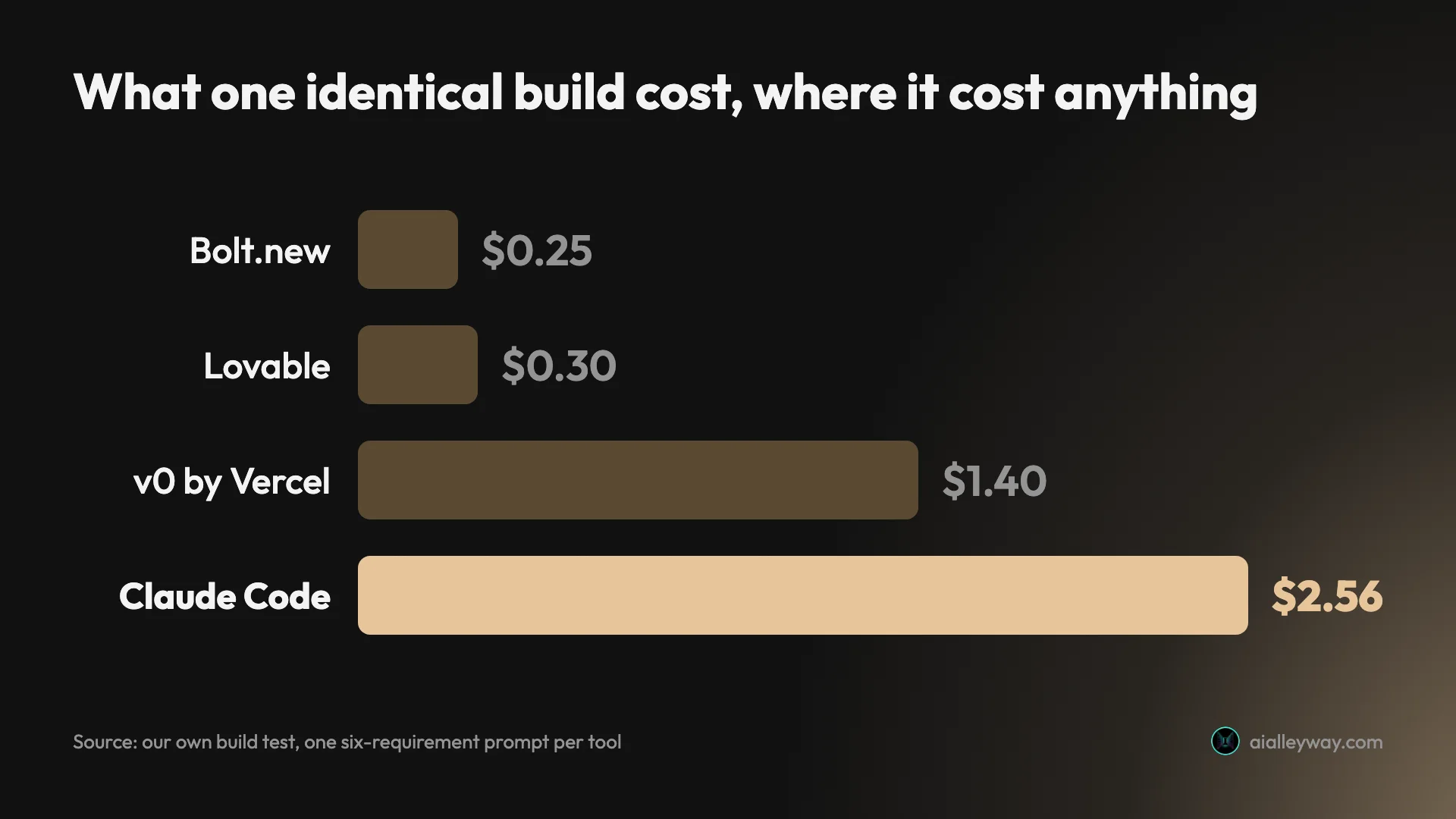
| Bolt.new, for reference | Cheapest measured build | 2–3 min | 100,000 tokens, ~$0.25 |
One of these I have not run, and it is marked as such wherever it appears.
Why people leave Bolt, and how I chose these
Bolt’s own reputation tells you what to select for. It held 1.4 out of 5 on Trustpilot across 196 reviews when I checked on 6 August 2026, the worst score of any tool in this category I have tested, and the complaints are almost never about the generated code. One caveat on that figure: Trustpilot blocks automated access, so the score and the count come from Google’s summary of that page rather than from reading the reviews myself.
They are about tokens vanishing into debugging loops, and then about billing. That points at the unit rather than the product. A Bolt token prices the model’s output, so a prompt that fails still bills you for everything the model produced while failing, and Bolt’s own pricing FAQ says usage scales with project size, which means the same edit costs more in month three than in week one.
So the selection criteria are the departure reasons, in order: is the price predictable before you spend it, how much free runway do you get, and do you end up owning anything. Feature parity was not a criterion, because on the test every single tool had it.
Seven tools got the identical brief and were judged on the app that came back. bolt.diy is here because it answers the open-source question honestly and Bolt’s own team publishes it, not because I have run it.
How I tested them
One message containing six numbered requirements: add a subscription with a name, cost and billing cycle; annual plans must display a monthly-equivalent figure rather than the annual one; a running monthly total pinned to the top; a cancelled state that leaves the total but stays visible in its own section; persistence across reloads; a dark theme.
Requirements two and four are deliberate traps. Each needs two ideas held at once — show a derived number instead of the one typed in, and exclude an item while keeping it on screen. Both are the kind of thing that gets half-implemented and looks fine.
No follow-up prompts, no second attempts. I then served each app, added two subscriptions until the total read $310.00, cancelled one and watched it fall to $110.00, hard-reloaded, and read the stored data. Not one result here comes from reading a tool’s summary of its own work.
1. Lovable — best for a price you can predict

If the token meter is what drove you off Bolt, this is the fix, and it is the only tool here that fixes it structurally rather than by being cheaper.
Lovable publishes what individual actions cost: a simple update at 0.50 credits, removing a component at 0.90, adding authentication at 1.20, a landing page with images at 1.70. A credit is a flat 25 cents on the $25 Pro plan. That means you can price a project before you start it, which no token meter allows.
On my brief it met all six requirements in 109 seconds, the fastest builder of the group, and spent 1.20 credits, about 30 cents. Five cents dearer than Bolt’s build. That gap is noise; the unit behind it is not.
It also handled the annual trap the sound way, storing the raw $2,400 figure with the billing cycle and computing the monthly equivalent at render rather than freezing the derived number.
What it costs. Free gives 5 build credits a day, capped at 30 a month. Pro is $25 for 100 credits, Business $50. Business carries the same credit count as Pro at twice the price, so a build costs 50 cents there rather than 25 — the extra buys governance, not capacity. Detail in the Lovable pricing breakdown and the Lovable review, and the wider field in Lovable alternatives.
2. Base44 — best for the longest free runway

The free tier that lasts longest, and the one with the sharpest catch in this whole roundup.
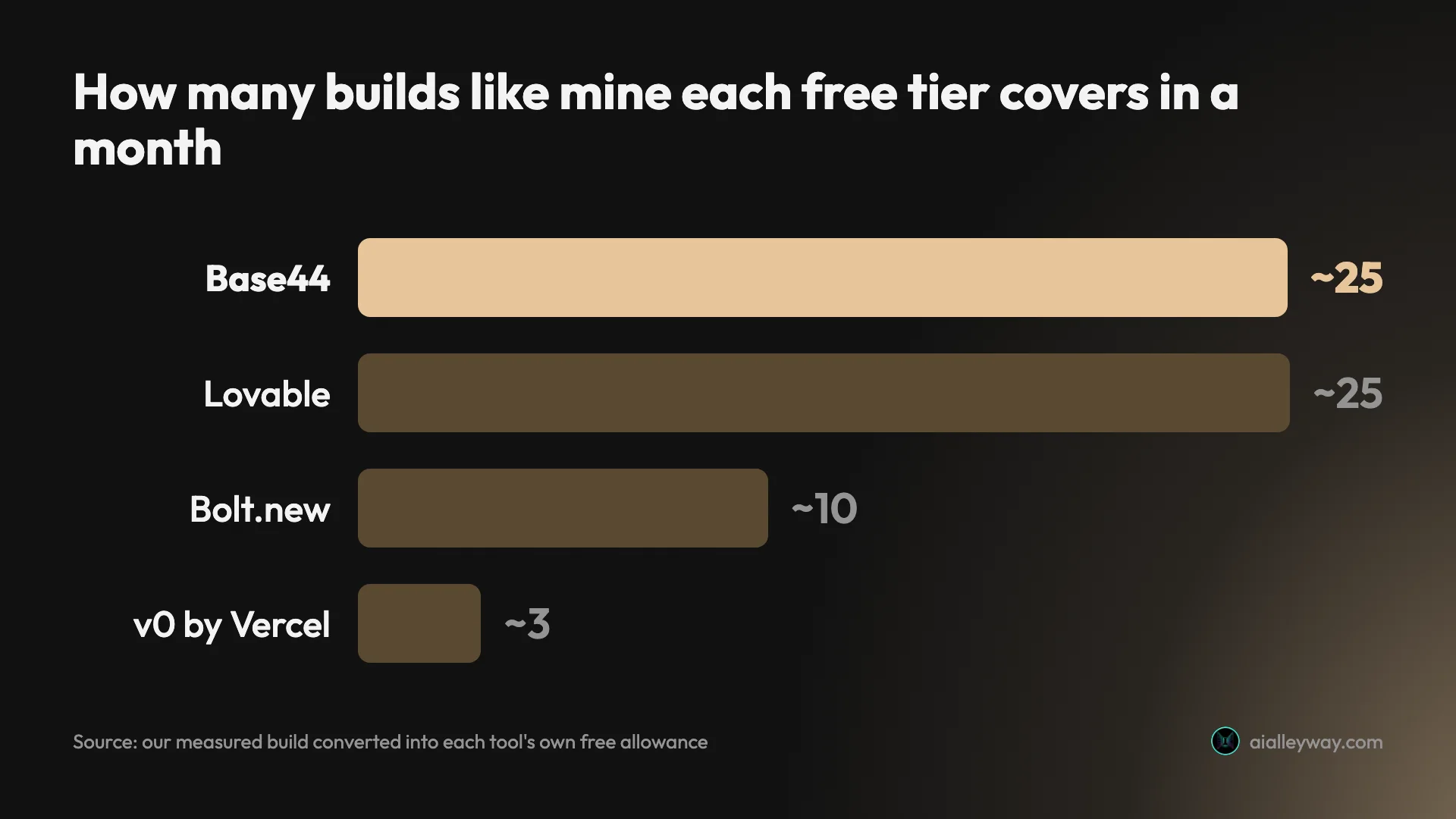
Base44 grants 25 message credits a month, and my entire build cost one credit. That works out at roughly 25 builds a month against Bolt’s 10, the biggest free runway of any hosted builder I measured, and unlike Bolt and Lovable there is no daily cap throttling how fast you spend it. The ceiling is 5 apps. It finished in about two and a half minutes, and it shows no timer, so 158 seconds is an upper bound rather than a reading.
Now the catch, and it is the reason this is second rather than first. The free plan will not show you your own source code. “In-app code edits” is the first bullet on the Starter plan and appears nowhere on Free. It also serves nothing until you press Publish — the other builders handed me a working URL immediately, while Base44 answered “Stack Cost isn’t available yet.”
That is $20 a month to see code the other builders show you for nothing, which is a real cost even though it is a small one.
| What $20 changes | Free | Starter, $20 |
|---|---|---|
| Message credits | 25 a month | 100 a month |
| Apps | Up to 5 | Unlimited |
| In-app code edits | No | Yes |
| Custom domain | No | Yes |
Take Base44 to find out cheaply whether this way of working suits you. Do not take its free tier if owning the output matters, which is exactly the thing many people leave Bolt for.
What it costs. Free at 25 message credits a month and up to 5 apps. Starter $20, or $16 yearly. Builder $50, or $40. Pro $100, or $80. Elite $200, or $160. Yearly billing is a flat 20% off every paid tier. Read off base44.com/pricing, 9 September 2026. It is part of Wix and carries ISO 27001, SOC 2 Type II and GDPR compliance, which is more than most tools on this page can say.
3. v0 by Vercel — best for code you actually own

The only tool here that handed back a project rather than a preview.
Where Bolt, Lovable and Base44 give you an app running on their infrastructure, v0 emitted a real multi-file Next.js project — app/, components/, hooks/, lib/ and a scaffold around them. If your reason for leaving is that you want the code somewhere you control, that difference is the entire decision.
It was also the only tool of the five app builders that verified its own work, and it did it by driving a browser rather than by writing a test file: it started a dev server, tested the add flow, cancelled an item, reloaded, and screenshotted its own result using its own test data. It took 3 minutes 36 seconds by its own timer and cost $1.40, read off both the credit badge and the itemised usage panel.
It gave the best answer to the annual trap of anything I tested, making $200.00 per month the headline and demoting $2,400.00 a year to a grey subtitle. The brief asked for the monthly equivalent, not the annual figure, and v0 was the only one that read it that literally.
What it costs. The Business tier is the line worth reading twice: it triples the price and includes the same credits.
| Plan | Price | Included credits | Builds like mine |
|---|---|---|---|
| Free | $0 | $5 a month, 7 messages a day | ~3 a month |
| Plus | $30 per user | $30 a month, plus $2 daily on login | ~21 a month |
| Business | $100 per user | the same $30 a month | ~21 a month |
| Enterprise | By quote | Custom | Not stated |
So the extra $70 buys data privacy and admin controls rather than capacity, the same shape as Lovable Business. Read live on v0.app/pricing, 9 September 2026.
4. Replit — best when you need a real backend

The answer whenever the words “database” or “Python” appear in your requirements, and the reason is structural rather than a matter of quality.
Bolt builds React web apps. Replit is a full cloud IDE: file tree, terminal, deployment logs, a built-in Postgres database and many languages. If your project needs a scheduled job or a worker process, no amount of prompting gets Bolt there, and that is the point at which speed comparisons stop mattering.
It met all six requirements in about four minutes, the slowest of the group. The cost is the awkward part, and it is a genuine step down from Bolt on transparency. That single build took the free plan from 0% to 31% of one day’s Agent credits, and I cannot convert that to dollars, because the free tier shows a percentage bar and the usage page is gated behind an active subscription.
One thing to watch in the output: Replit was the only tool that dropped the annual figure from the interface entirely. It still passed the requirement, but its app cannot tell you the real renewal amount.
What it costs. Starter is free with daily Agent credits. Core is $20 a month, or $18 yearly. Pro is $100, or $90. Enterprise is quote-only. The subscription is among the cheapest here; the consumption is not, and the two get confused constantly. See the Replit review, or Replit alternatives if it is Replit you are leaving.
5. Cursor — the fastest, and its free tier is better than advertised

Cursor is not a prompt-to-app builder, and it still produced a working app faster than anything else I have given this brief: under a minute, 581 lines across three files, six of six, on the free Hobby tier for nothing.
That last part is the fact most comparisons skip. Cursor’s free tier is real and it completed the whole job. What it excludes is frontier models, MCPs and cloud agents, which is the actual line between free and paid rather than the one people assume.
The catch arrives later and it is a real one. Above the free tier, Cursor charges a subscription plus metered usage billed in arrears at the model’s API rate. I paid $510.70 across eleven months on a plan advertised at $20, averaging about $46 a month, with one month reaching $159.22. There is a spend limit on every paid tier and it is off until you switch it on.
| Cursor’s real cost, 11 measured months | Figure |
|---|---|
| Advertised plan | $20 a month |
| What I actually paid | $510.70 |
| Average per month | ~$46 |
| Worst single month | $159.22 |
| Spend limit | On every paid tier, off until you set it |
If you left Bolt because the bill was unpredictable, read that table twice. Cursor solves the free-tier problem and reproduces the forecasting problem in a different currency.
What it costs. Hobby is free and cursor.com/pricing still showed a $20 individual entry price and $40 team seats on 9 September 2026. Above that, Pro is $20 a month or $16 yearly, Pro+ $60 or $48, and Ultra $200 or $160 — a flat 20% off on yearly billing — all of it sitting on top of metered usage. See the Cursor review and the Cursor pricing breakdown.
6. Google Antigravity — best free tier, and it checks its own work

The only tool here whose free tier is free indefinitely rather than a trial with a slower fuse. Antigravity’s pricing page contains exactly one number and it is $0, and that tier includes Gemini models alongside Claude Sonnet and Opus.
It met all six requirements in about two and a half minutes, then did something only one other tool of the eight managed: it wrote a test file, ran it under Node, and recorded six assertions I confirmed independently against the shipped app. If you want the thing that built your app to check it before handing it over, this is the free option that does.
Two costs. It will not run unattended — it produces a plan and waits for approval, which took one click and one permission grant. And it sprawls: 2,894 lines for six requirements against Cursor’s 581, for an identical passing result. Google also publishes no number for the free allowance, describing it only as “basic weekly rate limits”.
What it costs. Nothing, indefinitely. Paid access is not an Antigravity subscription but a Google One AI plan: $4.99 for AI Plus, $19.99 for AI Pro, $99.99 for Ultra 5x and $199.99 for Ultra 20x. What those buy in Antigravity terms is described as “expanded” agent requests, which is as specific as Google gets. More in the Antigravity review.
7. Claude Code — the best code, at the worst price

Here because it produced the best result of everything I tested, and seventh because it is the least like Bolt.
It refused to build from the brief at all. It ran a three-question interview, wrote a design document, and produced code only when told to — eight exchanges before a single line existed. Nothing was blocking it. It chose to ask.
What arrived was the best of the eight. It stored money as integer cents, explaining unprompted that adding 9.99 and 19.99 as floats gives 29.979999999999997, and it shipped a 28-assertion test suite covering corrupt storage, non-array payloads and float precision. I ran it: 28 passed, 0 failed.
It also took about eight and a half minutes and cost roughly $2.56 on metered billing, more than ten times Bolt’s 25 cents. There is no free tier at all.
The honest way to read that figure: on a subscription, the marginal cost of one more build is zero, so $2.56 is what the test cost rather than what the tool costs you.
What it costs. No free tier. It arrives with a Claude subscription: Pro at $20 a month, Max 5x at $100, Max 20x at $200. You can also run it against metered API billing, which is where the $2.56 came from. See is Claude Code worth it.
8. bolt.diy — the open-source Bolt.new alternative, and it is Bolt’s own

I have not run bolt.diy, so everything here is its documented shape rather than a measured result. It earns a place anyway, because it is the only honest answer to “is there an open-source Bolt” and because the answer is stranger than most lists let on.
bolt.diy is the official open-source version of Bolt.new, published by StackBlitz Labs and forked from Bolt’s own repository. It is MIT-licensed and carried 19.9k GitHub stars when I checked on 9 September 2026.
The difference is the billing model, and it is the exact thing people leave Bolt over. Bolt.new meters tokens and sells them to you. bolt.diy asks you to bring your own API key, and it supports around 19 providers including OpenAI, Anthropic, Google Gemini, DeepSeek, Groq, Mistral and OpenRouter, plus local runners like Ollama and LM Studio. Point it at a local model and the per-token bill disappears entirely.
What replaces the bill is your own time. Nobody hosts it, nobody updates it, and nobody answers when it breaks. That trade is worth it for a certain kind of person and terrible for everyone else, and knowing which you are is the whole decision.
What it costs. The software is free. The models are not, unless you run them locally. There is no plan to compare, which is either the appeal or the disqualifier.
| What changes | Bolt.new | bolt.diy |
|---|---|---|
| Who runs it | StackBlitz | You |
| Who you pay | StackBlitz, in tokens | Your model provider, or nobody locally |
| Model choice | Bolt picks | ~19 providers, including Ollama and LM Studio |
| Licence | Proprietary | MIT |
| Who fixes it | Bolt | The repository, and you |
The Bolt pricing guide covers where it sits against Bolt’s own 14-tier token ladder.
What the measured results actually showed
Seven tools, one brief, and the headline is that capability did not separate them at all. Every one scored six of six on the first attempt, including both traps.
| Tool | Requirements | Time | Own tests | Cost of the build |
|---|---|---|---|---|
| Cursor | 6 of 6 | Under 1 min | No | $0 free tier |
| Lovable | 6 of 6 | 109 sec | No | ~$0.30 |
| Antigravity | 6 of 6 | ~2.5 min + gate | Yes, 6 | $0 |
| Base44 | 6 of 6 | ~2.5 min | Not determinable | 1 of 25 monthly credits |
| v0 | 6 of 6 | 3 min 36 sec | Verified in a browser | $1.40 |
| Replit | 6 of 6 | ~4 min | No, hooks only | 31% of a day’s credits |
| Claude Code | 6 of 6 | ~8.5 min | Yes, 28 | ~$2.56 |
| Bolt, for reference | 6 of 6 | 2–3 min | No | ~$0.25 |
Three things fall out of that table that no feature comparison would surface.
Bolt was the cheapest thing on it. At about 25 cents against Lovable’s 30, Bolt won the cost axis outright among hosted builders, which is awkward for a page about leaving it. The case against Bolt was never the price of a build that works. It is the price of one that does not.
Most of them verified nothing. Claude Code wrote 28 assertions and Antigravity 6. v0 drove a browser. Every other hosted builder — Bolt, Lovable, Replit — wrote nothing that checked anything. That gap matters most for the people hosted builders are sold to, who are least equipped to catch a bug by reading the code.
Every single one invented a Restore button. My brief asked for cancelled items to leave the total and stay visible. It said nothing about bringing them back. Every tool added a way to. Read generously, they all inferred that cancelling implies undo. Read less generously, every one of them added scope to a spec written to be precise.
Which Bolt.new alternatives are free, and for how long?
“Free” covers two completely different offers here, and the difference decides more than the subscription prices do.
Free indefinitely means the tier is a product. Free as a trial means it is a countdown you cannot see the end of. Antigravity and Cursor are the first kind. Every hosted builder on this page is the second, and they differ enormously in how long the countdown runs.
Converting my measured build into free builds a month is the only comparison that survives contact with five different billing units:
| Tool | Free tier | Builds like mine | What ran down |
|---|---|---|---|
| Base44 | 25 credits a month, no daily cap | ~25 a month | 1 credit |
| Lovable | 5 credits a day, 30 a month | ~25 a month | 1.20 of the day’s 5 |
| Bolt | 1M tokens a month, 300k a day | ~10 a month | 100,000 tokens |
| v0 | $5 of credits, 7 messages a day | ~3 a month | $1.40 |
| Replit | Daily Agent credits, no monthly cap | ~3 a day, refreshing | 31% of one day |
| Antigravity | Free indefinitely | No visible limit | Nothing measurable |
| Cursor | Hobby, no card | No visible limit | Nothing measurable |
| Claude Code | None | n/a | n/a |
Base44’s roughly 25 builds a month against v0’s roughly 3 is more than an eight-fold spread in runway for tools whose pricing pages look broadly similar. Not one of those pages tells you this, because none of them publishes what a build costs.
Replit is the row that resists the table. Its grant refreshes daily with no stated monthly ceiling, so it is simultaneously the tightest free tier in one sitting — about three attempts before you are choosing a paid plan — and the loosest across a month. Whether that suits you depends entirely on whether you build in bursts.
And Bolt’s own free tier has a decoy in it. The 300,000-token daily cap looks like the tighter limit, but spending at that rate exhausts the 1-million monthly allowance in 3 days and 8 hours, so the monthly ceiling is the wall you actually hit.
What Bolt still does better than most of these
A page about alternatives has an obvious bias, so it is worth being explicit about what the incumbent won on my own test.
It built the best app of the three hosted builders. Bolt was the only one to version its storage key, the only one to add a correct yearly projection nobody asked for, it used Intl.NumberFormat for currency, and it put the persistence layer in a separate 76-line module. On engineering, it beat both Lovable and Replit.
It is the most transparent free tier about cost. Bolt shows an exact token balance, a daily cap, and refill and expiry dates, with no card needed. Replit’s free plan shows a percentage of an unstated total. One of those lets you plan and the other does not, and Bolt is the one that does — though the setting that surfaces token usage above the chat box is off by default.
It followed the brief over its own upsell. Bolt sells a hosted database. It wrote “The user explicitly requested localStorage persistence (requirement #5), so I’ll use localStorage rather than Bolt Database”, then mentioned the upgrade path afterwards rather than quietly taking it.
| Where Bolt won on my own test | Against |
|---|---|
| Best-engineered app of the hosted three | Lovable, Replit |
| Cheapest measured build, ~$0.25 | Lovable ~$0.30, v0 $1.40 |
| Exact token balance on the free plan | Replit’s percentage bar |
| Declined its own upsell mid-build | Nobody else was tested on this |
None of that is a reason to stay if the unit is your problem. It is a reason not to believe that leaving is obviously an upgrade. Full detail in the Bolt.new review and the head-to-head at Bolt vs Lovable.
What moving off Bolt actually costs
Alternatives coverage tends to stop at the recommendation. The migration is where the real cost sits, and it differs sharply by which row you picked.
To Lovable or Base44: almost nothing. Same shape of tool, same kind of prompt, same kind of output. You are re-describing an app rather than porting one, which for a prototype is usually faster than migrating anyway.
To v0, Cursor or Claude Code: a real project. Bolt exposes code in its editor, so the source is retrievable. What does not travel is the managed layer — the preview URL, the hosting, and Bolt Database if you took it. Rewiring that is work measured in days.
To bolt.diy: a different bill, not a different tool. The interface is familiar because it is the same codebase. What changes is that you now run it and you now pay a model provider directly.
| Question | If yes |
|---|---|
| Is the app still a prototype? | Rebuild in the new tool. Migration is not worth it |
| Does it have real users and data? | Budget the backend rewiring in days, not clicks |
| Do you need to own the source? | v0, Cursor or Claude Code. Not Base44’s free plan |
| Is unpredictable cost the only complaint? | Try Lovable before you rebuild anything |
The rule that holds across all of them: the convenience you bought is the part that does not travel. Every managed platform here trades portability for speed, which is a fair trade right up to the moment you want to leave.
What I left out, and why
Lists like this grow until they stop being useful, so here is what did not make it.
Windsurf and Bubble. Both appear in most rankings for this question and both answer a real need — an agentic IDE in the first case, visual no-code business logic in the second. Bubble in particular is the most established option in the wider category, priced free at 50K workload units a month, then $59, $209 and $549 a month billed annually, read on 9 September 2026. I have not run either through the brief, and a ranked position implies a measurement I do not have.
A long tail of newer hosted builders. Another prompt-to-app product launches every few weeks, and several turn up in other roundups. Adding names I cannot speak to would make this page longer without making it more useful.
| What is on this page | Basis |
|---|---|
| Lovable, Base44, v0, Replit, Cursor, Antigravity, Claude Code | Measured on the identical brief |
| Bolt, as the baseline | Measured |
| bolt.diy | Documented only, labelled untested |
| Windsurf, Bubble, newer builders | Excluded — not tested, not ranked |
Seven measured results are the reason to read this page. Everything else is signposting, and it is marked as such.
Which Bolt.new alternative should you pick?
The useful question is not which tool is best but which problem sent you looking.
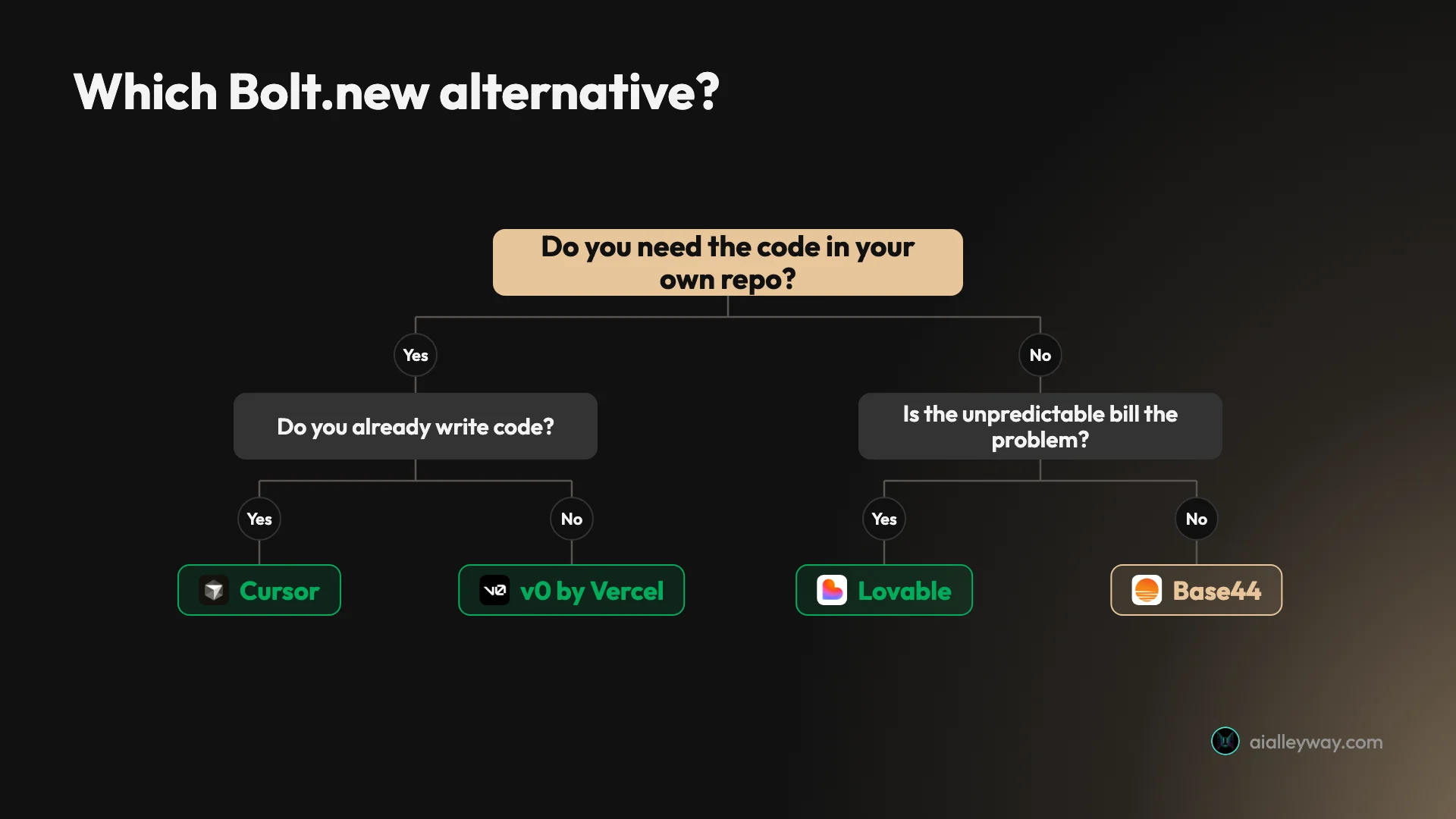
| If you left Bolt because | Pick |
|---|---|
| You cannot quote a job when tokens price the model’s output | Lovable — a published per-action rate card |
| The free tier ran out mid-afternoon | Base44 or Lovable, at roughly 25 builds a month |
| You want a real project, not a hosted preview | v0 by Vercel |
| You need a database, a terminal or Python | Replit |
| You want to own and edit the code yourself | Cursor |
| You cannot spend anything at all, ever | Antigravity or Cursor’s free tier |
| Generated code quality is the priority | Claude Code |
| You want no vendor between you and the model | bolt.diy, untested |
| Nothing in particular | Stay on Bolt |
That last row is not filler. Bolt produced the cheapest measured build and the best-engineered app of the hosted three, and if none of the rows above describes your situation, switching will cost you more in relearning than it returns.
The final word
Most alternatives lists are unhelpful for a simple reason: they compare tools that do not compete, usually with the publisher’s own product at the top. Lovable and Base44 genuinely replace Bolt. v0 replaces the part of Bolt you never got — the code. Replit replaces the thing Bolt structurally cannot do, and Cursor and Claude Code are a different job that people arrive at after outgrowing the builder entirely.
On measured results: Lovable fixes the pricing model rather than the price, Base44 has the longest free runway and will not show you your own source, v0 is the only builder that handed back a project, and Replit is the answer whenever “database” or “Python” appears in your requirements.
The result I keep returning to: every one of these tools met all six requirements on the first attempt. The differences were never capability. They were cost, shape, and whether anything verified the work.
For the measured ranking behind these picks, see the best AI app builder or the best vibe coding tool for the wider field including coding agents.
On Bolt itself: the Bolt.new review has the build trace these comparisons rest on, Bolt.new pricing explains the 14-tier token ladder that only renders when you sign in, and Bolt vs Lovable is the head-to-head most people arrive here looking for.
Frequently asked questions
What can I use instead of Bolt.new?
It depends on which part of Bolt pushed you off. If you want the same shape of tool with a price you can predict before you spend it, Lovable is the closest swap: it publishes what each kind of action costs, and my build came to 1.20 credits, about 30 cents.
If the free tier ran out too fast, Base44 gave me roughly 25 builds a month against Bolt's 10. If you want a real project on disk rather than a hosted app, v0 handed back a multi-file Next.js scaffold. If you need a terminal and a database, Replit. And if the answer is that you have outgrown prompt-to-app builders entirely, Cursor and Claude Code are the exits, in that order by price. If what you want is no vendor at all, bolt.diy is Bolt's own open-source version and you bring your own API key.
Is there a free Bolt.new alternative?
Several, and they are not equally free. Google Antigravity costs nothing indefinitely rather than as a trial, and it built my entire six-requirement brief without a card. Cursor's Hobby tier did the same for nothing.
Among the hosted builders the runway differs more than the sticker price does. On the identical build, Base44's free plan is worth about 25 builds a month and Lovable's about 25, against roughly 10 on Bolt and about 3 on v0. Replit is the odd one: a single build took 31% of one day's free Agent credits, but that grant refreshes daily with no stated monthly ceiling, so it is the tightest free tier in one sitting and the loosest across a month. Base44 is the only one of the four with no daily cap at all, which matters if you build in bursts rather than evenly.
Is there an open-source Bolt.new alternative?
Yes, and it is Bolt's own. bolt.diy is the official open-source version of Bolt.new from StackBlitz Labs, MIT-licensed, and it carried 19.9k GitHub stars when I checked on 9 September 2026.
The difference that matters is the billing model. Bolt.new meters tokens and sells them to you; bolt.diy asks you to bring your own API key and supports around 19 providers including OpenAI, Anthropic, Google Gemini, DeepSeek, Groq and Mistral, plus local runners like Ollama and LM Studio. Point it at a local model and the per-token bill disappears entirely. What you pay instead is setup and maintenance, because nobody is hosting it for you, and nobody answers when it breaks. That trade suits a certain kind of person and is miserable for everyone else. I have not run it, so treat all of that as its documented shape rather than a measured result.
Which Bolt.new alternative is cheapest per build?
On the identical brief, nothing hosted beat Bolt itself. Bolt's build cost 100,000 tokens, about 25 cents at its entry rate, against Lovable's 1.20 credits at about 30 cents and v0's $1.40. Five cents separates the top two, which is close enough to call level.
The free-tier tools are cheaper still in the literal sense. Cursor built it on the free Hobby tier and Antigravity built it for nothing at all, both without visibly consuming anything. Claude Code was the dearest at roughly $2.56, more than ten times Bolt's 25 cents, and it produced the best code of the group. Cost per build is the wrong axis to optimise alone. Treat every one of these figures as a floor, too: each was a single prompt that worked first time, so none of them includes the debugging loops that generate the actual complaints.
Which alternative gives me code I actually own?
v0 by Vercel was the clearest on my test. It returned a real multi-file Next.js project with app, components, hooks and lib directories rather than a hosted preview, which is the thing most prompt-to-app builders will not give you.
Cursor and Claude Code go further, because they were never hosted platforms to begin with: both write files into a folder on your machine that you already own. Base44 sits at the other end, and it is the trap in this category. Its free plan will not show you your own source at all, because in-app code edits are the first feature listed on the $20 Starter plan and appear nowhere on Free, read off base44.com/pricing on 9 September 2026. Bolt itself exposes code in its editor, so on this axis it is better than its reputation suggests, and it is one of the reasons the case against Bolt is narrower than most alternatives lists imply.
Should I switch off Bolt.new at all?
Often not. Bolt produced the best-engineered app of the three hosted builders I gave the identical brief, and it was the only one to version its storage key and the only one to add a correct yearly projection nobody asked for. It also shows you an exact token balance where Replit's free plan shows only a percentage bar.
The reasons to leave are specific. You bill clients a fixed price and a unit that meters the model's output makes that impossible to quote. You need a backend or a language Bolt does not do. Or you keep burning tokens in debugging loops, which is the complaint behind its 1.4 out of 5 on Trustpilot across 196 reviews when I checked on 6 August 2026. If none of those is your problem, switching will cost you more than it returns.
Keep reading
Bolt vs Lovable: same brief, and what each build cost
Bolt vs Lovable, tested on one identical six-requirement brief. Both met all six. Lovable finished in 109 seconds; the two builds cost 30 cents and 25 cents.
Bolt.new pricing: the token ladder you only see signed in
Bolt.new pricing has 14 token tiers that never render logged out, a 28% yearly discount that is really 10%, and a measured 100,000-token build.
Bolt.new review: the best build, the worst reviews
Bolt.new review from a measured build: the same six-requirement prompt I gave Lovable and Replit, 100,000 tokens, and the 1.4-star gap nobody explains.
Best AI app builder: 5 tools, one brief, every app used
The best AI app builder, measured. I gave five builders one brief and used every app. All five passed — what separated them was the cost of the second build.