
Bolt vs Lovable: same brief, and what each build cost
Bolt vs Lovable, tested on one identical six-requirement brief. Both met all six. Lovable finished in 109 seconds; the two builds cost 30 cents and 25 cents.
Contents
Bolt vs Lovable: which should you use?
Lovable, for most people — and by less than our ratings imply.
We gave both tools an identical brief with six numbered requirements, on free accounts, with no follow-up prompts. Both met all six. Lovable was finished in 109 seconds; Bolt took two to three minutes and produced the better-engineered app of the two.
| If you want | Pick | Why |
|---|---|---|
| The shortest path to a working page | Lovable | 109 seconds, and a bill you can predict |
| The most finished first draft | Bolt | Versioned storage, a projection nobody asked for |
| A bill you can quote a client | Lovable | A credit is a flat 25 cents |
| A real database and more than React | Replit | Built-in Postgres, many languages |
The thing almost no comparison of these two will tell you is what a build actually costs. We measured it: 30 cents on Lovable, 25 cents on Bolt. Everything below explains how those numbers were arrived at, and why the five-cent gap is the least interesting part of the difference.
The test both of them took
One prompt, six numbered requirements, typed once into each product’s free tier. No follow-ups, no second attempts, no clarifications.
Build a single-page app called Stack Cost that tracks AI tool subscriptions.Requirements: (1) add a subscription with name, cost in USD, and billing cycleof monthly or annual; (2) annual subscriptions must display a monthly-equivalentcost, not the annual figure; (3) a running total of monthly spend pinned at thetop; (4) each subscription can be marked cancelled, which removes it from thetotal but keeps it visible in a separate Cancelled section; (5) all datapersists in localStorage across reloads; (6) dark theme throughout.Two of those were written to be fumbled. Requirement 2 asks for a derived figure rather than the one you typed in, and requirement 4 asks for a state that is simultaneously excluded from a total and still visible. Tools that pattern-match rather than read tend to drop one or both.
Neither dropped either. We then used both apps — adding subscriptions, cancelling them, reloading the page — rather than judging the screenshot.
We also gave the same brief to Replit, which is why it appears in the tables below. All three met six of six.
The comparison, axis by axis
Seven axes we could measure from one identical brief. It comes out level.
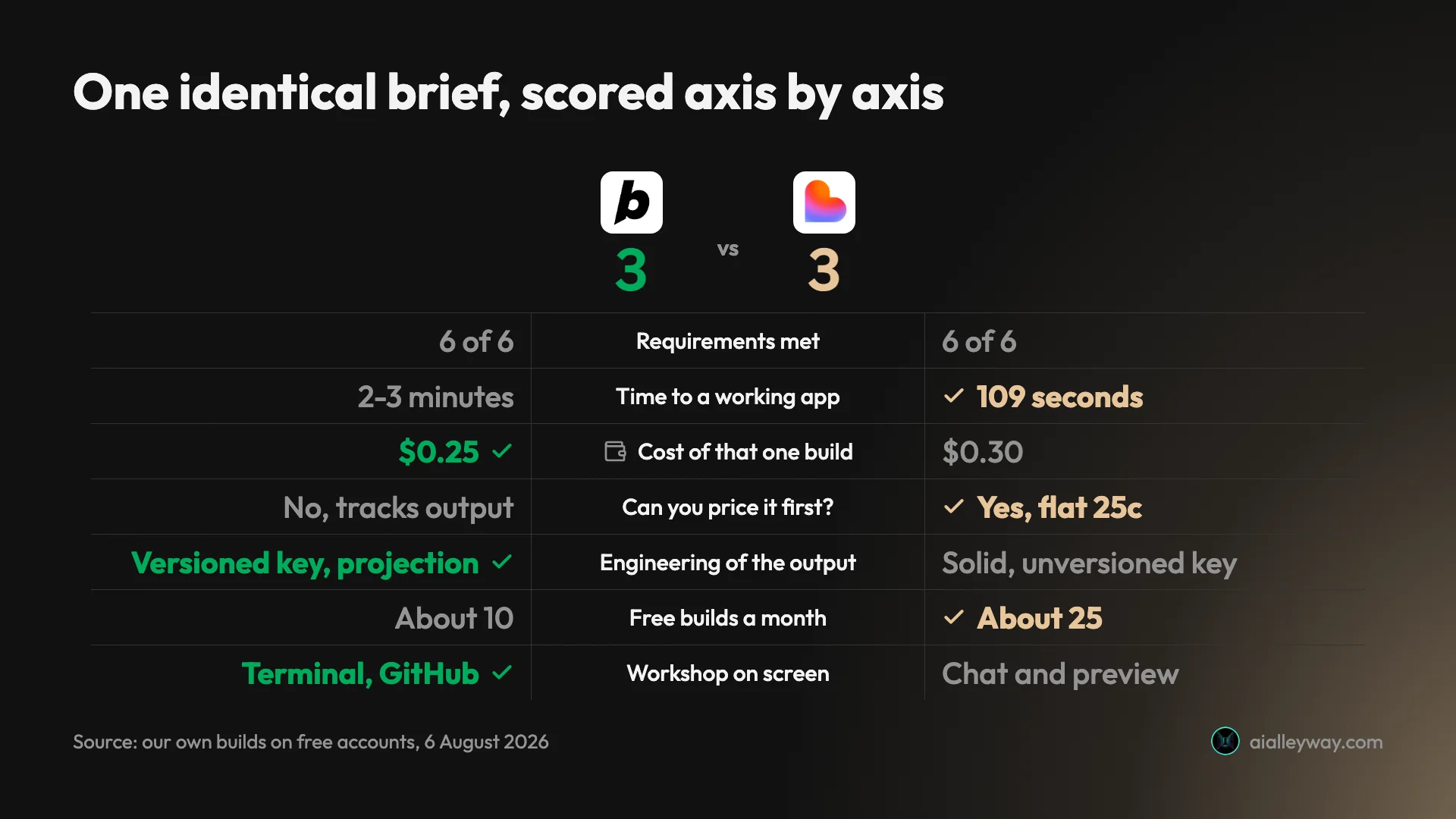
| Axis | Bolt | Lovable | Winner |
|---|---|---|---|
| Requirements met | 6 of 6 | 6 of 6 | Tie |
| Time to a working app | 2-3 minutes | 109 seconds | Lovable |
| Cost of the one build we ran | $0.25 | $0.30 | Bolt |
| Can you price it first? | No, tracks output | Yes, flat 25c | Lovable |
| Engineering of the output | Versioned key, projection | Solid, unversioned key | Bolt |
| Free builds a month | About 10 | About 25 | Lovable |
| Workshop on screen | Terminal, GitHub | Chat and preview | Bolt |
Three each and a tie, which is the honest result and not the one our ratings imply. We score Lovable 4.6 against Bolt 4.4, and that gap was set by each tool on its own terms rather than by this head-to-head.
Read the rows rather than the tally, though. Two of Bolt’s three wins are about the artefact: the code it produced and the environment it produced it in. Two of Lovable’s three are about the meter: how fast it ran and whether you could have predicted the bill. The remaining win on each side is about money, and they split it — Bolt’s build was the cheaper one, Lovable’s free tier gives you more builds to spend. Which set matters is a question about you, not about the tools.
What did each one actually build?
Correctness was a tie, so the difference is in what each chose to do beyond the brief.

Lovable finished first and made two good calls nobody asked for. It added a Restore button to cancelled items, and it kept the annual price visible as context underneath the monthly-equivalent figure — which is exactly the thing a person would ask for on a second pass, because requirement 2 destroys information the user typed in.

Bolt built the more considered application. It was the only one of the two to version its localStorage key, writing stackcost.subscriptions.v1 rather than a bare string — the difference between a schema you can migrate later and one you cannot. It added a yearly projection nobody requested, and got the arithmetic right in a way that shows requirement 2 working: a $110-a-month subscription plus a $2,400-a-year one displaying as $200 a month gives $310 a month, which it projected as $3,720 a year. It used Intl.NumberFormat for currency rather than string-concatenating a dollar sign. And it put the persistence layer in a separate 76-line module instead of inlining it.
None of that was in the brief. All of it is what a competent developer would have done.
One small thing all three did: every tool invented a Restore button for cancelled items. Three independent models reading the same six requirements each decided the same feature was missing.
What does one build cost on Bolt vs Lovable?
This is the question the field does not answer. We swept the five ranking editorial comparisons of these two tools for spend figures and got zero hits. Nobody converts tokens and credits to a common denominator either.
| Tool | Unit | Our build consumed | Unit price at entry | Build cost |
|---|---|---|---|---|
| Lovable | Credit | 1.20 credits | $0.25 a credit | $0.30 |
| Bolt | Token | 100,000 tokens | $2.50 per million | $0.25 |
| Replit | Checkpoint | 1 checkpoint | Effort-priced | Not convertible on free |
Five cents separates them, which is close enough to call even.
Both figures are arithmetic on each tool’s published entry rate rather than an invoice: Lovable’s $25 Pro plan divided by its 100 credits gives a flat 25 cents a credit, and Bolt’s $25 for 10 million tokens gives $2.50 a million. We have never bought a paid plan on either.
Treat both as floors rather than as typical. Each was one prompt that worked first time, which is the best case for any of these tools and not what a normal week looks like. Iteration is where the money goes, and neither of us can price your iteration in advance — which brings us to the part that actually matters.
Why is one bill predictable and the other not?
The five-cent gap is trivia. The unit difference is not.
A Lovable credit is a fixed price you can multiply. Twenty-five cents at the entry tier, flat from 100 credits all the way to 800. Lovable publishes its own per-action figures, so you can estimate a month of work on paper before you spend anything.
Lovable’s published rate card, against the 1.20 credits our build consumed:
| Action | Credits | Cost at the entry tier |
|---|---|---|
| Simple update | 0.50 | $0.13 |
| Remove a component | 0.90 | $0.23 |
| Implement authentication | 1.20 | $0.30 |
| Our whole Stack Cost build | 1.20 | $0.30 |
| Landing page with images | 1.70 | $0.43 |
Our six-requirement app cost Lovable exactly what its own rate card charges to add authentication to an existing app. That is the point of a fixed unit: you can read that table before you spend anything.
A Bolt token prices the model’s output. It measures how much text the model produced, not what you asked for, which has two consequences people discover late. A long argument with the model about a small change can cost more than a short instruction that builds a lot. And a request that fails still bills you for everything the model generated while failing. That is how token pricing works by construction, not something we had to go and measure. A credit behaves differently: a failed attempt is priced in the same terms as a successful one.
We did not run a failing loop on either tool, so treat that as a property of the two billing units rather than something we measured.
Bolt’s own pricing FAQ adds the compounding part, and it is worth quoting: most token usage goes on “syncing your project’s file system to the AI: the larger the project, the more tokens used per message.” So the same edit costs more in month three than in month one, against an allowance that does not grow.
That is the real answer to “which is cheaper”. At the door they are identical — $25 a month for the entry paid plan on both. Over a project, Lovable is the one you can forecast.
What did the two apps look like?
Design was not in the brief beyond “dark theme throughout”, so neither tool was being graded on it. Both delivered a dark theme without being asked twice.
The visible difference was in information design rather than styling. Requirement 2 destroys information by design: it asks you to display a figure the user never typed. Both tools noticed, and both kept the original annual price on screen next to the derived monthly one. Lovable put the annual figure as sub-text under a monthly headline; Bolt reversed the order, keeping the annual figure in the row with the derived monthly as a highlighted badge beside it. Replit, given the same brief, dropped it.
Where Bolt went further was forward. It added a yearly projection next to the monthly total, so the pinned figure at the top answered two questions instead of one. Lovable preserved the input; Bolt preserved the input and then extrapolated from it.
Neither is better. It is a useful illustration of what “the model made a choice” looks like when nobody specified the choice.
| Tool | What it added, unprompted |
|---|---|
| Bolt | Versioned storage key, yearly projection, separate persistence module |
| Both | A Restore button, and the annual price kept as context — neither was in the brief |
The axis we cannot score is the one that matters most over a project: whether the code is pleasant to read six weeks later. We can describe the structural decisions — Bolt’s separate persistence module and versioned key point that way; Lovable never showed us its file structure, so we cannot say — but we did not audit either codebase. Anyone telling you which of these two writes more maintainable code from a single prompt is guessing.
Which one is faster?
Lovable, clearly — 109 seconds against two to three minutes.
| Tool | Time to a working app |
|---|---|
| Lovable | 109 seconds |
| Bolt | Two to three minutes |
| Replit | About four minutes |
Bolt shows no timer, so its figure is our own observation of a range rather than a number the product reported. Lovable’s 109 seconds is our own timing, from submission to a finished app.
Whether that matters depends on what you are doing. For a first draft you will iterate on twenty times, a gap this size disappears into the noise. For a demo you are building live in front of someone, it does not.
What you can take with you
This is the question that decides whether a prototype becomes a product, and of the five comparisons we swept, exactly one touches licensing at all, in a single unsourced FAQ paragraph.
Both tools are React web-app builders, so the output shape is similar. What differs is how much of the surrounding machinery you can see and reach.
| Signal | Bolt | Lovable |
|---|---|---|
| On screen | File tree, terminal, package manager, GitHub button | Chat and preview |
| Free tier backend | Bolt Database offered, not exercised | No auth, no database, no third-party API |
| GitHub | A button in the toolbar on free | Sync is paid |
| Custom domain | Paid | Paid |
| Branding | Made in Bolt badge on what you publish, removed on Pro | Edit with Lovable badge on the preview, removed on paid |
Bolt puts the workshop on screen. A file tree, a terminal, a package manager and a GitHub button sit behind the same screen as the chat. That makes it closer in shape to Replit than to Lovable: you are looking at a project, not only at a preview. On the free tier what you publish carries a Made in Bolt badge, and Pro removes it and adds custom domains, private sharing and unlimited databases.
Lovable keeps the machinery further back. The features that decide whether a prototype becomes a product — GitHub sync, Supabase-backed data, custom domains, publishing — all sit on paid tiers. On the free plan we stayed on, there was no auth, no database and no third-party API. The advice we would repeat from our Lovable review is to connect GitHub early, so the code lives somewhere you control and the generated app is a starting point you own rather than a service you rent.
Neither locked us out of anything on the brief we set, because a localStorage app has nothing to lock. The moment your project needs a database and a login, both tools want a paid plan and the comparison changes shape.
One thing Bolt did that deserves credit here. It sells a hosted database, and the brief asked for localStorage. It wrote the localStorage implementation the brief specified, said so explicitly, and disclosed the upgrade path afterwards rather than quietly routing us onto the paid product.
What do the free tiers actually give you?
Both let you build and test a working application without entering a card. We did exactly that on each. The shapes differ more than the headline suggests.
| Signal | Bolt | Lovable |
|---|---|---|
| Free allowance | 1M tokens a month, 300k daily cap | 5 build credits a day, capped at 30 a month |
| Roughly how many builds like ours | About 10 | About 25 |
| Do unused ones bank? | No, they expire | No, daily grants expire nightly |
| Branding | A Made in Bolt badge on what you publish | An Edit with Lovable badge on the preview |
Two things worth drawing out.
Bolt’s daily cap is less binding than it looks. Spending at the 300,000 maximum exhausts the monthly million in three days and eight hours, so for most of the month the monthly ceiling is the wall you actually hit, not the daily one.
Lovable’s grants expire nightly rather than accumulating, so an unused Tuesday is simply gone. That makes its free tier better for steady daily use and worse for a burst of weekend work.
How does Replit compare to Bolt and Lovable?
We ran the same brief on Replit and it met six of six in about four minutes, the slowest of the three.
Its billing is the least legible of the set. A checkpoint has been effort-priced since June 2025, scaling with the complexity of the request, so unlike Lovable’s flat credit you cannot price a request before sending it. On the free plan it reports usage as a percentage bar rather than a number — our build consumed 31% of one day of free Agent credits, and there is no way to convert that to dollars.
What Replit buys instead is the workspace. It has a real built-in Postgres database and works across many languages, where both Bolt and Lovable are React web-app builders. If your project needs a backend rather than a page, that is the trade.
Our Lovable vs Replit comparison covers that pairing in full.
What do you keep, and what expires?
Neither tool’s economics are only about the sticker price.
Bolt’s paid tokens roll over for one additional month, making them valid for two months in total, and only while the subscription is active — cancel and whatever you banked goes with it. Free tokens expire outright.
Lovable’s credits expire two months after they are issued on a monthly plan, and its daily free grants expire at the end of each day. Its Business tier is the sharper trap: at $50 it carries the same credit count as Pro, but a Business credit costs 50 cents — so the same build costs twice as much in dollars. The extra $25 buys governance, not credits.
The pattern on both is that the plan is not a bank. Buying a large balance to cover a busy quarter works against the expiry rules rather than with them.
What neither of them did
Worth stating plainly, because a single clean build flatters both tools.
| What neither did | Detail |
|---|---|
| Shipped a visible test | Six requirements, zero assertions |
| Stopped to ask anything | Both guessed, both guessed right |
Neither shipped a test we could see. Six requirements, two of them deliberately awkward, and no assertion in either output proving any of them held. We read Bolt’s generated source and drove both apps, so treat that as an observation rather than a code audit.
Neither stopped to ask anything. A brief with a derived-value requirement and a two-state list is exactly where a developer would ask one clarifying question. Both went straight to building, and both guessed right — this time.
Both of those are what one clean first attempt looks like, which is the shape of our test and not the shape of a working week. The gap that leaves matters most for Bolt. It held 1.4 out of 5 on Trustpilot across 196 reviews when we checked in August 2026, the lowest of any tool in this category we have tested.
We should be precise about what that is and is not. Trustpilot blocks automated access, so what we have is the score and the count, via Google’s summary of the page, rather than the reviews themselves. We have not read them and are not going to tell you what they say.
What we can say is what our own test could not reach. One carefully specified prompt that works first time is the best case for any tool here, and a 1.4 average across 196 people is not describing a best case. Whatever produces that number, we did not go near it.
What did we not test?
Four things, stated plainly, because one clean build on each flatters both.
We never bought either paid plan. Every dollar figure here is arithmetic on published entry rates. We have not seen an invoice from either company.
We ran one prompt each. No follow-ups, no corrections, no debugging loop — which is the single most important scenario for a token-metered tool and the one our method cannot reach. If you want to know what happens on prompt fifteen with a database attached, neither this post nor anything we found while researching it can tell you.
We stayed on the free tiers. So GitHub sync on Lovable, custom domains, publishing, real databases and team features on both are unexercised. On Lovable in particular, the features that turn a prototype into a product are the ones we did not touch.
We did not grade the code. We read Bolt’s source and drove both apps, and can describe the structural choices we could see, but we did not run a linter over it, write tests against it, or ask a second engineer to review it.
Who should pick Bolt?
You want the most finished first draft. On our brief Bolt made the choices a developer would have made unprompted — the versioned key, the derived projection, the separated persistence module — and that is a real head start.
You are building something you will keep extending. Better-structured output at the start compounds, and Bolt’s was better structured.
You are on the free tier and want a real number. Bolt shows you exactly what a build cost, in tokens, on both a monthly and a daily line. Replit shows a percentage. That transparency is genuinely unusual.
Who should pick Lovable?
You want it working now. 109 seconds to a usable app against two to three minutes, on the same brief.
You need to quote a price. A flat 25-cent credit is the only unit here you can multiply before you spend it. If you bill clients fixed-price, that decides it.
You are new to this. Lovable finished fastest of the three, and it never puts code in front of you at all: no file tree, no terminal, no editor. That is what you want when you are still learning what to ask for. Its unprompted additions were not unique, since Bolt made the same two, but it got there first.
The final word
These two are closer than the ratings suggest. Both met a deliberately picky brief on the first attempt, both cost within five cents of each other on that build, and both charge $25 to start.
We rate Lovable 4.6 against Bolt 4.4, and the gap is speed and predictability rather than output — Bolt built the better app of the two. If those were the only considerations we would call it for Bolt.
What tips it is the unit. A credit is a price; a token is a measurement of something you do not control. On a good day that difference is five cents. On a bad day, in a debugging loop, it is the difference between a bill you expected and one you cannot explain afterwards.
If neither of these two is the answer, Bolt.new alternatives widens the same test to eight tools, and Lovable alternatives runs it from the other direction.
Frequently asked questions
Is Bolt or Lovable better?
Lovable, for most people, and we rate it 4.6 against Bolt's 4.4. But the margin is narrower than those numbers suggest, and on the one brief we gave both, Bolt produced the better-engineered app.
Lovable was faster — 109 seconds against two to three minutes — and its billing is easier to reason about. Bolt was the only one of the two to version its storage key and to add a yearly projection nobody asked for.
Pick Lovable if you want the shortest path to a working page and a bill you can predict. Pick Bolt if you want the most finished first draft.
What does one app actually cost to build on Bolt vs Lovable?
On the identical brief, 30 cents on Lovable and 25 cents on Bolt, at each tool's entry-tier rate.
Lovable charged 1.20 credits, and a credit is 25 cents on the $25 Pro plan. Bolt charged 100,000 tokens, and a million tokens is $2.50 at Pro's entry rung, so 100,000 is a quarter.
For scale, Lovable's own published rate card prices a simple update at 0.50 credits, removing a component at 0.90 and implementing authentication at 1.20 — so our six-requirement app cost exactly what Lovable charges to add authentication to an existing app.
No other comparison we could find publishes a measured per-build figure for either tool. Treat both as floors rather than typical: each was one prompt that worked first time, and iteration is where the money actually goes.
Which is cheaper, Bolt or Lovable?
They cost the same at the door — $25 a month for the entry paid plan on both — and five cents apart on the one build we measured.
The real difference is predictability rather than price. A Lovable credit is a fixed 25 cents you can multiply before you spend it. A Bolt token prices the model's output, so a request that fails still bills you for everything the model produced while failing.
One trap on the Lovable side: its $50 Business tier carries the same credit count as the $25 Pro plan, but a Business credit costs 50 cents, so the identical build costs twice as much in dollars. The extra $25 buys governance, not credits.
If you invoice fixed-price work, the predictability difference matters more than the five cents.
Are Bolt tokens or Lovable credits easier to work with?
Credits, and it is not close for planning purposes.
One Lovable credit is 25 cents on the entry plan, flat, so 100 credits is $25 and a 1.20-credit build is 30 cents. You can price a month of work on paper.
A Bolt token tracks how much the model produced rather than what you asked for, and Bolt's own FAQ says usage scales with project size — the same edit costs more as the codebase grows. The unit is finer-grained and less intuitive, which is why the bill surprises people.
Expiry differs too. Bolt's paid tokens roll over one extra month and only while you stay subscribed; Lovable's credits expire two months after they are issued on a monthly plan. Neither unit banks indefinitely, so buying capacity ahead of a project is a bet on using it.
Do Bolt and Lovable have free tiers you can build on?
Both, and they are shaped differently.
Bolt grants 1 million tokens a month with a 300,000 daily cap, which is roughly ten builds the size of ours. Lovable grants 5 build credits a day capped at 30 a month, which at 1.20 credits a build is around 25.
Bolt's daily cap is less binding than it looks: spending at the full 300,000 exhausts the monthly million in three days and eight hours, so the monthly ceiling is the real wall. Lovable's daily grants expire nightly rather than accumulating.
Both brand what you make. Bolt stamps a Made in Bolt badge on what you publish; Lovable's free tier keeps an Edit with Lovable badge on the preview. We built and tested a working app on each without entering a card.
How does Replit compare to Bolt and Lovable?
We gave Replit the same brief and it also met all six requirements, in about four minutes — the slowest of the three.
Its billing unit is the checkpoint, priced by effort since June 2025, so unlike Lovable's flat credit it cannot be converted to a per-build dollar figure in advance. On the free plan it reports usage as a percentage bar rather than a number, so our build showed as 31% of one day of free Agent credits with no way to price it.
Replit's advantage is the workspace: a real Postgres database and many languages, where both Bolt and Lovable are React web apps.
Keep reading
Bolt.new pricing: the token ladder you only see signed in
Bolt.new pricing has 14 token tiers that never render logged out, a 28% yearly discount that is really 10%, and a measured 100,000-token build.
Bolt.new review: the best build, the worst reviews
Bolt.new review from a measured build: the same six-requirement prompt I gave Lovable and Replit, 100,000 tokens, and the 1.4-star gap nobody explains.
Bolt.new alternatives: 8 tools, 7 took the same brief
The best Bolt.new alternatives, ranked by a measured build rather than a feature table. Seven tools took one identical brief. Here is what each build cost.
Lovable alternatives: 7 tools, and I gave 5 the same brief
The best Lovable alternatives, ranked by a build test rather than a feature list. Five of the seven took an identical brief. Here is what each cost.