
Lovable pricing: what a credit actually costs
Lovable pricing decoded: one credit costs 25 cents, a measured real build cost thirty cents, and Business charges double per credit for the same 100 a month.
Contents
How much does Lovable cost?

Pro is $25 a month for 100 credits, or $21 a month billed annually. Business is $50 a month for 100 credits that cost twice as much each. Enterprise is a platform fee with volume pricing, and there is a genuinely usable free plan underneath all of it.
That is the answer most pages give. It is also the least useful way to think about what Lovable costs, because Lovable does not charge you by the month. It charges you by the credit, and the month is just how often it refills them.
So here is the number that actually matters, and none of them does the division for you: one Lovable credit costs 25 cents. Twenty-five dollars divided by a hundred credits. On annual billing it is 21 cents.
Once you have that, Lovable pricing becomes arithmetic instead of guesswork. The app I built and measured for the Lovable review consumed 1.20 credits, which is thirty cents. That is the figure I could not find in any other write-up, and the rest of this guide is built on it.
What is a credit actually worth?
A credit is consumed when Lovable does work for you, and how much work varies. Since July 2025 the cost has been weighted by complexity rather than flat, which is worth saying plainly because at least one published guide still describes it as one credit per message regardless of complexity. That was the old model.
Lovable’s own published examples give the shape:
| The action | Credits | At $0.25 a credit |
|---|---|---|
| A simple update (“make the button gray”) | 0.50 | $0.13 |
| Removing a component | 0.90 | $0.23 |
| Adding authentication | 1.20 | $0.30 |
| A landing page with images | 1.70 | $0.43 |
One thing that is not on that list and should be: Plan mode costs a flat one credit per message. Lovable’s documentation is explicit that Plan mode never modifies your code, and equally explicit that every message deducts a credit. Thinking out loud is not free here.
That flat rate cuts both ways, and it is worth understanding rather than avoiding. A Plan message always costs one credit whether you ask something trivial or something enormous, while a build action costs whatever the work turns out to be. So planning is expensive relative to a small tweak and cheap relative to a large build you would otherwise have got wrong. The habit that saves money is not avoiding Plan mode, it is refusing to discover your requirements through builds.
I had this wrong initially and said so in the review: I read Lovable’s tip about Plan mode making no code changes as meaning it made no charge either. It does not modify your app. It still bills you.
What a real build actually cost
Every guide to Lovable’s pricing explains the credit system. None of them tells you what a finished app actually costs, so here is mine.
I gave Lovable a single prompt with six numbered requirements and no follow-ups, and it produced a working single-page app with forms, a computed running total, a cancelled state and browser persistence. The full build write-up is in the Lovable review.
That build cost 1.20 credits. My balance went from 10.00 to 8.80, and 1.20 credits at 25 cents is thirty cents.
That number is worth holding onto because it cuts both ways. At thirty cents a build, the $25 Pro plan buys roughly 83 builds of that size a month, which sounds enormous. It is also deeply misleading, because almost nobody builds an app in one prompt and stops. The credits go during iteration, and a fourth attempt at the same layout costs the same as the first.
The honest framing is that my build was cheap because it was right the first time. Prompt discipline is the only lever you control on a metered plan, which is an odd thing to need from a product sold to people who would rather not think like engineers.
What a month actually costs
The credit price only becomes useful when you run it forward. Here are three months, built from my measured 1.20-credit build and Lovable’s own published action costs.
The cautious builder. One new app a fortnight, each taking a first build plus four rounds of tweaks. Call it 1.20 for the build and four updates at 0.50, so about 3.20 credits an app, or 6.40 a month. That is $1.60 of a $25 plan, and 94% of the allowance goes unused and then expires. This person should be on the free plan.
The working prototyper. Two apps a week, each with a first build and a dozen rounds of iteration, plus some planning. Say 1.20 for the build, twelve updates at an assumed 0.70 average — my own midpoint between Lovable’s published 0.50 and 0.90 examples, not a figure they publish — and five Plan mode messages at one credit each. That is roughly 14.60 credits an app, or 117 a month.
Which overshoots the 100-credit Pro plan in the last week of every month. The fix is Pro’s 200-credit rung, which is $50 — the same figure as Business but a different purchase — rather than a top-up. If that shape sounds familiar it is the same trap Claude Code’s pricing sets from the other direction, where the plan is capped and you wait rather than pay.
The team. Five people on one Pro workspace, each doing the cautious builder’s volume. Thirty-two credits a month between them, comfortably inside 100, and they pay $25 in total because Lovable’s seats are unlimited. The same five people on a per-seat product at $30 a head pay $150.
| The month | Credits used | Costs | Verdict |
|---|---|---|---|
| Cautious builder: 1 app a fortnight, 4 tweaks each | ~6 | $1.60 of $25 | Stay free |
| Working prototyper: 2 apps a week, 12 tweaks each | ~117 | Overshoots 100 | Move to the 200 rung |
| Five-person team, one shared workspace | ~32 | $25 between them | Pro, unlimited seats |
The gap between the first and second of those is the whole story of this pricing model. Same product, same headline plan, and one person is wasting 94% of what they bought while the other runs out early. Nothing on the pricing page helps you work out which one you are, which is why the per-action numbers matter more than the plan names.
Lovable pricing plans, in full
Read off Lovable’s pricing page on 6 August 2026, in a rendered browser. That detail matters: the plan cards are generated in JavaScript and are invisible to a plain fetch, which is why several published guides disagree with each other and one still quotes a $20 entry price.
| Plan | Monthly | Annual | Credits |
|---|---|---|---|
| Free | $0 | $0 | Daily grants only |
| Pro | $25 | $21/mo | 100 a month |
| Business | $50 | $42/mo | 100 a month |
| Enterprise | Platform fee | Volume-based | Custom |
Look at the credits column. Lovable Business costs twice Pro for the same number of credits — but read that carefully, because the cards say “100 Pro credits” and “100 Business credits”, and Lovable means the distinction. That doubling holds exactly for nine of the eleven rungs, from 100 credits through 5,000: Business 200 is $100 against Pro’s $50, Business 400 is $200 against Pro’s $100. It only breaks at the top two, where Business is slightly cheaper than double — $3,300 at 7,500 credits against twice Pro’s $3,376, and $4,300 at 10,000 against $4,500.
Why does Business cost double?
Lovable’s FAQ says credits are “not necessarily equal in value across different plans”, and that moving from Pro to Business brings “a decrease in credit usage for Run and AI cost”. Read alone that sounds like a discount. The sentence immediately before it rules that out: “The cost for running their app and for AI features built into apps is the same for Business and Pro subscribers and not more expensive on the business plan.”
The arithmetic behind that is simple once you see it. A Business credit costs 50 cents, because Business is $50 for the same 100 credits. Hosting and in-app AI consume fewer credits on Business precisely because each credit is worth twice as much, so the dollar cost lands in the same place. Nothing is cheaper.
Build actions work the other way. Those are quoted in fixed credits — 1.20 to add authentication, whatever plan you are on — so a build that costs 30 cents on Pro costs 60 cents on Business.
So the second $25 buys governance and nothing else: SSO, role-based access, a team workspace, internal publishing, a security centre, design templates, personal projects and priority support. Note that user roles and permissions already sit on Pro, so basic permissions are not the upgrade. And Pro already includes unlimited users.
That last point is easy to miss and genuinely valuable: Lovable’s seats are unlimited on Pro. A five-person team on Pro pays $25 between them. The same team on a per-seat competitor at $30 a head pays $150, which is six times as much.
If you are still choosing rather than budgeting, the best AI app builder ranks Lovable against four rivals on cost per build — the number that decides how long a free tier lasts — and the best vibe coding tool covers the wider field.
How much do credits cost in bulk?
Lovable’s two paid tiers each sell eleven credit bundles rather than one, and the price holds flat at 25 cents a credit through the first four rungs. This is the part most write-ups omit entirely, and it changes what “Pro is $25” means.
| Credits | Pro monthly | Pro annual | $/credit (monthly) |
|---|---|---|---|
| 100 | $25 | $21 | $0.25 |
| 200 | $50 | $42 | $0.25 |
| 400 | $100 | $84 | $0.25 |
| 800 | $200 | $167 | $0.25 |
| 1,200 | $294 | $245 | $0.245 |
| 2,000 | $480 | $400 | $0.24 |
| 3,000 | $705 | $588 | $0.235 |
| 4,000 | $920 | $767 | $0.230 |
| 5,000 | $1,125 | $938 | $0.225 |
| 7,500 | $1,688 | $1,407 | $0.225 |
| 10,000 | $2,250 | $1,875 | $0.225 |
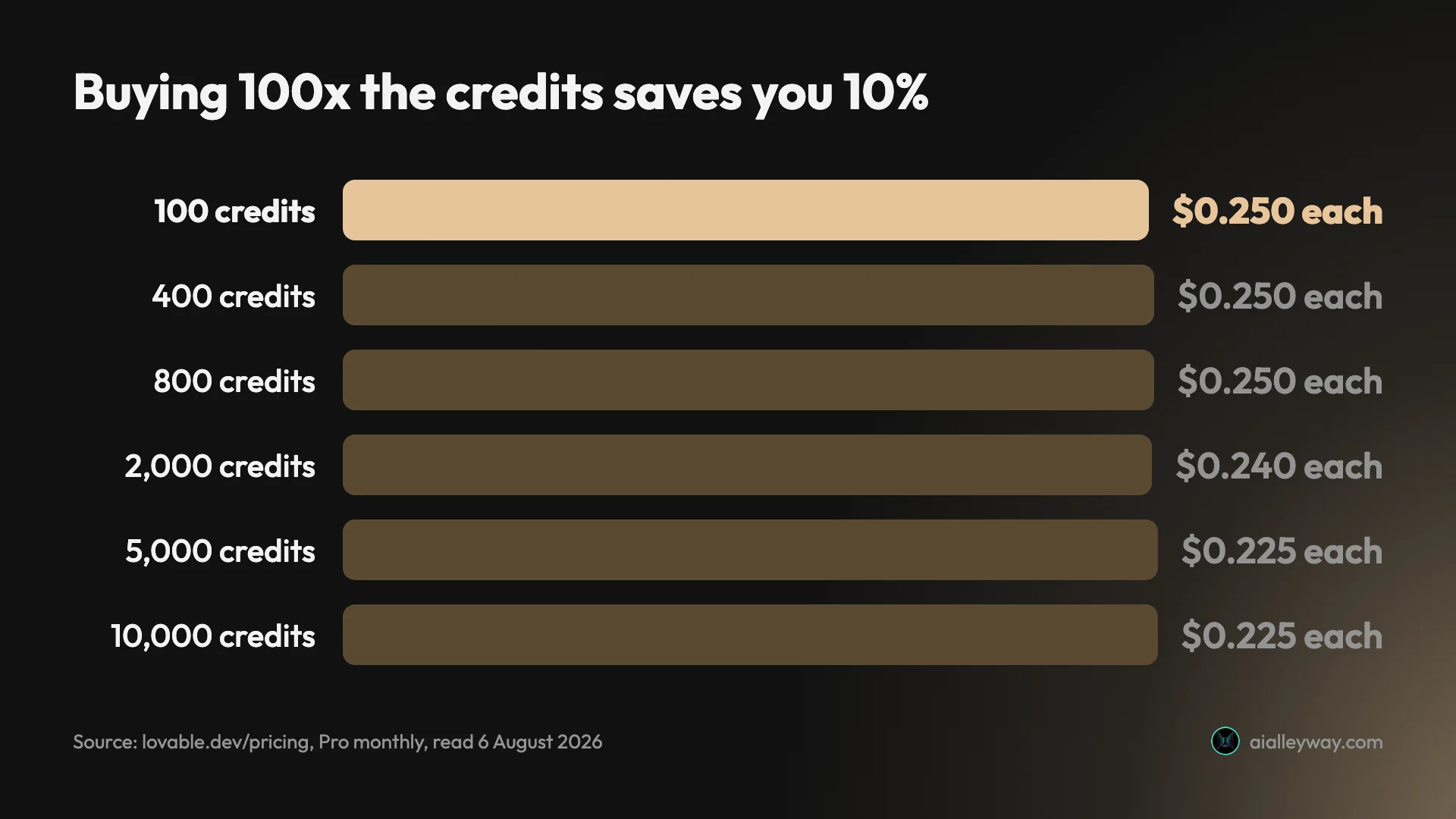
The shape is unusual. On monthly billing, from 100 credits to 800 the rate does not move at all: you pay 25 cents whether you buy the smallest bundle or eight times it. Annual starts shading a rung earlier, which is why its 800 row reads $167 rather than $168. The discount only begins at 1,200 and it caps at 10% on monthly Pro, reached at 5,000 credits and no better at 10,000.
Buying a hundred times the entry bundle saves you a tenth. That is a volume ladder that exists to let heavy users buy more, not to reward them for it.
Business bends slightly further at the top, reaching 12% at 7,500 credits and 14% at 10,000 — the only place in the whole structure where Business discounts harder than Pro.
Annual billing is the better lever. At the entry rung it takes $25 to $21, a 16% saving that beats every volume tier on the ladder, including the 10,000-credit one. (Bolt runs the opposite shape: its headline 28% applies to one tier and every other rung saves 10%.) That is the opposite shape to Bolt’s ladder, where the tiers start at 10 million tokens and the discount arrives through volume rather than commitment.
What does the free plan give you?
Lovable’s free plan is real, and I built and stress-tested a working application on it without entering a card.
You get a daily grant of 5 build credits, capped at 30 a month, plus a monthly grant of 20 Cloud credits and 4 credits usable by AI features inside the apps you build.
| What the free plan grants | Amount | Resets |
|---|---|---|
| Build credits | 5 a day, 30 a month max | Daily, no rollover |
| Cloud credits | 20 | Monthly |
| In-app AI credits | 4 | Monthly |
Two things about that are easy to misread, and I misread one of them myself.
The daily grants expire daily. Lovable’s own wording is that they expire at the end of each day and do not roll over. An unused Tuesday is worth nothing on Wednesday. At my measured 1.20 credits a build, five daily credits is four builds a day. The monthly ceiling is 30 credits rather than 30 builds, so the daily allowance only stretches that far for about six days of a month.
The balance you see is not one pool. The workspace menu shows a single combined number. Mine read ten, and I took that for the daily grant, which would have made the published figure of five wrong. It is not: five were the daily build credits, and the other five were a one-off bonus grant that never refreshes. Only the billing page separates them.
Paid subscribers keep receiving the same grants on top of their plan credits — both the 5 daily build credits and the monthly 20 Cloud credits — which is a genuinely generous detail that nobody advertises. It is also the opposite of Replit’s free tier, which shows you a percentage bar and puts the real figure behind a subscription.
Do the credits expire?
Every credit in Lovable has a clock on it, and the clocks differ.
| Credit type | Expires |
|---|---|
| Daily grant credits | End of the same day |
| Monthly plan credits | Two months after issue |
| Annual plan credits | One month after the annual period ends |
| Purchased top-ups | Twelve months from purchase |
The practical consequence: a Lovable plan is not a bank. Buying a large bundle to cover a busy quarter runs against the expiry rules rather than with them, because plan credits lapse two months after they land. The Pro card does list credit rollover and on-demand top-ups as features, so unused credits do carry forward — just not indefinitely.
I have seen a top-up price quoted elsewhere but no top-up pricing appeared on the pricing page when I read it, so I am not going to state a figure I did not see.
What does it cost after you publish?
This is the question I see asked most often and answered least, usually phrased as some version of do I have to keep paying every month just to keep my app up?
Lovable’s answer, in its own words, is that hosting an app on Lovable “does not cost anything” and is “in most cases fully covered by the included grant”. But the sentence continues, and the continuation is the important half: apps with significant visitor traffic or size “may start incurring cost”, and that cost is “covered by your credit balance”.
So hosting is not free. It is metered from the same credit pool that pays for building, and it is silent until it isn’t. For a prototype shown to three people this will never matter. For anything that finds an audience, your build budget and your hosting budget are the same budget, and traffic quietly competes with development.
I have not run an app at volume on Lovable, so I cannot tell you where the threshold sits. I would rather say that than repeat the dollar estimates circulating secondhand.
Is there a student discount?
Lovable runs a student discount that almost nobody documents properly. The terms are worth setting out in full, because this is the cheapest legitimate way into the product.
- 50% off Lovable Pro at the 100-credit rung, which is $12.50 a month
- Or a flat $12.50 a month off any other plan
- Valid for up to 12 months
- Verified on Lovable’s student page with a university email address or a student ID
- Cancel the subscription and you lose the discount permanently; it cannot be reactivated
Two conditions catch people. The discount can only be applied to an account that is currently on the free plan, so upgrade first and you have missed it. And it is not transferable between accounts.
Lovable vs Bolt vs Replit: which is cheaper?
I have run the identical six-requirement prompt through all three products, which makes the billing units comparable in a way the marketing pages never are.
| The measure | Lovable | Bolt | Replit |
|---|---|---|---|
| Unit | Credits | Tokens | Checkpoints |
| Entry paid plan | $25 | $25 | $20 |
| What my build cost | 1.20 credits | 100,000 tokens | 1 checkpoint |
| In dollars, free plan | $0.30 | $0.25 | Not derivable |
| Free plan shows spend | Yes, itemised | Yes, exact | No, a bar |
Lovable and Bolt both charge $25 to start. Replit undercuts them at $20, having cut Core from $25 in February 2026, and two of the three let you turn usage into a dollar figure. Lovable publishes a credit count and a credit price. Bolt publishes an exact token balance and an allowance of 10 million tokens for $25, so my 100,000-token build works out at 25 cents by exactly the same division. Replit is the outlier: free users get a percentage bar and the usage page sits behind a subscription, which its own pricing guide goes into.
So Bolt built my app for five cents less than Lovable did. What Lovable has over it is legibility rather than exclusivity: a credit is a round 25 cents you can hold in your head, where 0.0000025 dollars per token is not. The measured builds are in the Bolt review and the Replit review.
Which plan should you pick?
| You are | Plan | Why |
|---|---|---|
| Testing whether it understands you | Free | Four builds a day answers that |
| A student | Pro at $12.50 | Half price for a year, free-plan accounts only |
| Building regularly, alone or in a small team | Pro annual, $21 | 16% beats every volume tier on the ladder |
| A team needing SSO or RBAC | Business | You are buying governance, not credits |
| Spending over ~$2,000 a month | Talk to them | Past 10,000 credits the ladder runs out |
The one recommendation I would make firmly: if you know you are staying past a month, take annual. A 16% cut at the entry rung is larger than any volume discount you can reach by spending more, which is an odd incentive structure but a real one.
The final word
Lovable’s pricing is more legible than most of this category, and the reason is arithmetic. A credit costs 25 cents, the product tells you how many credits a build consumed, and those two facts multiply into a number you can check without a spreadsheet. Bolt gives you both halves too, in tokens; Replit gives free users neither.
What the pricing page does not make obvious is everything in this table:
| The thing it does not say plainly | What it means |
|---|---|
| Business gives the same credit count as Pro | Each credit costs 50c, so builds cost double |
| The monthly ladder is flat to 800 credits | 8x the credits, identical unit price |
| The discount caps at 10% | 100x the entry bundle saves a tenth |
| Every credit type expires differently | Daily, 2 months, 12 months |
| Hosting draws on your credit balance | Traffic competes with development |
None of that is hidden exactly. It is just spread across a JavaScript-rendered plan card, a FAQ and a docs page, which is how a straightforward price ends up being reported four different ways by four different pages.
One practical habit closes the gap between those two builders, and it costs nothing. Lovable tells you what each action consumed, so after a fortnight of ordinary work you can add up your own credits and multiply by 0.25. That gives you a real monthly figure rather than a plan name, and it is the only way to know whether you are the person wasting 94% of an allowance or the one running dry in the last week.
Do it before the annual decision rather than after. Annual is the largest single saving available here, at 16% off the entry rung, and it is also the one commitment that stops being refundable the moment you make it. Two weeks of measured usage is cheap insurance against buying the wrong rung for a year.
If you want the shape in one line: thirty cents a build, $25 a month, and the meter never stops being the thing to watch.
Frequently asked questions
How much does Lovable cost per month?
Pro is $25 a month for 100 credits, or $21 a month billed annually, which Lovable describes as two months free. Business is $50 a month, and Enterprise is a platform fee with volume pricing.
Both paid tiers sell the same eleven credit bundles, from 100 credits up to 10,000. The headline price is only the first rung: Pro 400 credits is $100 a month, Pro 2,000 is $480.
What is one Lovable credit worth in dollars?
Twenty-five cents on monthly billing and twenty-one cents on annual. That is simply $25 divided by the 100 credits the entry Pro plan includes.
On monthly billing that rate holds exactly at every rung up to 800 credits. Annual starts discounting one rung earlier, so 800 annual credits are $167 rather than $168.
That number is the one worth carrying around, because Lovable prices work in credits and bills in dollars. A build action costing 1.20 credits is costing you about thirty cents.
Is Lovable's volume discount worth it?
Barely. The price per credit is flat at $0.25 from 100 credits all the way to 800, so buying eight times as many credits saves nothing at all.
Above that the discount creeps in slowly and caps out: 10% on monthly Pro at 5,000 credits and no better at 10,000. Buying a hundred times the entry bundle saves you a tenth. Business goes slightly further, reaching 14% at its top rung.
Does Lovable have a free plan?
Yes, and it is a real one. You get a daily grant of 5 build credits, capped at 30 a month, plus a monthly grant of 20 Cloud credits and 4 credits usable by AI features inside the apps you build.
The catch is in the word daily. Those grants expire at the end of each day and do not roll over, so an unused Tuesday is simply gone. Paid subscribers receive the same grants on top of their plan credits: 5 daily build credits and a monthly grant of 20 Cloud credits.
What does one Lovable build actually cost?
Mine cost 1.20 credits, which is thirty cents at the $25 Pro plan's rate of 25 cents a credit. That was one prompt carrying six numbered requirements, producing a working single-page app with forms, a computed running total, a cancelled state and browser persistence.
No other write-up I could find reports a measured per-build figure, which is why it is worth stating plainly. Treat it as a floor rather than a typical month: my build was cheap because it was right first time, and iteration is where credits actually go.
Do Lovable credits expire?
All of them, on different clocks. Daily grant credits expire at the end of each day. Credits on a monthly plan expire two months after they are issued. On an annual plan they expire one month after your annual period ends, and purchased top-ups last twelve months.
So the plan is not a bank. Buying a large bundle to cover a busy quarter works against the expiry rules rather than with them.
Is there a Lovable student discount?
Yes, and it is the least-written-about thing in Lovable's pricing. Verified students get 50% off Lovable Pro at the 100-credit rung, which is $12.50 a month, or a flat $12.50 a month off any other plan. It is valid for up to 12 months.
Two conditions catch people out. You verify with a university email address or student ID, and the discount can only be applied to an account currently on the free plan. It is not transferable between accounts.
Keep reading
Lovable vs Replit: same prompt, same six requirements, two bills
Lovable vs Replit on one identical brief. Both hit 6 of 6 — Lovable in 109 seconds, Replit in four minutes and 31% of a day's credits. The cost model decides.
Lovable review: six requirements, six passes, 109 seconds
Lovable review from a real build. One prompt, six requirements, a working app in 109 seconds — and an honest look at what it got right and where it stops.
Lovable alternatives: 7 tools, and I gave 5 the same brief
The best Lovable alternatives, ranked by a build test rather than a feature list. Five of the seven took an identical brief. Here is what each cost.
Best AI app builder: 5 tools, one brief, every app used
The best AI app builder, measured. I gave five builders one brief and used every app. All five passed — what separated them was the cost of the second build.