
Lovable vs Replit: same prompt, same six requirements, two bills
Lovable vs Replit on one identical brief. Both hit 6 of 6 — Lovable in 109 seconds, Replit in four minutes and 31% of a day's credits. The cost model decides.
Contents
Lovable vs Replit: which should you use?
I gave both tools the same six-requirement brief, once, with no follow-up prompts. Both built a working app on the first attempt. Both scored 6 of 6, including the two requirements I wrote specifically to be fumbled.
Then I looked at what each build had cost, and that is where the comparison actually is.
| Verdict | |
|---|---|
| Best for speed and cost clarity | Lovable — 109 seconds, 1.20 credits, on a published rate card |
| Best for a real backend | Replit — a full IDE, a Postgres database, many languages |
| Best overall | Lovable, 4.6 to Replit’s 4.2, on efficiency rather than capability |
The test both of them took
One message, six numbered requirements: add a tool with a name, cost and billing cycle; annual plans must display a monthly-equivalent figure rather than the annual one; a running monthly total pinned to the top; a cancelled state that leaves the total but stays visible in its own section; persistence across reloads; a dark theme.
Requirements two and four are traps. Each needs two ideas held at once — display something other than the number you typed, and exclude an item while keeping it on screen. They are the kind of thing that gets quietly half-implemented.
I verified both results by serving the app and using it, checking the running total against a calculator and reading the stored data. Not by reading either tool’s summary of itself.
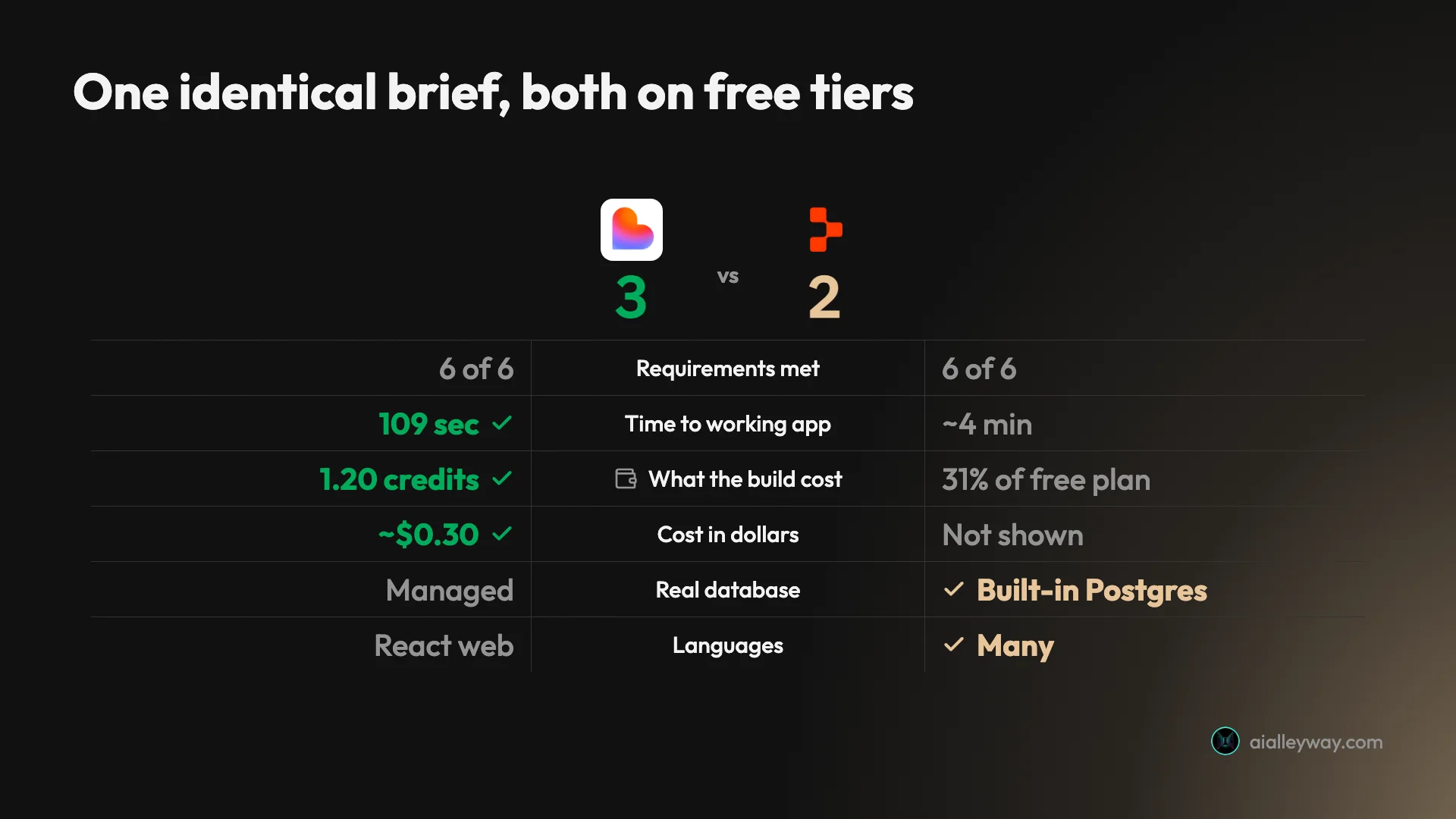
| Axis | Lovable | Replit | Winner |
|---|---|---|---|
| Requirements met | 6 of 6 | 6 of 6 | Tie |
| Time to a working app | 109 seconds | ~4 minutes | Lovable |
| What the build consumed | 1.20 credits | 31% of a day’s credits | Lovable |
| Dollar cost, derivable? | Yes, ~$0.30 | No — percentage bar only | Lovable |
| What you get at the end | Preview subdomain | Dev URL, full workspace | Replit |
| Real database | Managed cloud / Supabase | Built-in Postgres | Replit |
| Languages | React web apps | Many | Replit |
| Wrote its own tests | No | No, test hooks only | Tie |
| Alley Rating | 4.6 | 4.2 | Lovable |

Lovable: strengths and gaps
It was fast in a way that changes how you work. 109 seconds from prompt to working app. Of the seven tools I have given this brief, only one has beaten it, and the difference between two minutes and ten is the difference between trying an idea and scheduling one.
It handled both traps correctly. A $2,400 annual plan rendered as $200.00 a month with the annual figure kept as context underneath. Cancelling removed an item from the total and left it visible in its own section. It also stored the raw annual figure with the billing cycle and derived the monthly number at render, which is the correct model rather than the shortcut.
The cost was legible. 1.20 credits, and Lovable publishes what credits buy: implementing authentication is priced at the same 1.20, a simple update at 0.50, removing a component at 0.90, a landing page with images at 1.70. You can estimate a project before you start it.
What Lovable publishes that a build costs:
| Action | Credits |
|---|---|
| Simple update | 0.50 |
| Remove a component | 0.90 |
| Implement authentication | 1.20 |
| My six-requirement build | 1.20 |
| Landing page with images | 1.70 |
The output is a polished app, not a codebase. React, Tailwind and a preview subdomain. That is exactly right for an MVP and a poor fit if you needed a Python worker.
Credits expire, and wrong answers cost the same as right ones. Monthly credits expire two months after issue, annual credits a month after the period ends, top-ups after twelve. A build action is charged whether or not it worked, so iteration is where the money goes. At 1.20 a build, a $25 Pro plan’s 100 credits is roughly 83 builds of my size — before any arguing.

Replit: strengths and gaps
You get a real environment. A file tree, a terminal, deployment logs, a built-in Postgres database, and support for many languages rather than one framework. This is the substantive difference between the two products and it is not a small one.
It met every requirement too. Same 6 of 6, same two traps handled, on the first attempt with no follow-ups. Nothing about the result was worse; it simply took about four minutes rather than 109 seconds.
Its agent debugs itself. Replit’s Agent reads terminal output and works through its own runtime errors, which is a genuinely different loop from prompting a chat window until the error goes away.
The billing unit is the problem. Replit charges per checkpoint, defined in its own documentation as the point where the Agent completes your request and implements the functionality. Since June 2025 those checkpoints are priced by effort rather than the old flat $0.25, so the cost of a build is decided after the fact by how hard the agent worked.
How Replit’s billing unit has changed:
| Before June 2025 | Now | |
|---|---|---|
| Unit | Checkpoint | Checkpoint |
| Price | Flat $0.25 | Effort-based |
| Known in advance? | Yes | No |
| Small task | $0.25 | Near $0.25 |
| Large task | $0.25 | Bundled, costs more |
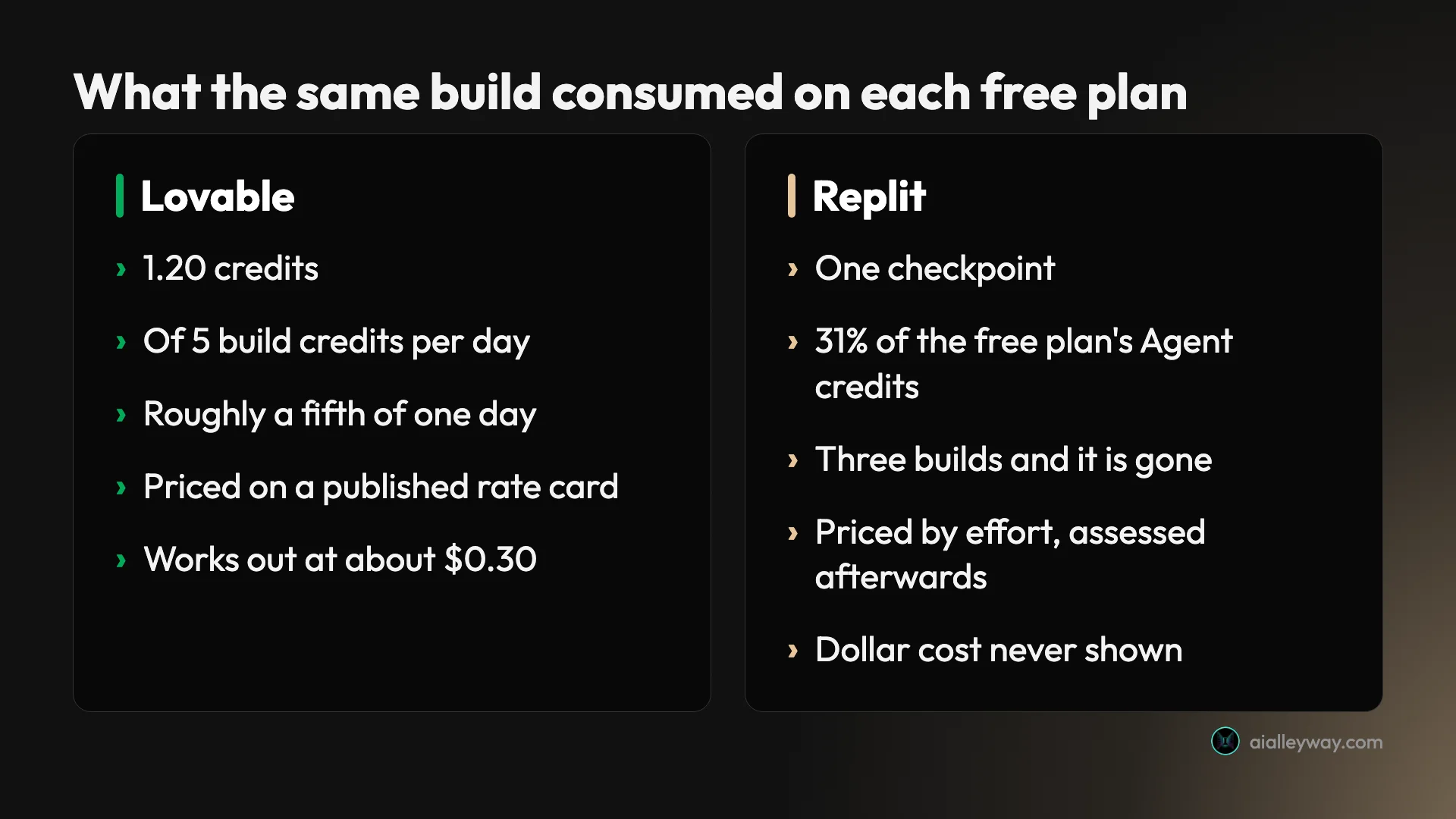
One build took 31% of a day’s free credits. That is the number that matters most on this page. My single Stack Cost build moved the free plan’s Agent credit bar from 0% to 31% used — three builds and the day’s allowance is gone, though the grant refreshes daily and Replit states no monthly cap. And because the free plan exposes only that percentage, I cannot tell you what the build cost in dollars. Not because I did not look, but because Replit does not show it.
How they differ on price
Subscription prices make these two look close. Replit is free to start, then $20 a month for Core or $18 billed annually, and $100 for Pro. Lovable is free to start, then $25 a month for Pro with 100 credits or $21 annually, and $50 for Business.
By that measure Replit is the cheaper product. On the identical build, it was the more expensive one.
| Lovable | Replit | |
|---|---|---|
| Free tier | Yes, 5 build credits a day | Yes, daily Agent credits |
| What my build consumed | 1.20 credits | 31% of a day’s credits |
| Cost in dollars | ~$0.30 | Not derivable |
| Billing unit | Credit, published rate card | Checkpoint, priced by effort |
| Entry paid plan | $25 Pro, 100 credits | $20 Core |
| Annual price | $21 a month | $18 a month |
The billing units are the whole story. A Lovable credit has a published price and a published list of what things cost, so you can forecast. A Replit checkpoint is priced by effort assessed after the work, which means the same request can cost different amounts depending on how much the agent struggled with it — and struggling is not something you control.
Replit’s own framing is reasonable: small tasks stay near the old $0.25, and larger ones bundle into a single checkpoint that costs more but reflects the total effort. That is fairer than a flat fee in the abstract. It is also unpredictable in exactly the situation where you want predictability, which is when a build is going badly.
How they differ on speed
109 seconds against about four minutes, on the same prompt, both first attempt.
Across the seven tools I have run this brief through, that puts Lovable near the top and Replit at the bottom.
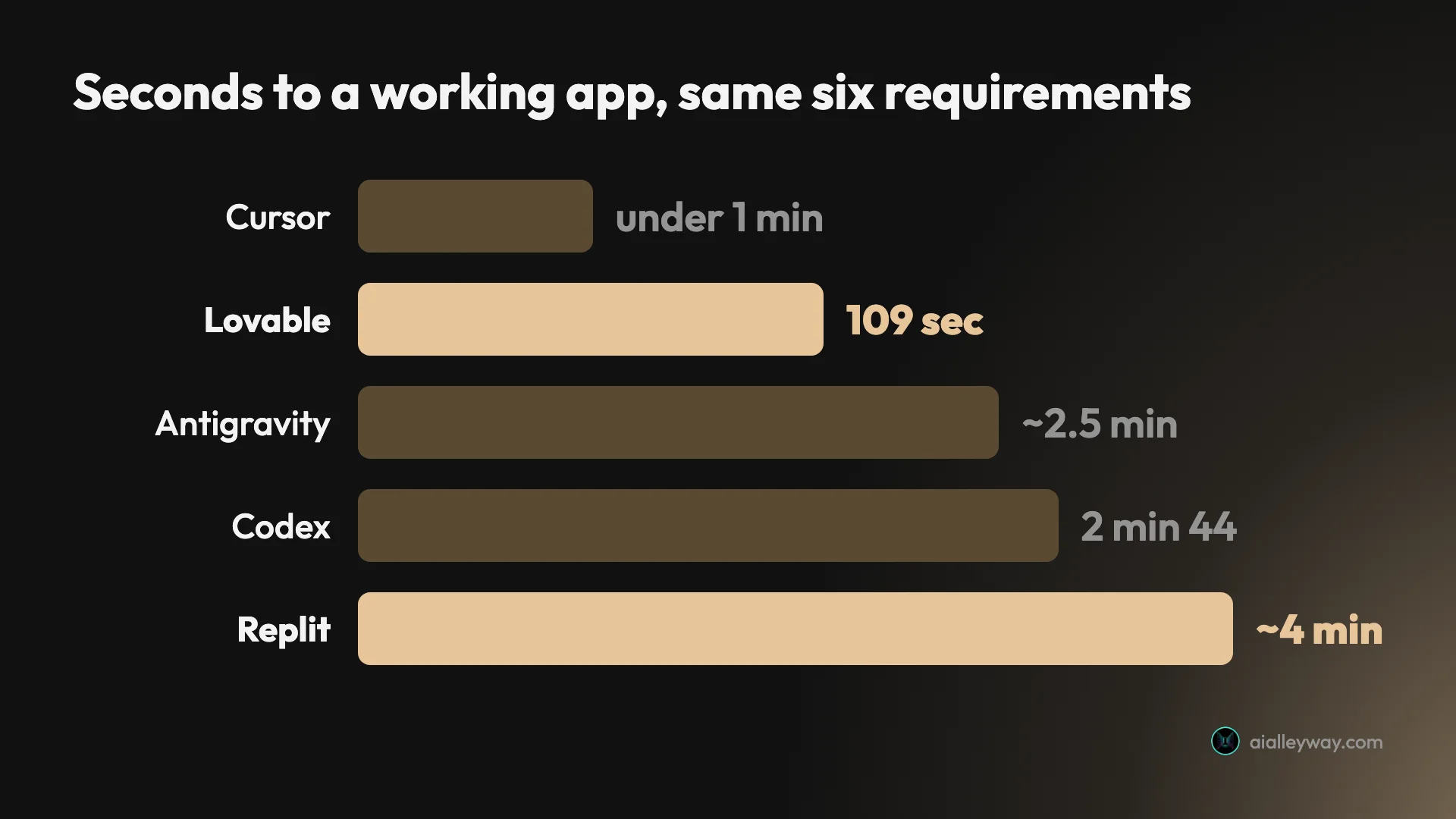
Two things to hold alongside that. First, both produced correct results, so this is a measure of efficiency and not of quality. Second, four minutes is not slow in any absolute sense — it is slow relative to a tool that took under two.
Where the gap compounds is iteration. On both platforms, the first prompt is the cheap part and the arguing is expensive. A tool that reaches the same place in half the time will usually get there in fewer paid actions too, and on Lovable a failed action costs exactly what a successful one does.
What each one is actually for
This is where the comparison resolves, and it is not really about the numbers above.
Lovable is a builder that produces an app. Describe what you want, get a polished React front end on a preview subdomain, connected to a managed cloud. It is optimised for going from idea to something you can show someone, quickly, and it is very good at that.
Replit is an environment that happens to have an agent in it. File tree, terminal, database, deployment, many languages. The agent builds inside a workspace you can open and drive yourself, which means you are never stuck at the boundary of what the agent will do for you.
That difference decides most real cases before any benchmark does:
| If you need | Pick |
|---|---|
| A React MVP to show someone this week | Lovable |
| A Python script, worker or non-web project | Replit |
| A database you control directly | Replit |
| Predictable, forecastable cost | Lovable |
| To drop into a terminal when the agent stalls | Replit |
| Design polish without doing design | Lovable |
What the free tiers actually give you
Both platforms have a free tier and they are not remotely the same offer. This is the most practical difference for anyone still deciding.
Lovable gives you a daily allowance. Five build credits a day, up to 30 a month, plus a small one-off bonus grant. Credits reset daily, so a bad afternoon costs you that afternoon rather than your month. My build consumed 1.20 of the day’s five, which is roughly a fifth of one day.
Replit gives you a pool that does not visibly refill. My single build moved the Agent credit bar from 0% to 31% used. Three builds of that size and there is essentially nothing left.
| Lovable free | Replit free | |
|---|---|---|
| Allowance | 5 build credits a day | Daily Agent credits |
| Resets | Daily | Daily |
| What one build cost | 1.20 credits, about a fifth of a day | 31% of a day |
| Builds before it runs out | Roughly four a day | About three |
| What the interface shows you | A credit number | A percentage bar |
That last row is the one that compounds. Lovable shows a number you can do arithmetic with. Replit shows a proportion of something whose size it does not state, which means you cannot convert your usage into money at any point, on the free plan or in your own head.
A fair caveat: this is one build each. A different task would consume different amounts on both platforms, and a heavier task on Lovable could easily cost more than 1.20. What generalises is not the numbers but their legibility.
The hybrid workflow people actually use
The most common recommendation from people who have used both is not to choose. It is to use them in sequence, and it works because their strengths sit at different ends of a project.
Start in Lovable. Describe the app, get a polished React front end in a couple of minutes, iterate on the look and the flow while it is cheap and fast to do so. This is the phase Lovable is built for, and it is the phase where Replit’s four minutes and opaque checkpoints hurt most.
Move to Replit when you need a computer. The moment the project needs a background worker, a Python script, a database you administer, or a language Lovable does not target, you have hit a wall that no amount of prompting gets you through. Replit is the environment where that work is possible at all.
The friction is the handoff. Lovable’s documented route out is GitHub sync, which I have not tested, and the code that comes across is a React app that assumed Lovable’s managed backend. Rewiring it to Replit’s Postgres is real work rather than a click.
So treat the hybrid pattern as a sequence, not a workflow you flip between daily. It is worth planning if you know the project will eventually outgrow a front end, and it is unnecessary overhead if it will not.
What you ship, and whether you can leave
The two platforms hand you different things at the end, and this is easy to miss while comparing build speeds.
Lovable gives you a preview subdomain with a polished app on it and a managed cloud behind it. Presentable immediately, and it looks finished in a way that matters if you are showing an investor or a customer.
Replit gives you a dev URL and the whole workspace — files, terminal, database, deployment. Less immediately pretty and considerably more real.
On leaving, both have a route and neither is free:
| Lovable | Replit | |
|---|---|---|
| Code is yours | Yes, via GitHub sync | Yes, it is already a workspace |
| Front end travels | React, portable | Depends what you built |
| The hard part | Managed cloud and integrations | Built-in Postgres and deploys |
| Realistic effort | Rewire the backend | Recreate the environment |
Getting the code out is straightforward on both. Getting a running app out is a project on both, because in each case the convenience you bought is the part that does not travel. That is not a criticism unique to either tool; it is what managed platforms are. It is worth pricing in before you build something you expect to still be running in two years.
I have not migrated an app off either platform, so treat that table as the documented shape rather than a tested result.
What neither of them did
Comparisons tend to list what each tool has. The more useful list, after running this brief through seven different tools, is what both of these skipped — because it is the same thing, and it tells you what a hosted builder is actually for.
Neither verified its own work. Lovable wrote no tests. Replit produced test hooks and nothing that ran. Of the seven tools I have given this brief, exactly two wrote and executed a real test suite, and both of those were agent-first developer tools rather than app builders. If you want the thing that built your app to check it before handing it over, neither of these is that.
That matters more than it sounds for the audience these two target. A developer reads generated code and spots the bug. Someone who chose a hosted builder specifically to avoid reading code has no such backstop, and is the person most exposed by a tool that does not test itself. The verification gap is widest exactly where the users are least equipped to close it.
Across all seven tools given this brief:
| Wrote and ran its own tests | Invented a Restore button | |
|---|---|---|
| Lovable | No | Yes |
| Replit | No, test hooks only | Yes |
| Cursor | No | Yes |
| Codex | No | Yes |
| Bolt | No | Yes |
| Claude Code | Yes, 28 assertions | Yes |
| Antigravity | Yes, 6 assertions | Yes |
Both invented a feature nobody asked for. My brief said a cancelled item must leave the running total and stay visible. Both tools added a Restore button to bring it back. So did every other tool I have given this brief — seven for seven, without exception, on a requirement that never mentioned reversing anything.
It is a small thing and it is the most consistent behaviour in the whole dataset. Read charitably, all seven inferred correctly that cancellation implies undo, which is good product instinct. Read less charitably, all seven added scope to a spec that was deliberately precise, which is the same instinct that produces an app with six features you did not ask for and one you did.
Neither told me what the build cost in a way I could plan with. Lovable came closest by a distance, with a published rate card and a credit figure I could convert to about thirty cents. Replit showed a percentage of an unstated total. But even Lovable’s number is retrospective: you learn the cost after the build, not before it, and a failed build costs the same as a good one.
None of this is a reason to avoid either. It is a reason to keep reading the output, keep the brief tight, and treat the first build as the cheapest part of the project rather than a representative sample of what it will cost.
Who should pick Lovable
Anyone building a web MVP against a deadline. Fastest to a presentable result, and the output looks finished rather than functional.
Anyone who needs to forecast spend. The published rate card is the thing Replit does not have, and it matters more than the $5 difference in subscription price.
Non-technical founders. The chat interface does not assume you will drop into a terminal, because it does not really offer one.
Not for you if your project is not a React web app, or you need a database you administer yourself.
Who should pick Replit
Anyone whose project is not a web front end. Many languages, a real runtime, background processes. Lovable does not compete here at all.
Anyone who wants to take over from the agent. When the agent stalls, you open the file and fix it. That escape hatch is worth a lot on anything real.
Anyone who wants the database in the same place as the code. Built-in Postgres, no third-party integration to wire up.
Not for you if you need to know what a build will cost before you run it. One build took 31% of a day’s free credits and I still cannot tell you its price in dollars.
The final word
These two get compared constantly and they are not really competitors. Lovable makes an app; Replit gives you a computer with an agent in it. Once you know which of those you need, the benchmark barely matters.
Where the benchmark does matter is cost, and there the result was clearer than I expected. Identical brief, identical score, and one build consumed a fifth of a single day’s free credits on Lovable against nearly a third of the entire free plan on Replit. That is not a small efficiency difference, and Replit compounds it by pricing checkpoints on effort assessed afterwards and then showing you a percentage bar instead of a number.
So Lovable takes it, 4.6 to 4.2, on efficiency and legibility rather than capability. Both are genuinely good at building the thing you asked for.
But if your project needs a terminal, a database you control, or any language that is not JavaScript, none of the above applies and Replit is the only one of the two that can do the job at all. Start there, not with the stopwatch.
Both sit inside the wider field measured in the best AI app builder, where five builders took this same brief, and the best vibe coding tool, which adds the coding agents.
One level down on either side: the Lovable review and Replit review hold the build traces these scores came from, Lovable pricing and Replit pricing explain two very different credits, and Replit alternatives is the wider switcher list if neither fits.
Frequently asked questions
Is Lovable or Replit better?
On the identical brief they were equally capable and nothing like equally efficient. Both met all six requirements on the first attempt, including the two written to be fumbled. Lovable finished in 109 seconds; Replit took about four minutes.
The separation is what each build consumed. Lovable's cost 1.20 credits, which its own documentation prices the same as implementing authentication. Replit's cost one checkpoint, which moved the free plan's Agent credit bar from 0% to 31% used. Same app, and one platform had spent nearly a third of what it gives you for a day. If you are choosing on speed and cost legibility, Lovable. If you want a real IDE, a database and more than one language, Replit.
Which is cheaper, Lovable or Replit?
Lovable, on the evidence of one identical build, and the gap is wider than the subscription prices suggest. Lovable is free to start, then $25 a month for Pro with 100 credits, or $21 a month billed annually. Replit is free to start, then $20 for Core or $18 annually, and $100 for Pro.
Replit's sticker price is lower and its consumption was heavier. My build cost Lovable 1.20 of its credits and cost Replit 31% of an entire day's free credits. The reason is the billing unit: Lovable charges per credit with a published rate card, while Replit charges per checkpoint under effort-based pricing introduced in June 2025, which replaced a flat $0.25 per checkpoint. Effort-based means the price of a build is decided after the fact by how hard the agent worked.
How long does each take to build an app?
On the same six-requirement brief, Lovable took 109 seconds and Replit took roughly four minutes. Both produced a working app on the first attempt with no follow-up prompts.
That ratio held against the wider field too. Of the seven tools I have given this brief, Lovable was second fastest and Replit was the slowest. Speed is not the same as quality here — both scored 6 of 6 — but it does compound, because on both platforms iteration is where the real consumption happens. A tool that takes twice as long to reach the same place will usually cost more to argue with.
Does Replit or Lovable give you a real backend?
Replit, and this is the strongest reason to pick it. Replit is a full cloud IDE with a file tree, a terminal, deployment logs, a built-in Postgres database and support for many languages. Lovable is specialised for React web apps with its managed cloud and Supabase integration.
So the honest split is not which builds better, but what you get at the end. Replit hands you an environment you can open, inspect and run arbitrary code inside. Lovable hands you a polished app on a preview subdomain. If your project needs a Python script, a background worker or a database you control directly, that decides it before any speed comparison matters.
What happens to Lovable credits if you do not use them?
They expire, and the schedule is worth knowing before you buy in bulk. Monthly plan credits expire two months after they are issued. Annual plan credits expire one month after the period ends. Top-up credits last twelve months.
The more expensive detail is that a build action costs the same whether the answer was right or wrong. Iteration is where credits go, not the first prompt. My build consumed 1.20 credits, so a $25 Pro plan's 100 credits works out at roughly 83 builds of that size a month before any back-and-forth, and back-and-forth is the normal case.
Can you move an app off Lovable or Replit?
Both give you a route out, and neither is frictionless. Lovable syncs to GitHub, so the React code is yours to take. Replit is a full IDE, so the files are already in a workspace you can export or push.
The part that does not travel is the managed layer. A Lovable app leaning on its cloud and Supabase integration needs somewhere to land, and a Replit app using the built-in Postgres and deployment needs the same. Getting the code out is easy; getting the app running elsewhere is a project. Weigh that before you build anything you expect to still be running in two years.
Keep reading
Lovable pricing: what a credit actually costs
Lovable pricing decoded: one credit costs 25 cents, a measured real build cost thirty cents, and Business charges double per credit for the same 100 a month.
Lovable review: six requirements, six passes, 109 seconds
Lovable review from a real build. One prompt, six requirements, a working app in 109 seconds — and an honest look at what it got right and where it stops.
Lovable alternatives: 7 tools, and I gave 5 the same brief
The best Lovable alternatives, ranked by a build test rather than a feature list. Five of the seven took an identical brief. Here is what each cost.
Best AI app builder: 5 tools, one brief, every app used
The best AI app builder, measured. I gave five builders one brief and used every app. All five passed — what separated them was the cost of the second build.