
Replit alternatives: 8 picks, and what a real build cost
Eight Replit alternatives ranked by job. I ran one identical prompt on three: Bolt built it for $0.25, Lovable $0.30, Replit would not say what it cost.
Contents
Which Replit alternative should you pick?
It depends on which of Replit’s three jobs you were actually using, because Replit bundles three products into one tab and almost nobody needs all three.
- You were prompting apps into existence → Lovable is the better builder, Bolt is the cheaper one.
- You were writing code with AI help → Cursor, or Claude Code if the codebase already exists.
- You just wanted a browser IDE that runs things → GitHub Codespaces, with far more predictable billing.
| Job you were doing | Best pick | Entry price |
|---|---|---|
| Prompt to working app | Lovable | $25/mo |
| Prompt to app, cheapest per build | Bolt | $25/mo |
| Prompt to app, React and Next.js | v0 | $30/user/mo |
| AI-assisted coding | Cursor | $20/mo |
| AI on an existing codebase | Claude Code | $20/mo |
| Cloud IDE, like-for-like | GitHub Codespaces | Free, then $0.18/hr |
| Experiments and sharing | CodeSandbox | Free, then $12/mo |
| Non-technical teams | Glide | $25/mo |
One thing worth saying before the list. Every published roundup I read on this topic comes from a company that sells one of the tools on it, and every one of them ranks its own product first or near it. One of them ranks a customer-support product inside a coding roundup. I do not build or sell any of these products. Three of the eight — Lovable, Bolt and Claude Code — pay a referral commission and are marked as sponsored links; the other five earn us nothing either way. The order below is the order I would give a friend.
Why do people leave Replit?
| What bites | Why it bites |
|---|---|
| Effort-based pricing | A request has no price until it has run |
| Free plan reporting | A percentage bar, no dollar figure |
| Billable conversation | Text-only Agent replies still charge |
| Shared credit pool | Hosting and databases draw on the same balance |
| Spending caps | Exist, but only if you switch them on |
Almost never because it cannot build. Replit met all six of my requirements on the first attempt in my review, and the code underneath was better engineered than I expected. People leave over money, and specifically over not being able to see it.
You cannot price a request before you send it. Replit moved to effort-based pricing in June 2025, where the cost of a request scales with how much work it turns out to involve. That is fairer per unit of work and strictly less predictable, and it makes fixed-bid client work awkward in a way no feature can fix.
Conversation is billable. Replit’s billing documentation is explicit that all Agent interactions are billable, including replies that only return text. Talking your way to a specification is not free thinking time.
Hosting draws on the same balance. Published apps, storage and databases all consume the credits you thought you were buying for the Agent, so a quiet month of running an app is not a free one.
Nothing caps your spending unless you set it up. Usage limits exist and work, but they are something you configure rather than something that arrives switched on. Neither does auto-reload, which buys more credits when you run low. The combination of no limit and auto-reload on is how people end up with a bill they did not plan.
None of that makes Replit a bad product, and its pricing guide covers the arithmetic in full. It makes it a metered one, and metered products suit people who can absorb a surprise.
How I picked these eight Replit alternatives
Three filters, in this order.
They had to answer one of Replit’s three jobs. Prompt-to-app, AI-assisted coding, or a browser IDE that runs your code. Anything that only overlapped by accident came off the list, which is why there are no general-purpose no-code website builders here.
They had to appear repeatedly in independent coverage. I checked which tools recur across the published roundups on this topic: GitHub Codespaces appears in six of seven, Cursor in five, CodeSandbox in five, Bolt in five, Lovable in four, Glide in four. That consensus set is most of this list.
Where I had hands-on data, I used it over anyone’s description. Replit, Lovable, Bolt, Cursor and Claude Code are tools I have actually used and reviewed. Everything else here — v0, Codespaces, CodeSandbox, Glide, and the open-source agents further down — is documented, not tested. I am describing what those are built to do, not what I watched them do.
One deliberate departure: Claude Code appears in none of the roundups I read, and it is on this list anyway, because “my Replit project became a real codebase” is a common enough ending that it deserves an answer.
What I actually measured
I gave the same six-requirement prompt to Replit, Lovable and Bolt: one message, no follow-ups, a subscription cost tracker with forms, a computed running total, a derived monthly figure from an annual price, a cancelled state and browser persistence.
| Metric | Replit | Lovable | Bolt |
|---|---|---|---|
| Requirements met | 6 of 6 | 6 of 6 | 6 of 6 |
| Time | ~4 min | 109 sec | 2–3 min |
| Billing unit | Checkpoint | Credit | Token |
| What the build cost | 1 checkpoint | 1.20 credits | 100,000 tokens |
| In dollars | Not derivable | $0.30 | $0.25 |
| Free plan shows spend | A percentage bar | Yes, itemised | Yes, exact |
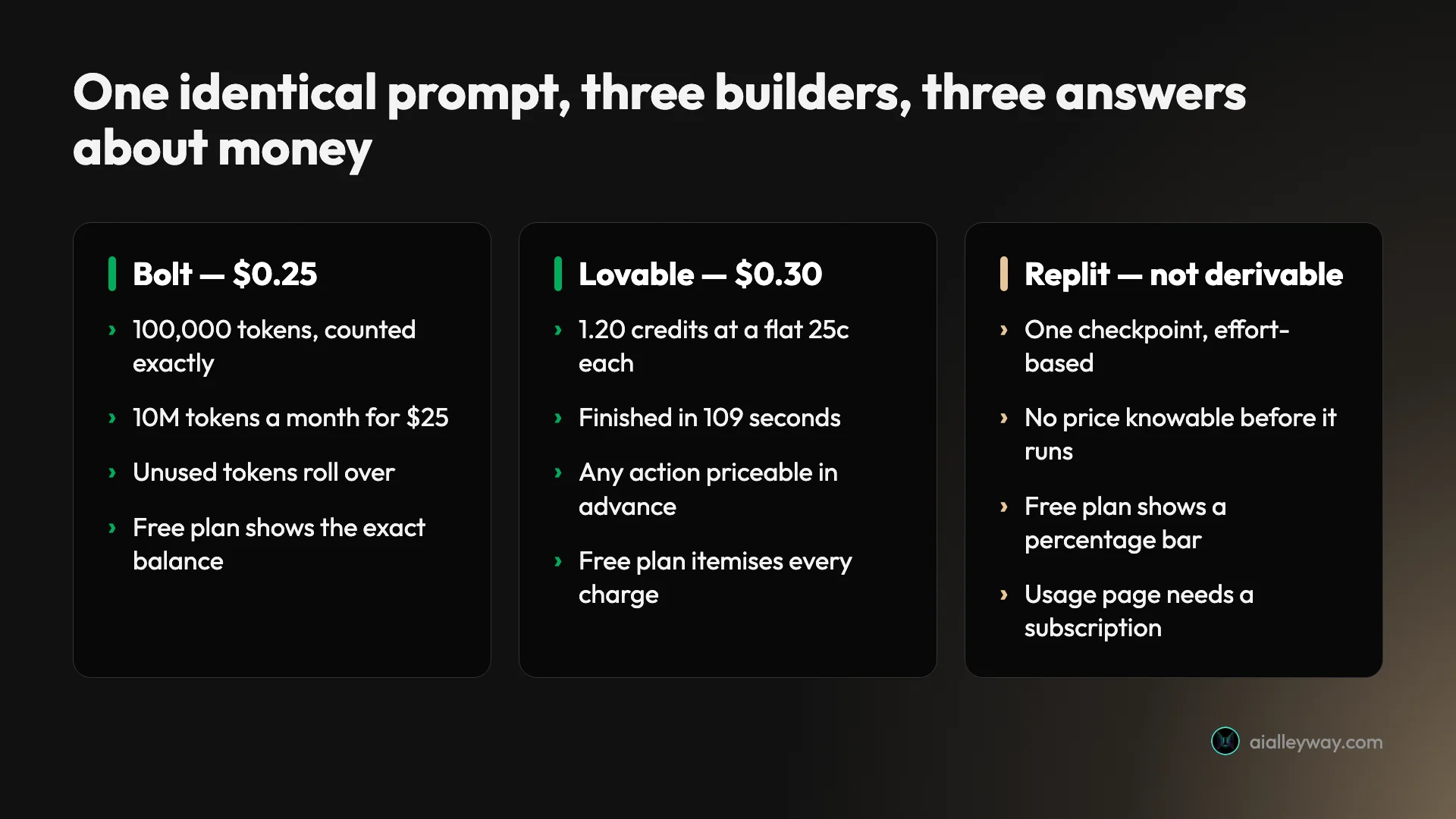
The same prompt cost $0.25 on Bolt and $0.30 on Lovable. On Replit it was not derivable to a dollar figure at all, because the free plan reports a percentage bar and puts the usage page behind a subscription.
All three produced a working application on the first attempt. All three also invented a Restore button nobody asked for, which tells you something about how similar the underlying models now are.
That bottom row is the whole reason this comparison exists. Replit’s bar moved from 0% to 31% used; on the other two I could do the division myself. That is the single clearest reason people go looking for an alternative, and it is why this comparison exists.
1. Lovable — the best prompt-to-app replacement

Lovable is the closest thing to a straight upgrade if you were using Replit to turn prompts into applications. It was the fastest of the three I tested by a wide margin, finishing in 109 seconds what took Replit about four minutes, and it handled the two requirements I wrote specifically to be fumbled.
Pricing is legible in a way Replit’s is not. Pro is $25 a month, or $21 billed annually, and a credit costs a flat 25 cents. That means any action has a price you can work out before you commit to it, which is the opposite of effort-based billing. My build cost 1.20 credits, so thirty cents.
Two numbers make the comparison concrete. The free tier grants 5 build credits a day, capped at 30 a month, which is enough to build something real before paying anything. And Business is $50 for the same 100 monthly credits Pro gets for $25, so the second $25 buys SSO and governance rather than capacity.
The trade is infrastructure. Lovable gives you a hosted app and a database, but it is a more opinionated environment than Replit’s, and there is no terminal to drop into when the prompting stops working. Full detail is in the Lovable review and the pricing breakdown.
For the measured ranking behind these picks, see the best AI app builder — or the best vibe coding tool for the wider field including coding agents.
2. Bolt — the cheapest prompt-to-app build I measured

Bolt built the best application of the three on an identical brief, and it did it for the least money. The same six requirements cost 100,000 tokens, which is twenty-five cents against a Pro plan starting at 10 million tokens for $25 a month.
Its billing is the most transparent on this list. Tokens are counted exactly, and on Pro unused tokens roll over into the following month. Read the free tier carefully though: its 1 million monthly tokens expire, and only paid tokens carry forward. If your objection to Replit is that you cannot see what you are spending, Bolt is the direct answer.
The free tier is unusually workable too: 300,000 tokens a day up to 1 million a month, against a build that cost me 100,000. Teams is $30 per member if you need shared billing.
One caveat I am not going to bury: its Trustpilot score stood at 1.4 out of 5 across 196 reviews as reported on 6 August 2026, the worst customer sentiment I have measured for any tool I would still recommend. My own build was flawless. The Bolt review works through what that gap does and does not tell you, and is worth reading before you commit a project to it.
3. v0 by Vercel — the prompt-to-app builder for React

v0 is the narrowest tool here, and narrow is the point. It generates React and Next.js interfaces, and because Vercel builds both the framework and the hosting, the output drops into a Vercel project with no adaptation.
The free tier is a taster rather than a home: $5 of monthly credits and a seven-message daily cap. Plus is $30 per user per month with $30 of credits and $2 of free daily credits on login.
Look closely at the Business tier before anyone talks you into it. It costs $100 per user per month and includes the same $30 of monthly credits as the $30 plan. The extra $70 buys training opt-out and governance, not capacity, which is the same shape as Lovable’s Business tier and worth spotting on any per-seat pricing page.
The daily credits are the detail worth knowing: $2 lands on login each day you actually show up, which on a working month is roughly another $40 of capacity on top of the $30 included. It rewards habit rather than volume, which is an unusual shape for this category.
4. Cursor — the AI code editor for when you outgrow prompting

There is a point in most projects where describing what you want stops being faster than writing it. Cursor is where people land at that point: a real editor, forked from VS Code, with agents that operate across the whole repository rather than one file.
It reads any Replit export directly, since it works on an ordinary local checkout. Pro is $20 a month, which is the same headline as Replit Core.
The honest warning is that $20 is a floor, not a ceiling. Across eleven months on a plan advertised at $20 a month I paid $510.70, because usage above the included allowance bills on top and I ended up on a higher tier to absorb it. That is a different failure mode from Replit’s, but it is the same failure mode in kind: a metered product with a reassuring sticker price. Averaged out, it cost about $46 a month against a $20 sticker. There is a free Hobby tier if you want to test that shape before committing. The Cursor review has the full billing history.
5. Claude Code — the AI coding agent for an existing codebase

Claude Code appears in none of the published roundups I read, which I think is an oversight rather than a judgement. If what you built on Replit has grown into something real, a terminal agent that reads the whole repository is a better fit than a builder that wants to regenerate it.
It is not sold separately. You pay for a Claude plan and it comes included: $20 a month on Pro, $100 or $200 on Max, with the higher tiers buying usage rather than features. Because it runs against a local checkout, it has no opinion about where your code came from.
One plan detail that catches people: Pro defaults to Sonnet 5 while Max defaults to Opus 5, and Max has no annual option at all, so the discount you might be looking for does not exist.
It is also the least beginner-friendly thing on this list. There is no canvas, no preview pane and no hosting. If you left Replit because prompting stopped scaling, that is exactly the trade you want; if you left because Replit was too technical, skip this one. See whether Claude Code is worth it and the pricing guide.
6. GitHub Codespaces — the closest cloud IDE to Replit

GitHub Codespaces is the most direct replacement if you used Replit as a browser IDE rather than an AI builder, and it appears in more competing roundups than any other tool on this list.
The billing is the reason to move. GitHub’s own rate card is public: a free Codespaces personal account includes 120 core-hours a month plus 15 GB of storage, rising to 180 hours on GitHub Pro. Past that you pay by the hour at a published rate: $0.18 for a 2-core machine, $0.36 for 4-core, up to $2.88 for 32-core, with storage at $0.07 per GB-month.
Worth doing the division once: 120 core-hours is 60 hours on a 2-core machine or 30 on a 4-core, and at $0.18 and $0.36 an hour respectively both work out to about $10.80 of compute given away each month. The free tier is the same value whichever machine you pick.
Nothing about that is effort-based. An hour on a 4-core machine costs 36 cents whether you spent it writing brilliant code or staring at the screen, which makes it the most forecastable option here. What you give up is the AI builder entirely — Copilot is a separate product and a separate bill.
7. CodeSandbox — the cloud IDE with the best free tier

CodeSandbox is the tool for the half of Replit’s use that was never a product: trying something out, sharing a reproduction, showing a colleague a bug.
Its free Build plan includes 40 hours of monthly VM credits, five members and unlimited sandboxes, on machines up to 4 vCPUs and 8 GiB. Paid starts at $12 a month per workspace for 100 hours and up to twenty members, and machine time is published per hour: $0.075 for a single core, $0.15 for two, up to $4.80 for a 64-core box.
The free allowance is more generous than it sounds. Forty hours a month on machines up to 4 vCPUs is the tier that bills at $0.30 an hour when you are paying, so the free plan hands over roughly the value of the entry subscription before you spend anything.
One quirk worth knowing before you compare it against anything: the pricing page defaults to showing Build, Scale and Enterprise, and the $12 Pro tier only appears once you switch to the Editor tab. It is easy to conclude the entry price is $170 when it is not.
8. Glide — no-code for teams with nobody to write the code

Glide is the outlier here and the right answer for a specific person: someone who reached for Replit because they had a business problem, not because they wanted to program, and who found even prompt-to-app too close to the machinery.
It builds business applications on top of a spreadsheet or database, and the output lives in Glide’s runtime rather than in a repository you own. Free covers one project. Solo is $25 a month for five projects. Team is $125 a month plus $10 per member with a five-member minimum, which makes it the most expensive entry on this list for a small group.
Do the Team arithmetic before you commit: $125 a month plus $10 per member with a five-member floor means the cheapest possible Team bill is $175 a month, which is more than eight Replit Core subscriptions.
Note that annual billing does not exist yet — the pricing page says annual plans are coming soon — so there is no commitment discount to negotiate against.
Are there open-source Replit alternatives?
Yes, though “open source” and “free” are two different claims here, and the gap between them is where most roundups mislead.
Cline is an open-source extension that turns an editor you already have into an agentic one. Aider does the same job from the terminal, working directly against a Git repository and committing as it goes. OpenCode takes the terminal-agent shape closest to Claude Code and is the largest open-source project in this category.
| Cline | Aider | OpenCode | |
|---|---|---|---|
| Licence | Apache-2.0 | Apache-2.0 | MIT |
| Shape | Editor extension | Terminal | Terminal, desktop, IDE |
| Default cost | Your API key, per token | Your API key, per token | Your API key, per token |
| Free route | Local model | Local model | Local model, or Zen free tier |
The licences are the straightforward part: OpenCode is MIT, Cline and Aider are Apache-2.0, and none of that is what will cost you. The catch is the model. Each is free to install and each needs a model to do anything, so by default you supply an API key and your provider bills you per token, with no monthly floor and no included allowance.
Two things genuinely escape that, and they are worth knowing because most write-ups miss both. Point any of them at a local model you run yourself and the per-token bill disappears entirely; you are paying in hardware and setup instead. And OpenCode’s own Zen catalogue currently carries a handful of genuinely free models, though they are explicitly time-limited and worth reading the small print on before you build anything durable on them. Our Claude Code alternatives guide goes through both in detail.
What none of them replaces is the rest of Replit. There is no hosting, no database, no preview pane and no browser workspace. If you left Replit because the bill was opaque, an agent plus your own key is the most transparent option on this page, because every token is itemised by the provider. If you left because you wanted less infrastructure to think about, this is the wrong direction entirely.
How do you move off Replit without a rewrite?
This is the part every competing roundup skips, and it is the part that actually decides whether you switch.
Most of it is just code. Replit produces ordinary repositories. Push to GitHub and the project opens in Codespaces, CodeSandbox or Cursor with no conversion step at all. If you are moving to another AI builder, you are effectively starting a new project and bringing the code as reference.
The database is the hard part. Replit’s built-in Postgres has no equivalent on most of this list. Export it first and decide where it is going before you move anything else, because that decision constrains the rest.
Three things will not travel. Deployment configuration, object storage, and any secrets you set in the workspace all have to be recreated by hand. None of it is difficult; all of it is the reason a migration takes an afternoon rather than ten minutes.
Budget for the hosting you were getting free. The thing Replit genuinely bundles is somewhere for the app to run. Codespaces, CodeSandbox and Cursor are all development environments, not hosts. Moving to any of them means adding a deployment target, and that is a second bill.
What to check before you commit
The tools on this list differ less in what they can build than in how they bill, and the billing differences are the ones you feel in month three. Six questions separate them.
| Ask this | Best answer on this list | Worst |
|---|---|---|
| Can the free tier price a build? | Bolt, exact token count | Replit, a percentage bar |
| Is the unit price fixed? | Codespaces, $0.18/hr | Anything effort-based |
| Does it host the result? | Replit, Lovable, Bolt | Cursor, Claude Code, Codespaces |
| Does the allowance roll over? | Bolt Pro, one month forward | Replit Core and Bolt free, both expire |
| Seat or workspace pricing? | CodeSandbox, 20 seats for $12 | v0, $30 per user |
| Does the code leave cleanly? | Anything producing a Git repo | Glide, proprietary runtime |
Which one should you actually pick?
| If this is you | Pick | Why |
|---|---|---|
| Non-technical, want the app to exist | Lovable | Fastest to a working result, and a credit has a knowable price |
| Watching every dollar | Bolt | Cheapest measured build, and tokens are counted exactly |
| Living in React and Vercel already | v0 | Output drops into your existing stack unchanged |
| Code has outgrown prompting | Cursor | A real editor over the whole repository |
| Maintaining something real | Claude Code | Reads an existing codebase instead of regenerating it |
| Just wanted the browser IDE | GitHub Codespaces | Published hourly rates and 120 free core-hours |
| Sharing experiments and repros | CodeSandbox | 40 free VM hours a month and instant sharing |
| Nobody on the team codes | Glide | Business apps without a repository |
Skip all of them and stay on Replit if what you valued was the bundle. Nothing on this list gives you a builder, a database and hosting in one tab, and reassembling that from parts costs more time than most people expect.
The final word
The pattern across every tool here is that Replit’s weakness is not capability, it is legibility. It built my application correctly, in one checkpoint, and then declined to tell me what that cost. Every alternative on this list is clearer about money, and most of them are narrower in exchange.
So pick by the job rather than the ranking. If you want the same experience with pricing you can read, go to Lovable or Bolt. If you have outgrown prompting, go to Cursor or Claude Code. If you only ever wanted somewhere to run code, Codespaces has been the answer the whole time.
Frequently asked questions
Is there anything better than Replit?
It depends entirely on which part of Replit you were using. If you were prompting an app into existence, Lovable is the more polished builder and Bolt is cheaper per build. If you were writing code with AI help, Cursor and Claude Code are stronger tools than Replit's editor.
If you only wanted a browser IDE that runs your code, GitHub Codespaces does that job with far more predictable billing. Replit's real advantage is that it bundles all three jobs into one tab, and that bundle is what you give up when you leave.
Which is better, Lovable or Replit?
For prompt-to-app work, Lovable. I gave both the identical six-requirement brief and Lovable finished in 109 seconds against roughly four minutes, and both met all six requirements on the first attempt with no follow-up prompts.
The more useful difference is legibility. Lovable's build cost 1.20 credits at 25 cents a credit, so I could price it at thirty cents. Replit charged one checkpoint under effort-based pricing and its free plan shows a percentage bar rather than a number, so the same build could not be priced at all. Replit wins on infrastructure, since it hosts and databases the result.
Are there free Replit alternatives?
Several, and they are genuinely usable rather than demos. Bolt gives 1 million tokens a month, which covered a complete build in my testing with room to spare. CodeSandbox includes 40 hours of monthly VM credits on its free Build plan.
GitHub Codespaces is the most generous for straight development: 120 core-hours a month plus 15 GB of storage on a free personal account, rising to 180 hours on GitHub Pro. Lovable and v0 both have free tiers too, but they are daily-credit limited and better suited to trying the tool than living on it.
Can I move my Replit app to another platform?
Usually yes, because most of what Replit builds is ordinary code. Push the repository to GitHub and it will open in Codespaces, CodeSandbox or Cursor with no conversion at all.
What does not travel is the platform-specific layer: Replit's built-in database, its deployment configuration, its object storage and any secrets you set in the workspace. Budget your migration time for reconnecting those rather than for the code itself, and move the database first, since it is the piece with no equivalent on most of this list.
What is better, Bubble or Replit?
They answer different questions. Bubble is a visual no-code builder aimed at people who will never open a terminal, and it produces applications inside Bubble's own runtime. Replit produces real code you can take elsewhere.
If nobody on your team writes code and nobody intends to, a no-code tool like Bubble or Glide will get you further with less frustration. If anyone will eventually need to read, debug or export the code, Replit and the AI builders on this list are the better foundation, because the output is a normal repository rather than a proprietary app.
Which Replit alternative works best with AI coding agents?
Anything that produces a plain Git repository, which is most of this list. Cursor and Claude Code both operate directly on a local checkout, so they work with output from Replit, Lovable, Bolt or v0 without any adaptation.
The combination worth knowing about is a builder plus an agent: prompt the first version into existence on Lovable or Bolt, push it to GitHub, then do the ongoing work in Cursor or Claude Code. That path avoids paying builder credits for maintenance work, which is where builder pricing gets expensive fastest.
Is Replit the best AI builder?
Not on the evidence I gathered. I gave Replit, Lovable and Bolt an identical six-requirement brief, and all three met every requirement on the first attempt, so capability did not separate them. Speed and cost did: Lovable finished in 109 seconds against Replit's four minutes, and Bolt built it for twenty-five cents against Lovable's thirty.
What Replit wins on is scope rather than quality. It is the only one of the three that hands you a hosted, databased application without touching any infrastructure, and that bundle is a real advantage. Best builder, no. Best single tab, arguably yes.
Is Replit still worth it?
Yes, for the specific job of going from a prompt to a hosted, databased application in one tab without touching infrastructure. Nothing else on this list does all of that in one place, and Core dropped to $20 a month in February 2026.
The reasons to leave are predictability and legibility. Effort-based pricing means a request cannot be quoted before it runs, and the free plan will not convert your usage into dollars at all. If you need to know what something costs before you approve it, that is a structural mismatch rather than a bug.
Keep reading

Replit pricing: what $20 of credits actually buys
Replit cut Core to $20 in February and most guides still say $25. A credit is exactly one dollar, and here is what a real measured build cost.
Replit review: I gave it the same brief I gave Lovable
Replit review from a measured build. The same six-requirement prompt I gave Lovable, scored the same way, plus the checkpoint maths that decides your bill.
Bolt.new alternatives: 8 tools, 7 took the same brief
The best Bolt.new alternatives, ranked by a measured build rather than a feature table. Seven tools took one identical brief. Here is what each build cost.
Best AI app builder: 5 tools, one brief, every app used
The best AI app builder, measured. I gave five builders one brief and used every app. All five passed — what separated them was the cost of the second build.