
Bolt.new pricing: the token ladder you only see signed in
Bolt.new pricing has 14 token tiers that never render logged out, a 28% yearly discount that is really 10%, and a measured 100,000-token build.
Contents
What does Bolt.new cost?

Bolt.new, StackBlitz’s browser-based AI app builder, is free for 1 million tokens a month and $25 a month for 10 million. That is the answer for almost everyone, and if it is all you needed, you can stop here.
The reason to keep reading is that $25 is the bottom rung of a ladder with fourteen of them, and the ladder does not appear on the pricing page until you sign in. Read that page logged out, as every write-up I can find has, and Pro shows a flat $25 a month with the words “Start at 10M tokens per month” underneath. Sign in and those words turn into a dropdown running from 10 million tokens to 1.2 billion.
| Plan | Entry price | Yearly | Tokens |
|---|---|---|---|
| Free | $0 | — | 1M a month, 300k daily cap, unused expire |
| Pro | $25/mo | $18/mo | From 10M a month, no stated daily cap, rollover |
| Teams | $30/member/mo | $27/member/mo | From 10M per member, not pooled |
| Enterprise | By quote | — | Custom |
Everything below comes from that signed-in page on 5 September 2026, read in a browser and pulled out of the live DOM rather than retyped. I should say plainly what I have not done: I read the ladder while signed in to a free account, and I have never bought a Bolt subscription. The prices are Bolt’s, the arithmetic on them is mine, and anything about how a paid plan behaves in practice is Bolt’s claim rather than my observation.
How Bolt meters, in one paragraph
Bolt bills in tokens, and a token measures how much the model produced rather than how much you asked for. That is the whole mental model, and it is the reason a Bolt bill behaves differently from Lovable’s credits or Replit’s checkpoints: a long argument with the model about a small change can cost more than a short instruction that builds a lot. I covered the unit itself, and what one build costs, in the full Bolt.new review. This piece is about the price attached to it.
One line from Bolt’s own pricing FAQ does more work than anything on the plan cards, so here it is verbatim: token usage is mostly about “syncing your project’s file system to the AI: the larger the project, the more tokens used per message.”
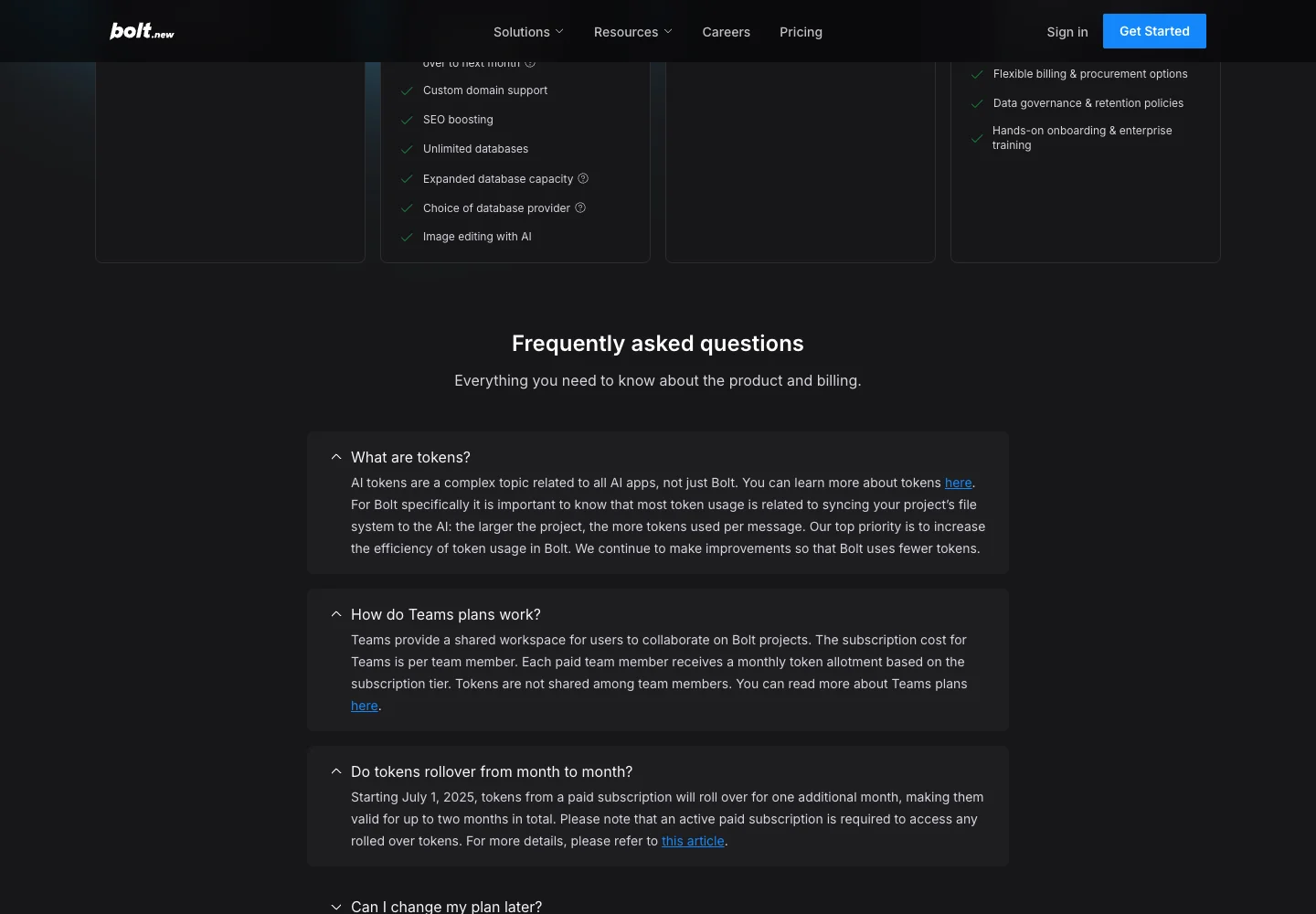
Read that as a cost curve rather than a technical note. The same edit costs more a few months in than it did at the start, because the project it has to read is bigger. Your allowance does not grow to match.
Why does Bolt.new show its price ladder only to signed-in visitors?
Here is the thing I did not expect to find. Signed out, the Pro card has no token selector on it at all. I checked this in headless Chrome with the network idle and six seconds of settling time: no “Monthly tokens” label, no ladder prices, and zero elements matching a select or combobox anywhere on the page.
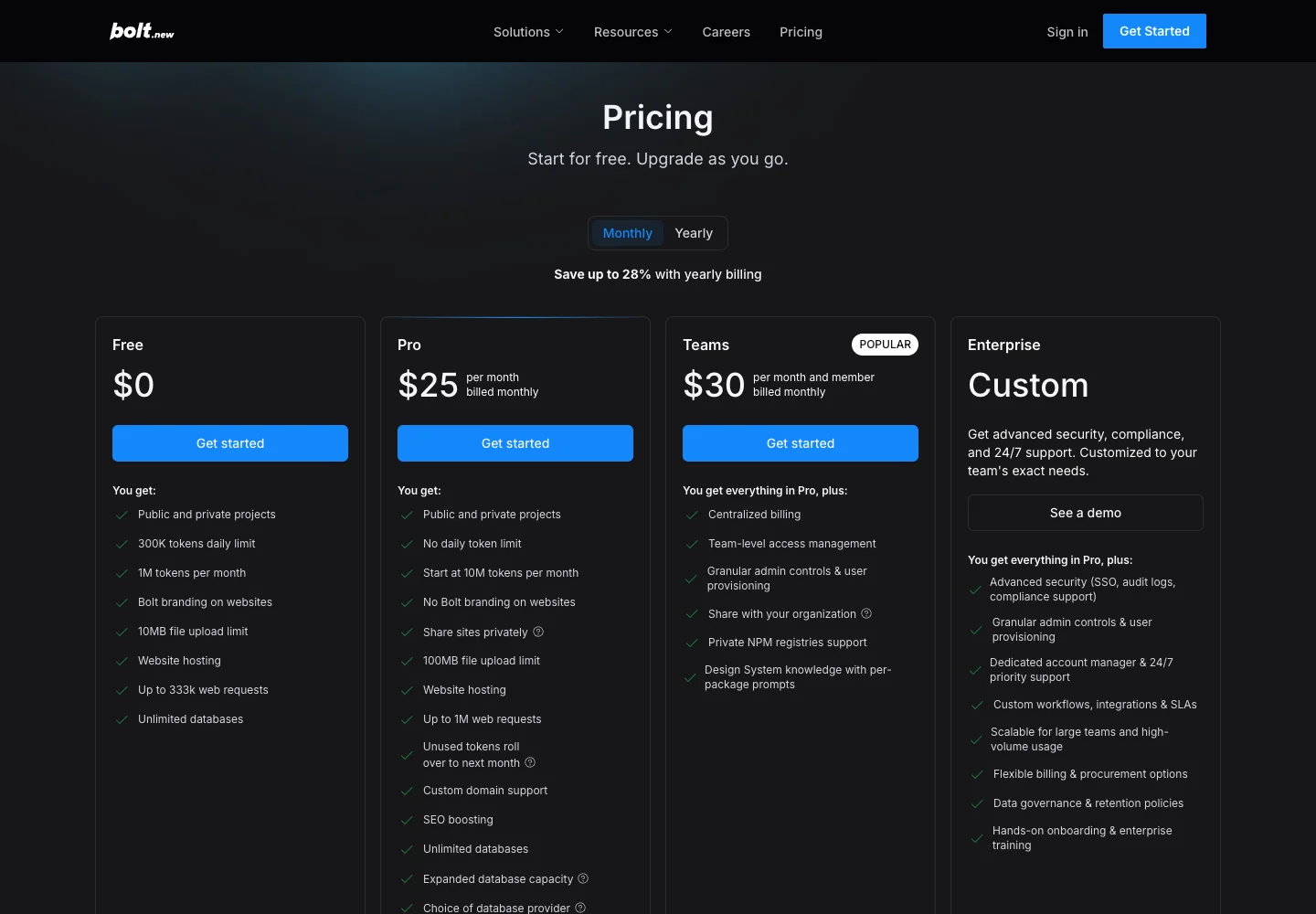
Signed in, both the Pro and Teams cards grow a dropdown with fourteen options each. This is the full ladder, both plans:
| Monthly tokens | Pro, monthly | Pro, yearly | Teams, monthly | Teams, yearly |
|---|---|---|---|---|
| 10M | $25 | $18 | $30 | $27 |
| 26M | $50 | $45 | $60 | $55 |
| 55M | $100 | $90 | $110 | $100 |
| 120M | $200 | $180 | $210 | $190 |
| 180M | $300 | $270 | $300 | $270 |
| 240M | $400 | $360 | $400 | $360 |
| 300M | $500 | $450 | $500 | $450 |
| 360M | $600 | $540 | $600 | $540 |
| 420M | $700 | $630 | $700 | $630 |
| 480M | $800 | $720 | $800 | $720 |
| 540M | $900 | $810 | $900 | $810 |
| 600M | $1,000 | $900 | $1,000 | $900 |
| 900M | $1,500 | $1,350 | $1,500 | $1,350 |
| 1200M | $2,000 | $1,800 | $2,000 | $1,800 |
There is nothing sinister in gating it. The dropdown is a purchase control, and purchase controls tend to live behind a session. The consequence is still real: every page explaining Bolt’s pricing that I could find describes a four-plan grid, because a four-plan grid is what the page shows a logged-out visitor, and Bolt actually sells fifty-six price points: fourteen tiers, across two plans, on two billing cycles.
What does one million Bolt.new tokens cost?
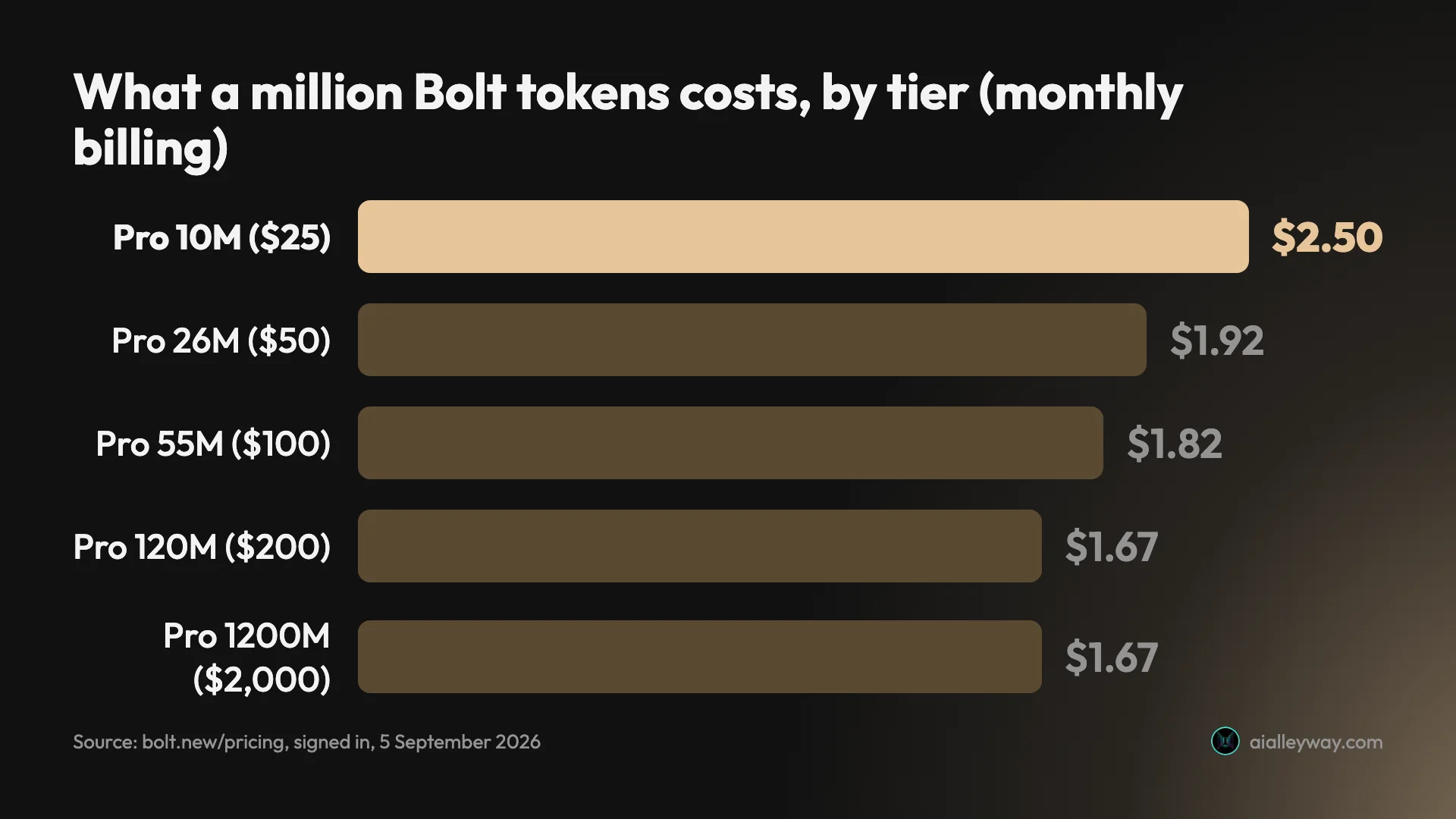
Divide each rung by its tokens and the ladder stops being a list and becomes a curve.
| Monthly tokens | Pro, $ per million monthly | Pro, $ per million yearly |
|---|---|---|
| 10M | $2.50 | $1.80 |
| 26M | $1.92 | $1.73 |
| 55M | $1.82 | $1.64 |
| 120M and above | $1.67 | $1.50 |
On monthly billing a million tokens costs $2.50 at the entry tier and $1.67 from 120 million onward. Then it stops. From 120 million to 1.2 billion, a tenfold increase in volume, the rate does not move at all.
So the volume discount is front-loaded into rungs almost nobody buys, and the person on the $25 plan is paying 50% more per token than the person on the $200 plan. That is normal for software and worth knowing anyway, because it inverts the usual intuition that the cheap plan is the efficient one. On Bolt the cheap plan is the expensive one per unit.
The yearly ladder runs the same shape one notch lower: $1.80, $1.73, $1.64, then flat at $1.50. Which produces a small piece of arbitrage worth knowing. Pro’s entry tier billed yearly costs $1.80 a million. The next rung up billed monthly costs $1.92. If you are choosing between committing for a year at the bottom and paying monthly for 2.6 times the tokens, the year-long commitment is cheaper per token than the bigger plan.
Is Bolt.new’s 28% yearly discount real?
The pricing page carries one line under the billing toggle: “Save up to 28% with yearly billing.”
It is true. Pro’s cheapest rung goes from $25 to $18, and that is 28%. It is also the only place on the entire ladder where that number occurs.
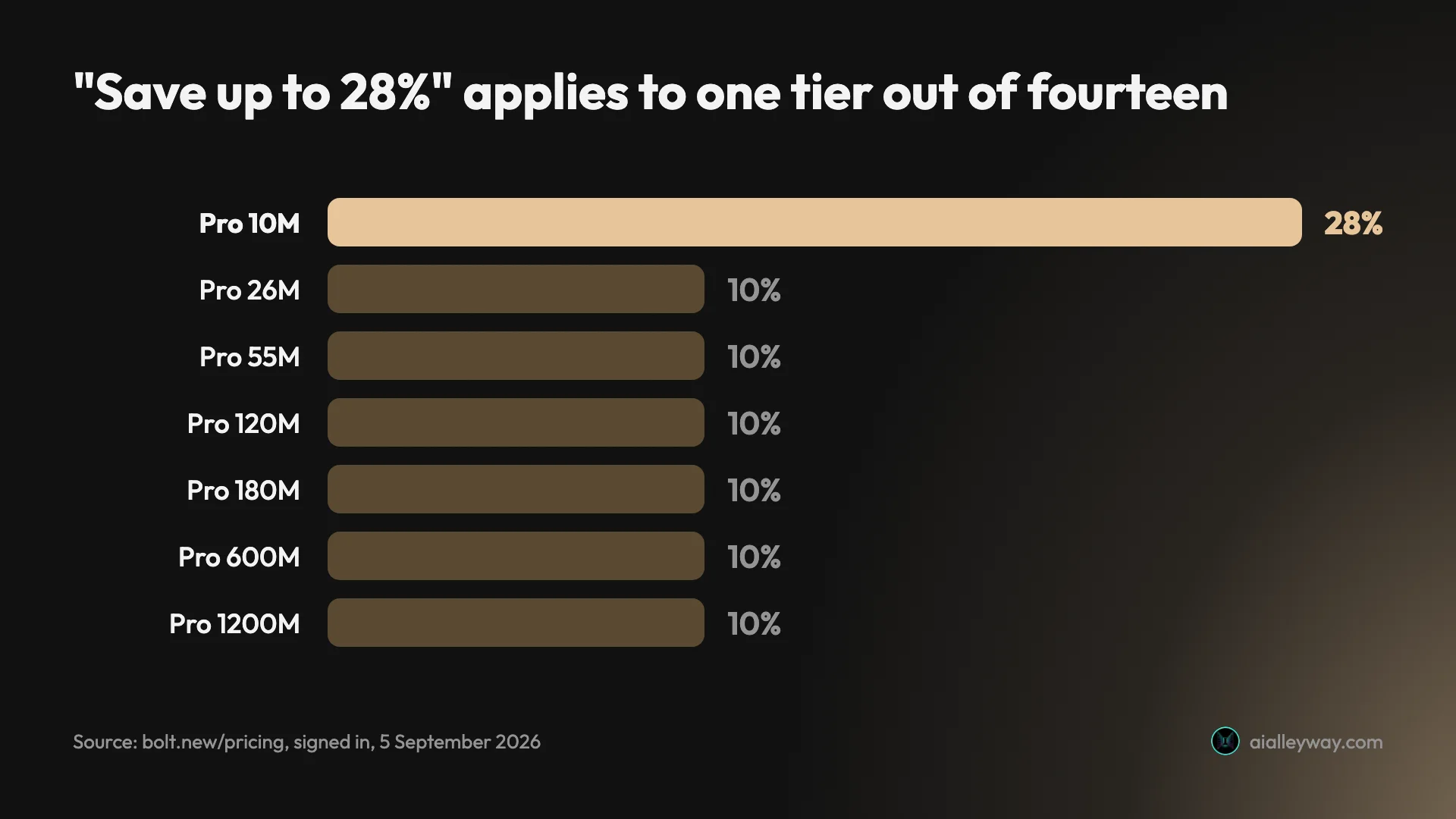
Every other Pro tier saves exactly 10%. Teams never reaches 28% at all, and dips below 10% in the middle of its ladder.
| Monthly tokens | Pro saving | Teams saving |
|---|---|---|
| 10M | 28% | 10% |
| 26M | 10% | 8.3% |
| 55M | 10% | 9.1% |
| 120M | 10% | 9.5% |
| 180M and above | 10% | 10% |
Count both plans across all fourteen tiers and there are twenty-eight monthly-to-yearly price pairs on offer. The advertised 28% is one of them.
I want to be fair about this, because “up to” is a legitimate English construction and Bolt has not said anything false. But the phrase sits under a toggle that changes every price on the page, and the number it quotes applies to the cheapest of them. If you are pricing a 120 million token Pro plan and budgeting a 28% saving, you will be out by $36 a month.
The saving is still worth taking. On Pro’s entry tier, twelve months at $18 is $216 against $300, so committing for the year keeps $84. On Teams at the same tier it is $324 against $360, or $36 per member. Just budget 10% and treat the extra as a discount that only exists at the door.
Is Bolt.new Teams worth it over Pro?
Teams is $30 per member against Pro’s $25, which reads like a 20% premium for collaboration features. At the entry tier it is $5. At 26, 55 and 120 million it is a flat $10.
From 180 million upward it is nothing at all. Teams and Pro are the same price, rung for rung, on both billing cycles, all the way to $2,000. Centralised billing, team access management, granular admin controls, organisation sharing, private NPM registries and Design System knowledge arrive at no extra cost once you are buying that much.
That inverts the usual advice about seat-based plans. If your team is genuinely consuming 180 million tokens a member, there is no reason to be on Pro. Below that, the premium is $5 a member a month at the entry rung, or $9 if you are billed yearly, and $10 a member at every rung between. Cheap enough that the price is not the thing to worry about. What to worry about is that the tokens those seats buy cannot be moved between them, which Bolt states in its FAQ and no plan card mentions.
Is the Bolt.new free plan enough?
Bolt’s own FAQ puts it in one line: “Free plans have a 300,000 token daily limit and 1 million token monthly limit.” The daily number is the one everybody quotes, and it is the less interesting of the two.
Spend at the daily maximum and you exhaust the month’s allowance in 3 days and 8 hours. A full month at 300,000 a day would be 9 million tokens, which is nine times what the plan permits. So the daily cap only binds you for the first three days; after that the monthly ceiling is what you are up against, and it is a wall rather than a throttle.
Against that, one build. The app I made for the review cost 100,000 tokens, so the free plan holds about ten of them, or three in any single day. That was one carefully specified prompt that worked first time, which makes it a floor rather than a typical figure. Iteration is where tokens actually go.
The honest summary: free is enough to find out whether Bolt builds the thing you have in mind, and it is not enough to develop anything. Which is a reasonable place for a free tier to stop, though it is not the most generous of the three. Lovable’s free plan grants 5 build credits a day capped at 30 a month, and at the 1.20 credits my build cost there, that is around 25 builds against Bolt’s ten.
What one working app costs across the three builders
I have now given the same six-requirement prompt to Bolt, Lovable and Replit and measured what each one charged. That is the only apples-to-apples number I can offer, and it comes with a caveat I would rather put first: all three were single prompts that worked first time, and none of them touch the debugging loops that generate the complaints.
| Tool | Unit | Measured cost of one build | What that cost |
|---|---|---|---|
| Bolt | Token | 100,000 tokens | $0.25 |
| Lovable | Credit | 1.20 credits | $0.30 |
| Replit | Checkpoint | 1 checkpoint, using 31% of one day of free Agent credits | Not convertible; the free tier shows a percentage bar, not dollars |
Five cents separates Bolt and Lovable on that build, which is close enough to call it even. The structural difference is what matters. A Lovable credit is a fixed 25 cents you can multiply before you spend it. A Bolt token prices the model’s output, so a request that fails still bills you for everything the model produced while failing, and Replit’s effort-based checkpoints sit somewhere between the two.
If you bill clients a fixed price, that ordering is the whole decision, and it does not favour tokens.
Five things the plan cards do not tell you
Three of these are in Bolt’s pricing FAQ, one click below the plan cards. The last two are not on the pricing page at all; you meet them in the product.
| What the card says | What it leaves out |
|---|---|
| “Unused tokens roll over to next month” | Two months maximum, and an active subscription is required to reach them |
| “$30 per month and member” | Allotments are per member and are not shared between them |
| “Start at 10M tokens per month” | Spend scales with project size, so the same edit costs more later |
| A feature list with no usage meter on it | The in-chat token counter exists and ships switched off |
| A price per month | No estimate, confirmation or cap before a request runs |
Rollover expires, and it dies with the subscription
The Pro card says “Unused tokens roll over to next month.” The FAQ underneath adds two conditions: tokens roll over for one additional month, “making them valid for up to two months in total”, and “an active paid subscription is required to access any rolled over tokens.”
So a balance is not savings. It has a two-month ceiling, and cancelling forfeits whatever is in it.
Team tokens do not pool
Bolt’s FAQ is explicit: “Each paid team member receives a monthly token allotment based on the subscription tier. Tokens are not shared among team members.”
Three seats at the entry tier is $90 a month for 30 million tokens that cannot be moved between the people holding them. If one member builds all week and two barely log in, you have bought 20 million stranded tokens. Seat-based pricing usually pools the resource. This does not.
The cost of an edit grows with the project
This is the FAQ line quoted at the top of this piece, and it is the single most expensive property of the pricing model. A plan sized in your first month can be tight within a few months, without you changing anything about how you work.
The usage meter is off by default
Settings, under General, has a toggle labelled “Display token usage in chat” that puts your balance above the chatbox, and it ships switched off. I found this while testing for the Bolt.new review; on a plan you are paying for, turning it on is the first thing to do.
You cannot price a request before you send it
There is no estimate, no confirmation step and no per-request cap. You write the prompt, the model works, and the cost is whatever it produced. All three builders have some version of this, but they differ in how much: a Lovable credit is a fixed 25 cents, a Replit checkpoint varies with effort, and a Bolt token varies with output, which is the one you control least.
Which Bolt.new plan should you pick?
Evaluating the product: free. It answers the only question that matters at this stage, which is whether Bolt builds what you have in mind, and it costs nothing to find out.
Building something real, alone: Pro at $25, and switch to yearly once you have used it for two full months. Committing at the door saves $84 a year; committing before you know your token burn saves nothing if you stop in March.
Consistently hitting the 10 million ceiling: move up the ladder rather than topping up around it. The rate improves by a third between the entry tier and 120 million, and that is the only stretch of the curve where volume buying does anything.
Two or more people: Teams, unless you need the admin layer so little that the entry premium is worth arguing about, which is $5 a member a month, or $9 a member a month on yearly billing. Above 180 million a member it costs the same as Pro, so there is no case for Pro at that volume.
Skip Bolt entirely if you invoice fixed-price work. The billing unit prices the model’s output, iteration is unbounded, and no plan on the ladder makes a Bolt bill predictable in advance. Lovable’s flat 25-cent credit is the easier number to quote a client.
If the tokens add up
Three places to look. I have measured the first two on the same brief as Bolt.
Lovable prices a credit at a flat 25 cents and holds that rate from 100 credits to 800, which makes a monthly bill something you can forecast on paper. It was five cents dearer than Bolt on the same build, comparing the two entry rates, and considerably easier to reason about.
Replit is the cheapest entry at $20 a month, and a Replit credit is exactly a dollar, which removes the conversion step Lovable and Bolt both impose. A checkpoint still consumes a variable number of those credits, so it sits between Lovable’s flat credit and Bolt’s token for predictability.
There is also a third option that removes Bolt’s meter entirely. bolt.diy is the official open-source version of Bolt.new, published by StackBlitz Labs and carrying 19.8k GitHub stars as of September 2026, and it lets you choose the model for each prompt across a long list of providers including OpenAI, Anthropic, Gemini, DeepSeek and Groq.
It is not free so much as differently billed. You supply the API keys and pay the model provider directly, which turns a subscription into metered inference you control, and both Ollama and LMStudio are on that provider list, so running it against a local model costs nothing but your own hardware. The trade is that you host and maintain it, and none of Bolt’s deployment, hosting or database conveniences come with it. That description comes from the project’s repository rather than a build of my own, so treat it as a lead to follow rather than a measured comparison.
| Option | Unit | Entry price | Predictable before you spend? |
|---|---|---|---|
| Bolt | Token | $25/mo for 10M | No, tracks model output |
| Lovable | Credit | $25/mo for 100 credits | Yes, flat 25c a credit |
| Replit | Checkpoint | $20/mo for $20 of credits | Partly, effort-priced |
| bolt.diy | Your API key | Self-hosted | Yes, at provider rates |
None of them is a straight upgrade. Given the identical brief, Bolt built the most complete app of the three hosted tools, which is the finding from the Bolt.new review that survives everything in this piece.
The final word
Bolt’s pricing is more transparent than most of this category once you can see it. The ladder is published, the rollover rule is stated in the vendor’s own words, and the free plan’s Subscription and Tokens page gives you an exact balance where Replit shows a percentage bar.
The problem is that the interesting half of it is behind a sign-in, and the one number promoted to the front of the page is the one that applies least often. Budget 10% for annual billing rather than 28%, expect your cost per edit to climb as the project grows, and turn the usage counter on before you turn anything else on.
If the arithmetic here is what pushes you off, Bolt.new alternatives prices the same build on seven other tools and converts each free tier into builds a month, which is the comparison no pricing page makes.
Frequently asked questions
How much does Bolt.new cost?
Free is $0 for 1 million tokens a month with a 300,000 daily cap. Pro starts at $25 a month for 10 million tokens, or $18 a month billed yearly. Teams starts at $30 per member per month, or $27 billed yearly. Enterprise is by quote.
Those entry prices are the bottom rung of a 14-tier ladder that runs to 1.2 billion tokens for $2,000 a month. The ladder does not render on the pricing page until you sign in, which is why most write-ups quote only the $25.
Is Bolt.new's yearly billing really 28% cheaper?
At one tier. Pro's cheapest rung drops from $25 to $18, which is a 28% saving, and that is the number the pricing page advertises.
Every other rung of Pro saves exactly 10%. Teams saves between 8.3% and 10% depending on the tier. Across both plans and all 14 tiers there are 28 price pairs, and 28% appears in one of them.
The discount is real and worth taking. It is just not the discount the headline implies if you are buying anything above the entry tier.
What does one million Bolt.new tokens cost?
One million Bolt.new tokens cost $2.50 per million at the entry Pro tier, falling to $1.67 per million from the 120 million tier upward on monthly billing. On yearly billing the same curve runs $1.80 per million down to $1.50 per million.
The curve flattens completely above 120 million tokens, so buying ten times that volume gets you no further discount at all. The whole discount is spent climbing from the entry rung to the fourth, and the rungs in between are ones almost nobody buys.
One consequence worth knowing: Pro's 10 million tier billed yearly works out at $1.80 per million, which is cheaper per token than the 26 million tier billed monthly at $1.92 per million.
Does Bolt.new have a free plan and is it enough?
Yes, and I built a complete working app on it without entering a card. It grants 1 million tokens a month with a 300,000 token daily cap.
The daily cap looks like the tighter of the two limits, but the monthly one binds first. Spending at the daily maximum exhausts the monthly allowance in 3 days and 8 hours, so for most of the month the monthly ceiling is the one you are actually up against.
It is enough to answer whether the product builds what you want. It is not enough to iterate on anything for more than a few days.
Do Bolt.new tokens roll over?
On paid plans only, for one extra month, and only while you keep paying. Bolt's pricing FAQ states that tokens from a paid subscription roll over for one additional month, "making them valid for up to two months in total", and that an active paid subscription is required to access any rolled over tokens.
So the balance is not savings. Cancel and whatever you banked goes with the subscription. Free plan tokens expire outright.
The plan card says only "Unused tokens roll over to next month". The two-month ceiling and the cancellation condition are both in the FAQ below it.
Which is cheaper, Bolt or Lovable?
On the one build I have measured on each, Bolt.new was slightly cheaper than Lovable. Both are AI app builders that generate a working web app from a written brief. The same six-requirement prompt cost 100,000 Bolt tokens, which is $0.25 at Pro's entry rate, and 1.20 Lovable credits, which is $0.30 at Lovable's flat 25 cents a credit.
Treat both as floors rather than typical. Each was one prompt that worked first time, and iteration is where the money actually goes on either tool.
The structural difference matters more than the five cents. Lovable's credit is a fixed price you can multiply. A Bolt token tracks how much the model produced, so a failed attempt bills you for the failure.
Why do people say Bolt.new is expensive when it starts at $25?
Because Bolt.new's meter tracks output, not effort you can predict, and because Bolt's own FAQ says token use is driven by project size: "the larger the project, the more tokens used per message".
That is a compounding cost curve. The same edit costs more a few months in than it did at the start, on a plan whose allowance does not grow to match.
The entry tier also carries the worst rate on the Pro ladder at $2.50 per million, so the people most likely to feel the pinch are the ones paying the most per token.
Keep reading
Bolt vs Lovable: same brief, and what each build cost
Bolt vs Lovable, tested on one identical six-requirement brief. Both met all six. Lovable finished in 109 seconds; the two builds cost 30 cents and 25 cents.
Bolt.new review: the best build, the worst reviews
Bolt.new review from a measured build: the same six-requirement prompt I gave Lovable and Replit, 100,000 tokens, and the 1.4-star gap nobody explains.
Bolt.new alternatives: 8 tools, 7 took the same brief
The best Bolt.new alternatives, ranked by a measured build rather than a feature table. Seven tools took one identical brief. Here is what each build cost.
Lovable alternatives: 7 tools, and I gave 5 the same brief
The best Lovable alternatives, ranked by a build test rather than a feature list. Five of the seven took an identical brief. Here is what each cost.