
Codex pricing: what you actually pay in 2026
Codex pricing runs $0–$200/mo inside a ChatGPT plan, plus token-priced credits past your limit. A credit is four cents. What it really costs in 2026.
Contents
How much does Codex cost?

Codex pricing doesn’t exist as a line item of its own. Codex is bundled into whatever ChatGPT plan you are already on, which means the honest answer to “what does Codex cost” is “whatever your ChatGPT plan costs, plus whatever you spend when you run out.”
That second half is new, and it is the part most pricing pages still miss.
| If you pay | You get |
|---|---|
| $0, free tier | Real Codex access, hard stop when you hit the limit |
| $8, Go | More of the same, still a hard stop |
| $20, Plus | The realistic entry point, and the first tier that can buy credits |
| $100 or $200, Pro | 5× or 20× Plus’s limits |
| $20 per user, Business | Annual billing; $25 if you pay monthly |
The number that matters most isn’t on that table. OpenAI’s own help centre states that Codex “costs ~$100-$200/developer per month” — on a product whose entry paid tier is $20. That is the vendor’s estimate, not mine, and it is the single most useful thing to know before you budget. It is the same shape as what Claude Code costs: a headline tier that badly under-describes the bill.
What changed in Codex pricing on 2 April 2026
Codex used to bill by the message. It now bills by the token.
OpenAI’s rate card documents the switch plainly: “On Apr 2, 2026, we updated Codex pricing to align with API token usage, instead of per-message pricing.” A second wave on 23 April pulled in the remaining Enterprise, Edu, Health, Gov and Teachers plans.
This matters more than a billing-mechanics footnote, because it changes what you can predict. Under per-message pricing you could count your messages and roughly forecast your month. Under token pricing, two messages that look identical can differ by an order of magnitude depending on how much context you dragged in and how much output the model produced.
There are two further changes that get folded into that one constantly, including by me until I checked the release notes, and the dates are worth separating:
| Date | What actually changed |
|---|---|
| 30 October 2025 | Plus and Pro users can buy credits at their limit instead of waiting |
| 10 March 2026 | Auto top-up — credits bought for you when your balance drops |
| 2 April 2026 | Credits repriced by token rather than by message |
Only the last of the three is a pricing-mechanics change. The first is the one that ended Codex’s best feature as a budgeting instrument, and it is nine months old.
That matters because the old story — repeated across most of the published guides, and published by me in my Codex versus Claude Code retest — is that Codex has a ceiling and simply stops. On Plus and Pro it hasn’t since October 2025. It offers to sell you credits, and with auto top-up enabled it buys them for you.
OpenAI Codex pricing at a glance
Every figure below comes from OpenAI’s own pricing documentation, checked on 2 August 2026.
| Plan | Price | What you’re buying |
|---|---|---|
| Free | $0/mo | Limited access to GPT-5.6, enough to evaluate |
| Go | $8/mo | Lightweight coding, more messages than Free |
| Plus | $20/mo | Expanded usage, the Codex desktop app, plugins |
| Pro 5× | $100/mo | Five times Plus’s rate limits |
| Pro 20× | $200/mo | Twenty times Plus’s rate limits |
| Business | $20/user/mo | Annual billing, 2+ users; $25 billed monthly |
| Enterprise / Edu | Contact sales | Priority processing, audit logs, data residency |
| API key | Standard API rates | No subscription; bills per token |
Two notes on that table that the summaries tend to flatten.
“Pro from $100” is genuinely two products. The 5× tier at $100 and the 20× tier at $200 are the same plan name at different prices, which is why you will see Codex described as both a $100 tool and a $200 tool by writers who each saw half of it.
The prices localise, and not by straight conversion. Loading the vendor pricing page from this machine rendered the ladder in Vietnamese dong — ₫0, ₫132,000, ₫522,500 and from ₫2,849,000 — rather than dollars. I’m reporting those as observed rather than converting them, because the point isn’t the exchange rate. It’s that the dollar figures every article quotes, this one included, are the US ones, and yours may not match.
How do Codex credits actually work?
Credits are the overflow mechanism, and they only ever engage after your included usage is spent. OpenAI’s help centre is unusually clear about the order: “Your plan’s included usage is used first. After you hit plan limits, usage draws from your credit balance.”
Four properties are worth knowing before you switch anything on.
| Credit terms | What it means |
|---|---|
| Who can buy | Plus and Pro only |
| Expiry | 12 months, no roll-over, non-refundable |
| Shared with | ChatGPT Work, Excel, Workspace Agents |
| Auto top-up | Optional, with a settable monthly cap |
They are Plus and Pro only. The credits documentation, as worded in August 2026, states they “currently can only be used with Codex (for Plus/Pro users only) and ChatGPT for Excel” — the shared pool below is the rate card’s wider list, so expect this to keep moving. On Free and Go there is nothing to buy, which is why those two tiers cannot overspend.
They expire. Credits are valid for twelve months from purchase, do not roll over past that, and are non-refundable and non-transferable. Buying a large balance to smooth out a busy quarter is a worse idea than it sounds.
The pool is shared. Codex, ChatGPT Work, ChatGPT for Excel and Workspace Agents all draw from the same credit balance. A spreadsheet habit and a coding habit compete for the same money.
Auto top-up exists and is a real risk surface. You set a minimum balance and a target, and when you drop below the minimum OpenAI buys enough to get you back up, using the card on file. There is a maximum monthly spend setting. Set it. This is the same lesson I learned the expensive way with Cursor’s spend limit, which sat available on my plan for eleven months while I never opened it.
The Codex rate card, model by model
Here is the part almost nobody reads and everybody should. Credits are consumed per million tokens, and the rate depends entirely on which model is doing the work.
| Model | Input (credits/1M tok) | Cached (credits/1M tok) | Output (credits/1M tok) |
|---|---|---|---|
| GPT-5.6 Sol | 125 | 12.50 | 750 |
| GPT-5.6 Terra | 50 | 5 | 300 |
| GPT-5.6 Luna | 5 | 0.5 | 30 |
| GPT-5.5 | 125 | 12.50 | 750 |
| GPT-5.5 Cyber | 312.5 | 31.25 | 1,875 |
| GPT-5.4 | 62.50 | 6.250 | 375 |
| GPT-5.4-Mini | 18.75 | 1.875 | 113 |
| GPT-5.3-Codex | 43.75 | 4.375 | 350 |
| GPT-5.2 | 43.75 | 4.375 | 350 |
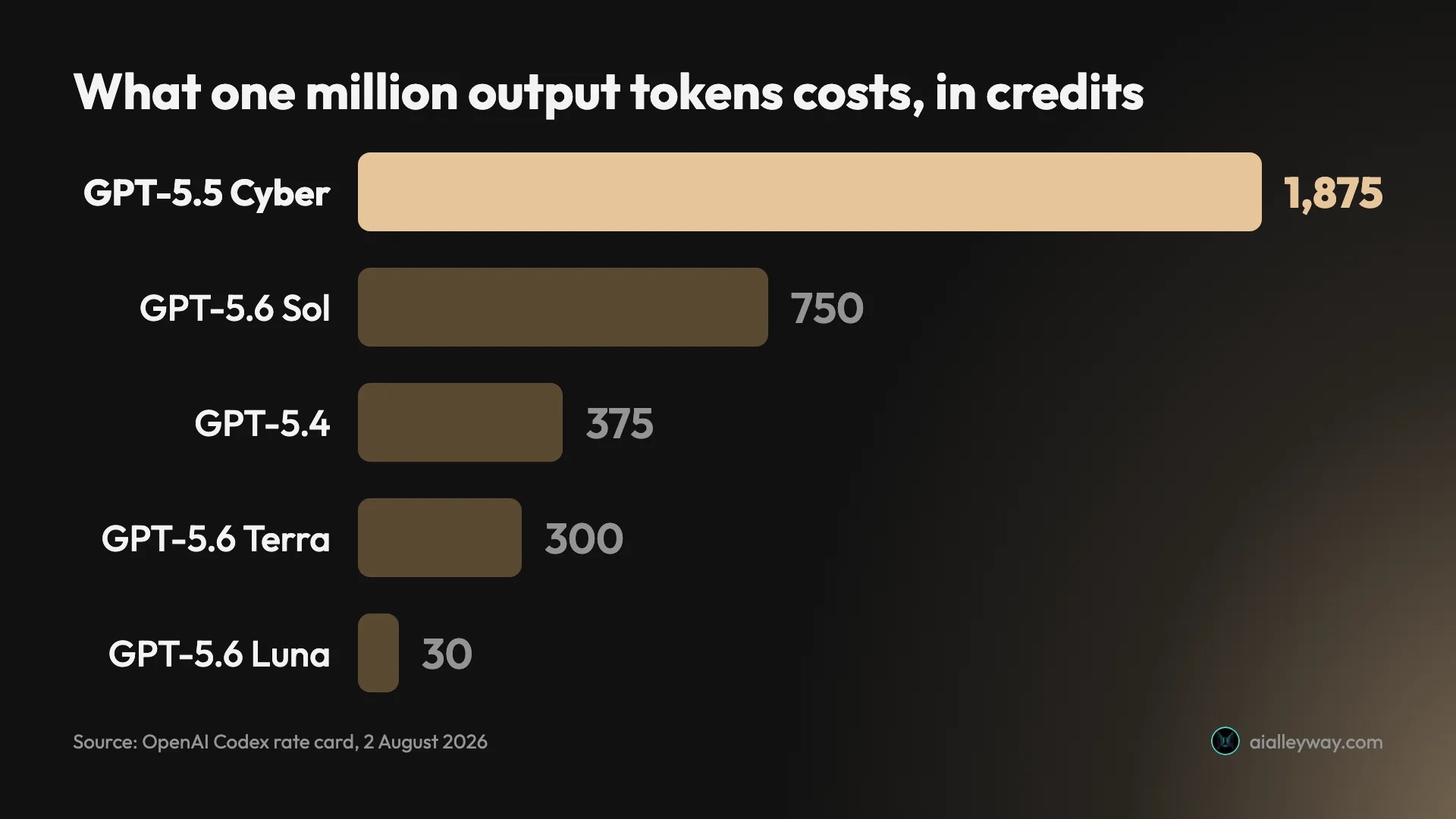
The spread is the story. Output on GPT-5.5 Cyber costs 62.5 times what the same output costs on GPT-5.6 Luna. Even inside the current generation, Sol bills output at exactly twenty-five times Luna’s rate.
Three practical consequences follow.
Output is where the money goes. On six of the nine models, output costs exactly six times what input costs, and GPT-5.4-Mini rounds to the same six. On GPT-5.3-Codex and GPT-5.2 it costs eight times — and GPT-5.3-Codex is the model OpenAI says code review runs on, so the priciest output ratio on the card sits under the feature you are least likely to be watching. A verbose agent that narrates its reasoning at length is literally more expensive than a terse one producing the same diff.
Cached input is nearly free, and cache writes are free outright. Cached input runs at exactly a tenth of fresh input on all nine models above (the two GPT-Image-2 rows, which I’ve left out, charge a quarter; a twelfth row, GPT-5.3-Codex-Spark, is a research preview with no final rates), and OpenAI confirms it “does not charge for cache writes.” Long sessions on one codebase are cheaper per turn than the token counts suggest.
Model choice is a bigger lever than prompt discipline. You can trim your prompts carefully and save a few percent, or switch model and save an order of magnitude. That is the opposite of how Claude Code and Cursor price the same work, where the plan rather than the model sets your ceiling.
What does a real Codex task cost?
OpenAI gives one worked example, in the Business rate card. It describes a Workspace Agent run rather than a Codex task, but it uses GPT-5.5 at rates identical to the Codex card, so the arithmetic transfers exactly. A GPT-5.5 run consuming 20,000 input tokens, 80,000 cached input tokens and 5,000 output tokens works out at:
| Component | Calculation | Credits |
|---|---|---|
| Input | 20,000 / 1M × 125 | 2.50 |
| Cached input | 80,000 / 1M × 12.50 | 1.00 |
| Output | 5,000 / 1M × 750 | 3.75 |
| Total | 7.25 |
Note what that shows: cached input was four times the volume of fresh input and cost less than half as much, while output was the smallest token count and the largest single charge.
For Codex specifically, OpenAI puts a typical GPT-5.6-Sol task at “between 5-40 credits.” Under the older per-message card, a Sol message averaged about 14 credits, a Terra message about 6, and a Luna message about 1.
The one thing the rate card never states is what any of that costs in money. It turns out you can work it out anyway, and OpenAI does publish the figure, just nowhere near here.
What is a Codex credit actually worth?
A Codex credit is worth exactly $0.04, so 25 credits is a dollar. OpenAI states this in the terms of the Codex student offer, where a $100 grant is described as “2,500 credits.” It is also independently derivable: divide any model’s published API dollar rate by its Codex credit rate and $0.0400 falls out across 17 of the 18 values I checked, six models by three token types, the eighteenth off only by a rounding.
Yet the figure appears on none of the five pages a person budgeting for Codex would actually read: the Codex pricing page, the pricing docs, the rate card, the Plus and Pro credits article, or the Business rate card. Only a student promotion’s fine print, the purchase screen and the arithmetic reveal it.
Pinning it down took two independent routes, because OpenAI publishes the figure only in a promotion’s fine print and on the purchase screen, never on a page built to help you decide.
Start with what isn’t there. I checked five of OpenAI’s own pages on 2 August 2026 — every one of them talks in credits, and none tells you what a credit is worth.
| OpenAI page | Credits per token? | Dollars per credit? |
|---|---|---|
| Codex pricing page | Usage limits only | No |
| Pricing docs | Plan prices + credit rates | No |
| Codex rate card | Full table, 12 rows | No |
| Plus & Pro credits article | Terms and expiry | No |
| Business rate card | Worked example | No |
The number does exist. It is in the terms of service for the Codex student offer, which states that the grant students receive is “2,500 credits, which is equivalent to $100.” That is four cents a credit, published, current, and sitting in the small print of a promotion rather than on any page built to explain pricing. The only other place it surfaces is the credit-purchase screen itself, which is behind a login on a Plus or Pro account.
You can also derive it, which is how I found it first. OpenAI said the April repricing was to “align with API token usage,” and that turns out to be exact rather than approximate. Divide each model’s published API dollar rate by its credit rate and the same number falls out every time but one:
| Model | API $/1M output | Credits/1M output | $ per credit |
|---|---|---|---|
| GPT-5.6 Sol | $30.00 | 750 | $0.0400 |
| GPT-5.6 Terra | $12.00 | 300 | $0.0400 |
| GPT-5.6 Luna | $1.20 | 30 | $0.0400 |
| GPT-5.5 | $30.00 | 750 | $0.0400 |
| GPT-5.4 | $15.00 | 375 | $0.0400 |
One credit is four cents — so 25 credits is a dollar. That holds across every model and all three token types I checked, eighteen figures in total, with a single rounding artefact. GPT-5.4-mini’s output is listed at 113 credits where the arithmetic gives 112.5. Two entirely separate documents, a student promotion and an API price list, agree to the cent.
That makes the rate card readable at last:
| What OpenAI says | In dollars |
|---|---|
| A typical GPT-5.6-Sol task, 5–40 credits | $0.20 – $1.60 |
| Their worked example, 7.25 credits | $0.29 |
| Their $100–200 per developer per month | 2,500 – 5,000 credits |
There is a third check, from outside OpenAI entirely. A thread on r/codex after the April repricing describes a basic prompt measured at 22 credits and puts it at roughly $0.88. Twenty-two credits at four cents is $0.88 to the penny. A user measuring in the wild, a student promotion and an API price list all land on the same number.
So the criticism isn’t that OpenAI hides the number. It’s that four cents a credit is a real, current, published figure that appears on none of the five pages a person budgeting for Codex would actually read. You can determine that a task costs 7.25 credits and, anywhere in the pricing documentation, still not learn whether that is a rounding error or real money.
That also explains the dollar figures on other published guides. They are derived by mapping credits onto the published API rates, which is sound — it lands on the same four cents — but it is reverse-engineering rather than something the pricing pages tell you.
And while the documentation is open, the two pages disagree with each other. The Codex pricing page’s FAQ says the new rate card “applies to Business (new + existing) and new Enterprise customers. Other plans will stay on message-based pricing until they’re migrated.” The rate card itself — updated hours before I read it — says it applies to “New and existing ChatGPT Plus and Pro customers.” Both were live on 2 August 2026. I’d trust the rate card, since it carries the fresher timestamp, but the fact that you have to choose is the finding.
What are the usage limits before credits start?
Limits are expressed as local messages per rolling five-hour window, and they vary by model. These are the Plus figures from the vendor pricing page:
| Model | Local messages / 5h on Plus |
|---|---|
| GPT-5.6 Sol | 15–90 |
| GPT-5.6 Terra | 20–110 |
| GPT-5.6 Luna | 50–280 |
| GPT-5.5 | 15–80 |
| GPT-5.4 | 20–100 |
| GPT-5.4 mini | 60–350 |
Those ranges are wide because they are averages that depend on task size, and OpenAI says additional weekly limits may also apply on top of the five-hour window.
Two limitations of the Plus tier are easy to miss. Cloud tasks and code reviews are not available on Plus at all — the vendor’s own table marks them “Not available” for every model on that tier. If you specifically want Codex reviewing pull requests, Plus is not the plan.
One more thing to diary: GPT-5.4 and GPT-5.4 mini retire in Codex on 31 August 2026 for users signed in with ChatGPT. Since 5.4 mini is the model OpenAI recommends for stretching your limits, that recommendation has about four weeks left in its current form. The suggested replacements are GPT-5.6 Terra and GPT-5.6 Luna. Anyone using Codex through their own API key is unaffected.
What does Codex cost for a team?
Business is $20 per user per month on annual billing, or $25 if you pay monthly, with a two-seat minimum. That buys a shared workspace, admin controls and SAML SSO on top of everything in the individual plans.
The mechanics change in one important way at this level. Where an individual buys credits for themselves, Business, Edu and Enterprise plans on flexible pricing purchase workspace credits — a shared balance for the organisation rather than a personal one. That is better for budgeting and worse for attribution: one team member’s expensive week draws down the same pool everyone else is working from, and nothing in the plan structure stops it.
Enterprise and Edu work differently again, and the vendor’s own note here is easy to skim past. Two things follow from it:
- With flexible pricing, there are no fixed rate limits at all. Usage simply scales with credits, which means the only real ceiling is what your organisation is willing to buy.
- Without flexible pricing, Enterprise and Edu seats “have the same per-seat usage limits as Plus for most features” — the same $20-tier allowance, at an enterprise price.
That second point is worth checking before signing anything. An enterprise contract does not automatically buy more Codex headroom than a $20 Plus seat; the flexible-pricing arrangement is what does.
When does a Codex API key beat a plan?
There is a third way to pay that sits outside the subscription ladder entirely. OpenAI states that “all users may also run extra local tasks using an API key, with usage charged at standard API rates” — no plan required, no credits involved, billed per token like any other API workload.
It is the right answer in three situations, and the wrong one in a fourth.
| Your situation | Better instrument | Why |
|---|---|---|
| A few tasks a month | API key | No monthly floor to justify |
| Billing work to clients | API key | Per-project keys, separable reporting |
| Codex running in CI | API key | No developer for a seat to belong to |
| Coding with it daily | A plan | Capped; per-token billing has no ceiling |
When your usage is genuinely occasional. A subscription is a bet that you will use it. If you reach for a coding agent twice a month, per-token billing on those two occasions will cost less than any monthly plan, including Go.
When you need per-project cost attribution. Credits come out of one pool and tell you nothing about which client or repository consumed them. API keys can be issued per project and reported on separately. For anyone billing work through to a customer, that is not a nice-to-have.
When Codex runs inside a pipeline. A subscription seat is attached to a person. If Codex is running in CI or on a schedule rather than in front of a developer, there is no person for the seat to belong to, and API billing is the shape that fits.
The case against is simply the one OpenAI’s own numbers make. If the company’s estimate of $100 to $200 per developer per month describes you, you are a daily user, and daily users are exactly who the capped plans are priced for. Per-token billing on that volume has no ceiling at all — and unlike the plan tiers, nothing prompts you to stop. Cursor’s metered billing has exactly that shape, and it is why I stopped treating “per token” as automatically cheaper.
There is also a useful hybrid the documentation permits: stay on a plan for your normal work, and use an API key for the overflow instead of buying credits. That keeps the predictable part predictable and pushes the spiky part somewhere you can meter and attribute it.
Three realistic Codex pricing scenarios
Using the four-cent figure from earlier, here is what the three common patterns actually look like in money rather than credits.
| Profile | What a month looks like | Overflow cost | Where it lands |
|---|---|---|---|
| Evenings and weekends | A handful of Sol tasks a session, well inside 15–90 messages per five hours | None | Free or Plus |
| Daily, one project | Regularly meeting the five-hour window, occasional weekly limits | ~50 extra tasks ≈ $10–80 | Plus plus credits, or Pro 5× |
| Several agents in parallel | Limits hit constantly, many Sol tasks a day at 5–40 credits each | Hundreds of tasks; the $100–200 estimate is realistic | Pro 20× |
Those middle-row numbers are a range rather than a forecast, because a “task” spans 5 to 40 credits depending on how much context and output it involves — an eight-fold spread that no amount of arithmetic will narrow for you in advance.
The middle row is where the money gets decided, and it is the row most people misjudge. Hitting your five-hour window a couple of times a week feels like a minor annoyance rather than a pricing signal, so the natural move is to buy a few credits and carry on. Do that repeatedly and you have built yourself a metered plan without ever choosing one — which is precisely how my Cursor bill reached $159.22 in a single month on a plan I had joined at $20.
The alternative is to treat the second or third limit-hit as a decision point rather than a nuisance: either move up a tier, where the cost is fixed and knowable, or switch to a cheaper model and stay where you are.
Is Codex free?
Yes, and unusually for this category, meaningfully so.
I tested this directly. On 31 July 2026 I ran two full Codex tasks on a free ChatGPT plan, no card involved, and the substantive one renamed 33 of 33 references across seven files and three languages. I verified the result against disk rather than trusting the transcript: the JSON still parsed at 28 nodes, the embedded JavaScript passed node --check, and four Python files passed py_compile.
That matters because a persistent claim in this category is that Codex requires ChatGPT Pro at $200 a month. It does not, and the free tier is not a demo — it completed a real multi-file refactor.
The free tier also has a property the paid tiers have now lost: it cannot bill you. Credits are Plus and Pro only, so when a free plan runs out it stops. If predictability is what you want from a coding agent, the free tier is currently the most predictable thing OpenAI sells.
Codex pricing versus Claude Code and Cursor
I’ve paid real invoices to two of these three, so the comparison below mixes verified billing with documented rates rather than pretending it’s all the same kind of evidence.
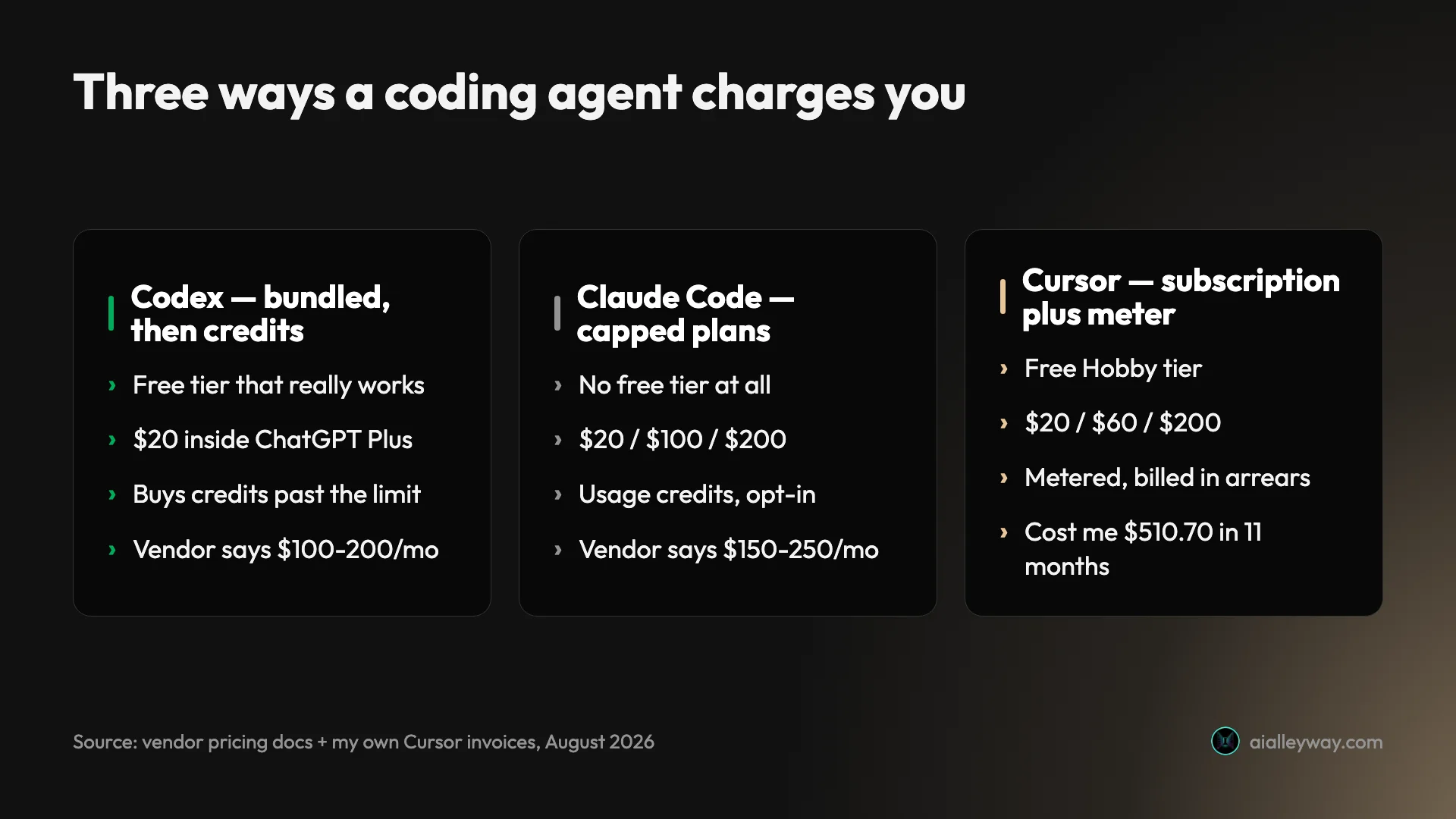
| Cost shape | Codex | Claude Code | Cursor |
|---|---|---|---|
| Free tier | Yes, real | None | Yes, Hobby |
| Entry paid | $20, inside ChatGPT Plus | $20, Claude Pro | $20, Pro |
| Top tier | $200 | $200 | $200 |
| Past the allowance | Buy credits (Plus/Pro) | Usage credits | Metered, billed in arrears |
| Vendor’s own usage estimate | ~$100–200/developer/mo | $150–250/developer/mo | not published |
The interesting column is the last one. Both OpenAI and Anthropic publish an expected monthly spend that sits far above their own headline tier, and the two figures nearly overlap. That is a strong hint about what running an agent seriously actually costs, regardless of which one you pick.
Where they genuinely differ is at zero. Codex is free to try properly; Claude Code has no free tier at all. And where they’ve converged is past the allowance: all three can now keep billing you, which was not true of two of them a year ago.
I’d add one caution about my own evidence here. My Cursor numbers come from eleven months of my own invoices and my Claude Code numbers from a live subscription, but my Codex figures are documentation plus twenty minutes of free-tier testing. I can tell you precisely what Cursor cost me at volume. I cannot tell you what Codex costs at volume from experience, only what OpenAI says it costs.
How do you keep the Codex bill down?
OpenAI publishes four suggestions: trim your prompts, shrink your AGENTS.md, cut unused MCP servers, and switch to the mini model. Below they’re reordered by how much difference each actually makes, with two of my own at the end.
- Switch models for routine work. OpenAI states that moving to GPT-5.4-mini extends local-message limits “by roughly 2.5x to 3.3x.” Nothing else here is close. Bear in mind the 31 August retirement and plan to land on Luna instead.
- Shrink your AGENTS.md. Every request carries it. OpenAI suggests nesting smaller files through a large repository rather than maintaining one big one at the root.
- Disable MCP servers you aren’t using. Each connected server adds context to every message, and the same context discipline is the first thing I set up when using Claude Code too. This is the one people forget, because an MCP server costs nothing while it sits idle in the config and costs on every request once it’s connected.
- Trim your prompts. OpenAI’s fourth, and the one I’d rank last — not because it doesn’t work, but because the model you pick moves the number by an order of magnitude and careful wording moves it by a few percent. Do it, but don’t mistake it for the lever.
- Turn fast mode off unless you need it. Not on OpenAI’s list, but the rate card notes fast mode “consumes credits at a higher rate for supported models.” Paying a premium for speed on a task you’re going to walk away from is pure waste.
- Watch the shared pool. Also mine. Because Codex, ChatGPT Work, ChatGPT for Excel and Workspace Agents draw from one credit balance, a heavy spreadsheet week reduces your coding headroom without anything in Codex changing.
Which Codex plan should you buy?
| You are | Buy | Because |
|---|---|---|
| Evaluating it | Free | It completes real multi-file work and cannot bill you |
| Coding a few evenings a week | Plus, $20 | The realistic entry point; add credits only if you hit walls |
| Working with it daily | Pro 5×, $100 | The step where limits stop shaping your day |
| Running several agents at once | Pro 20×, $200 | The only tier built for parallel work |
| Needing PR review or cloud tasks | Pro or Business | Both are unavailable on Plus |
| A team | Business, $20/user | Annual billing; $25 if you go monthly |
The upgrade path I’d actually recommend is to start on Free rather than Plus. Not to save $20, but because the free tier is the only one that tells you the truth about your usage: it stops, visibly, at a limit, instead of quietly converting your habits into a credit purchase. Find out how fast you hit that wall, then buy the tier that matches. That is the same test I applied to whether Claude Code is worth it, and it gave a different answer than the pricing page did.
The final word
Codex pricing is $0 to $200 a month, and that range is close to meaningless without the second half of the sentence.
| The whole thing | In five rows |
|---|---|
| Cheapest real option | Free tier, and it genuinely works |
| Realistic entry | Plus, $20/mo |
| What a credit is worth | $0.04 of API value — 25 to the dollar |
| A typical Sol task | 5–40 credits, so $0.20–$1.60 |
| What OpenAI says you’ll spend | $100–200 per developer per month |
The plan price buys an allowance. Since 30 October 2025 the allowance is no longer the end of the story on Plus and Pro, because credits let the meter keep running — with auto top-up available to make that happen without a decision. OpenAI’s own estimate of what developers spend, $100 to $200 a month, is five to ten times its own entry paid tier. Both numbers come from the same company.
Four things I’d take away. A credit is four cents of API value, so 25 credits is a dollar and a typical task runs $0.20 to $1.60 — you can do this arithmetic yourself now. The free tier is genuinely worth using, and it is the only tier left that cannot surprise you. Model choice moves the bill far more than prompt discipline, by 62.5 times between the cheapest and dearest output rates. And set a maximum monthly spend before enabling auto top-up, because unbounded and expensive feel identical right up until the month they aren’t.
One caveat on all of the above, and I’d rather state it than let it age quietly: this describes what OpenAI published on 2 August 2026. The pricing model changed in April, the rate card was updated the same morning I read it, two of the vendor’s own pages currently disagree about who has been migrated, and two models retire at the end of this month. Check the date on anything you read about Codex pricing, including this. The rest of my coding-agent teardowns are here.
For what that budget buys against the alternatives, we ranked eight tools on one identical build.
Frequently asked questions
How much does Codex cost?
Codex is not sold on its own. It is included in whichever ChatGPT plan you are already on, so the price you pay is the plan price: Free at $0, Go at $8, Plus at $20, Pro from $100, and Business at $20 per user per month on annual billing or $25 monthly. Enterprise and Edu are quoted by sales.
That is the sticker, not the ceiling. Since October 2025, Plus and Pro users who exhaust their included usage can buy credits to keep going rather than waiting for a reset, and since April 2026 those credits have been priced by token rather than by message. OpenAI's own help centre puts typical spend at roughly $100 to $200 per developer per month, which is well above the $20 most people think they are committing to.
Is Codex free?
Genuinely yes, with real limits. Codex is included on the free ChatGPT tier, and I ran two full agent tasks on exactly that plan in July 2026 without entering a card. It renamed 33 of 33 references across seven files and three languages, and everything still parsed afterwards.
The free tier is also the one tier that cannot overspend. Credits are a Plus and Pro feature, so on Free and Go there is nothing to buy when you run out — you wait. That makes the free plan the honest way to find out whether Codex suits you before any money is involved.
What are Codex credits?
Credits are a pay-as-you-go top-up that starts only after your plan's included usage is gone. Since 2 April 2026 they are priced by tokens rather than by message, so a task's cost depends on how much input, cached input and output it produces. OpenAI charges nothing for cache writes.
A credit is worth four cents. OpenAI states this in the terms of the Codex student offer, where a $100 grant is described as 2,500 credits, and you get the same figure by dividing any model's published API dollar rate by its credit rate. That makes 25 credits a dollar, and a typical Codex task between 20 cents and $1.60.
They come with terms worth reading before you enable auto top-up. Credits expire twelve months after purchase, they are non-refundable and non-transferable, and they are drawn from a single pool shared with ChatGPT for Excel, ChatGPT Work and Workspace Agents. Auto top-up will buy more automatically when your balance drops, though you can set a maximum monthly spend.
Is Codex cheaper than Claude Code?
At the entry point, clearly. Codex costs nothing on the free ChatGPT tier and $20 inside Plus, while Claude Code has no free tier at all and starts at $20. If you only want to find out whether an agent helps you, Codex is the cheaper experiment by exactly the price of a month.
Higher up they converge more than the headline suggests. Both now top out around $200, and both can bill past their allowance if you let them — Claude Code through usage credits, Codex through purchasable credits since October 2025. OpenAI's own $100 to $200 per developer figure sits close to Anthropic's published $150 to $250. The honest answer is that at volume neither is cheap, and the plan price stops predicting the bill.
What happens when you hit Codex usage limits?
It depends on your plan, and this changed recently enough that most write-ups still have it wrong. On Free and Go you stop and wait for the window to reset. On Plus and Pro you are offered credits, and if auto top-up is switched on the purchase happens without you doing anything.
There are two other routes out. You can run extra local tasks with your own API key, billed at standard API rates rather than against your plan. Or you can switch to a cheaper model — OpenAI says moving to GPT-5.4-mini extends local-message limits by roughly 2.5 to 3.3 times, depending on what you switched from.
Keep reading
Codex vs Claude Code: I quit Codex. Then I retested it.
Codex vs Claude Code from someone who dropped Codex in May over one specific flaw — and found it fixed in July. What changed, and what I'd still watch.
OpenAI Codex review: it deleted the rule that made it wrong
OpenAI Codex renamed 33 references across 7 files and 3 languages in a single run. Then it edited my rules file, ungated, deleting the line that made it wrong.
Claude Code alternatives: 7 tools, and what switching costs
Claude Code alternatives ranked by what they actually cost. Real invoices, the vendors' own $150-250 figures, and which ones I've tested versus only read about.
Claude Code vs Codex vs Cursor: one brief, three results
Claude Code vs Codex vs Cursor, measured. I gave all three the same brief and used every app they built. All three passed — here is what separated them.