
Best AI voice generator: what an hour of audio really costs
ElevenLabs wins on voice and costs $10.91 an hour. We normalised six AI voice generators plus open-source to one unit: the cost of an hour you can publish.
Contents
The best AI voice generator, in one line each
Best overall: ElevenLabs. Still the best-sounding voice, the widest language coverage and the strongest cloning, at $10.91 per finished hour on the $22 Creator plan.
Best value per hour: Speechify Studio at $4.17 an hour if you can commit annually, or Hume Octave at $6.00 with no annual lock-in.
Best for regulated work: WellSaid Labs — the most expensive hour here by a distance, bought for documented voice rights rather than for the audio.
Here is the thing every roundup in this category skips. These tools do not meter the same thing, so their monthly prices are not comparable and never were. ElevenLabs and Hume charge per character of input text. Murf charges by the hour of generated audio. Speechify charges credits per second. WellSaid charges only for the minutes you actually download, and lets you generate as much as you like for free.
So we converted all of them to one unit: what it costs to produce one finished hour of audio you are licensed to publish. That number moves by a factor of seven across the six branded tools below, and it does not track the sticker price at all.
How we chose, and what we deliberately left out
Three criteria, in this order.
It has to grant commercial rights at a price a person can actually pay. Every free tier in this roundup withholds commercial use. That is the real free-tier limit, not the minute count, and it is why the cost-per-hour table below uses each tool’s cheapest commercial plan rather than its headline price.
The metering has to be legible before you buy. A tool that cannot tell you what a project will cost until after you have made it is a tool that will surprise you. This is where the spread comes from, and where most of the value in this post sits.
It has to still exist. That sounds like a low bar. It is not.
| Criterion | Why it comes first |
|---|---|
| Commercial rights at a payable price | Every free tier here withholds them |
| Legible metering before you buy | It is where the 7x cost spread hides |
| The vendor still exists | Two names in this category no longer do |
One tool that many other roundups still list is gone. LOVO, and its Genny product, is dead — lovo.ai now returns an HTTP 402 with a DEPLOYMENT_DISABLED header, its app, docs, blog and API subdomains all 404, and Lovo Inc. filed for Chapter 7 bankruptcy in May 2026 amid a voice-actor lawsuit. Half the write-ups we checked still recommend it. We tested every domain in this list before writing, because the category has form here: PlayHT is also gone, and stale roundups kept recommending it for months after its domain stopped resolving.
We also left out Cartesia, despite rating it highly. It is an API-first tool for developers building real-time voice agents, and putting it in a creator roundup would flatter nobody. It has its own Cartesia review and pricing guide, and it leads our separate best TTS API roundup where it belongs.
The six, plus open-source, at a glance
| Tool | Best for | Cheapest commercial plan | Meters | Cloning |
|---|---|---|---|---|
| ElevenLabs | Overall quality | $6/mo Starter | characters | Instant $6, Pro $22 |
| Murf AI | All-in-one studio | $19/mo annual | hours generated | Enterprise only |
| Hume Octave | Emotional range | $14/mo Creator | characters | All tiers, API gated |
| Speechify Studio | Volume on a budget | $100/yr Starter | credits per second | Starter and up |
| Descript | Editing plus voice | $16/mo annual | media hours + credits | $16/mo, cheapest here |
| WellSaid Labs | Regulated work | $10/mo annual | minutes downloaded | Not offered |
| Open-source | Zero marginal cost | free | nothing | Chatterbox, XTTS |
On testing, plainly: we have run real scripts through ElevenLabs, Murf and Descript, and those sections carry first-hand observations. Speechify Studio, Hume Octave and WellSaid Labs are assessed from their published pricing, docs and licensing terms, which is where the cost analysis comes from either way. We have not put our own audio through those three and do not pretend otherwise.
How AI voice generation actually works, briefly
You do not need the architecture to buy well, but three mechanics explain almost every pricing and quality decision on this page.
The model reads text, it does not splice recordings. Older text-to-speech stitched together recorded phonemes, which is why it sounded robotic and why it could not do emphasis. Current models generate the waveform directly from the text, conditioned on a voice. That is why they can put stress on the right word — and also why they are non-deterministic, so the same script generated twice gives you two slightly different reads.
That non-determinism is the hidden cost driver. It is why every tool charges per generation rather than per script, and why “re-roll to fix one word” is the line item nobody budgets for.
Voice cloning comes in two grades, and the words are used loosely. Instant cloning takes a short sample, usually 10 to 30 seconds, and adapts a general model toward it. It is fast, free to train on most tools, and good enough for a consistent character or agent persona. Professional cloning trains on 30 minutes or more of clean audio and produces something far closer to indistinguishable, which is why it sits behind higher tiers and a consent recording.
If a tool advertises “voice cloning” without saying which, assume instant. The gap between the two is larger than the gap between most tools. For a cloning-specific shortlist, including Resemble and HeyGen which do not appear in this roundup, see best AI voice cloning.
| Instant cloning | Professional cloning | |
|---|---|---|
| Sample needed | 10–30 seconds | 30+ minutes of clean audio |
| Training cost | Usually free | Usually free, gated by tier |
| Quality | Consistent persona | Close to indistinguishable |
| Consent recording | Sometimes | Effectively always |
| Available from | ElevenLabs $6, Descript $16, Hume free | ElevenLabs $22, Descript $16 |
Latency and quality trade against each other, and creator tools pick quality. The models optimised for sub-100-millisecond response — Cartesia’s Sonic, Deepgram’s Flux — sacrifice some expressive range to answer fast enough for a live conversation. The tools in this roundup make the opposite trade, because nobody is waiting on the other end of an audiobook.
This is the technical reason the creator tools and the API tools are genuinely different products rather than the same product at different prices, and why we split them across two posts.
What this means for your purchase: budget for more generations than your script length implies, check which grade of cloning you are being sold, and do not pay a latency premium for work that renders in the background.
The five ways these tools charge you, and how each one bites
Nobody comparing AI voice tools has a pricing problem. They have a units problem. The tools on this page meter five genuinely different things, and each meter fails in its own specific way.
| Meter | Tools | Re-rolls cost you | Worst failure |
|---|---|---|---|
| Per character | ElevenLabs, Hume, Cartesia | Yes, every time | Iteration silently doubles the bill |
| Per hour generated | Murf | Yes, every time | Small allowance, no rollover |
| Per second, credits | Speechify Studio | Only if you change prosody | Annual commitment, no monthly |
| Per minute downloaded | WellSaid Labs | No | Tight allowance, no rollover |
| Two meters at once | Descript | Credits only | Cheapest tier cannot buy top-ups |
Per character of input text
ElevenLabs, Hume Octave and Cartesia all charge for the text you send, not the audio you get back. One character costs one credit, give or take, which makes a script cheap to price before you generate it: paste it into a word counter and you know the bill.
The failure mode is re-rolls. You pay per generation, so a line you regenerate four times to fix a mispronunciation costs four times what the script says. Anyone iterating heavily should assume the real cost is well above the character count, which is why we tell people to budget a tier higher than the headline suggests.
Per hour of generated audio
Murf meters finished audio time. This is the most intuitive unit on the list, because it matches how you think about the deliverable, and it is the one people most often underestimate.
The bite is the same as above but sharper: a re-recorded take spends the budget twice, and Murf’s allowances are small. Creator’s 24 hours a year sounds generous until you notice it covers two hours a month and does not roll over.
Per second, in credits
Speechify Studio charges 1 credit per second of voiceover, 3 for dubbing, 30 for avatar video. It is the most legible meter here: multiply your runtime by 60 and you have your credit cost, before you make anything.
The catch is subtle. Re-exporting unchanged audio is free, but changing pitch, speed or emotional prosody sends the text back through the model and charges you again. Only volume adjustments are genuinely free, which is not obvious until you have spent the credits.
Per minute downloaded
WellSaid Labs is the outlier, and its design is the most creator-friendly on this list. Generation is unlimited on every paid plan. You are charged only for minutes you actually download and keep.
That removes the re-roll penalty entirely — iterate for an afternoon, pay for the one take you use. The bite is elsewhere: the allowances are small, they reset monthly with no rollover, and annual plans hand you the whole year’s minutes up front, which rewards planning and punishes a slow start.
Two meters at once
Descript runs media hours and AI credits in parallel, and they run out independently. You can have plenty of one and none of the other, which is exactly the failure people report.
Worse, the cheapest paid tier cannot buy top-ups at all. Hobbyist has no route to more credits short of upgrading, so hitting the cap mid-project means an upgrade decision rather than a small purchase.
Which meter should you want?
| How you work | The meter that suits you | The tool |
|---|---|---|
| Many takes, few keepers | Per minute downloaded | WellSaid Labs |
| Clean scripts, generate once | Per character | ElevenLabs, Hume |
| Fixed runtime, fixed budget | Per second in credits | Speechify Studio |
| Fixed annual output, planned ahead | Per hour generated | Murf AI |
| Voice is one part of an edit | Two meters | Descript |
If you iterate heavily, WellSaid’s download-only model is structurally the best deal on this page and its per-hour price is the worst. If you write clean scripts and generate once, per-character billing is the most predictable, because you can count the cost before you generate it. It is not the cheapest, though — that is Speechify’s per-second meter at $4.17 an hour. If you cannot tell which you are, assume you iterate more than you think — almost everyone does.
What an hour of audio actually costs
This is the table the category is missing. Each row uses the cheapest plan that grants commercial rights, converted to cost per finished hour of audio.
| Tool | Plan | What it meters | Cost per finished hour |
|---|---|---|---|
| Speechify Studio | $100/year Starter | credits, 1 per second | $4.17 |
| Hume Octave | $14/mo Creator | characters | $6.00 |
| Murf AI | $19/mo Creator, annual | hours of generated audio | $9.50 |
| ElevenLabs | $22/mo Creator | credits ≈ characters | $10.91 |
| WellSaid Labs | $33/mo Pro, annual | minutes downloaded | $11.00 |
| WellSaid Labs | $10/mo Starter, annual | minutes downloaded | $30.00 |
| Descript | $16/mo Hobbyist, annual | media hours + AI credits | see note |
| Open-source | $0 + your GPU | nothing | your compute |
Three of those need a word of explanation.
Each row names its plan, because the cheapest plan is not always the cheapest hour. ElevenLabs’ $6 Starter grants commercial rights but works out to $12.00 an hour, dearer than the $22 Creator plan at $10.91, because the allowance scales faster than the price. WellSaid is the same story more dramatically: $30.00 an hour on Starter, $11.00 on Pro. Read the row, not the sticker.
The character-to-minute conversions are each vendor’s own, and the vendors disagree. ElevenLabs and Hume both publish roughly 1,000 characters per minute of speech, and their own plan tables show it — 121,000 credits for about 121 minutes, 140,000 characters for about 140. Cartesia publishes 750 to 800 for the same thing. We use each vendor’s own figure rather than imposing one across all of them, which is why the numbers here differ from a naive per-character comparison.
Descript is not really comparable and we have not forced it. Its media-hours meter covers editing your whole timeline, not just generating speech, so a “cost per hour of AI audio” figure would flatter it enormously and mean nothing. If you are editing video anyway, its AI voice is close to free. If you only want narration, you are paying for an editor you will not open.
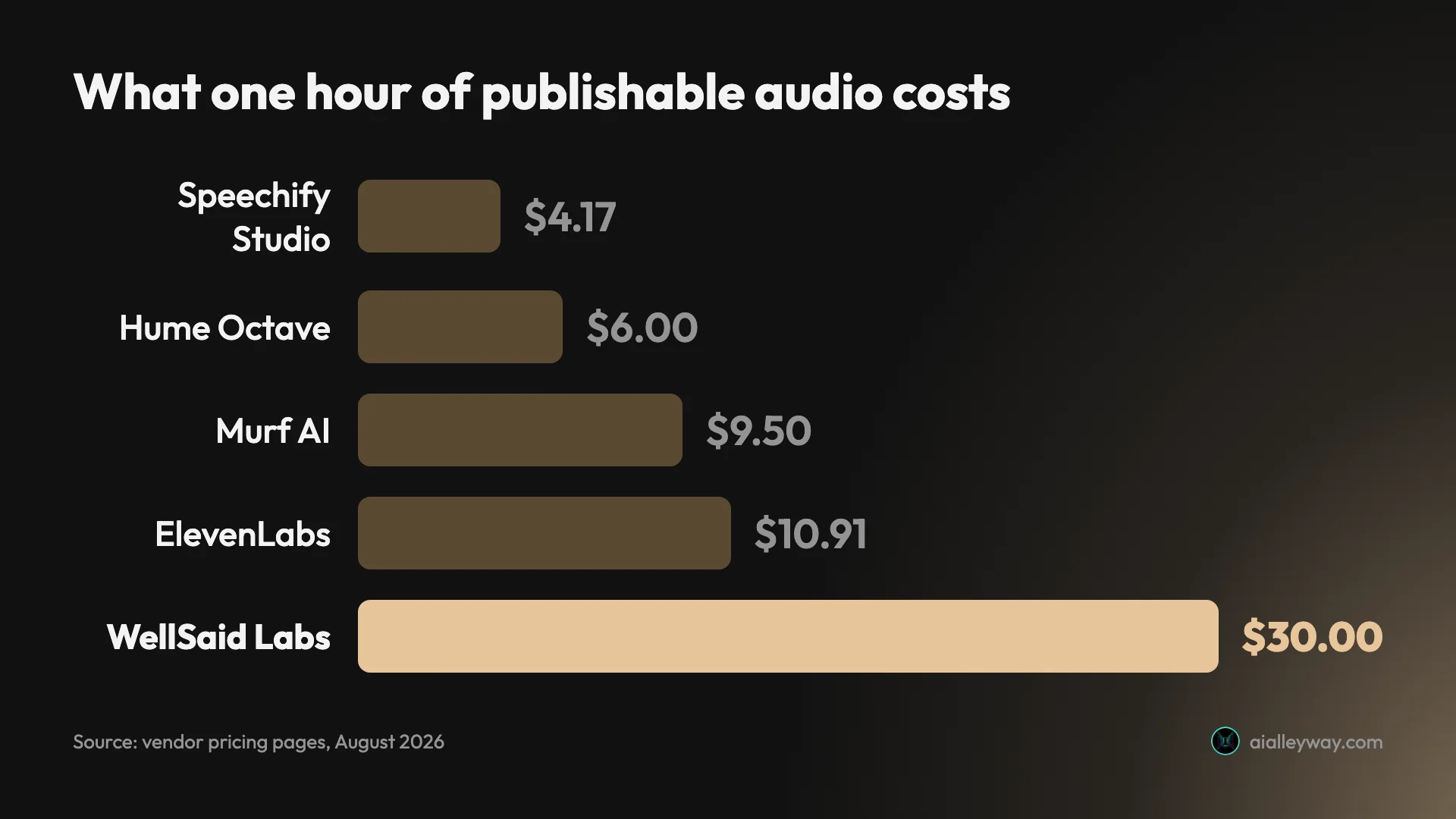
The headline finding: WellSaid Labs costs about seven times what Speechify Studio costs per hour, $30.00 against $4.17, and both are legitimate purchases. One is priced as a rights-cleared enterprise service and the other as a volume creator tool. The monthly prices, $10 and $8.33, tell you none of that.
1. ElevenLabs — best overall
Still the one to beat, and still the one most people should buy. The voices breathe, place emphasis on meaning rather than on syllables, and hold up across a long script in a way the cheaper tools do not quite manage.
It is also the broadest tool here. Instant cloning from a short sample, professional cloning trained on 30 minutes or more, 32-plus languages, a dubbing studio and a long-form editor. Nothing else on this list does all of those competently.
Pricing. Free gives 10,000 credits a month with no commercial licence. Starter is $6 for 30,000 credits and is the cheapest plan you can legally publish from. Creator at $22 for 121,000 credits is where most individual creators land, and it is the first tier with professional cloning. Pro is $99 for 600,000, Scale $299 for 1.8M, Business $990 for 6M.
| Plan | Price | Credits/mo | ~Minutes | Cloning |
|---|---|---|---|---|
| Free | $0 | 10,000 | ~10 | None |
| Starter | $6 | 30,000 | ~30 | Instant |
| Creator | $22 | 121,000 | ~121 | Professional |
| Pro | $99 | 600,000 | ~600 | Professional |
| Scale | $299 | 1.8M | ~1,800 | Professional x3 |
| Business | $990 | 6M | ~6,000 | Professional x10 |
The catch is the meter. Credits map roughly one-to-one to characters on the high-quality model, but you pay per generation, so every re-roll to fix a reading spends the allowance again. Budget a tier above what the headline minutes suggest. Our ElevenLabs pricing guide works through what the credits really buy, and the full ElevenLabs review covers the quality verdict.
What it actually sounds like, from our own scripts. The thing ElevenLabs does that the cheaper tools do not is place emphasis on the word that carries the meaning, rather than on the word a rule would pick. Run a sentence with a subordinate clause through it and the clause gets subordinated. It also breathes in roughly the right places, which sounds trivial and is the single largest contributor to a listener not noticing.
Where it slips is the same place everything slips: long proper nouns, transliterated names and technical jargon drift over a long project unless you maintain a pronunciation dictionary.
Who it is for. Anyone whose deliverable is the voice itself: audiobooks, podcasts, YouTube narration, character work. It is also the only tool here we would trust for a project in a language we do not speak, because the second-tier language quality is meaningfully ahead of the rest of this list.
Who it is not for: anyone chasing lowest cost per hour, where it is nearly double Hume and more than twice Speechify, and anyone whose workflow involves heavy iteration — the per-generation meter punishes exactly that.
Already on ElevenLabs and looking for a way out? That is a different question with a different answer, and we cover it in best ElevenLabs alternatives.
2. Murf AI — best all-in-one studio

Murf is not trying to win the realism contest and does not need to. It is a production studio with a timeline, and for business narration, e-learning and course work it replaces about three other tools.
The editor is fast and forgiving, the delivery controls are granular enough to hand-tune pacing line by line, and MultiNative voices switch language mid-sentence, which is a genuine edge if your scripts mix languages.
Pricing. Free is a 10-minute demo with no downloads. Creator is $29 monthly or $19 billed annually, Business $99 or $66 annually, Enterprise by quote. Annual saves about 34%, one of the steeper discounts here.
The meter is hours, and it is stingy. Creator gives 24 hours of generated audio per year, Business 96. Re-rolls spend from that budget and unused time does not roll over. At $228 a year for 24 hours that is $9.50 per finished hour, which is fair for what you get but nowhere near the cheapest. The Murf pricing guide has the full breakdown.
What the studio buys you. The reason to pick Murf is not the voice, it is everything around it. A timeline you can drag audio around on, per-block pacing and emphasis controls, a project system that makes sense when you are producing 40 modules of a course rather than one video, and integrations that save real time.
For e-learning and corporate work that structure matters more than the last 10% of realism, and Murf is priced and built for exactly that buyer. For a solo creator making one video a week it is a lot of machinery.
| Plan | Monthly | Annual | Generation/year | Per hour | Cloning |
|---|---|---|---|---|---|
| Free | $0 | $0 | 10 min total, no downloads | — | No |
| Creator | $29 | $19 ($228/yr) | 24 hours | $9.50 | No |
| Business | $99 | $66 ($792/yr) | 96 hours | $8.25 | No |
| Enterprise | Custom | Custom | Unlimited | — | Yes |
The dealbreaker for some: voice cloning is Enterprise-only, a sales call rather than a plan upgrade. If cloning your own voice is the job, stop here. Our Murf AI review covers where the studio earns its keep.
3. Hume Octave — best value per hour, with two catches
Hume is the emotional-range specialist, and the cheapest way to buy expressive range on this page. Octave is built to act a line rather than read it, taking direction on tone in a way most engines cannot.
Pricing, and it is unusually granular. Free is $0 for 10,000 characters. Starter $3 for 30,000. Creator $14 a month for 140,000 characters, half price the first month. Pro $70 for 1M, Scale $200 for 3.3M, Business $500 for 10M. Overage runs from $0.15 down to $0.05 per 1,000 characters as you climb. There is no annual billing at all, which is unusual and simplifies the decision.
At Creator’s 140,000 characters, that is about 140 minutes of speech for $14, or $6.00 an hour — second cheapest on this page.
And there is an upside the language caveat below obscures. On Octave 2, Hume meters characters at half rate, so the same allowance buys roughly double the minutes and the overage rates halve too. Creator’s 140,000 characters become about 280 minutes, which is $3.00 an hour — the cheapest number anywhere in this roundup. That model is still marked preview, so treat it as a reason to watch Hume rather than a reason to buy it today.
| Plan | Price/mo | Characters | Overage per 1,000 | Commercial |
|---|---|---|---|---|
| Free | $0 | 10,000 | none — hard stop | No |
| Starter | $3 | 30,000 | none — hard stop | No |
| Creator | $14 | 140,000 | $0.15 | Yes |
| Pro | $70 | 1,000,000 | $0.12 | Yes |
| Scale | $200 | 3,300,000 | $0.10 | Yes |
| Business | $500 | 10,000,000 | $0.05 | Yes |
Catch one: free and Starter have no commercial licence, and no overage either. Both are hard stops. You hit 10,000 or 30,000 characters and generation stops until you upgrade. Commercial use begins at Creator.
Catch two, and it matters if you are building anything: you can create a voice clone on every tier including free, but only Enterprise can call a cloned voice through the API. Clone in the web app all you like; shipping it in a product means a sales conversation.
Language coverage is narrower than it looks. Octave 1 supports English and Spanish only. Octave 2 reaches 11 languages but is still marked preview. If you need broad multilingual output today, this is the wrong tool.
4. Speechify Studio — best value if you can commit annually

The cheapest publishable hour on this list, with a structure that trips people up before they get to it.
Speechify is three separate products with three separate subscriptions, and the one you want for generating voiceover is Speechify Studio, not the read-aloud app that speechify.com/pricing shows you. Their own FAQ says the two are different subscriptions. Buying the wrong one is an easy mistake to make.
Pricing. Studio is annual-only; no monthly option exists. Free gives 600 credits, about 10 minutes. Starter is $100 a year for 86,400 credits, which is 24 hours of voiceover. Creator is $300 a year for 345,600 credits, or 96 hours. At Starter that works out to $4.17 per finished hour, the lowest here.
The metering is per second, not per character, which is refreshingly legible: 1 credit per second of voiceover, 3 for dubbing, 30 for avatar video. You can price a project off its runtime before you make it.
What free withholds: commercial rights and voice cloning, both explicitly. And one detail worth knowing — re-exporting unchanged audio is free, but adjusting pitch, speed or emotional prosody sends it back through the model and costs credits again. Only volume changes are free.
| What you generate | Credits per second | One finished hour |
|---|---|---|
| Voiceover | 1 | 3,600 credits |
| Dubbing | 3 | 10,800 credits |
| Avatar video | 30 | 108,000 credits |
The annual-only structure is the real decision. There is no way to try Studio for a month. You commit $100 or $300 up front, which is a different kind of purchase from a $22 subscription you can cancel in week two. At 24 hours a year the Starter plan is excellent value if you will actually use it, and a dead $100 if your project stalls in February.
Work out your annual volume honestly before you buy, because this is the one tool on the list where guessing wrong costs you the whole year rather than one month.
Who it is for. High-volume narration on a fixed annual budget, and anyone who wants to price a project off its runtime rather than its character count. Who it is not for: anyone who wants to pay monthly, anyone who needs the voice quality to match ElevenLabs, and anyone whose output is unpredictable month to month.
5. Descript — best if you are editing as well as generating
Descript comes at this from the other direction. It is a podcast and video editor where you cut media by deleting words in a transcript, and AI voice is a feature inside that workflow rather than the product.
That framing decides whether it is cheap or expensive for you. If you were going to buy an editor anyway, the AI voice arrives at close to no marginal cost. If you only want narration, you are paying for a timeline you will never open.
Pricing. Free, then Hobbyist at $24 monthly or $16 annually, Creator $35 or $24, Business $65 or $50 per seat. Annual saves 33% at the entry tier and less as you climb, despite the page advertising “up to 35%”.
It has the cheapest voice cloning here. Custom voice clones are limited on free but fully available from Hobbyist at $16 a month annually, undercutting every other tool on this list for cloning specifically.
Two meters run at once, media hours and AI credits, and they fail differently. Hobbyist gets 600 minutes and 400 credits a month, and cannot buy top-ups — that is Creator and above. Our Descript pricing guide untangles both, and the Descript review covers the editor itself.
One quirk worth naming: regenerating speech has an undisclosed limit, after which Descript’s own documentation says you will hear “jibber jabber” in the output. It is a strange way to hit a cap.
6. WellSaid Labs — best for regulated and rights-sensitive work
The most expensive hour on this list, and the reason to buy it has almost nothing to do with the audio.
WellSaid’s voices come from contracted voice actors through a formal Voice Actor Program rather than from scraped or cloned material. For healthcare, finance, government and anything with a compliance team, that provenance is the product. It also explains why the company does not offer self-serve cloning at all: the word does not appear anywhere on its pricing page.
Pricing, freshly changed. Trial is free. Starter is $19 monthly or $10 billed annually at $120 a year. Pro is $49 or $33 annually at $396. Business is annual-only at $160 per user per month. The annual discounts are the largest here, up to 47%.
The meter is the interesting part: you are charged for minutes you download, and generation is unlimited on paid plans. Iterate as much as you like; you only spend when you keep something. That is a genuinely creator-friendly design and nobody else here does it.
The allowances are tight, though. Starter gives 240 minutes a year, which is where the $30 per finished hour comes from. Pro’s 2,160 minutes a year at $396 is far better value at about $11 an hour, and is the tier most buyers should actually look at. Unused minutes do not roll over.
| Plan | Monthly | Annual | Download minutes | Per hour |
|---|---|---|---|---|
| Trial | Free | Free | 3/month, no commercial | — |
| Starter | $19 | $10 ($120/yr) | 240/year | $30.00 |
| Pro | $49 | $33 ($396/yr) | 2,160/year | $11.00 |
| Business | — | $160/user ($1,920/yr) | 2,880/year/user | $40.00 |
The trap. WellSaid markets 240+ voices across 30+ languages, but Starter, Pro and Business all say “All English voices”. Additional languages and translation sit in the Enterprise block only. The multilingual number is unreachable at any published price.
7. Open-source — best free, if you have the hardware
Free stopped meaning “worse” in this category somewhere around 2025, and the gap is now small enough that a lot of narration work does not need a subscription at all.
Kokoro 82M is the current favourite for quality-per-watt: an 82-million-parameter model, permissively licensed, small enough to run on modest hardware and startlingly good for its size. Fish Audio is the stronger multilingual option and has a hosted tier if you would rather not self-host. Chatterbox from Resemble is the pick if cloning is the point, and Coqui XTTS remains the most flexible if you are comfortable in Python.
What you actually pay: GPU time, setup hours, and the ongoing maintenance of a thing nobody supports. That is a real cost and it is not small. It is simply not a subscription.
| Model | Best at | Licence | Cloning |
|---|---|---|---|
| Kokoro 82M | Quality per watt, runs on modest hardware | Apache 2.0 | No |
| Fish Audio | Multilingual, hosted tier available | Permissive | Yes |
| Chatterbox | Cloning, from Resemble | MIT | Yes |
| Coqui XTTS | Flexibility if you live in Python | Coqui Public Model | Yes |
Where the quality actually lands. For clean, scripted, single-speaker English narration, Kokoro is close enough to the paid tools that most listeners would not sort them reliably. The gap opens on expressive range, on non-English output, and on long-form consistency, which is precisely where the subscriptions earn their money.
What you actually pay: GPU time, setup hours, and the ongoing maintenance of a thing nobody supports. No SLA, no indemnity, and no one to email when a model update changes how your voice sounds. On a commercial project that support gap is a genuine risk rather than a theoretical one.
Who it is for. Developers, high-volume users whose bill has become the problem, and anyone whose content cannot leave their own infrastructure for compliance reasons. Who it is not for: anyone who wants to generate audio this afternoon, and anyone who would rather pay $14 a month than maintain an inference server.
What the free tiers actually give you
“Best free AI voice generator” is one of the most-asked questions in this category, and the honest answer is uncomfortable: there is no free tier here you can legally publish from.
| Tool | Free allowance | Commercial use | Cloning | Other limits |
|---|---|---|---|---|
| ElevenLabs | 10,000 credits/mo (~10 min) | No | No | — |
| Hume Octave | 10,000 characters (~10 min) | No | Yes, web app only | Hard stop, no overage |
| Speechify Studio | 600 credits (~10 min) | No | No | — |
| Murf AI | 10 minutes total | No | No | No downloads at all |
| WellSaid Labs | 3 minutes/month | No | Not offered | 24 kHz, MP3 only |
| Descript | 60 min media, 100 credits once | Watermarked | Limited | 720p ceiling |
| Open-source | Unlimited | Yes | Yes | Your hardware, your setup |
Look at that commercial-use column. Five of the seven say no outright, and Descript’s free tier watermarks your video, which is its own kind of no. The free tiers exist so you can hear the voices before you pay, and that is a reasonable thing for them to exist for. They are auditions, not runways.
The pattern worth internalising: in this category the licence is the real free-tier limit, not the minute count. People plan around the minutes, run a small project inside the allowance, publish it, and never notice they were outside the terms the whole time. The allowance is generous enough to let you make that mistake.
Two of these are meaner than they look. Hume’s free and Starter tiers are hard stops with no overage available, so generation simply ceases at 10,000 or 30,000 characters. And Murf’s free tier does not let you download anything, so it is a listening demo rather than a trial.
The only genuinely free route with commercial rights is self-hosting an open-source model, which is why that section exists further down. It is free in the sense that a vegetable garden is free.
Voice rights: the question the pricing pages don’t answer
Here is where this category gets legally interesting, and where almost every roundup goes quiet.
A commercial licence on your plan grants you the right to publish the output. It says nothing whatsoever about where the voice itself came from. Those are two separate questions, and most buyers only ever check the first one.
The three ways a voice gets made
Contracted voice actors. WellSaid Labs runs a formal Voice Actor Program: real performers, under contract, compensated. This is the cleanest provenance available and it is the entire reason to pay $30 an hour instead of $4. It is also why WellSaid does not sell you cloning — the business model depends on the voices being theirs to license.
Cloned from a consenting speaker. ElevenLabs, Descript and Hume all let you train a voice from a sample. Every serious tool now requires a consent recording before it will train a professional clone, and Google’s Instant Custom Voice goes further by mandating verbatim consent wording and prohibiting custom consent scripts. Vendors do not add that friction for fun.
Trained on a corpus you cannot inspect. This is the honest description of most stock voice libraries, and the disclosure varies from thin to absent.
| Voice source | Tools | Provenance you can document |
|---|---|---|
| Contracted voice actors | WellSaid Labs | Strongest — a named program and contracts |
| Cloned with consent | ElevenLabs, Descript, Hume | Yours, if you keep the consent recording |
| Stock library, undisclosed corpus | Most of the rest | Thin to absent |
What actually creates exposure
Cloning someone else’s voice without documented consent, and publishing it. That is the live risk, and it is not hypothetical: LOVO, which we removed from this roundup, filed for bankruptcy in May 2026 amid a voice-actor lawsuit.
Note what that means practically. The company vanished, and everyone who had built a workflow on it lost the workflow. Legal exposure in this category does not only arrive as a lawsuit against you. It arrives as your vendor disappearing.
What to do about it
If you are a solo creator narrating your own scripts with a stock voice on a paid plan, you are fine, and you can stop reading this section.
If you work in healthcare, finance, insurance, government or education — anywhere a contract gets reviewed — buy documented provenance rather than the cheapest hour. WellSaid at Pro is $11.00 an hour against ElevenLabs at $10.91, which is within a penny. At that point the documented provenance is effectively free, which makes it an easy call rather than a trade-off.
And if you are cloning a voice that is not yours, get consent in writing, keep the recording, and understand that the tool requiring a consent clip is protecting itself rather than you.
Three real projects, costed
Per-hour rates are a starting point, not an answer. What decides your bill is the shape of your work, and specifically how much you re-record. Here are three common projects, costed from the published rates above.
Assumptions, stated so you can check them: 6 characters per word including spaces, and 1,000 characters per minute of speech, which is the ratio ElevenLabs and Hume both publish. Cartesia publishes 750 to 800 for the same thing, so treat these as bridges rather than measurements.
A 40,000-word audiobook, recorded once
That is roughly 240,000 characters, or about 4 hours of finished audio at the ~1,000 characters a minute ElevenLabs and Hume publish. On Cartesia’s 750 figure the same book would run 5.3 hours, which tells you how soft these conversions are.
Costed as the share of each plan the project consumes:
| Tool | Route | Cost |
|---|---|---|
| Speechify Studio | 4h of the Starter plan’s 24h/year | ~$17 of $100/yr |
| Hume Octave | Creator $14 x 2 months (140k chars each) | $28 |
| Murf AI | 4h of Creator’s 24h/year | $38 of $228/yr |
| ElevenLabs | Creator $22 x 2 months (121k credits each) | $44 |
| WellSaid Labs | 240 min of Pro’s 2,160/year | $44 of $396/yr |
ElevenLabs and WellSaid tie at the top, and ElevenLabs is no longer the outlier a per-hour rate would suggest — because an audiobook is generated once, and the tools that punish iteration do not get to punish anything here. Speechify at about $17 is the value play, and the $27 it saves against ElevenLabs is real but small against the work of writing 40,000 words. For the narration-specific shortlist, including where each platform lets you publish the result, see best AI voice for audiobooks.
A weekly podcast intro and outro, 5 minutes a week
About 22 minutes a month, or roughly 22,000 characters. Tiny, and this is where the small-allowance tools bite.
ElevenLabs Starter at $6 a month covers it with room to spare, and is the cheapest legal option on this list for a job this size. Hume needs Creator at $14, because Starter carries no commercial licence at any volume. Speechify’s $100 a year is enormously over-provisioned for 22 minutes.
WellSaid is the interesting failure. Starter gives 20 download minutes a month, and this job needs 22. You are pushed to Pro at $33 a month for the sake of two minutes, or you plan around the cap. Tight allowances punish small regular jobs more than large one-off ones.
A 6-hour e-learning course, re-recorded twice
Six hours of output, but eighteen hours of generation. This is the scenario that separates the meters, and the ranking changes completely.
Every per-character tool charges you for all eighteen hours. ElevenLabs needs about 1,080,000 characters, which is two months of Pro at $198 if you can spread the work, or Scale at $299 if it has to land inside one billing cycle. Murf’s 18 hours of generation eats 75% of Creator’s entire annual allowance in one project.
WellSaid charges for the six hours you download and nothing for the twelve you discarded: 360 minutes of Pro’s 2,160, or about $66 of a $396 annual plan. The tool with the worst headline rate on this page comes in around a third of the leader’s cost on this particular job.
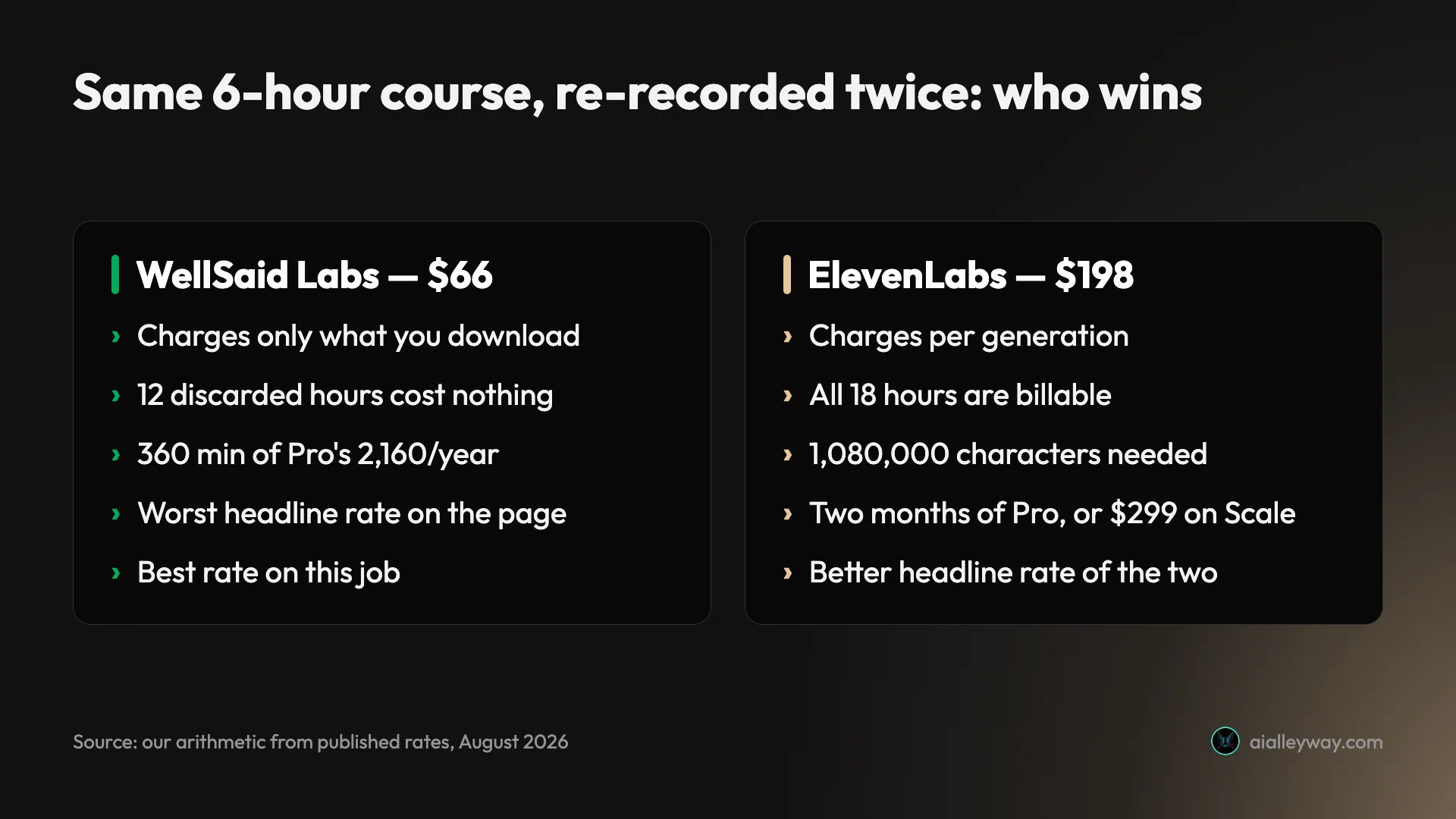
That is the whole argument for reading the meter before the price. Nothing about WellSaid’s $30-an-hour entry rate tells you it wins here, and nothing about ElevenLabs’ $10.91 tells you it loses.
What none of them do well yet
Worth knowing before you buy, because every vendor demo is a scripted single-speaker read and that is the easy case.
Genuine conversation. Overlapping turns, interruptions, two voices reacting to each other in real time — none of these tools produce that convincingly. Multi-speaker dialogue still means generating each part separately and editing them together, which is slow and never quite lands.
Performance rather than reading. Hume is the closest, and it is the reason to pick it, but “read this line angrily” remains directable in a narrow band. Comedic timing, sarcasm and genuine emotional escalation are still where a human narrator earns the fee.
Consistent pronunciation of the unusual. Proper nouns, technical terms, brand names and anything transliterated will drift across a long project, and every tool solves it with a pronunciation dictionary you have to maintain by hand. On a long audiobook that maintenance is real work nobody costs for.
Non-English quality parity. The language counts in the table above measure availability, not quality. English leads on every one of these tools, usually by a wide margin, and the second-tier languages are noticeably behind the first. Audition in your target language rather than in English.
Knowing what you will pay. This entire post exists because the answer to “what will this project cost” is not on any of their pricing pages. That is a category-wide failure, not a quirk of one vendor.
Language coverage, compared honestly
Every tool here advertises a language count, and several of those numbers are unreachable at any price you can actually pay.
| Tool | Advertised | What you get on a normal paid plan |
|---|---|---|
| ElevenLabs | 32+ | 32+, from $6 Starter |
| Murf AI | 20+ | 20+, plus mid-sentence switching |
| Descript | 30 dubbing / 14 native speakers | 14 native-sounding, from $16/mo |
| Speechify Studio | 20 voiceover languages | 20, from $100/yr |
| Hume Octave | 11 on Octave 2 | 2 — English and Spanish on the stable model |
| WellSaid Labs | 30+ | English only below Enterprise |
| Open-source | Varies by model | Fish Audio strongest; Kokoro English-led |
Two entries in that right-hand column deserve to be shouted about.
WellSaid markets 30+ languages, and Starter, Pro and Business all say “All English voices”. Additional languages and translation sit in the Enterprise feature block. If multilingual output is why you were considering WellSaid, no published plan will get you there.
Hume’s 11 languages belong to Octave 2, which is still marked preview. Octave 1, the stable model, does English and Spanish. Voice design is English-only with multilingual described as coming soon. Building today’s multilingual workflow on a preview model is a decision, not a default.
The tools that deliver what they advertise here are ElevenLabs and Murf, and Murf’s mid-sentence language switching is a genuinely distinctive feature if your scripts mix languages inside a paragraph. For anything beyond a handful of major languages, ElevenLabs remains the safe answer.
How to pick
- You want the best voice and the bill is secondary → ElevenLabs. It leads on quality and it is the only tool here that is strong at everything at once.
- Cost per hour is the deciding number → Speechify Studio at $100/year if you can pay annually, or Hume Octave at $14/mo. Speechify is about a third of ElevenLabs per hour, Hume a little over half.
- You need a production studio, not a voice box → Murf AI. Buy the timeline and the project system; the voices are the supporting act.
- You are already editing video or podcasts → Descript. The voice is nearly free alongside an editor you were going to buy anyway, and its cloning is the cheapest here.
- You are in a regulated industry, or a lawyer will read your contract → WellSaid Labs, at Pro rather than Starter. You are buying documented voice provenance.
- You need broad language coverage → ElevenLabs or Murf. Not Hume, which is two languages on its stable model, and not WellSaid, whose non-English voices are Enterprise-gated.
- Cloning your own voice is the whole job → Descript at $16/mo for the cheapest route, ElevenLabs for the best result. Skip Murf and WellSaid entirely.
- Your bill has outgrown the tools, or your audio cannot leave your servers → open-source. Kokoro to start, Fish Audio if you need languages.
- Skip this list entirely if you are building a real-time voice agent. That is an API problem, not a creator-tool problem, and it lives in best TTS API.
Final word
The realism argument is mostly over. Every tool in the top half of this list clears the bar for published narration, and picking on demo quality alone will lead you to the most expensive answer by default.
What is left is arithmetic and licensing, and both are more interesting than they sound. An hour of finished audio ranges from $4.17 to $30.00 across tools that all look similarly priced on their pricing pages, and the free tier that seems generous is usually the one that will not let you publish.
Start with ElevenLabs if you want the best voice, and read the full review before you commit to a tier.
Frequently asked questions
What is the best AI voice generator?
ElevenLabs, for most people, because it still leads on raw voice quality and it is the only tool here that is strong at narration, cloning and multi-language work at once. It is not the cheapest: at $22 a month on Creator it works out to $10.91 per finished hour of audio.
The honest answer depends on what you are buying. If you want the lowest cost per hour, Speechify Studio's $100-a-year plan is about $4.17 and Hume Octave at $14 a month is $6.00. If you need a full production studio rather than a voice box, Murf. If you are already editing video, Descript. And if you need documented voice rights for regulated work, WellSaid Labs. Pick the meter that matches your job, not the loudest demo. The seven-fold spread between the cheapest and dearest hour on this list is entirely a metering artefact, not a quality one.
How much does an AI voice generator cost per hour of audio?
Between about $4 and $30 an hour, which is a far wider spread than the monthly prices suggest. Speechify Studio works out at $4.17 an hour on its $100-a-year Starter plan, Hume Octave $6.00 on Creator, Murf $9.50, ElevenLabs $10.91 on Creator, and WellSaid Labs $30.00 on Starter.
The spread is this wide because these tools meter completely different things. ElevenLabs and Hume charge per character of input, Murf charges by hour of generated audio, Speechify charges credits per second, and WellSaid charges only for minutes you actually download. Comparing monthly prices tells you almost nothing. Convert everything to the same unit before you choose, which is what the table in this post does. WellSaid's $30 entry rate also drops to $11 an hour on its Pro plan, so the tier matters as much as the tool.
Is there a free AI voice generator with commercial rights?
Not among the mainstream cloud tools. Every free tier here withholds commercial use: ElevenLabs, Hume Octave, Speechify Studio and WellSaid Labs all grant it only on a paid plan. Free tiers are auditions, and treating one as a publishing runway is how people end up outside the terms without noticing.
Open-source models are the real answer. Kokoro 82M, Fish Audio and Chatterbox are permissively licensed and free to run on your own hardware, so the cost is your GPU time and your setup effort rather than a subscription. Quality now sits close enough to the paid tools for a lot of narration work. The trade is that nobody supports you and nobody indemnifies you, and you are running the inference yourself. Descript's free tier is the one partial exception among the paid tools, in that it lets you export at all, but it watermarks the video.
Which AI voice generator can clone my voice?
Descript is the cheapest route at $16 a month billed annually, and ElevenLabs is the best at it, with instant cloning from a short sample on its $6 Starter plan and professional cloning on the $22 Creator plan. Hume Octave offers cloning on every tier including free.
Two traps are worth knowing. Hume lets you create a clone on any plan but only Enterprise can call a cloned voice through the API, so building a product on it means a sales conversation. Murf locks cloning to Enterprise entirely, and WellSaid Labs does not offer self-serve cloning at all because its voices come from contracted voice actors. If cloning is why you are here, those two are the wrong tools regardless of price. Instant cloning takes 10 to 30 seconds of audio and is usually free to train; professional cloning wants 30 minutes or more and sits behind a higher tier and a consent recording.
Do AI voice generators sound realistic enough to publish?
For scripted narration, yes, and that stopped being the interesting question around 2025. The top tools clear the bar for audiobooks, e-learning, explainers and corporate voiceover, and most listeners will not flag them. Where they still struggle is unscripted emotional range, overlapping conversational turns, and any script that needs a performance rather than a read.
The realism gap between the leaders has also narrowed to the point where it rarely decides a purchase. Metering, licensing and language coverage decide it instead. That is why this roundup ranks on cost per finished hour and on what each tool will actually let you publish, rather than on which demo sounds best in isolation. Audition in your target language rather than in English, too: the language counts these tools advertise measure availability, not quality, and the second-tier languages lag the first noticeably.
Can I use an AI voice commercially without legal risk?
Only if the licence says so in writing and the voice itself is cleanly sourced. Those are two separate questions and most buyers only check the first. A paid plan usually grants commercial use of the output, but that says nothing about where the underlying voice came from.
WellSaid Labs is the clearest on this: its voices come from contracted voice actors through a formal Voice Actor Program, which is why regulated buyers pick it despite it being the most expensive per hour here. At the other end, cloning someone else's voice without documented consent is the actual legal exposure, and every serious tool now requires a consent recording before it will train a professional clone. If you are in healthcare, finance or anything with a compliance team, buy the documented voice rights rather than the cheapest hour.
Keep reading
Best AI voice cloning: which tool actually sounds like you?
ElevenLabs is the best AI voice cloning tool overall, but the right pick depends on whether you're cloning your own voice, building an app, or want it free.
Best AI voice generator for audiobooks (and where to publish it)
ElevenLabs is the best AI voice for audiobooks, but the right pick depends on whether you're cloning your own narrator voice, publishing free, or on a budget.
ElevenLabs vs Descript: voice engine vs editing suite
ElevenLabs makes the best AI voice; Descript is the editor that even runs ElevenLabs inside it. Here's which you actually need, and when to use both.
ElevenLabs vs Murf: the cheaper one is your script
Murf bills by audio duration, ElevenLabs by characters, so the cheaper voice tool depends on your script's pace, not the price page. I ran the numbers.