
Cartesia pricing: the $5 plan goes further than it looks
Cartesia pricing sells credits, not minutes. With overages on, the $5 Pro plan beats the $49 one right up to 777K credits a month. The real per-unit math.
Contents
How much does Cartesia cost?
Cartesia is free to test and $5 a month to actually ship with. That $5 Pro plan is the first tier with a commercial use license, which makes it less a pricing decision than a formality, and it covers about 133 minutes of generated speech.

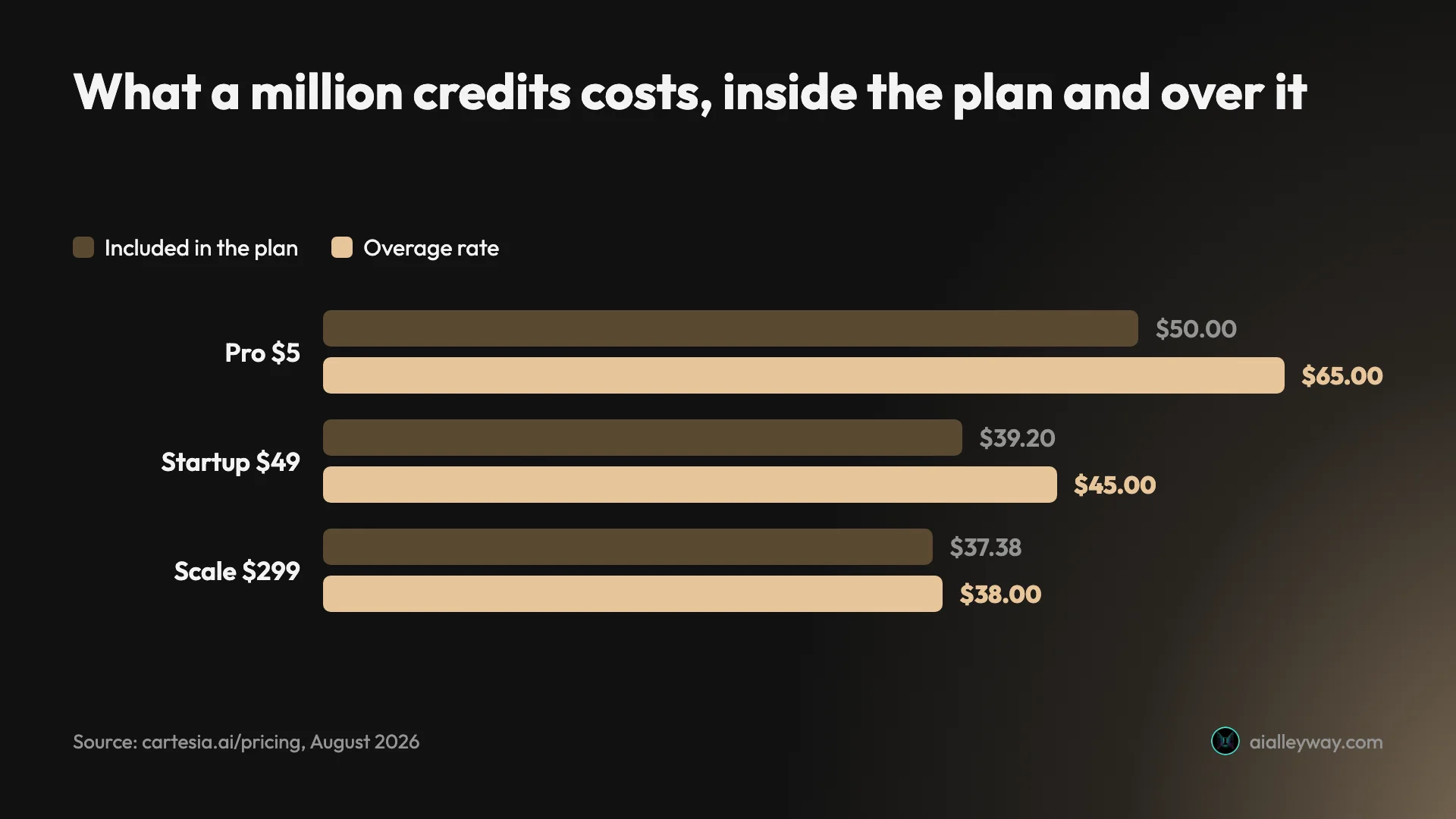
The number the pricing page never puts in front of you is what a credit costs once you leave the plan. Pro bills overage at $65 per million credits against an in-plan rate of $50 per million. Scale bills $38 against $37.38. The penalty for going over shrinks almost to nothing as you climb, and that single fact changes which plan you should buy.
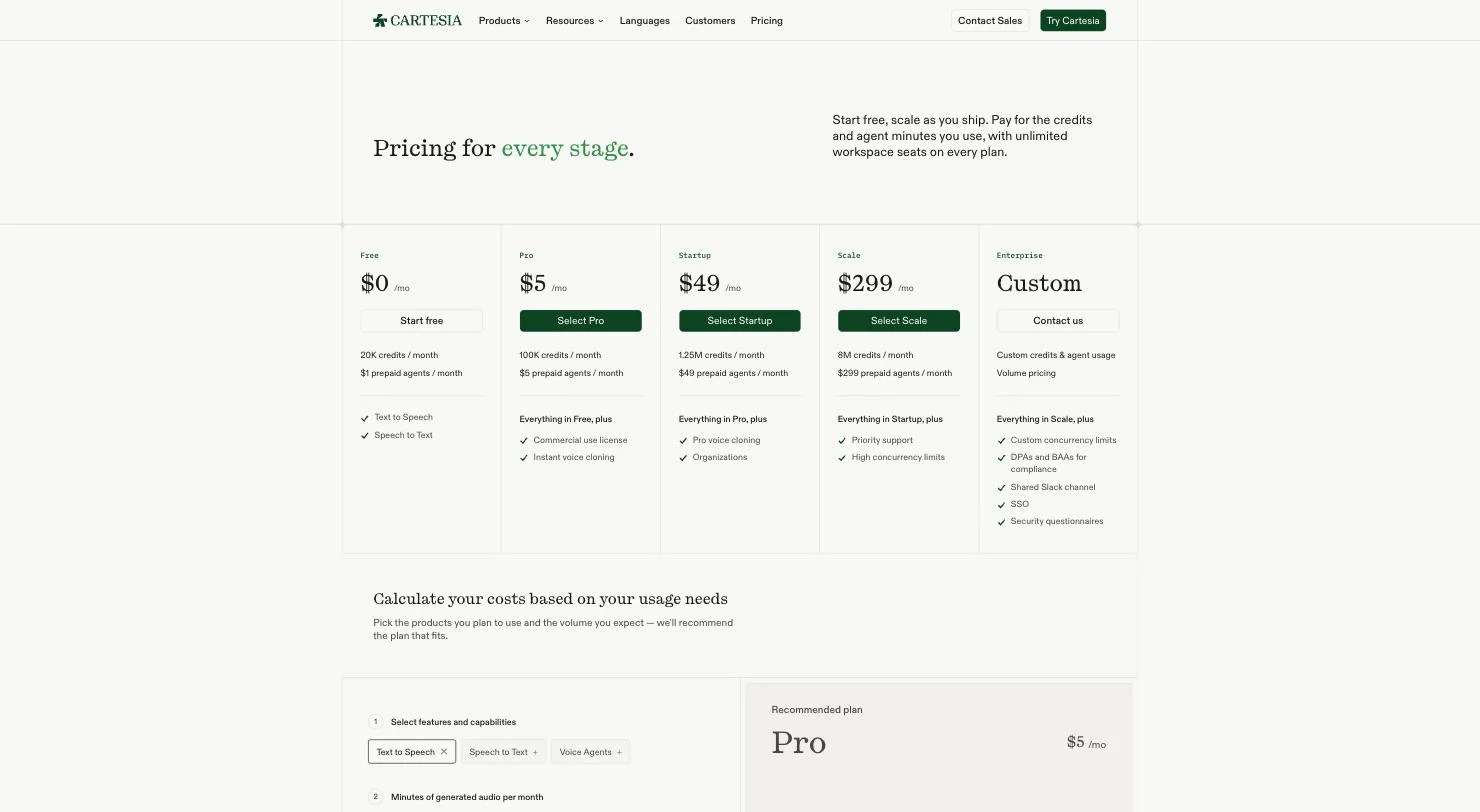
| Plan | Price | Model credits/mo | Prepaid agent $ | Speech included | Transcription included |
|---|---|---|---|---|---|
| Free | $0 | 20K | $1 | ~27 min | ~1h 51m |
| Pro | $5/mo | 100K | $5 | ~133 min | ~9h 16m |
| Startup | $49/mo | 1.25M | $49 | ~1,667 min | ~115h 44m |
| Scale | $299/mo | 8M | $299 | ~10,667 min | ~740h 44m |
| Enterprise | Custom | Custom | Custom | Custom | Custom |
If you want the quality verdict rather than the bill, that lives in our full Cartesia review. This guide is about what it costs and where the cost surprises you.
How Cartesia’s credits work: one credit, one character
Cartesia sells one currency and spends it three different ways. Every plan comes with a pool of model credits, and text-to-speech, speech-to-text, voice changing and voice localization all draw from the same pool at different rates.
For Sonic text-to-speech, one credit equals one character of input text. Not a word, not a second of audio, a character. That is the cleanest metering model in the category, because you can count the cost of a script before you generate it.
Cartesia’s own pricing FAQ converts that to time at 750 to 800 credits per minute of speech, and its plan table backs the figure out exactly: 100,000 credits divided by 750 is 133 minutes, which is the number printed against Pro.
Speech-to-text runs on a different clock. Ink-2 costs 3 credits per second of audio, so a minute costs 180 credits and an hour costs 10,800. Put those side by side and generation is the expensive meter: an hour of transcription costs about the same as 14 minutes of generated speech.
Voice agents are the exception that breaks the pattern. Cartesia’s Line agents do not spend credits at all. They spend dollars, at $0.06 per minute of call, out of a prepaid balance that every plan includes.
That prepaid balance is set to exactly the plan price. Free gets $1, Pro gets $5, Startup gets $49, Scale gets $299. Your subscription fee is effectively handed straight back to you as agent calling, on top of the credits.
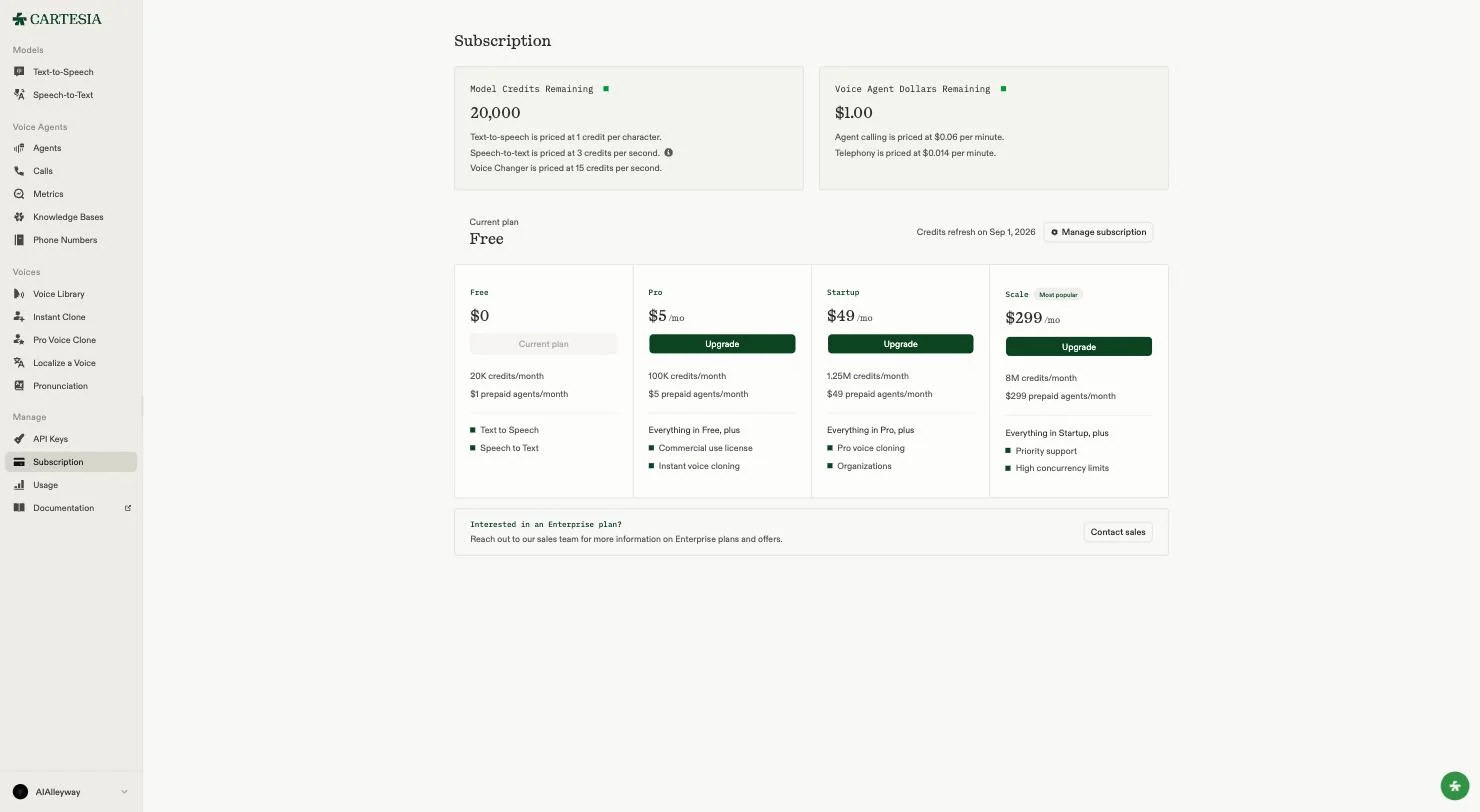
Here is the full rate card, and it is worth reading once because three of these lines are easy to trip over.
| What you’re doing | What it costs |
|---|---|
| Sonic text-to-speech | 1 credit per character |
| Ink-2 speech-to-text | 3 credits per second of audio |
| Voice changer | 15 credits per second of audio |
| Localizing a voice | 225 credits, one-time |
| Pro voice clone training | Free |
| Speech from a pro voice clone | 1 credit per character, same as instant cloning |
| A single break tag in your text | 1 credit |
| Line voice agent call | $0.06 per minute |
| Cartesia-provided phone number | +$0.014 per minute |
The plans, broken down
Four published tiers, and the gaps between them are wider than the price ladder suggests. Here is what each one is genuinely for.
Free — $0, 20,000 credits
An audition, not a runway. Twenty thousand credits is 27 minutes of speech or 1 hour 51 minutes of transcription, and the $1 of agent dollars buys about 17 minutes of calling.
The hard stop is not the volume. Free carries no commercial use license, which arrives at Pro. Ship anything a customer touches on this tier and you are outside the terms.
The plan grid also lists instant voice cloning as a Pro feature, but the Instant Clone tool is reachable on a free account with no upgrade prompt. Treat the licence as the real gate and the feature list as approximate.
Concurrency is thin too: 2 concurrent text-to-speech requests, 8 for transcription, 8 concurrent agent calls. Enough to test, not enough to serve.
Pro — $5/mo, 100,000 credits
The plan almost everyone should start on, and the one most people leave too early. Five dollars buys the commercial license, instant voice cloning, 133 minutes of speech, and a third concurrent text-to-speech slot.
It also buys the right to overage. Paid accounts can switch overages on and let the credit balance go negative at $65 per million, which means hitting the allowance on Pro changes your rate instead of stopping you.
What Pro does not include is professional voice cloning or organizations. If you need either, the tier decision is made for you regardless of volume.
Startup — $49/mo, 1.25M credits
The first tier that is really a team plan. It adds pro voice cloning with 2 clone slots, organizations, and raises concurrency to 5 text-to-speech and 20 transcription requests.
On pure credit cost it is a modest improvement: $39.20 per million against Pro’s $50.00. The overage rate drops to $45 per million, which is 15% above its in-plan rate rather than the 30% Pro charges.
Scale — $299/mo, 8M credits
Bought for concurrency and support as much as for credits. It lifts you to 15 concurrent text-to-speech requests, 60 transcription requests, 10 agent slots and priority support, with 4 pro voice clone slots.
Its overage rate is the interesting part. At $38 per million against an in-plan $37.38, going over budget on Scale costs about 1.7% more than staying inside it. At that point the allowance is little more than a billing convenience.
Enterprise — custom
Quote-only, and the feature list tells you who it is for: custom concurrency limits, DPAs and BAAs, SSO, security questionnaires and a shared Slack channel. Volume pricing is negotiated, so none of the per-unit maths below applies.
What you’re really buying up the ladder
Credits are the thing everyone compares and rarely the thing that forces an upgrade. Three other limits move with the tier, and any one of them can decide your plan on its own.
Concurrency is the first. Each service has its own pool, and Cartesia is explicit that they do not interfere: running text-to-speech does not eat into your transcription or agent capacity. That is genuinely useful, because it means you size each workload separately rather than budgeting one shared ceiling.
| Limit | Free | Pro | Startup | Scale |
|---|---|---|---|---|
| Concurrent text-to-speech requests | 2 | 3 | 5 | 15 |
| Concurrent transcription requests | 8 | 12 | 20 | 60 |
| Agent slots | 1 | 3 | 5 | 10 |
| Concurrent agent calls | 8 | 12 | 20 | 60 |
| Pro voice clone slots | none | none | 2 | 4 |
Read the text-to-speech row carefully, because it is the tightest number in the table. Going from Free to Pro buys you one extra concurrent stream. Going from Startup to Scale triples it.
If you are serving a live product where several users might hit generate at the same second, that row decides your plan before any credit maths does. A queue caused by a concurrency cap looks exactly like latency, which is the one thing people buy Cartesia to avoid.
Pro voice cloning is the second forcing function, and it is binary. It does not exist on Free or Pro at any volume, arrives with 2 slots on Startup, and reaches 4 on Scale. Training a clone is free, so the slot count is the only limit that matters.
The third is organizations. Shared workspaces start at Startup, so a solo developer can live on Pro indefinitely while a two-person team cannot.
What does a Cartesia credit actually cost?
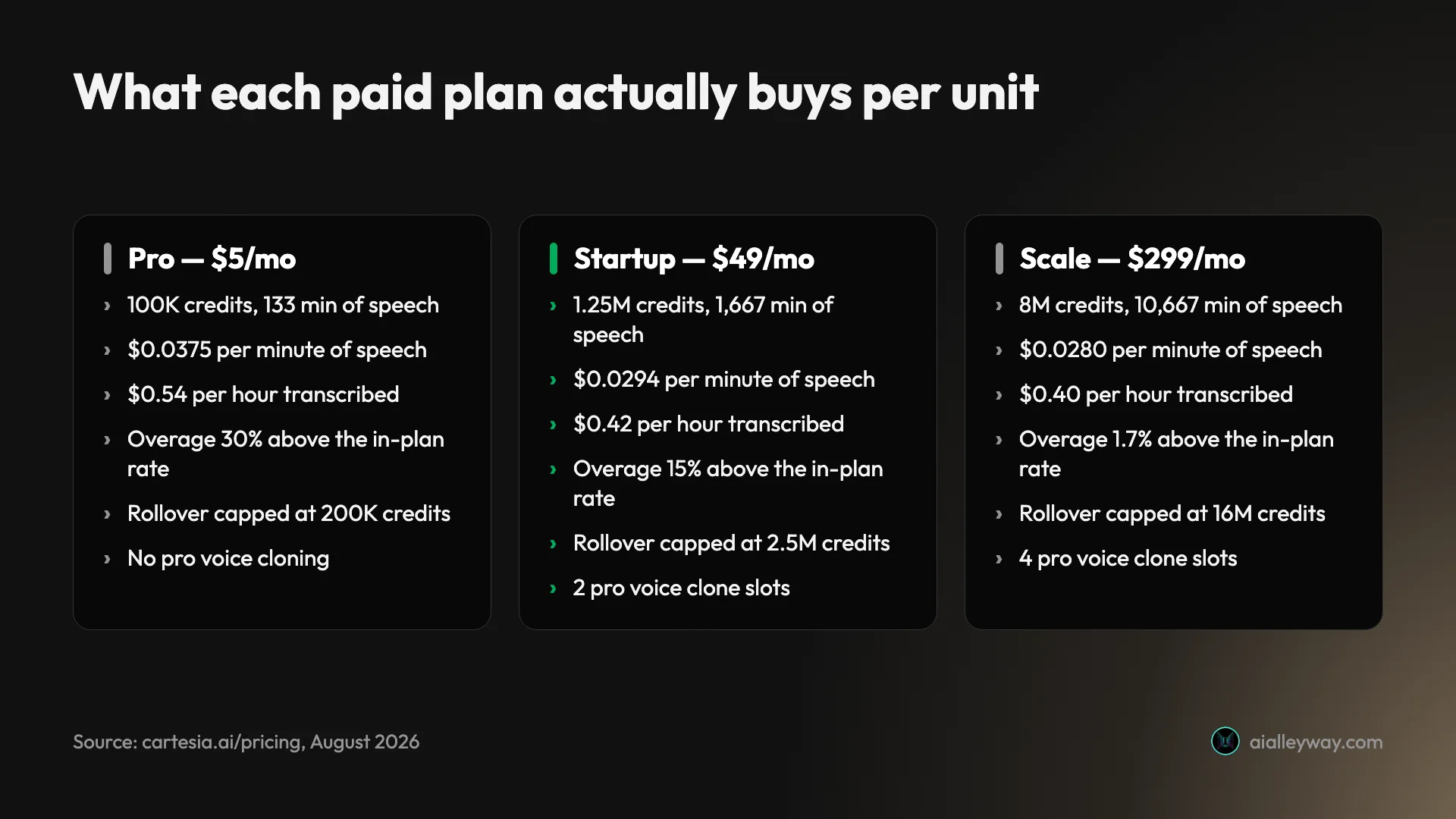
Plan prices are close to meaningless until you normalize them. Divide each plan’s cost by its credit allowance and the real ladder appears.
Pro costs $50.00 per million credits. Startup costs $39.20. Scale costs $37.38. Free costs nothing, which is why it is capped so tightly.
Translate that into speech at 750 credits a minute and Pro runs $0.0375 per minute of audio, Startup $0.0294, Scale $0.0280. An hour of generated narration costs $2.25 on Pro and $1.68 on Scale.
Transcription at 10,800 credits an hour lands at $0.54 an hour on Pro, $0.42 on Startup and $0.40 on Scale. Cartesia’s own FAQ quotes $0.39 for the Scale figure, a rounding away from what its plan table implies, and either number is cheap enough that transcription volume rarely decides your tier.
The gap between the cheapest and dearest paid tier is smaller than the price tags imply. Scale costs 60 times what Pro costs, but a credit on Scale is only about a quarter cheaper than a credit on Pro: $37.38 against $50.00.
That is the whole argument for staying low and turning overages on. You are not buying cheaper credits by moving up. You are buying concurrency, cloning slots and support, and paying a modest volume discount for the privilege.
The model you pick moves the bill more than the plan you buy
This is the single biggest lever in Cartesia’s pricing, and it is not on the pricing page at all. It is in the docs, and it applies to transcription.
Cartesia ships two speech-to-text models. Ink-2 costs 3 credits per second of audio. Ink-whisper costs 1 credit per second streaming, and 1 credit per 2 seconds in batch mode.
Carry that to an hour and the spread is severe. Ink-2 costs 10,800 credits an hour. Ink-whisper streaming costs 3,600. Ink-whisper in batch costs 1,800, which is exactly a sixth of the ink-2 figure.
| Transcribing one hour | Credits | On Pro | On Startup | On Scale |
|---|---|---|---|---|
| Ink-2, streaming | 10,800 | $0.54 | $0.42 | $0.40 |
| Ink-whisper, streaming | 3,600 | $0.18 | $0.14 | $0.13 |
| Ink-whisper, batch | 1,800 | $0.09 | $0.07 | $0.07 |
An hour of batch transcription on Pro costs $0.09. The same hour with ink-2 on Scale costs $0.40. Moving up two tiers and paying $294 more a month gets you a worse rate than simply picking the cheaper model.
Cartesia leads with ink-2 and prices it three times higher, which tells you which one it considers the better model, though its docs make no published accuracy claim between the two. Ink-2 is also unavailable on the batch endpoint. So this is a real trade rather than free money, and the point is that it is a trade you get to make: on a transcription-heavy workload the model picker is worth more than the plan picker.
There is a similar trap on the generation side. Infill requests carry a fixed 300 credits before a single character is voiced, on top of the normal per-character rate. If your workflow patches short corrections into existing audio, that fixed fee dominates: a 40-character fix costs 340 credits rather than 40.
How much do Cartesia voice agents cost?
Agents are priced in dollars, not credits, and the mental model is different enough that it catches people out. Every plan comes with a prepaid agent balance equal to its price, and calls draw against it at $0.06 a minute.
Once that balance is gone, calls do not stop and they do not get more expensive. Cartesia keeps billing the same $0.06 a minute. That makes agent spend perfectly linear, which is unusual and genuinely helpful for forecasting.
The corollary is that the plan fee is close to free if you use agents. On Startup you pay $49 and get $49 of calling back, so the real cost of the subscription is whatever value you place on the 1.25M credits and the concurrency that come with it.
Two line items on the pricing page are marked as temporary and both are currently zero. LLM usage during calls is “free for UI-created agents for a limited time”, and evaluations are “free of charge for a limited time only”. Neither has a published end date or a published future rate.
Budget as though both will one day carry a price. An agent’s language model calls are the largest variable cost in most voice-agent stacks, and a stack costed today against a free LLM line is a stack that has not been costed.
Cartesia against ElevenLabs and Murf, per million characters
Normalizing across three tools takes some care, because none of them meters the same way. Cartesia sells credits at one credit per character. ElevenLabs sells credits that map roughly one-to-one to characters on its high-quality model. Murf sells hours, which I have converted at Cartesia’s own 750 characters per minute so the columns compare.
| Tool and plan | Price | What $299 or equivalent buys | Cost per 1M characters |
|---|---|---|---|
| Cartesia Scale | $299/mo | 8M credits | $37.38 |
| Cartesia Startup | $49/mo | 1.25M credits | $39.20 |
| Cartesia Pro | $5/mo | 100K credits | $50.00 |
| ElevenLabs Scale | $299/mo | 1.8M credits | $166.11 |
| ElevenLabs Creator | $22/mo | 121K credits | $181.82 |
| Murf Creator | $19/mo annual | 24 hours per year | about $211 |
The Scale-against-Scale row is the one to sit with. Both platforms charge $299. Cartesia hands you 8 million credits, ElevenLabs hands you 1.8 million, so the same money buys about 4.4 times the characters. We put the two head to head on quality as well as cost in ElevenLabs vs Cartesia, and the same normalisation across nine providers is in best TTS API.
That gap is real and it is also not the whole story. ElevenLabs has the larger voice catalog, wider language coverage, and the narration and dubbing workflows Cartesia does not build. You are not buying the same product at two prices.
Murf’s number looks worst here and it is the least fair comparison of the three, because Murf is sold as a studio rather than an API. Nobody buys Murf to generate a million characters. They buy it to avoid thinking in characters at all.
Where Cartesia’s per-character price genuinely decides the purchase is a product that generates speech at machine volume: an agent, a reader, an app that voices dynamic text. For a person recording a podcast once a week, the difference between $37 and $166 per million characters is a difference on a bill neither of them will ever reach.
Four workloads, costed
These are modelled from the rates above rather than metered from a live account. The arithmetic is simple enough to check, and every input is printed on this page.
A solo creator narrating 45 minutes a month. That is 33,750 credits at 750 a minute, which overshoots the free tier’s 20,000 and sits comfortably inside Pro’s 100,000. Cost: $5, with two thirds of the allowance unused and rolling over. Cartesia’s own on-page calculator recommends Pro at exactly this volume.
A weekly podcast doing intros, outros and a 20-minute read. Call it 90 minutes of finished audio a month, or 67,500 credits. Still Pro at $5, still inside the allowance, though re-recording a bad take spends the budget twice and there is not much headroom left for that.
A support agent handling 500 calls a month at 4 minutes each. Two thousand agent minutes at $0.06 is $120. The Pro plan’s prepaid $5 covers the first 83 minutes, and the rest bills at the same rate, so the monthly total is $120 and the plan fee disappears into it. Add a Cartesia phone number and the same 2,000 minutes cost $148.
A team transcribing 40 hours of calls a month. That is 432,000 credits at 10,800 an hour. Startup covers it at $49. Pro plus overages covers it too, at $5 plus 332,000 excess credits at $65 per million, which is $21.58, for a total of $26.58. The $5 plan wins by about $22 a month.
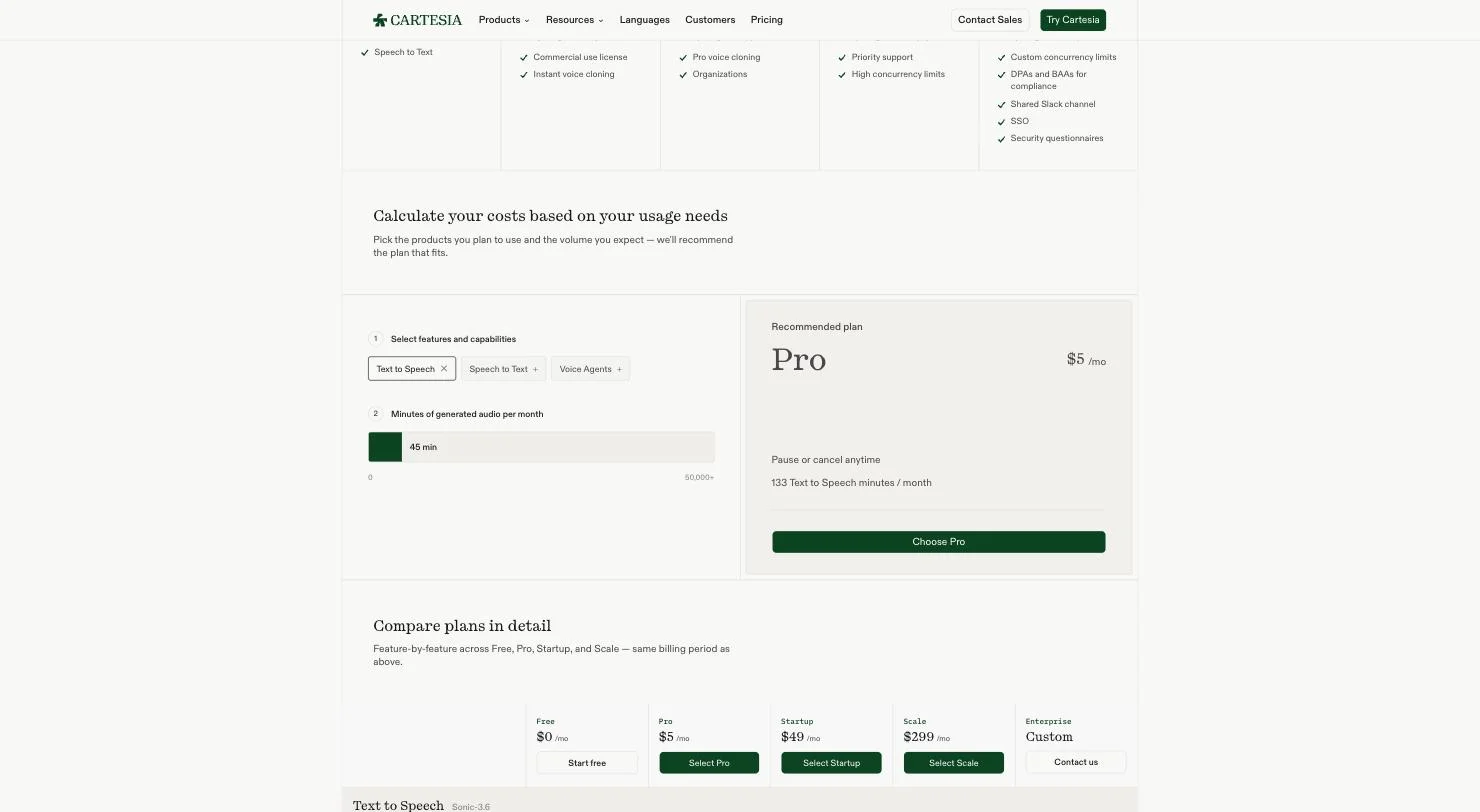
That last one is no accident. It is the shape of Cartesia’s whole pricing table, and the tipping point can be calculated exactly.
The two crossovers the pricing page won’t show you
Because overage is priced per tier and the tiers are flat fees, there is a specific volume where each upgrade starts paying for itself. Neither number appears anywhere in Cartesia’s documentation.
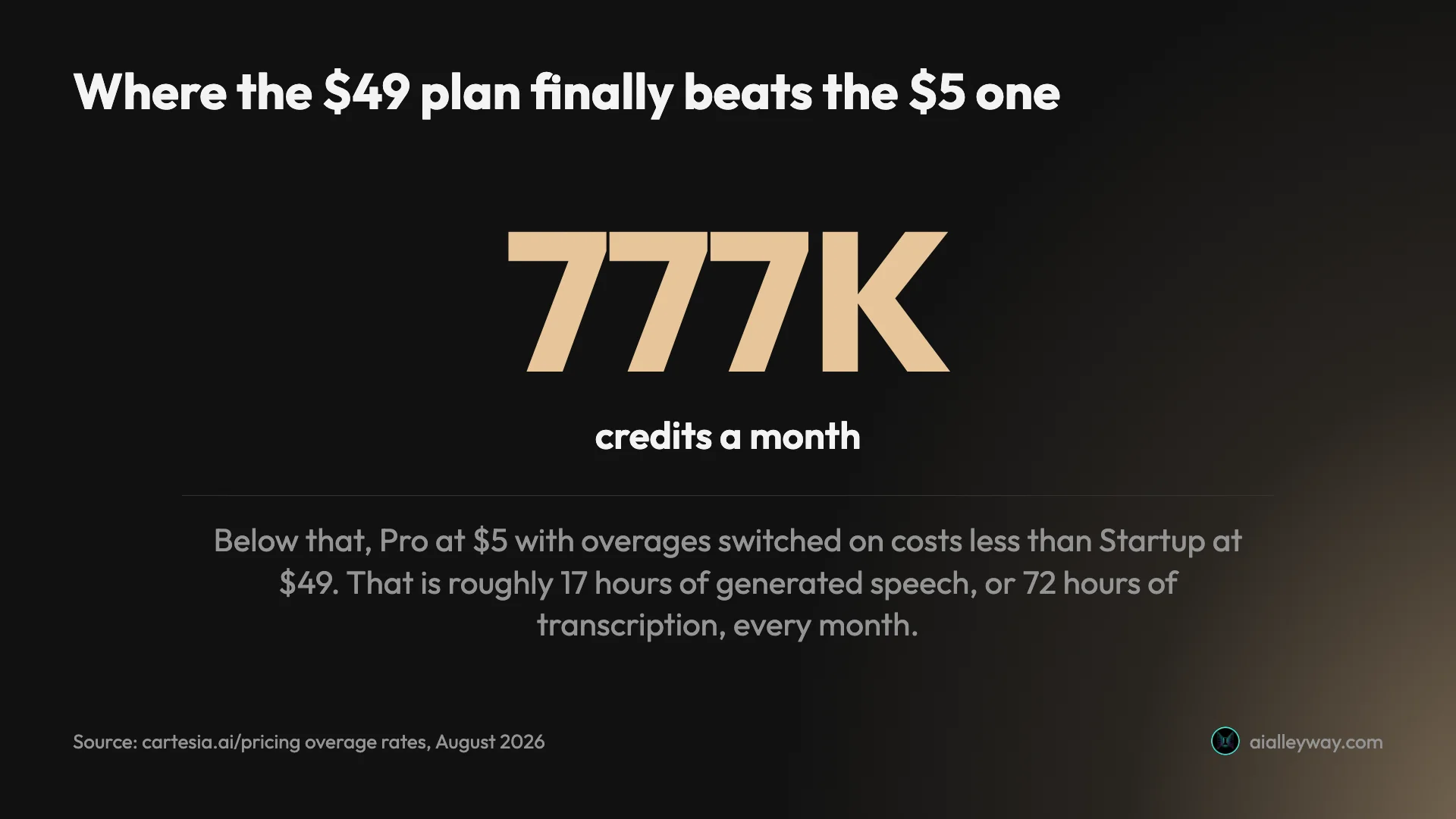
Pro plus overage beats Startup up to about 777,000 credits a month. Set $5 plus excess-at-$65-per-million equal to a flat $49, and the excess works out to 676,923 credits, on top of Pro’s included 100,000. In speech that is roughly 1,036 minutes, or about 17 hours a month. In transcription it is about 72 hours.
Startup plus overage beats Scale up to about 6.8 million credits a month. Same method: $49 plus excess-at-$45-per-million equals $299 when the excess reaches 5,555,556 credits, on top of Startup’s 1.25 million. That is roughly 9,074 minutes of speech, or 151 hours.
Both crossovers are about credits alone. They ignore everything else the higher tiers include, and that is exactly where you should be careful.
Pro voice cloning starts at Startup, and it starts at 2 slots. Concurrent text-to-speech goes 3 on Pro, 5 on Startup, 15 on Scale, so the big jump is at the top of the ladder rather than the middle. If your product needs 15 simultaneous streams, no amount of overage on a $5 plan will give them to you.
So read the crossovers as a floor, not a rule. Below 777,000 credits, upgrading from Pro buys you features and headroom, never cheaper credits. Above it, the upgrade pays for itself twice.
The billing mechanics: rollover, upgrades, and cancelling
This is the part of Cartesia’s pricing I like most, and it is buried in a collapsed accordion at the bottom of the page where almost nobody reads it.
Credits roll over, capped at twice your monthly allowance. A quiet month is banked rather than burned. On Pro that ceiling is 200,000 credits, on Startup 2.5 million, on Scale 16 million.
That single policy changes how you should plan. Most voice platforms reset the meter monthly, so buying for your peak month means paying for that peak twelve times a year. With a 2x rollover you can buy for something closer to your average and let the quiet months absorb the busy ones.
Upgrading credits you immediately. Cartesia’s FAQ says the new tier’s credits are added to your current balance rather than replacing it, and the rollover cap resets to twice the new plan rate. You do not lose the balance you built up on the smaller plan.
Downgrading and cancelling are equally forgiving. You keep credits already in the account until you spend them, and the account stays on its current tier until the end of the billing period before dropping to the new one. There is no clawback of paid-for credits.
Renewal follows your purchase date, not the calendar. Cartesia’s own example is buying on 31 March and renewing on 30 April, then 31 May. Worth knowing if you are lining a subscription up against a client’s billing month.
| Situation | What happens to your credits |
|---|---|
| Unused at month end | Roll over, up to 2x the monthly allowance |
| Upgrade tier | Added to the existing balance; cap resets to 2x the new rate |
| Downgrade tier | Kept; the tier changes at the end of the period |
| Cancel mid-period | Kept until spent; tier holds until the period ends |
| Balance hits zero, overages on | Balance goes negative, billed at the tier’s overage rate |
| Balance hits zero, overages off | New requests are blocked |
The one setting to change on day one is that last row. Overages default to off, and off is a hard stop rather than a slowdown.
The costs the pricing page soft-pedals
Six things that are true, documented, and easy to miss on a first read of the plan grid.
Overages are off by default, and off means blocked
Cartesia’s pricing FAQ is explicit: “If your overages are off, new requests will be blocked if all your credits have been consumed.” That is a hard stop on a production API, triggered by a setting most people never open.
Turn it on before you need it. The alternative is discovering the toggle exists during an outage.
The commercial licence is the real free-tier limit
The free plan’s 20,000 credits get all the attention, but its licence terms are what actually stop you. Commercial use starts at Pro, per the plan grid.
The grid puts instant voice cloning at Pro too, though the tool itself opens on a free account. That gap between the published entitlement and the shipped product is a reason to read the licence rather than the feature ticks. At $5 the fix is trivial, which is the point: treat the free tier as an audition and budget Pro from day one.
A Cartesia phone number eats a fifth of your agent budget
Telephony adds $0.014 per minute on top of the $0.06 call rate, taking the total to $0.074. Against a prepaid balance, that is 18.9% of every minute going to the phone number.
In practice Pro’s $5 buys 83 agent minutes without telephony and 68 with it. Startup’s $49 goes from 817 minutes to 662.
| Plan | Prepaid agent $ | Minutes at $0.06 | Minutes at $0.074 with a phone number |
|---|---|---|---|
| Free | $1 | 17 | 14 |
| Pro | $5 | 83 | 68 |
| Startup | $49 | 817 | 662 |
| Scale | $299 | 4,983 | 4,041 |
Break tags cost a credit each
Cartesia counts each break tag in a TTS request as 1 credit. On a heavily marked-up script with a pause after every sentence, that is a few hundred credits a session, which is noise on Startup and noticeable on Free.
It is a small thing, but it is the kind of small thing that makes your metered usage disagree with your character count.
An hour of speech costs four times an hour of transcription
The two meters run at very different speeds, and it is the wrong one that feels expensive. Generating speech costs 750 credits a minute, so an hour of finished audio is 45,000 credits. Transcribing costs 180 credits a minute with ink-2, so an hour of input audio is 10,800.
Anyone sizing a plan off “hours of audio” without separating the two will size it wrong, usually by underestimating generation. Cost the two workloads separately, then add them.
There is no annual discount to wait for
Cartesia’s pricing page shows a single monthly figure per plan and no billing-period toggle, and the in-app upgrade screen for our account shows the same $5, $49 and $299. Several published guides still describe a 20% annual saving. Whatever was true before, the toggle is not there now.
There is a genuine upside hiding in that, though. Unused credits roll over up to twice your monthly allowance, so a quiet month is banked rather than lost. That is the opposite of how ElevenLabs meters credits, where the monthly allowance simply resets.
The grant that skips the ladder entirely
If you are an early-stage startup, every number above may be irrelevant to you, and this is the least-publicized thing in Cartesia’s pricing.
The Cartesia Startups Grant gives 12 months free on the full stack: 8 million Sonic and Ink credits a month, plus $300 a month in agent credits, with 2x rollover and high concurrency limits. That is the Scale plan and then some, for a year.
Cartesia values the package at “over $8,000 in total value”. Priced against its own list rates the maths lands a little lower, at $299 plus $300 a month for twelve months, or $7,188. Either way it is a great deal more than most seed-stage voice budgets.
The application is short by design. Cartesia asks what you are building, who is on the team and where you are headed, promises a reply within a week, and issues a coupon code that activates the credits.
There is a second door for anyone already inside Google’s ecosystem. Scale Tier members of the Google for Startups Cloud Program get 12 months of Cartesia’s Startup tier, at 1.25 million credits a month with up to 5 concurrent requests and pro voice cloning included.
Apply before you subscribe, not after. Nothing on the pricing page points you here, and a year of Scale-level capacity is worth more than any tier decision on this page.
Which Cartesia plan should you pick?
Prototyping, no customers yet. Free. Twenty thousand credits is enough to hear Sonic’s latency, wire up the API and decide whether the voices fit. Do not ship on it.
A solo product, an app, or any commercial work under about 17 hours of speech a month. Pro at $5, with overages switched on. It is the cheapest legal way to ship, and overage keeps it running past the allowance instead of blocking.
You need a professional voice clone or a shared organization. Startup at $49, regardless of volume. Pro voice cloning does not exist below this tier, and no amount of overage buys it.
A live product needing more than 5 concurrent streams, or 15-plus at peak. Scale at $299. You are buying concurrency and priority support here; the credits are close to the same price as Startup’s.
Skip Cartesia entirely if you want narration, audiobooks or dubbing. The catalog reads like a support-desk roster and the long-form tooling is not there. That is a product judgement rather than a pricing one: our Cartesia review makes the case in full, and our best AI voice for audiobooks roundup covers what to buy instead.
If the credit math doesn’t work: three other routes
ElevenLabs is the broader tool by a distance: a far larger voice catalog, real language coverage, and the narration and dubbing workflows Cartesia does not build. It costs more per character at the low tiers and its credits do not roll over. Our ElevenLabs pricing guide has the credit maths, and the ElevenLabs review has the quality verdict.
Murf AI sells hours instead of credits, which suits anyone who would rather not do arithmetic before recording. The trade is that voice cloning is an Enterprise-only add-on. See the Murf pricing breakdown for what the hours really buy.
Descript is the odd one out and the right answer for a particular reader: it bundles text-to-speech into an editor, so if you were going to buy a voice tool and an editing tool, one subscription can cover both. Its own metering has two meters and its own traps, which we untangle in the Descript pricing guide.
None of these three is cheaper than Cartesia per character at volume. They are cheaper in effort, or broader in what they cover, which for most creators is the axis that actually decides the bill.
Final word
Cartesia’s pricing is honest and unusually easy to model. One credit is one character, the rate card is published, credits roll over, and the plan fee comes back to you as agent calling.
The mistake to avoid is upgrading on instinct. The plan ladder looks like a volume discount and mostly is not: a credit on Scale costs $37.38 against $50.00 on Pro, while the sticker goes from $5 to $299. What you are actually buying up the ladder is concurrency, cloning slots and support.
So start on Pro, switch overages on, and let the bill tell you when you have crossed 777,000 credits. Until then the $5 plan is doing the work of the $49 one.
Frequently asked questions
How much does Cartesia cost per month?
Cartesia has four published plans plus a custom tier. Free is $0 and includes 20,000 model credits a month. Pro is $5 for 100,000 credits, Startup is $49 for 1.25 million, and Scale is $299 for 8 million. Enterprise is quote-only. Every paid plan also hands you a prepaid voice-agent balance equal to the plan price, so the $49 Startup plan includes $49 of agent calling on top of its credits.
Most people building a normal text-to-speech workload land on Pro at $5, which covers about 133 minutes of generated speech a month. With overages switched on it keeps billing past that at $65 per million credits rather than cutting you off, so the step up to Startup only pays for itself around 777,000 credits a month. There is no annual billing toggle on the pricing page or in the app, so the monthly figures above are the only prices on offer.
How many credits does one minute of Cartesia audio use?
One credit equals one character of text, and Cartesia's own pricing FAQ puts one minute of Sonic speech at 750 to 800 credits. That works out to roughly 133 minutes on the 100,000-credit Pro plan, which is exactly the figure Cartesia publishes in its plan comparison table. An hour of finished narration therefore costs about 45,000 credits.
Speech-to-text meters differently, and more cheaply per minute of audio. The Ink-2 model costs 3 credits per second, which is 180 credits a minute or 10,800 an hour. The ink-whisper model costs 1 credit per second streaming and 1 credit per 2 seconds in batch, dropping that same hour to 3,600 or 1,800 credits. On a transcription-heavy workload the model you pick moves the bill more than the plan you buy, because batch ink-whisper costs exactly a sixth of ink-2 for identical audio.
Do Cartesia credits roll over?
Yes, and this is the most underrated line in Cartesia's billing. Unused credits roll into the next month, capped at twice your monthly plan allowance. On Pro that cap is 200,000 credits, on Startup 2.5 million, on Scale 16 million. Most voice platforms reset the meter every month, so a rollover lets you buy for your average month rather than your peak one.
Changing tier does not burn what you have already paid for either. Cartesia's pricing FAQ states that existing credits remain when you upgrade or downgrade, and that the rollover cap simply resets to twice the new plan rate. Upgrading adds the new tier's credits to your current balance rather than replacing it. If you cancel or downgrade mid-period you keep the credits until you use them, and the account stays on the old tier until the billing period ends, which renews from your purchase date rather than the first of the month.
What happens if I run out of Cartesia credits?
It depends on one toggle, and it ships switched off. Paid accounts can turn overages on, which lets the credit balance go negative and bills the excess at a per-tier rate: $65 per million credits on Pro, $45 on Startup, $38 on Scale. With overages off, new requests are simply blocked once the balance hits zero. On a production API that is a hard stop rather than a slowdown, so turn it on before you need it.
Those overage rates matter more than they first appear. Measured against what a credit costs inside each plan, going over budget adds 30% on Pro, 15% on Startup and about 1.7% on Scale, so the penalty for exceeding your allowance almost disappears at the top tier. Voice agents behave differently again: once the prepaid agent dollars are spent, calls keep running and keep billing at the same $0.06 per minute your plan already charges.
Is Cartesia's free plan enough to build on?
Only for testing. The free plan gives 20,000 credits a month, which is about 27 minutes of generated speech or 1 hour 51 minutes of transcription, plus $1 of prepaid agent calling that buys roughly 17 minutes at $0.06 a minute. It also caps you at 2 concurrent text-to-speech requests. More importantly it carries no commercial use license, which starts at Pro.
That makes the free tier an audition rather than a runway. It is enough to wire up the API, hear Sonic's latency for yourself, and confirm the voice quality suits your product. The moment you ship anything a customer touches, you need at least the $5 Pro plan for the license alone. If you are an early-stage startup, apply to the Cartesia Startups Grant first: it gives 12 months of 8 million credits a month plus $300 a month in agent credits.
Is Cartesia cheaper than ElevenLabs?
Per character of generated speech, yes, and by a wide margin at volume. Both platforms sell a $299 plan. Cartesia's Scale tier includes 8 million credits at one credit per character, while ElevenLabs' Scale tier includes 1.8 million, so the same money buys about 4.4 times the characters. That is $37.38 per million characters against $166.11. Cartesia also rolls unused credits over, which ElevenLabs does not.
The comparison stops being about price quite quickly, though. ElevenLabs has the far larger voice catalog, broader language coverage, and the long-form and dubbing workflows Cartesia does not build. If you want narration, audiobooks, or podcast voices, the cheaper per-character rate is not the deciding factor, and neither tool's bill will get near a million characters. If you are wiring speech into a real-time product at machine volume, it is the whole argument.
Keep reading
Cartesia review: the fastest AI voice, made for agents
Cartesia's Sonic model is the lowest-latency AI voice going: a developer's dream for real-time agents, but creators hit its limits fast. My hands-on review.
Best TTS API: the price spread is 40x, and nobody says so
Cartesia for agents, ElevenLabs for quality, Google for cheap. Eight TTS APIs normalised to cost per million characters: the range is $4 to $166.
Best AI voice cloning: which tool actually sounds like you?
ElevenLabs is the best AI voice cloning tool overall, but the right pick depends on whether you're cloning your own voice, building an app, or want it free.
Best ElevenLabs alternatives: which one replaces it?
The best ElevenLabs alternative depends on why you're leaving. I lined up Murf, Descript, Cartesia and 4 more against the one job each actually wins.