
AI notetaker for Microsoft Teams: Copilot vs free apps
The best AI notetakers for Microsoft Teams — the native Copilot and intelligent recap vs free apps like Fathom — and how to set each one up.
Contents
Getting AI notes on Microsoft Teams comes down to your Microsoft licensing. If your organization pays for Copilot or Teams Premium, Teams has native AI note-taking built right in. If it does not, a free third-party app like Fathom gives you the same result on Teams without the upgrade, and usually a more generous one.
Below, both routes — Microsoft’s native AI notes and the best third-party notetakers that work with Teams — what each costs, how to set it up, and which fits your calls. The third-party picks come from hands-on testing rather than a spec sheet, so they reflect how each tool actually behaves on a call.
What are the two ways to get AI notes in Microsoft Teams?
There are two paths, and which one you take depends on your Microsoft plan and whether you want anything joining the call.
Microsoft’s native AI notes. Teams has built-in AI note-taking, but it comes in two paid flavours: Copilot, which writes AI notes during the meeting, and Teams Premium’s intelligent recap, which assembles a fuller recap afterward. Both are the most integrated option because the output lands in Microsoft tools, but both sit behind a license and are Teams-only.
A third-party notetaker. Tools like Fathom, Otter, Granola, and tl;dv connect to Teams regardless of your Microsoft plan. Several are free, they often do more than the native options on their own, and most also cover Zoom and Google Meet, so they are the better choice if you do not have the licenses or you work across platforms.
| The measure | Native (Copilot / recap) | Third-party notetaker |
|---|---|---|
| Cost | Paid Copilot or Teams Premium | Free options available |
| Setup | License + admin allow; toggle per meeting | Connect calendar or add app |
| Works beyond Teams | No, Teams only | Usually Zoom + Meet too |
| Output | Loop page, Planner tasks, Recap tab | Summary in the tool, with exports |
| Bot in the call | No (runs inside Teams) | Usually a visible bot; some bot-free |
What’s the difference between Copilot and intelligent recap?
Teams is unusual in offering two native AI note layers, and it helps to know which one you have.
Copilot AI notes are the live layer. With a Microsoft 365 Copilot license, Teams writes AI notes as the meeting happens onto a shared Microsoft Loop page, capturing the key points, decisions, and follow-up tasks, and it can push those tasks straight into Microsoft Planner. Because the notes build during the call and live in Loop, the whole team can see and edit them in real time.
Intelligent recap is the after-the-meeting layer, included with Teams Premium. Once recording and transcription are on, Teams fills a Recap tab when the call ends with AI-generated notes, chapters you can jump between, a speaker timeline, suggested action items, and the recording and transcript together. It is the fuller archive of the meeting rather than the live scratchpad.
In practice, which one you reach for depends on what you want. If you want notes the whole team works from live, during the call, Copilot’s Loop page is the one, and it is the closer match to what most people mean by an AI notetaker. If you mostly want a thorough record to review afterward — the recording, transcript, and a navigable summary in one Recap tab — intelligent recap is enough, and it is the cheaper of the two licenses. Many larger organizations end up with both, since Copilot bundles the recap experience, but a team on Teams Premium alone still gets solid post-meeting AI notes.
The catch with both is cost and scope. Copilot requires a Microsoft 365 Copilot add-on, and intelligent recap requires Teams Premium; neither is part of a standard Microsoft 365 plan, and an admin may need to turn the features on for your organization. Both are also Teams-only, so they do nothing for calls you take elsewhere. You can confirm the current behavior on Microsoft’s meeting-notes support page.
| Microsoft Teams native AI notes | |
|---|---|
| Copilot AI notes | Live notes on a Loop page; tasks to Planner; needs a Copilot license |
| Intelligent recap | Post-meeting Recap tab: notes, chapters, action items; needs Teams Premium |
| Works on | Microsoft Teams only |
| Bot in the call | No — both run inside Teams |
| Best for | Orgs already paying for Copilot or Teams Premium |
So the native route is the obvious pick if your organization already pays for Copilot or Teams Premium and lives entirely in Teams. If you do not have either, or you want something free, the third-party route is where most people land.
The best third-party AI notetakers for Microsoft Teams
Every leading notetaker works with Teams, and none of them care what Microsoft plan you are on. Here are the four we would choose between, with how each handles Teams. We tested the first three hands-on.
| Tool | How it joins Teams | Free plan | Saves video | Our rating |
|---|---|---|---|---|
| Fathom | Visible bot (bot-free beta) | Unlimited | Yes | 4.6 / 5 |
| Otter | Visible bot, calendar auto-join | 300 min/mo | Business tier | 3.8 / 5 |
| Granola | Bot-free, captures device audio | Limited history | No | 4.6 / 5 |
| tl;dv | Bot or bot-free desktop | Unlimited | Yes | Surveyed |
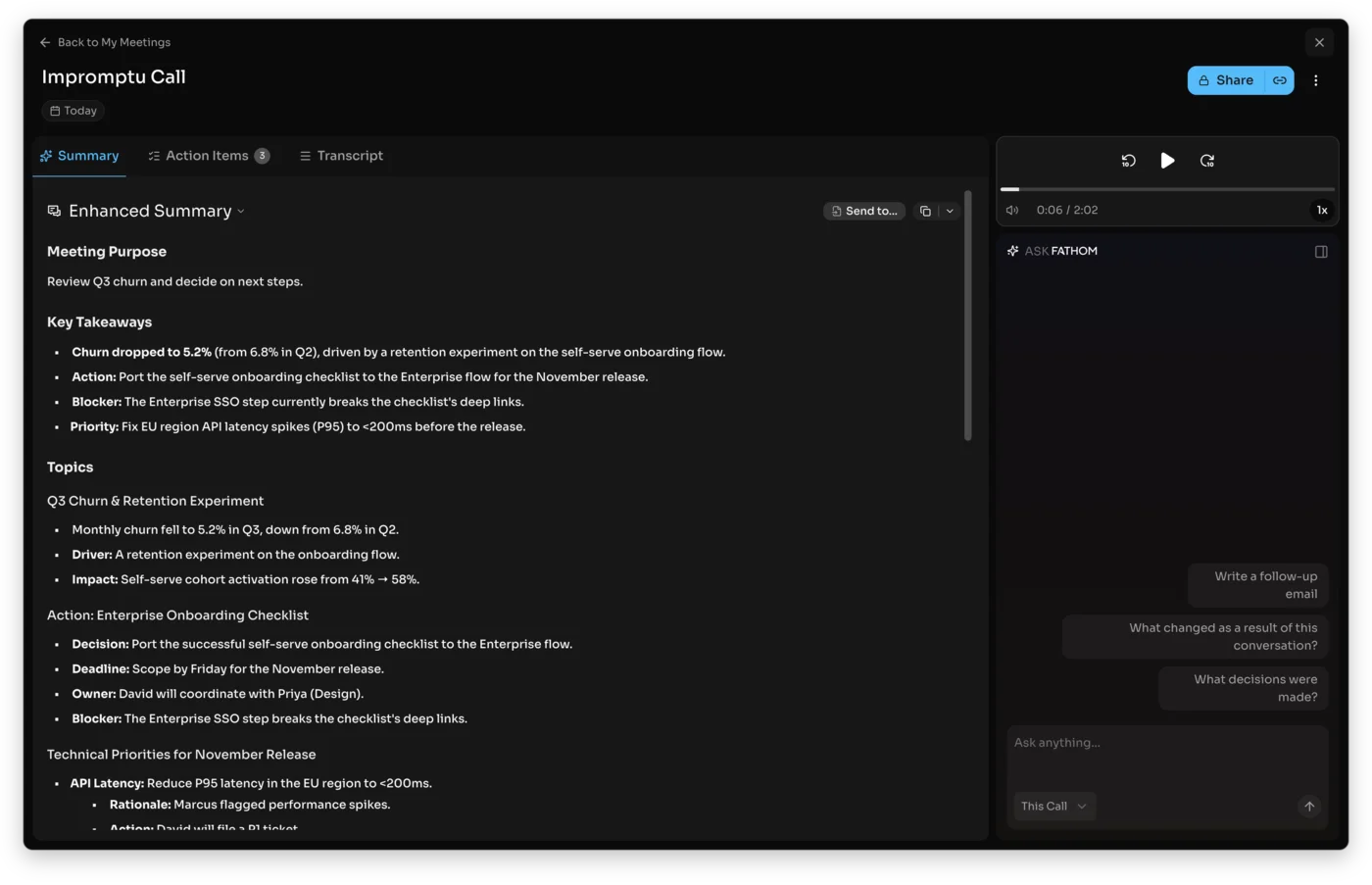
Fathom — the best free pick. Fathom joins your Teams meeting as a visible bot, records and transcribes it, and hands you a clean structured summary with timestamped action items as soon as the call ends. Its free plan is genuinely unlimited, which is what makes it the default when you do not pay for Copilot, and it covers Zoom and Google Meet too. In our testing it produced the cleanest summary of any tool we ran, and it saves the video so you can re-watch a Teams call later. See our full Fathom review.
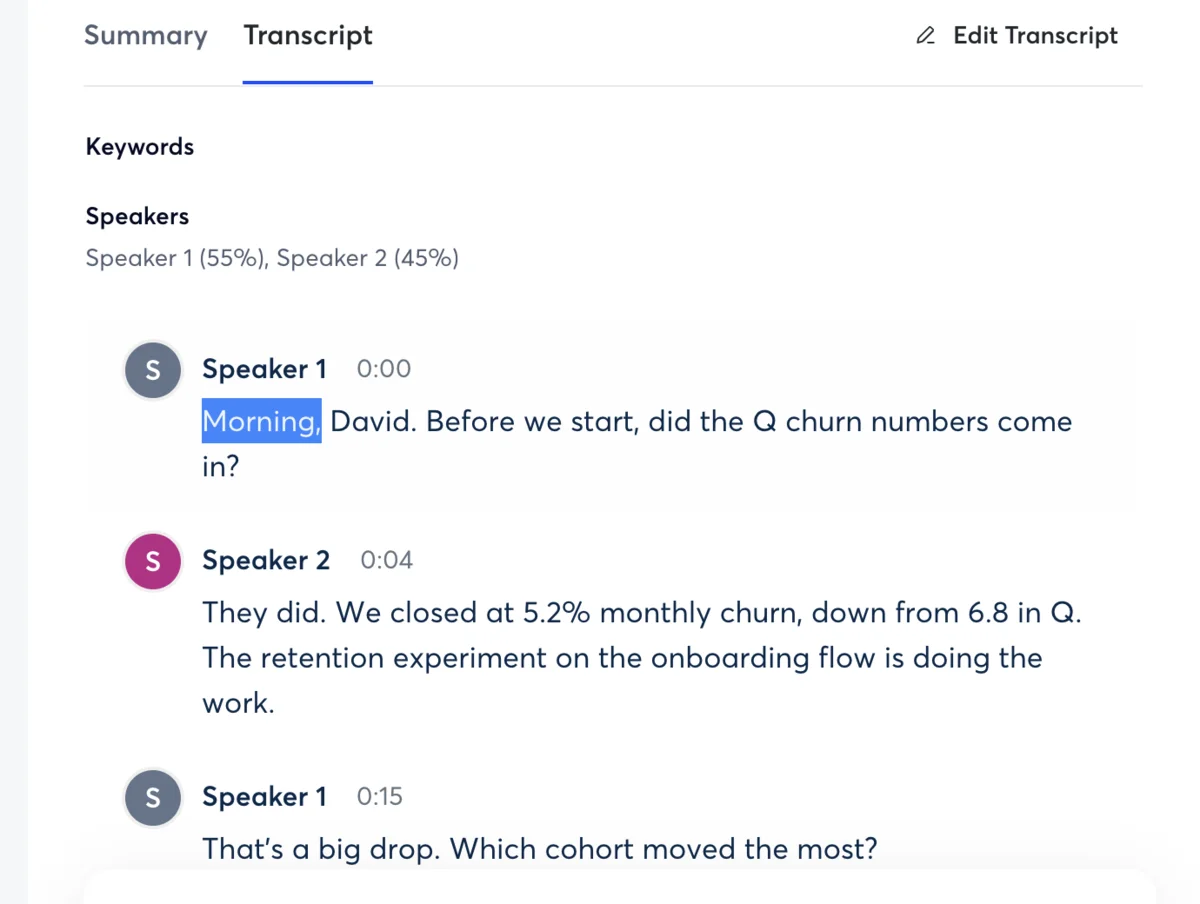
Otter — for live transcription and mobile. Otter’s OtterPilot connects to your calendar and auto-joins your Teams meetings, showing a live transcript with speaker labels as people speak. Its free plan is tighter, at 300 minutes a month, but it is the better pick if you want to read the transcript in real time or capture in-person meetings on a phone. Because OtterPilot joins from your calendar, it needs no Teams-side configuration and behaves on a Teams meeting just as it would on any other. Our Otter review and Otter pricing guide have the detail.
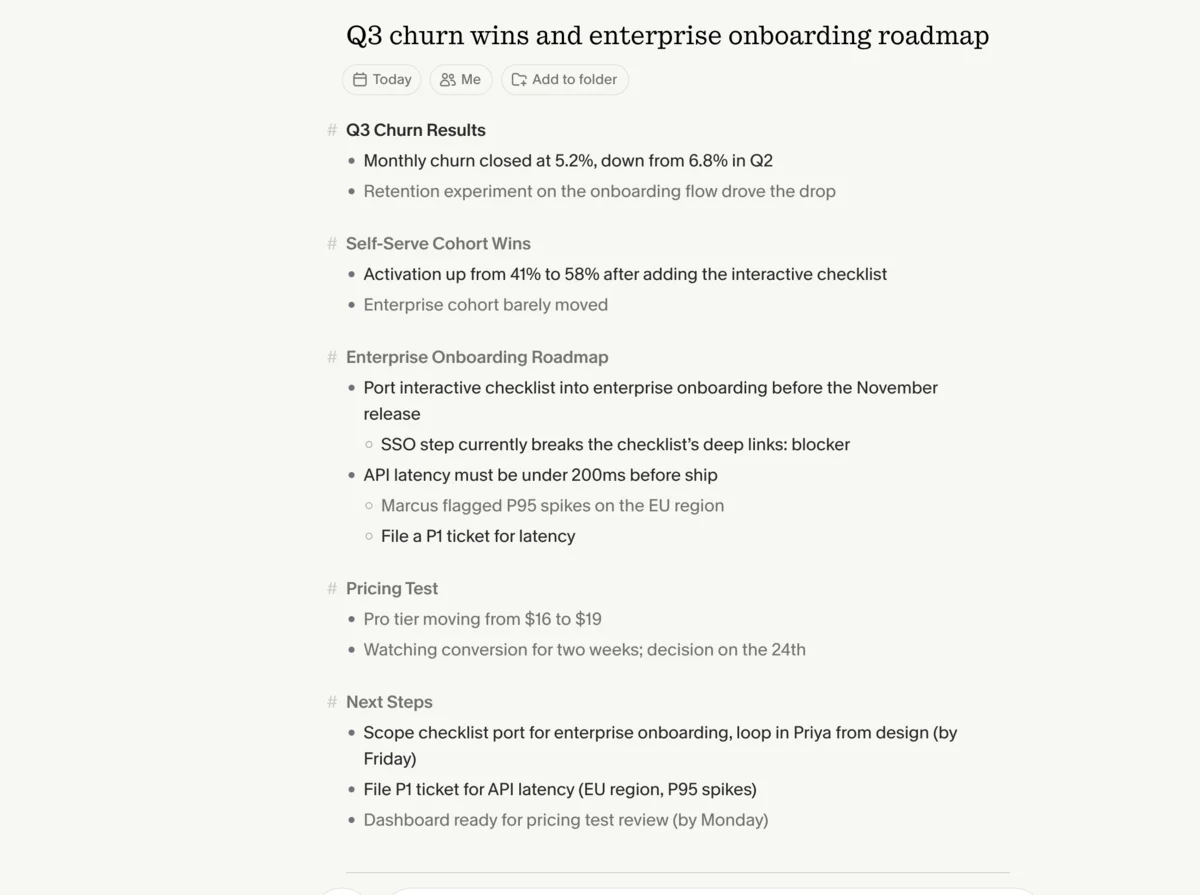
Granola — for bot-free Teams calls. If you would rather nothing appear in the participant list, Granola captures your computer’s audio while you are on the Teams call, so the meeting stays clean, and folds your rough notes into a polished summary. It runs on Mac, Windows, and iPhone, and because it never joins the call it is the tool we reach for on external Teams meetings. The trade-off is that it keeps no video and its free plan limits older history. See our Granola review.
tl;dv — for saved video and clips. tl;dv records Teams meetings unlimited on its free plan, keeps the video, and lets you cut shareable timestamped clips, with a bot-free desktop capture mode as an option. Like Fathom it also covers Zoom and Meet, so one tool handles every platform your calls happen on. It is the pick when re-watching and sharing moments matter more than the cleanest summary, and the saved Teams recording is useful when a colleague who missed the call needs the context, not just the bullet points.
Beyond these four, browser and marketplace tools are worth knowing for Teams. Tactiq transcribes inside the Teams web client without a bot, Bluedot captures via a desktop app or extension, and native Teams Marketplace apps such as TeamsMaestro add note-taking with privacy controls. They suit people who want capture without a separate desktop app, though the dedicated tools above generally produce richer summaries.
How to set up an AI notetaker on Microsoft Teams
Either route is a few-minute job; the steps differ by which one you pick.
Turning on Microsoft’s native notes depends on your license:
- Copilot: in a Teams meeting, open the Copilot or AI-notes control and choose to take AI notes; they build on a Loop page during the call, and you open them from the meeting afterward.
- Intelligent recap: make sure recording and transcription are on for the meeting; when it ends, the Recap tab fills in automatically with the AI notes and highlights.
- If neither appears: your account may not have a Copilot license or Teams Premium, or an admin has not enabled the feature for your organization yet — the most common reason people cannot find it.
Connecting a third-party notetaker is usually faster and needs no Microsoft license:
| Step | What you do |
|---|---|
| 1 | Sign up for the tool (Fathom, Otter, and the others have free plans) |
| 2 | Connect your calendar so it sees your scheduled Teams meetings |
| 3 | Choose whether it auto-joins every meeting or you start it manually |
| 4 | Join your Teams call; the bot joins too, or the app captures in the background |
| 5 | Read the summary and action items in the tool after the call |
A bot-free tool like Granola skips the join step entirely — you open it alongside Teams and it captures the audio your computer plays — and browser tools like Tactiq transcribe inside the Teams web client. Either route has you capturing notes on your next Teams call, not next week.
Bot or bot-free: which fits your Teams calls?
The one decision worth making first is whether you want a recorder visible in the meeting, because it shapes which tool you choose more than any feature.
| On a Teams call | Visible bot | Bot-free |
|---|---|---|
| Tools | Fathom, Otter, tl;dv | Granola, Tactiq/Bluedot, native Copilot |
| In the participant list | Yes | No |
| Captures if you step away | Yes, it joins the call | No, it needs your device |
| Best for | Internal calls, hands-off capture | Client calls, a quiet footprint |
A visible bot, used by Fathom, Otter, and tl;dv, is the simplest and most reliable: it joins the Teams meeting as a participant and captures everything even if your laptop sleeps or your tab closes. The downside is that everyone sees it, which can be awkward or against policy on an external call, and some Teams tenants restrict guest participants, which can block a bot from joining at all.
A bot-free approach — Granola, the browser tools, or Microsoft’s own Copilot and recap — keeps the participant list clean. Granola and the extensions capture what your device hears, so they are quiet but depend on you being in the call. The native Microsoft notetakers are the exception that is both bot-free and fully automated, which is part of their appeal if you already pay for them.
If your Teams calls are internal, a bot is fine and usually easiest. If they are external, or your tenant blocks guest bots, lean bot-free, and Granola is the cleanest summary-quality option.
What should you know before turning one on?
An AI notetaker records and stores your conversations, so settle a few details before you let one into your Teams calls.
Consent comes first. Recording is a legal and courtesy question, not just a technical one. In two-party-consent regions everyone on the call generally needs to agree, and even where it is allowed, saying a notetaker is running is the decent thing to do. Teams shows a recording banner, and a visible bot announces itself, but a bot-free tool can be quieter, so make it explicit on external meetings.
Tenant policy may block bots. Microsoft Teams gives admins tight control over guests and external participants, so a third-party bot that works fine on your personal calls may be blocked on your employer’s tenant. If a bot cannot join, a bot-free tool like Granola or a browser extension is the reliable fallback, since it does not depend on joining the meeting at all. One wrinkle to check there: some bot-free tools capture only from the Teams desktop app, not the browser version, so if your team runs Teams in a web tab, confirm your tool supports it.
Free does not mean unlimited. Some free plans cap you in ways that bite mid-month. Otter’s free tier stops at 300 minutes with a 30-minute limit per call, and Granola’s free plan hides your older history. Fathom and tl;dv are the exceptions with genuinely uncapped free recording. Read the limits before a busy week of calls.
Know where the notes live and who can open them. The native notetakers keep the output inside Microsoft — a Loop page, Planner tasks, and the meeting Recap — so it follows your organization’s sharing rules and is visible to people with access to the meeting. Third-party tools keep the notes in their own app with their own permissions. For sensitive Teams calls, know which one you are using and who can reach the result before you record.
| Before you record on Teams | Why it matters |
|---|---|
| Get consent | Two-party-consent regions require it; announce it either way |
| Check tenant policy | Teams admins can block guest bots from joining |
| Check the free limits | Otter caps 300 min/mo; Granola hides older history |
| Know where the notes land | Native saves to Loop/Recap; apps keep their own copy |
Which AI notetaker should you use for Microsoft Teams?
Match the tool to your situation:
- You already pay for Copilot or Teams Premium → use the native AI notes. Copilot for live notes in Loop, intelligent recap for the fuller post-meeting Recap, both inside Teams.
- You want a free notetaker and have neither license → Fathom. Its unlimited free plan is the most generous, and it works on Teams, Zoom, and Meet.
- You take client calls, or your tenant blocks bots → Granola, which captures the call with nothing in the participant list.
- You want a live transcript or to record in person → Otter, with its live captions and mobile app.
- You want saved video and shareable clips → tl;dv, free and unlimited on Teams.
If you are unsure, start on Fathom’s free plan and keep it as your cross-platform default — it costs nothing and captures Teams, Zoom, and Meet alike. Move to the native Copilot or intelligent recap only once you know your organization is paying for the license anyway, so you are not buying a notetaker twice. For the wider field, our best AI note taker roundup ranks the top picks side by side, and our Fathom and Otter pricing guides break down what each costs.
Final word
The whole decision on Microsoft Teams turns on your Microsoft licensing. If your organization already pays for Copilot or Teams Premium, the native AI notes are the most integrated answer, flowing straight into Loop, Planner, and the meeting Recap with nothing to install. If you do not, the third-party route is cheaper and more portable, since one free tool like Fathom covers Teams alongside your other platforms instead of locking your notes inside Microsoft. Whichever route you land on, the days of assigning someone to type up the Teams call are over.
Frequently asked questions
Does Microsoft Teams have a built-in AI notetaker?
Yes, and it has two native layers rather than one. With a Microsoft 365 Copilot license, Teams generates AI notes during the meeting on a shared Microsoft Loop page, capturing key points, decisions, and follow-up tasks, and it can sync those tasks into Microsoft Planner. Separately, Teams Premium adds intelligent recap, which after the meeting populates a Recap tab with the recording, transcript, AI-generated notes, chapters, a speaker timeline, and suggested action items.
Both are paid add-ons on top of your normal Microsoft 365 plan, and both are Teams-only, so they do nothing for your Zoom or Google Meet calls.
If your organization already pays for Copilot or Teams Premium, the native notetaker is the most integrated option because the notes land in the Microsoft tools you already use. If it does not, a free third-party notetaker like Fathom gives you AI notes on Teams without either upgrade.
What is the best free AI notetaker for Microsoft Teams?
Fathom is the best free AI notetaker for Microsoft Teams for most people, because its free plan is genuinely unlimited and Teams' own AI notes are not free at all. Fathom joins your Teams call as a visible bot, records and transcribes it, and returns a clean structured summary with action items the moment it ends, with no minute cap, and we rated it 4.6 out of 5.
tl;dv is the other strong free option, with unlimited recording on Teams plus saved video and shareable clips, and a bot-free desktop mode. Granola is the pick if you want nothing in the participant list, since it captures your computer's audio with no bot, though its free plan limits how far back your history goes.
The native Copilot and intelligent recap both require paid Microsoft licenses, so for a no-strings free notetaker on Teams, Fathom is the place to start.
How do I turn on AI notes in Microsoft Teams?
For the native option, you first need the right license, then you switch it on per meeting. With Microsoft 365 Copilot, open the meeting, click the Copilot or AI notes control, and choose to take AI notes; they build on a Loop page during the call and you can open them from the meeting afterward. For Teams Premium intelligent recap, you enable meeting recording and transcription, and after the meeting the Recap tab fills in automatically with the AI notes and highlights. An admin may need to allow these features for your organization first.
For a third-party notetaker, the setup is usually faster and needs no Microsoft license: you sign up for a tool like Fathom or Otter, connect it to your calendar, and it then joins your Teams meetings automatically, or you start it manually when a call begins.
Either way you can be capturing AI notes on your next Teams call within minutes.
Do I need Microsoft 365 Copilot for AI notes in Teams?
No. Copilot gives you the most polished native AI notes in Teams, but it is a paid add-on, and you do not need it to get AI notes on your Teams calls.
There are two ways around it. First, Teams Premium offers intelligent recap, a lighter native option that still produces AI notes, chapters, and action items after the meeting without a full Copilot license. Second, and the route most people take, every leading third-party notetaker works with Teams regardless of your Microsoft plan: Fathom, Otter, Granola, and tl;dv all capture and summarize Teams meetings, and several are free. Fathom's free plan is unlimited and the simplest no-Copilot option, Granola captures the call bot-free, and browser tools like Tactiq transcribe inside the Teams web client.
So Copilot is the most seamless if you already pay for it, but it is far from the only way to get AI notes in Teams.
Is there a bot-free AI notetaker for Microsoft Teams?
Yes. If you do not want a recorder showing up in the participant list on your Teams calls, you have a few bot-free choices. Granola is the strongest: it captures your computer's audio directly, so nothing joins the meeting, and it turns your rough notes into a polished summary afterward, which suits external or sensitive calls where a visible bot is awkward.
Microsoft's own native notetakers are technically bot-free too, since Copilot and intelligent recap run inside Teams rather than joining as a participant, though they need a paid license. Browser-based tools such as Tactiq and Bluedot are another bot-free route, transcribing the call from inside the app or an extension without adding a participant. The trade-off with bot-free desktop and extension tools is that they capture what your own device hears, so they work best when you are actively in the call.
For a clean, bot-free summary on Teams, Granola is our pick.
Which AI notetaker is best for Microsoft Teams?
It depends on your Microsoft setup. If your organization already pays for Microsoft 365 Copilot or Teams Premium, the native notetaker is the most integrated choice, since the notes flow into Loop, Planner, and the meeting Recap with nothing to install.
If you do not have either license, or you also take calls on Zoom or Google Meet, a third-party notetaker is better, and Fathom is our top pick: its free plan is unlimited, its summaries are the cleanest we tested, and it works across all three platforms, not just Teams. Choose Granola instead if you want a bot-free footprint on client calls, Otter if you want a live transcript and a strong mobile app for in-person meetings, or tl;dv if saved video and shareable clips matter most.
For most people on Teams, the honest answer is native Copilot or intelligent recap if you already pay for it, and Fathom if you do not.
Keep reading
AI notetaker for Zoom: AI Companion vs free apps
The best AI notetakers for Zoom — the native AI Companion, included on paid Zoom plans, vs free apps like Fathom — and how to set each one up.
AI notetaker for Google Meet: best picks and setup
The best AI notetakers for Google Meet — Google's native Gemini notes vs free apps like Fathom — plus how to set each one up in minutes.
Best free AI note taker: which free plan actually lasts
Most free AI notetakers are trials in disguise. We tested the tiers: Fathom's stays unlimited forever, and Granola, Fireflies, and Otter each win a niche.
Fireflies AI alternatives: 5 tested, simpler and free
We tested the top Fireflies alternatives. Fireflies is powerful but heavy — leaving for a simpler tool, a real free plan, or no bot? Here's the one that fits.