
Midjourney Pricing: What $10 to $120 a Month Really Buys
Midjourney pricing runs $10 to $120 a month, $8 to $96 billed yearly. What each plan buys in images, Fast hours and video, plus the refund and expiry traps.
Contents
How much does Midjourney cost?
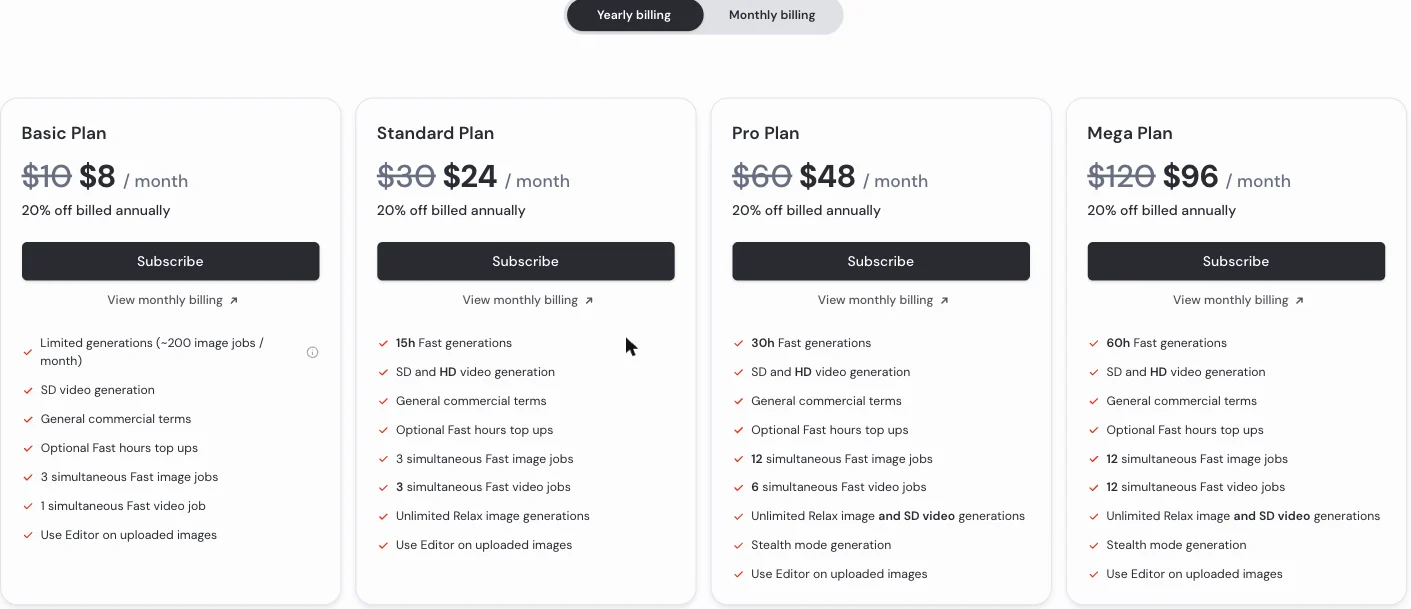
Midjourney costs $10 to $120 a month, or $8 to $96 a month billed yearly, and there is no free tier. Whether it is worth paying for at all is a separate question, covered in our Midjourney review. Most people should pick Basic at $10 for occasional use or Standard at $30 if they make images regularly, because Standard is the cheapest plan with unlimited Relax-mode images. Pro at $60 is the real starting point for anyone whose images must stay private, or for a company earning more than $1 million a year.
| Plan | Monthly | Yearly (per month) | Fast GPU time | Relax mode | Stealth mode | Video |
|---|---|---|---|---|---|---|
| Basic | $10 | $96 ($8) | 3.3 hours | No | No | SD only |
| Standard | $30 | $288 ($24) | 15 hours | Unlimited images | No | SD and HD |
| Pro | $60 | $576 ($48) | 30 hours | Images and SD video | Yes | SD and HD |
| Mega | $120 | $1,152 ($96) | 60 hours | Images and SD video | Yes | SD and HD |
Prices are from Midjourney’s plans page, which I read signed in on 24 September 2026, and its plan comparison in the help centre, read on 25 September. Any sales tax or VAT due is added on top at checkout.
How Midjourney pricing works: you buy GPU minutes
Midjourney does not sell images. It sells time on its graphics processors, and every job spends some of it. That is the single most useful thing to understand before choosing a plan, because it explains why the same plan can last a month for one person and a week for another.
There are three speeds. Fast mode runs your jobs straight away and spends your plan’s Fast hours. Relax mode, on Standard and above, queues your jobs for spare capacity and spends nothing, which is why those plans are effectively unlimited for images. Turbo is up to four times faster than Fast but uses twice the Fast time, and Midjourney’s GPU speed article says it is experimental and not currently supported in V8.1; the article does not mention V8.2, the current default.
The exchange rate is published. Midjourney’s documentation says a typical image prompt uses about one minute of GPU time and a typical video prompt about eight. Every image prompt returns a grid of four images, so one minute buys four pictures. That is how the plans page arrives at its own figure for Basic: about 200 image jobs, or 800 images.
What each job costs in Fast time
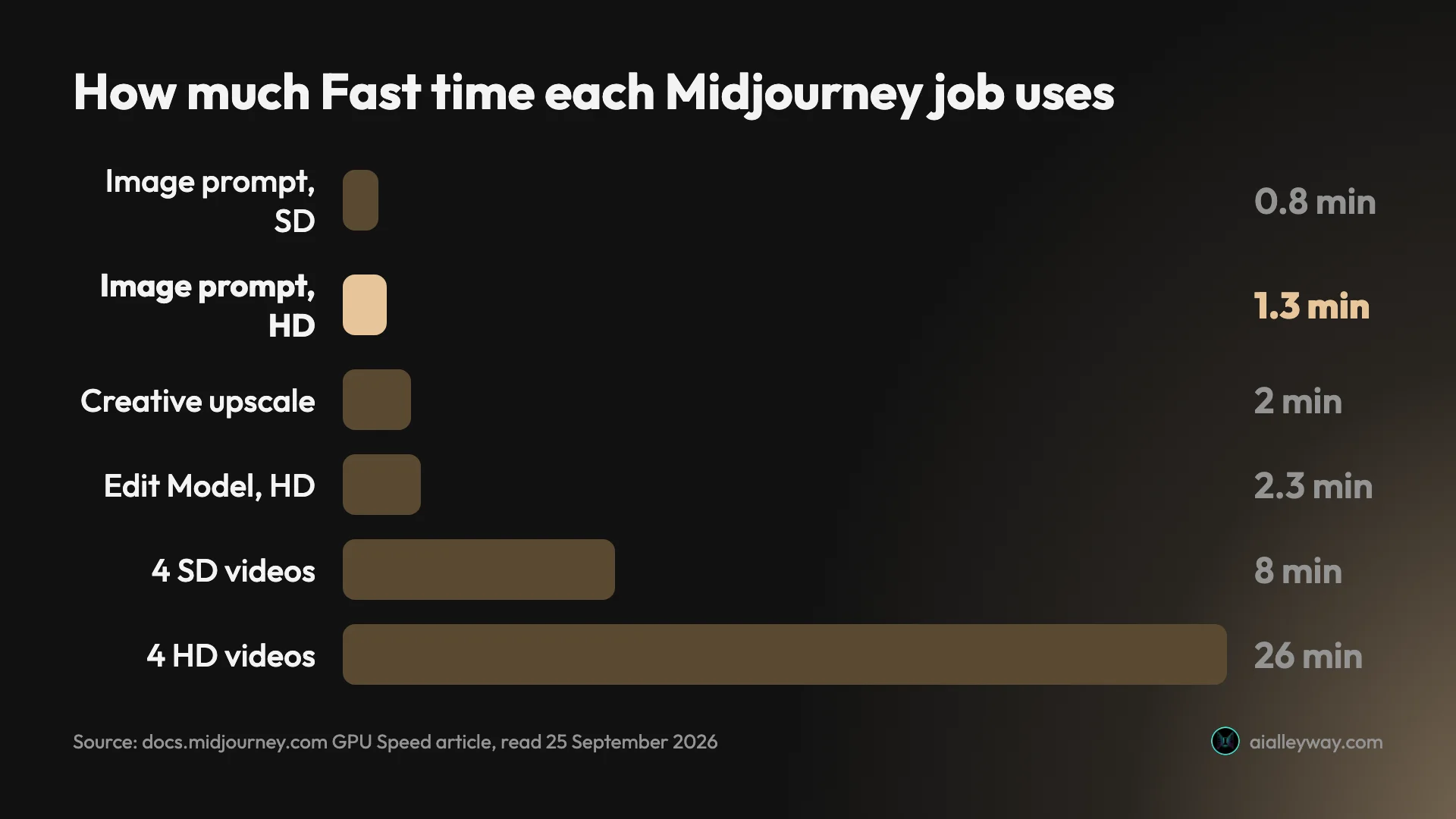
The one-minute rule is an average. Midjourney’s GPU speed article breaks it down, and the spread is wide: a batch of HD video costs as much as twenty-odd image jobs.
| Job | Fast GPU time |
|---|---|
| Image prompt, standard definition | 0.8 minutes |
| Image prompt, HD | 1.3 minutes |
| Variation | Under 1 minute |
| Creative or Subtle upscale | 2 minutes |
| Edit Model, SD / HD | 1 / 2.3 minutes |
| Omni Reference (V7) | 2 minutes |
| Video, batch of 4, SD / HD | 8 / 26 minutes |
| Video, batch of 1, SD / HD | 2 / 7 minutes |
Three settings quietly raise the cost: non-standard aspect ratios, older model versions, and HD. Lower quality settings reduce it. Jobs that Midjourney’s filters block cost nothing.
The Midjourney plans in detail
Each plan is a bundle of Fast hours plus a set of features that the hours alone do not explain. Here is what each one actually buys.
Basic: $10 a month
Basic includes 3.3 hours of Fast time, which Midjourney’s plans page puts at about 200 image jobs, or about 800 images. There is no Relax mode, so that allowance is the whole month: when it runs out, you buy more at $4 an hour or wait for renewal. Video is standard definition only.
It is enough for someone making a handful of images most days. It is not enough to iterate heavily, and every image is public on the Explore page.
Standard: $30 a month
Standard is the plan that changes the economics. It includes 15 hours of Fast time, about 3,600 images, and unlimited images in Relax mode. Relax jobs usually wait 0 to 10 minutes, according to the plans page, and up to 30 minutes if you use Relax heavily compared with other users, according to the help centre. Standard also adds HD video, in Fast mode.
Pro: $60 a month
Pro doubles the Fast time to 30 hours and adds two things that matter to professionals. Stealth mode keeps your images off the public Explore page, and it is the cheapest plan that has it. Relax mode extends to standard-definition video. Pro also raises the number of Fast jobs you can run at once, from three image jobs to twelve.
Mega: $120 a month
Mega doubles Pro’s Fast time to 60 hours, about 14,400 images, and raises the number of simultaneous video jobs from six to twelve. Everything else matches Pro. It is for studios and heavy users who would otherwise be buying extra hours every month. It costs exactly two Pro plans and includes the same 60 hours two Pro plans would, so the case for it is having all that time on one account rather than a discount.
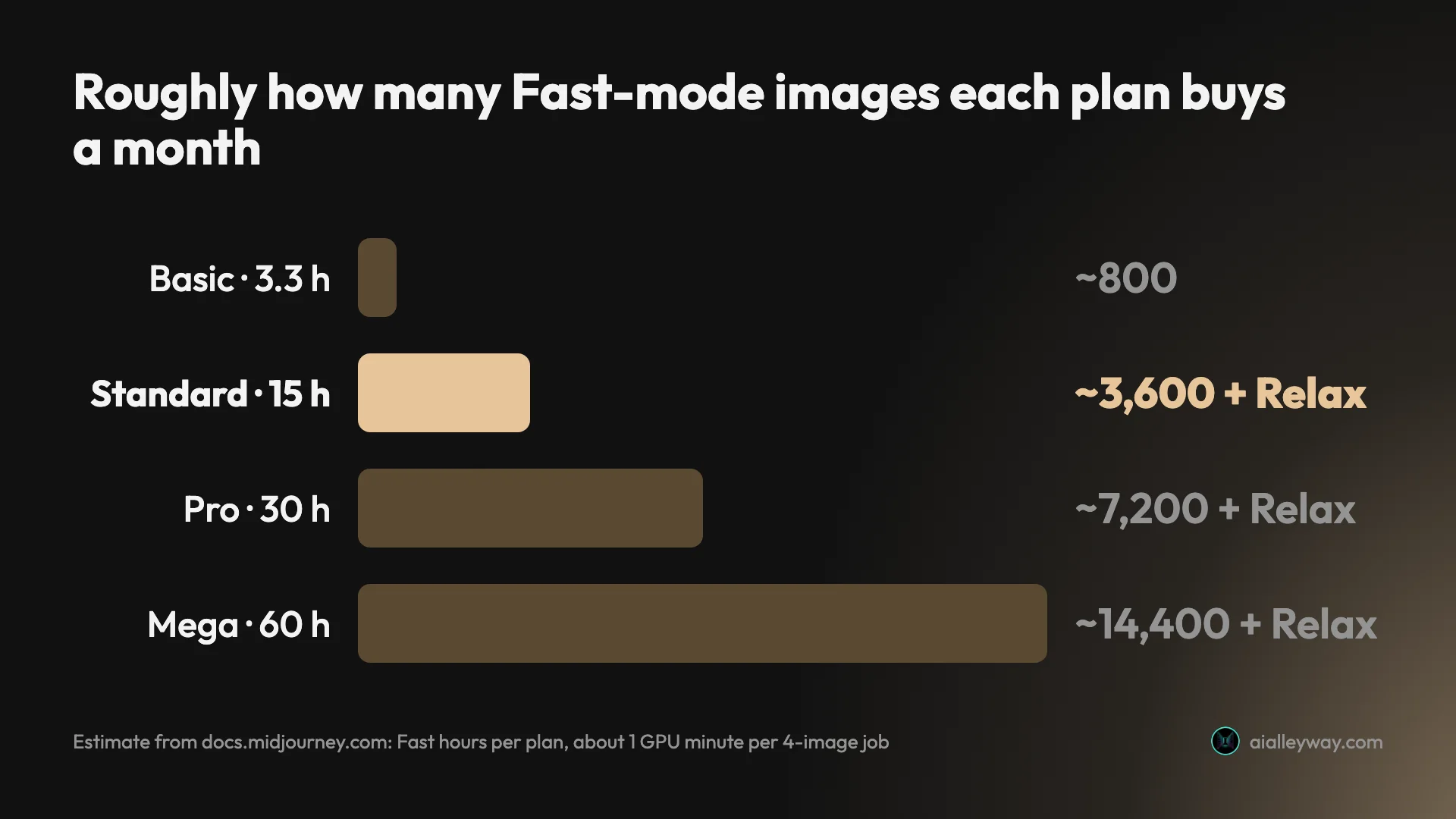
Those image counts are estimates at about one minute per four-image job. HD prompts, upscales and edits lower them, and so does any video.
What Midjourney video costs
Video is where Fast time disappears. Every clip is five seconds, and Midjourney generates them in batches, so the cost depends on the batch size and the resolution.
| Batch | SD (480p) | HD (720p) |
|---|---|---|
| 4 clips | 8 minutes | 26 minutes |
| 2 clips | 4 minutes | 13 minutes |
| 1 clip | 2 minutes | 7 minutes |
A batch of four HD clips uses 26 minutes, about as much as 26 image jobs. On Basic, which can make only SD video, its 200 minutes buy about 25 SD batches, or about 100 clips. Extending a clip adds four seconds at the cost of a new generation, up to 21 seconds. Only Pro and Mega can make video in Relax mode, and only in standard definition.
What real Midjourney use costs
The plan that fits depends on how you work, not just on how many images you want. These are estimates from Midjourney’s published figures, not measurements from an account of my own.
- A blogger making 30 images a week. About 130 images a month. If you keep one image from each four-image grid, plus a few retries, that is roughly 130 to 150 jobs, inside Basic’s 200 with some headroom. Cost: $10, or $8 billed yearly.
- A social media manager running 20 prompts a working day. About 440 jobs a month, well past Basic’s 200. Standard’s 15 hours covers it in Fast mode, with Relax as a safety net. Cost: $30, or $24 yearly.
- A designer working on client projects. The volume might fit Standard, but client work usually needs Stealth mode, which starts on Pro. Cost: $60, or $48 yearly.
- A creator making HD video. At 26 minutes per four-clip batch, Standard’s 900 minutes buy about 34 batches, or about 136 clips. Heavy video users will reach Mega, or buy extra hours at $4 each.
- Someone trying Midjourney for the first time. Start on monthly Basic rather than yearly. It costs $2 more for the month, but with refunds ending after 20 minutes of use, a month is a much smaller commitment than a year paid up front. Cost: $10.
- A company earning more than $1 million a year. Midjourney’s terms require Pro or Mega regardless of volume, per person, since there are no team seats.
Extra Fast time and free hours
When a plan’s Fast time runs out, you have three options.
Buy more. Extra Fast time costs $4 an hour on every plan, which is about 60 image jobs. Bought hours expire after 60 days, need an active subscription and are non-refundable.
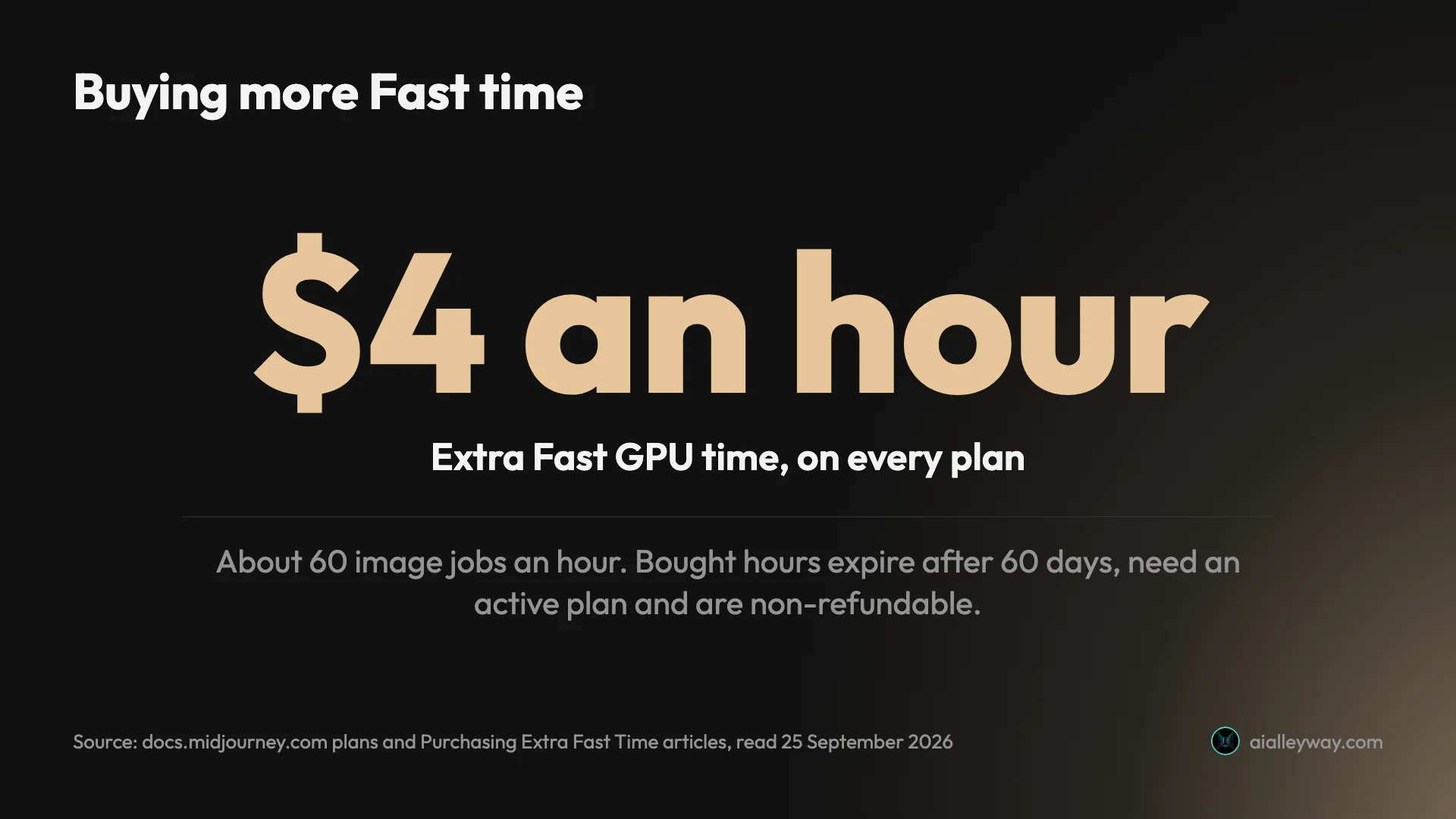
Do the arithmetic before buying hours on Basic. Five extra hours cost $20, which takes Basic to $30, the price of Standard. Standard at $30 includes 15 Fast hours plus unlimited Relax images, so anyone regularly topping up Basic by more than a couple of hours a month should switch plans instead.
Earn it. Midjourney gives an extra Fast hour each day to its top 2,000 image raters, and rewards some surveys with time. Rating rewards are not guaranteed, and awarded time expires after 30 days.
Switch to Relax. On Standard and above, Relax mode costs nothing and has no image limit, at the price of a queue.
Unused Fast time from your plan does not roll over, on monthly or yearly billing. It resets every month.
The limits the price doesn’t show
Two sets of limits separate the plans as much as their Fast hours do, and both matter most to people working in bulk.
How many jobs run at once. Basic and Standard run up to three image jobs at the same time. Pro and Mega run up to twelve in Fast mode, or three in Relax. Video is tighter: one Fast video job at a time on Basic, three on Standard, six on Pro and twelve on Mega. Every plan can queue up to ten jobs. For someone generating one idea at a time, none of this matters; for someone exploring fifty variations of a product shot, twelve at once is the difference between minutes and an hour.
What Relax mode can’t do. Relax is free but restricted. Midjourney’s documentation says it does not run permutations or the —repeat parameter, cannot make HD video and cannot run Max Upscale. Those jobs need Fast time even on a plan with unlimited Relax, so heavy users of batch prompts or HD video will spend Fast hours regardless. The size of permutation and repeat batches also scales with the plan, from 4 jobs on Basic to 10 on Standard and 40 on Pro and Mega.
Monthly or yearly: what billing really changes
Yearly billing is the same plan for 20% less, paid up front. Over a year it saves $24 on Basic, $72 on Standard, $144 on Pro and $288 on Mega. It does not give you more Fast time: the hours still reset every month and do not roll over, on yearly plans as on monthly ones.
The catch is flexibility. Midjourney’s help centre says you can upgrade immediately or at your next renewal. An immediate upgrade is discounted according to the Fast time you have left and restarts your billing cycle from that day; if you have no Fast time left, you pay the full price of the new plan. Downgrades only take effect at renewal and are not refunded, and moving from a yearly plan to a higher monthly one means contacting support.
So yearly billing suits people who already know their plan. If you are unsure whether you need Standard or Pro, a month or two on monthly billing costs a little more and keeps the option to change without a year’s commitment.
Privacy, ownership and cancelling
Three rules decide what you keep and who can see it, and they matter as much as the price.
Privacy costs $60. Every image made on Basic or Standard appears on Midjourney’s public Explore page. Stealth mode, on Pro and Mega, hides new images from the website, though images you make in Midjourney’s public Discord channels stay visible regardless. If you upgrade later, older images are not hidden automatically: you have to make them private yourself. Anything you have made private stays private if you later cancel or downgrade.
You own what you make. Midjourney’s help centre says you own your images and videos even after you cancel, subject to the $1 million revenue rule for companies. Upscaling someone else’s image does not make it yours.
Cancelling is simple. You can cancel at any time. The cancellation takes effect at the end of the billing period, you keep your plan’s features and remaining Fast time until then, and your images are not deleted.
Free trials, students, teams and payment
There is no free trial. Midjourney’s free trial page says there is no trial on the website or in Discord. The only exception is niji·journey, its anime-focused mobile app, which offers a limited trial. Pages that still describe a Midjourney free trial are out of date.
There is no student or team discount. Each student needs their own account and subscription, which a school can reimburse. Organisations, schools and non-profits get no discount either. Bulk billing exists only for 50 or more yearly Pro or Mega plans, with no discount beyond the usual 20%, and there is no seat management, admin console or single sign-on.
Payment is by card or wallet, in dollars. Midjourney accepts Visa, Mastercard and American Express, plus Apple Pay, Amazon Pay, Alipay, Google Pay and Link in some regions, all through Stripe. It does not take PayPal, and invoices cannot be changed once issued.
How Midjourney’s price per image compares
Per image, Midjourney is cheap if you use your plan. At about four images per Fast minute, Standard’s 15 hours work out at under a cent an image before you touch Relax mode, and Relax takes the marginal cost to nothing. Basic, at $10 for about 800 images, is about 1.25 cents an image.
The comparison changes with how often you generate. ChatGPT’s Plus plan, at $20 a month, advertises 120 images a day in the app, and ChatGPT’s free plan allowed me three requests a day. Google’s Nano Banana is free in the Gemini app, where my test ran twelve requests without a refusal, and Nano Banana 2 costs $0.067 for a 1K image on Google’s API. For occasional use, the free options cost nothing at all; Midjourney’s advantage appears only for people who generate enough to use its hours.
Midjourney pricing traps to watch
The plans page is clear, but several rules that affect what you pay sit in the help centre rather than on it.
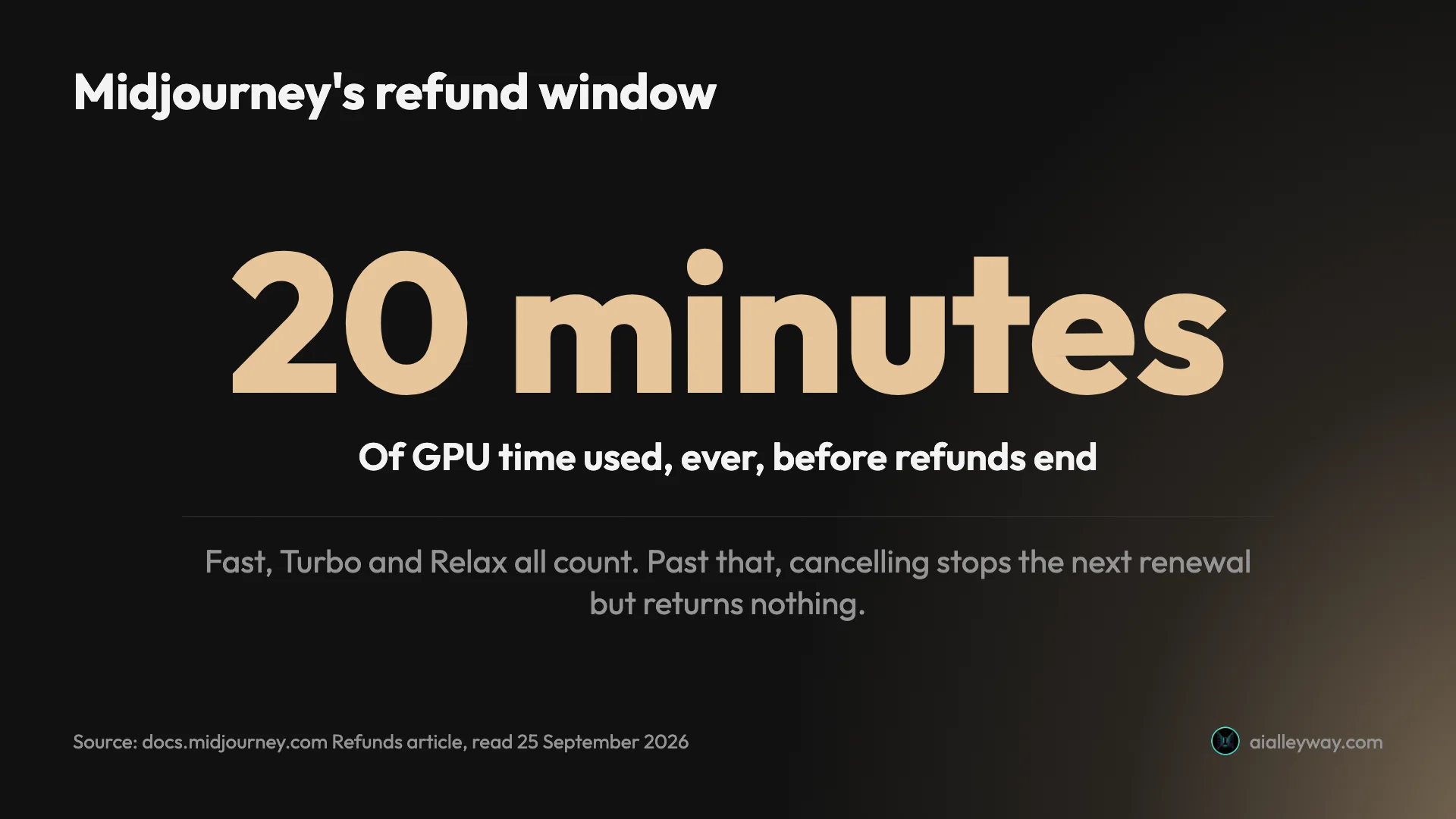
Refunds end after 20 minutes of use
Midjourney’s refund policy says it refunds only accounts that have used less than 20 GPU minutes in their lifetime, counting Fast, Turbo and Relax together. That is about 20 image jobs, which a curious new user can spend in an evening.
Checkout defaults to yearly billing
The subscription flow selects yearly billing by default, according to Midjourney’s own subscription help page. Yearly is 20% cheaper, but it is paid up front, and with the refund rule above, a year paid by mistake is a year you keep.
Your Fast hours expire
Midjourney’s help pages on Fast time say plan hours reset every month, bought hours expire after 60 days and earned hours after 30. None of them carry over indefinitely, so buying extra hours ahead of a busy month only works if the month is within 60 days.
The price shown is before tax, in dollars
Midjourney’s billing help says Stripe adds any sales tax or VAT due on top of the listed price, and Midjourney bills in US dollars only, so buyers elsewhere also pay their bank’s conversion rate and any foreign transaction fee. PayPal is not accepted, and there is no euro or pound pricing: buyers in Europe are charged in dollars, plus any VAT due.
Turbo costs double
Turbo mode spends Fast time at twice the normal rate. Midjourney’s GPU speed article says it is not currently supported in V8.1, which was the default before V8.2, and that when Turbo is unavailable jobs fall back to Fast. If you have switched it on, check what it is costing you.
Big companies must buy Pro
Companies, or employees of companies, with more than $1 million a year in gross revenue must be on Pro or Mega to own their images, according to Midjourney’s commercial use page. Google’s AI Overview for Midjourney pricing did not mention this rule when I checked on 25 September, but for a business it sets the real entry price at $60 a month per person.
Which Midjourney plan should you buy?
- Buy Basic if you make images occasionally and don’t mind them being public. At $8 a month yearly, it is the cheapest way to use Midjourney.
- Buy Standard if you make images most days. Unlimited Relax mode is the best value in the lineup, and 15 Fast hours cover urgent work.
- Buy Pro if your images are for clients, unreleased products, or a company earning more than $1 million a year. Stealth mode and the ownership rule make it the business plan.
- Buy Mega if you regularly exhaust Pro’s 30 hours, particularly with video, and would otherwise buy extra hours every month.
- Skip Midjourney if you need something free, or a tool that follows a detailed brief exactly. It has no free tier, and its strength is look rather than literal accuracy.
Cheaper options if Midjourney doesn’t add up
If the price or the privacy rules put you off, three places are worth a look.
- ChatGPT Images. Makes images on the free plan and on the $20 Plus plan, which the app says allows 120 images a day, and it spelled every word I asked for. Our ChatGPT image generator review has the test.
- Nano Banana (Gemini). Free in the Gemini app, where my test ran twelve image requests without a refusal. Our Nano Banana review covers it.
- Leonardo AI and three more. Unlike Midjourney, Leonardo has a free allowance, 150 tokens a day, and private images from its $12 plan rather than $60. Our Midjourney alternatives roundup compares it with five other tools, including Stable Diffusion.
The bottom line on Midjourney pricing
Midjourney’s pricing is simpler than most once you see it as GPU minutes: about one minute buys four images, $4 buys an extra hour, and Standard’s Relax mode makes images effectively unlimited for $30 a month. The costs to watch are the ones off the plans page: a 20-minute refund window, a yearly default at checkout, hours that expire, and a $60 minimum for private work or larger companies. Our Midjourney review covers whether it is worth paying for at all.
Frequently asked questions
How much is Midjourney per month?
Midjourney has four plans. Billed monthly, Basic is $10, Standard $30, Pro $60 and Mega $120. Billed yearly, they cost $96, $288, $576 and $1,152 a year, which works out at $8, $24, $48 and $96 a month, a 20% discount paid up front. Any sales tax or VAT due is added on top at checkout, and billing is in US dollars only.
What the plans differ in is GPU time rather than image counts. Basic includes 3.3 hours of Fast time, about 200 image jobs of four images each. Standard has 15 hours plus unlimited Relax-mode images, Pro has 30 hours plus Stealth mode for private images, and Mega has 60 hours. Extra Fast time costs $4 an hour on any plan.
Does Midjourney have a free trial?
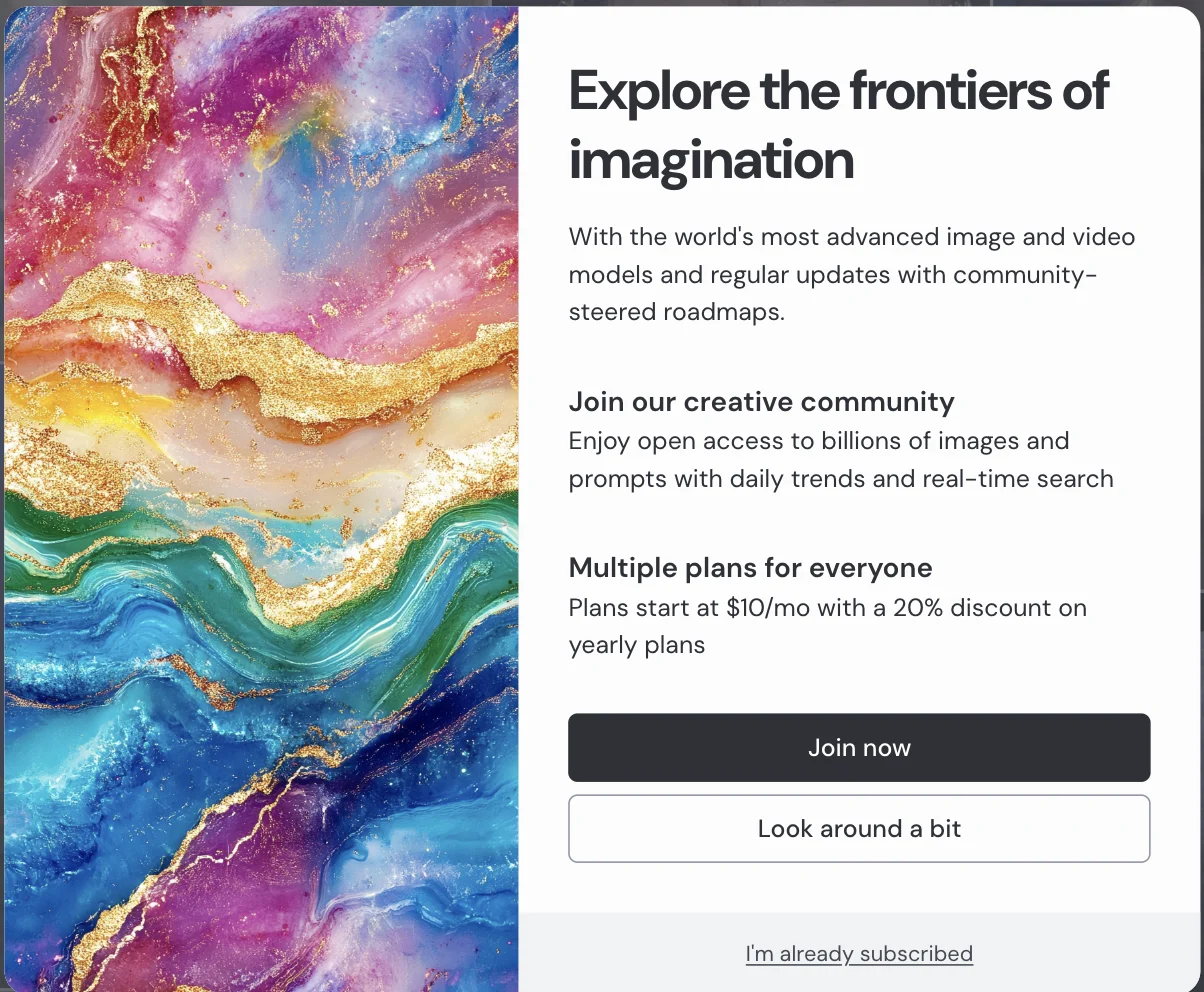
Not on the website or in Discord. Midjourney's own help page says there is no free trial for the main service, and on 24 September 2026 a signed-in account without a plan was shown a panel saying plans start at $10 a month. Midjourney used to offer a free trial, and some pages still describe it.
The one exception is niji·journey, Midjourney's anime-focused mobile app for iOS and Android, which Midjourney's help page says offers a limited trial. Otherwise the cheapest way in is the $10 Basic plan, and the refund policy is strict: you can only get your money back if you have used less than 20 minutes of GPU time in the account's lifetime.
How many images do you get with Midjourney?
Roughly four images per minute of Fast time, because an image job usually uses about one GPU minute and returns a grid of four. Midjourney's documentation puts a standard-definition image prompt at 0.8 minutes and an HD prompt at 1.3. On that basis Basic's 3.3 hours buy about 200 jobs, or about 800 images, which is the figure Midjourney's own plans page gives.
Standard's 15 hours work out at about 3,600 images in Fast mode, Pro's 30 hours about 7,200 and Mega's 60 hours about 14,400, and all three add unlimited Relax-mode images on top. The real number depends on what you make: upscales, HD edits, unusual aspect ratios and older models all use more time, and video uses far more.
Can I get a refund from Midjourney?
Only in a narrow case. Midjourney's refund policy says a refund is available if you have used less than 20 GPU minutes across the lifetime of the account, counting Fast, Turbo and Relax time together. If you qualify, the option appears automatically when you cancel, and it can take up to ten business days to process.
Past those 20 minutes, which is about 20 image jobs, there is no refund. Cancelling stops the next renewal and you keep your features and remaining Fast time until the end of the period. Accounts suspended for breaking the rules get no refund either. Because checkout defaults to yearly billing, check which you selected before paying.
Does Midjourney offer a student or team discount?
No. Midjourney's help pages say there is no education discount: each student needs their own account and subscription, which a school can reimburse. There are no discounts for organisations, schools or non-profits either, and no seat management, admin controls, single sign-on or negotiated terms.
The only volume arrangement is bulk billing for 50 or more yearly Pro or Mega plans, and that carries no discount beyond the standard 20% for paying annually. For most people the cheapest route is simply the yearly version of the smallest plan that fits, bearing in mind that companies earning more than $1 million a year must buy Pro or Mega.
Keep reading
Midjourney Review: Is It Worth $10 a Month?
A Midjourney review from its own plans page and docs: no free tier, $10 for about 800 images, and every picture public unless you pay $60 a month.
Midjourney Alternatives: 6 Picks, Two Tested Side by Side
The best Midjourney alternatives in 2026: ChatGPT for exact briefs, Nano Banana for free and fast, plus Leonardo, Ideogram, Stable Diffusion and Playground.
Nano Banana vs ChatGPT: 12 Prompts, Two Different Winners
Nano Banana vs ChatGPT, tested with the same 12 prompts: ChatGPT follows a brief exactly, Nano Banana is twice as fast and free. Which one to use, and when.
Best AI Image Generator for Realistic Photos: 6 Picks
The best AI image generator for realistic photos: ChatGPT and Nano Banana, tested on portraits, hands and products, plus Midjourney, FLUX, Leonardo and more.