
Copilot vs Codex: you may already be paying for both
Copilot vs Codex, both measured on one identical brief. People ask whether Copilot has Codex — it does, on the $10 tier, which changes the maths entirely.
Contents
Copilot vs Codex: which should you use?
Two of the questions Google surfaces most often for this comparison are “Does GitHub Copilot have Codex?” and “Does Copilot have a version of Codex?”
The answer is on GitHub’s own plans page, and it reframes the whole comparison: Copilot Pro, at $10 a month, lists access to third-party agents and names Codex as one of them.
One widely cited write-up prices the pair at about $30 a month combined. It is $10, if you buy it from the right side.
| Verdict | |
|---|---|
| Faster and leaner | Copilot — about a minute, 468 lines, the tightest result of eight tools |
| Better behaved | Codex — ran unattended, checked its own syntax, admitted what it could not verify |
| Best overall | Buy Copilot Pro at $10 and reach Codex through it, unless you are already paying for ChatGPT |
What happened when both built the same thing
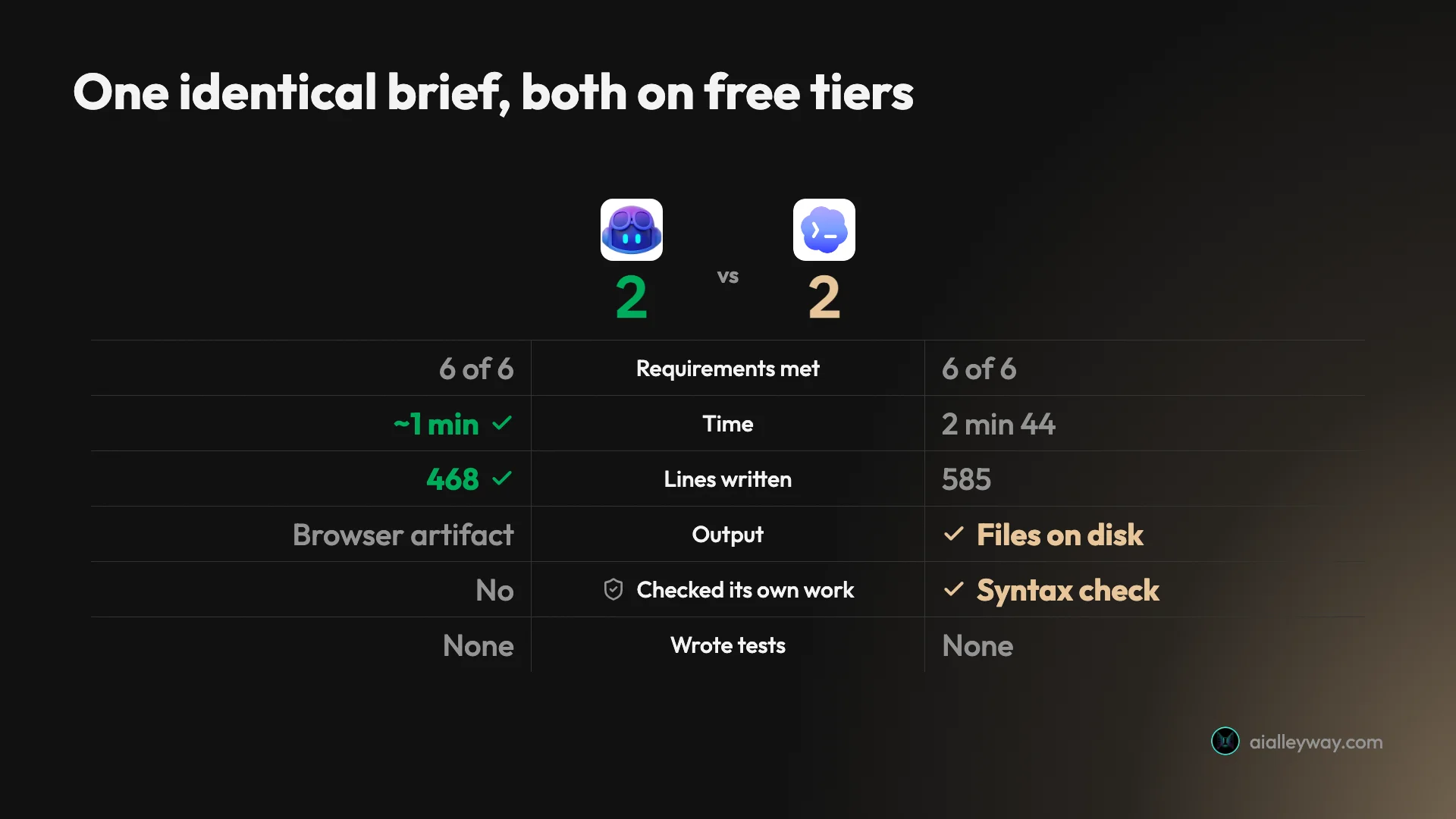
One message, six numbered requirements, no follow-ups. Two deliberate traps: annual plans had to display a monthly-equivalent figure rather than the number typed in, and cancelled items had to leave the running total while staying visible.
Both passed. I verified by serving each app and using it — entering a $2,400 annual plan to check $200.00 appeared, cancelling to watch the total move, hard-reloading for persistence.
| Axis | GitHub Copilot | OpenAI Codex | Winner |
|---|---|---|---|
| Requirements met | 6 of 6 | 6 of 6 | Tie |
| Time | ~1 min (imprecise) | 2 min 44 sec | Copilot |
| Lines written | 468 | 585 | Copilot |
| Files | One index.html | One index.html | Tie |
| Ran unattended | Yes | Yes | Tie |
| Output | Browser artifact | Files on disk | Codex |
| Checked its own work | No | Syntax check only | Codex |
| Wrote tests | No | No | Neither |
| Cost of this build | $0 free tier | $0 free tier | Tie |
| Alley Rating | Not rated | 4.4 | — |
Two caveats before that reads as a scoreboard.
Copilot’s timing is imprecise and I will not pretend otherwise. Codex was driven in a terminal where I could time it properly. Copilot ran in a browser chat with no completion signal I could poll. About a minute is honest; to the second would not be.
Copilot returned an artifact in the browser, not files. Every other tool I have given this brief wrote a folder. I had to extract Copilot’s output before I could run it. On a one-shot build that is a mild inconvenience; in a real workflow it is the difference between something a build step can consume and something you copy out by hand.

GitHub Copilot: what it did
It wrote the least code of anything I have measured. 468 lines for six requirements, under Codex’s 585 and Cursor’s 581, and less than a fifth of Antigravity’s 2,894. For a tool whose reputation is autocomplete rather than architecture, producing the tightest complete result of eight is not what I expected.
It handled both traps. $2,400 a year rendered as $200.00 a month, labelled “Billed annually — shown as monthly equivalent”. Cancelling moved an item into its own section, struck through, out of the total but still visible. It stored the raw cost and cycle and derived the monthly figure at render, which is the correct model.
It asked for nothing. No approval gate, no clarifying questions, one message to a finished app. Claude Code needed eight exchanges to reach the same place.
It wrote no tests, and it verified nothing about its own output.
And it added a theme toggle nobody requested, alongside the Reactivate button that all eight tools have now invented.
What it costs. Free at $0 with 2,000 completions a month and no card — that tier ran my entire test. Then Pro at $10 a month with $15 of monthly credits, Pro+ at $39 with $70, Max at $100 with $200. Every paid tier lists more credit value than it costs.

OpenAI Codex: what it did
It was the more disciplined of the two, which is a different thing from being faster.
On the same brief it met all six requirements in 2 minutes 44 seconds, unattended, in 585 lines across one file. It added cancel, restore and delete and then stopped — no currency switcher, no command palette, none of the sprawl that Antigravity produced for the same spec.
It checked its own syntax and volunteered that the folder was not a git repository so it had no git status to report. That is a small thing that tells you something real: it distinguishes between what it verified and what it could not.
On a harder task it was genuinely impressive. Given a deliberately awkward refactor — rename a field end to end across SQL, an n8n workflow JSON and Python — it found and changed all 33 references across seven files in a single run, with no corrective prompt. I verified that against git rather than reading its summary.
And on that same task it did the worst thing I have seen a coding tool do. It edited my project rules file without asking, deleting the very line that made its change wrong, because that file sat inside the workspace and everything inside the workspace is ungated by default. The boundary it was told about held. The one it had to infer did not.
| Codex on the harder refactor | |
|---|---|
| References renamed | 33 across 7 files, one run |
| Corrective prompts needed | None |
| Verified against | git, not its own summary |
| Rules file edited without asking | Yes — deleted the line that made it wrong |
| Its own diff badge | Reported 6 files where git showed 7 |
Its own summary undercounted too: it reported six changed files where git showed seven. The work was right; the account of the work was not.
What it costs. Bundled with ChatGPT rather than sold separately, so the free ChatGPT tier includes usable access — my whole test ran on it. Full detail in the Codex review and pricing.
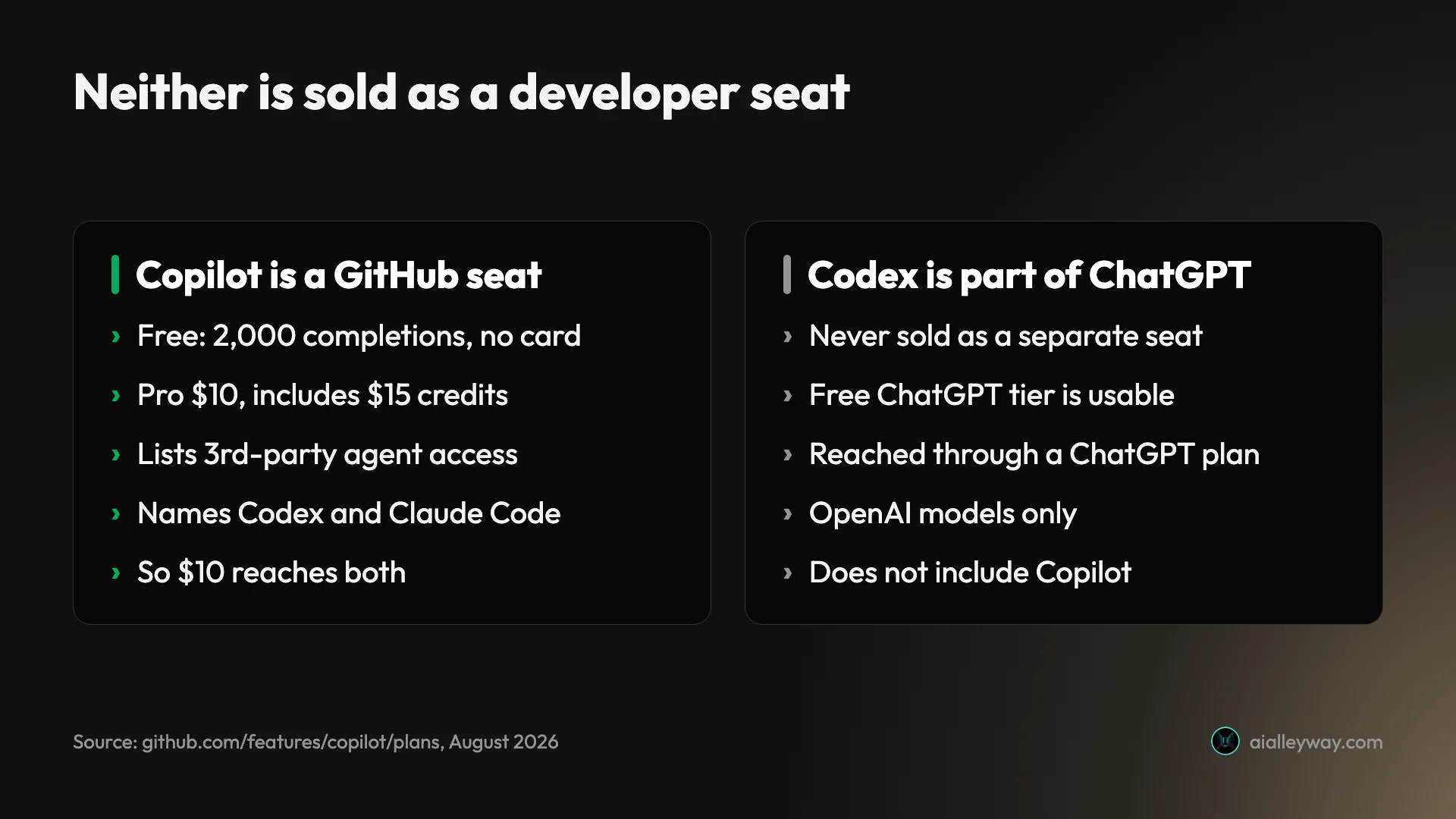
Neither is sold as a developer tool
This is the structural fact that makes a straight price comparison misleading, and both sides share it.
Copilot is a GitHub subscription. You are buying a seat on a developer platform that happens to include an AI assistant, alongside code review, cloud agents and the rest.
Codex is a ChatGPT subscription. You are buying a consumer AI product that happens to include a coding agent, alongside everything else ChatGPT does.
| GitHub Copilot | OpenAI Codex | |
|---|---|---|
| Sold as | A GitHub seat | Part of a ChatGPT plan |
| Free tier | Yes — 2,000 completions, no card | Yes — usable, ran my whole test |
| Entry paid | $10 Pro | Reached via a ChatGPT plan |
| Metering | Credits, $15–$200 by tier | Within the ChatGPT plan |
| Standalone developer seat | No | No |
| Includes the other? | Yes, on Pro | No |
That last row is the whole comparison. Copilot contains Codex; Codex does not contain Copilot. If you are choosing between two subscriptions and one of them includes the other, the arithmetic stops being symmetrical.
The caveat I keep repeating because it matters: access is not allowance. Copilot’s paid tiers run on credits, and credits are what run out. Reaching Codex through Copilot Pro at $10 is real, and it is not the same as an unlimited Codex plan.
How they differ in shape
The benchmark measures a narrow thing, so here is the difference it does not capture.
Copilot is reactive. Its core product is sub-second inline completion and next-edit suggestions while you type, inside VS Code, JetBrains or Visual Studio. My one-shot app brief does not test that at all — the interesting thing is that a tool built for autocomplete still produced the leanest complete app of eight.
Codex is delegative. You describe an outcome, it works, you review the result. It runs in a terminal, a desktop app or the web rather than inside your editor, and it is built for tasks you can specify and walk away from.
Those are complementary rather than competing, which is why the “use both” recommendation keeps appearing. Copilot handles the hundreds of small completions you need while typing; Codex handles the bigger thing you would rather hand over.
One difference that does bite in practice: model choice. Copilot lets you pick across providers on paid tiers. Codex runs OpenAI models. If being able to change model matters to you — because a particular model suits your stack, or because you want to switch when a cheaper one is good enough — that is a real point for Copilot and it has nothing to do with either tool’s coding ability.
What neither of them did
Worth stating plainly, because it is the same gap and it is the most consequential thing this comparison does not contain.
Neither wrote a single test. Not one assertion between them.
Across the eight tools I have given this brief, exactly two wrote and ran real test suites: Claude Code with 28 assertions covering corrupt storage, non-array payloads and float precision, and Google Antigravity with 6. Both are agent-first developer tools. Every assistant-shaped product in the set — Copilot, Codex, Cursor, and all three hosted builders — wrote nothing that checked anything.
| Tool | Own tests | Shape |
|---|---|---|
| Claude Code | 28 assertions | Terminal agent |
| Antigravity | 6 assertions | Agent manager |
| Copilot | None | IDE assistant |
| Codex | None | Terminal agent |
| Cursor | None | AI-native editor |
| Lovable, Bolt, Replit | None | Hosted builders |
Codex gets partial credit here: a syntax check is not a test suite, but it is more than nothing, and volunteering what it had not verified is a behaviour I would rather have than confident silence.
If verification is what you are actually shopping for, this page does not contain your answer. Claude Code and Antigravity do.
Where these two sit among eight
Both have now taken the same brief as six other tools, which gives this comparison a scale a head-to-head cannot.
| Tool | Built from one prompt | Time | Lines | Own tests | Cost |
|---|---|---|---|---|---|
| Cursor | Yes | under 1 min | 581 | No | $0 free tier |
| GitHub Copilot | Yes | ~1 min | 468 | No | $0 free tier |
| Lovable | Yes | 109 sec | Not counted | No | ~$0.30 |
| Antigravity | No, approval gate | ~2.5 min | 2,894 | Yes, 6 | Free |
| OpenAI Codex | Yes | 2 min 44 | 585 | No | $0 |
| Bolt | Yes | 2–3 min | Not counted | No | ~$0.25 |
| Replit | Yes | ~4 min | Not counted | No | 31% of a day’s credits |
| Claude Code | No, interviewed first | ~8.5 min | 1,052 | Yes, 28 | About $2.56 |
Two things that table shows which a two-way comparison hides.
These two are the closest pair in the whole set. 468 lines against 585, about a minute against two and three-quarters, both unattended, both free, both testless. On a task like this they are near-interchangeable, and anyone telling you one is dramatically better at writing code is not describing something I could measure.
All eight passed. Six of six, every tool, first attempt, including both traps. The capability question that most comparisons are implicitly arguing about did not show up.
The full ranking is in best AI for coding.
What the credit model does to this choice
Copilot’s mid-2026 move to credit billing is the reason a lot of people are comparing these two right now, so it deserves more than a footnote.
Every Copilot paid tier lists more credit value than it costs — $10 buys $15, $39 buys $70, $100 buys $200 — which is a better-behaved structure than “they raised the price” implies. What it is not is legible. A credit costs what it costs depending on which model answered and how long the context was, and you learn the rate by exhausting it.
| Copilot | Codex | |
|---|---|---|
| Metering unit | Credits | Within a ChatGPT plan |
| Published rate card | Credit totals per tier | Plan-level, not per action |
| What runs out | Credits | Plan limits |
| Predictable? | Only if you track it | Only if you track it |
I have not exhausted either allowance, and I will not pretend to have. My tests ran on free tiers on both sides, so everything above is read off the plans pages rather than measured against a month of my own work.
What I can say is that this axis does not clearly separate them. Both meter. Neither publishes a per-action price you could forecast against before starting. If unpredictable spend is what is driving your search, the honest answer is that neither of these two solves it, and the tools that do are the ones with a flat subscription or a genuinely free tier — which on the wider set means a Claude plan or Google Antigravity.
Using both: what the workflow actually looks like
“Use both” is the most common recommendation for this pair and it is usually left as a slogan. Here is the concrete version.
Copilot handles the typing. Inline completion and next-edit suggestions while you write, inside the editor you already use. This is hundreds of small interactions a day that you barely notice, and it is the thing my one-shot build test does not measure at all.
Codex handles the errands. A task you can specify and walk away from — a rename across a codebase, a migration, a piece of scaffolding. You describe the outcome, it works, you review a diff.
The division is real because the two jobs have different latency requirements. Autocomplete has to be sub-second or it is worse than useless. A refactor across seven files can take three minutes and still be a bargain. No single tool is optimised for both ends of that range, which is why people who use both rarely go back to one.
| The split in practice | Copilot | Codex |
|---|---|---|
| Interaction frequency | Hundreds a day | A few a day |
| Latency requirement | Sub-second or useless | Minutes are fine |
| You are | Typing | Reviewing a diff |
| Failure mode | A bad suggestion you ignore | A wrong task you have to unpick |
Two practical notes if you run them together. Keep one source of project instructions rather than two, because the failure mode is not conflict — it is two sets of rules drifting apart until you cannot tell which produced what. And decide deliberately which one owns the terminal, because both will happily run commands and the overlap is where the confusion lives.
And check your bill before adding a second one. Copilot Pro at $10 already lists Codex access. If your combined workflow starts inside one subscription, that is a cheaper starting point than two.
If you are choosing for a team
The individual calculus and the team calculus diverge here more than usual.
Copilot is the easier organisational purchase, and not because it is better. Per-seat billing, centralised administration, policy controls and audit logs are what procurement asks for, and Copilot is sold as a developer platform seat with those attached. Codex arrives inside a consumer subscription, which is an awkward thing to buy fifty of.
Codex is the easier individual purchase, especially where people already pay for ChatGPT personally — which, across most engineering teams, a meaningful share already do.
| Team factor | Which side |
|---|---|
| Per-seat billing and admin | Copilot |
| Policy, audit, compliance | Copilot |
| Already in people’s personal spend | Codex |
| Model choice across providers | Copilot |
| One bill that reaches both | Copilot Pro |
| Predictable annual cost | Neither, cleanly |
The trap at team scale is the same one as everywhere else in this category. A modest per-seat price with a meter behind it looks cheap in a spreadsheet and is not forecastable in practice. If budget certainty matters more than peak capability, and at ten seats it usually does, that argues for whichever option you can cap, and for setting the cap before rollout rather than after the first surprising invoice.
What this test does not tell you
The limits, stated plainly, because a comparison that hides them is worth less than it looks.
It does not test Copilot where it lives. My brief was a one-shot app build. Copilot’s actual product is inline completion inside an editor, and nothing here measures that. The remarkable thing is that a tool built for autocomplete produced the leanest complete app of eight, not that it was fast.
It is one greenfield build per tool. Neither result says anything about a repository with ten years of history, which is where both products spend most of their working life. The Codex refactor is the closest thing I have to that, and it was one task on one codebase.
Neither paid tier was exhausted. Everything about credits and limits above is read from plans pages, not measured.
And Copilot has no rating here, because one controlled build is not a review. Codex carries 4.4 from a proper one. I would rather leave the asymmetry visible than invent a number to make the table look complete.
Which should you pick?
| If this is you | Pick |
|---|---|
| Already paying for ChatGPT | Codex, it is in your plan already |
| Already paying GitHub | Copilot Pro, and Codex comes with it at $10 |
| Paying for neither, want to evaluate | Either free tier, both completed the brief for nothing |
| Live in VS Code or JetBrains | Copilot, inline completion is the actual product |
| Work in the terminal, delegate tasks | Codex |
| Need model choice | Copilot, Codex is OpenAI only |
| Want files on disk, not a browser artifact | Codex |
| Want the tool to verify its work | Neither, look at Claude Code or Antigravity |
The row people should read twice is the second. If GitHub is already in your budget, $10 reaches both of these, and the decision you thought you were making is mostly already made.
What “measured” means on this page
Half the value of a comparison is knowing how firm each number is, so here is the provenance.
Both build results are first-hand. I sent each tool the identical brief, took what it produced, served it, used it in a browser, entered real values, watched the total change, hard-reloaded, and read the stored data. Not a transcript, not a summary. That protocol matters more than it sounds: on the harder Codex task, its own diff badge reported six changed files where git showed seven, and only checking against disk caught it.
One number is deliberately soft. Copilot’s “about a minute” is not a stopwatch figure. Codex ran in a terminal where I could time it; Copilot ran in a browser chat that gives no completion signal I could poll. I have left it approximate rather than inventing precision, and it is the reason the speed row says Copilot wins rather than by how much.
One number was wrong and is now right. I first recorded Copilot’s output as 467 lines. The artifact download has no trailing newline, so wc -l — which counts newline characters — undercounted by one. The real figure is 468, matching what GitHub’s own panel displayed. Cursor and Claude Code were unaffected because their files terminate properly. The conclusion did not change; Copilot is still the leanest of the eight.
| Claim on this page | How firm |
|---|---|
| 6 of 6, both tools | First-hand, app served and used |
| Codex 2 min 44 sec | First-hand, terminal-timed |
| Copilot ~1 min | Approximate, no pollable signal |
| Copilot 468 lines | First-hand, corrected from 467 |
| Codex 33 refs across 7 files | First-hand, verified against git |
| Copilot tier prices | Read live off the plans page |
| Credit drain at volume | Not measured, free tiers only |
Pricing is read live, not recalled. Copilot’s tiers came off its plans page on 14 August 2026 rather than from an earlier note, which matters in a category where two products have restructured pricing this year.
And what is not measured is labelled. Copilot’s inline completion, either tool on a large existing codebase, and the behaviour of an exhausted paid allowance are all outside what I tested, and each is named where it would otherwise be assumed.
The one thing that would change this verdict
Worth naming what would move it, since a comparison that could never be wrong is not worth much.
If the third-party agent access turns out to be thin, the recommendation flips. The whole “buy Copilot Pro at $10 and reach Codex through it” argument rests on a line on GitHub’s plans page. What that line guarantees is access; what it does not state is how much Codex work $15 of monthly credits actually buys. If the honest answer turns out to be “an afternoon”, then anyone doing serious delegated work should buy a ChatGPT plan directly and the $10 route is a trial rather than a solution.
I cannot resolve that from a free-tier test, and I would rather say so than round it into a confident recommendation. If you run Codex through Copilot Pro at real volume, that is the number worth knowing, and it is the thing I would test next given a paid account.
If Copilot’s inline completion is what you are actually buying, nothing on this page measures it, and my build result, leanest of eight, says nothing about whether its suggestions are good while you type. That is the product’s core and my brief does not touch it.
And if either restructures pricing again, this comparison ages fast. Copilot moved to credits in mid-2026 and Codex’s tiers have shifted inside ChatGPT’s plan changes more than once. Every figure here carries a date for that reason.
The final word
These two get compared constantly and, on the evidence, they are much more similar than the framing suggests. Copilot was slightly faster and slightly leaner. Codex was slightly better behaved. Both passed the same brief, both did it free, and neither checked its own work.
Where they genuinely diverge is not capability but how you buy them. Neither is a developer seat: one is a GitHub subscription, the other is a ChatGPT subscription, and both throw in a coding tool. Once you see it that way, the honest recommendation follows from your existing bill rather than from any benchmark. Pay for ChatGPT already? You have Codex. Pay GitHub? Ten dollars gets you Copilot and Codex, which is the fact this comparison usually misses.
That is a genuinely unusual situation, and it is worth checking your own bill before you spend anything, because the cheaper of the two products is the one that contains the other. The one thing I would not do is buy both separately. A widely cited write-up prices the pair at around $30 a month combined, and GitHub’s own plans page contradicts it.
And, because it is now eight for eight: my brief asked for cancelled items to leave the total and stay visible. It said nothing about restoring them. Both tools added a Reactivate button anyway — as has every other tool I have ever given this to.
If the $10 bundle is what brought you here, Claude Code vs Copilot covers the other agent it includes, and GitHub Copilot alternatives covers what to do if it does not fit. Codex against the rest of the field is Codex vs Claude Code and Cursor vs Codex.
Frequently asked questions
Does GitHub Copilot have Codex?
Yes, and the answer is more useful than most pages make it. GitHub's own plans page lists access to third-party agents on the Copilot Pro tier at $10 a month, and it names Codex and Claude Code specifically.
So the question people usually ask — which of these two should I buy — has a third answer: a single $10 Copilot subscription reaches both. Worth checking what your credit allowance actually covers before assuming that replaces a ChatGPT plan, because on Copilot's paid tiers the credits are the constraint rather than the access.
Which is better, Copilot or Codex?
They lost to each other on different axes when I gave them the identical brief. Copilot was faster and leaner: about a minute, 468 lines, the tightest complete result of the eight tools I have measured. Codex took 2 minutes 44 seconds and 585 lines.
Codex was better behaved on the things that matter beyond a one-shot build. It ran unattended, checked its own syntax, and volunteered that the folder was not a git repository so it had no git status to report. On a separate harder task it renamed a field across 33 references in seven files in a single run. Neither wrote tests.
How much does each cost?
Neither is sold as a standalone developer seat, which is the structural thing they share. Copilot runs Free at $0 with 2,000 completions a month and no card, then Pro at $10 with $15 of monthly credits, Pro+ at $39 with $70, and Max at $100 with $200.
Codex is bundled into ChatGPT rather than priced separately, so you reach it through a ChatGPT plan and the free tier includes usable access — my entire test ran on it. That makes a direct price comparison awkward: you are not comparing two developer tools, you are comparing two subscriptions that happen to contain them.
Which one runs unattended?
Codex, cleanly. Given the brief it built the whole thing in one pass with no approval gate and no clarifying questions, and it ran a syntax check on its own output afterwards.
Copilot also produced a complete result from one message, but it returned a browser artifact rather than files on disk — I had to extract the code to run it. That is a real structural difference. Of eight tools I have given this brief, Codex is among the five that wrote files and ran start to finish without stopping; Claude Code and Antigravity both halted for input.
Do either of them write tests?
No, and that is the clearest shared weakness. Neither Copilot nor Codex produced anything that verified its own work on the identical brief.
Of the eight tools I have measured, exactly two wrote and ran real test suites — Claude Code with 28 assertions and Google Antigravity with 6. Both are agent-first developer tools. If verification is what you are shopping for, this comparison does not contain your answer, and you should be looking at one of those two instead.
Can you use both together?
Yes, and unusually you may not have to pay twice. The common recommendation is Copilot for inline completion while you type and Codex for work you delegate, which is a real division of labour rather than redundancy.
What has changed is the arithmetic. One widely cited comparison prices the pair at about $30 a month combined. GitHub's plans page lists third-party agent access, Codex included, on the $10 Pro tier — so the combined workflow can start from one subscription. Whether it stays there depends on your volume, since credits run out before access does.
Keep reading
GitHub Copilot pricing in 2026: what one AI credit actually buys
GitHub Copilot pricing runs $0 to $100 a month, but since June 2026 you buy credits, not seats. Here is what a credit buys and how fast it goes.

Cursor alternatives: I left after $510.70, here's where I went
Cursor alternatives from someone who actually cancelled. Real invoices, what each option does about the metered bill, and which ones I've tested.
Claude Code alternatives: 7 tools, and what switching costs
Claude Code alternatives ranked by what they actually cost. Real invoices, the vendors' own $150-250 figures, and which ones I've tested versus only read about.
Codex pricing: what you actually pay in 2026
Codex pricing runs $0–$200/mo inside a ChatGPT plan, plus token-priced credits past your limit. A credit is four cents. What it really costs in 2026.