
Claude Code vs Copilot: $10 now buys you both
Claude Code vs Copilot, both measured on one identical brief. Copilot Pro at $10 now bundles Claude Code access, which changes the question entirely.
Contents
Claude Code vs Copilot: which should you use?
I gave both tools the same six-requirement brief and used the apps they produced. Then I read GitHub’s pricing page and found the thing that makes the comparison obsolete.
Copilot Pro costs $10 a month and includes access to third-party agents. GitHub names Claude Code as one of them.
That is on GitHub’s own plans page, and none of the comparisons I read while researching this mention it. They all assume you are choosing. Increasingly you are not.
| Verdict | |
|---|---|
| Best code quality | Claude Code — integer cents for money, 28 passing assertions, and it was the only one of the two that tested anything |
| Best value and best free tier | Copilot — $10 against $20, a real free plan, and it now bundles the competitor |
| Best overall | Depends on the bill you are already paying. If you pay GitHub, start there. If code quality is the whole job, Claude Code direct |

What happened when both built the same thing
One message, six numbered requirements, no follow-ups. Two deliberate traps: annual plans had to display a monthly-equivalent figure rather than the number entered, and cancelled items had to leave the running total while staying visible.
Both met all six. I verified by serving each app and using it — entering a $2,400 annual plan to see whether $200.00 appeared, cancelling to watch the total move, hard-reloading to test persistence.
| Axis | Claude Code | GitHub Copilot | Winner |
|---|---|---|---|
| Requirements met | 6 of 6 | 6 of 6 | Tie |
| Time to working code | ~8.5 min | ~1 min | Copilot |
| Exchanges before any code | 8 | 1 | Copilot |
| Lines written | 1,052 | 468 | Copilot |
| Wrote its own tests | Yes, 28 assertions | No | Claude Code |
| Money handling | Integer cents | Floating point | Claude Code |
| Output | Files on disk | Browser artifact | Claude Code |
| Cost of this build | ~$2.56 metered | $0 on the free tier | Copilot |
| Entry price | $20/mo, no free tier | $10/mo, real free tier | Copilot |
| Alley Rating | 4.7 | Not rated | — |
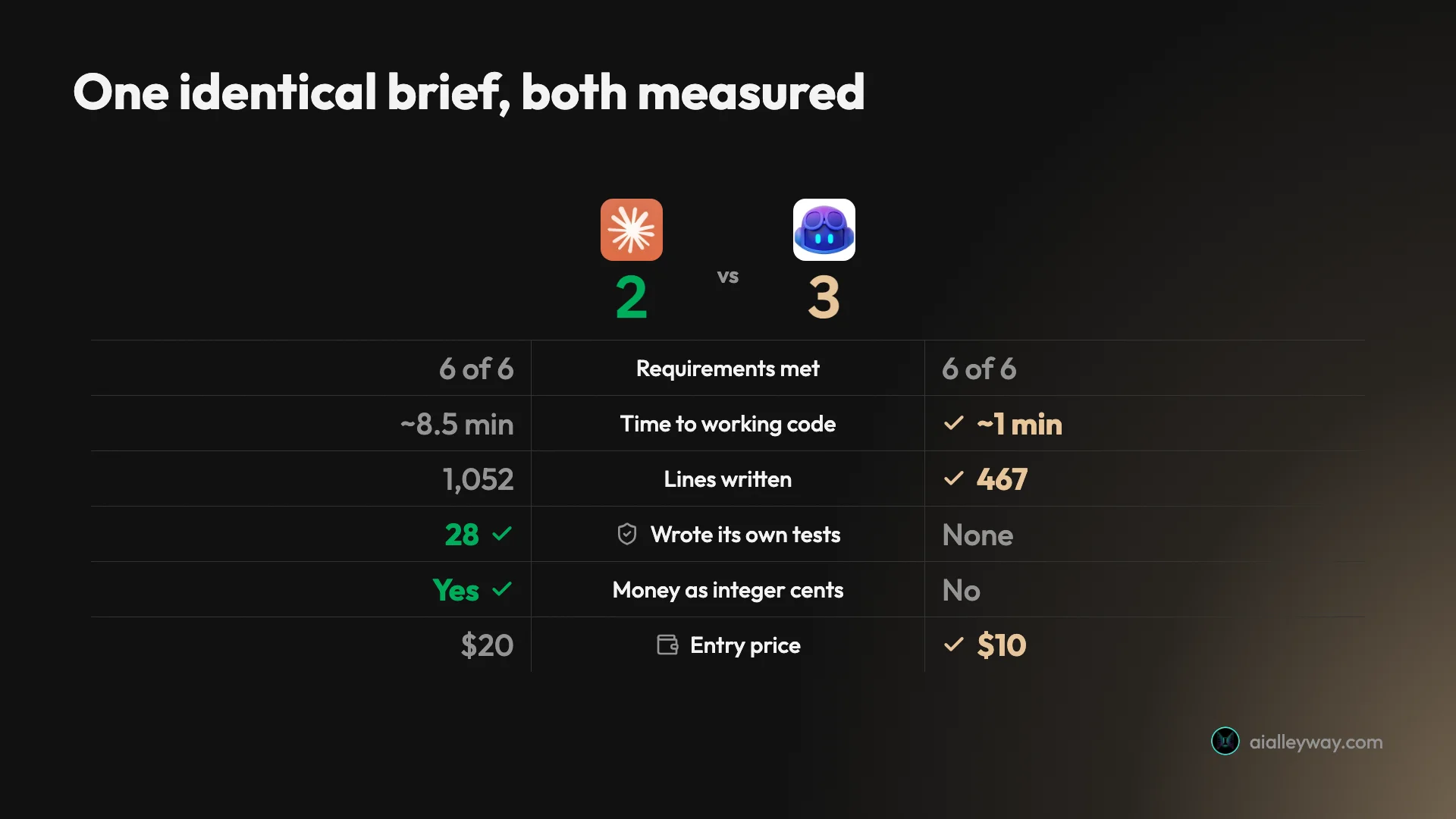
Two things need stating plainly before anyone reads that table as a scoreboard.
Copilot’s timing is imprecise and I am not going to pretend otherwise. Claude Code was driven headless, so its 394-second build turn came from the CLI’s own JSON output. Copilot ran in a browser chat that gives no completion signal I could poll. About a minute is honest; to the second would not be.
Copilot returned an artifact in the browser, not files on disk. Every other tool I have given this brief wrote a folder. I had to extract Copilot’s output to run it at all. That is a difference in kind, not a quibble, and it is the clearest signal that these two products are built for different moments.
The $10 fact that reframes everything
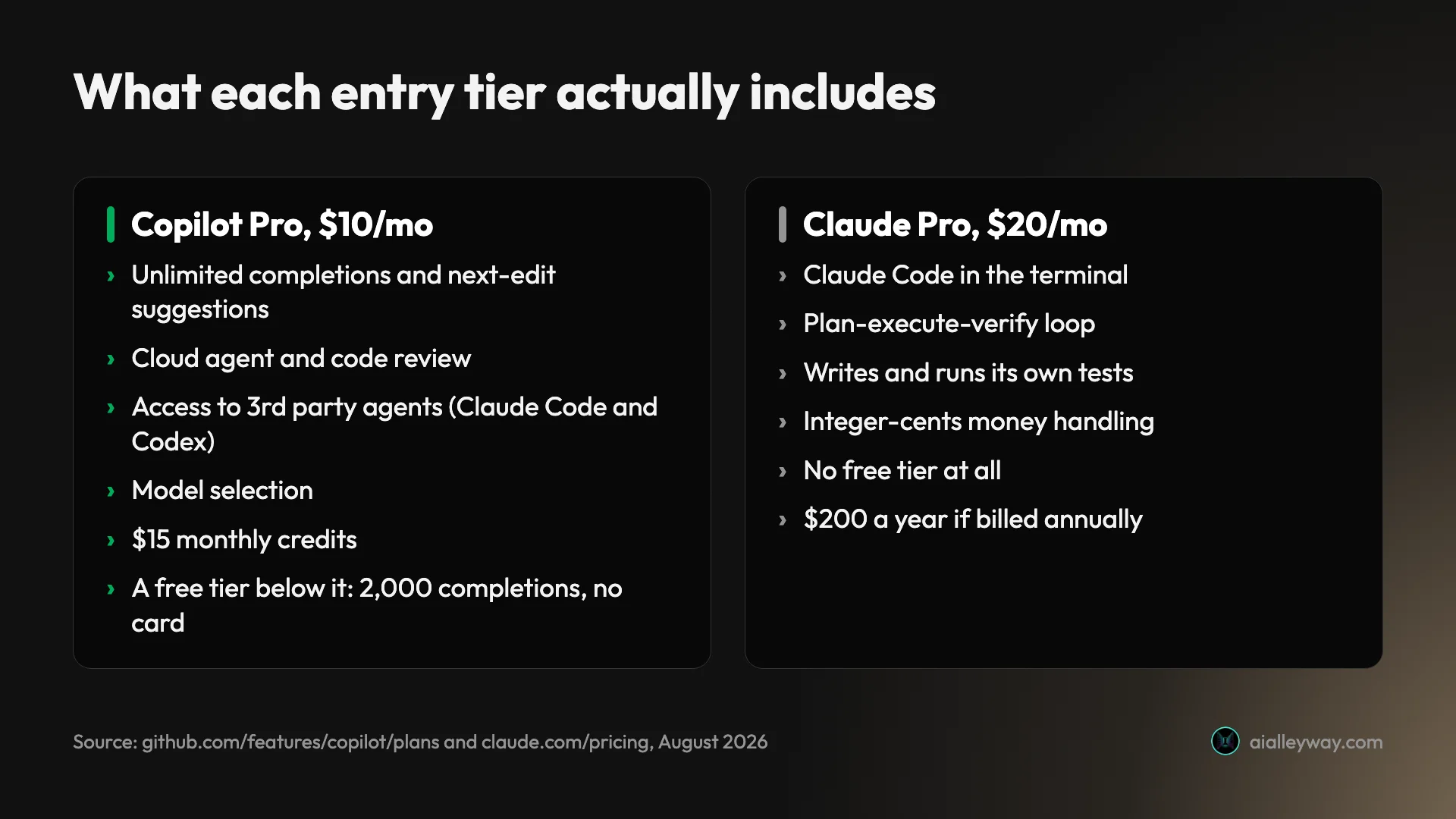
Here is GitHub’s Pro tier, as listed on its own plans page:
| Copilot Pro, $10 per user per month | |
|---|---|
| Everything in Free, plus | |
| Cloud agent and code review | |
| Unlimited code completion and next edit suggestions | |
| Access to 3rd party agents (Claude Code and Codex) | |
| Model selection | |
| Monthly credits | $15 |
Read that fourth row again. The cheaper product includes access to the more expensive one.
I want to be careful about what that does and does not mean, because it would be easy to overstate. It does not mean $10 buys you unlimited Claude Code. Copilot’s paid tiers run on credits — $15 a month on Pro, $70 on Pro+, $200 on Max — and credits are what runs out. Access is not the constraint; allowance is.
What it does mean is that the framing every comparison uses, including the ones that come up first when you search this, is out of date. The choice is no longer Claude Code or Copilot. For a developer already paying GitHub $10 a month, it is a question about how much agent work you do and whether your credits cover it.
If your answer is “a lot”, a direct Claude subscription still makes sense and the comparison below matters. If your answer is “some”, you may already be paying for this.
How they differ on price
Copilot is cheaper at every comparable tier and it is the only one of the two you can try for nothing.
| Claude Code | GitHub Copilot | |
|---|---|---|
| Free tier | None | Yes — 2,000 completions a month, no card |
| Free tier models | n/a | Haiku 4.5, GPT-5 mini and others |
| Entry paid | $20/mo (Claude Pro) | $10/mo (Pro) |
| Mid tier | $100 (Max 5x) | $39 (Pro+), $70 credits |
| Top tier | $200 (Max 20x) | $100 (Max), $200 credits |
| Annual discount | $200/yr ≈ $17/mo | Not listed on the plans page |
| Students | Not listed | Student plan for verified students |
Two observations that the row-by-row hides.
The credit allowances are worth more than the subscriptions. Pro costs $10 and includes $15 of credits; Pro+ costs $39 and includes $70; Max costs $100 and includes $200. That is unusual and it is a real answer to the complaint that Copilot’s mid-2026 move to credit pricing was a price rise in disguise — at list, the credits exceed the fee at every tier.
Claude Code having no free tier is the sharper difference. Copilot will let you run 2,000 completions a month forever without a card. Claude Code’s floor is $20. If you are evaluating rather than committed, that is not a small gap, and it is the single most practical reason to start on Copilot regardless of which you end up preferring.
How they differ on quality
This is where Claude Code earns its price, and the gap was not subtle.
Money. Claude Code stored currency as integer cents, explaining unprompted that summing 9.99 and 19.99 as floats gives 29.979999999999997. Copilot used floating point, which is what almost every tool does and what almost every tutorial teaches. Both apps display correct totals today. Only one of them will still reconcile after a few hundred entries.
Verification. Claude Code wrote a 74-line test file alongside the app: 28 assertions covering corrupt JSON in storage, non-array payloads, a storage API that throws on read, negative and non-numeric inputs, and float precision. I ran it and got 28 passed, 0 failed. Copilot wrote nothing that checked anything.
That second point generalises. Across eight tools given this brief, exactly two wrote and ran real tests, and both were agent-first developer tools rather than assistants. Copilot is not unusual in skipping it. Claude Code is unusual in not.
| What each did with the same requirement | Claude Code | Copilot |
|---|---|---|
| Money storage | Integer cents | Floating point |
| Explained the choice unprompted | Yes | No |
| Test file written | 74 lines | None |
| Assertions | 28, all passing | 0 |
| Corrupt-storage handling tested | Yes | No |
| Float-precision tested | Yes | No |
Restraint cuts the other way. Copilot did the job in 468 lines against Claude Code’s 1,052. Both are self-contained apps meeting the same six requirements, and less code is less to read when something breaks. Copilot also produced its result in one exchange where Claude Code needed eight.
So the honest summary is not that one writes better code. It is that Claude Code writes more careful code and more of it, and whether that trade is worth double the price depends entirely on whether the thing you are building has to survive contact with next year.
How they differ on shape
The benchmark barely touches the real difference, so it is worth stating directly.
Copilot lives where you type. It is an extension inside VS Code, JetBrains and Visual Studio, built for sub-second inline completion and next-edit suggestions. Its defining feature is that it changes nothing else about how you work — no new application, no migration, no argument with your team about tooling. My build test measures none of that, because a one-shot app brief is not what inline completion is for.
Claude Code lives in the terminal and takes work away from you. You describe an outcome, it plans, executes and verifies, and you review what comes back. It is editor-agnostic precisely because it does not live in one.
That is why “which is better” keeps producing unsatisfying answers. They are optimised for different moments in the same day: one for the code you are already writing, one for the work you would rather delegate. The people who report the best results from either tend to be the ones who stopped trying to make one do both.
What the June 2026 credit change actually did
Copilot’s pricing is the subject of a live argument, and it is worth understanding before the $10 figure above reads as straightforwardly cheap.
In mid-2026 GitHub moved Copilot onto credit-based billing. The reaction was not warm: developer threads from the weeks afterwards carry titles like “GitHub Copilot’s new credit-based pricing is highway robbery”, and one widely shared post reported burning through 7,000 credits in a single afternoon of ordinary work. Interest in the term “GitHub Copilot credits” is up roughly seventeenfold year on year, which is what a pricing controversy looks like in search data.
I have not reproduced that experience, and I want to be precise about why: my build consumed the free tier, not credits, so I have no first-hand measurement of how fast a paid allowance drains. What I can verify is the structure.
| Tier | Price | Monthly credits | Credits per dollar |
|---|---|---|---|
| Free | $0 | None | n/a |
| Pro | $10 | $15 | 1.5 |
| Pro+ | $39 | $70 | 1.8 |
| Max | $100 | $200 | 2.0 |
At list, every paid tier returns more credit value than it costs, and the ratio improves as you go up. That is a genuinely defensible design and it is not what “price rise” usually looks like.
The complaint underneath is different from the headline, though, and it is the same complaint I have made about three other tools this month: a credit is not a unit you can feel. A request costs what it costs depending on which model answered and how long the context was, and you learn the rate by exhausting it. The people describing the change as a price rise are mostly describing the loss of predictability rather than an increase in the number.
Which is the honest thing to weigh against Claude Code’s flat $20. One of these bills is legible and one is cheaper, and until you have run a month of your own work through Copilot’s meter you will not know which of those matters more to you.
What I did not test
The limits, because a comparison that does not state them is worth less than it looks.
I did not test Copilot where it lives. My brief was a one-shot app build in a browser chat. Copilot’s actual product is sub-second inline completion inside an editor you already use, and nothing here measures that. A tool built for autocomplete being slower to produce a whole app than an agent built for whole apps would be an unremarkable finding; the interesting thing is that it was faster.
I did not test either on an existing codebase. One greenfield single-page app says nothing about a repository with ten years of history, which is where both products spend most of their real working life.
I did not exhaust a paid Copilot allowance. Everything above about credits is structural, read off the plans page, rather than measured against my own usage.
And I have not reviewed Copilot properly, which is why it carries no rating on this page.
Where these two sit among eight tools
Both of these have now taken the same brief as six other tools, which gives the comparison a scale that a head-to-head cannot.
| Tool | Built from one prompt | Time | Lines | Own tests | Cost |
|---|---|---|---|---|---|
| Cursor | Yes | under 1 min | 581 | No | $0 free tier |
| GitHub Copilot | Yes | ~1 min | 468 | No | $0 free tier |
| Lovable | Yes | 109 sec | Not counted | No | ~$0.30 |
| Antigravity | No, approval gate | ~2.5 min | 2,894 | Yes, 6 | $0 |
| Codex | Yes | 2 min 44 | 585 | No | $0 |
| Bolt | Yes | 2–3 min | Not counted | No | ~$0.25 |
| Replit | Yes | ~4 min | Not counted | No | 31% of a day’s credits |
| Claude Code | No, interviewed first | ~8.5 min | 1,052 | Yes, 28 | ~$2.56 |
Three things that table says which neither product’s marketing does.
Copilot wrote the least code of anything here. 468 lines, fewer than Codex’s 585 and Cursor’s 581, for the same six requirements. For a tool whose reputation is autocomplete rather than architecture, producing the leanest complete result of eight is not what I expected going in.
Claude Code is an outlier at both ends. Slowest, wordiest, dearest — and the only one of eight with a serious test suite. Every axis where it loses is a speed or cost axis, and the one where it wins is the one that shows up months later.
All eight passed. Six of six requirements, every tool, first attempt, including both traps. If you take one thing from a page comparing two AI coding tools, let it be that on work of this size the capability question is largely settled, and what is left is cost, shape and whether anything checks the result.
The full ranking is in best AI for coding, and the individual results are in the Claude Code review, Codex review and Cursor review.
Who should pick Claude Code
Anyone whose code has to be maintained. The integer-cents decision and the 28-assertion suite are the same instinct twice, and neither shows up on the day you build the thing.
Anyone working on a large existing repository. This is the job it is built for, and my greenfield test does not measure it — the independent reporting consistently favours it here.
Anyone who wants the interview. Its three questions before writing anything are the ones you would otherwise answer by rejecting a first draft.
Not for you if you want to evaluate before paying, since there is no free tier, or if most of your day is autocomplete rather than delegation.
Who should pick GitHub Copilot
Anyone who will not change editor. This is the whole argument and it decides most cases before any benchmark does.
Anyone evaluating on a budget of zero. 2,000 completions a month, no card, indefinitely.
Anyone who already pays GitHub. At $10 with third-party agent access included, the marginal cost of trying the agent workflow is nothing extra.
Students. GitHub lists a Student plan for verified students, which Claude Code does not advertise.
Not for you if you need the tool to verify its own work, or if your workflow is delegation rather than completion.
Why Copilot has no rating here
A note on what this page is and is not.
Claude Code carries an Alley Rating of 4.7, earned across eight months of daily use and documented in is Claude Code worth it. Copilot has no rating, because one controlled build is not a review and I am not going to imply otherwise by inventing a number.
There is also a practical reason the review does not exist yet: the obvious keyword for it is owned by Copilot’s own code review feature, so a product review published against that phrase would be answering a question nobody asked. When Copilot gets a rating here it will be off sustained use, the way Claude Code’s was.
What this page rests on is narrower and, I think, more useful: two tools, one identical brief, every result verified by using the app rather than reading a transcript.
Which one, in one table
| If this is you | Pick | Why |
|---|---|---|
| Evaluating, budget of zero | Copilot Free | 2,000 completions a month, no card. Claude Code has no free tier |
| Already paying GitHub $10 | Copilot Pro | Third-party agent access is already in your bill |
| Verified student | Copilot | A Student plan exists; Claude Code does not advertise one |
| Live in VS Code or JetBrains | Copilot | Nothing else about your setup changes |
| Building something you will maintain | Claude Code | Integer cents, and the only test suite of the two |
| Large existing repository | Claude Code | The job it is built for, though my test does not prove it |
| Underspecified work | Claude Code | The interview is faster than rejecting a first draft |
| Heavy daily agent use | Claude Code direct | A flat $20 beats a credit meter you cannot feel |
The row worth dwelling on is the second one. A developer already paying for Copilot Pro has access to both approaches for a single $10 bill, which makes “try the agent workflow before committing to it” close to free. That is a genuinely new situation, and it is the reason this comparison reads differently in August 2026 than it did six months ago.
The final word
Every comparison of these two that I read while researching this frames it as a choice. GitHub’s own pricing page disagrees.
On the measurable work, they split cleanly. Copilot was faster, leaner and free — a complete app in about a minute, 468 lines, on a tier that costs nothing. Claude Code was slower, wordier and more expensive, and produced the better code by a margin that will only show up later: integer cents for money, and the only test suite either of them wrote.
| The split, in short | |
|---|---|
| Faster, leaner, free | Copilot, ~1 min, 468 lines, $0 tier |
| Better code, tested | Claude Code, integer cents, 28 assertions |
| Cheaper entry | Copilot, $10 vs $20, and it bundles the other |
| Legible bill | Claude Code, flat, against a credit meter |
But the recommendation that actually follows is not “pick the better one”. It is start with the bill you already have. If you pay GitHub $10 a month, you have a free trial of this entire argument sitting in your existing subscription. If you are paying for neither, Copilot’s free tier lets you find out what you need before spending anything, and Claude Code’s $20 is worth it the moment your answer is “the code has to last”.
One practical note before that. If you do end up running both, keep one source of project instructions rather than two. Copilot reads its own configuration and Claude Code reads its own, and the failure mode of a two-tool setup is not conflict — it is two sets of rules drifting apart until you cannot tell which one produced the thing you are looking at.
And one small thing that has now happened eight times out of eight. My brief said cancelled items must leave the total and stay visible. It said nothing about bringing them back. Copilot added a Reactivate button, exactly like every other tool I have given this to. Nobody has asked for it yet. Everybody builds it.
One level down on either side: Claude Code pricing and GitHub Copilot pricing for what each tier actually meters, or Copilot vs Codex — the other half of what that $10 bundles. If Cursor is in the running too, Claude Code vs Codex vs Cursor puts the three agents on the same brief.
Frequently asked questions
Is Claude Code better than GitHub Copilot?
On code quality, measurably yes. Given the same six-requirement brief, Claude Code stored money as integer cents to avoid float drift and shipped a 28-assertion test suite that passed when I ran it. Copilot produced a working app that met every requirement and wrote no tests at all.
But better is the wrong frame now. Copilot Pro at $10 a month includes access to third-party agents, and GitHub names Claude Code and Codex as two of them. So the practical question is no longer which to buy, it is whether you want Claude Code on its own at $20 or reached through a $10 Copilot subscription that also gives you inline completion.
How much does each one cost?
Copilot is cheaper at every comparable tier and has a real free plan. Free gives you 2,000 completions a month with no card. Pro is $10 per user a month and includes $15 of monthly credits, Pro+ is $39 with $70 of credits, and Max is $100 with $200 of credits.
Claude Code has no free tier at all. It arrives with a Claude subscription: Pro at $20 a month or $200 a year, Max 5x at $100, Max 20x at $200. So the entry point is $10 against $20, and only one of the two lets you try it for nothing.
Can GitHub Copilot use Claude models?
Yes, and this is the fact that reshapes the comparison. GitHub's own plans page lists access to third-party agents on the Pro tier and names Claude Code and Codex specifically. Paid tiers also include model selection, so you are not locked to one provider.
That means the two products are no longer purely competitors. For a developer already paying GitHub $10 a month, adding Claude Code is a question about limits and workflow rather than a second subscription. Check what your credit allowance actually covers before assuming it replaces a direct Claude plan, because credits are the constraint rather than access.
Which is faster?
Copilot, comfortably, on the one task I measured both on. It returned a complete 468-line app in about a minute. Claude Code took roughly eight and a half minutes and, before that, refused to write anything until it had asked three clarifying questions — eight exchanges passed before any code existed.
The caveat is that these are different kinds of speed. Copilot is built for sub-second inline completion while you type, which my build test does not measure at all. Claude Code trades speed for a plan-execute-verify loop. On a fully specified brief that loop is overhead; on an underspecified one it is the point.
Do they write tests?
Claude Code does, Copilot did not. On the identical brief Claude Code produced a 74-line test file alongside the app with 28 assertions covering corrupt storage, non-array payloads, storage that throws on read, negative inputs and binary float precision. I ran it and got 28 passed, 0 failed.
Copilot wrote no tests. Of eight tools I have given this brief, only two verified their own work, and both were agent-first developer tools rather than assistants. If you want the thing that writes your code to also check it, that is a real dividing line and it does not favour Copilot.
Should I use both?
That is the most common recommendation from people who have used both seriously, and the pricing now makes it easier rather than harder. The pattern is Copilot for fast inline completion while you type, and Claude Code for the deep multi-file work you delegate.
What changed is that you no longer necessarily pay twice. A $10 Copilot Pro subscription includes third-party agent access covering Claude Code, so the two-tool workflow can start from one bill. Whether that is enough depends on your volume, since the credit allowance rather than the access is what runs out.
Keep reading

Claude skills marketplace: what it is and which to add
A Claude skills marketplace is just a git repo with a manifest. Anthropic's official one lists 291 plugins; 23 say Anthropic wrote them. How to read one.
Claude Code vs Codex vs Cursor: one brief, three results
Claude Code vs Codex vs Cursor, measured. I gave all three the same brief and used every app they built. All three passed — here is what separated them.
Claude Code tips: what eight months of daily use taught me
Claude Code tips from running a production pipeline on it daily for eight months, plus a controlled build test. The habits that changed my output.
Claude Code vs Cursor: I paid for both for a year
Claude Code vs Cursor, decided on invoices rather than vibes. They have converged on capability. Three axes still separate them, and only one decided it for me.