
ChatGPT for writing: fast free drafts that still need a fact check
ChatGPT for writing, tested on the free plan with four fixed tasks. It got 10 of 10 facts right in a news piece, then added a claim it was told not to.
Contents
Is ChatGPT good for writing?

OpenAI’s ChatGPT scores 3.4 out of 5 for writing on its free plan, from our fixed four-task test in November 2026. It is a capable first-draft writer that you have to check. I gave it a blog intro, a launch email, a brand-voice rewrite and a news paragraph built from ten facts. It was plain and accurate on the hardest task, then broke three simple rules elsewhere.
Overall we rate ChatGPT 4.6 in our full ChatGPT review, because it does more jobs well than any other assistant. Writing alone, on the plan most people use, is a narrower verdict.
The most telling moment came in the email task. I told it to use only seven facts. It added a sentence about bringing “convenience to your everyday workspace”, and a suggestion button appeared underneath: “Remove the unsupported lifestyle claim”. The interface spotted the problem. The draft still had it.
Everything here was tested on the free plan, with no trial and no paid model. Where I mention a paid feature, it comes from OpenAI’s pricing page and is marked as untested.
How did ChatGPT do on our writing test?
Every tool in this series gets the same brief, one task per fresh chat, with no follow-up prompts. The facts in two of the tasks are invented on purpose, so the model cannot be right from memory: every claim it makes is either in my list or it isn’t.
Here is the whole result before the detail.
| Task | What I asked for | What ChatGPT did |
|---|---|---|
| W1: blog intro | 150 words, no headings, end with a preview | 151 words, no headings, preview sentence at the end |
| W2: launch email | 7 facts only, subject line, under 150 words, one call to action | all 7 facts, 94 words, but one claim added |
| W3: voice rewrite | match a blunt sample, keep 6 facts, add none | blunt and plain, but 1 of 6 facts dropped |
| W4: news paragraph | about 200 words from 10 facts, add nothing | 10 of 10 facts right, nothing invented, but 165 words with repetition |
What this test can and can’t tell you. Each task ran once, on one account, on 22 November 2026. The chat never named the model it used and showed no picker, so a later session may get a different model. No limit or fallback message appeared, and “Think”, the extended reasoning toggle on the free plan, stayed off, as I found it. The composer turned my bullet and numbered fact lists into formatted lists; the wording was identical. The scores are our editorial judgment against a fixed rubric applied the same way to every tool, not a benchmark.
The blog intro hit its length almost exactly
The first task asked for a 150-word intro for a beginner’s guide to running shoes, in plain English, for adults who find running stores intimidating. ChatGPT returned 151 words in a “Writing” block, with no headings, and closed with a sentence previewing the post. That is the brief met.
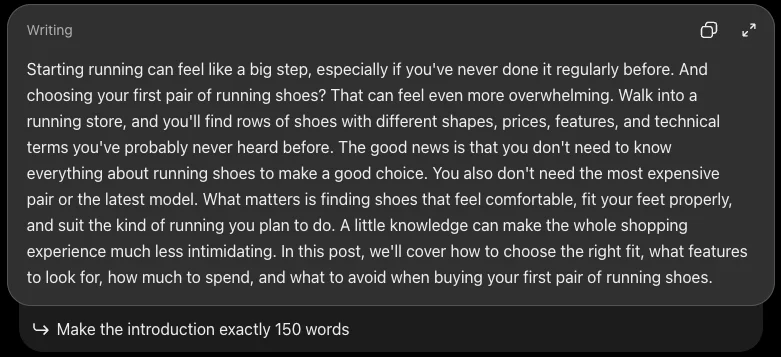
The prose is clean and a little generic. “The good news is that you don’t need to know everything” and “A little knowledge can make the whole shopping experience much less intimidating” are the kind of filler a human editor would trim. Nothing in it is wrong, though, and a beginner would find it readable.
Under the answer sits a suggestion chip, “Make the introduction exactly 150 words”, flagging the one-word overrun. Under this first answer of the session the free plan also showed an upgrade banner: “Improve accuracy for writing and career work. Upgrade to Plus and use increased reasoning to refine writing”.
The email added a claim it was told not to
The second task gave seven facts about a fictional desk lamp called Driftwood: name, price, launch date, three features and the company name. The instruction was blunt: “Use only these facts and do not add any others.”
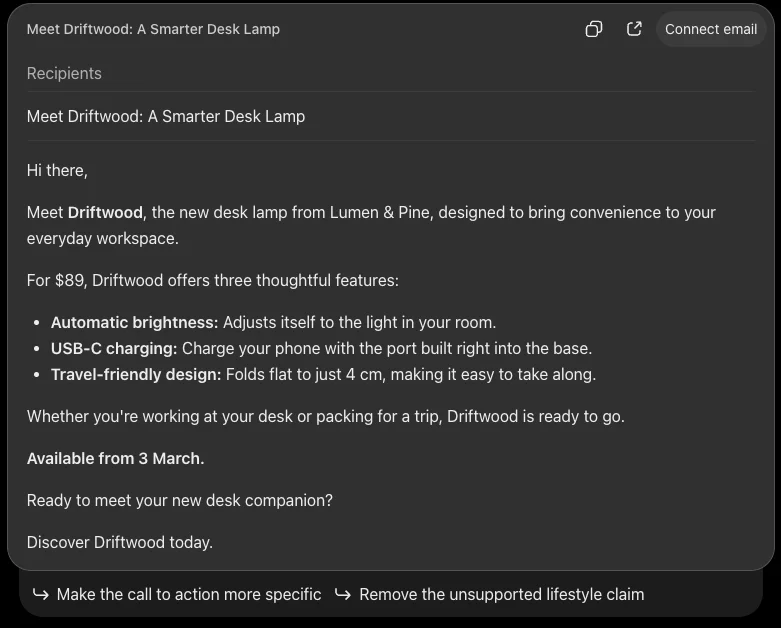
All seven facts are there and correct, and the body is 94 words, well under the limit. The features are laid out as bullets with bold labels, which suits an email. ChatGPT rendered it in an email card with a “Connect email” button, which shows where OpenAI wants this feature to go.
The problem is the opening line: “designed to bring convenience to your everyday workspace”. That is a claim about the product’s purpose, and I never gave it. “Whether you’re working at your desk or packing for a trip” is softer filler built on the travel fact.
The chip at the bottom, “Remove the unsupported lifestyle claim”, names exactly the line I would cut. That is the most useful thing this test shows: the default draft is the marketing version, and the clean-up is a separate step you have to take.
The rewrite was blunt but lost a fact
The third task gave a short voice sample from a bike shop (“We fix bikes. That’s it. No smoothies, no spin classes…”) and asked for a corporate scooter-repair paragraph rewritten in that voice, keeping six facts and adding none.
“We fix electric scooters. Our technicians are trained to do the job properly, and most repairs are done within five working days. A standard battery check starts at $25. Find us on Harbour Street. We’re open six days a week.”
Every trace of corporate phrasing is gone, and the sentences are short and plain. Five of the six facts survive. The one that didn’t is the point of the original paragraph: scooter repairs are new. “We fix electric scooters” reads as if they always have.
The voice is close but not quite there. The sample’s character comes from its dry asides, and the rewrite has none, so it reads as a clean neutral notice rather than the same author. Good enough for a website update, not for a brand that lives on its tone.
The news paragraph got every fact right
The fourth task is the one I care about most, because it is where AI writing does real damage: ten numbered facts about a fictional cycle path, turned into a news paragraph of about 200 words, adding nothing. The table checks all ten facts, grouped into eight rows.
| Fact checked | ChatGPT’s version | Right? |
|---|---|---|
| Opened on 14 June | “officially opened on 14 June” | yes (“officially” is decoration) |
| 23 km between Alderford and Mossbridge | “23-kilometre route between the towns of Alderford and Mossbridge” | yes |
| Cost 4.2 million pounds | “£4.2 million” | yes |
| 60% council, rest national grant | “60% … regional council … remaining amount … national transport grant” | yes |
| Built in 19 months on a railway closed in 1965 | both stated | yes |
| 3 bridges, 1 tunnel, the 400 m Hallow Tunnel | “three bridges and … one tunnel, including the 400-metre Hallow Tunnel” | yes, but “including” implies more tunnels |
| About 1,800 users in the first weekend | “around 1,800 people” | yes |
| Tunnel lighting next spring | “lighting due to be installed inside the tunnel next spring” | yes |
Ten out of ten facts are right, with no invented numbers, names or quotes. That is the result that matters for anyone using ChatGPT to turn notes or research into prose.
Two things pulled it down. It came in at 165 words against “about 200”, and the last two sentences restate the length and the two towns instead of using the space. It also added soft colour that sounds like reporting but isn’t: “attracted considerable interest” and “a major construction project” are not in the facts.
How the score adds up
Each task feeds five criteria scored from 0 to 5, the same rubric every tool in this series gets.
| Criterion | Score | Why |
|---|---|---|
| Accuracy | 4 | 1 invented claim (the email); 0 errors in the 10-fact paragraph |
| Following instructions | 2 | 3 misses: the added claim, a dropped fact, a short paragraph |
| Voice match | 4 | blunt and plain, missing the sample’s dry asides |
| Clarity | 4 | plain throughout; some padding by repetition |
| AI-tells | 3 | “Whether you’re… or…” filler, a restating closer |
| Writing rating | 3.4 | the average of the five |
On our rating bands that is a “Niche Pick”: strong at a narrow job (drafting from facts you supply) and unreliable at following rules without supervision.
What does ChatGPT cost for writing?
ChatGPT’s free plan is enough for writing, and it is what this review tested. OpenAI’s pricing page, read on 22 November 2026, lists “Unlimited text chats with GPT-6” for free users, with uploads, image creation, voice chats and deep research limited rather than removed. A writing session is text, so you are unlikely to hit a wall.
| Plan | Price | What changes for writing |
|---|---|---|
| Free (tested) | $0 | unlimited text chats with GPT-6; no model picker in the chat; ads may appear |
| Go | $8/mo | more messages with tools, more uploads, longer memory; ads may appear |
| Plus | $20/mo | “advanced reasoning models with GPT-6”, more messages and uploads; no ads |
| Pro | $100, $200 or $500/mo | three usage tiers, the highest limits |
Plan contents from chatgpt.com/pricing (22 November 2026); prices as covered in our ChatGPT review; ads per OpenAI’s help centre. Only Free was tested here.
The free plan’s real limit for writing is not a message cap but the missing picker. The pricing page names GPT-6, but the chat itself never says which model answered, and you can’t choose another. For a hard draft your only lever is switching on “Think” and waiting longer.
Is Plus worth it for writing? OpenAI’s own upgrade banner says Plus improves “accuracy for writing”. I haven’t tested that claim on our brief. If your writing goes out under your name, my advice is the same either way: the problems in this test were discipline problems (adding a claim, dropping a fact), and an editing pass fixes them for free.
Who should use ChatGPT for writing?
ChatGPT suits people who start from facts and need prose quickly.
- People turning notes into drafts. This is its strongest showing. Give it a list and say “add nothing”, and the facts come back intact. Meeting notes into a summary, research into a paragraph, bullet points into an email.
- Small business owners writing routine copy. The launch email came back usable on the first try. Budget a minute to delete the added marketing lines.
- Students drafting from their own sources, where their institution allows it. It restructures well. It should never be the source of a fact or a citation.
- Anyone who already uses ChatGPT for everything else. If you’re in it all day for questions, images and voice, writing in the same tool saves a context switch, and the free plan covers it.
It is a weaker fit for three groups.
- Brands that live on voice. The rewrite was plain and clear but not the sample’s author. If tone is your product, test Claude first; our ChatGPT review rates it the nearest rival on writing quality.
- Fiction and long-form creative work. Much of the forum talk about writing with ChatGPT is about stories and novels, and a thread in r/WritingWithAI complains that ChatGPT “rewrites instead of edits”. I didn’t test fiction, so treat that as their report, not my finding.
- Anyone who will publish without reading. One invented claim in four tasks is a small number until it is the line a customer quotes back at you.
What is ChatGPT good at for writing?
It keeps the facts you give it
In the hardest task, ten facts in a paragraph with nothing added, it got all ten right and invented no numbers, names or quotes. For notes-to-prose work, that is the thing that matters most, and it is what most people fear AI writing gets wrong.
It hits a length when the length is the job
The 150-word intro came back at 151, and the email body at 94 against a 150-word ceiling. When you state a length, ChatGPT treats it as a real target, which saves a round of trimming.
The prose is plain by default
None of the four answers used the words that mark lazy AI writing: no “delve”, no “unlock”, no “seamless”, no stacks of dashes. The rewrite stripped every corporate phrase from the original (“pleased to announce”, “comprehensive range”, “highest possible standard”) without being asked to name them.
Its suggestion buttons point at real problems
The two buttons I saw were specific. “Remove the unsupported lifestyle claim” named the line I would have cut, and “Make the introduction exactly 150 words” caught a one-word overrun. One click gives you an edit you would otherwise have to find yourself.
Where does ChatGPT fall short for writing?
It adds claims it was told not to add
The email instruction said “do not add any others”, and the first sentence added one. Invented marketing claims are exactly what gets a business into trouble, and the fix only came as a button after the draft, not in the draft.
It drops facts when it rewrites
The rewrite lost the one fact that was the reason for the paragraph: the service is new. If you use ChatGPT to tighten copy, compare the fact list before and after.
It pads instead of stopping
Asked for about 200 words from ten facts, it wrote 165 and spent its last two sentences repeating the start. It filled the gap with soft colour (“considerable interest”, “a major construction project”) rather than stopping or saying it had run out of material.
Voice matching copies the surface
The sample’s personality came from its asides (“No smoothies, no spin classes”), and the rewrite had none. ChatGPT picked up short sentences and plain words more readily than character. For brand copy, budget an editing pass for tone as well as facts.
The chat hides the model
There is no picker on the free plan, no model name on the answer, and nothing in the answer’s menu beyond the time, “Retry” and “Branch in new chat”. The pricing page says GPT-6, but inside the chat you can’t confirm it, choose another, or tell whether two sessions used the same model.
Alternatives worth considering
If you’ve decided ChatGPT isn’t the right writing tool for you, these are where I’d look next.
- Claude is the one to try if voice matters more than breadth. On the same four-task brief, Claude for writing scored 4.6 on its paid Opus model and 3.2 on the free plan’s model. It doesn’t generate images, which is the trade.
- Grammarly works on text you’ve already written rather than producing new drafts. If your problem is polishing your own writing, it keeps the words yours.
- QuillBot is built for paraphrasing and summarising. It is narrower than ChatGPT and aimed at rewording what you already have.
For the full field, our best AI writing tools roundup ranks the rest, and ChatGPT vs Claude compares the two assistants head to head.
Final word
ChatGPT’s free plan is a good writing partner and a poor final editor. Give it your facts as a list, tell it to add nothing, state the length and paste a voice sample. Then read every line before it goes out, starting with any sentence that sounds like marketing.
That routine turns its one real weakness, discipline, into a minute of editing. For writing alone on the free plan that earns a 3.4, and the free plan is the right place to start.
Frequently asked questions
Is ChatGPT good for writing?
For first drafts, yes. On our fixed four-task test on the free plan in November 2026, it wrote a 150-word blog intro in 151 words, turned ten numbered facts into a news paragraph with all ten right and nothing invented, and produced a usable launch email on the first try. We rate it 3.4 out of 5 for writing, against 4.6 for ChatGPT overall.
The score is held down by discipline rather than skill. It added a claim to an email after being told to use only the facts given, dropped one of six facts in a rewrite, and fell 35 words short of a 200-word target while repeating itself. So it is a good drafting partner and a poor final editor. Read everything it writes before you send it, and check every number against your own source.
Is ChatGPT free for writing?
Yes. OpenAI's pricing page, read in November 2026, lists unlimited text chats with GPT-6 on the free plan, which is all a writing task needs, and we ran our whole test on it without seeing a limit message. The catch is that the chat never shows which model answered and has no model picker, so you cannot ask for a stronger model on a difficult draft.
Paid plans start with Go at $8 a month and Plus at $20. Plus adds what OpenAI calls advanced reasoning models with GPT-6, plus more messages and uploads. We did not test the paid plans for this review. On the free plan, ChatGPT also showed an upgrade banner promising better accuracy 'for writing and career work', and OpenAI's help centre says ads may appear on the Free and Go plans.
Can I use ChatGPT for academic writing?
It depends on your institution, not on ChatGPT. Universities and journals set their own rules, and they range from banning AI-written text outright to allowing it with disclosure. Check your course handbook or the journal's author guidelines before you start, because the rule that applies to you is the one written there, and saying you didn't know rarely helps.
Where it is allowed, our test suggests a safe pattern. ChatGPT handled a fixed list of facts accurately when told not to add anything, but it still invented a marketing claim in a different task under the same instruction. Use it to restructure your own notes and sources, never to supply facts or citations, and verify every claim and reference yourself before you submit anything with your name on it.
How can you tell if writing is AI-generated?
Not reliably by a tool alone. AI detectors produce false positives on human writing and miss AI text that has been edited, so a detector score is a hint, not proof. Reading closely works better, because default AI prose has habits you start to notice once you look for them.
In our test, ChatGPT's tells were mild but present. It used filler like 'The good news is', closed a news paragraph with a sentence that restated facts it had already given, and added soft phrases such as 'attracted considerable interest' that sound like reporting but carry no information. A careful editor removes these in a minute. If you use ChatGPT for writing, that editing pass is also what makes the text sound like you rather than like the default.
What are good prompts for writing with ChatGPT?
Prompts that state the facts and the limits do better than prompts that ask for quality. In our test, ChatGPT kept every fact when it got a numbered list and the instruction not to add anything, and it hit a 150-word target almost exactly when the length was the whole job.
Four habits help. Give it the facts as a list rather than trusting it to know them. State the length and the format. Paste a sample of the voice you want rather than describing it. And finish with a check, such as asking it to list any claim in its draft that is not in your facts. In our email task, one of ChatGPT's own suggestion buttons offered to remove an unsupported claim, which shows that check is worth running every time.
Keep reading
ChatGPT review: the free tier is the story, not the $20 one
A ChatGPT review from a year on the free tier plus one month of Plus. Six rungs from $0 to $500, and ads now run on both the Free and $8 Go tiers.
Best AI writing tools: one to draft, one to check
The best AI writing tools, tested on one email brief and 23 planted errors. Claude drafted best, Grammarly checked best, and Gemini changed a promise.
ChatGPT vs Claude: one writes, one does everything else
ChatGPT vs Claude, from a paid Claude account and a year on ChatGPT free. Both $20, but the free tiers differ far more — and only one generates images.
ChatGPT PowerPoint: it made my deck free, then locked me out
Can ChatGPT make a PowerPoint? My free account got an 8-slide .pptx in a minute, then hit a limit. The add-in, ChatGPT Slides and Copilot, compared.