
Claude for writing: Opus scored 4.6, the free model 3.2
Claude for writing, tested on two models with the same four tasks. Opus 5.5 invented nothing and hit every target. Free-plan Sonnet added four claims.
Contents
Is Claude good for writing?

Anthropic’s Claude scores 4.6 out of 5 for writing on Opus 5.5, the model paid plans include from Pro up, from our fixed four-task test in November 2026. It is the cleanest result in our writing series so far: every word target met, every fact kept, nothing invented.
The free plan’s model tells a different story. I ran the same four tasks on Sonnet 5.5, which is what free users get, and it scored 3.2. Its voice was excellent, but it added four small claims along the way, slightly behind ChatGPT’s free plan at 3.4 in our ChatGPT for writing test.
So the honest answer is “yes, if you pay”. On Pro ($20 a month) and above, it is the strongest writing tool we have run through this brief.
Overall, as an assistant, we rate Claude 4.4 in our full Claude review. This page rates writing alone.
How did Claude do on our writing test?
Every tool in this series gets the same brief, one task per fresh chat, with no follow-up prompts. Three of the four tasks use invented facts, so every claim in the answer is either in my list or it isn’t. I ran Claude in incognito chats so memory and saved preferences played no part, once on each model.
| Task | What I asked for | Opus 5.5 (paid plans) | Sonnet 5.5 (free model) |
|---|---|---|---|
| W1: blog intro | 150 words, no headings, end with a preview | 150 words, all checks met | 153 words, all checks met |
| W2: launch email | 7 facts only, subject, under 150 words, one call to action | all 7 facts, nothing added, 81 words | all 7 facts, 90 words, one claim added |
| W3: voice rewrite | match a blunt sample, keep 6 facts, add none | 6 of 6 kept, nothing added | 6 of 6 kept, one claim added |
| W4: news paragraph | about 200 words from 10 facts, add nothing | 10 of 10, nothing added, 195 words | 10 of 10, two claims added, 166 words |
| Writing score | 4.6 | 3.2 |
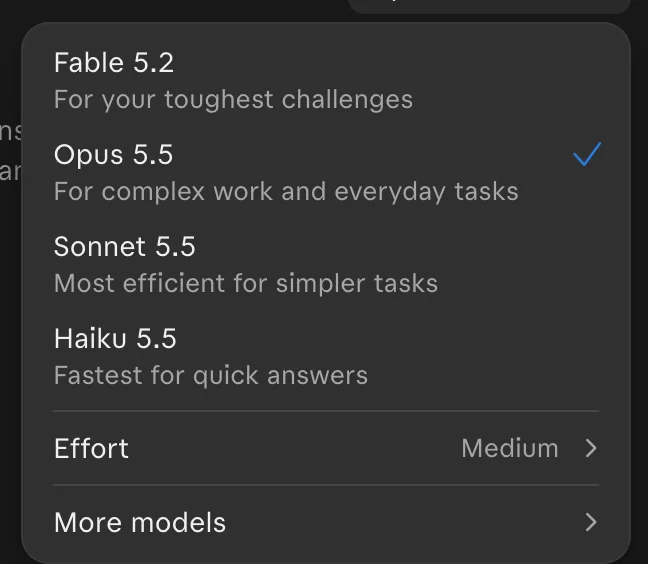
What this test can and can’t tell you. Each task ran once per model, on one account, on 22 November 2026. I tested Sonnet by picking it in the model menu on a Max account, not on a free account, so free-plan usage limits did not apply. Effort was left at the default “Medium”. I did not test Fable 5.2, Max’s top model. The composer turned my fact lists into formatted lists, as ChatGPT’s did; the wording was identical. The scores are our editorial judgment against a fixed rubric applied the same way to every tool.
Opus checked its own work before answering
On every task, Opus showed a short thinking step before it wrote: “Counting the words in the intro draft”, “Choosing the tool and checking the email’s claims”, “Checking the paragraph’s figures and phrasing against the facts”. Those labels match what it then did. The intro came back at exactly 150 words, and the news paragraph at 195 against “about 200”.
Sonnet showed no such step on any task; it simply answered. I can’t see inside either model, but the pattern fits the results: the run that checked its work invented nothing, and the run that didn’t added small claims.
The intros: same metaphor, different discipline
Both Claude models opened the running-shoe intro with the same image. Opus: “Walking into a running store for the first time can feel like showing up to a party where everyone already knows each other.” Sonnet: “…a party where everyone already knows the rules.” Same model family, same instinct for a concrete picture; ChatGPT’s intro on the same brief opened with a plain statement instead.
The difference was in the finish. Opus named the jargon a nervous beginner actually hears (“pronation and heel drop”) and landed on 150 words exactly. Sonnet landed on 153, still inside the brief. Both ended with the preview sentence the brief asked for, and both used one “Here’s the good news” line, which is about the only filler either intro carried.
For a short, warm piece like this, the free model is genuinely good. The gap between the two only opens up when the task has rules to break.
The email: the only clean one in the series
The email task gives seven facts about a fictional desk lamp, Driftwood, with a blunt rule: “Use only these facts and do not add any others.” ChatGPT added a lifestyle claim here, and so did Claude’s free model (“a desk lamp that works the way you do”). Opus did not.
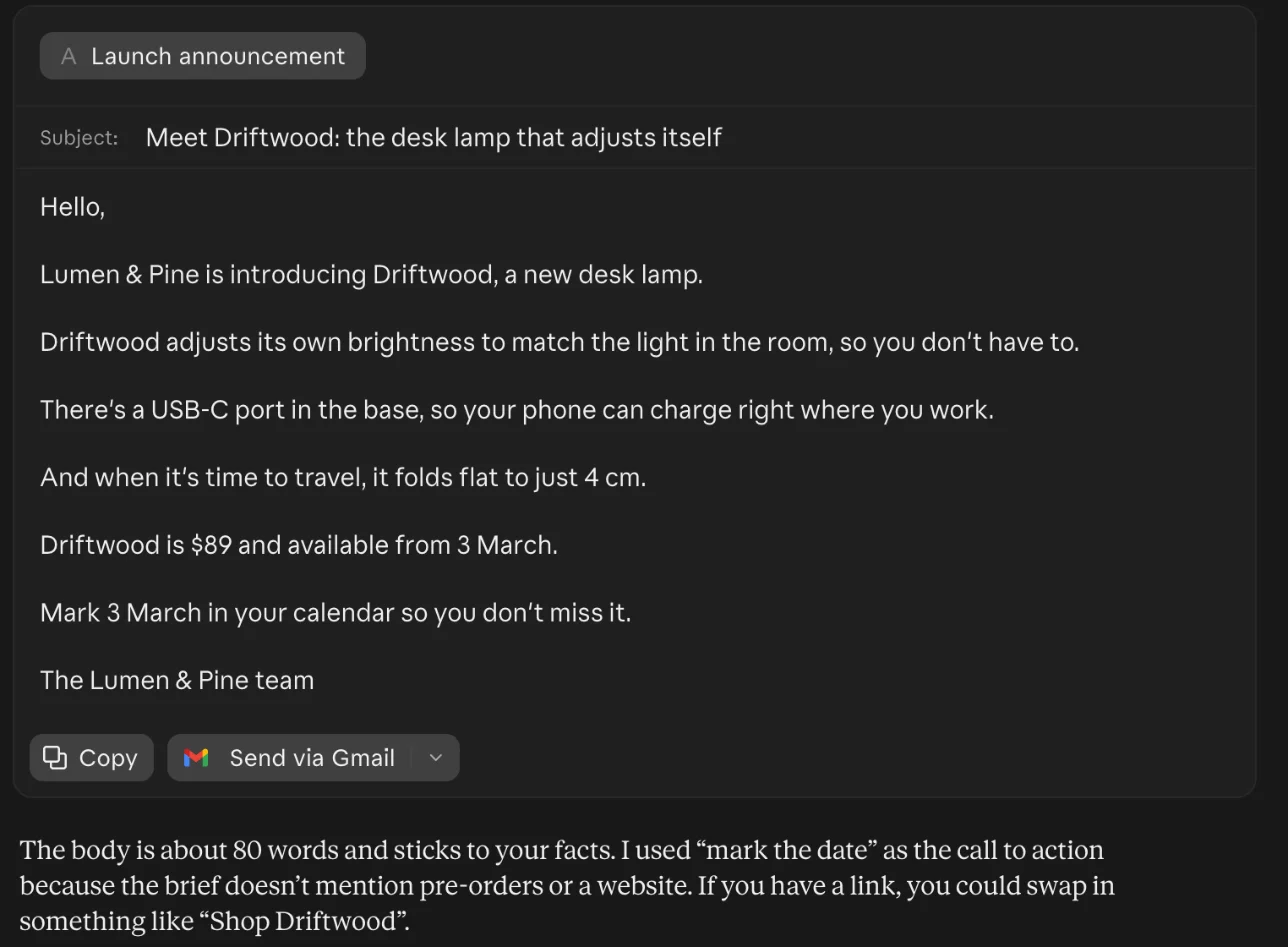
Look at the call to action: “Mark 3 March in your calendar so you don’t miss it.” Then the note underneath: “I used ‘mark the date’ as the call to action because the brief doesn’t mention pre-orders or a website.” No other run on this brief so far, ChatGPT or Claude’s free model, handled the missing link that way. Opus wrote around the gap instead of inventing a shop link I never gave it.
The email arrived in a card with “Copy” and “Send via Gmail” buttons. It used 81 words, well inside the limit.
The rewrite: both models nailed the voice
The third task gives a short voice sample from a bike shop (“We fix bikes. That’s it. No smoothies, no spin classes…”) and a stiff corporate paragraph about scooter repairs to rewrite in that voice, keeping six facts and adding none.
| Opus 5.5 | Sonnet 5.5 | |
|---|---|---|
| Opening | “We fix electric scooters now. All of it, the full range of repairs.” | “We now fix electric scooters too. Same deal as the bikes:” |
| “The service is new” kept? | yes (“now”) | yes (“now… too”) |
| Facts kept | 6 of 6 | 6 of 6 |
| Anything added? | no | yes: bikes and a “plain words” promise from the sample |
Both rewrites sound like the sample’s author, which ChatGPT’s did not quite manage. Sonnet’s “Same deal as the bikes” is the funniest line in the series, and it is also the problem: it carries the sample shop’s bike repairs and its “we’ll tell you what’s wrong in plain words” promise into a business whose paragraph claimed neither.
Opus kept the punch (“All of it, the full range of repairs.”, “New customer or old, come on in.”) without borrowing a single fact. That is what brand copy needs.
The news paragraph: Opus hit the length, Sonnet padded
The fourth task turns ten numbered facts about a fictional cycle path into a news paragraph of about 200 words, adding nothing. Both models got all ten facts right. What happened around them differed.
| Opus 5.5 | Sonnet 5.5 | |
|---|---|---|
| Length (asked for about 200) | 195 words | 166 words |
| Listed facts right | 10 of 10 | 10 of 10 |
| Invented claims | none | “almost six decades ago” (a derived number the list never gave; 1965 to 2026 is 61 years) and “a growing number of residents are likely to make use of it” |
| Padding | one redundant sentence about passing every bridge | a 50-word speculative closing sentence |
Sonnet’s “almost six decades” is the kind of slip that matters most, because it looks like a fact. Nothing in the list gave a year for the opening, so any “decades” figure is the model’s own arithmetic on an assumption. Opus wrote “decades later” and left it there.
How the scores add up
Each task feeds five criteria scored from 0 to 5, the same rubric every tool in this series gets.
| Criterion | Opus 5.5 | Sonnet 5.5 | ChatGPT Free (for reference) |
|---|---|---|---|
| Accuracy | 5 (0 added) | 2 (4 added) | 4 (1 added) |
| Following instructions | 5 (0 misses) | 1 (4 misses) | 2 (3 misses) |
| Voice match | 5 | 5 | 4 |
| Clarity | 4 | 4 | 4 |
| AI-tells | 4 | 4 | 3 |
| Writing score | 4.6 | 3.2 | 3.4 |
The pattern is clear. Claude’s voice is better on both models. What you pay for with Opus is discipline: the checking step that stops a good sentence from also being an invented one.
What does Claude cost for writing?
The model is what you are buying. Claude’s pricing page, read on 22 November 2026, gives the free plan Sonnet and Haiku, and adds Opus from Pro up.
| Plan | Price | Models for writing | Usage |
|---|---|---|---|
| Free | $0 | Sonnet 5.5, Haiku 5.5 | limited every 5 hours and every week |
| Pro | $20/mo, or $17/mo billed yearly ($200) | adds Opus 5.5 | at least 5x Free per 5-hour session |
| Max | $100/mo | adds Fable 5.2 (up to half the weekly limit) | 5x Pro |
| Ultra | $200/mo | as Max | 10x Pro weekly, no 5-hour limit |
From claude.com/pricing, 22 November 2026. Tested here: Opus 5.5 and Sonnet 5.5 on a Max account.
For writing, Pro is the plan that matters. It is the cheapest way to get Opus, which is the model that scored 4.6. Max and Ultra add usage and Fable, which you need only if Pro’s limits get in your way.
Usage limits are the catch. Anthropic meters by a rolling five-hour window and a weekly cap rather than a message count, and how fast you hit them depends on the model and how long your chats are. Our Claude review covers the meters in detail.
What version of Claude is best for writing?
Opus 5.5 is the best Claude model for writing in our test, at 4.6 against 3.2 for the free plan’s Sonnet 5.5. The menu on a paid account lists four models, and their one-line descriptions undersell that difference.
- Opus 5.5 (“for complex work and everyday tasks”) is the one to write with. It scored 4.6 here, is included from Pro up, and was the default on our Max account.
- Sonnet 5.5 (“most efficient for simpler tasks”) is the free plan’s model. Use it for first drafts and brainstorming, and fact-check the result.
- Haiku 5.5 (“fastest for quick answers”) is also on the free plan. I didn’t test it for writing; it is built for speed, not prose.
- Fable 5.2 (“for your toughest challenges”) is included on Max, and the menu warns it draws down usage much faster. I didn’t test it either; for a 200-word email, Opus already left nothing to fix.
The effort setting matters too. I left it at the default “Medium”, where Opus showed its short checking step on every task. Lowering it may save usage on simple pieces; I would not lower it for anything with facts in it.
Who should use Claude for writing?
Claude suits people for whom the words themselves are the product.
- Marketers and copywriters. Opus kept every fact in a launch email and wrote a call to action that didn’t promise a link nobody gave it. That is the job.
- Brands with a defined voice. Both models matched a blunt voice sample from three sentences. Paste your best paragraph and Claude will write in its rhythm.
- Anyone who writes from notes and sources. Opus turned ten facts into 195 words with nothing invented. For reports, briefs and summaries, that is the property that matters.
- Writers willing to pay $20. Opus scored 4.6 where the free model scored 3.2.
It is a weaker fit for two groups.
- Free-plan users who will publish without checking. Sonnet’s voice is a pleasure, but it added claims in three of four tasks. Read everything.
- People who need images too. Claude doesn’t generate images. If one subscription has to cover writing and pictures, ChatGPT is the broader tool.
What is Claude good at for writing?
It writes around gaps instead of filling them
The Opus email is the best single answer in this series. With no website in the brief, it used “Mark 3 March in your calendar” as the call to action and said why. Every other run reached for a claim or a link it hadn’t been given.
It hits word counts precisely
Opus wrote 150 words for a 150-word brief and 195 for “about 200”. It showed a “Counting the words” step before both. That saves an editing round on anything with a fixed slot.
Its voice matching is the best we’ve tested
Both Claude models rewrote a corporate paragraph into a blunt bike-shop voice from a four-sentence sample. “All of it, the full range of repairs.” is a line a human copywriter would be pleased with.
It keeps facts through a rewrite
Opus and Sonnet both kept the one fact ChatGPT dropped in the same task: that the scooter service is new. Shortening for voice did not cost content.
Where does Claude fall short for writing?
The free model invents to round things off
Sonnet 5.5 added a small claim in three of the four tasks: a lifestyle line in the email, the sample shop’s bike repairs in the rewrite, and an unsupported “six decades” figure plus a guess about residents in the news piece. Each one makes a sentence feel finished, which is exactly why they are easy to miss.
The best results cost $20 a month
The jump from 3.2 to 4.6 is a jump from free to Pro. ChatGPT’s free plan scored slightly higher than Claude’s free model on this brief, so a writer who won’t pay gets no advantage from switching.
Usage limits are hard to predict
Anthropic meters by five-hour windows and weekly caps that vary with the model and chat length, with no fixed message count. A long editing session on Opus can run into a wait. I didn’t hit a limit in this test, but it ran on Max.
No images, and it pads at the end
Claude doesn’t make pictures, so a post that needs a header image needs a second tool. And even Opus added one redundant sentence to the news paragraph; both models round off pieces with a line the brief didn’t need.
Alternatives worth considering
If you’ve decided Claude isn’t the right writing tool for you, these are where I’d look next.
- ChatGPT is the better free choice by a whisker (3.4 against 3.2 on this brief) and the broader tool: our ChatGPT review covers its images, voice and research in one subscription.
- Grammarly works on text you’ve already written rather than drafting new copy. If you want to keep your own words and fix them, it is the better fit.
- Jasper is aimed at marketing teams; our review tested its Brand Voice feature on top of the drafting.
For the full field, see our best AI writing tools roundup and ChatGPT vs Claude.
Final word
Claude on Opus is the strongest writing tool we have run through this brief. Same brief, same rules: it hit every word count, kept every fact, matched the voice and invented nothing, and when the brief left a gap it said so instead of filling it.
The free model writes nearly as well and checks far less, so if you stay on free, treat every sentence that sounds finished as a sentence to verify. If writing is your job, Pro at $20 a month is the purchase.
Frequently asked questions
Is Claude good for writing?
Yes, on its paid models. On our fixed four-task writing test in November 2026, Claude's Opus 5.5 (included from Pro up) scored 4.6 out of 5: every word target met, all facts kept, nothing invented, and a brand-voice rewrite that read like the sample's author. That is the best result in our writing series so far, ahead of ChatGPT's free plan at 3.4.
The free plan is a different story. Its model, Sonnet 5.5, matched the voice sample even better than ChatGPT did, but it added four small claims across the tasks and wrote 166 words where we asked for about 200. It scored 3.2. So Claude is the strongest writing tool we have tested when you pay for it, and a good but careless one when you don't. Either way, give it your facts as a list.
What version of Claude is best for writing?
Opus 5.5, in our test. On the same four tasks, Opus scored 4.6 and Sonnet 5.5 scored 3.2. Opus invented nothing, hit 150 words on a 150-word brief and 195 on a 200-word one, and kept every fact in a rewrite. Sonnet added claims in three of the four tasks, including an unsupported derived figure, 'almost six decades', for a railway that closed in 1965.
Opus is included from Pro ($20 a month) up; the free plan gets Sonnet and Haiku. Max also includes Fable 5.2, Anthropic's most capable model, which we did not test; the model menu warns that it draws down usage much faster. For most writers, Opus on Pro is the sweet spot. Sonnet is still worth using for quick first drafts and brainstorming on the free plan, as long as you check every fact it adds before you publish.
Is Claude better than ChatGPT for writing?
On the paid plan, yes, clearly, in our test. Claude's Opus 5.5 scored 4.6 on our four-task writing brief, against 3.4 for ChatGPT's free plan, and it was the only one of the three runs that invented nothing at all. Both ChatGPT and free Claude added claims to a launch email after being told not to; Opus did not.
Free against free it is close and slightly in ChatGPT's favour: 3.4 for ChatGPT against 3.2 for Claude's Sonnet 5.5. Claude's free model wrote with more personality and matched a voice sample better, while ChatGPT kept closer to the facts. If you are not going to pay, try both on your own writing, because the two free models fail in different ways. If you are going to pay, Claude Pro at $20 a month is the better writing purchase on this evidence.
Can Claude be used for script writing?
Yes. Script writing leans on the two things Claude did best in our test: matching a voice from a short sample, and keeping to a fixed set of facts and a word count. Its paid Opus model hit word targets almost exactly and kept every fact it was given, which matters when a script has to fit a running time.
We did not test screenplays or video scripts specifically, so treat that as an inference from our writing brief rather than a tested verdict. One practical tip from the test: give Claude the facts as a list and tell it to add nothing. On the free model that instruction mattered most, because Sonnet 5.5 added small claims when it wanted to round off a piece. For a script, paste a short sample of the voice you want too; both Claude models matched a three-sentence sample closely.
Keep reading
Claude AI review: brilliant at words, strange about limits
A Claude AI review from a paying Max account. My $100 Max plan invoiced at $111.11, three usage meters run at once, and overflow is billed at API rates.
ChatGPT for writing: fast free drafts that still need a fact check
ChatGPT for writing, tested on the free plan with four fixed tasks. It got 10 of 10 facts right in a news piece, then added a claim it was told not to.
Best AI writing tools: one to draft, one to check
The best AI writing tools, tested on one email brief and 23 planted errors. Claude drafted best, Grammarly checked best, and Gemini changed a promise.
Claude Artifacts tested: a working app in 2 minutes, private at first
I built a tip calculator, a five-slide deck and an AI reply tool as Claude artifacts. What saved, what exported, what asked permission, and what Free gets.