
Make vs Zapier: which is cheaper, and which is easier?
We built in both. The honest Make vs Zapier verdict: who's cheaper at scale, who's easier to start, and which one actually fits how you work.
Contents
Make vs Zapier: the verdict at a glance
Make and Zapier are the two most popular no-code workflow automation platforms, and they solve the same problem from opposite ends. Zapier is the easiest automation tool there is and connects the most apps; Make gives you more branching logic for a fraction of the price. Your choice comes down to one trade: do you want the simplest tool with the widest reach, or the cheaper one with deeper logic.
We can compare these two with more standing than a spec-sheet rehash, because we built in both. For our Make review we created a real lead-routing scenario through the Make API and ran it live. For our Zapier review we built a multi-step Zap with its Copilot and drove its new MCP layer across Gmail, Google Calendar, and Slack. The verdict below rests on that, plus both tools’ live June 2026 pricing and more than 5,000 third-party reviews.
| Pick this | Tool |
|---|---|
| Best for the easiest start and the widest app library | Zapier |
| Best for branching logic and cost at scale | Make |
| Best overall value, if you can watch a meter | Make |
If you read only one section below, make it the price deep-dive: the per-operation-versus-per-task gap, and what each plan actually includes, is the fact that decides this for most people. Everything else, ease and reach and governance, is real but secondary to what these two do to your monthly bill as you grow.
Make vs Zapier compared, axis by axis
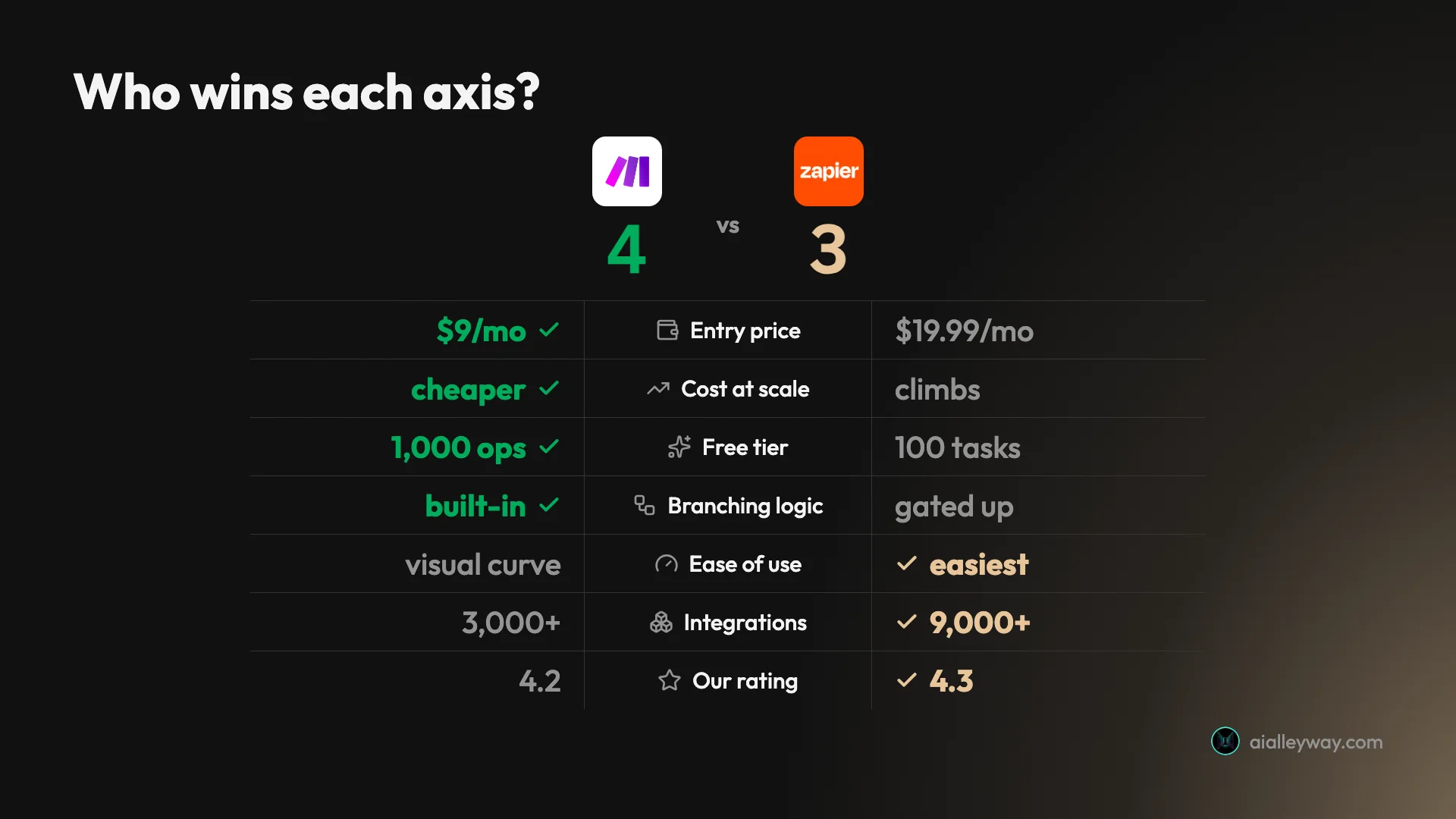
Here is the whole comparison in one place. The “how it bills” and “starting cost” rows are the ones that decide most switches, and the “integrations” and “ease” rows are why people pick Zapier anyway.
| Axis | Make | Zapier | Winner |
|---|---|---|---|
| How it bills | Per operation (one module run) | Per task (one app action) | Make |
| Free tier | 1,000 ops, 2 scenarios | 100 tasks, two-step Zaps | Make |
| Paid from | $9/mo (10,000 ops) | $19.99/mo (750 tasks) | Make |
| Cost at volume | Cheaper at most volumes | Climbs fast with tasks | Make |
| Branching logic | Routers, iterators, aggregators | Paths, gated to higher tiers | Make |
| Pre-built integrations | 3,000+ (plus HTTP) | 9,000+ (plus HTTP) | Zapier |
| Ease of starting | Visual canvas, steeper | Easiest in the category | Zapier |
| Drafts from a sentence | No | Yes (Copilot, all plans) | Zapier |
| AI / agents | AI modules, MCP | Copilot, Agents, MCP | Tie |
| Governance | Teams roles, SSO on higher tiers | SOC 2, SSO, audit logs | Zapier |
| Our Alley Rating | 4.2 | 4.3 | Zapier |
The tally splits almost evenly, which is the honest shape of this matchup: Make wins everything about cost and logic, Zapier wins everything about ease, reach, and governance, and the tenth of a point in our ratings goes to Zapier for being the tool a non-technical team can pick up on day one.
What Make does better than Zapier

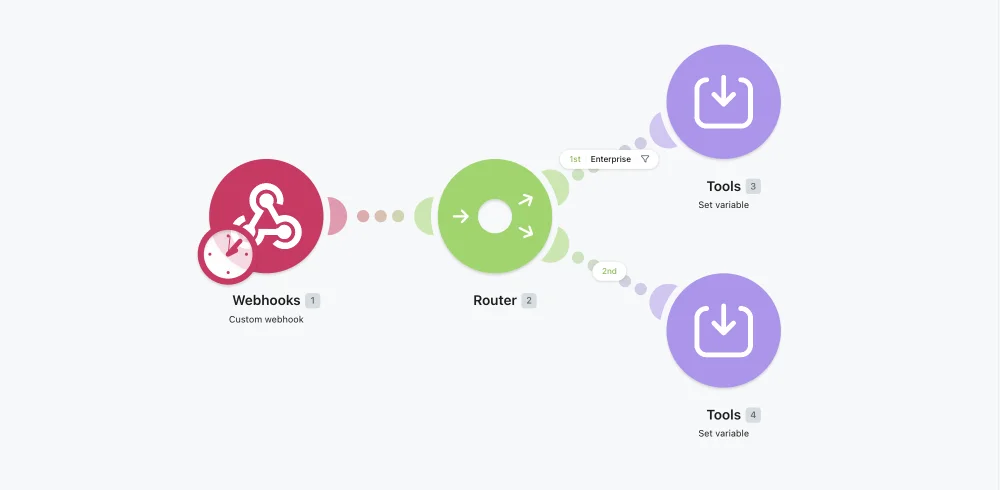
Make is the value-and-logic pick, and its whole case is doing more for less. It gives you a visual scenario builder where routers split a flow into conditional paths, iterators loop over lists, and aggregators collapse the results back together, the kind of branching Zapier reserves for its pricier tiers. When we built a lead-routing scenario through the Make API, the router-by-company-size logic was legible at a glance in a way a vertical list of Zap steps never is.
It is dramatically cheaper to start and to scale. Make’s Core plan is $9 a month for 10,000 operations, against Zapier’s $19.99 Professional for 750 tasks. Even accounting for the fact that Make meters every module while Zapier only bills app actions, the included allotment is so much larger that Make wins on cost at almost every real volume. The common refrain in user comparisons holds up: a $9 Make plan covers what a much costlier Zapier plan does.
The branching logic is included, not gated. Routers, filters, and iterators come standard from Core, so a single scenario can fan out to “if enterprise, do this; if SMB, do that” without paying for a premium tier. On Zapier, the multi-step Paths that do the same job sit on higher plans. For anyone whose automations branch, that difference compounds every month.
The free tier is genuinely usable. A thousand operations a month and two active scenarios is enough to build something real before you pay, where Zapier’s free plan caps you at single-action, two-step Zaps. Make is the better place to learn what you actually need.
It has a built-in database. Make’s Data Stores let a scenario remember state between runs, deduplicate records, or hold a lookup table without bolting on a separate tool. Zapier answers with Tables, but having state on the canvas means one less moving part to wire up for any automation that has to remember what it already did.
The gaps are real and they are the mirror of Zapier’s strengths. The connector library is narrower at roughly 3,000 apps. The operations meter demands active management: a polling trigger or a runaway loop drains credits fast, and the August 2025 move to credit-based pricing raised costs for AI and bulk workflows. And the advanced modules take a week or two to master. Our full Make.com review scores it 4.2, a Power Tool.
What Zapier does better than Make

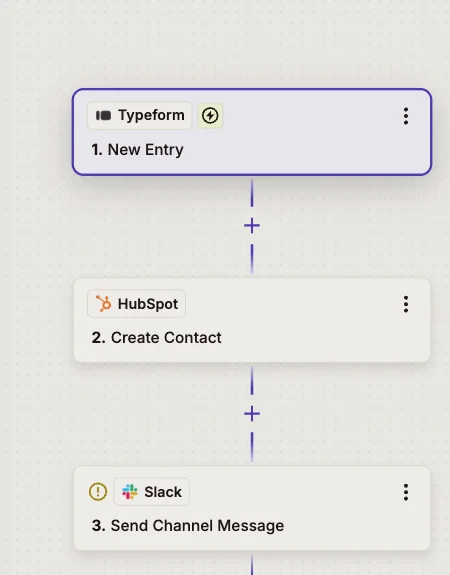
Zapier is the easiest place to get a working automation, and for most non-technical teams that is the whole decision. Its trigger-then-action format is the simplest in the category, and Copilot drafts a working Zap from a plain-English sentence on every plan, including the free one. We had a multi-step Typeform-to-HubSpot-to-Slack Zap scaffolded from a description in minutes, tuning field mappings rather than wiring from scratch.
The app library is the widest there is. Zapier connects more than 9,000 apps against Make’s 3,000-plus, so the niche tool you need is far likelier to have a native connector, and its per-app integrations often expose more triggers and actions. For a sprawling or unusual stack, that reach is the deciding factor before price ever enters the conversation.
The meter is gentler than it looks. Zapier bills only successful app actions; triggers, filters, Paths, and built-in tools like Formatter and Delay are all free. So a Zap that triggers, filters, formats text, and creates one contact is one task, not four. A disciplined builder who filters early can hold a surprisingly low task count, which softens the per-task model for simple, low-frequency work.
It is enterprise-grade on governance, and more than a connector now. SOC 2 Type II ships on all plans, SAML SSO on Team and up, and audit logging on Enterprise, which makes it an easy approval for IT. Tables, Interfaces, Agents, and a Model Context Protocol server turn it into a light app-building platform, not just a pipe between apps. We ran that MCP live across Gmail, Google Calendar, and Slack, and an agent pulled a rundown across all three with no Zap pre-built.
The integration depth is real, not just the count. Popular Zapier apps expose dozens of triggers and actions, not a token one or two, so you react to granular events, a specific label added or a particular field changed, and write back exactly the field you mean. That depth is part of why a sprawling stack feels at home on Zapier in a way a smaller catalog cannot match.
The catch is the one that sends people to Make: cost at volume. A long Zap run thousands of times a month burns tasks fast, and a $20 plan can become hundreds. The June 2026 move to model-based AI pricing adds a task multiplier on AI steps. Trustpilot sits at 1.4 from 303 reviews, almost entirely about billing and cancellation, the usual tax of a usage-metered leader. Our Zapier review scores it 4.3, a Power Tool.
Which is cheaper, Make or Zapier?
This is the section that decides most switches, and it is more than a sticker-price comparison, so here is the real math. The two tools meter in different units. Make bills one operation per module run, so a 10-step scenario is roughly ten operations every time it fires. Zapier bills one task per successful app action, and its triggers, filters, Paths, and built-in tools are free, so the same 10-step automation is closer to six billable tasks per run.
That makes Zapier’s per-run unit count lower. The twist is what each plan includes, and it more than cancels the difference out.
The free tiers tell the same story before you pay a cent. Make’s free plan gives you 1,000 operations a month and two active scenarios, enough to run a real multi-step automation; Zapier’s free plan gives you 100 tasks and caps Zaps at two steps, so it is more of a demo than a working tier. If you want to prove out a genuine scenario before committing, Make’s free plan goes further, which is why it is the better place to learn what your automations actually cost.
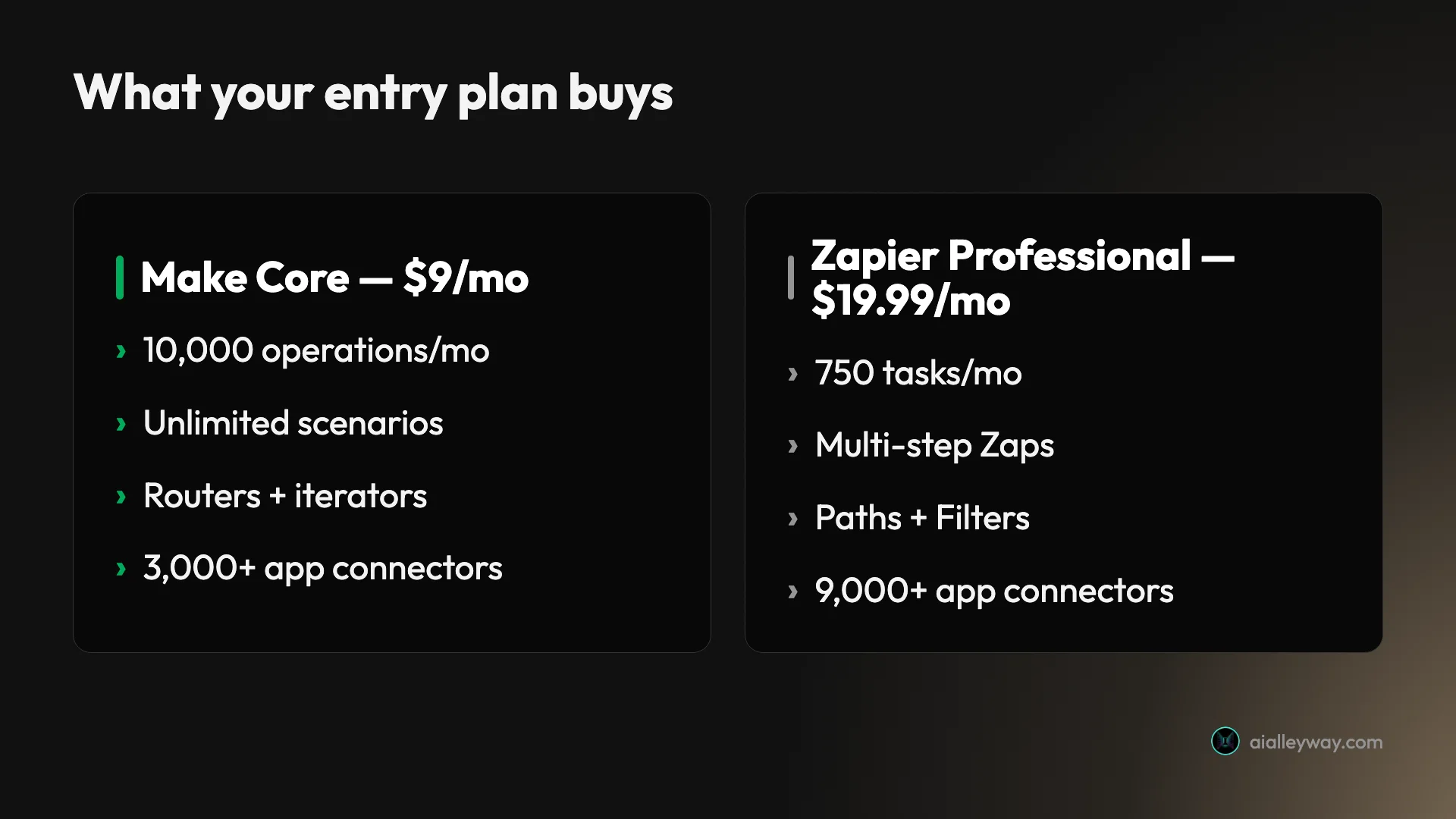
Make’s $9 Core plan includes 10,000 operations. Zapier’s $19.99 Professional includes 750 tasks. That is more than thirteen times the units for under half the price, and it is why Make wins on cost despite metering more aggressively per run. Now watch it play out as you run a 10-step automation more often.
| Monthly runs (10-step flow) | Make operations | Zapier tasks | Who’s cheaper |
|---|---|---|---|
| 100 | ~1,000 | ~600 | Make: 1,000 ops fits the free plan; 600 tasks is past Zapier’s 100 free, so Professional at $19.99 |
| 1,000 | ~10,000 | ~6,000 | Make: 10,000 ops is exactly $9 Core; 6,000 tasks is 8x past Professional’s 750 base, into a far pricier tier |
| 10,000 | ~100,000 | ~60,000 | Make: slide Core’s credits up; 60,000 tasks is an expensive high-volume plan |
That table is the whole argument. At a hundred runs of a simple workflow, Make’s free tier may cover you outright while Zapier already wants a paid plan. At a thousand runs, Make is $9 and Zapier has blown well past its base. The gap only widens with volume, because Zapier’s task count climbs with every billable action while Make’s operations stay inside a far larger included pool.
The crossover is not exotic. Zapier stays genuinely competitive only at the bottom of that table, low volume with lean, filter-early Zaps where the free steps carry most of the work. The moment an automation runs daily or fans out into several billable actions, Zapier crosses its 750-task base and Make’s larger pool pulls ahead. For most teams the real question is not whether Make is cheaper but how quickly they will hit the volume where it stops being close.
Be fair to Zapier on two counts, though. Its free trigger, filter, and built-in steps genuinely soften the meter, so a lean Zap that filters early bills fewer tasks than its step count suggests. And annual billing cuts about a third off the headline price, a steeper discount than Make’s roughly 15%. Neither changes the shape of the curve, but both make Zapier’s bill gentler than a naive per-step count implies.
Make has its own asterisk in the other direction. Its operations meter punishes waste: a polling trigger that checks every five minutes burns roughly 8,640 operations a month before doing any real work, and the August 2025 credit change made AI and code modules cost more than one credit each. Make is cheaper, but only if you treat the usage screen as part of the build. Our n8n pricing breakdown covers the third option for teams that outgrow per-unit billing entirely.
How they differ on power and logic
Price decides the bill; capability decides whether the tool can do the job at all, and here the two trade clean wins. Make’s edge is logic. Routers, iterators, and aggregators put real branching on the canvas, so one scenario handles cases that would need several separate Zaps or a premium Zapier tier. The iterator-aggregator pair, run a step per item then recombine, is everyday work in real automation and is where Make earns its “more powerful” reputation.
Zapier’s edge is reach and maturity. Its 9,000-plus connectors dwarf Make’s 3,000, and depth matters as much as count: popular apps expose dozens of triggers and actions, so you react to granular events and write back specific fields. When a connector is missing, both tools fall back to an HTTP module that calls any REST API, so neither truly runs out of road, but Zapier covers more of the common cases without that escape hatch.
| Tool | Pre-built integrations |
|---|---|
| Zapier | 9,000+ |
| Make | 3,000+ (plus HTTP) |
On AI the two are a genuine tie on capability, both investing hard. Make ships AI agent modules, an AI Toolkit, and Model Context Protocol support, so a model becomes a draggable step you branch on. Zapier ships Copilot, Agents, Chatbots, and its own MCP server, which we ran live across three apps with no setup.
Where they diverge is the cost of the AI itself. Make’s built-in AI modules bill at variable credit rates above one operation, and its November 2025 bring-your-own-key option lets you route calls through your own model to dodge the premium. Zapier’s June 2026 move to model-based pricing adds a task multiplier on AI steps, roughly one times for a standard model, three times for an advanced one, and five times for a premium one, with a bring-your-own-key path back to the base rate.
Either way, lean on the built-in AI and the meter moves faster than the step count suggests, so an AI-heavy build is the one place to model costs carefully on both tools.
Reliability is where the aggregate reviews speak, and they split in an instructive way. Both tools are dependable in production; the rating gaps are about support and billing, not whether automations run.
| Aggregate (June 2026) | Make | Zapier |
|---|---|---|
| G2 | 4.6 | 4.5 |
| Capterra | 4.8 | 4.7 |
| Trustpilot | 2.7 | 1.4 |
Read those carefully. On the developer-and-operator aggregates the two are neck and neck, with Make’s Capterra 4.8 and Zapier’s 4.7 both reflecting power users who build real scenarios. The Trustpilot scores are low for both and track the same thing: billing surprises and support friction, the usual fate of usage-metered tools, not a product that fails. The one place Zapier pulls clearly ahead is governance, where SOC 2 on every plan, SSO, and audit logging clear an IT review that a younger tool faces more scrutiny on.
The day-to-day reliability tools differ in shape, too. Make gives you per-module error handlers, where you attach a retry or a fallback path to any step that might fail, plus an incomplete-executions queue you can replay by hand. Zapier leans on automatic retries and a clear Zap history with replay, plus error notifications that keep a broken Zap from failing silently. Both let you build automations that recover instead of stalling; the difference is that Make asks you to wire the safety net, while Zapier ships more of it on by default, which is the no-code-versus-power split showing up again in how you handle failure.
Execution speed is closer to a wash than either marketing page admits. Make runs a scenario module by module, on a schedule or instantly via webhook; Zapier fires on its trigger and runs the chain. For the everyday jobs most teams automate, neither is meaningfully faster, and the real throughput question only shows up at high volume, where both queue runs and respect each app’s rate limits rather than dropping work. In practice you optimize the meter and the logic, not the milliseconds, so let cost and capability decide rather than a stopwatch.
How they differ on ease and workflow
If price is Make’s home turf, ease is Zapier’s, and the gap is just as wide in the other direction. Getting started on Zapier is genuinely fast: pick a trigger app, describe what you want, and Copilot drafts the Zap, which you can run against real data and watch step by step before turning it on. That guardrail is exactly what wins over cautious first-timers, and it needs no manual.
Make’s on-ramp is steeper by design. The visual canvas is approachable for a first simple scenario, and running a single module to inspect its output is genuinely pleasant. But routers, iterators, and solid error handling take noticeably longer to learn, and large scenarios become dense webs that are harder to read later. A first automation takes roughly twenty minutes; fluency with the advanced modules takes a week or two.
| Build experience | Make | Zapier |
|---|---|---|
| First working automation | ~20 min, visual canvas | Minutes, no setup |
| Draft from a sentence | No | Yes (Copilot, all plans) |
| Branching logic | Routers, iterators (included) | Paths (higher tiers) |
| Test before turning on | Run a single module | Run the Zap on real data |
| When you outgrow the basics | More modules; watch the meter | Mostly more clicking |
That table is the ease-versus-power trade in one frame: Zapier removes friction at the start, Make removes ceilings later. Both lean on large template galleries, so a common job starts from a working example on either tool, though Make’s templates often need their modules remapped to your apps before they run.
The day-to-day difference is what happens when you outgrow the template. On Zapier you are still clicking, adding another action in a familiar linear flow. On Make you are dragging in a router or an iterator and thinking about how data moves between modules. For a non-technical user that is exactly the wall Zapier is built to avoid; for a builder who wants real logic, it is the reason Make is worth the climb.
One cost the spec sheets skip is switching between the two. There is no one-click importer in either direction, because a Zap and a Make scenario describe their logic in different models, so moving means rebuilding by hand. The practical move is to migrate one real automation first, the one whose pain pushed you to switch, rebuild it on the free tier of the other tool, and run both in parallel for a week before you move the rest. That dry run tells you the true cost of leaving far better than any feature table, and it surfaces a missing connector or a metering surprise before you have committed.
Who should pick Make
Make is the right call when cost and logic outweigh convenience. It fits these people:
- Anyone who outgrew Zapier’s price. If you keep hitting “you need a higher Zapier plan for that,” Make’s per-operation pricing and included routers usually do the same job for less, often far less, at the volumes real businesses run.
- Visual thinkers who want branching without a premium tier. If you can picture your automation as a flowchart, Make’s routers, iterators, and aggregators handle multi-path logic that Zapier gates behind higher plans.
- Solo operators and small teams automating real processes. Lead routing, content pipelines, onboarding, cross-posting: Make handles multi-app, multi-branch jobs at a small-business price, and the free plan proves a real scenario before you pay.
- Teams adding AI on a budget. The AI modules plus bring-your-own-key keep LLM-in-the-loop workflows economical, where Zapier’s AI task multiplier can surprise you.
- Builders who want logic, not a sandbox. If your automation needs loops, conditional fan-out, and aggregation, Make expresses all three natively, where Zapier needs workarounds or a step up to a premium tier.
The common thread is that you will watch a meter in exchange for more power per dollar. If that trade sounds fine, Make is the better long-term home, and you can start free.
Who should pick Zapier
Zapier is the right call when ease and reach matter more than the bill. It fits these people:
- Non-technical teams and solo founders. If you want the shortest path from idea to working automation and would rather not think about how data moves between steps, Zapier is the easiest tool there is, and Copilot drafts the first one for you.
- Anyone with a wide or unusual stack. With 9,000-plus integrations, Zapier is the safest bet that your specific apps are supported, and the per-app depth means more triggers and actions to work with.
- Low-to-moderate volume users. If your automations run hundreds or low thousands of times a month and you filter early, the per-task bill stays reasonable and the polish is worth the premium.
- Businesses that need governance fast. SOC 2 on every plan, SSO, and audit logging make Zapier an easy approval for IT, where a younger tool faces a longer security review.
- Teams that value time over money. If an hour of your team’s time is worth more than the gap between the two bills, the easiest tool is the right tool, and at modest volume that is Zapier.
The common thread is that you are buying speed, reach, and simplicity. Just be honest about your trajectory: a workflow that is cheap on Zapier today can get expensive fast if it succeeds and you scale it.
Make vs Zapier: which should you pick?
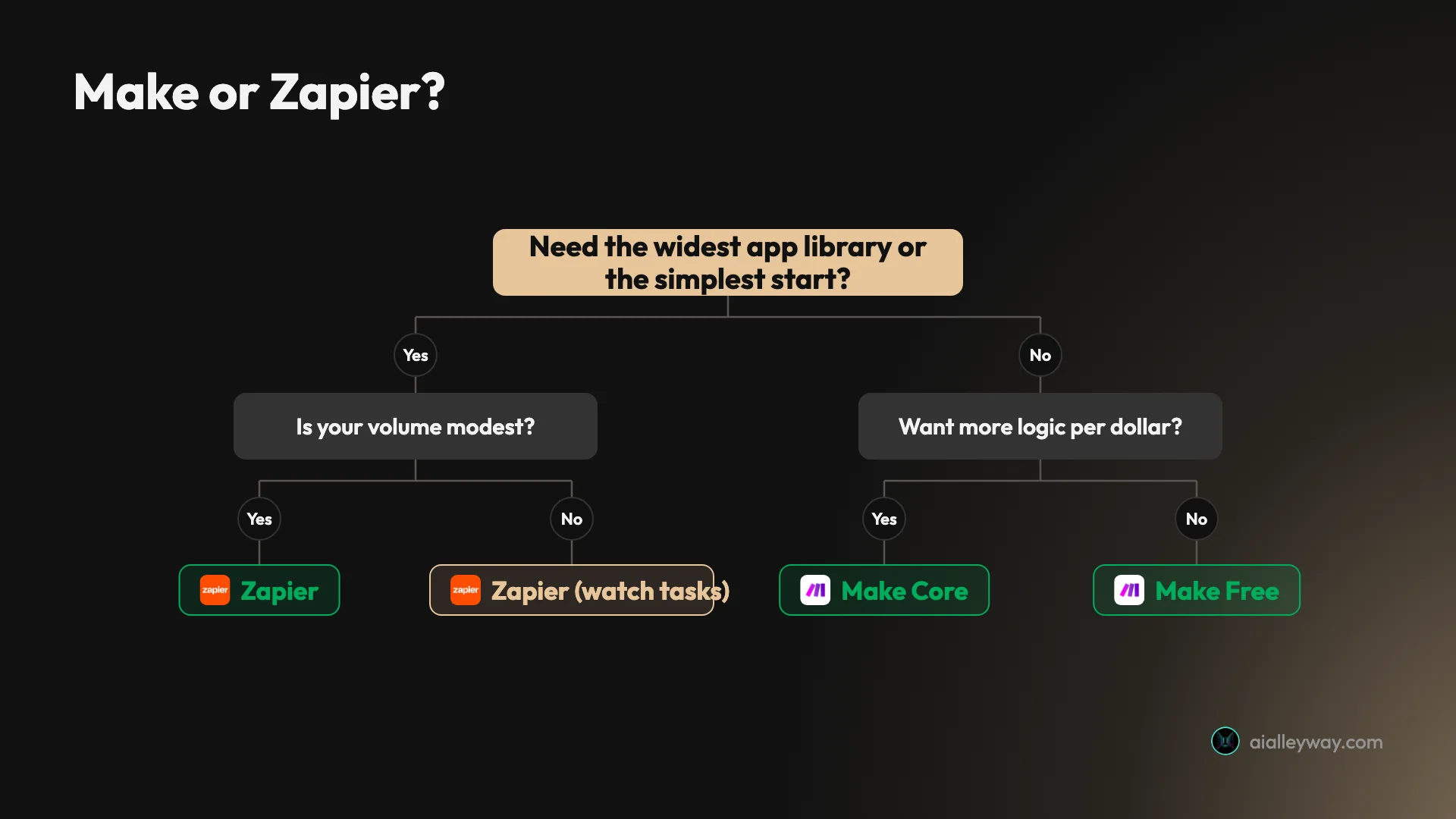
Whether you searched Make vs Zapier or Zapier vs Make, the decision is genuinely close for most individual buyers, and it turns on two questions. How many times will your busiest automation run each month, and does your stack include an app only Zapier supports? If volume is modest and reach is everything, pick Zapier and enjoy the easiest tool in the category. If volume is real or your automations branch, pick Make and bank the savings.
Our own lean tells you where we land for value: Make does most of what Zapier does for under half the entry price, with more logic included. But Zapier earns its 4.3 by being the tool we would still hand a non-technical founder on day one, and the one most likely to support whatever niche app they throw at it.
| The bottom line | Pick |
|---|---|
| Easiest setup, widest app library | Zapier |
| Lowest cost at real volume | Make |
| Branching logic without a premium tier | Make |
| Enterprise governance (SOC 2, SSO, audit) | Zapier |
| Best overall value | Make |
The fastest way to decide is to estimate one number before you commit: your busiest automation’s billable steps times how often it runs each month. If that lands in the hundreds, either tool is fine and Zapier is the nicer experience. If it lands in the tens of thousands, Make will save you real money. And if it climbs past what any per-unit plan can hold, read our n8n vs Zapier and n8n vs Make comparisons, or the full best AI automation tools roundup, for the self-hosted option that bills per whole run instead.
Pricing and ratings verified June 2026 from each vendor’s pricing page and our own hands-on reviews of Make and Zapier.
Frequently asked questions
Is Make cheaper than Zapier?
Usually yes, and often by a wide margin. The clearest way to see it is the entry plan: Make's Core is $9 a month for 10,000 operations, while Zapier's Professional is $19.99 a month for 750 tasks.
Make counts more units per run, because every module that runs is one operation, where Zapier only bills successful app actions (its triggers, filters, and built-in tools are free). But Make's plans include so many more units for the money that it still wins on cost at almost every volume.
A 10-step automation run 1,000 times a month is roughly 10,000 operations on Make, comfortably inside the $9 Core plan, versus about 6,000 tasks on Zapier, eight times past Professional's 750-task base and into a much pricier tier.
The one case where Zapier's bill stays reasonable is low volume with disciplined, filter-early Zaps.
Is Make harder to use than Zapier?
Yes. Zapier is the easiest automation tool to start with, full stop: its trigger-then-action format is the simplest in the category, and Copilot drafts a working Zap from a plain-English sentence on every plan, including the free one.
Make is more powerful but asks more of you. Its visual canvas, with routers that branch a scenario and iterators that loop over lists, is genuinely legible once it clicks, but the advanced modules take a week or two to feel fluent. The dividing line is what you are building: a simple app-to-app connection is faster on Zapier, while a multi-branch scenario with loops and error handling is where Make's canvas pays off.
Start on Zapier if you want the gentlest on-ramp; choose Make if you want more logic and are willing to climb a short learning curve for it.
What is the difference between Make and Zapier pricing?
The billing unit and what it includes. Make bills per operation, where every single module run counts as one (renamed credits in August 2025). Zapier bills per task, where only each successful action in an outside app counts, so triggers, filters, Paths, and built-in tools like Formatter are free.
That makes Zapier's per-run unit count lower for the same automation, but Make's plans pack far more included units: $9 buys 10,000 operations on Make, while $19.99 buys 750 tasks on Zapier. The practical upshot is that Make is cheaper at almost every real volume, while Zapier's free trigger-and-filter steps soften its meter for simple, low-frequency Zaps.
Run a 10-step automation 1,000 times a month and you use roughly 10,000 operations on Make, inside the $9 Core plan, versus about 6,000 tasks on Zapier, eight times past the $19.99 Professional base. Model your real run frequency against the included allotment, not the sticker price, before you commit.
Does Make have more integrations than Zapier?
No, Zapier has far more. Zapier connects more than 9,000 apps, the largest library in the category, while Make advertises more than 3,000.
Both tools cover the apps a typical small business actually touches, and both include an HTTP module that calls any REST API when a native connector is missing, so neither truly runs out of road for a determined builder.
But if your stack includes a newer or niche SaaS tool, check Zapier first, because its catalog is roughly three times the size and its per-app integrations often expose more triggers and actions, where Make may have only a basic connector or none at all.
Should I pick Make or Zapier in 2026?
Pick Zapier if you want the easiest possible setup, the widest app library, and enterprise governance, and your volume is modest enough that per-task billing stays cheap. Pick Make if you want more branching logic per dollar and a visual canvas, and you are willing to watch an operations meter and climb a slightly steeper learning curve.
The deciding questions are rarely about features, since both handle most everyday automation well. They are your budget at the volume you will actually run, your need for complex branching, and whether the specific apps you use are supported.
We rate Zapier 4.3 and Make 4.2, a near tie that splits cleanly: Zapier for ease and reach, Make for power and value.
Keep reading
Make.com pricing: what you'll really pay per operation
Make is free for 1,000 credits, then $9/mo Core — but every module run spends a credit, so the operations meter sets your real Make.com pricing.
Make.com review: more power than Zapier, if you watch the meter
Make is the visual middle ground between Zapier and n8n: router logic and 3,000+ apps, at a price that depends entirely on how fast you burn operations.
Make.com alternatives: 8 cheaper, more flexible picks
Make's per-operation credit meter is the top reason to leave. The 8 best Make.com alternatives — cheaper or a better fit — and who each one actually suits.
Best n8n alternatives: who each one is actually for
We run n8n in production, so we know what you'd trade away. The 9 best n8n alternatives, from managed to open-source, and who each one actually fits.