
n8n vs Make: which is cheaper, and which is easier?
We run n8n in production and built a real scenario in Make. The honest n8n vs Make verdict: who's cheaper at scale, who's easier to start, who wins.
Contents
n8n vs Make: the verdict at a glance
n8n and Make are both workflow automation platforms, but they sit one rung apart on the same ladder rather than competing head-on. Make is the friendlier, fully managed visual tool that wins converts from Zapier; n8n is the cheaper, more powerful, code-first platform that technical teams graduate to. Your choice comes down to one question: do you want to run a server and write the occasional line of code, or do you want a tool that just works without either.
We can compare these two with more standing than most, because we have built in both. n8n runs the entire AI Alleyway content pipeline: ten production workflows, including a 28-node render flow and a 33-node publisher, on a self-hosted box. For our Make review we built a real lead-routing scenario through the Make API in our own account and ran it live. The verdict below is grounded in that, plus both tools’ live June 2026 pricing and more than a thousand third-party reviews.
| Pick this | Tool |
|---|---|
| Best for non-coders and the fastest start | Make |
| Best for cost at scale, self-hosting, and AI depth | n8n |
| Best overall value, if you have technical hands | n8n |
| Pricing starts at | Make: free / $9 Core (annual). n8n: free self-host / €20 Cloud Starter |
| Billing model | Make: per operation (one module run). n8n: per execution (one workflow run) |
If you read only one section below, make it the price deep-dive: the per-execution-versus-per-operation gap is the single fact that decides this for most people, and unlike Make-versus-Zapier, the answer genuinely flips on your volume. At a low run count Make is often the cheaper tool. Once your scenarios get long or run often, n8n pulls ahead, and free if you self-host.
n8n vs Make compared, axis by axis
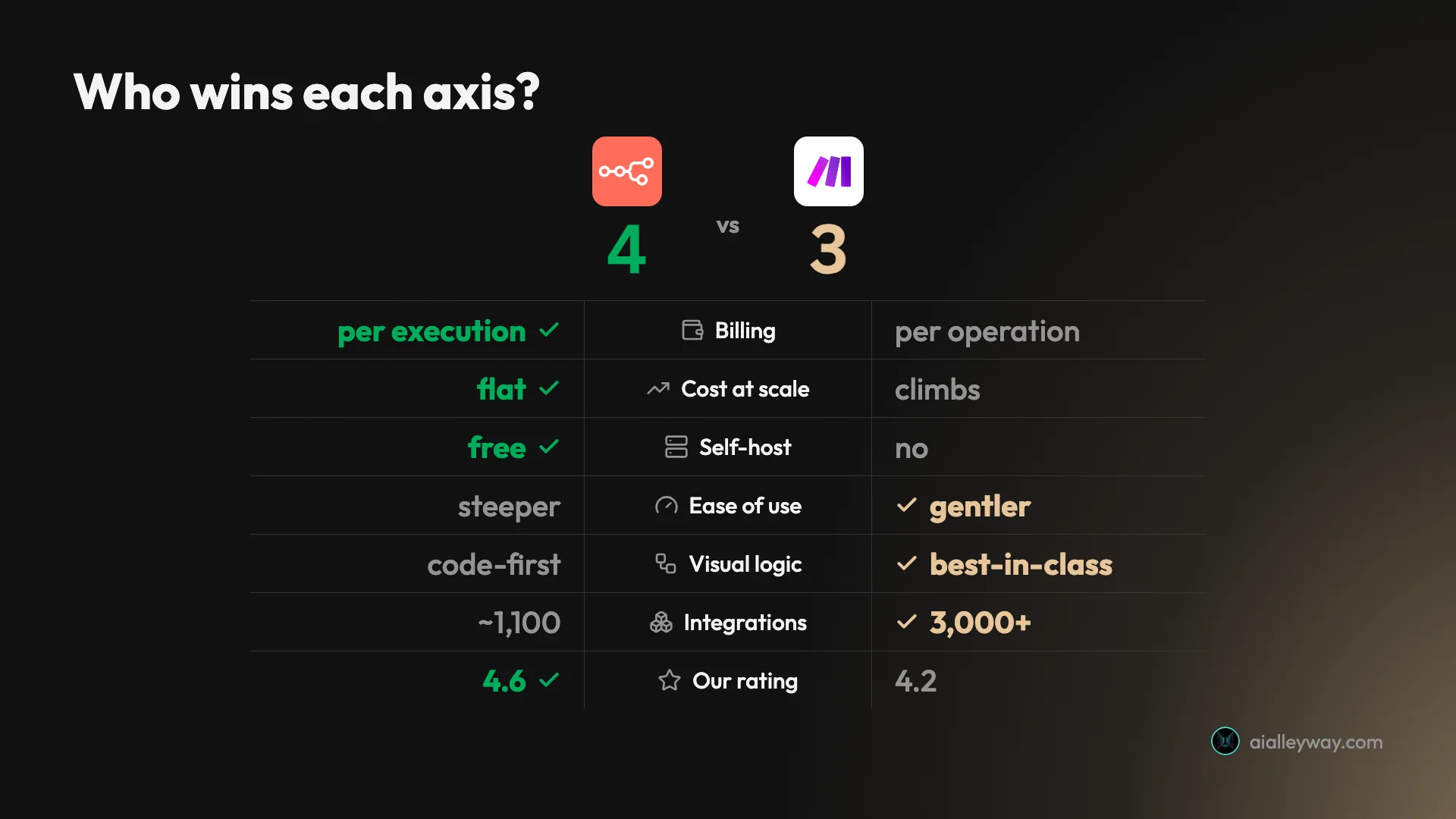
Here is the whole comparison in one place. The “how it bills” and “cost at volume” rows are the ones that decide most switches, and the “ease” and “self-host” rows are the ones that decide who is even a candidate.
| Axis | n8n | Make | Winner |
|---|---|---|---|
| How it bills | Per execution (one whole run) | Per operation (one module run) | n8n |
| Free tier | Yes, self-host, unlimited | Yes, 1,000 credits, 2 scenarios | n8n |
| Paid from | €20/mo (2,500 exec) or free self-host | $9/mo (10,000 credits) | Make |
| Cost at volume | Stays flat; one run, one execution | Climbs with steps × runs | n8n |
| Self-host | Yes, free | No | n8n |
| Pre-built integrations | ~1,100 (plus HTTP to anything) | 3,000+ (plus HTTP) | Make |
| Ease of starting | Steeper; rewards code | Gentle; visual-first | Make |
| Visual builder | Functional node canvas | Best-in-class flowchart | Make |
| Code as first-class | Yes (JavaScript, Python) | Limited (code module, metered) | n8n |
| AI / agents | LangChain nodes, deep | AI modules, MCP, friendly | Tie |
| Our Alley Rating | 4.6 | 4.2 | n8n |
The tally is n8n four axes, Make three, with one tie, which is the honest shape of this matchup: n8n is the stronger and cheaper platform once you can use it, and Make wins on everything that gets you started faster.
Where n8n wins

n8n is the tool we trust with our own production pipeline, and its case against Make rests on three things Make structurally cannot match: cost at scale, ownership, and depth. The reason to start here is the billing model. n8n charges per execution, so our 28-node render workflow costs exactly one execution per run, the same as a two-node one. Make charges per operation, so that same 28-step logic would meter 28 times every run. That single design difference is the whole cost story, and it is why teams running real volume land on n8n.

Self-hosting is real ownership, and free. The Community edition runs on your own server with unlimited executions and zero license cost. We run the whole pipeline on one small 4-vCPU box, and every API key it touches stays on infrastructure we control rather than handed to a third-party vendor. Make is fully hosted with no self-host option at all, so your automation data and credentials always flow through Make’s cloud. For regulated work or a wall of sensitive keys, that distinction can rule Make out before price enters the conversation.
Code is a first-class citizen. Every workflow we run leans on Code nodes where you write plain JavaScript or Python with the workflow’s data in scope, and the HTTP Request node calls any API even when there is no pre-built integration. Make has a code module, but it bills at a premium credit rate, roughly two credits per second of execution, so heavy data reshaping is metered against you. On n8n, code is the default tool, not a costed exception.
The AI nodes are deep. n8n ships LangChain-based nodes for LLM calls, agents, and retrieval, which is why it is increasingly the home for serious AI automation in 2026. Our pipeline drives Anthropic, ElevenLabs, and Buffer from inside n8n every day. Make’s AI tooling is genuinely good and friendlier to start with, but its built-in AI modules bill at variable rates that climb fast, which pushes serious AI work toward bringing your own model key.
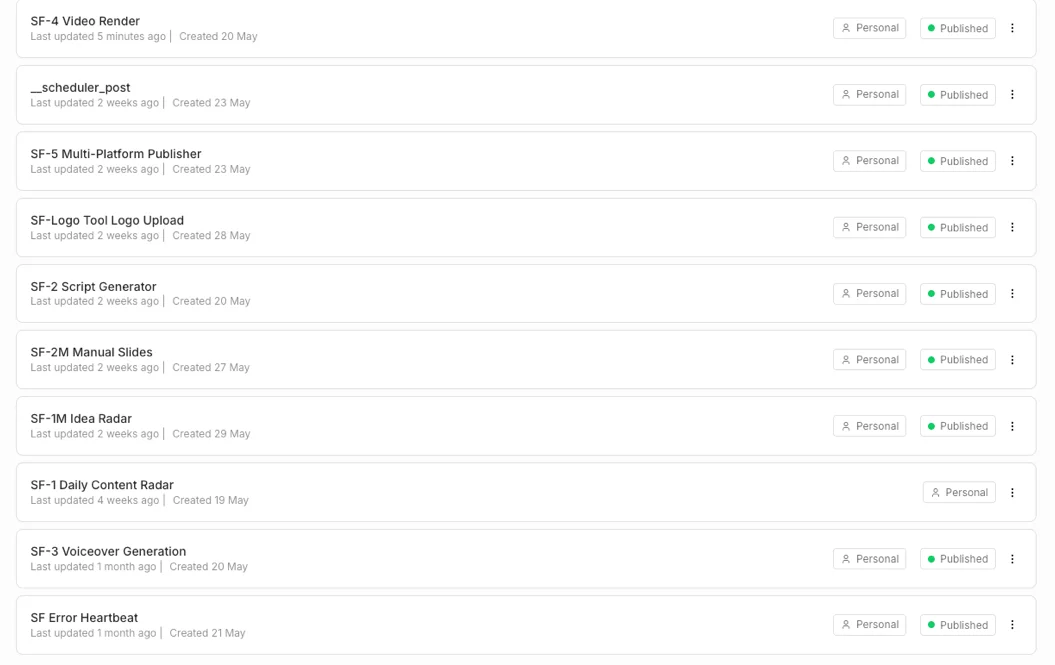
It is reliable, and the workflows live in Git. Pulling our live execution history in June 2026, the last 93 stored runs across the pipeline came back at 100% success (n8n prunes execution records by age, not by outcome, so that is a fair recent sample rather than a cherry-pick). And because every workflow exports to JSON, ours sit in version control next to the rest of our code: we review changes in a pull request and revert a bad one in seconds. Make keeps your logic inside its dashboard, with no real version history or rollback, which is a different way of working once a team treats automation as part of the stack.
The gaps are the mirror image of Make’s strengths, and they are real. The learning curve is steep; Capterra reviewers name it the top complaint, with ease of use at 4.1 against a 4.6 overall. The integration library is narrower at roughly 1,100 connectors against Make’s 3,000-plus. And if you self-host, you own the upgrades, the backups, and the occasional 2am debugging that Make absorbs for you. Our full n8n review scores it 4.6, a Category Leader.
Where Make wins

Make is the easiest place to build a genuinely capable automation, and for anyone who does not want to run a server, that is most of the decision. Where n8n hands you a node editor that rewards code, Make hands you a polished visual canvas where routers, iterators, and aggregators are draggable modules. It is the friendlier middle ground: more branching logic than Zapier, a far gentler on-ramp than n8n.
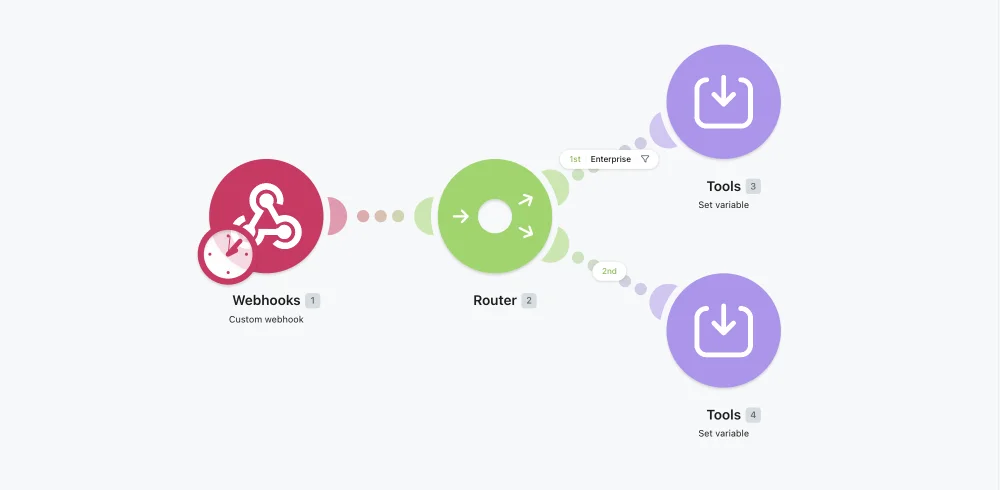
The visual builder is the best in its class. Laying an automation out as a left-to-right flowchart, rather than a list of nodes, makes multi-app logic legible in a way n8n’s canvas does not quite match. When we built our lead-routing scenario in Make, the router-by-company-size logic was obvious at a glance, and we could run a single module in isolation to inspect exactly what it returned before committing the scenario to a schedule. For visual thinkers, seeing the whole flow at once is a real productivity win.
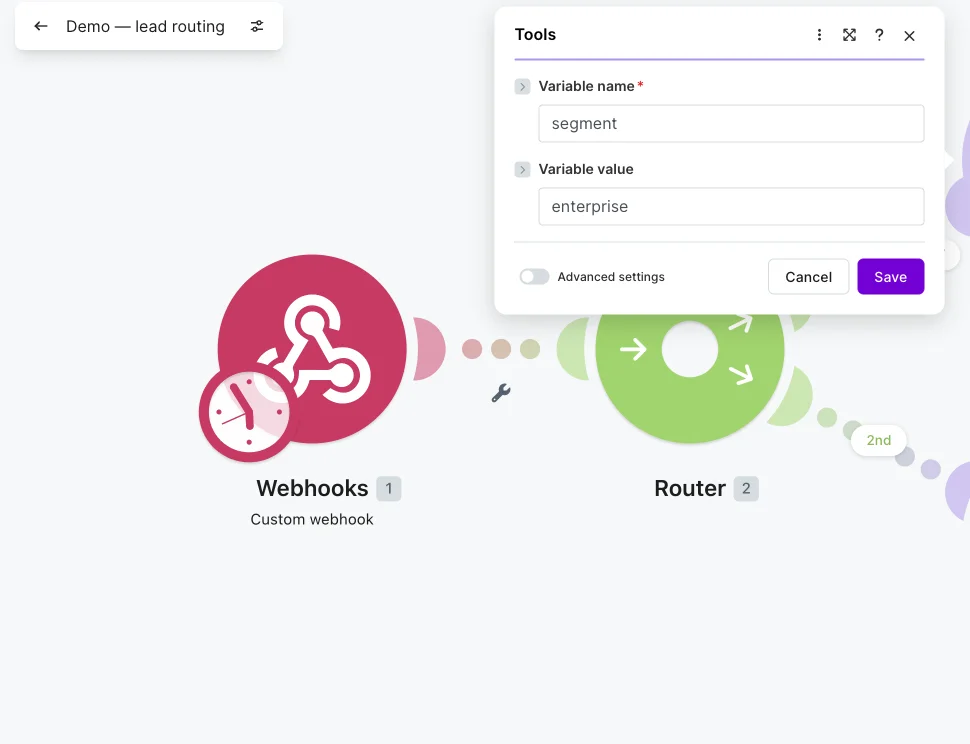
The on-ramp is genuinely gentle. A first useful scenario, something like a form submission becoming a CRM contact and a Slack ping, is about a twenty-minute job, with no Docker, no Postgres, and no server to patch. n8n’s “30 minutes to the canvas” assumes you can follow a Docker tutorial first; Make’s assumes nothing. That gap is the entire reason Make wins converts from spreadsheets and manual copy-paste while n8n waits for them to become technical.
It is cheaper to start, and the free tier is real. Make’s free plan includes 1,000 monthly credits and two active scenarios, enough to prove a real automation before you pay, and Core is $9 a month on annual billing against n8n Cloud’s €20 Starter. For a small operator running modest volume on a hosted plan, Make is the cheaper hosted option, and that surprises people who assume n8n’s per-execution model wins everywhere. It only wins at scale.
The connector library is deeper. Make advertises more than 3,000 app integrations against n8n’s roughly 1,100, and when a native module is missing the HTTP module calls any REST API directly. For a no-code-first tool, that breadth means Make rarely runs out of road for a small or mid-sized stack.
The AI tooling is current and friendly. Make ships AI agent modules, an AI Toolkit, and Model Context Protocol support, so you can wire a model into a scenario as a first-class step without code, and the November 2025 bring-your-own-key option lets you sidestep the premium AI credit rates. It is a friendlier on-ramp to AI-in-the-loop automation than n8n’s more technical LangChain nodes.
The catch is the meter, and it is the defining complaint. Because every module run is one operation, a scenario that does real work consumes credits quickly, and while the August 2025 rename of operations to credits was a 1:1 conversion, it moved AI-native and code modules to variable-rate pricing that quietly raised costs for AI and bulk workflows. The rating picture splits on exactly this: Capterra 4.8 and G2 4.6 from power users building scenarios, against Trustpilot 2.7 from complaints about support, billing surprises, and account issues. Our full Make.com review scores it 4.2, a Power Tool.
Which is cheaper, n8n or Make?
This is the section that decides most of these calls, and it is more nuanced than the usual “n8n is cheaper” headline, so here is the real math. The two tools meter in completely different units. n8n charges one execution per whole workflow run, however many steps it has. Make charges one operation per module run, so a multi-step scenario burns several operations every time it fires.
That difference is invisible at a glance and decisive at scale. Take a 10-step automation, the shape of a normal real-world workflow. On n8n that is one execution per run. On Make it is roughly ten operations per run. Now watch what happens as you run it more often.
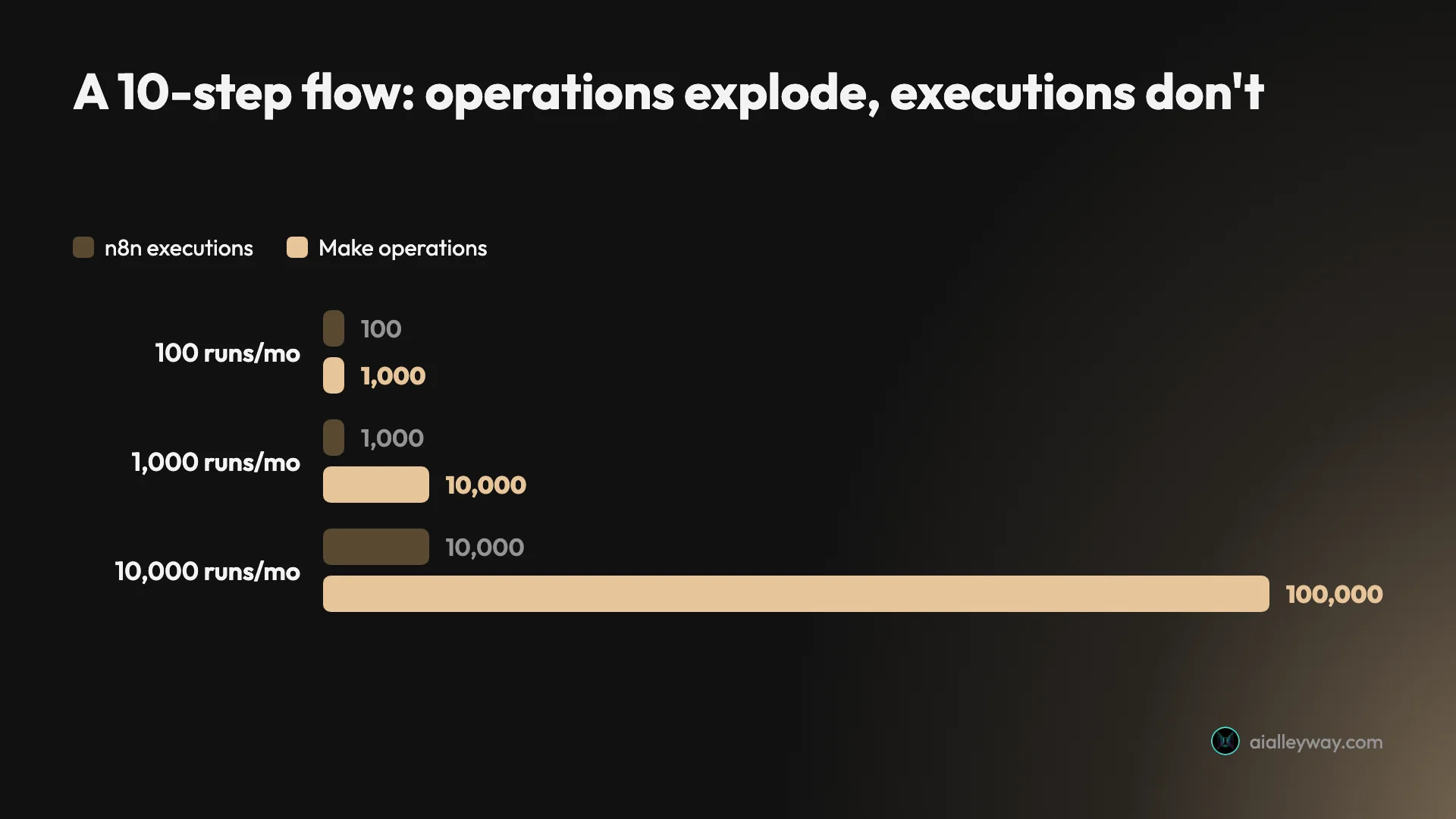
| Monthly runs (10-step flow) | n8n executions | Make operations | Who’s cheaper |
|---|---|---|---|
| 100 | 100 | ~1,000 | Make: 1,000 ops fits its free 1,000 credits; n8n is €20 Starter or free self-host |
| 1,000 | 1,000 | ~10,000 | Close: 10,000 ops is exactly Make Core’s $9 base; 1,000 exec is n8n’s €20 Starter, or free self-hosted |
| 10,000 | 10,000 | ~100,000 | n8n: 10,000 exec is the €50 Pro tier; 100,000 ops pushes Make’s credit slider well past Core’s $9 base |
That table is the whole argument, and notice it does not point one way. At a hundred runs of a simple workflow, Make is the cheaper, friendlier choice, and its free tier may cover you outright. At a thousand runs the two are close on a hosted plan, with Make’s $9 Core actually undercutting n8n’s €20 Cloud Starter, while n8n stays free if you self-host. The gap only opens decisively at the top of the table: as your operation count climbs into the tens of thousands, Make’s metered bill rises with it, while n8n’s execution count tracks your run count, not your step count.
Make’s per-operation model has a second cost that n8n’s does not: the things you do not see. A polling trigger that checks an app every five minutes runs about 8,640 times a month before doing any real work, eating most of a Core plan’s 10,000 credits just checking for new data. Instant webhook triggers fire only when there is real data, so they avoid all those idle checks; the trap is specific to scheduled or polling-based scenarios, and the fix is to use webhooks where the app supports them.
Two smaller edges compound it. Failed or partial runs still bill for the operations already executed, and a filter costs an operation even when it stops the flow. None of that is hidden maliciously, but it means budgeting Make is an active task: model your real run frequency, not your happy-path step count.
n8n’s side has its own asterisk, in the opposite direction. The €20 Starter and €50 Pro Cloud prices are real, but the Community edition is free at any volume if you self-host, so for a technical team the entire right-hand column of that table can be zero plus the cost of a small server.
The honest counterweight, the one we flag in our own n8n review, is that “free” is only free if your time is: self-hosting means you provide the server, the database, the upgrades, and the monitoring. For a team with technical hands that is a rounding error; for a team without them, paying Make to absorb all of it is exactly the right trade.
A worked example makes the divergence concrete. Picture two ordinary automations running every month:
| Two real automations | n8n executions | Make operations |
|---|---|---|
| Lead scenario (5 modules × 500 runs) | 500 | 2,500 |
| Order sync (8 modules × 1,000 runs) | 1,000 | 8,000 |
| Monthly total | 1,500 (inside €20 Starter) | 10,500 (just past Core’s 10,000) |
Two normal automations, and the units have already split by 7x. The 1,500 executions sit comfortably inside n8n’s €20 Starter plan, and at zero if you self-host; the 10,500 operations nudge you just past Make Core’s 10,000 credits, where you either slide the credit allowance up, which raises the bill, or trim the polling. Neither workflow is exotic, which is the point: the per-operation meter starts to matter the moment your scenarios get genuinely useful.
One last note on cadence, because both reward annual billing. Make’s annual rate is about 15% below month to month, so the headline $9 Core is $10.59 paid monthly. n8n’s annual saving is gentler, around 17%, so €20 Starter is €24 monthly. Budget for the monthly figure on either unless you are sure you will stay. The honest summary: Make is usually cheaper and friendlier to start; n8n is cheaper at scale and free if you self-host. Our n8n pricing breakdown walks the tiers in detail.
How they differ on power and reliability
Price decides the bill; capability decides whether the tool can do the job at all, and here the two trade wins in a closer fight than the cost section suggests. Make’s surprise strength is logic. Its router module splits one scenario into parallel conditional paths, iterators loop over lists, and aggregators collapse the results back together, so branching that needs custom code or a premium tier elsewhere is draggable on Make’s canvas. The iterator-aggregator pair in particular, run the next modules once per item then recombine, is everyday work in real automation and genuinely well-built.
n8n’s answer is raw depth. Code nodes run JavaScript or Python with the workflow’s data in scope, the HTTP Request node reaches any API, and when even that is not enough you can build and install custom nodes so a niche internal service becomes a first-class block on the canvas. Make can reach anything through its HTTP module too, but you are hand-mapping payloads rather than working with a typed node, and its code module is metered. So Make wins legible visual logic for the common case, and n8n wins ceiling for the complex one.
| Tool | Pre-built integrations |
|---|---|
| Make | 3,000+ |
| n8n | ~1,100 (plus HTTP to anything) |
Integration breadth is a clean win for Make: roughly 3,000 connectors against n8n’s 1,100. For a non-developer that count is the difference between clicking and connecting versus building an HTTP call by hand. n8n closes the gap in practice through the HTTP node, but only if you are comfortable reading an API doc, which is the whole no-code-versus-low-code split in a sentence.
On AI, the two are a genuine tie, investing hard where the category is heading. Make ships AI agent modules, an AI Toolkit, and MCP support, so a model becomes a draggable step you branch on. n8n ships LangChain-based nodes for LLM calls, agents, and retrieval, and we drive Anthropic from inside n8n in production. Make is the friendlier on-ramp; n8n is the deeper platform for an agent you fully control. One honest note on both: each platform’s highest-level AI Agent node is younger than the marketing, so for our critical path we call models over HTTP directly and keep control of the prompt.
Reliability is where the aggregate reviews speak, and they split in an instructive way. Both tools are dependable in production; the rating gaps are about support and billing, not uptime.
| Aggregate (June 2026) | n8n | Make |
|---|---|---|
| G2 | 4.7 | 4.6 |
| Capterra | 4.6 | 4.8 |
| Trustpilot | 3.4 | 2.7 |
Read those carefully. On the developer-and-operator aggregates the two are neck and neck, with Make’s Capterra 4.8 reflecting how much power users love the visual builder and n8n’s G2 4.7 reflecting how much developers love the flexibility. The Trustpilot split is not about the products failing; both scores there are dominated by support and billing complaints, which is the usual fate of any tool with a metered or support-gated model. We have run n8n unattended at 100% success across the executions we keep, and Make’s execution log made debugging our test scenario genuinely tractable. For the job of running real business processes, both clear the bar.
The scaling stories diverge sharply, and this is the other half of the cost trade. Make scales invisibly, because it is fully hosted, so a workload that grows ten-fold is a billing change, not an engineering project. n8n scales on a single box right up until it does not: two heavy jobs cannot run at once on a small machine, and going past that means queue mode, separate worker processes, and a Redis instance. That is real configuration work Make absorbs for you, and it is the operations tax the free license never mentions.
The last axis is data sovereignty, the cleanest win for n8n. Self-hosted, every key and byte of automation data stays on infrastructure you own, where Make, by definition, is a third party your data flows through. For a regulated business or anyone handling client data, that distinction can rule a hosted-only tool out before price or features enter the conversation.
Is n8n harder to use than Make?
If price is n8n’s home turf, ease is Make’s, and the gap is just as wide in the other direction. Getting started on Make is genuinely fast: pick a trigger app, authorize it once, and the canvas walks you through connecting the next module, with a searchable library of 3,000-plus apps and a gallery of templates to start from. There is no server to stand up and nothing to patch. We had a working router scenario built and inspected without reading a single setup doc.
n8n’s on-ramp is steeper by design. The self-host path is a Docker command plus a Postgres database, about 30 minutes to the canvas if you can follow a Docker tutorial, and the build loop is pleasant once you are there. But the first time a downstream node needs reshaped data or a branching error path, you are in expression-and-Code-node territory, and the syntax expects you to be comfortable there. A non-coder can build a basic flow; an ambitious one rewards a developer, and the gap between those two is where most people bounce off n8n and toward Make.
| Build experience | n8n | Make |
|---|---|---|
| First working automation | ~30 min (after Docker, if self-hosting) | ~20 min, no setup |
| Server to run | Yes, if self-hosting | None, fully hosted |
| Branching logic | Code nodes + If nodes | Routers, filters, iterators (no code) |
| When you outgrow the basics | Code nodes + expressions | More modules; code module is metered |
| Version control | JSON in Git | Dashboard only |
That table is the trade in one frame: Make removes friction at the start and keeps you on the canvas, while n8n removes ceilings later at the cost of a steeper climb. Both let you test before you trust, but differently: Make runs a single module and shows what it returned, while n8n executes a single node and inspects its raw output before you wire the next one. Both lean on large template galleries, though in both tools a template usually still needs its modules remapped to your own apps before it runs.
Where n8n pays its learning curve back is in treating automation as code. Every workflow exports to a JSON file, so ours live in Git next to the rest of our code: we review changes in a pull request and deploy with a script instead of clicking around a dashboard, and a bad change is one revert away. Make keeps your logic inside its dashboard with no real version history or rollback. For a solo builder that does not matter; for an engineering team that treats automation as part of the stack, it is the difference between a toy and a tool.
There is a quieter ease cost on Make’s side that only shows up later. Large scenarios become dense, overlapping webs that are hard to read and modify, so the visual clarity that wins you over on a five-module flow works against you on a fifty-module one.
Who should pick n8n
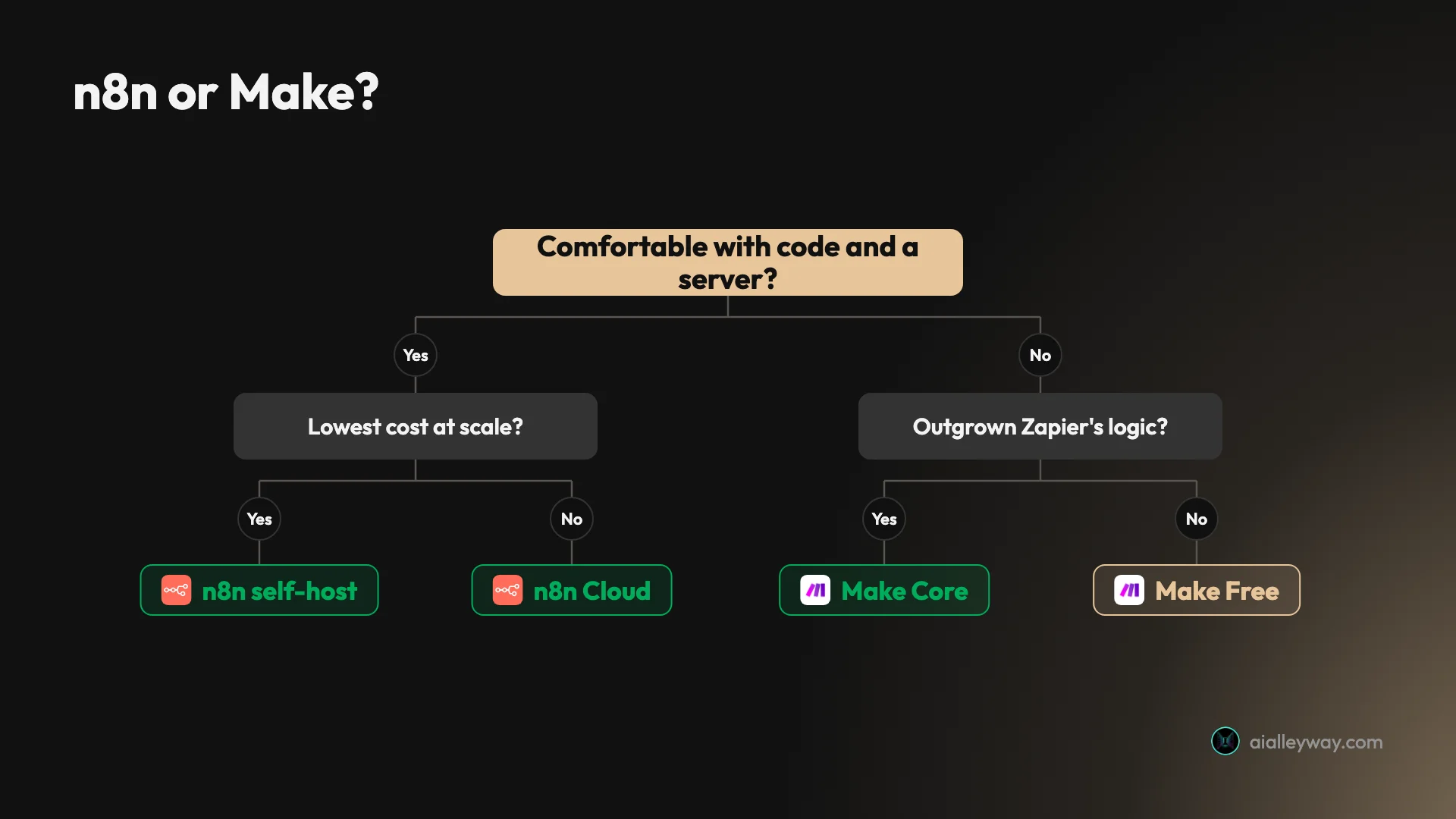
n8n is the right call when cost, control, or depth outweighs convenience. It fits these people:
- Technical teams automating at volume. If you run long workflows or fire them thousands of times a month, the per-execution model and free self-host make n8n dramatically cheaper than Make’s per-operation meter. Our whole pipeline runs for the price of a small server.
- Developers who want code, not a metered code module. If your automations need real data transformation, custom API calls, or AI orchestration, n8n’s Code and HTTP nodes give you room without billing you per second of execution the way Make’s code module does.
- Privacy- and compliance-minded shops. Self-hosting keeps automation data and credentials on infrastructure you own, which matters for regulated work or client data you would rather not route through Make’s cloud. Make has no self-host option at all.
- Engineering teams that treat automation as code. Because workflows export to JSON, n8n fits a Git-based, review-and-deploy way of working that Make’s dashboard-locked model cannot match.
- Builders of AI agents who want full control. The LangChain-based nodes make n8n the natural home for LLM-driven workflows wired into the rest of your stack, with you owning the prompt and the parsing.
The common thread is technical capacity. If “API” and “JSON” do not scare you and cost at scale is real, n8n is the better long-term home, and you can start free.
Who should pick Make
Make is the right call when ease and a fast start matter more than the cost ceiling. It fits these people:
- Non-coders and visual thinkers. If you can picture your automation as a flowchart but do not want to write expressions, Make’s canvas, routers, and iterators will feel natural in a way n8n’s node editor never quite does.
- Anyone who outgrew Zapier but does not want a server. If you keep hitting Zapier’s price or its straight-line flows, Make gives you branching logic at a lower price with nothing to host, which is its largest and happiest audience.
- Solo operators and small teams at modest volume. At a few thousand operations a month, Make’s $9 Core (or even the free plan) is genuinely cheaper than n8n Cloud, and you never touch a server.
- Teams adding AI without a setup project. The AI agent modules and MCP support make Make a friendly home for LLM-in-the-loop workflows, especially if you bring your own model key to control the credit cost.
- People who value time over operations work. If an hour spent patching a server is worth more to you than the savings n8n offers at scale, Make’s managed convenience is the right trade.
The common thread is that you are buying speed and simplicity. Just watch the meter as you grow: a scenario that is cheap on Make today gets pricier as it adds modules and runs more often, which is exactly the point where people start eyeing n8n.
The final word
For most individual buyers the decision is genuinely simple once you are honest about two things: whether you can run a server, and how much your automations will actually do. If you do not code and want the fastest path to a capable, branching automation with nothing to host, pick Make, start on the free plan, and keep the usage screen open as you grow. If you have technical hands and care about cost at scale, data control, or AI depth, pick n8n, start with the free self-hosted edition, and you will likely never look back.
Our own choice tells you where we land for a technical team running real volume: n8n powers everything we ship, for the price of one small server. But that is our situation, not everyone’s, and Make earns its 4.2 by being the tool we would hand a non-technical founder who has outgrown Zapier and wants more logic without becoming a sysadmin.
| The bottom line | Pick |
|---|---|
| You do not code, or do not want a server | Make |
| You want the cheapest start on a hosted plan | Make |
| You run high volume or long scenarios | n8n |
| You need self-hosting or data control | n8n |
| Best overall value for a technical team | n8n |
The fastest way to decide is to estimate one number before you commit: your busiest scenario’s module count times how often it runs each month. If that operation count lands in the low thousands, Make is cheaper and far nicer to use. If it lands in the tens of thousands, n8n will save you real money, and free if you self-host. Decide by the meter and your comfort with code, not by the marketing. For the deeper picture, read our full n8n review and Make.com review, see how both compare to the market leader in n8n vs Zapier, or get the whole field in our best AI automation tools roundup.
Pricing and ratings verified June 2026 from each vendor’s pricing page and our own hands-on reviews.
Frequently asked questions
Is n8n cheaper than Make?
Cheaper to start, usually Make; cheaper at scale or self-hosted, n8n. It depends on volume and whether you self-host.
At low volume Make is often cheaper, because its free plan includes 1,000 monthly credits and Core is $9 a month against n8n Cloud's €20 Starter. The picture flips as your automations get busy, because the two meter differently: n8n charges one execution per whole workflow run, while Make charges one operation per module run, so a 10-step scenario costs about 10 operations on Make every time it runs but stays one execution on n8n. At 10,000 runs of that flow, n8n counts 10,000 executions while Make counts roughly 100,000 operations, which pushes you up Make's credit slider. And n8n's self-hosted Community edition is free at any volume, so for a technical team the whole right-hand side of the cost curve can be zero plus a small server.
Cheaper to start: usually Make. Cheaper at scale or self-hosted: n8n.
Is n8n harder to use than Make?
Yes. Make is the friendlier tool by a wide margin: a polished visual canvas, drag-and-connect routers and iterators, and a first useful scenario in about twenty minutes with no server to run.
n8n's canvas is approachable for the first hour, but anything ambitious rewards comfort with APIs, JSON, and a few lines of JavaScript, and Capterra reviewers name the learning curve as its top complaint. If you self-host, you also own the upgrades and the occasional 2am debugging. The dividing line is the same one that separates no-code from low-code: the moment a step needs reshaped data or custom logic, Make keeps you on the canvas while n8n hands you a Code node.
Start on Make if you do not code; move to n8n when cost or control starts to bite.
What is the difference between n8n and Make's pricing?
The billing unit. n8n bills per execution, where one execution is a single run of your entire workflow no matter how many steps it has. Make bills per operation (renamed credits in August 2025), where every module that runs counts as one.
That single difference decides the cost at scale: a complex scenario costs more every time it runs on Make because each module is metered, while on n8n it costs the same one execution as a simple one. Make's per-operation model is fine and often cheaper at low volume, but it climbs with the number of steps times the number of runs. n8n's per-execution model stays flat as workflows get sophisticated, and the self-hosted edition removes the software cost entirely.
Can Make do everything n8n can?
Almost, with one boundary on each side. Make matches or beats n8n on ease, on the visual builder, and on breadth, with more than 3,000 pre-built connectors against n8n's roughly 1,100, and its HTTP module reaches any REST API when a native one is missing.
Where n8n goes further is raw power and control: Code nodes that run JavaScript or Python with the workflow data in scope, deep LangChain-based AI nodes, workflows that export to JSON for version control, and a free self-hosted option that keeps your data and API keys on infrastructure you own.
So they overlap on most everyday jobs, and each keeps something the other cannot copy: Make its best-in-class visual logic and managed convenience, n8n its first-class code, deep AI, and free self-hosting. For a no-code-first job Make is usually enough; for a code-first one n8n has more ceiling.
Should I pick n8n or Make for AI automation?
For friendly, no-code AI-in-the-loop automation, pick Make; for deep, code-controlled agents you fully own, pick n8n. Both are investing hard in AI, so the dividing line is how much control you want.
Make ships AI agent modules, an AI Toolkit, and Model Context Protocol support, so you can drop a model into a scenario as a draggable step, branch on its output, and act on it without code. The catch is that AI modules bill at variable credit rates above one operation, so the November 2025 option to bring your own model API key matters for cost. n8n ships LangChain-based nodes for LLM calls, agents, and retrieval, and we drive Anthropic from inside n8n in production every day, which makes it the deeper pick for developers building custom AI workflows they fully control.
Choose Make for a friendly, no-setup on-ramp to AI-in-the-loop automation; choose n8n to build and own the agent's logic yourself.
Keep reading
n8n vs Zapier: which is cheaper, and which is easier?
We run n8n in production and tested Zapier hands-on. The honest n8n vs Zapier verdict: who's cheaper at scale, who's easier to start, and which fits you.
n8n pricing: what you'll really pay (and when it's free)
n8n is free self-hosted or €20/mo on Cloud — but the per-execution model decides what you actually pay. The real cost, plan by plan, with worked math.
n8n review: the tool that runs our whole content pipeline
We run 10 production workflows on self-hosted n8n. Where it beats Zapier on price, where the learning curve bites, and who should actually use it.
Best n8n alternatives: who each one is actually for
We run n8n in production, so we know what you'd trade away. The 9 best n8n alternatives, from managed to open-source, and who each one actually fits.