
Can you sell music made with Suno? What the terms actually say
Suno grants commercial rights on paid downloads, then says it cannot promise you a copyright. Three gates decide whether you can sell a track.
Contents
Can you sell music made with Suno?
Yes, if you downloaded the track while you were paying. Suno’s terms grant commercial use only for a song you obtained as a permitted download on Pro or Premier, and the trial downloads a free account gets are, in Suno’s own words, “not eligible for commercial use.”
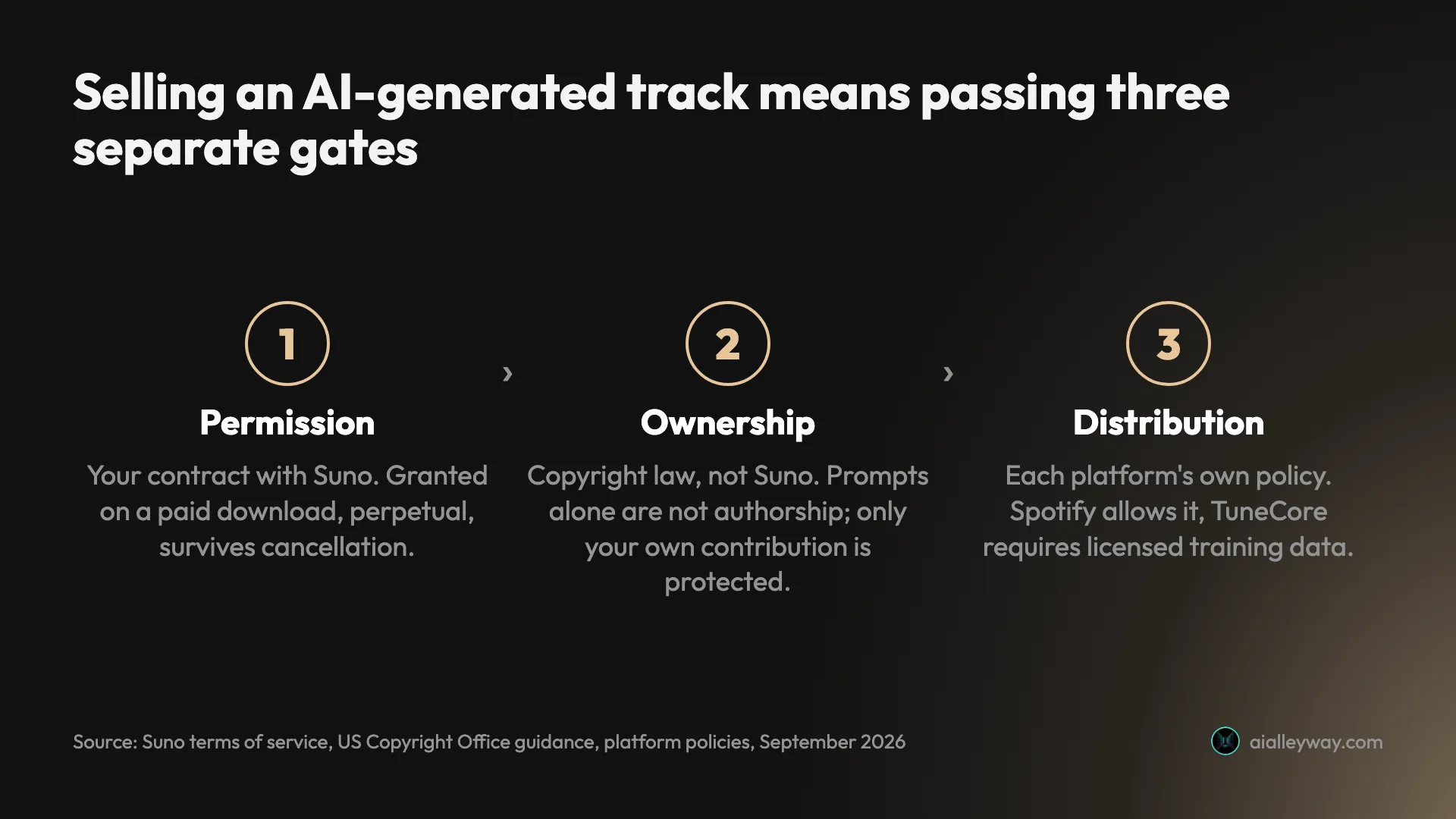
That is the short answer, and it is where almost every other page on this question stops. It is also the least interesting third of the problem, because “Suno permits it” is only the first of three gates a track has to pass.
| The gate | What decides it | Suno’s answer |
|---|---|---|
| May I sell it? | Your contract with Suno | Yes, on a paid download |
| Do I own it? | Copyright law | Suno will not promise you do |
| Will anyone carry it? | Each platform’s own policy | Suno does not control this |
Everything below comes from the primary documents, read on 6 September 2026: Suno’s terms of service, the US Copyright Office’s own guidance, the court docket, and the published policies of the platforms you would actually release through. Where two of Suno’s own pages disagree, we say so rather than picking a winner.
The first gate: what Suno’s contract actually grants
Suno’s terms were last revised on 10 August 2026 and took effect on 3 September. The clause that matters for paid subscribers reads:
“Subject to your compliance with these Terms of Service, if you are a user who has subscribed to the Pro or Premier paid tier of the Service, Suno hereby assigns to you all of its right, title and interest in and to any Output owned by Suno and generated from Submissions made by you through the Service, provided such Output will remain subject to these Terms of Service including any applicable commercial use restrictions. Due to the nature of machine learning, Suno makes no representation or warranty to you that any copyright will vest in any Output.”
Read that twice. The first sentence hands you everything Suno has. The second says Suno cannot promise there is anything to hand over. Both are in the same paragraph, and the second is the more useful of the two.
Free accounts get something structurally different. There is no assignment clause for them at all — instead a covenant that “you will only use such Outputs for your lawful, personal and non-commercial purposes.” You are not being given a restricted licence. You are being restricted.
The right is also tied to the act of downloading rather than the act of creating:
“You may commercially exploit Output solely to the extent it adheres to Suno’s Conditions of Access and Use as outlined above provided you have obtained a permitted download of that Output in accordance with the download allocations for your applicable service tier.”
And the workaround is closed explicitly: “Obtaining a copy of an Output by any means other than a download channel made available by Suno is prohibited (for example, recording or stream ripping are prohibited).”
The one clause that works in your favour
Buried in the same section is the most generous term in the document:
“Any assignment made to you under the paragraphs above, and the commercial use rights described in this paragraph with respect to a Download you have obtained, are perpetual and are not affected by your exhaustion of your Download allotment, by any later change to allotments or pricing, or by the expiry, cancellation, downgrade or suspension of your subscription.”
So the tracks you pulled down while subscribed stay commercially yours after you cancel. You lose the ability to download more, not the right to use what you already have. If you are scoring a single project, that makes a one-month subscription a legitimate strategy rather than a trap: pay, download everything you need, stop.
Three traps in the same document
Trial downloads are not commercial, and the wording is explicit. Suno’s announcement of the September change says free users get “up to 7 (lifetime) trial downloads” and then, in a footnote, “Trial downloads are not eligible for commercial use.” A file on your hard drive is not a licence.
Remixes can never be sold, at any tier. A remix is, to the extent copyright vests in it at all, a joint work owned by you and the remixer, and the terms say it “may only be used for lawful, personal and non-commercial purposes, regardless of your subscription tier or whether the Remix is a permitted Download.” That last clause is doing a lot of work. Paying does not fix it.
Suno’s own two pages disagree about when the right attaches. The pricing page advertises “Commercial use rights for new songs made”, which reads as a test tied to when the song was created. The terms of service key the right to obtaining a download while on a paid tier, and the announcement FAQ agrees with the terms: limits “apply to all downloads starting September 3, including songs created before that date.” Marketing copy and contract are not saying the same thing. The contract is the one that governs, but we would not want to be arguing the point, so download the thing you intend to sell while you are paying.
The second gate: do you own a copyright at all?
This is the question Suno’s no-warranty sentence is pointing at, and it has a clearer answer than the hedging suggests.
The US Copyright Office’s registration guidance, published in the Federal Register in March 2023, addresses prompting directly:
“these prompts function more like instructions to a commissioned artist—they identify what the prompter wishes to have depicted, but the machine determines how those instructions are implemented in its output.”
Its January 2025 report on copyrightability is blunter still: “Copyright does not extend to purely AI-generated material, or material where there is insufficient human control over the expressive elements,” and “based on the functioning of current generally available technology, prompts do not alone provide sufficient control.”
What that leaves you is narrower than most people assume.
| What you did | Protected? |
|---|---|
| Typed a prompt, kept the output | No |
| Wrote the lyrics | Yes, the lyrics |
| Recorded your own vocal over it | Yes, your performance |
| Arranged generated parts creatively | Yes, the arrangement |
| Edited it substantially | Yes, your modifications |
The Office protects “the creative selection, coordination, or arrangement” of material as well. But copyright covers only the human-authored parts, and if you register you have a duty to disclose the AI-generated content and identify what you contributed.
The practical consequence is worth stating plainly. A track you generated from a prompt and sold is one you can sell under your contract with Suno, and one you may have no copyright in. Those are compatible facts. It means you can exploit it and you may not be able to stop anyone else from using it.
Suno says as much itself, in the clause explaining that its restrictions “apply as contractual obligations regardless of whether copyright or any other proprietary right subsists in any Output.”
The third gate: will a distributor or platform take it?
This is where the plan usually dies, and it is the part no roundup covers.
| Platform | Position on AI-made music | What actually bites |
|---|---|---|
| Spotify | Allows it | AI artist identity loses recommendations |
| YouTube | Allows it, disclosure required | Content ID needs exclusive rights |
Spotify does not care how the music was made. Its September 2025 statement is unambiguous: “all music is treated equally, regardless of the tools used to make it.” What changed since is about identity, not tooling. From mid-September 2026 Spotify applies an AI Persona badge to profiles that present as AI rather than as a person, and says that “by default, Spotify will not include AI Personas in any editorial or algorithmic recommendations.” Spotify is explicit that “this badge is about the artist’s public identity, not about how the music was made.” Release under your own name and it does not apply to you.
YouTube wants disclosure and does not punish it. Its policy requires creators to disclose content “generated or meaningfully altered with AI when it appears realistic”, and names AI generated music in that list. It also states that “disclosing AI content won’t limit a video’s audience or impact its eligibility to earn money.” Content ID is the harder gate, and interestingly it says nothing about AI at all: the bar is “exclusive rights to the material in the reference file,” plus a distinctness requirement that already excludes sound-alikes. Given Suno’s own no-copyright-warranty, exclusive rights is the phrase to think hard about.
Which distributors will actually take it
The platforms above decide whether a track can live on them. The distributor decides whether it ever gets there, and this is the layer where a release plan usually fails.
| Distributor | Takes AI music? | The condition |
|---|---|---|
| DistroKid | Yes | You must own 100% of the rights |
| TuneCore | Only from licensed-data models | Names Flow Music, not Suno |
| CD Baby | Licensed-data test, with a threshold | Only bites if wholly or primarily AI |
| Amuse | Yes | Drops Qobuz, Meta and Content ID; no imitation, no AI covers |
DistroKid says yes in as many words — “DistroKid accepts music created with AI tools, but there are some rules” — and the rules are the obvious ones: own 100% of the rights, no impersonation, no mass-generated spam, no infringement.
It also runs AI Credits, a disclosure step at upload for AI-generated audio, lyrics or composition, which Spotify and Apple Music surface to listeners. Budget for declaring it rather than hoping nobody asks.
TuneCore is the one that would stop us. Its GenAI framework says it “only distributes music created using GenAI models trained on fully licensed datasets,” and that “if GenAI is used at any point in the creation of a track, the tools involved must rely on fully licensed datasets.” The test is the training data, not how much of the track is synthetic, which means the common line that TuneCore rejects “100% AI” music misstates the rule.
TuneCore names Google Flow Music as an approved partner. It does not mention Suno anywhere. We are not going to tell you it would refuse a Suno track, because TuneCore has published no ruling on Suno, but on its own stated test we would check before paying for a release.
CD Baby gates on training data too, but with a threshold TuneCore does not have. The Downtown policy that governs CD Baby prohibits “content created wholly or primarily by AI models trained on copyright protected sound recordings without a license from the applicable copyright owners”, and separately bars AI content that mimics popular artists.
That difference matters for what you make. TuneCore’s licensing test applies if generative AI touched the track at any point, and what it then demands is that those tools ran on fully licensed data. CD Baby’s applies only if the track is wholly or primarily AI, and only where the training data was unlicensed sound recordings. A track you wrote and sang over a generated bed may clear CD Baby and still fail TuneCore. And if you have read that CD Baby bans all AI music, that is wrong.
Amuse allows it and quietly narrows your reach. Its policy says “AI-generated music is allowed, but there are a few things to keep in mind”, and there are three: Qobuz, Meta and YouTube Content ID do not accept AI content so Amuse excludes those destinations, tracks that imitate a well-known artist are not approved, and AI covers are rejected outright.
What the lawsuits mean for you
Suno has been defending a copyright case brought by the major labels since 24 June 2024, in the US District Court for the District of Massachusetts, before Judge F. Dennis Saylor IV.
The shape of it has changed since, and the dates matter more than the headlines.
| When | What happened |
|---|---|
| 24 Jun 2024 | Major labels file in D. Mass. |
| Nov 2025 | Warner announces a partnership with Suno |
| Dec 2025 | Warner dismisses its claims; ordered that January |
| Aug 2026 | UMG, Capitol and Sony file an amended complaint |
| 1 Sep 2026 | Suno files its answer |
| 9 Apr 2027 | Earliest date for dispositive motions |
| Not yet | No fair-use ruling, no trial date, no summary-judgment motion |
Warner’s entities voluntarily dismissed their claims in a stipulation entered in December 2025, ordered that January, and announced a partnership with Suno instead. Universal, Capitol and Sony filed an amended complaint in August 2026, and Suno filed its answer on 1 September 2026. Suno announced a further partnership with BMG in August 2026.
What has not happened is any of the things you will read that it has. No summary-judgment motion has been filed. There has been no fair-use ruling. There is no trial date. The court’s own scheduling order does not open dispositive motions until 9 April 2027. If a page tells you a court has decided whether training on recordings is fair use, it is wrong, and we found at least one widely-copied claim naming a judge who is not on this case and a hearing that did not happen.
For a buyer the honest read is narrow. The claims are against Suno, not its users, and we found no case brought by a label against someone who made a song. That is not the same as a guarantee, and Suno’s terms also bind you to individual arbitration and waive class actions, so your own remedy against Suno is limited if the ground moves.
How Suno compares to the alternatives on this one question
Most comparisons in this category rank audio quality. On the narrow question of whether you can sell the output, the ranking is much simpler.
| Tool | Sell the track? | The actual rule |
|---|---|---|
| Suno | Yes, on a paid download | Perpetual, survives cancellation |
| Udio | No, at any price | Personal, non-commercial only; no downloads |
| Mubert | No | “Commercial usage” means use in your content |
Udio grants nothing. Its terms, last revised 12 November 2025, permit Output “solely for your personal and non-commercial purposes” and bar downloading Output “for any purpose”. The word commercial appears three times in the entire document and restricts use every time. There is no paid-tier exception in it — a point worth making loudly, because Udio’s paid plans are frequently described as opening up commercial use, and we made that mistake ourselves before reading the document properly.
Mubert is the subtler trap. Its Creator tier at $14 a month billed monthly is labelled Non-Commercial and its $39 Pro tier Commercial Usage, which reads clearly enough until you notice the disclaimer covering the whole pricing page: tracks cannot be sold or commercially distributed, cannot be published to streaming platforms, and cannot be registered with Content ID. Mubert Pro buys you the right to put music behind your own video. It does not buy you the right to sell the music.
What to do, depending on what you are actually making
Background music for your own videos or podcast: Suno Pro, download what you need, and you are done. Our Suno pricing breakdown has the tier maths, and how to use Suno walks the workflow. This is the case the licence fits best, and cancelling later does not take it away.
A track you intend to release commercially: subscribe, download the final version while subscribed, and settle your distributor before you commit. TuneCore’s licensed-data test is the one to check against.
Anything where you need to own it: do not rely on the generated audio alone. Write the lyrics, sing the vocal, edit the arrangement — put human authorship into it, and be ready to describe that contribution on a registration form.
Client work: read your own contract before you read Suno’s. If you are promising a client exclusive ownership of a track, Suno’s no-copyright-warranty means you may be promising something you cannot deliver.
Skip it entirely if you need a clean chain of title — a sync placement, a label deal, anything where a lawyer will look at the paperwork. The honest position today is that the ownership question is unsettled, and no subscription tier settles it.
The final word
Suno’s licence is more generous than its reputation and more limited than its marketing. It genuinely lets you sell what you download while paying, genuinely lets you keep those rights after you stop, and genuinely tells you it cannot promise you a copyright — which is the most useful sentence in the document, because it is the one that matches the law.
Licence terms vary more than the audio does, which is why our best AI music generator roundup ranks the category on rights rather than on sound.
The mistake to avoid is treating permission as ownership. Suno can grant you the first. Only your own contribution to the track earns you the second, and only a distributor’s policy decides whether anyone will carry it.
Frequently asked questions
Can you sell music made with Suno?
Yes, if you downloaded the track while subscribed to Pro or Premier. Suno's terms grant commercial use only for Output you obtained as a permitted Download on a paid tier, and its announcement of the September 2026 change says the trial downloads a free account gets are "not eligible for commercial use".
Two things that sound like the same question are not. Being permitted to sell it is a contract between you and Suno. Owning a copyright in it is a matter of law, and Suno explicitly declines to promise you one. A distributor agreeing to carry it is a third question again.
We read the live terms of service on 6 September 2026.
Do you own the copyright to a Suno song?
Suno assigns you whatever it holds, and then says in the same clause that it "makes no representation or warranty to you that any copyright will vest in any Output".
That hedge tracks US law. The Copyright Office's position is that purely AI-generated material is not protected, and that prompts alone do not give a human enough control to count as authorship. Its 2023 guidance compares a prompt to instructions given to a commissioned artist: you say what you want, the machine decides how.
What can be protected is your own contribution, if there is one, plus creative selection and arrangement. Registration also carries a duty to disclose the AI-generated content.
Can you put Suno songs on Spotify?
Spotify's own position is that it does not care how music was made. Its September 2025 statement says "all music is treated equally, regardless of the tools used to make it".
The catch is not the music, it is the identity. From mid-September 2026 Spotify applies an AI Persona badge to artist profiles that present as AI rather than as a person, and by default it will not include AI Personas in editorial or algorithmic recommendations. Spotify says the badge is about the artist's public identity, not about how the music was made.
So a real person releasing Suno-assisted tracks is not the target. An invented AI artist is, and loses reach.
Will a distributor accept AI-generated music?
It depends which one, and the split is sharper than most write-ups suggest.
DistroKid says yes outright, with conditions: you must own 100% of the rights, no impersonation, no mass-generated spam, no infringement. TuneCore is the hard case. Its GenAI framework says it "only distributes music created using GenAI models trained on fully licensed datasets", and that if GenAI is used at any point the tools must rely on fully licensed datasets.
TuneCore names Google Flow Music as an approved partner and does not mention Suno anywhere. CD Baby gates on training data too, but only for tracks that are wholly or primarily AI. Amuse allows AI music but excludes Qobuz, Meta and YouTube Content ID from the release, rejects artist imitation and refuses AI covers. DistroKid additionally requires you to declare AI use at upload, which Spotify and Apple Music surface to listeners. On those tests we would not assume a Suno track qualifies everywhere. Check before you pay for a release.
Do Suno's commercial rights disappear if you cancel?
No, and this is the most reassuring line in the whole document. The terms say the assignment and the commercial rights attached to a Download you already obtained "are perpetual and are not affected by your exhaustion of your Download allotment, by any later change to allotments or pricing, or by the expiry, cancellation, downgrade or suspension of your subscription".
So the tracks you downloaded while paying stay yours to use after you stop paying. What you lose is the ability to download more.
One exception sits nearby: remixes can never be used commercially, whatever tier you are on.
Is Suno being sued, and does it affect me?
Suno has been defending a copyright suit brought by the major labels since June 2024, in the US District Court for the District of Massachusetts. Warner voluntarily dismissed its claims in late 2025 and announced a partnership instead; Universal, Capitol and Sony filed an amended complaint in August 2026 and Suno answered on 1 September 2026.
There has been no fair-use ruling and no trial date. The court's schedule does not open dispositive motions until April 2027, so anyone telling you the case has been decided is wrong.
The suits are against Suno, not against its users. We found no case brought by a label against a Suno user. But Suno's terms also impose individual arbitration and waive class actions, so your remedy against Suno is limited too.
Can you sell music made with Udio or Mubert?
Udio, no, at any price. Its terms of service permit Output "solely for your personal and non-commercial purposes" and bar downloading Output "for any purpose", with no paid-tier exception anywhere in the document. All three uses of the word commercial in it are restrictions.
Mubert is more subtle. Its Creator tier at $14 a month billed monthly is labelled Non-Commercial and its $39 Pro tier Commercial Usage, but a disclaimer covering the whole pricing page says tracks cannot be sold or commercially distributed, cannot be published to streaming platforms, and cannot be registered with Content ID. Mubert Pro means using music inside your own content, not selling the music itself.
On the narrow question of selling a track, Suno is the only one of the three that says yes.
Keep reading
Best AI music generator: the three we ran, and what the rest are for
We gave Suno and Udio the same brief on the same day. Suno wins on output. On the licence the field splits three ways, and one tool grants nothing at any price.
Udio vs Suno: one brief, one day, two free accounts
Udio vs Suno, or Suno vs Udio: same sentence, same day, both free tiers. Suno gave us more music, Udio gave us more control, and only one let us keep a file.
How to use Suno: the free account, honestly
How to use Suno step by step, from your first prompt to getting a file out — including the two results you can't play and the seven downloads you get.
Suno pricing: the number that isn't credits
Suno sells credits, but caps something else: downloads. Seven for the lifetime of a free account, 20 a month on Pro, 60 on Premier. What each plan really costs.