
Best Claude skills: the 8 I kept out of 162 installed
The best Claude skills, ranked from 162 sitting on one machine. What each pack does, what it costs you in context tokens, and the four I stopped firing.
Contents
The best Claude skills, in one screen

Best overall: Superpowers. Fourteen skills that force Claude to plan, test and verify before it writes code. The cheapest pack here to keep loaded, and the only one that changed how I work rather than what I know.
Best for a content operation: claude-blog. Thirty skills that carried the 159 posts this site published before this one.
Best value per token: frontend-design. One skill, roughly 55 tokens of context, and design output that stops looking like a template.
I have 162 skills installed. Eight of them earn their place. This post is about which eight of the best Claude skills earn their seat, and about the number nobody publishing these lists ever prints: what each pack costs you in context before you have typed a word.
All of them run on Claude Code, which we rate 4.7 out of 5 in our full review. If you are still deciding whether to pay for it at all, start there, because none of this matters until you have the terminal open.
How I picked these, and what I measured
Every skill you install charges you context on every session, used or not. On this machine that bill is 162 skills, 78,012 characters of names and descriptions, and roughly 19,503 tokens gone before I type anything. That number, not a feature list, is what ranks the eight below.
The selection rule was blunt: it had to be installed on this machine, and it had to have been fired in real work. No pack got in on reputation. That rules out most of the lists you will find, because ranking a skill you read about is a different exercise from ranking one you have been living with for months. The eight below were installed between January and August 2026, and the dates are in each section.
Then I measured something. Every installed skill puts its name and description into context at session start, because Claude cannot route to a skill it does not know exists. That is a fixed tax you pay on every session, and it scales with how many skills you have installed, not with how many you use.
Here is the script. It walks the plugin cache and the user skills directory, pulls the frontmatter out of every SKILL.md, and adds up what those names and descriptions cost.
import os, re, glob
def frontmatter(path):    text = open(path, encoding="utf-8", errors="ignore").read(6000)    match = re.match(r"^---\s*\n(.*?)\n---", text, re.S)    if not match:        return None, None    block = match.group(1)    name = re.search(r"^name:\s*(.+)$", block, re.M)    desc = re.search(r"^description:\s*(.+(?:\n\s+.+)*)$", block, re.M)    return (name.group(1).strip() if name else None,            desc.group(1).strip() if desc else "")
paths  = glob.glob(os.path.expanduser("~/.claude/plugins/cache/*/*/*/skills/*/SKILL.md"))paths += glob.glob(os.path.expanduser("~/.claude/skills/*/SKILL.md"))
skills = {}for path in paths:    name, desc = frontmatter(path)    if name:        skills[name] = desc
chars = sum(len(n) + len(d) + 2 for n, d in skills.items())print(f"{len(skills)} skills, {chars:,} chars, ~{round(chars/4):,} tokens")
On my machine, on 2 September 2026, that prints 162 skills and 78,012 characters. At the usual four-characters-per-token rule of thumb, roughly 19,503 tokens are spent before the first prompt.
It dedupes by skill name on purpose. Two of my packs both ship a skill called seo-audit, and the plugin cache keeps old versions of a plugin alongside the current one, so counting files rather than names inflates the total by about 690 characters.
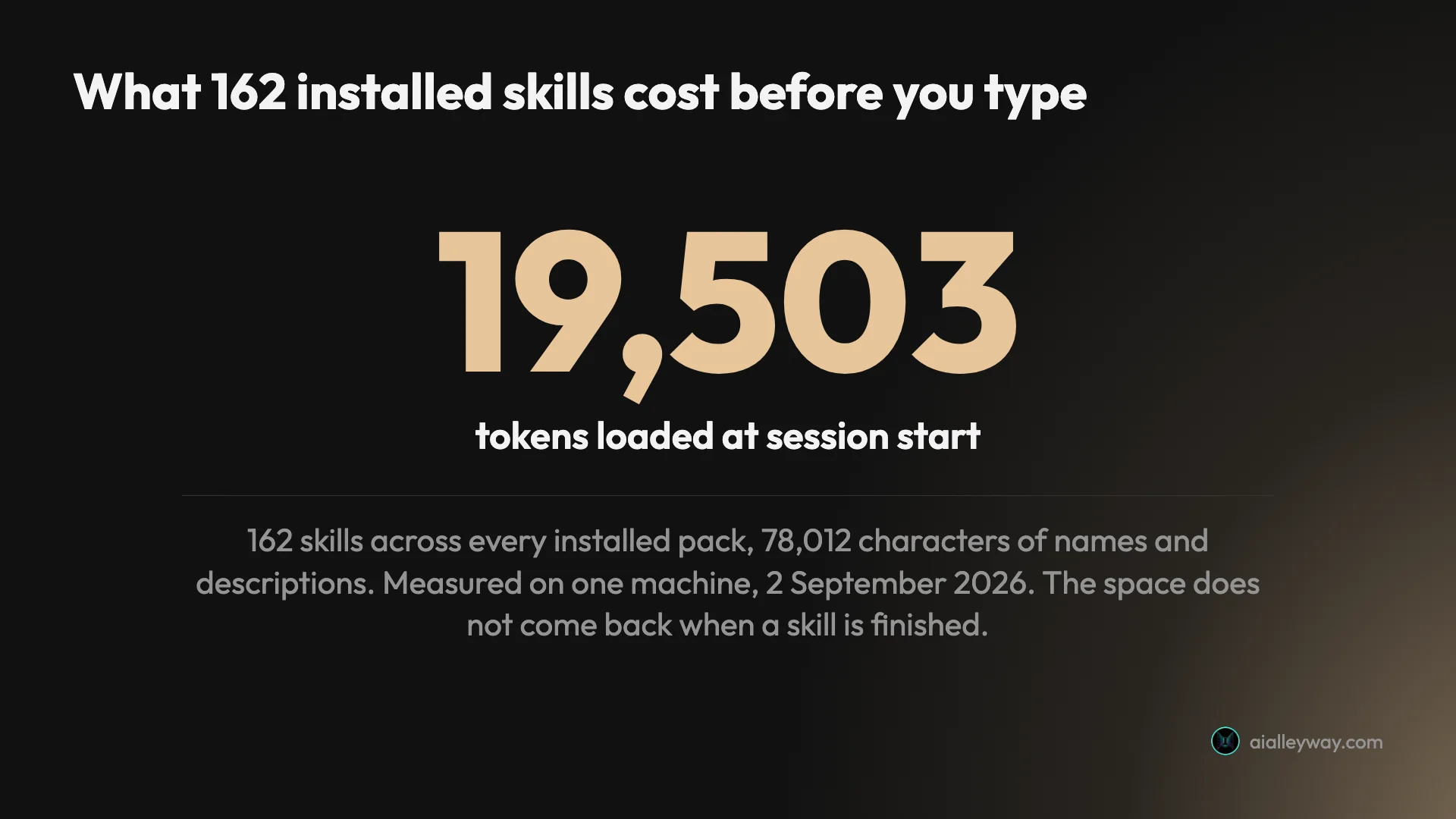
That number would matter less if the space came back. It does not. A feature request asking Claude Code to remove skills from context when they are no longer needed was opened on 29 January 2026 and closed as not planned. Fire a single-use skill in your first message and it keeps its seat for the rest of the session.
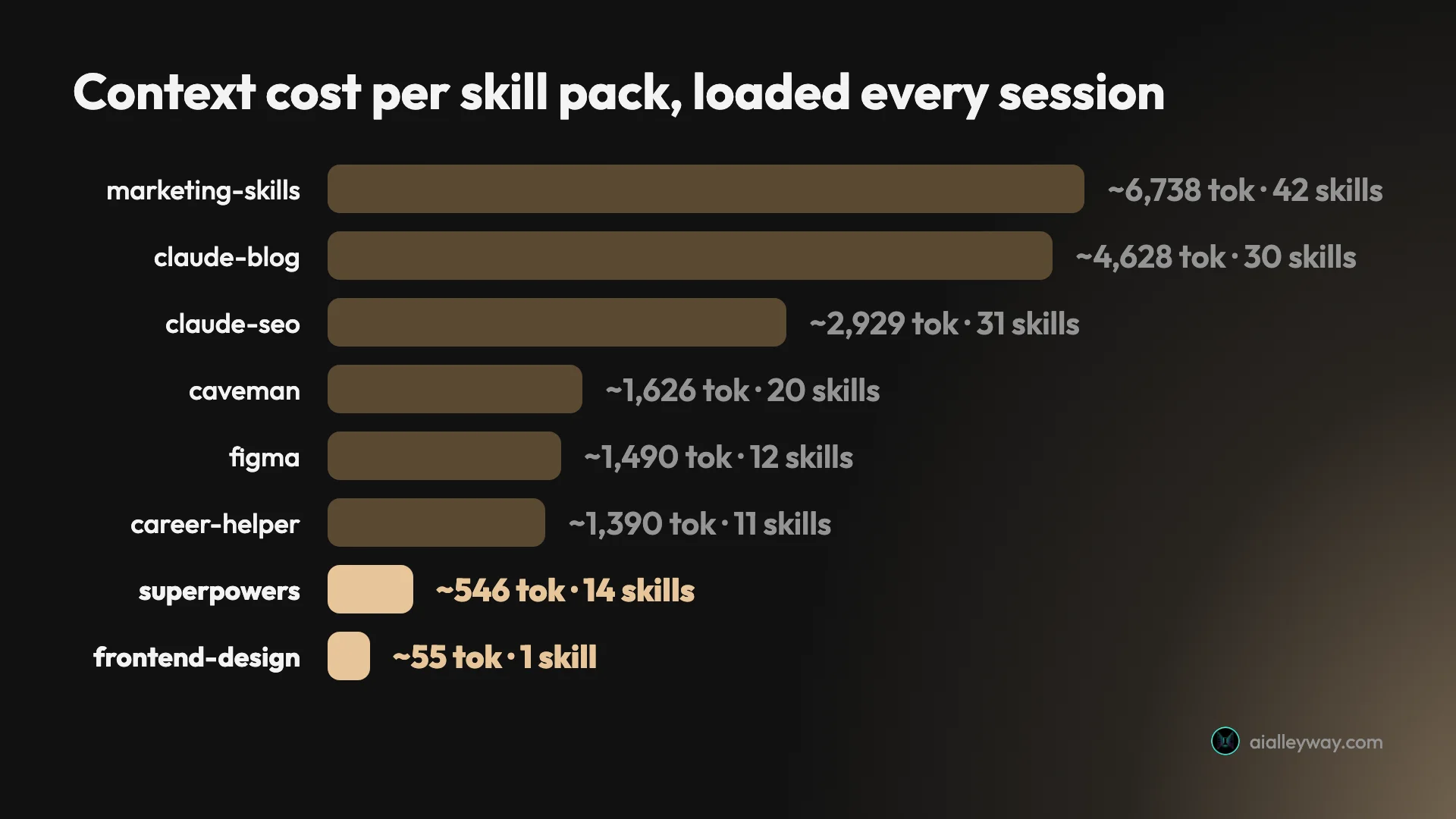
So the ranking below is not just “which packs are good”. It is which packs are good for what they charge. A 42-skill pack costing roughly 6,738 tokens has to be more than four times as useful as a 14-skill pack costing roughly 546, or it is a bad trade.
Four packs on this machine did not make the list, and it is worth saying why. career-helper is 11 skills at roughly 1,390 tokens and I have not fired it since installing it in April. swift-lsp is dead weight because nothing here is Swift. feature-dev overlaps almost entirely with Superpowers, and Superpowers won. youtube-transcribe-skill stays only because at roughly 47 tokens it is cheaper to keep than to think about.
One thing skills do not change is the bill. Every pack here is free, and none of them alters what Claude Code charges you, which is a separate question covered in our Claude Code pricing guide. What they change is how much of your context window is already spoken for when a session begins.
There is a second filter, and it is not about usefulness at all. In February 2026 Snyk audited 3,984 skills from ClawHub and skills.sh. 36.82 percent of them, 1,467 skills, carried at least one security flaw. 534, or 13.4 percent, held at least one critical-level issue, and 76 confirmed malicious payloads were built for credential theft, backdoor installation and data exfiltration. A skill runs with your permissions on your machine. Every pack below is a named public repository with visible history, which is the minimum bar, not a guarantee.
The eight at a glance
Context cost is measured on this machine; star counts and licenses were pulled from the GitHub API on 2 September 2026.
| Pack | Best for | Skills | Context cost | Per skill | Stars | License |
|---|---|---|---|---|---|---|
| Superpowers | Planning before coding | 14 | ~546 tok | ~39 tok | 280,654 | MIT |
| claude-blog | Publishing operations | 30 | ~4,628 tok | ~154 tok | 2,020 | MIT |
| claude-seo | Search and audit work | 31 | ~2,929 tok | ~94 tok | 16,102 | MIT |
| marketing-skills | Go-to-market breadth | 42 | ~6,738 tok | ~160 tok | 46,558 | MIT |
| frontend-design | Interface work | 1 | ~55 tok | ~55 tok | 35,810 | Apache-2.0 |
| Figma | Design to code | 12 | ~1,490 tok | ~124 tok | 1,946 | None declared |
| code-simplifier | Cleanup after the agent | 1 agent | negligible | — | 35,810 | Apache-2.0 |
| caveman | Cutting output tokens | 20 | ~1,626 tok | ~81 tok | 102,362 | None declared |
1. Superpowers — best for making Claude think before it types
One pack on this list changed my defaults rather than my capabilities, and this is it.
Superpowers is Jesse Vincent’s plugin, and it has been installed here since 16 March 2026, currently on version 6.3.0. It ships 14 skills that impose a sequence: brainstorm the requirements, write a plan, drive the work test-first, verify before claiming anything is done. The skills that matter most are the process ones. brainstorming refuses to let a vague feature request turn into code. systematic-debugging stops the guess-and-check loop that burns tokens on a bug nobody has characterised yet. verification-before-completion is the one that has saved me the most, because it makes “it works” an assertion that needs evidence.
At 280,654 stars it is the most-starred repository in this post by a factor of nearly three over the next one at 102,362, and the commit history is current, last pushed on 31 August 2026.
All 14, grouped by the phase they govern:
| Phase | Skills |
|---|---|
| Before code | brainstorming, writing-plans, using-git-worktrees |
| During | test-driven-development, executing-plans, subagent-driven-development, dispatching-parallel-agents |
| When stuck | systematic-debugging |
| Before you claim done | verification-before-completion, requesting-code-review, receiving-code-review, finishing-a-development-branch |
| Meta | using-superpowers, writing-skills |
The context arithmetic is where it wins outright. Fourteen skills for roughly 546 tokens works out to about 39 tokens each, the cheapest ratio of any pack here and roughly a quarter of what the biggest packs charge per skill. Its skill descriptions are short because the skills are disciplines, not catalogues of niche jobs.
The honest caveat is that the discipline costs time on small work. Asking for a twenty-line script and getting a planning phase first is overhead you did not want, and independent testing of the plugin has found the same thing: the savings show up on complex work and invert on trivial work. There is a real split in how people take it, and some install it, turn it off, and turn it back on within a day.
I keep it on. The tasks where planning is overhead are the tasks where the overhead is small. It is also the pack that most closes the gap between Claude Code and the tools it competes with, which we ranked by a controlled build test in the best AI for coding.
Cost: free, MIT licensed, on version 6.3.0 here and last pushed on 31 August 2026.
Who it is for: anyone whose sessions go wrong at the start rather than the end. If Claude keeps producing code before it has understood the problem, this is the fix, and it is the one pack on this list I would install before knowing anything else about how you work.
2. claude-blog — best for running an actual publishing operation
This is the pack with the clearest paper trail, because I can point at what it produced.
claude-blog has been installed here since 5 June 2026, currently version 1.9.1, and it ships 30 skills plus 5 agents covering research, outlining, writing, SEO checking, fact-checking, schema and translation. Since that install date this site published 159 posts before this one. Not all of that is the pack’s doing, and I will be precise about why in a moment, but the engine underneath every one of those posts is this one.
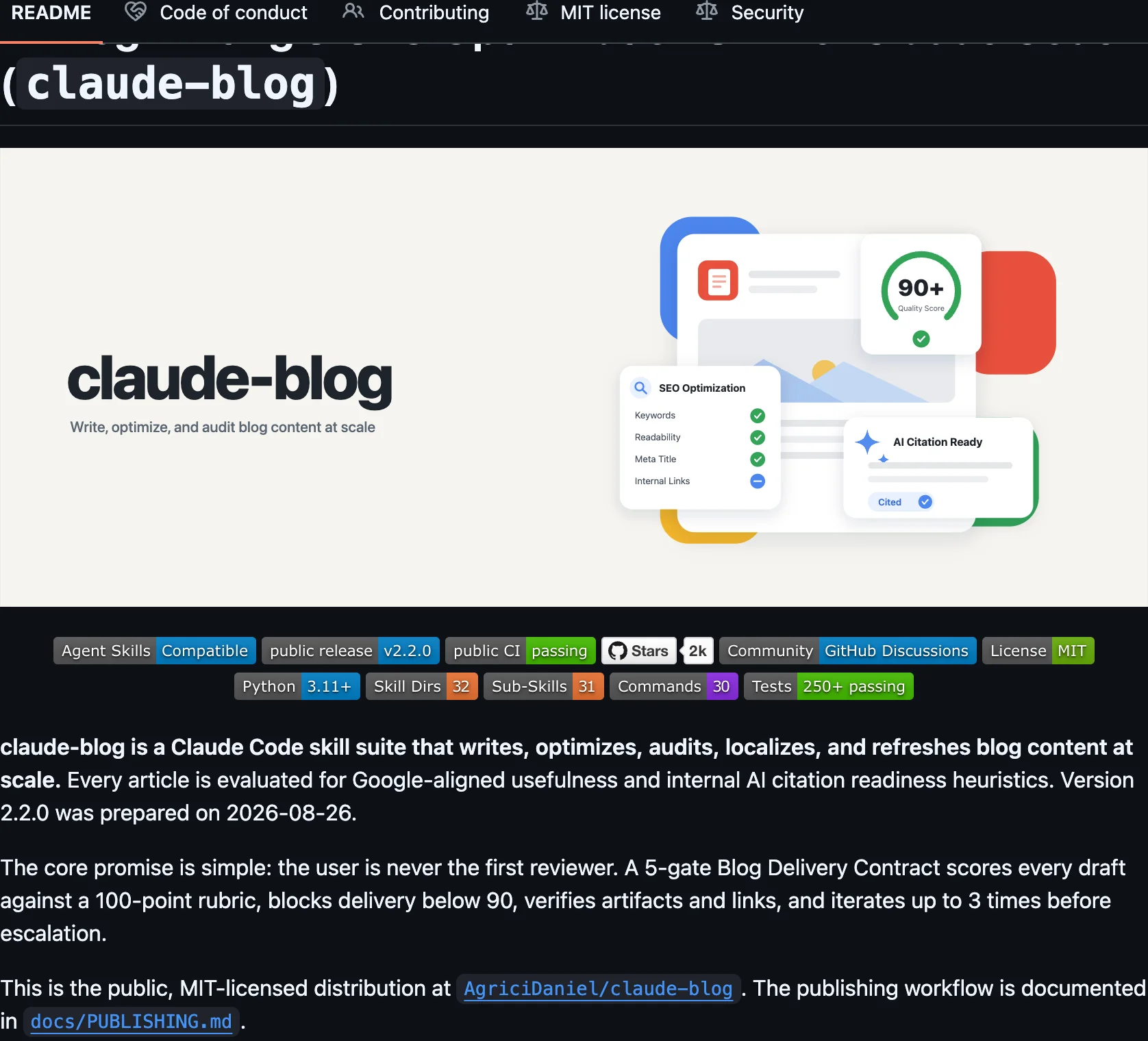
The pieces I actually fire are narrower than the catalogue. Two of the thirty earn the whole pack:
| Skill | What it does | Where it showed up here |
|---|---|---|
blog-discourse | Pulls 30 days of practitioner discussion across Reddit, Hacker News and dev.to | Surfaced the context-bloat issue and the security audit |
blog-factcheck | Re-fetches every cited URL and checks the claim against the page | Caught a mangled statistic before it shipped |
That middle row is not hypothetical. A search summary reported the Snyk audit as finding 1,467 malicious payloads. Fetching the source shows 1,467 flawed skills and 76 malicious payloads, which is a different claim entirely.
At roughly 4,628 tokens for 30 skills, it is the second most expensive thing installed here. It survives the audit because publishing is what this site does. If you write occasionally, it is not worth the tax.
The important qualification: the skills that run this site are a custom wrapper around this pack, not the pack alone. Our own skill knows our frontmatter schema, our affiliate link cloak and our voice rules. Public packs are the engine. Your specifics are still your job.
Cost: free, MIT licensed, currently version 1.9.1 and last pushed on 28 August 2026.
It is also the least-starred repository in this post at 2,020, which is worth saying plainly rather than hiding. Star count measures attention, not quality, and this is a niche pack for a job most developers do not have. I would rather tell you that than let you discover it after installing.
Who it is for: people publishing on a schedule, where the same research, fact-check and schema work repeats every week. If you write a post a quarter, the 4,628 tokens buy you nothing between posts, and doing it by hand four times a year is cheaper.
3. claude-seo — best for search work you would otherwise pay for
Thirty-two skill folders sounds absurd until you try to do this work by hand.
claude-seo installs as 31 separate skill directories under ~/.claude/skills, which is unusual: most packs arrive as one plugin, and this one arrives as a suite. The README counts its parts differently, as sub-skills plus specialist agents; 31 is what the install actually puts on disk, which is what the context bill is charged on. It covers technical audits, schema validation, content quality scoring, clustering, backlinks, local search, hreflang and the AI-search work that people now call GEO. At 16,102 stars it is the third most-starred pack here.
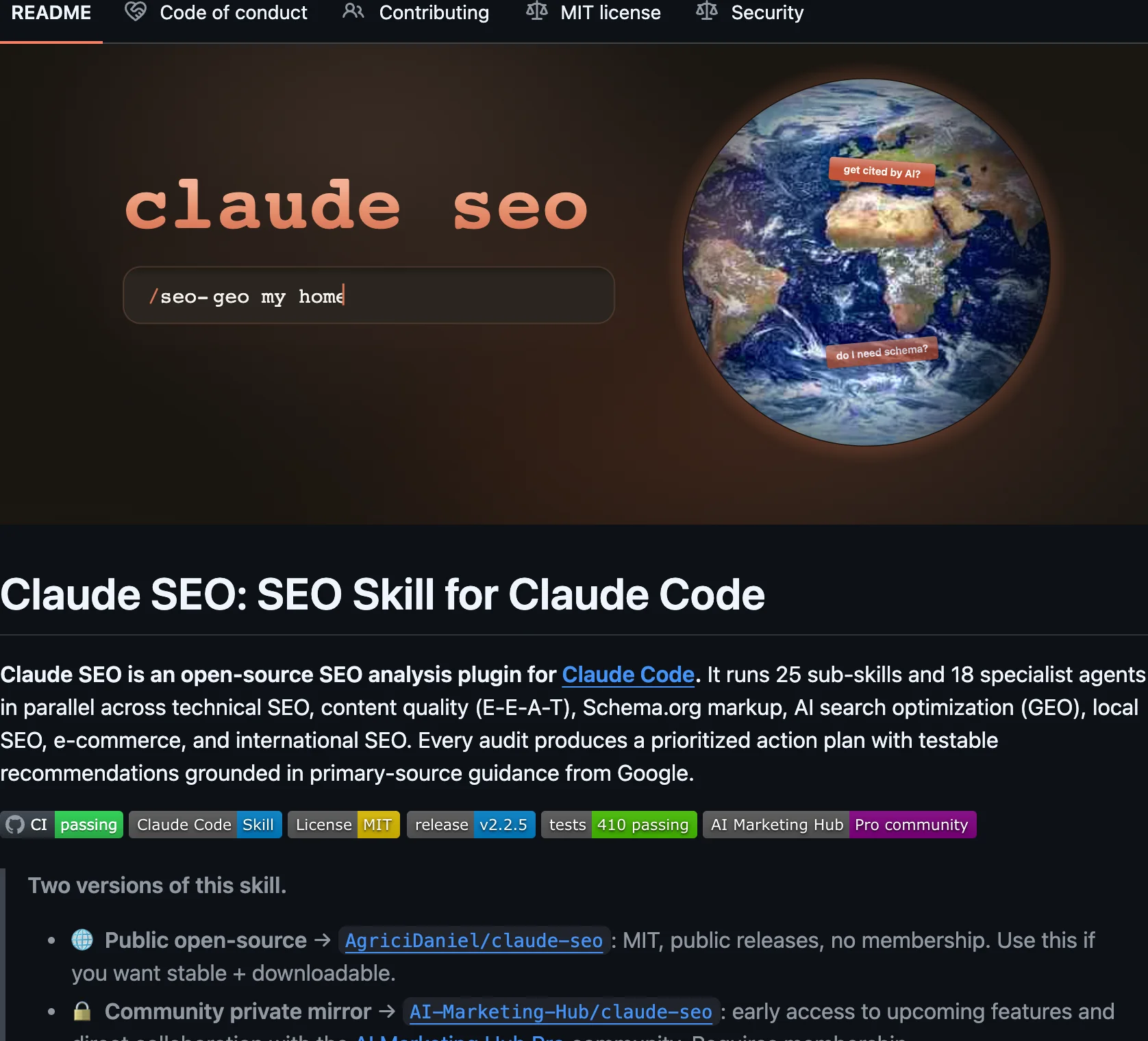
What makes it worth roughly 2,929 tokens is the DataForSEO integration. seo-dataforseo pulls live search volume, keyword difficulty, live result sets and per-page word counts. Every number in the planning that produced this post came through it: the keyword difficulty of 12 on this phrase, the backlink counts behind the guides already covering it, and the length of each one, which is how the target for this post got set rather than guessed.
This is the pull that decided this post existed and how long it had to be, taken on 31 August and 2 September 2026:
| What it returned | Value |
|---|---|
| Searches, most recent month | 2,900 |
| Keyword difficulty | 12 |
| Average referring domains on page one | 62.6 |
| Editorial guides measured for length | 4 |
| Their average length | 2,846 words |
| Target this post had to beat | 3,273 words |
None of those are estimates. The last row is arithmetic on the row above it, and it is why this post is the length it is.
The caveat is that the good parts need paid API credentials. Without a DataForSEO account you get the audit and schema skills, which are genuinely useful, and none of the live data, which is the reason to install it. Judge it on that basis before you spend the context.
Cost: the pack is free and MIT licensed. The live data behind it is not, and that is the real price of admission.
There is a second thing worth knowing. Because it installs as 31 loose directories rather than one plugin, removing it later means deleting 31 folders rather than uninstalling one thing. That is a small annoyance right up until the moment you are trying to cut context and cannot work out what is charging you for what.
Who it is for: anyone whose work is judged on whether pages rank. If search is somebody else’s problem at your company, this is the easiest 2,929 tokens on the list to skip.
4. marketing-skills — best breadth, and the most expensive seat in the house
Forty-two skills is the largest pack installed here, and it is also the one I have argued with myself about most.
marketing-skills is Corey Haines’ collection, installed since 2 May 2026 on version 2.2.0, at 46,558 stars and pushed as recently as 2 September 2026. The coverage is genuinely wide: paid ads, cold email, pricing, onboarding, churn, referrals, positioning, launch planning, directory submissions, programmatic SEO. Each is a real playbook rather than a stub, and the ones I have used have held up.
The eight I have actually fired, out of 42:
| Playbook | Used for |
|---|---|
directory-submissions | Backlink and listing campaigns |
programmatic-seo | Templated page architecture |
content-strategy | Cluster planning |
competitor-profiling | Rival teardowns |
analytics | Event and UTM tracking plans |
copy-editing | Tightening existing pages |
launch | Release sequencing |
free-tools | Tool-as-marketing planning |
Now the arithmetic. It costs roughly 6,738 tokens, more than twelve times what Superpowers charges at roughly 546, and about 160 tokens per skill against Superpowers’ 39. Every session on this machine pays that, including the sessions that are pure code. Breadth is exactly what makes a pack expensive: 42 distinct jobs need 42 distinct descriptions, and most of them describe work I do a few times a year.
I keep it because this site is a marketing operation as much as a codebase, and because directory-submissions and programmatic-seo are the two I would argue have earned their seat. If you are shipping software rather than selling it, this is the first pack I would cut, and I would not feel the loss.
Cost: free, MIT licensed, and actively maintained. It was last pushed on 2 September 2026, the same day I wrote this, which is a better maintenance signal than its star count.
The thing to understand about a pack this wide is that you cannot part-install it. You take all 42 descriptions or none of them, so a pack that is 80 percent irrelevant to you still charges full price every session. That is an argument for forking it and keeping the eight playbooks you use, which is more work than most people will do and is exactly why the pack is priced the way it is.
Who it is for: founders and solo operators who are the marketing department. If you have colleagues who own pricing, ads and lifecycle, they own those playbooks too, and you are paying context for their jobs.
5. frontend-design — the best trade on this entire list
One skill. Roughly 55 tokens. It is the only entry here where I would call the value obvious.
frontend-design ships from Anthropic’s own plugin marketplace and has been installed here since 26 April 2026. It does one thing: it loads a set of opinions about typography, spacing, colour and layout before Claude builds an interface, so the output stops defaulting to the same centred card on a grey background that every model produces unprompted.
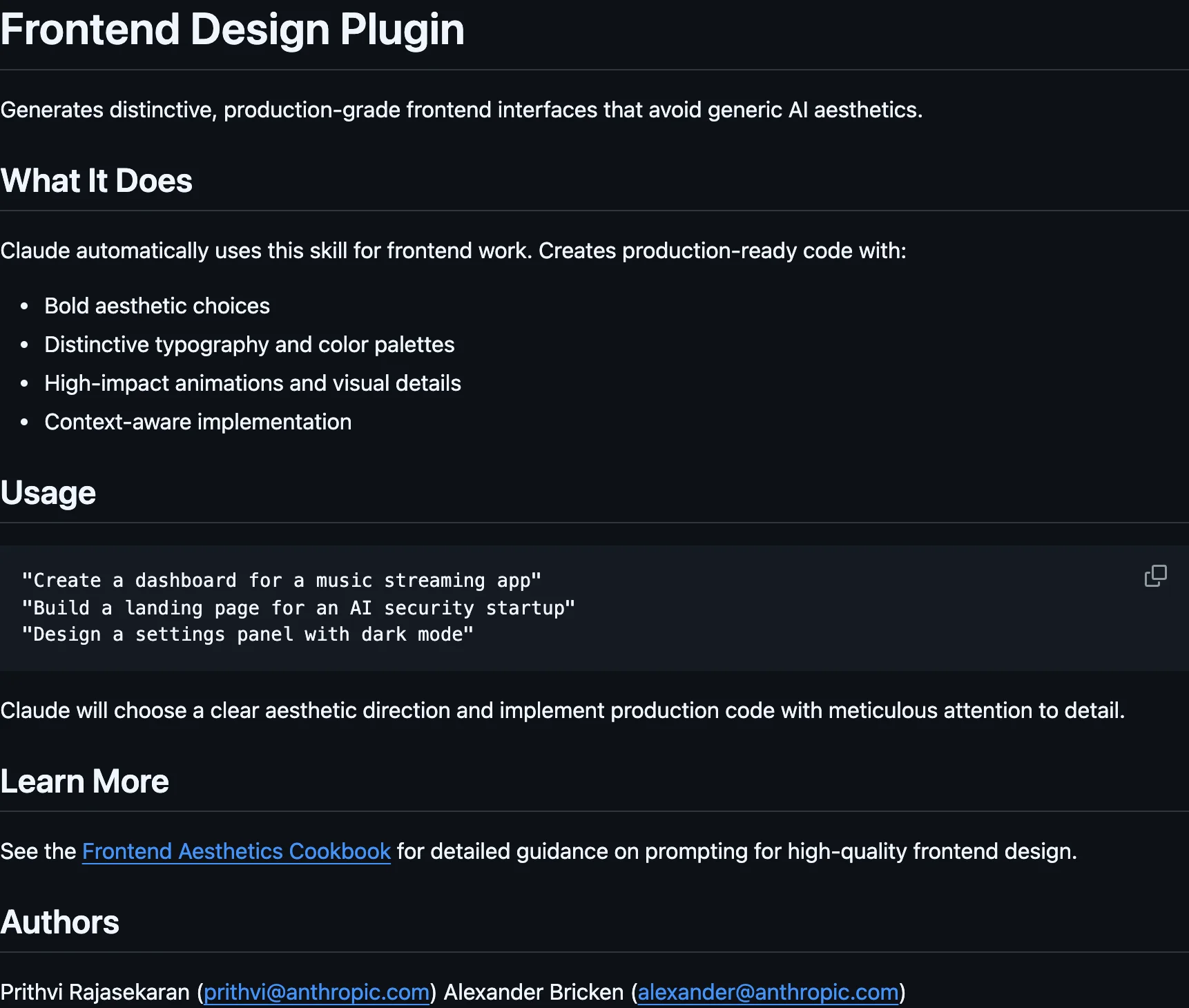
This is the entire thing Claude carries in context for it, copied from the installed SKILL.md:
---name: frontend-designdescription: Guidance for distinctive, intentional visual design when building new UI or reshaping an existing one. Helps with aesthetic direction, typography, and making choices that don't read as templated defaults.license: Complete terms in LICENSE.txt---The name and description together are 221 characters, and that pair is the whole of what sits in context. Everything else in the skill loads only once Claude decides the job is design work.
It is also the pack most consistently named by other people writing about this, which is unusual agreement for a category this new. Google’s AI Overview named frontend-design outright when I checked on 31 August 2026, and it turns up in both of the ranked community lists I read while researching this, one on dev.to and one on a personal blog.
Because it is a single skill with a short description, it never shows up in a context audit as a problem. That is the whole argument: the cost is so small that the only question is whether you build interfaces at all. If you do, install it and stop thinking about it.
Cost: free, Apache-2.0, and it ships from Anthropic’s own marketplace rather than a community registry, which removes the provenance question entirely.
The limit is worth naming. It sets taste, not layout. It will stop Claude producing the generic centred card, and it will not give you an information architecture, a component system or a decision about what the page is for. Those remain yours, and a skill that claimed otherwise would be lying.
Who it is for: anyone who ships a user interface, at any frequency. This is the one entry here I would install without thinking about the trade, because at roughly 55 tokens there is no trade to think about.
6. Figma — best for turning a design into code without the guessing
Twelve skills that exist because reading a design out of a screenshot is a bad way to build anything.
The Figma plugin is the newest thing on this list, installed 13 August 2026 on version 2.2.96. It is listed in Anthropic’s marketplace, but unlike the other Anthropic-listed entries here it is not Anthropic’s: the marketplace record points at a pinned commit of figma/mcp-server-guide, Figma’s own repository, which carries 1,946 stars and was last pushed on 1 September 2026.
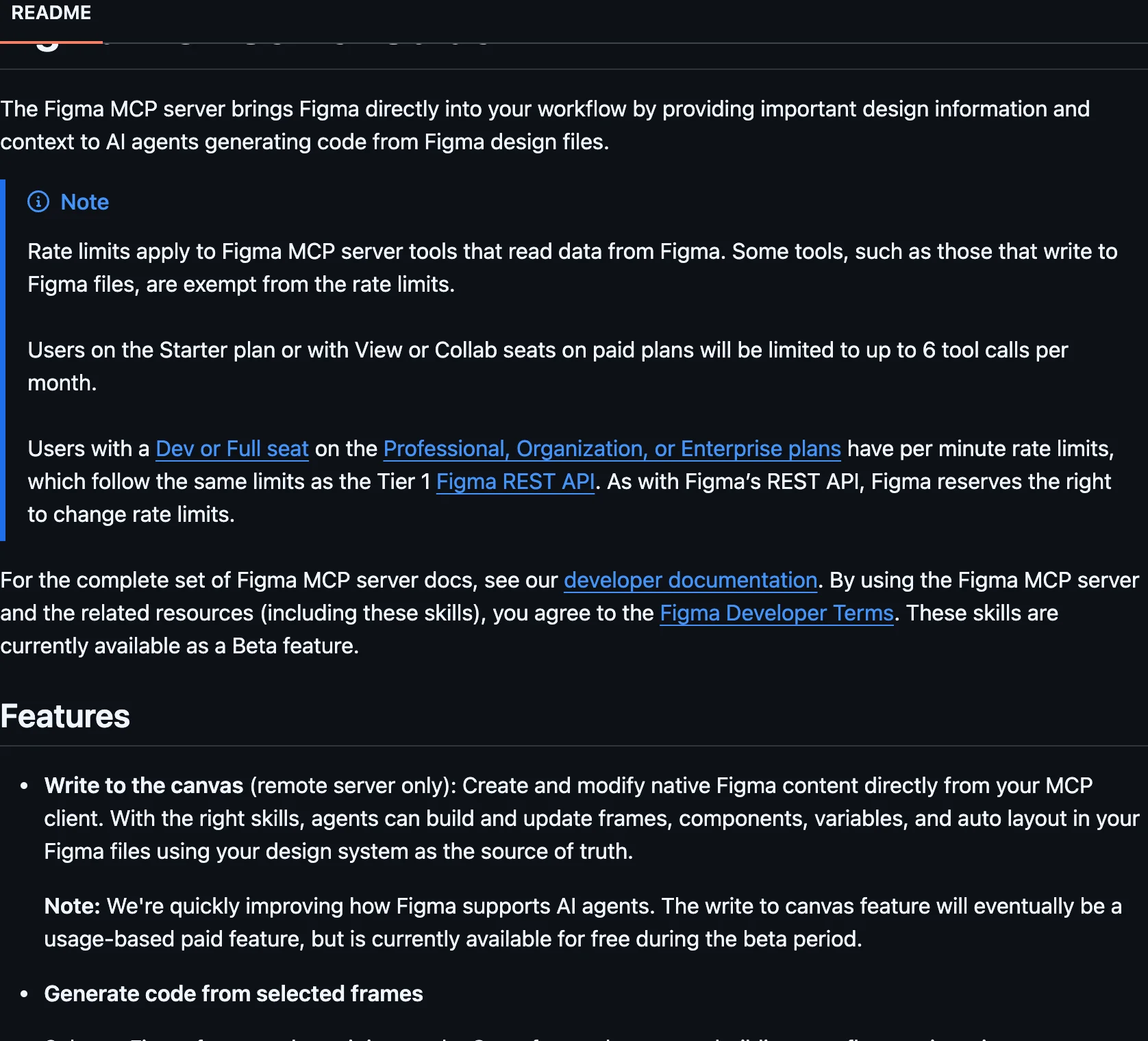 It reads real design context out of a file rather than inferring it from an image: variable definitions, component metadata, the actual spacing tokens. It also writes in the other direction, generating Figma files from code, and handles Code Connect mapping between design components and the components in your repo.
All twelve, by direction of travel:
| Direction | Skills |
|---|---|
| Figma into code | figma-design-to-code, figma-code-connect, figma-implement-motion, figma-swiftui |
| Code into Figma | figma-generate-design, figma-generate-library, figma-create-new-file |
| Working inside Figma | figma-use, figma-use-figjam, figma-use-motion, figma-use-slides, figma-generate-diagram |
At roughly 1,490 tokens for 12 skills it sits in the middle of the pack on cost. The value depends entirely on whether design work reaches you as Figma files. If it does, the gap between this and pasting a screenshot into the chat is not subtle, because variables and components survive the trip and pixels do not.
If design does not reach you that way, this is 1,490 tokens of nothing. There is no middle case.
Cost: free, but published by Figma rather than Anthropic and carrying no declared license, and it needs a live connection to Figma to do anything. The plugin is the interface; your Figma account is the data.
One practical note: the plugin’s own guidance insists you load its design-to-code instructions before pulling design context, and says plainly that skipping the step is what turns real variable definitions into a description of a picture. It is the rare tool that tells you how to hold it and means it.
Who it is for: developers on a team with designers. If you are a solo builder deciding the design yourself, frontend-design is the cheaper answer to the same underlying problem, and this is 27 times its context cost.
7. code-simplifier — the oldest install here, and still running
Installed 10 January 2026. Nothing else on this machine has survived that long.
code-simplifier ships from anthropics/claude-plugins-official, the same 35,810-star Anthropic monorepo that publishes frontend-design, which is why those two share one number in the table rather than carrying their own. It is a single agent rather than a skill pack, which is why its context cost is negligible. It reads recently modified code and rewrites it for clarity and consistency without changing behaviour. That is a narrow job, and it is exactly the job that agentic coding creates more of, because an agent that ships working code ships a lot of nearly-duplicate working code.
/simplify # review what changed and apply the cleanupsThe reason it has outlived every other early install is that it fits after the work rather than during it, in the same way the habits in how to use Claude Code pay off at the end of a task rather than the start. Most packs want to change how a task starts. This one runs at the end, on a diff, when the shape of the change is already settled and the only question left is whether it reads well. That makes it almost impossible to have a bad session with.
It is the least exciting entry on this list and the one I would defend hardest.
Cost: free, Apache-2.0, still on version 1.0.0 since January. Nothing about it has needed changing, which for a tool with one job is a compliment rather than neglect.
The one thing to watch is scope. It works on recently modified code by default, and that default is the whole point. Turned loose on a repository it will happily rewrite things nobody asked it to touch, and reviewing a large simplification diff is exactly as tedious as it sounds. Run it on a change, not on a codebase.
Its real limitation is structural. It ships an agent and no skills, so there is no description for Claude to match against and it will never fire on its own the way brainstorming does. It runs when you remember to run it, which on a bad week means it does not run at all.
Who it is for: anyone letting an agent write more than a few files a week. The mess agentic coding creates is real and it accumulates quietly, and this is the cheapest available broom.
8. caveman — the unserious one that cut real token spend
At 102,362 stars this is the second most-starred repository here, which says something about what developers actually install.
caveman compresses how Claude writes back to you. It strips articles, hedging, pleasantries and transition padding while keeping the technical content intact. It has been installed here since 13 August 2026, ships 20 skills with descriptions plus a set of commands and agents, and costs roughly 1,626 tokens.
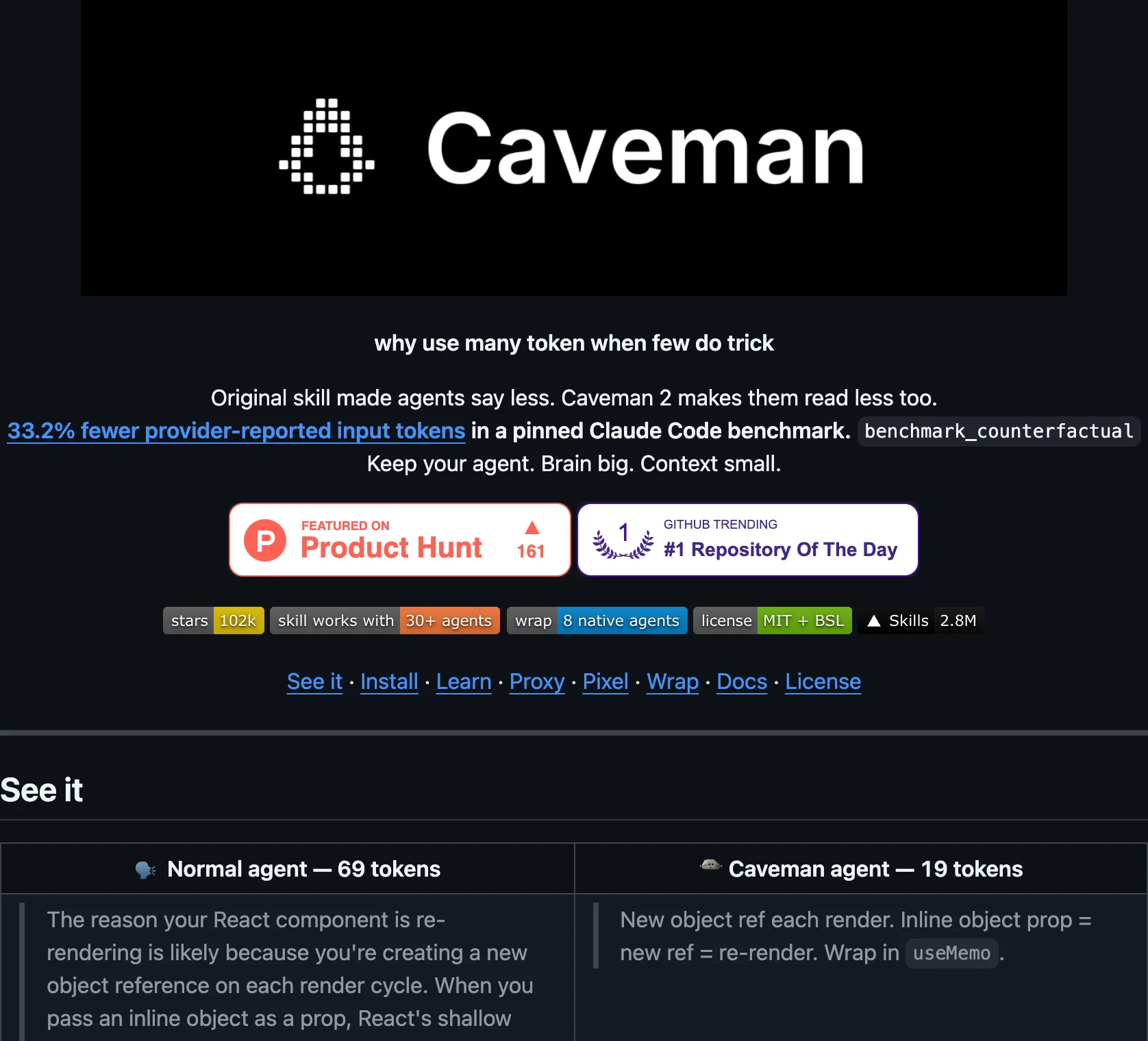
Before: "Sure! I'd be happy to help. The issue you're experiencing is likelycaused by an incorrect comparison operator in the auth middleware..."
After:  "Bug in auth middleware. Token expiry check use `<` not `<=`. Fix:"
Output tokens are the expensive half of a session, and a long agentic run generates a great deal of prose you skim rather than read. Compressing it is a straightforward saving.
It has six intensity levels. Three are English, running from a light setting that keeps whole sentences and only cuts the filler, through to one that strips conjunctions wherever cause and effect stay unambiguous. The other three render the same idea in classical Chinese. The light setting is the one that survives contact with real work.
Two honest warnings. The first is that it is a taste decision, and I have no data on how it splits: some people find the compressed register unreadable. The second matters more. The GitHub API reports no recognised license on the repository. It is not alone in that, since the Figma plugin has none either, but the other six packs here are all MIT or Apache-2.0. For a personal machine that is a small risk. For work you ship commercially, both are a question to resolve before you install, not after.
Cost: free, actively maintained, last pushed on 2 September 2026, and legally undefined. Two of those three are good.
Who it is for: people running long agentic sessions who read maybe a fifth of what comes back. If you read every word Claude writes, compressing it is removing something you were using.
Which Claude skills should you install first?
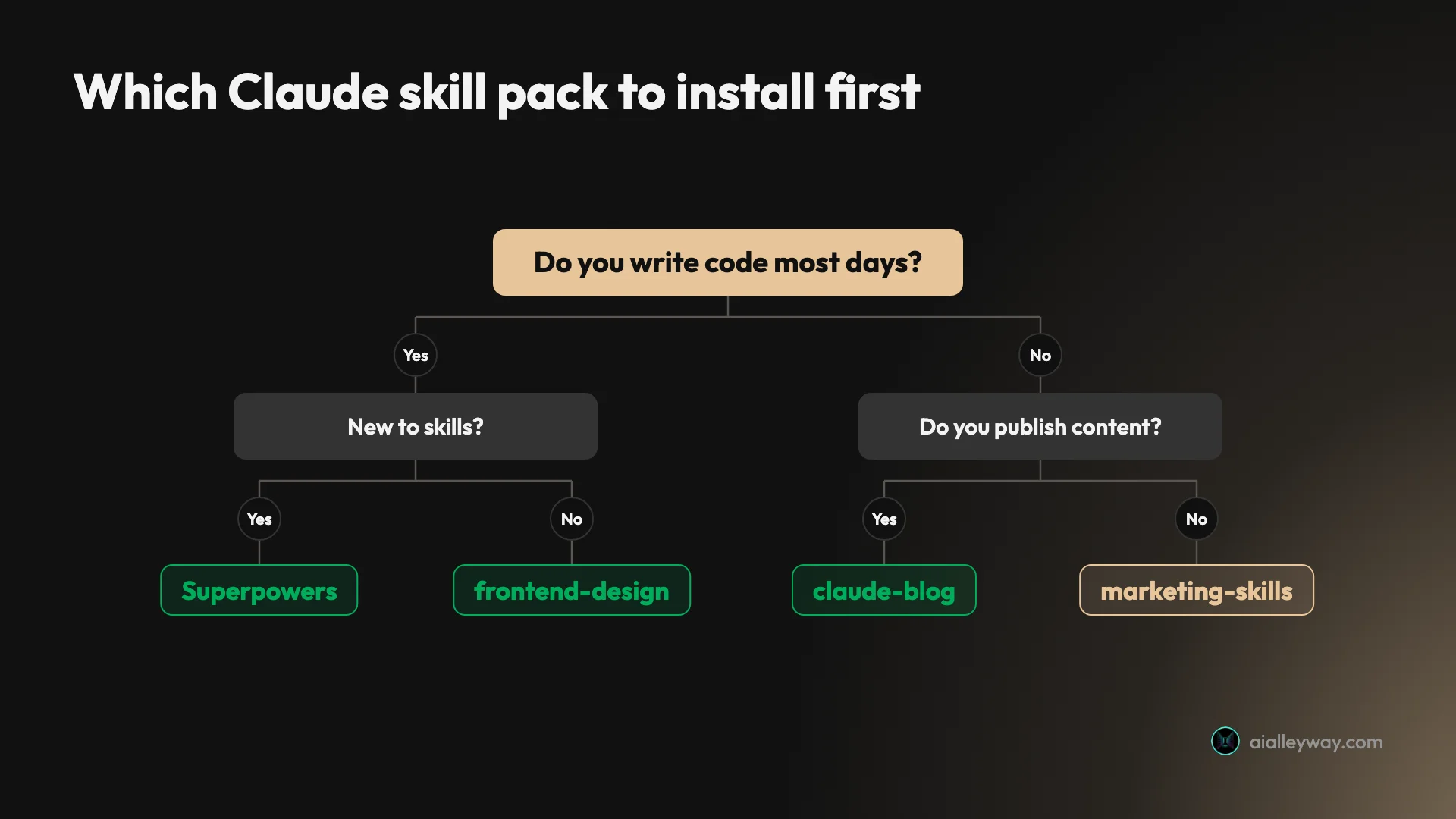
- If you have installed nothing yet: Superpowers, alone, for a week. It is the cheapest pack per skill and the only one that changes your defaults. Adding a second pack in the same week makes it impossible to tell what did what.
- If Claude keeps writing code before it understands the problem: Superpowers again, specifically
brainstormingandsystematic-debugging. - If your interfaces come out looking like every other AI-built page: frontend-design. Roughly 55 tokens is not a decision worth deliberating.
- If designs reach you as Figma files: the Figma plugin. If they do not, skip it entirely.
- If you publish regularly: claude-blog, then claude-seo once you need real search data rather than opinions about it.
- If you sell the thing you build: marketing-skills, with the warning that it is the most expensive seat here and the first one to cut when it stops earning.
- If your sessions are long and your output bill is high: caveman, once you have satisfied yourself about the license.
- If you already have a setup that works: leave it alone and spend the time on Claude Code tips instead. A better prompt beats another pack more often than this list admits.
- If you want to install from somewhere other than this list: read what a Claude skills marketplace actually is first — it is a git repo with a manifest, and the manifest tells you who wrote each plugin.
- If you have more than about 150 skills installed: stop installing and run the audit script above. The pack you cannot justify per token is the one to remove, regardless of how good it is.
Final word
The lists ranking the best Claude skills mostly rank features. Features are the easy half. The half that decides whether a pack is worth having is what it charges you on every session for the privilege of being available, and that number is measurable in about ten seconds with the script in this post.
Run it against your own machine before you install anything else. If you are starting from zero, start with Superpowers and Claude Code, and add the second pack only when a specific job has hurt enough times to name it.
If you are not sold on the terminal in the first place, read the Claude Code review before the skills question, or the alternatives if you want to know what else would run these disciplines.
Frequently asked questions
What are the best Claude skills to install first?
Superpowers, and then nothing else for a week.
It is the one pack that changes how Claude works rather than what it knows. Its 14 skills force a plan-then-verify discipline before code gets written, which is the failure mode most people actually have. It also happens to be the cheapest pack on this list to keep loaded, at roughly 546 tokens of description across all 14 skills.
After that week, add packs only when a specific job keeps hurting. Writing and publishing regularly is the case for claude-blog. Design work that keeps coming out generic is the case for frontend-design, which costs about 55 tokens to keep installed. Installing five packs on day one leaves you unable to tell which one is responsible for anything, good or bad, and you will keep all five out of superstition.
How many Claude skills is too many?
The honest answer is that the limit is a token budget, not a count.
I measured my own machine while writing this: 162 installed skills, whose names and descriptions total 78,012 characters, or roughly 19,503 tokens. That is loaded before I type anything, because Claude has to know a skill exists in order to decide to use it.
The number that matters is not how many skills you have but what they charge per session. A 42-skill pack on my machine costs about 6,738 tokens. A 14-skill pack costs about 546. Judge a pack on that ratio rather than on its skill count, and audit it every month or so. The script that produces these numbers is in the post, it takes about ten seconds, and it runs against your own installs rather than mine.
Are third-party Claude skills safe to install?
Treat every install as running someone else's code with your permissions, because that is what it is.
Snyk audited 3,984 skills from ClawHub and skills.sh in February 2026 and found that 36.82 percent, or 1,467 skills, carried at least one security flaw. 534 of them, 13.4 percent of the total, held at least one critical-level issue. The audit confirmed 76 malicious payloads built for credential theft, backdoor installation and data exfiltration.
That does not make skills unusable. It makes provenance the first filter. Every pack in this post is a named public repository with visible commit history, and seven of the eight carry a recognised open-source license. Read the SKILL.md files before you install, prefer packs that ship from a marketplace you can name, and be suspicious of anything that wants network access it has no reason to need.
Do Claude skills slow Claude down or use up context?
They use context permanently, and that is the real cost nobody prices in.
Skill names and descriptions load at session start so the model can route to them. On my machine that is roughly 19,503 tokens before the first prompt. Worse, they do not leave once used. A feature request asking Claude Code to unload skills from context when they are no longer needed was opened in January 2026 and closed as not planned, so a single-use skill you fired at the start of a session keeps occupying space for the rest of it.
The practical response is to be ruthless about breadth. A pack of 42 skills covering jobs you do twice a year is worse value than a pack of 14 you fire daily, no matter how good the 42 are individually.
What is the difference between a Claude skill and a plugin?
A skill is one folder of instructions. A plugin is a shipping container that can hold many of them.
A skill is a directory with a SKILL.md file containing a name, a description and instructions Claude loads when the job matches. You can write one by hand and drop it in .claude/skills in your project, which is how the six custom skills that run this site work.
A plugin is installed from a marketplace and can bundle skills, slash commands, agents and hooks together. Superpowers ships 14 skills as one plugin. The Figma plugin ships 12. That packaging is why most of the entries in this post are plugins rather than individual skills, and it is also why the context arithmetic matters: you install a plugin as one decision and pay for every skill inside it.
Can I write my own Claude skill instead of installing one?
Yes, and past a certain point you should.
This site runs on six custom skills totalling 1,565 lines of instruction, and they do things no public pack could: they know our frontmatter schema, our affiliate link cloak, our voice rules and our publishing gate. A public skill cannot know any of that.
The rule I would give is that public packs are for general disciplines and custom skills are for your specifics. Install Superpowers because planning before coding is universal. Write your own skill when you catch yourself pasting the same context into Claude for the third time in a week. Custom skills also cost context, so the same audit applies to your own work as to anyone else's, and a custom skill you wrote and stopped using is exactly as expensive as a public one you never fire.
Keep reading
Claude skills marketplace: what it is and which to add
A Claude skills marketplace is just a git repo with a manifest. Anthropic's official one lists 291 plugins; 23 say Anthropic wrote them. How to read one.
Claude Code vs Codex vs Cursor: one brief, three results
Claude Code vs Codex vs Cursor, measured. I gave all three the same brief and used every app they built. All three passed — here is what separated them.
Claude Code vs Copilot: $10 now buys you both
Claude Code vs Copilot, both measured on one identical brief. Copilot Pro at $10 now bundles Claude Code access, which changes the question entirely.
Claude Code tips: what eight months of daily use taught me
Claude Code tips from running a production pipeline on it daily for eight months, plus a controlled build test. The habits that changed my output.