
Zapier alternatives: 8 cheaper, more capable picks
Zapier's per-task pricing is the top reason to leave. The 8 best Zapier alternatives, cheaper or more powerful, and who each one actually fits.
Contents
The best Zapier alternatives, at a glance
Almost nobody leaves Zapier because it stopped working. They leave because of the bill. Zapier charges per task, so a multi-step automation that runs often climbs fast, and once a $20 plan turns into a few hundred, the search for an alternative begins. The good news is that the alternatives are cheaper, more powerful, or both, and the right one depends on why Zapier stopped fitting.
We can map this honestly because we are not selling our own automation tool. Most “Zapier alternatives” lists are published by a tool that conveniently ranks itself first; this one is not. We run n8n in production for the entire AI Alleyway pipeline, we built a real scenario in Make for its review, and we assessed the rest from their live pricing and docs. We say which is which in every section.
- Best overall, cheaper with more logic: Make. Per-operation billing and branching included, from $9 a month.
- Best for cost at scale and self-hosting: n8n. Per-execution billing, free to self-host, deepest AI.
- Best on a tight budget: Pabbly Connect. Only action steps count, plus frequent lifetime deals.
- Best for Microsoft 365 shops: Power Automate. Native Office integration and desktop RPA.
- Best open-source: Activepieces. MIT-licensed, free to self-host, friendly to start.
- Best for developers: Pipedream. Code-first automation on a hosted, serverless platform.
- Best for AI agents: Lindy. An AI assistant built around agents, not a wiring diagram.
- Best for simple, personal automation: IFTTT. Smart-home and one-step applets for a few dollars.
How we picked, and why people leave Zapier
Start with the why, because it points to the which. Zapier is a genuinely good tool, the easiest in the category and the one with the most integrations, which we score 4.3 in our Zapier review. People leave it for specific reasons, and there are three big ones.
The first and largest is cost. Zapier bills per task, where every successful app action counts, so a 10-step automation run 1,000 times a month is roughly 6,000 tasks, eight times past what a $19.99 Professional plan includes. The bill scales with how much your automations actually do, and that surprises people who priced it off the headline plan.
The second is logic. Zapier gates multi-step branching and Paths behind higher tiers, so the moment your automation needs to fan out by a condition, you are paying more. The third is control: Zapier is fully hosted with no self-host option, so your data and the per-task meter are both things you cannot escape on its platform.
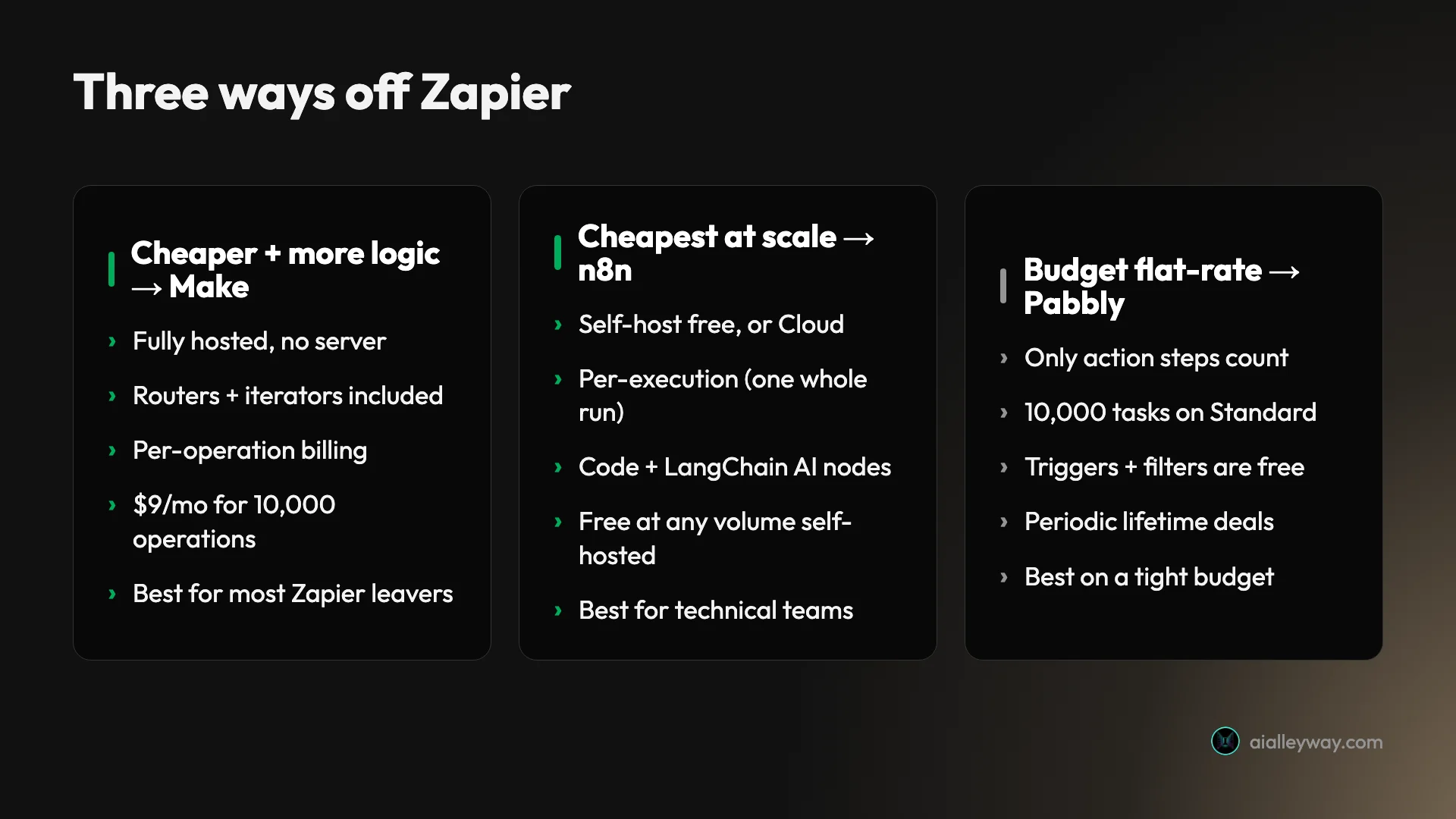
Each reason points somewhere different, which is why a flat ranking would mislead you. Leaving over cost points to Make or n8n. Leaving over a tight budget points to Pabbly. Leaving over logic points to Make again, and leaving for a Microsoft stack points to Power Automate.
Two of these we ran ourselves: n8n powers our production pipeline, and we built a real lead-routing scenario in Make through its API. The other six we assessed from their live pricing, documentation, and aggregate reviews, not production use, and we flag that in each section. We weighed one criterion above the rest, the one that pushed you here: what the tool actually costs at the volume you will run, not the price on the plan card.
That math is worth doing concretely, because it is the calculation that sends people looking. Take a 10-step automation, the shape of a normal workflow, at roughly six billable actions per run, and watch the Zapier task count climb past the plan you bought.
| Monthly runs (10-step flow) | Zapier tasks | Cheaper alternative |
|---|---|---|
| 100 | ~600 | Make free tier, or n8n self-hosted (free) |
| 1,000 | ~6,000 | Make $9 Core (10,000 ops); n8n free self-hosted |
| 10,000 | ~60,000 | n8n €50 Pro (10,000 exec) or free self-hosted |
The same flow is roughly 10,000 operations on Make at 1,000 runs, inside its $9 plan; 1,000 executions on n8n, free if you self-host; and only the action steps on Pabbly. Same automation, very different invoices, which is the whole reason this list exists.
Cost is the headline, but two other criteria shaped the picks. Data control matters for regulated work: a self-hosted tool like n8n or Activepieces keeps automation data and API keys on infrastructure you own, and Power Automate inherits Microsoft’s compliance posture, where a hosted-only tool cannot. And if the real goal is AI agents rather than app-to-app plumbing, that points to a different shortlist than a pure cost cut does. We flag both where they decide the call.
The 8 best Zapier alternatives compared
Here is the whole field at a glance. Read the “billing unit” column first, because it is the axis that decides your real cost, and the “tested?” column second, because it separates what we ran from what we assessed.
| Tool | Best for | Billing unit | Self-host | Free tier | Tested? (Alley rating) |
|---|---|---|---|---|---|
| Make | Most Zapier leavers | Per operation (module run) | No | 1,000 ops | ✅ Tested, 4.2/5 |
| n8n | Cost at scale, self-host | Per execution (whole run) | Yes (free) | Unlimited (self-host) | ✅ Tested, 4.6/5 |
| Pabbly Connect | Tight budgets | Per task (action steps only) | No | 100 tasks | From docs |
| Power Automate | Microsoft 365 shops | Per user / per bot | No | 30-day trial | From docs |
| Activepieces | Open-source self-hosters | Per active flow | Yes (MIT) | Self-host free | From docs |
| Pipedream | Developers | Per credit (compute) | No | Daily credits | From docs |
| Lindy | AI agents & assistants | Usage allowance | No | 7-day trial | From docs |
| IFTTT | Simple personal automation | Per applet | No | 2 applets | From docs |
1. Make — best overall, cheaper with more logic
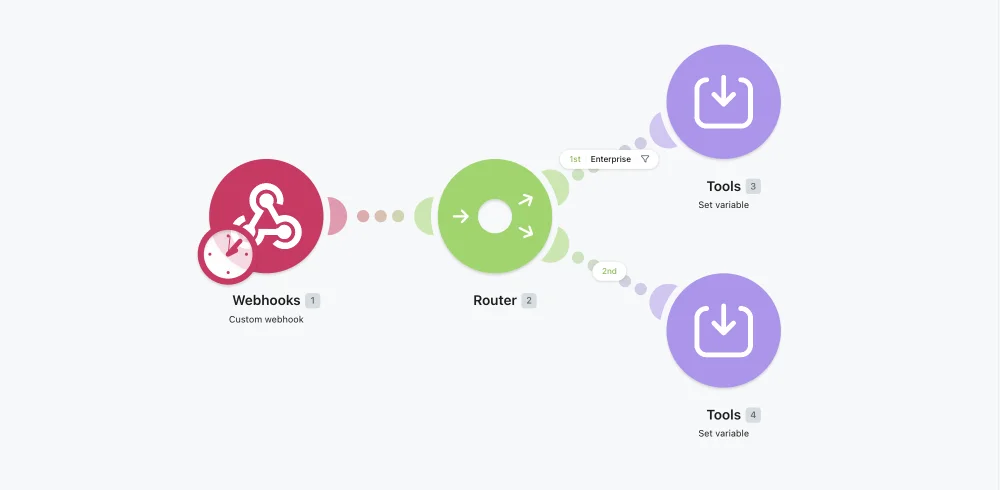
Make is the closest thing to “Zapier but cheaper and more powerful,” which is why it is the right landing spot for most people leaving. It is fully hosted and no-code like Zapier, but it bills per operation instead of per task, and its plans include far more units for the money. When we built a real lead-routing scenario through the Make API, the visual canvas made multi-step branching legible in a way Zapier’s linear list never is.
Pricing: Free for 1,000 operations and two scenarios, then Core at $9 a month for 10,000 operations. That is more than thirteen times the units of Zapier’s $19.99 Professional plan and its 750 tasks, for under half the price. The catch is the meter: Make counts every module run, so a polling trigger or a heavy scenario drains operations faster than the plan price suggests.
What you gain over Zapier is branching for free. Routers, filters, and iterators come standard from Core, where Zapier gates multi-step Paths behind pricier tiers, so a scenario that fans out by condition costs nothing extra. The connector library is smaller at 3,000-plus apps against Zapier’s 9,000, which is the one place Zapier still wins.
Two extras quietly seal the switch. Make’s Data Stores give a scenario a built-in database, so it can remember state or deduplicate without bolting on another tool, and its error handlers let you attach a retry or fallback to any module that might fail. Both are what you reach for the moment an automation has to run unattended.
Power users reward Make with a 4.8 on Capterra and 4.6 on G2; the Trustpilot 2.7 tracks billing and support friction, not whether the engine works. Buy Make if you want Zapier’s ease with lower cost and more logic, and you can keep an eye on the meter. Our full Make.com review scores it 4.2, and our Make vs Zapier comparison runs the cost math in detail.
2. n8n — best for cost at scale and self-hosting

n8n is the alternative for anyone whose Zapier bill is the whole problem and who has, or can borrow, a little technical capacity. It bills per execution, where one whole workflow run counts once no matter how many steps it has, which is the opposite of Zapier’s per-task model. We run our entire content pipeline on it: ten workflows on a self-hosted box, billed as nothing because the Community edition is free.

Pricing: the self-hosted Community edition is free at any volume, so you pay only for a small server. n8n Cloud starts at €20 a month for 2,500 executions if you would rather not host it. Against Zapier, the gap widens with every step and every run: a 30-step workflow that would shred a task budget is still one execution per run here.
The depth is the other half. Code is a first-class citizen, the HTTP node calls any API, and LangChain-based nodes make it the strongest pick for AI workflows, which we drive in production daily. The cost is the on-ramp: n8n expects comfort with APIs, JSON, and a little JavaScript, and self-hosting adds an operations burden Zapier never asks of you.
What keeps it in production rather than just impressive is that every workflow exports to JSON, so ours live in version control and a bad change is one revert away. Across the executions we retained in June 2026, the pipeline ran at 100% success, which is the bar that matters for automations that post to three platforms unattended.
Buy n8n if cost at scale or data control matters and you have technical hands. Skip it if you want something that just works with zero setup. Our full n8n review scores it 4.6, a Category Leader, and n8n vs Zapier has the head-to-head.
3. Pabbly Connect — best on a tight budget

Pabbly Connect is the pick when price is the only thing that matters. Based on its pricing and docs, it is a no-code automation tool built explicitly to undercut Zapier, and its billing model is the most task-liberal in this roundup: only action steps count against your task quota, where the other hosted tools meter internal steps in some form.
That is the detail that changes the math. Triggers, filters, routers, formatters, and iterators are all free tasks, so a multi-step automation bills for far fewer tasks than the same flow on Zapier, where every successful action counts. Combined with large flat allotments, it makes Pabbly genuinely cheap for busy workflows.
| Plan | Price (annual) | Tasks/mo |
|---|---|---|
| Free | $0 | 100 |
| Standard | $19/mo | 10,000 |
| Unlimited | $79/mo | Unlimited |
Pricing: the free plan includes 100 tasks, Standard is $19 a month for 10,000 tasks, and the Unlimited plan is $79 a month for unlimited tasks, with multi-year prepay dropping those to roughly $14 and $59. Pabbly also runs periodic one-time lifetime deals, recently $349 for lifetime access, which no other tool here offers.
The lifetime deals are the part bargain-hunters chase: Pabbly periodically sells one-time access that replaces the monthly bill entirely, which no subscription-only rival here offers. For a solo operator running steady, simple automations, that can make Pabbly the cheapest tool on this page over any multi-year horizon.
The honest limits: Pabbly’s interface and connector library are less polished and narrower than Zapier’s or Make’s, and it is a value tool rather than a power tool, so deep branching and AI orchestration are not its strength. We assessed it from its pricing and docs, not production use.
Choose Pabbly Connect if budget is the deciding factor and your automations are straightforward. Skip it if you need a polished builder or heavy branching logic.
4. Microsoft Power Automate — best for Microsoft 365 shops

If your work already lives in Microsoft 365, Power Automate is the obvious alternative. Based on Microsoft’s documentation and pricing, it combines cloud flows for app-to-app automation with desktop flows for robotic process automation (RPA) that clicks through legacy software no API can reach. Inside Outlook, SharePoint, Teams, and Dynamics, it is the native option, and that integration is the entire reason to pick it over Zapier.
The billing is a different shape from Zapier’s, which is the point: it bills per user or per bot, not per task, so it scales with headcount and automation count rather than volume.
| Plan | Price | Bills by |
|---|---|---|
| Premium | $15/user/mo | Per user (cloud + attended desktop) |
| Process | $150/mo | Per bot (unattended RPA) |
| Hosted Process | $215/mo | Per bot (Microsoft-hosted RPA) |
Pricing starts at $15 per user a month for Premium, with per-bot RPA tiers climbing from $150. For a team already paying for Microsoft 365, some automation may already be included, and the licensing is famously confusing on exactly what is bundled versus what needs Premium.
Two things deepen the Microsoft case beyond integration. A Copilot builds flows from a plain-English description, and the tie-in to Copilot Studio puts AI agents where your company data already lives, inside one security boundary. And the admin controls, data-loss-prevention policies, and audit trails are built for an IT department that has to sign off on what automation can touch, a different world from a solo Zap.
The honest caveats: outside the Microsoft ecosystem Power Automate feels heavy and its licensing is hard to reason about, and we assessed it from docs rather than production. But for a Microsoft shop, the automation, the data, and the AI sit inside one license and one security boundary, which no neutral tool matches.
Choose Power Automate if you are a Microsoft 365 shop that wants native Office automation and RPA. Skip it if you are outside that ecosystem, where Make or Pabbly will be simpler and cheaper.
5. Activepieces — best open-source alternative

Activepieces is the pick if leaving Zapier is partly about wanting to own your automation rather than rent it. Based on its docs and pricing, it is MIT-licensed, which makes it genuinely open source, and free to self-host with a 270-plus contributor community. For anyone who wants Zapier’s no-code feel without the hosted lock-in, it is the closest match.
The builder is designed to be approachable, with a visual flow canvas, a growing library of “pieces,” and native AI agent and MCP support, so it does not assume the API-and-JSON comfort that n8n does.
| Plan | Price | Notes |
|---|---|---|
| Community (self-hosted) | Free | MIT-licensed, self-host |
| Cloud Standard | $5 per active flow / mo | Unlimited runs, 10 free flows |
| Ultimate (enterprise) | Custom | RBAC, SSO, audit logs |
Pricing does something different from Zapier: the cloud plan bills per active flow at $5 a flow a month with unlimited runs, so a high-volume workflow costs the same as a quiet one. The self-hosted Community edition is free, the same deal as n8n, without the steeper learning curve.
That per-flow model is worth a second look if you run a few busy workflows: $5 a flow with unlimited runs can beat any per-task or per-operation meter once a single automation fires thousands of times a month. It is the cleanest answer on this list to “my one busy workflow is the whole bill.”
The honest caveats: Activepieces is younger than Zapier, so its connector library and community, while growing, are smaller, and self-hosting carries the usual operations burden. We assessed it from its docs and license, not production use.
Choose Activepieces if you want open source and a gentle on-ramp. Skip it if you wanted to stop running a server entirely, where Make or Pabbly fit better.
6. Pipedream — best for developers

Pipedream is the alternative for the developer who finds Zapier too limiting and too costly but never wanted to run a server. Based on its documentation, it is a hosted, serverless platform where you wire together triggers and steps and drop into real code, Node.js, Python, Go, or Bash, between any of them, with thousands of pre-built integrations to skip the boilerplate.
For someone comfortable in a terminal, that is the appeal Zapier cannot match: actual code, fully managed, with no infrastructure to own.
| Plan | Price | Notes |
|---|---|---|
| Free | $0 | Daily free-credit allowance |
| Basic | $29/mo | Monthly credit base |
| Advanced | $79/mo | Larger credit base |
Pricing is credit-based and tied to compute: one credit covers 30 seconds of compute at the default memory, the free workspace gets a daily allowance, and paid plans start at $29 a month. That meter rewards efficient code and punishes heavy steps, a different discipline from Zapier’s per-task count but the same need to watch usage.
The escape hatch is the appeal for a developer: with real code between steps and an HTTP block for anything missing, Pipedream rarely runs out of road the way a pure no-code tool does. The trade is that you maintain that code yourself, and the compute meter rewards keeping it lean.
The honest caveats: Pipedream is developer-first, so a non-coder will find it less approachable than Make or Pabbly, and the compute meter means a long-running step costs more than a light one. We assessed it from its docs, not production use.
Choose Pipedream if you want code-first automation on someone else’s servers. Skip it if you do not write code.
7. Lindy — best for AI agents and assistants

Lindy is the pick when the automation you want is really an AI assistant, not a wiring diagram. Based on its product and pricing pages, it positions as an AI work assistant that handles routine tasks, drafting email, scheduling, taking notes, across more than 100 integrations. Where Zapier connects apps with rules, Lindy ships an agent and asks what you want it to do.
That makes it faster to start for a non-developer who wants outcomes rather than flows. The trade is flexibility: you work within Lindy’s idea of what an assistant does, not an open canvas.
| Plan | Price | For |
|---|---|---|
| Plus | $49.99/mo | Individuals |
| Pro | $99.99/mo | Power users |
Pricing has no free tier, only a 7-day trial, and starts at $49.99 a month, several times Zapier’s entry price. The plans are sold on a usage allowance that scales steeply, so the AI-assistant convenience carries a premium that a workflow you build yourself would not.
From its product positioning, Lindy is sold as outcomes, not building blocks: an assistant that triages an inbox, books meetings from email threads, and updates a CRM across its integrations. For someone who wants those jobs done and has no interest in wiring them, that packaging is the whole appeal; for someone who already builds automations, it is a narrower, pricier version of what an LLM step in Make or n8n would do.
The honest caveats: Lindy is a narrower, pricier tool than a general automation platform, and it makes sense only if AI agents are the actual goal. We assessed it from its pricing and docs, not production use.
Choose Lindy if you want a ready-made AI assistant for email and meetings. Skip it if you want general-purpose automation or a free tier to learn on.
8. IFTTT — best for simple, personal automation

IFTTT is the alternative when Zapier is overkill, not too expensive. Based on its plans page, it is built around simple one-trigger, one-action “applets,” and it shines on smart-home and personal automation, connecting lights, speakers, phones, and consumer apps that business-focused tools often skip.
It is the wrong tool for complex, multi-step business workflows, and the right one for “when I leave home, turn off the lights” or “save my Instagram photos to a folder.” For personal use it is far cheaper and simpler than Zapier.
| Plan | Price | Applets |
|---|---|---|
| Free | $0 | 2 applets |
| Pro | $2.99/mo | 20 applets |
| Pro+ | $8.99/mo | Unlimited applets |
Pricing is by applet count rather than tasks: Free covers 2 applets, Pro is $2.99 a month for 20, and Pro+ is $8.99 a month for unlimited applets, with annual billing available. For a handful of personal automations, that is a fraction of any business tool’s cost.
The applet model is the tell: each one is a single trigger and a single action, which is why IFTTT feels effortless for “do this when that happens” and falls apart the moment you need a second step or a condition. It is the only tool here built for consumers first and businesses second, and for personal automation that focus is a feature, not a limitation.
The honest caveats: IFTTT does not do multi-step branching, deep business-app integration, or anything resembling Zapier’s professional use cases, and we assessed it from its plans and docs, not production. Its case is narrow and real: simple, personal, and cheap.
Choose IFTTT if your automations are personal and one-step. Skip it for any real business workflow, where Make or Pabbly belong.
How to pick your Zapier alternative
The whole list collapses to one question: why is Zapier no longer fitting? Match your reason to the pick.
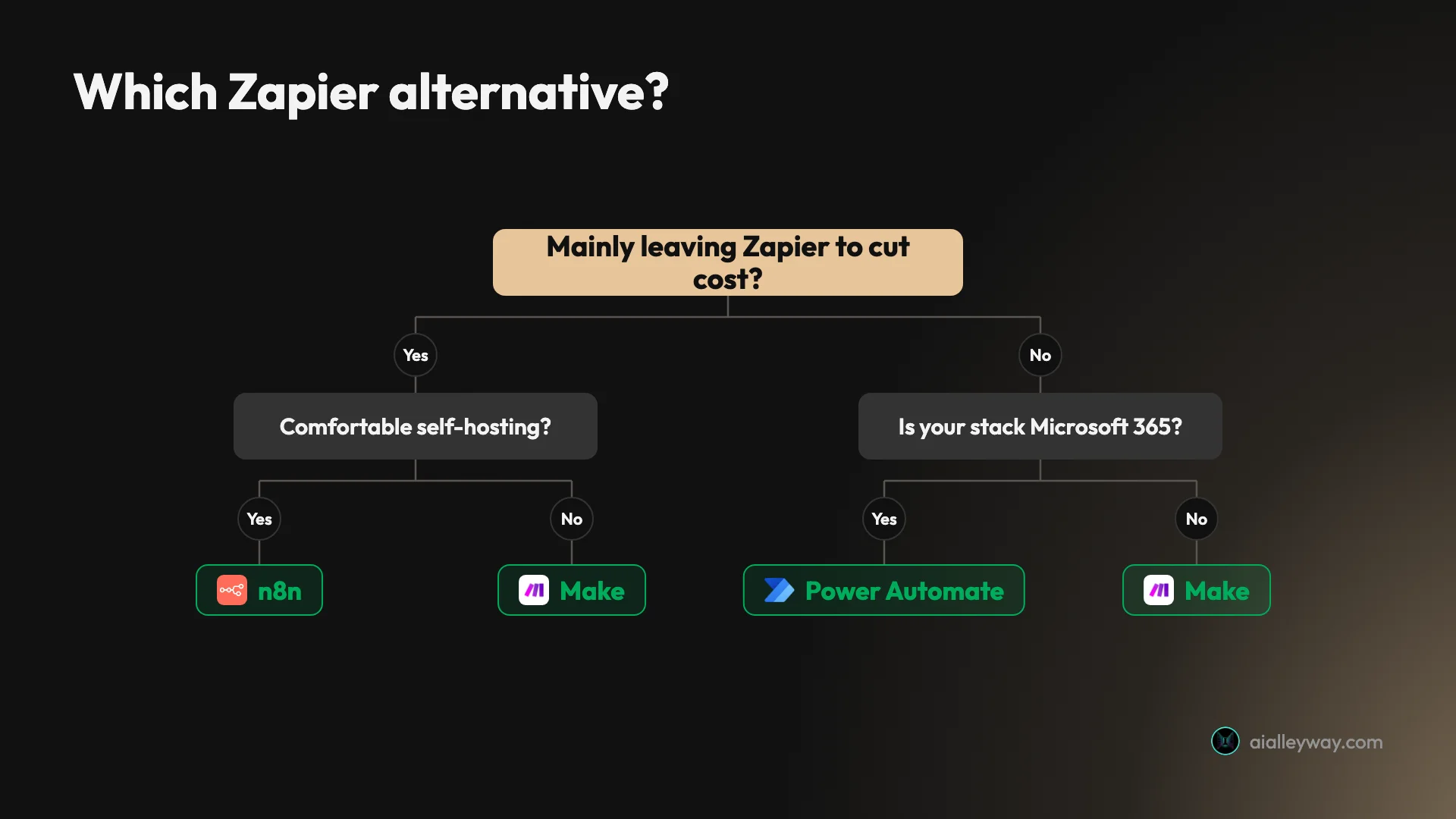
- The bill is the problem, and you can self-host → n8n. Per-execution billing and free self-hosting make it the cheapest serious option.
- The bill is the problem, but you want no-code and no server → Make. More units per dollar than Zapier, with branching included, from $9 a month.
- Budget is tight and your flows are straightforward → Pabbly Connect. Only action steps count, plus lifetime deals.
- Your stack is Microsoft 365, or you need RPA → Power Automate. Native Office automation the others cannot match.
- You want to own it, open source → Activepieces. MIT-licensed and free to self-host, friendlier than n8n.
- You write code and want it hosted → Pipedream. Real code, serverless, no infrastructure.
- The automation is really an AI agent → Lindy, if the $49.99 entry fits.
- It is personal and one-step → IFTTT. Smart-home and consumer applets for a few dollars.
And the honest non-switch: if your automations are few, simple, and low-volume, and you value the widest app library and the gentlest setup, stay on Zapier. Its per-task bill only bites once you scale, so the reason to leave should be real, a bill that stings or a wall you keep hitting, before the migration work is worth it.
One rule cuts through all of it: model your real run frequency against each tool’s billing unit before you commit, because the unit, not the plan price, decides your bill. A per-operation model (Make), a per-execution model (n8n), an action-steps-only model (Pabbly), and a per-user model (Power Automate) produce wildly different totals for the same automation.
And there is no one-click importer from Zapier to any of them, so migrate one workflow first, rebuild it on a free tier, and run both in parallel for a week before you move the rest. That dry run is the cheapest insurance against a missing connector or a pricing surprise.
Which Zapier alternative should you actually use?
There is no single best Zapier alternative, only the best one for the reason you are leaving, and for most people that reason is the per-task bill. If you want the closest no-code replacement that costs less and does more, the answer is Make, a gentle switch that keeps the visual builder and loses the per-task meter. If you can self-host, n8n is cheaper still and the most powerful of the lot.
From there it splits by need: Pabbly for the tightest budgets, Power Automate for a Microsoft stack, Activepieces for open source, Pipedream for developers, Lindy for AI agents, and IFTTT for simple personal automation. None of them is selling you a ranking, which most “Zapier alternatives” lists quietly are.
Before you switch, estimate one number: your busiest automation’s billable steps times how often it runs each month. If that lands in the hundreds, Zapier may still be fine and Make is the easy upgrade. If it lands in the tens of thousands, the move pays for itself fast. For the deeper picture, read our Make vs Zapier and n8n vs Zapier comparisons, or the full best AI automation tools roundup.
Pricing and ratings verified June 2026 from each vendor’s pricing page and our own hands-on reviews of Make, n8n, and Zapier.
Frequently asked questions
What is the best alternative to Zapier?
For most people leaving Zapier, Make is the best alternative: it keeps the visual, no-code approach but bills per operation instead of per task, so its $9 Core plan includes 10,000 operations against Zapier's $19.99 plan for 750 tasks, and it adds branching logic Zapier charges a premium for.
If you are technical and want the lowest cost at scale, n8n is cheaper still, because it bills per whole-workflow execution and self-hosts for free. If budget is the only concern, Pabbly Connect counts only action steps and runs frequent lifetime deals.
The honest answer is that the best Zapier alternative depends on why you are leaving: cost points to Make or n8n, a tight budget to Pabbly, and a Microsoft stack to Power Automate.
Why is Zapier so expensive?
Because it bills per task, where every successful action in an outside app counts as one. A multi-step Zap that runs often multiplies fast: a 10-step automation firing 1,000 times a month can burn roughly 6,000 tasks, far past the 750 a $19.99 Professional plan includes, which pushes you onto a much pricier tier.
Zapier softens this by making triggers, filters, Paths, and built-in tools free, so a lean Zap costs less than its step count suggests. But the shape of the bill is still per-action, and it climbs with volume.
That single pricing fact is the most common reason people look for an alternative, and it is why per-operation tools like Make and per-execution tools like n8n win on cost as you scale.
Is there a free Zapier alternative?
Yes, several. The most powerful free option is n8n: its self-hosted Community edition is free at any volume, with unlimited executions, so you pay only for a small server. Activepieces is also free to self-host and is MIT-licensed, genuinely open source.
Among hosted tools, Make's free plan (1,000 operations and two scenarios) is more usable than Zapier's (100 tasks, two-step Zaps only), and Pabbly Connect's free tier includes 100 tasks where only action steps count.
If you want free with zero setup, start with Make's free plan; if you can run a server and want unlimited free automation, self-host n8n or Activepieces.
What is the best open-source Zapier alternative?
n8n and Activepieces are the two to know. n8n is source-available under a fair-code license, self-hosts for free, treats code as a first-class citizen, and ships LangChain-based AI nodes, which makes it the most powerful open option. Activepieces is MIT-licensed, so it is genuinely open source in the strict sense, with a friendlier on-ramp and a per-active-flow cloud model.
Both let you keep automation data and API keys on infrastructure you control, which Zapier cannot offer. The trade is the same one self-hosting always carries: free in license cost, but you own the server, the upgrades, and the monitoring.
Choose n8n for power and AI, Activepieces for a gentler open-source experience.
How do I move my automations from Zapier?
There is no one-click importer from Zapier to any of these tools, because each describes its logic in a different model, so migration means rebuilding by hand. The good news is that the concepts transfer directly: a Zap's trigger and actions map cleanly onto a Make scenario, an n8n workflow, or a Pabbly task.
The practical approach is to migrate one automation first, the one whose Zapier cost or limits pushed you to switch, rebuild it on the free tier of your chosen tool, and run both in parallel for a week to confirm it behaves before you move the rest.
That dry run also surfaces any missing connector or pricing surprise before you commit, which is cheaper than discovering it after a full migration.
Keep reading
Zapier pricing: what you'll really pay as tasks add up
Zapier is free for 100 tasks, then $19.99/mo — but the per-task bill climbs fast as you scale. The real Zapier pricing, plan by plan, with worked cost math.
Zapier review: easiest to start, priciest to scale
Zapier connects 9,000+ apps with the easiest setup in automation. The catch is per-task pricing that climbs fast — here's who it's actually worth it for.
Best n8n alternatives: who each one is actually for
We run n8n in production, so we know what you'd trade away. The 9 best n8n alternatives, from managed to open-source, and who each one actually fits.
Make.com pricing: what you'll really pay per operation
Make is free for 1,000 credits, then $9/mo Core — but every module run spends a credit, so the operations meter sets your real Make.com pricing.