
Synthesia alternatives: cheaper, or more lifelike?
Leaving Synthesia over the price or the stiff avatars? HeyGen (4.8 on G2) is more lifelike and cheaper, plus 5 more picks sorted by why you're switching.
Contents
Synthesia is a genuinely good tool. That is not why you are here. You are here because the bill grows faster than your video count, because the avatars look a little too composed next to what HeyGen is shipping now, or because you are paying for enterprise governance you never actually use. The tool is fine. It just stopped being the right fit.
Short answer: for most people leaving Synthesia the best alternative is HeyGen, which makes more lifelike avatars, renders faster, and starts cheaper. But the right pick depends on why you are leaving, so this guide sorts six of them by the reason you are switching.
The single biggest reason is cost, and it is worth understanding before you shop. Synthesia meters you in minutes, and they are not cheap. The Creator plan at $64 a month buys 360 minutes a year, which is about six hours of finished video, or roughly two dollars per finished minute (we broke the full pricing down in our Synthesia review).
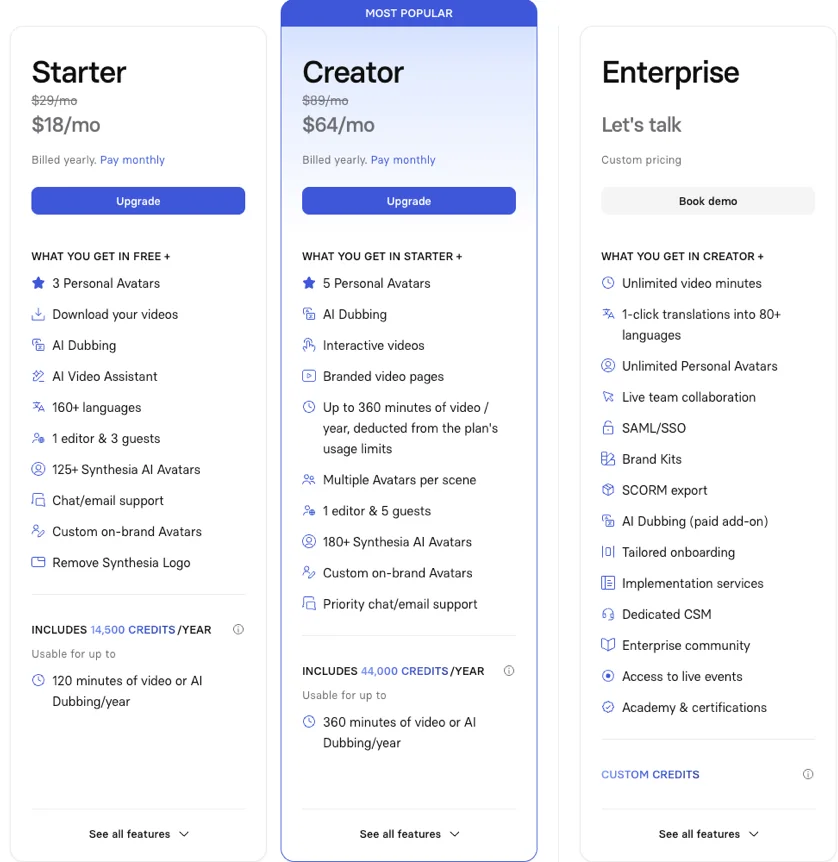
That per-minute math is fine for occasional use and painful at volume, which is what sends most people looking. The other common gripe is speed: Synthesia moderates both your script and the finished video before releasing it, so a short clip that takes HeyGen about a minute can take Synthesia four or five. That safety step is exactly why enterprises trust it, and exactly what feels like friction if you are not one. Below, each alternative is matched to a specific reason for leaving: cheaper, more lifelike, training-focused, ad-focused, real-time, or developer-first.
Before you shop, two things about how these tools charge will save you a headache. Nearly all of them, Synthesia included, sell you minutes or credits that reset every month, so a lower monthly fee attached to fewer minutes can quietly cost more per finished video than Synthesia did. Work out your real cost per minute at the volume you actually publish, not the number on the pricing page.
The second is that a free plan is not a free tool. Vidnoz, HeyGen, Colossyan, and Creatify all stamp a watermark on free output and usually lock the download, the same wall that pushed you off Synthesia’s free tier. Use a free plan to judge avatar quality, then expect to pay to ship anything. With those two in mind, the six picks sort cleanly by the reason you left.
The short version
- Best overall / most lifelike: HeyGen — more expressive avatars, one-minute renders, from $29/mo.
- Best for training and LMS: Colossyan — SCORM and quizzes without Synthesia’s Enterprise price.
- Best free / cheapest: Vidnoz — three-minute renders and 1,800+ avatars at no cost.
- Best for UGC ads: Creatify — URL-to-video and batch ad production.
- Best for real-time video: Tavus — avatars you talk to, not script.
- Best for developers: D-ID — API-first, photo-to-video, from $4.70/mo.
How did we choose these Synthesia alternatives?
There is no single best Synthesia alternative, because “best” depends entirely on which of Synthesia’s limits pushed you out. Someone leaving over price wants a different tool than someone leaving because the avatars feel stiff, and both want something different from a training team that just needs SCORM without the Enterprise invoice. So we scored these tools against the specific reason people leave.
Three criteria did the sorting. Avatar realism and speed, because “the avatars look corporate” and “renders take five minutes” are the two most common quality complaints, and HeyGen in particular has pulled ahead here. Real cost per finished minute, not the sticker price, because Synthesia’s whole pain point is per-minute metering and a cheaper-looking plan with tighter minutes can cost more. The job, because scripted avatars, conversational video, and course authoring are three different categories that do not belong on one leaderboard.
We tested three of these tools hands-on: HeyGen, Tavus, and Synthesia itself each got a full review on this site, with real clips generated and dashboards captured. The other three, Colossyan, Creatify, and D-ID, we assessed from their pricing pages, feature docs, and aggregate ratings, and we flag which is which as we go. This is a sibling to our HeyGen alternatives guide, written from the opposite direction.
Synthesia alternatives compared
| Tool | Best for | Free plan | Starts at | vs Synthesia |
|---|---|---|---|---|
| HeyGen | Lifelike avatars, speed | Yes (watermark, no download) | $29/mo | More expressive, faster, cheaper |
| Colossyan | Training, LMS, SCORM | Yes (20 min/mo) | $59/mo | SCORM without the Enterprise price |
| Vidnoz | A usable free tier | Yes (3-min, 720p) | Credit-based | Free output you can actually keep |
| Creatify | UGC-style ads at scale | Yes (10 credits) | $39/mo | Built for ads, not corporate video |
| Tavus | Real-time conversation | Yes (~20 min) | $22/mo | A different category entirely |
| D-ID | Developers, photo-to-video | Free trial (watermark) | $4.70/mo | API-first and much cheaper entry |
1. HeyGen — best overall replacement

If you left Synthesia because the avatars felt a little lifeless or the renders dragged, HeyGen is the fix. It is the same core job (type a script, get a talking-avatar video) done with some of the most lifelike output you can buy. In our hands-on HeyGen review it scored 4.3, and its newer Avatar IV and V engines produce expressive delivery, natural gestures, and lip-sync that passes at a glance.
Two differences hit you immediately. Speed: HeyGen returned a clip in about a minute in our test, where Synthesia’s moderated pipeline took four to five. And realism: HeyGen holds a 4.8 on G2 across 1,500-plus reviews as of July 2026, the highest G2 score among the avatar tools here.

Pricing starts at $29 a month for Creator (600 credits, 1080p, watermark removed), rising to $49 Pro and $149 Business. That undercuts Synthesia’s $64 Creator tier. The credit math is the thing to watch, since the premium Avatar IV and V engines burn 20 credits a minute, so 600 credits is about 30 minutes of top-tier video, while the older Avatar III engine costs 3 credits a minute and stretches much further.
One honest weak spot: HeyGen’s built-in AI voices are the least impressive part of the product, and many creators pair its visuals with audio from a dedicated voice tool like ElevenLabs. Its video translation and dubbing, on the other hand, are rated among the best in the category, so it doubles as a localization tool.
The one place Synthesia still wins is governance: HeyGen has lighter enterprise controls, no content moderation on every render, so if you left for cost or realism it is the clear upgrade, but if you left over compliance and brand safety you may not find it here.
| The good | The catch |
|---|---|
| Most lifelike avatars; 4.8 on G2 | Lighter enterprise governance than Synthesia |
| ~1-minute renders vs Synthesia’s ~5 | Premium engines burn 20 credits/min |
| Cheaper entry ($29 vs $64) | Free plan still watermarks and blocks download |
Who it’s for: anyone who left Synthesia for more lifelike avatars, faster renders, or a lower bill, and who does not need heavy enterprise governance.
2. Colossyan — best for training and LMS

Plenty of people use Synthesia for one thing: training video that has to land in an LMS. If that is you, Colossyan does the same job and puts the features you need on a cheaper plan. It is built for instruction, with branching scenarios, in-video knowledge-check quizzes, and SCORM export that drops a finished video straight into a learning management system.
Here is the money detail: Synthesia gates SCORM export behind its custom-priced Enterprise tier, while Colossyan includes SCORM on its $59-a-month Professional plan (billed yearly). For a training team that left Synthesia because the LMS features cost too much, that is the entire argument. You get the interactive course-building Synthesia charges enterprise rates for, at a self-serve price.
The branching and quiz features are the real differentiator. A learner can pick an option mid-video and be routed down a different path, answer a knowledge check that gets scored, and have the whole thing exported as a SCORM package the LMS tracks. That is course authoring, not just video generation, and it is why L&D teams reach for it over the bigger avatar names.
It is no slouch on video either, with a 4.6 on G2 as of July 2026, two avatar engines (its standard NEO and the more lifelike NEO2), and auto-translation across 120-plus languages. The free Starter tier gives 20 minutes a month with a 14-day trial that needs no card, and Professional adds watermark removal, unlimited MP4 downloads, and up to three editors at $30 each. Unlimited SCORM, SSO, and SOC 2 Type II sit on custom Enterprise, but the point is that the everyday training features arrive far earlier than they do on Synthesia.
| The good | The catch |
|---|---|
| SCORM + quizzes on the $59 plan, not Enterprise | Pricier entry than a pure avatar tool |
| Built for L&D, not repurposed for it | Fewer languages than Synthesia’s 160+ |
| 4.6 on G2, 14-day trial, no card | Overkill if you do not need training features |
Who it’s for: L&D teams that used Synthesia mainly for LMS-bound training and want SCORM and quizzes without paying Enterprise rates.
3. Vidnoz — best free and cheapest

If you left Synthesia purely because the bill got out of hand, start here. Vidnoz runs the most generous free tier on this list: up to three minutes per render, 720p export, and a library of 1,800-plus avatars, 3,200-plus templates, and hundreds of voices you can use without paying. Where Synthesia’s free plan stamps a watermark and locks the download, Vidnoz actually lets you make something usable for nothing.
It is still a preview tier, so free clips carry a watermark and top out at 720p. But for doing real work at zero cost it stretches further than anything else here, and even its paid credit plans sit well under Synthesia’s per-minute rate.
Realism is the trade. We ran Synthesia and HeyGen ourselves but not Vidnoz, and by most accounts its avatars land a notch below their newest engines, better than free has any right to be, but short of broadcast. Paid plans move you to 1080p, drop the watermark, allow 60-minute videos, and add voice cloning and translation on the Business tier. Credits reset every month with no rollover, so buy for the volume you will genuinely use.
| The good | The catch |
|---|---|
| Free tier renders 3-min clips at 720p, no card | Watermark and 720p ceiling on free output |
| Credit plans undercut Synthesia’s per-minute rate | Realism a notch below Synthesia and HeyGen |
| 1,800+ avatars; voice clone and translation paid | Monthly credits expire with no rollover |
Who it’s for: budget-driven creators who left Synthesia over cost and value a usable free tier and avatar volume over top-end realism.
4. Creatify — best for UGC-style ads

Some people try to make ads in Synthesia and find it is the wrong shape. Creatify is built for exactly that job. Paste a product URL and it writes a script and generates a video ad; run it in batch and it produces dozens of variants; then it exports straight to ad platforms with a built-in launcher and tracker.
The library is built for output, not for one hero video: hundreds of AI actors (300 on the entry plan, 1,500-plus on Pro) and templates deliberately styled to look like a real person filmed it on their phone. That scrappy, native look is what converts on TikTok and Reels, and it is a world away from a Synthesia presenter reading a corporate script.
Pricing runs from a free tier (10 credits, watermarked) to Starter at $39 a month (100 credits) and Pro at $99 (300 credits, the popular plan, five seats, and the ad launcher). One credit is roughly one video, so a marketer testing a dozen hooks a week burns through Starter fast and really lives on Pro. Enterprise layers on a done-for-you studio, white-labeling, and API discounts.
| The good | The catch |
|---|---|
| Made for UGC-style ad output at volume | Not the tool for one polished spokesperson |
| URL-to-video, batch runs, ad-platform export | One credit per video; testing drains them |
| 300–1,500 AI actors, native-looking templates | Free tier is 10 watermarked credits |
Who it’s for: performance marketers producing UGC-style video ads in volume, who need batch output and ad-platform exports more than a polished presenter.
5. Tavus — best for real-time video

Tavus is the outlier here, and that is the point. It does not make scripted talking-head videos at all. It builds conversational video: real-time, two-way AI agents with a face and voice that you can actually talk to, like a video call with software. If you were bending Synthesia toward something interactive, this is the tool that actually does it.
In our hands-on Tavus review it scored 4.0. I held a live conversation with “Charlie,” its onboarding agent, and the real-time video was the closest thing to talking to a person I have tested, rendered by its Phoenix-4 model.

The caveats are real. It is still in beta, and my own first call dropped before it reconnected. It is built API-first for developers: you spec a persona (a PAL, in Tavus’s terms) and its goals, though a no-code builder will now assemble one for you. And it bills by the conversational minute with pay-as-you-go overage and a 30-second floor on every call, so lots of short sessions add up faster than the plan number suggests. Pricing runs from free (about 20 minutes) through $22 Starter and $59 Builder to Growth and Business for heavier use.
| The good | The catch |
|---|---|
| Real-time two-way video nothing scripted matches | Beta; a call dropped mid-test |
| Phoenix-4 rendering, API-first, no-code builder | Overkill for a plain scripted clip |
| Whitelabeled APIs even on the free plan | 30-sec minimum per call, plus overage |
Who it’s for: developers and product teams building real-time conversational agents, not anyone who only needs a scripted talking-head clip.
6. D-ID — best for developers

If you were pushing Synthesia toward something embedded, avatars inside your own product rather than videos in a dashboard, D-ID is the tool shaped for that, and its entry price is the lowest here. Its original trick is turning a single still photo into a talking head, and its API and SDK are mature enough to sit under avatar features in plenty of other apps. It does real-time interactive avatars too.
For a developer the API-first design is the whole appeal: hand an endpoint a photo and a script or audio stream, get a rendered talking head back to drop in anywhere. That suits the case where the avatar is a feature of what you are building, not the finished deliverable. Realism is the trade, and independent reviews put its output a touch stiffer than HeyGen’s newest engines, especially on body movement, so treat it as a precision tool rather than the most lifelike face on the market.
Studio pricing opens with a free trial (3 minutes, full-screen watermark), then Lite at $4.70 a month, Pro at $16, and Advanced at $108, all billed annually, up to custom Enterprise. Each tier buys tight monthly minutes (10, 15, and 100) that do not roll over, and API usage is metered separately.
| The good | The catch |
|---|---|
| Lowest entry price here ($4.70/mo), mature API | Stiffer avatars than HeyGen’s top engines |
| Turns one still photo into a talking head | Tight minute caps, 10 to 100 by tier |
| Offers real-time interactive avatars | Minutes expire; trial is watermarked |
Who it’s for: developers embedding avatars via API, and anyone turning a specific photo into a talking presenter at the lowest entry price here.
Which Synthesia alternative should you pick?
Name the reason you left Synthesia and the choice narrows to one.
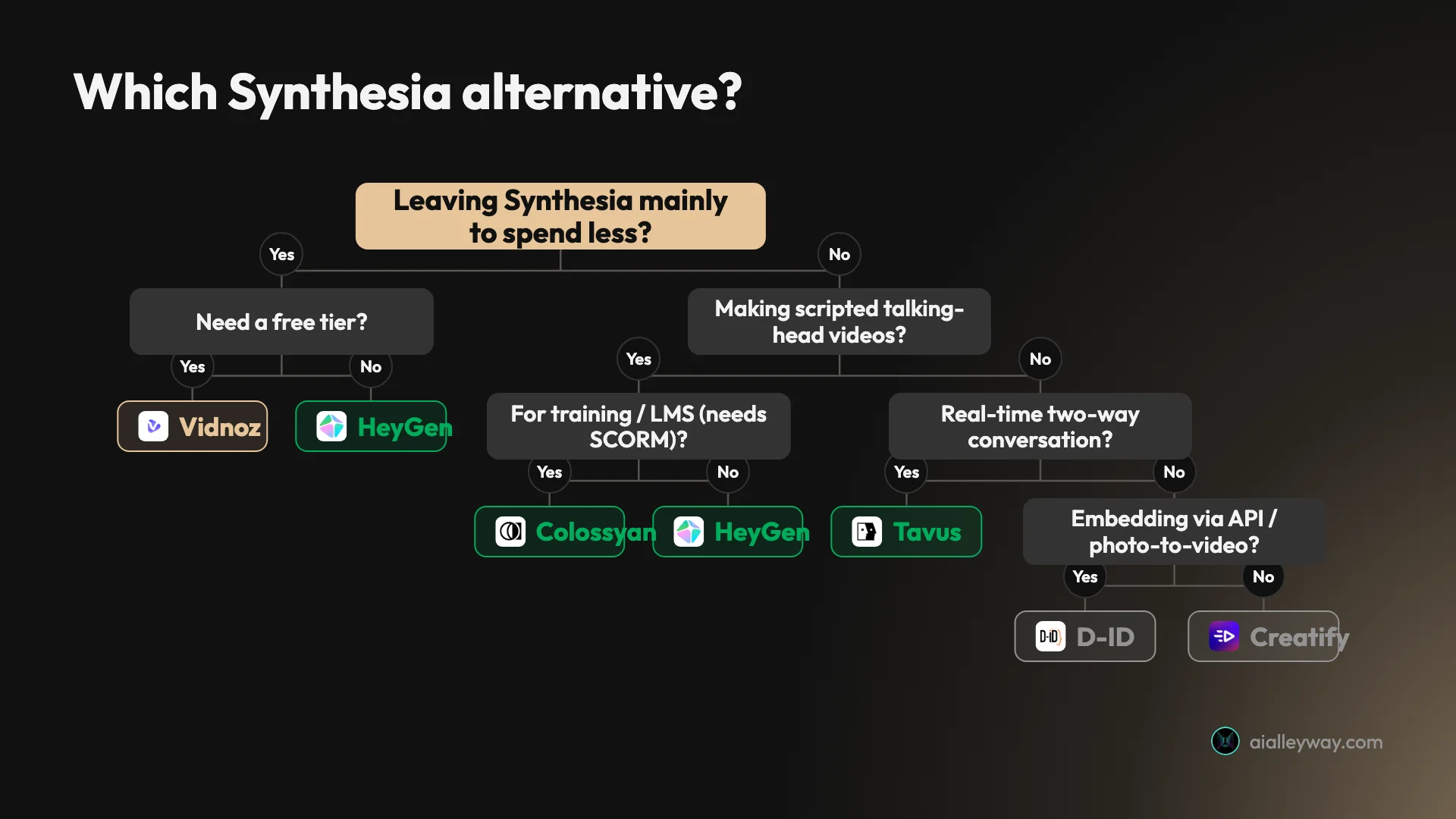
- You want more lifelike avatars or faster renders: pick HeyGen, the closest upgrade.
- You left over price and want a free ride: pick Vidnoz for the most usable free tier.
- You only needed training video and SCORM: pick Colossyan for LMS features without the Enterprise invoice.
- You are making ads at volume: pick Creatify for batch, URL-to-video, and ad exports.
- You want real-time, interactive video: pick Tavus.
- You are a developer embedding avatars: pick D-ID for its API and low entry price.
- You need enterprise governance and 160+ languages: you may want to stay on Synthesia; that is the one thing none of these fully replaces.
Tools on the same branch are genuinely swappable for that job, so break the tie on what you touch every day: the cost at your real monthly minute count, the languages you publish in, and how much of Synthesia’s governance you were actually using. Whatever branch you land on, spend the free tier before you enter a card. They all have one, and thirty minutes in the editor tells you more than any table here, mine included.
Final word
There is no single best Synthesia alternative, only the best one for the reason you walked. For most people that is HeyGen, more lifelike and cheaper, covered in full in our HeyGen review; if it was the training bill, Colossyan; if it was any bill, Vidnoz; if you wanted real conversation, Tavus. Name what pushed you out, and the replacement picks itself.
Frequently asked questions
What is the best Synthesia alternative overall?
HeyGen, for most people leaving Synthesia. It makes more lifelike, expressive avatars, renders in about a minute where Synthesia takes four or five, and its Creator plan starts at $29 a month. It holds a 4.8 on G2, the highest avatar-quality score in the category.
The trade is that HeyGen is creator-first rather than enterprise-first, so it has lighter governance than Synthesia's SSO, SCORM, and content moderation. If you left Synthesia for more natural avatars or a faster workflow, HeyGen is the upgrade. If you left purely to spend less, look at Vidnoz's free tier or Colossyan for training.
Is there a cheaper alternative to Synthesia?
Yes, several. Synthesia's real cost is per minute (its $64 Creator plan works out to about $2 for every finished minute), which is what pushes most people to look. Vidnoz has the most generous free tier and low-cost credit plans, and D-ID's Lite plan starts at $4.70 a month.
For paid avatar video with a proper workflow, HeyGen's $29 Creator plan undercuts Synthesia's $64 Creator tier while producing more lifelike output. The catch with the cheapest options is always minutes and watermarks, so map your real monthly output against each plan's allowance before you switch.
What is the best free Synthesia alternative?
Vidnoz has the most usable free plan of the tools here. It lets you render up to three minutes per video, exports at 720p, and opens up more than 1,800 avatars without paying, where Synthesia's free plan watermarks the result and blocks the download entirely.
Vidnoz's free output still carries a watermark and caps at 720p, so it is a preview tier like everyone else's, just a more generous one. If you only need to test avatar quality before committing, it lets you do more for free than Synthesia or HeyGen.
Which Synthesia alternative is best for training and LMS/SCORM?
Colossyan, the one tool here built specifically for learning and development. It has branching scenarios, in-video knowledge-check quizzes, and SCORM export that drops a finished video straight into a learning management system.
Synthesia also does SCORM, but only on its custom-priced Enterprise tier, whereas Colossyan puts SCORM export on its $59 Professional plan. If you left Synthesia because the training features you needed were locked behind Enterprise pricing, Colossyan is the more affordable route to the same LMS workflow.
Is HeyGen better than Synthesia?
For lifelike avatars and speed, yes; for enterprise governance, no. In our hands-on tests HeyGen produced more expressive, natural avatars and rendered a clip in about a minute, while Synthesia's moderated pipeline took four to five. HeyGen also starts cheaper at $29 versus $64 for a comparable Synthesia plan.
Synthesia wins on the enterprise side: content moderation that screens every video, SSO, SCORM, and 160-plus languages make it the safer choice for a company standardizing training at scale. Different buyers. If avatar quality and cost are your priorities, HeyGen; if governance is, stay closer to Synthesia.
Should I leave Synthesia at all?
Not always. If you need enterprise governance (content moderation on every render, SSO, SCORM) or the widest language coverage, Synthesia earns its price and no cheaper tool fully replaces it. Switching to save money can cost you the exact features you were paying for.
The reasons that do justify leaving are concrete: the per-minute cost is too high for your volume, you want more lifelike or expressive avatars (HeyGen), you only need training video and Enterprise pricing is overkill (Colossyan), or you want a usable free tier (Vidnoz). Match the switch to the reason and you will not trade one set of limits for another.
Keep reading
Best AI avatar generator: our picks for every use case
We tested the top AI avatar generators. Synthesia (4.6) wins for enterprise, HeyGen for creators, Tavus for live conversation. The best one for your use case.
Synthesia review: the enterprise standard, at a price
I made a real avatar video on Synthesia's free plan. The output is enterprise-clean, but you can't download it and the minutes run out fast. Who should pay.
HeyGen alternatives: the best one depends on why you left
Leaving HeyGen? The best HeyGen alternative isn't one tool: Synthesia (4.6 on G2) for training, Creatify for ads, Tavus for real-time, plus 3 more by job.
Synthesia pricing: what the minutes really cost
Synthesia starts at $18/mo, but it meters by video minutes, and they're tight: Starter is about 10 minutes a month at roughly $2 a minute. Here's the math.