
Higgsfield pricing: what a credit actually costs you
Higgsfield pricing read off the live page: $15 to $270 a month solo, $65 a seat for teams, and the plan that looks cheapest is the worst value per credit.
Contents
How much does Higgsfield cost?

Most solo users want Higgsfield Plus at $39 a month billed annually, which buys 1,000 credits and the full Seedance line-up. Starter at $15 is the only tier that takes no annual discount at all and cannot run Seedance 2.0 or 2.5, so it tests very little. Teams should look hard before buying a team plan: Team costs $65 a seat, which is more than double Ultra’s rate at the top of its slider and still dearer than Ultra’s entry tier.
| Plan | Credits / month | Billed annually | Billed monthly |
|---|---|---|---|
| Starter | 200 | $15 | $15 |
| Plus | 1,000 | $39 | $49 |
| Ultra | 3,000 | $99 | $129 |
| Ultra | 6,000 | $194 | $220, renews $250 |
| Ultra | 9,000 | $270 | $310, renews $375 |
| Team | 1,000 per seat | $65 per seat | $69, renews $79 |
| Scale | 2,500 per seat | $150 per seat | $169 |
| Enterprise | custom | contact sales | — |
Every Higgsfield pricing figure here was read off the live page on 21 September 2026. Prices exclude VAT and local taxes, which the page states in a footnote and adds at checkout.
It is worth knowing why published figures for this tool disagree so wildly. Higgsfield draws its price cards entirely in JavaScript, roughly five seconds after the page opens, and the HTML underneath carries nothing — no tiers, no numbers. Any tool that reads the markup without executing it comes away empty, which is the likeliest reason so many write-ups quote figures Higgsfield no longer charges.
These are calculations against Higgsfield’s published rates rather than generations I ran. For whether the shelf is worth buying at all — on breadth, disclosure and billing behaviour — see the Higgsfield AI review. This guide covers what it costs.
How do Higgsfield credits work?
One currency runs the whole platform. Video, images and lip-sync all draw on the same monthly credit balance, and each model charges a published rate per generation that varies by resolution and duration.
That design is why the plan names tell you almost nothing. A 1,000-credit month is a lot of images and very little 4K video, because Higgsfield Soul 2.0 costs 0.12 credits an image while five seconds of Seedance 2.0 at 4K costs about 110. One subscription is either a few thousand stills or well under a minute of premium video, depending entirely on which you point it at.
Four rules govern the balance itself, and the first two are the ones that cost money. Credits do not roll over, and on an annual plan the cycle that expires them is 30 days from your subscription start date, not the year you paid for. So an annual plan is twelve separate allowances with twelve separate deadlines.
| The rule | What it means for your balance |
|---|---|
| Credits do not roll over | Anything unused expires at the end of the cycle |
| The cycle is 30 days | Counted from your start date, on annual plans too |
| Unlimited is not priority | Unlimited runs the standard queue; credits run the priority queue |
| Unlimited is site-only | Not available through MCP, CLI, Canvas or Supercomputer |
The other two concern “unlimited” models, which are a different thing from credits. Higgsfield’s own pricing FAQ states that unlimited generations run in the standard queue while credit-based generations always run in the priority queue, and that unlimited access works only on higgsfield.ai, not through MCP, CLI, Canvas or Supercomputer. Unlimited saves you credits. It does not make you faster.
One surface meters differently and it is the one worth knowing about. On Higgsfield Supercomputer the interface shows “the credit cost upfront — before anything renders. You approve the spend, then it generates.” The same FAQ answer notes that credits there are consumed by text requests as well as by generations, so the prompting itself is billable. It is the only surface that quotes before it spends, which is worth knowing if predictable billing matters more to you than raw speed.
Is there a Higgsfield free trial?
There is a free account, and it is a look rather than a workshop. New accounts get a small trial allotment of credits, and individual models carry their own free-generation allowances that appear in the create panel as a labelled toggle with the remaining count printed on it.
Two details decide how far that goes. The first is that the allowance moves with your billing term: flip the Plus card between annual and monthly and its free Genjutsu count changes by one, which the toggle never announces. And once the trial credits are gone, no monthly refill arrives. The app runs a persistent banner reading “Credits are running low! All credits used” with an Upgrade button, and that is the end of the free tier.
So the honest framing is that the free account exists to let you see the interface, the model picker and the published credit rates before paying, not to produce work. If you want to evaluate output quality before committing, the cheapest real test is a single month of Plus rather than the free tier, because Starter cannot run the Seedance models most people are evaluating.
What does each individual plan cost?
Here are the three individual plans on annual billing.
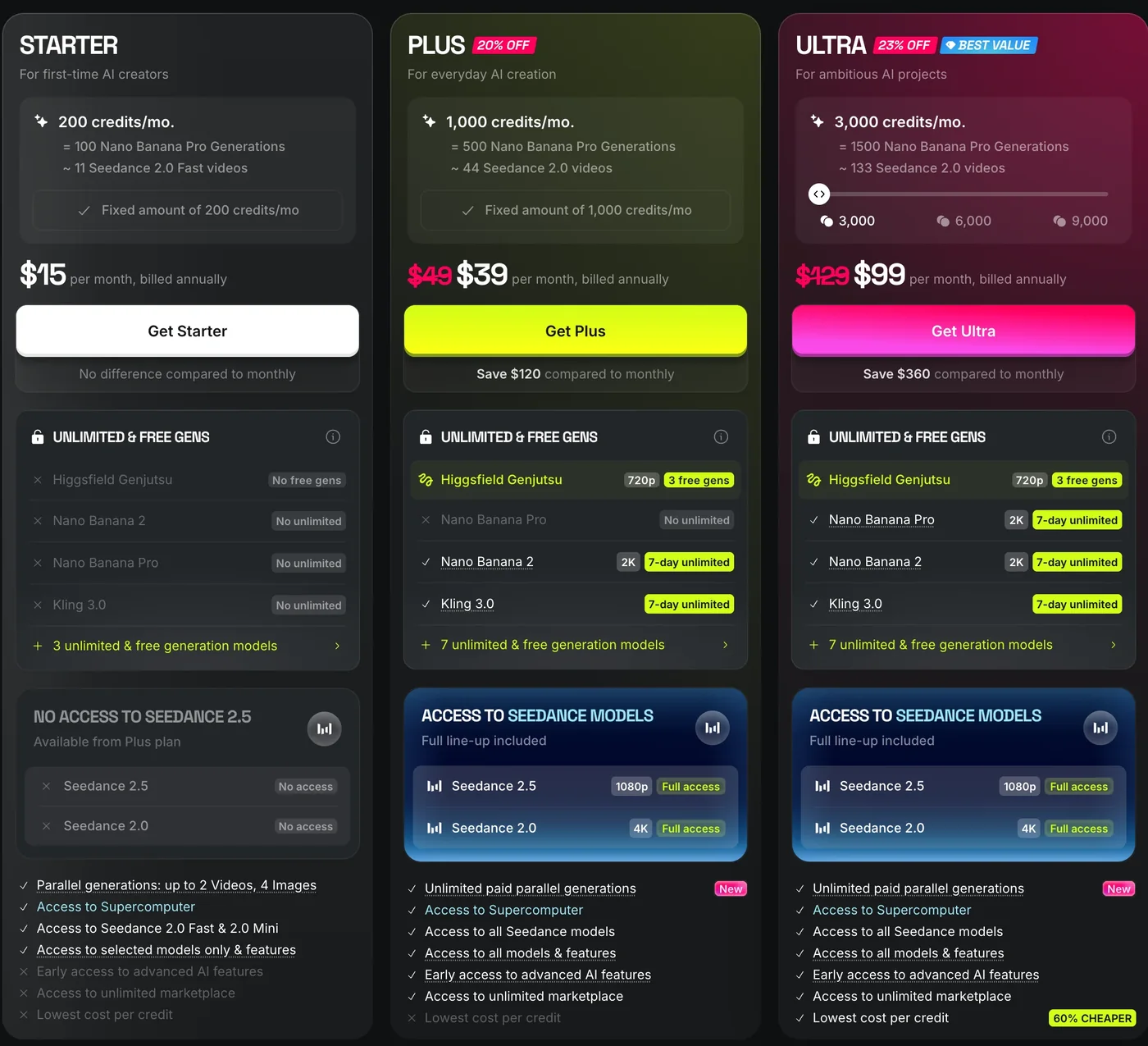
Starter — $15 a month, 200 credits
The cheapest plan is also the one that tells you least about the product. It takes no annual discount whatsoever, its own card reading “No difference compared to monthly”, and 200 credits at $15 works out at $0.075 a credit, the most expensive rate Higgsfield sells.
The gating is where it really fails as a trial. Seedance proper is off the menu entirely, leaving the Fast and Mini variants, and nothing on the plan carries an unlimited window. Two videos and four images is the ceiling on parallel work.
Plus — $39 a month annually, $49 monthly, 1,000 credits
This is the plan most people should buy. It is the first tier with the full Seedance line-up, including 2.5 at 1080p and 2.0 at 4K, and it opens the seven-day unlimited windows on Nano Banana 2 and Kling 3.0. Parallel work rises to 6 videos and 8 images.
At $39 for 1,000 credits it costs $0.039 a credit, a little over half Starter’s rate. The annual saving is $120 a year against the $49 monthly price, and unlike the larger Ultra tiers, both of those numbers are exactly what the page charges.
Ultra — $99 to $270 a month annually, 3,000 to 9,000 credits
Ultra is a slider rather than a single plan. It opens at 3,000 credits for $99 a month annually, then steps to 6,000 for $194 and 9,000 for $270. Per credit that runs $0.033, $0.032 and $0.030, so the discount for scale is real but it flattens quickly after the first step.
The two larger steps behave differently from everything else on the page. On monthly billing they open below the price they renew at: 6,000 credits opens at $220 and renews at $250, and 9,000 opens at $310 and renews at $375. Budget against the renewal figure, not the one on the button.
What do the Higgsfield team plans cost?
Switch to the Business tab and the pricing changes shape: per seat, with a credit pool shared across the workspace.
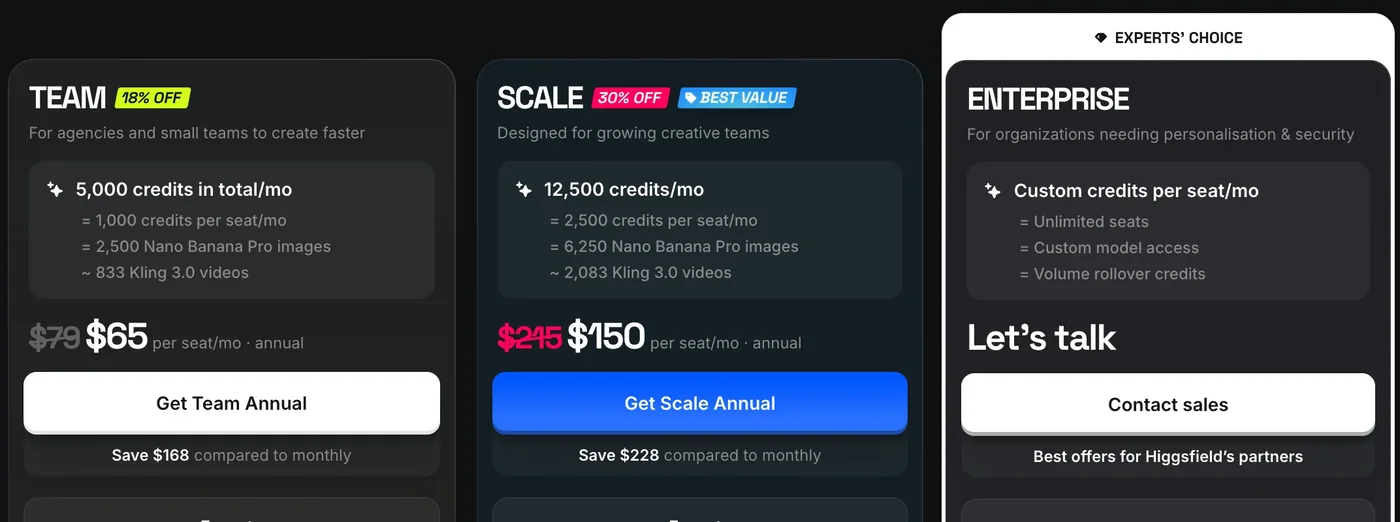
Team is $65 per seat per month on annual billing, struck through from $79, for 1,000 credits per seat pooled across the workspace. There is a two-seat minimum, so the smallest Team subscription is $130 a month for 2,000 pooled credits — against Ultra’s $99 for 3,000. It covers 2 to 9 members, runs 16 concurrent jobs, and carries admin spend control, SSO, delegated top-up access, indemnification and a no-training-on-your-data commitment. It has no unlimited models at all.
Scale is $150 per seat annually for 2,500 credits per seat, covering 5 to 15 members with 32 concurrent jobs, and it does include the seven-day unlimited windows on Nano Banana Pro, Seedream 5.0 Pro and Kling 3.0.
Enterprise is quote-only, and the only tier advertising volume rollover credits, which is notable given that every other plan expires them.
Why a team seat costs more per credit
This is the finding that surprised me most, and it runs against how these ladders usually work.
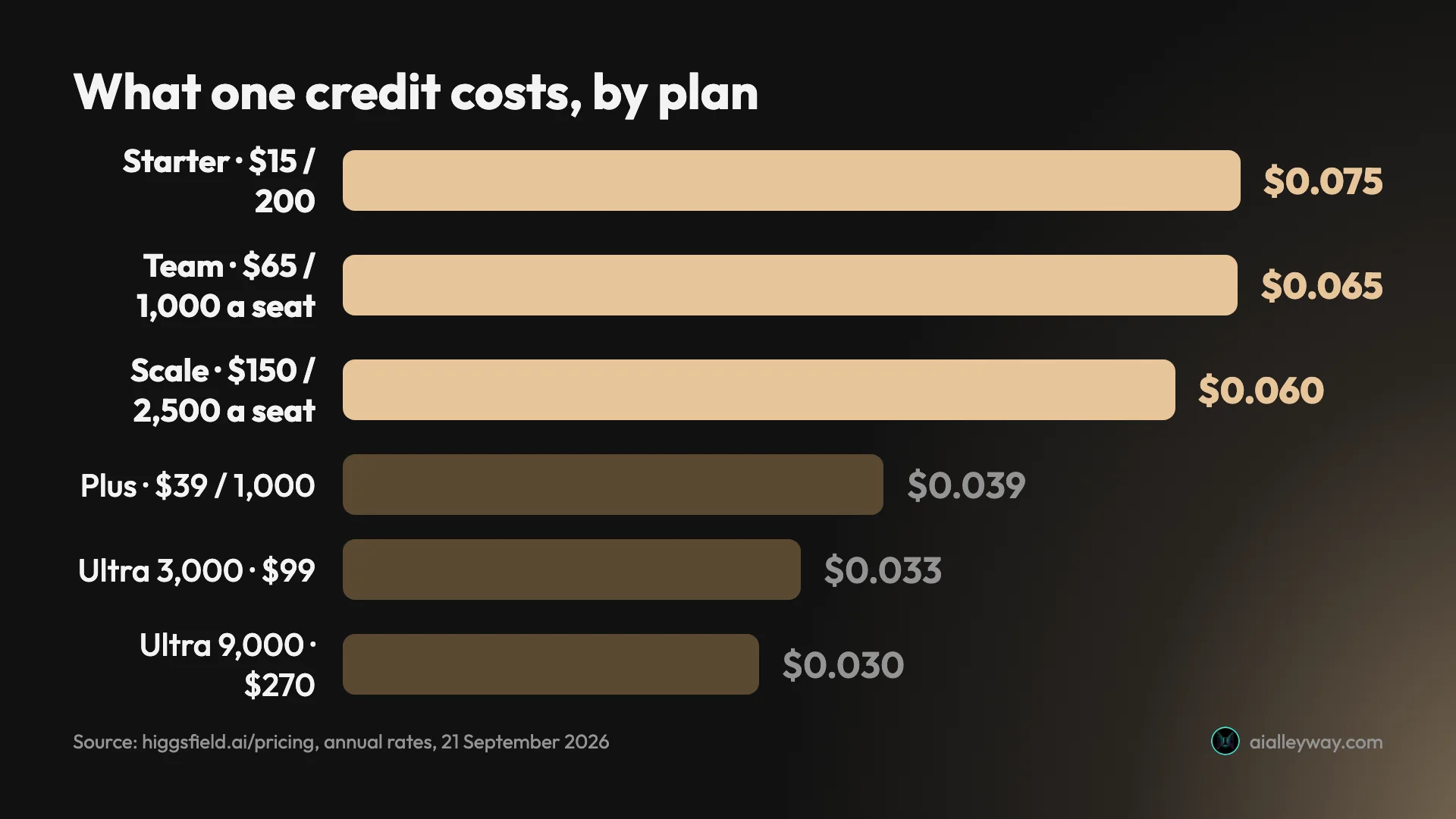
Team works out at $0.065 a credit and Scale at $0.060. Ultra at 9,000 credits is $0.030. A team seat therefore costs about twice what the top individual tier charges for the same credit, and Team is only about an eighth cheaper per credit than Starter, the entry plan.
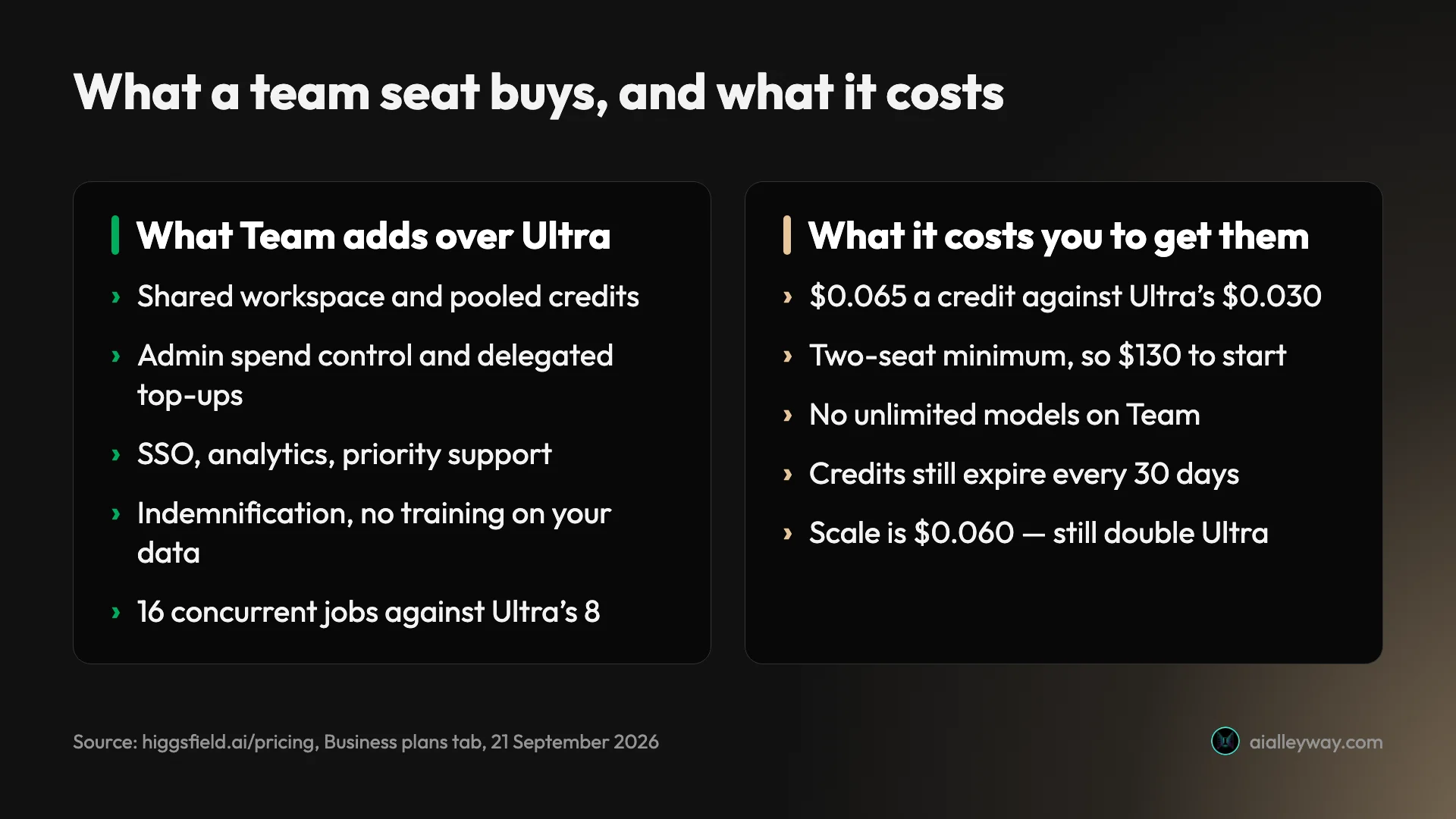
That is defensible pricing, as long as you know what you are buying. The team tiers sell governance: a pooled balance, spend controls, SSO, indemnification, higher concurrency and a contract. They do not sell cheaper generation. If your requirement is volume rather than administration, several Ultra subscriptions are the cheaper answer.
What does a month of Higgsfield credits buy?
Published rates make this arithmetic possible before you pay. Converted at the Plus annual rate of $0.039 a credit:
| Model and setting | Credits | Cost at the Plus rate |
|---|---|---|
| Higgsfield Soul 2.0 | 0.12 / image | $0.005 |
| Nano Banana Pro | 2 / image | $0.078 |
| Kling 3.0, 720p | ~7 / 5s | $0.27 |
| Wan 3.0, 720p | 8.75 / 5s | $0.34 |
| Google Veo 3.1 Fast, 720p | ~11 / 4s | $0.43 |
| Seedance 2.0, 720p | ~22 / 5s | $0.86 |
| Google Veo 3.1, 720p | ~29 / 4s | $1.13 |
| Seedance 2.0, 1080p | ~45 / 5s | $1.76 |
| Seedance 2.0, 4K | ~110 / 5s | $4.29 |
Images sit in another world entirely, and the rates fall below a single credit.
| Image model | Credits per image | Cost at Plus rate |
|---|---|---|
| Higgsfield Soul 2.0 | 0.12 | $0.005 |
| Higgsfield Soul | 0.25 | $0.010 |
| Reve | 0.25 | $0.010 |
| Wan 2.2 | 0.5 | $0.020 |
| Nano Banana | 1 | $0.039 |
| Seedream | 1 | $0.039 |
| Higgsfield Popcorn | 1.5 | $0.059 |
| Nano Banana Pro | 2 | $0.078 |
| Nano Banana Pro 4K | 4 | $0.156 |
Two things drive that spread, and neither is the model’s name. Resolution is the bigger lever: Seedance 2.0 costs about 22 credits per five seconds at 720p, about 45 at 1080p and about 110 at 4K, so the same shot at 4K costs roughly five times what it costs at 720p. Duration is the other, and it is charged in blocks rather than seconds, with most video models metered per 5 seconds and the Veo and Sora families per 4.
Concurrency quietly matters too, because it changes how you work rather than what you pay. Starter runs 2 video jobs at once, Plus runs 6 and Ultra runs 8. Parallel exploration is part of what the higher tiers are actually selling, and it is the one plan difference that changes how the work feels rather than what it costs.
Three worked examples, all on a Plus plan’s 1,000 credits a month.
A social creator posting daily stills. At 0.12 credits an image on Soul 2.0, a Plus month’s thousand credits is more than 8,000 images. Nobody posting daily will exhaust that. Starter is the open question: 200 credits is 1,666 Soul images if Starter reaches Soul, and 100 Nano Banana Pro images if it does not — roughly three a day, which is not enough for a daily poster.
A weekly short built from Kling 3.0. Four 30-second shorts a month, assembled from six five-second clips each, is 24 clips at roughly 7 credits, about 168 credits before any re-rolls. Even at three attempts per usable clip — a ratio I have not measured, and one nobody publishing on this tool has — that lands near 500 credits, comfortably inside Plus.
A premium 4K product spot. A single 30-second cut at Seedance 2.0 4K is six clips at about 110 credits, or 660 credits, and that assumes every shot works first time. One month of Plus buys roughly one finished spot with nothing left for revisions. This is the job Ultra exists for.
The pattern is that Higgsfield’s cheapest plans are generous for images and thin for video, and the gap between those two realities is the single biggest driver of what you should pay.
What happens when you run out of credits?
Four mechanics govern what happens after you have spent the month’s allowance, and Higgsfield’s FAQ is clear on all of them.
| Action | When it takes effect | What happens to credits |
|---|---|---|
| Buy a credit pack | Instantly | Added to the balance, usable on every supported model |
| Upgrade a plan | Immediately | The credit difference is applied to your account there and then |
| Downgrade a plan | End of the current period | Existing plan stays live until then |
| Cancel | End of the current period | Current cycle’s credits stay spendable until it ends |
Buying more. You can either upgrade the plan for a higher monthly limit or buy credit packs “to generate more media without changing your current subscription”. Purchased credits are added instantly and work across every supported model. One thing the FAQ does not say is whether pack credits carry the same 30-day fuse as subscription credits: the expiry rule is written specifically about subscription credits, and nothing on the page extends or exempts it. Until Higgsfield says otherwise, budget as though packs expire too.
Changing plans. Upgrades apply immediately with the credit difference added to your account, downgrades wait for the end of the period. Given that credits expire monthly regardless, immediate upgrades are the only sensible behaviour — but it does mean a downgrade decided in week one still costs you the full period.
The 365 Unlimited promo. Periodically Higgsfield runs a promotion granting a year of unlimited generations on the models listed on each plan card, and it stacks: every time the promo activates, active subscribers on eligible plans receive another twelve-month extension. The terms cut one way, though. Upgrade and the unlimited access continues for the full year; cancel or move to a lower plan that does not include it and access “stops immediately when your current plan ends”. The promo tracks the subscription, not the calendar.
Annual or monthly?
As shown above, annual wins on every plan except Starter. The more interesting question is when it should not.
The case for staying monthly is the expiry rule rather than the price. Because credits reset every 30 days regardless of billing term, an annual commitment does not bank capacity — it only locks the rate. If your workload is seasonal or uncertain, monthly costs more per credit but lets you stop paying during the months you would have forfeited the allowance anyway.
What to watch in Higgsfield’s pricing before you subscribe
The discount badges do not always match the prices
Ultra’s larger tiers strike through prices the page does not charge, and Scale’s card is the clearest example on the site. It strikes $245, but neither of its badges is computable from $245: 30% off arrives at $150 and 22% off arrives at $169, both implying a reference price around $215. Its “Save $228” line, meanwhile, is exactly (169 − 150) × 12, computed from the monthly price it actually charges.
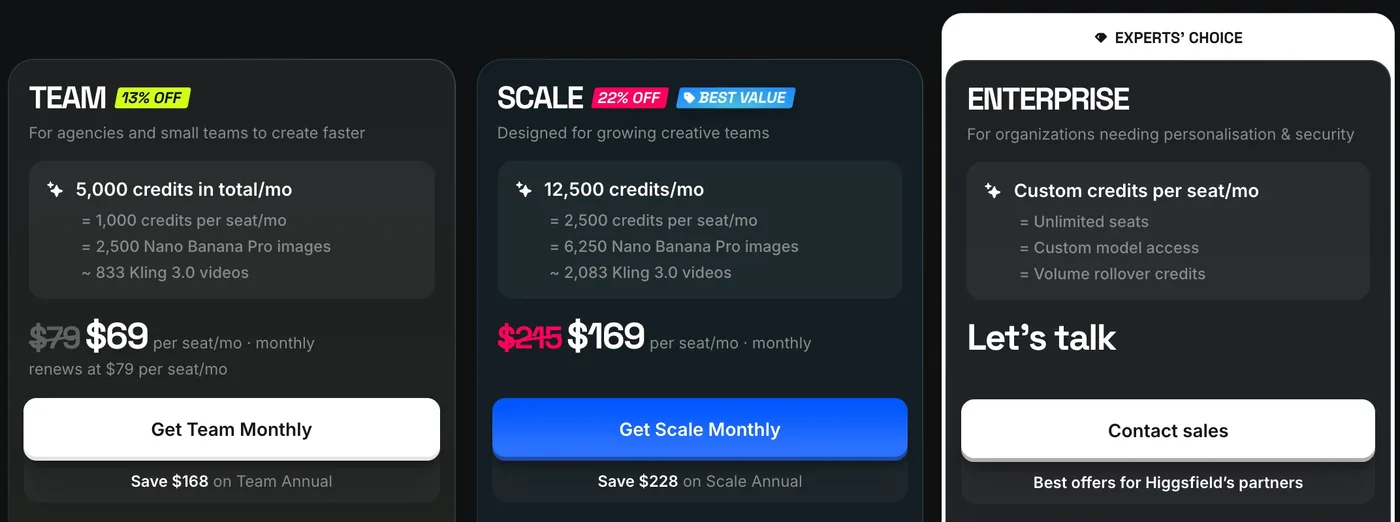
Team, for contrast, reconciles cleanly: $79 struck, $65 annually, and (79 − 65) × 12 is exactly the $168 saving it claims. When a card’s own arithmetic checks out, you can trust the badge. When it does not, work from the renewal price.
Credits expire every 30 days, annual plans included
Paying for a year does not buy a year of credits; it buys twelve monthly allowances on a rolling 30-day cycle from your start date. There is no rollover on any plan except Enterprise, which advertises volume rollover as a feature.
”Unlimited” is the slow lane
Higgsfield’s FAQ is explicit: unlimited generations run in the standard queue, credit-based generations always run in the priority queue, and you can switch to Credit Mode to “bypass the standard queue and return to maximum speed instantly.” Unlimited also excludes MCP, CLI, Canvas and Supercomputer, so it does nothing for an automated pipeline.
The cheap plans people quote do not exist
Google’s AI Overview describes a Basic tier at $5 to $9 a month and a Business plan at $62 to $71 a seat, and several write-ups repeat both. Neither appears anywhere on the live page. The individual tiers are Starter, Plus and Ultra; the business tiers are Team, Scale and Enterprise. If a page is quoting you $9, it is quoting something Higgsfield no longer sells.
Prices exclude tax, and renewals are automatic
VAT and local taxes are added at checkout rather than shown on the cards, so the headline figure is not the charge. Subscriptions also renew automatically, which the FAQ confirms, and cancellation has to be deliberate: the plan stays live until the end of the current period and then stops.
Which Higgsfield plan should you buy?
- Image-led work: Starter at $15, with one thing to check first. Its card promises 100 Nano Banana Pro generations from 200 credits, and the video gating that cripples it for filmmakers is irrelevant to you. Whether it also reaches Higgsfield Soul 2.0 at 0.12 credits an image is the difference between 100 images a month and over 1,600, and I could not confirm Starter’s access to Soul from the plan cards. Check the comparison table before you buy on that basis.
- Most video creators: Plus at $39 annually. It is the first plan with the full Seedance line-up, the credit rate drops by nearly half against Starter, and its discount maths is the only one on the page that is uncomplicated.
- Heavy or 4K video: Ultra, starting at $99 for 3,000 credits. One 4K spot can eat two thirds of a Plus month, so if premium video is the job, the step up pays for itself in re-rolls alone.
- Agencies that need controls: Team or Scale, with eyes open. You are buying SSO, spend control, a pooled balance and indemnification at roughly double Ultra’s credit rate. Worth it for procurement and governance, not for volume.
- Skip this if your usage is lumpy. No plan below Enterprise lets unused capacity carry forward, so a quiet month is simply money spent on nothing.
If the credit maths does not work
Three models on the shelf are cheaper bought on their own, and the gap is large enough to matter if you only ever reach for one of them. Our Higgsfield alternatives roundup ranks seven of them on tested output, and owns the full per-clip comparison.
Kling AI is the model most Higgsfield users are reaching for, and it is around 7 credits per 5 seconds at 720p inside Higgsfield. Bought direct it has its own billing and its full feature surface, which suits anyone who has already settled on it.
Seedance AI is the cheapest route to quality clips if you are willing to go direct. A 1080p Seedance 2.0 clip costs roughly $1.76 in Higgsfield credits against about $0.32 to $0.40 on ByteDance’s own Dreamina, which also wants a plan — our Seedance pricing guide has the detail, from a July 2026 read. That is about 4.4 times the clip price at the cheaper end of Dreamina’s range, and 5.5 at the dearer one.
Google Veo is worth buying on its own terms when synchronised audio matters, and it is one of the more expensive models to iterate on through an aggregator at about 29 credits per 4 seconds.
The bottom line
Higgsfield’s pricing is more honest than its presentation. The per-model credit rates are published in full before you spend anything, which is rarer than it should be, and the arithmetic they enable is the reason this guide can give you a cost per clip at all. What undermines it is a set of strike-through prices and badges that do not consistently reconcile, and a credit expiry rule that quietly resets an annual plan every 30 days.
Buy Plus if you are one person making video, Starter if you are making images, and Ultra if 4K is the job. Buy Team only if you need the admin controls enough to pay double for your credits, and whichever you choose, spend the allowance inside its 30 days.
Frequently asked questions
Is there a Higgsfield coupon code?
Not one worth chasing, and the discounting is already built into the page. Higgsfield runs a standing promotional rate rather than codes: on 21 September 2026 the billing toggle advertised 30% off annual — a label no individual plan actually reaches, which the review takes apart — Ultra's larger tiers opened below the price they renew at, and a banner offered a seven-day Nano Banana Pro and Kling 3.0 unlimited window on Ultra. Those apply without a code.
Worth knowing why you will not find one on a deals site either. The rules screen shown when signing up to Higgsfield's own affiliate programme forbids partners from posting its links to coupon or deal sites, from bidding on its brand name in search, and from advertising discounts it has not authorised. So the coupon pages you will find are either recycling the public promotional rate or sending you somewhere that breaches those terms. Check the toggle and the slider on the pricing page instead.
Does Higgsfield have a Basic plan?
No. Read live on 21 September 2026, the individual plans are Starter, Plus and Ultra, and the business plans are Team, Scale and Enterprise. There is no Basic tier and no plan at $5 or $9 a month.
This matters because the claim is everywhere. Google's AI Overview describes a Basic tier at $5 to $9 with 70 to 120 credits, and several write-ups repeat it alongside a Business plan at $62 to $71 a seat. Neither figure appears anywhere on the live pricing page. Some of it looks like older tiers that have since been retired, and some of it looks like one page copying another. If you are budgeting against a $9 Higgsfield plan, the cheapest thing it actually sells is Starter at $15.
Is the Higgsfield Team plan cheaper than Ultra?
No, and it is not close. Team costs $65 per seat per month on annual billing for 1,000 credits per seat, which works out at $0.065 a credit. Ultra at its 9,000-credit setting costs $270 a month for 9,000 credits, or $0.030 a credit. You pay more than twice as much per credit on the team plan.
That is not necessarily wrong, it is just not what the names suggest. Team and Scale buy a shared credit pool, admin spend control, SSO, delegated top-ups, indemnification and a contractual promise not to train on your data, plus 16 concurrent jobs on Team and 32 on Scale, against Ultra's 8. Those are governance and procurement features. If what you actually need is volume, Ultra is the cheaper purchase and the team tiers are the expensive way to get it.
How much does one Higgsfield video cost?
Between about 27 cents and $4.29 a clip, depending entirely on the model and resolution. At the Plus annual rate of $0.039 a credit, a five-second Kling 3.0 clip at 720p costs about 27 cents, a five-second Seedance 2.0 clip at 1080p costs about $1.76, and the same clip at 4K costs about $4.29. Images are cheaper by orders of magnitude: Higgsfield Soul 2.0 runs 0.12 credits an image, or about half a cent.
The number that actually matters is cost per usable shot, not cost per generation, and that depends on how many attempts your prompts take. Higgsfield publishes the per-model credit rates up front, so you can build your own estimate: take the rate for the model you plan to use, multiply by your typical attempts, and divide your plan's monthly credits by the result to see how many keepers a month buys.
What happens to my Higgsfield credits if I cancel?
Your plan stays active until the end of the period you have already paid for, and the credits inside the current 30-day cycle stay spendable until that cycle ends. Higgsfield's FAQ says you can cancel any time in account settings and the plan remains active until the end of the current period.
The part that catches people is what happens without cancelling. Subscription credits do not roll over: they expire at the end of each cycle, and on annual plans the cycle is 30 days from the subscription start date rather than the whole year. So an annual plan is twelve separate monthly allowances, and a quiet month is capacity you paid for and lost. Subscriptions also renew automatically, so cancelling has to be a deliberate act rather than something that happens by letting a plan lapse.
Keep reading
Higgsfield AI review: the 30% off that is never 30% off
A Higgsfield AI review: 15 video models on one credit balance, rated 4.0 — the breadth is real, the discount badges are not. Who it suits, and who should skip.
Seedance Pricing: What It Really Costs by Route
Seedance has no single price — it depends where you run it: ~$0.62 a 1080p clip on fal.ai, credits on Dreamina. Full route-by-route breakdown, tested hands-on.
The Best AI Video Generator for Every Kind of Video
The best AI video generator depends on the job. We tested 10 hands-on: Google Veo for generation, Synthesia for avatars, Fliki for script-to-video, and more.
Kling AI Review: The Best AI Video, and a Billing Problem
Kling AI makes some of the best AI video anywhere, but one free clip cost 60 of my 66 credits. My hands-on take on quality, credits, and trust issues.