
HeyGen pricing: what the credits really cost
HeyGen starts at $29/mo, but credits decide your real cost: 600 credits is 30 min of premium avatar or 200 on the cheaper engine. Here's the full breakdown.
Contents
How much does HeyGen cost?

HeyGen’s paid plans start at $29 a month for Creator ($24 annually), which gives you 600 credits a month. The catch is that those 600 credits are worth about 30 minutes of video on the premium avatars, or 200 on the cheaper engine, so the same plan can be cheap or expensive depending on what you generate. The free plan is $0 but hands you only one to three short, watermarked videos you cannot download; above Creator, Pro is $49 a month and Business is $149 plus $20 per seat.
That is the whole trap of HeyGen pricing: it does not meter in dollars or minutes, it meters in credits, and the credit number tells you far more than the price does. This guide is mostly about that math, because it is the difference between HeyGen being a bargain and HeyGen being expensive. All figures are current as of July 2026.
| Plan | Price / month | Credits | What you actually get |
|---|---|---|---|
| Free | $0 | None (video-count) | 1–3 short videos/mo, ~1 min each, watermark, no download in our test |
| Creator | $29 ($24 annual) | 600 | 1080p, voice cloning, 1 custom avatar, watermark removed |
| Pro | $49 | 1,000 | 4K export, script translation, more credits |
| Business | $149 + $20/seat | 1,500 | 5 custom avatars, SSO, teams, up to 60-min videos |
| Enterprise | Custom | Custom | Unlimited length, 10+ avatars, dedicated support |
How do HeyGen credits work?
Here is the mental model that makes every plan legible: on the paid tiers, HeyGen gives you a monthly bucket of credits, and generating video spends them by the minute. What changes the price is that different avatar engines burn credits at very different rates.
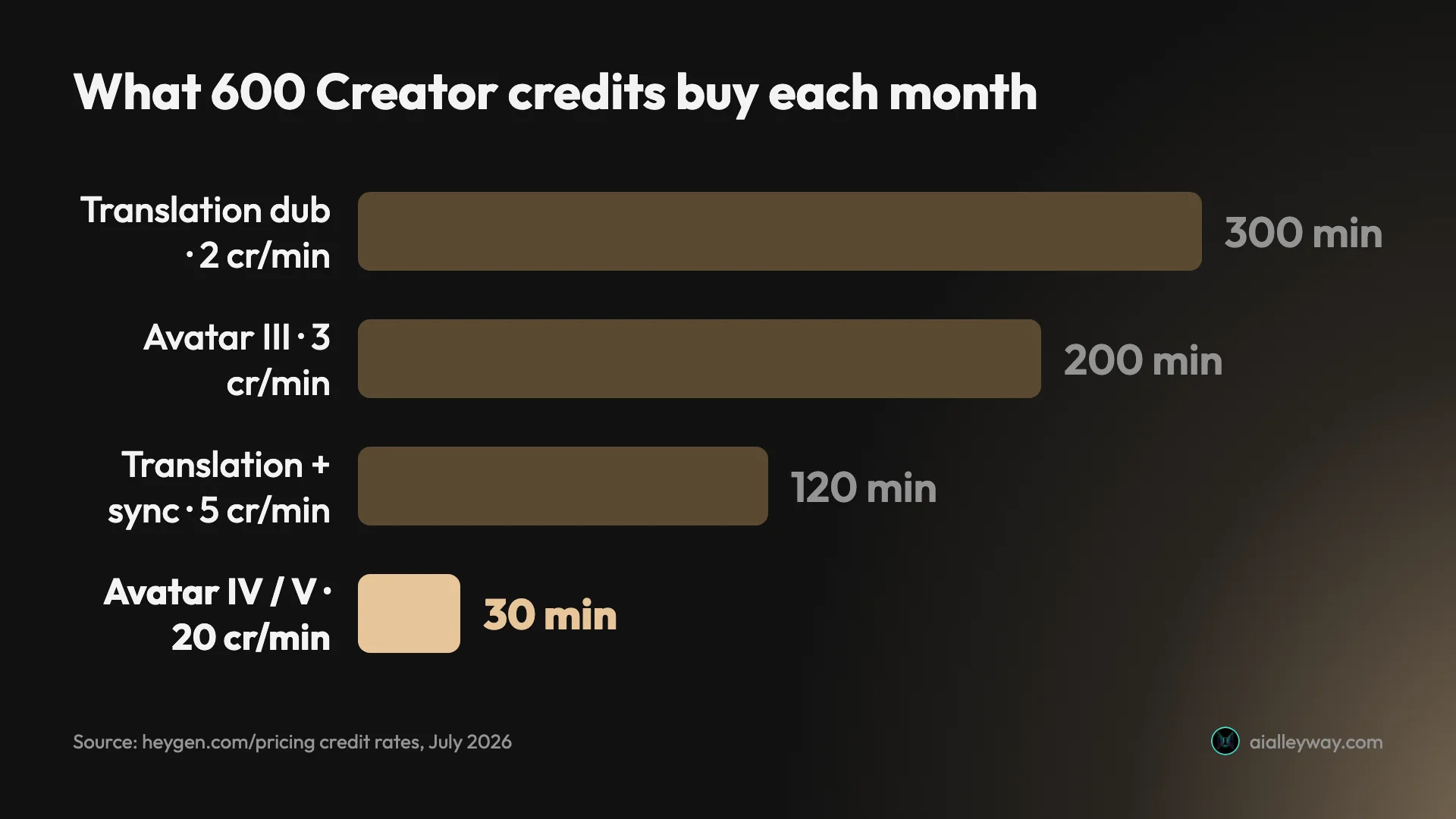
In our hands-on testing, the premium Avatar IV and V engines, the lifelike ones HeyGen is known for, cost about 20 credits per minute of finished video. The older Avatar III engine costs about 3 credits per minute. Video translation runs roughly 2 to 5 credits a minute on top. So the engine you choose is really a pricing decision dressed up as a quality setting.
| Engine | Credits per minute | Minutes on 600 credits |
|---|---|---|
| Avatar III (older, less lifelike) | ~3 | ~200 |
| Avatar IV / V (premium, realistic) | ~20 | ~30 |
| Video translation (add-on) | ~2–5 | — |
That is why the credit number matters more than the dollar figure. Creator’s 600 credits equal about 30 minutes of premium-avatar video a month, but roughly 200 minutes on Avatar III. Pro’s 1,000 credits and Business’s 1,500 scale the same way. The free plan is the exception: it is not credit-metered at all, just capped at a handful of short videos a month.
The trap most people hit is assuming “600 credits” means a fixed amount of video. It does not. Run the best avatar for a long video and you can spend your entire monthly allowance on a single clip, which is exactly the surprise behind complaints that HeyGen gets expensive at scale.
It is worth understanding why HeyGen chose credits over a simpler minute count. Credits let one currency price very different actions: a minute of premium avatar, a minute of the cheaper engine, a minute of translation, and other features all draw from the same bucket at their own rates. That flexibility is genuinely useful, but it shifts the budgeting work onto you, because the same plan behaves like a cheap tool or an expensive one depending on choices you make inside the editor.
Picture two people on the same $29 Creator plan. One makes short social clips on the premium engine and uses maybe 200 credits a month; the other renders a single long training video on that same engine and blows through all 600 in one afternoon. Identical price, wildly different value, and the only variable is what they made and which engine they picked. Rival Synthesia takes the opposite approach and meters purely by finished minutes, which is easier to predict but less flexible; we break that difference down in our HeyGen vs Synthesia comparison.
The plans in detail
Free — a preview, not a tool
The free plan costs nothing and, per HeyGen, gives you one to three avatar videos a month depending on your region (we got one in testing), each capped at about a minute, with a watermark and access to 500+ stock avatars. It even lists one custom digital twin.
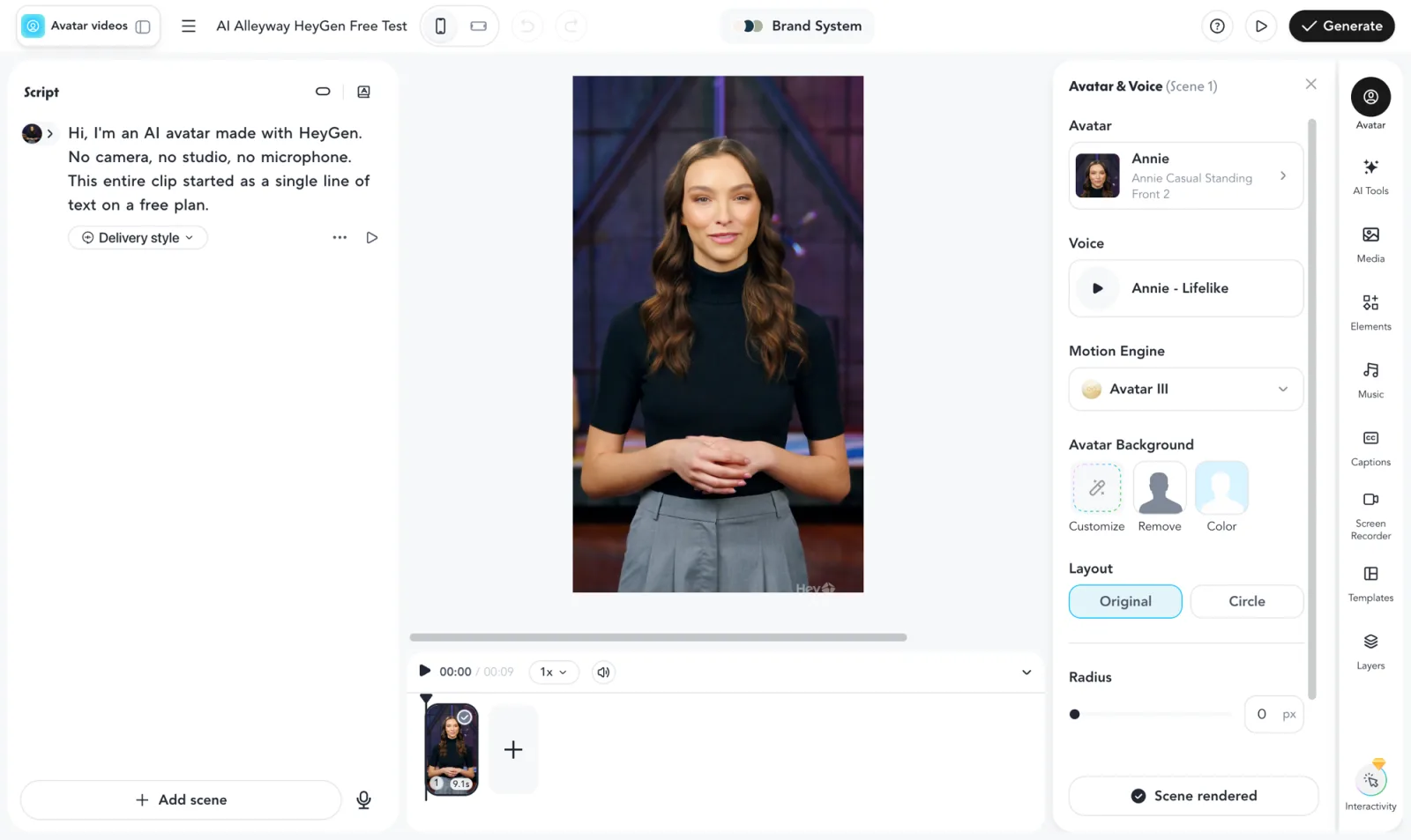
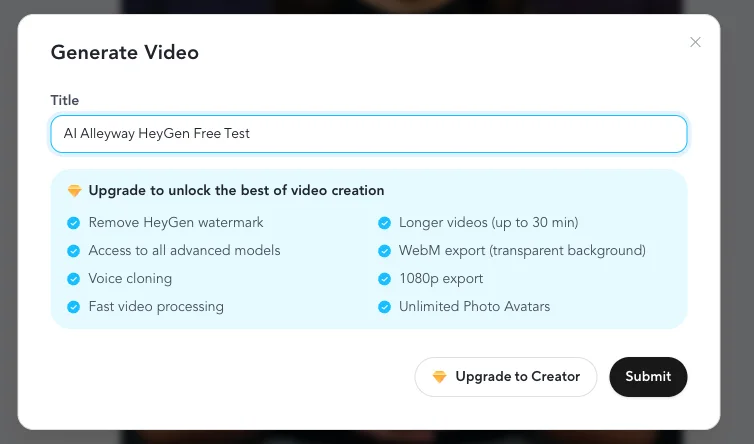
The catch is what it withholds. There is no voice cloning, no 4K, and the watermark stays. Most tellingly, in our hands-on test the free plan would not let us download the finished video at all, and it defaulted to a premium engine that stopped and asked us to upgrade, so we had to switch to Avatar III just to render. Treat it as a way to judge avatar quality, nothing more; our full HeyGen review walks through that free-plan friction in detail.
Creator — $29/month, the real entry point
Creator at $29 a month ($24 annually) is where HeyGen becomes usable. It removes the watermark, enables 1080p export and downloads, adds voice cloning and a custom avatar, and supports 175+ languages, all on 600 credits a month. For a solo creator, this is the plan.
The 600 credits are the thing to watch. If you use the premium engine, that is about 30 minutes of video a month; if you drop to Avatar III, it stretches to roughly 200. Most individual creators making short, frequent clips never come close to the ceiling, so Creator is genuinely enough for a lot of people, as long as you are deliberate about the engine.
Pro — $49/month, more credits and 4K
Pro at $49 a month roughly doubles the allowance to 1,000 credits, adds 4K export and script editing and translation, and lets you scale credits further (up to 100,000 a month on the higher sub-tiers). It suits an individual or small operation producing more premium video than Creator’s 30-minute premium ceiling allows, or anyone who needs 4K.
If your monthly premium-avatar output is somewhere between 30 and 50 minutes, Pro is the plan that stops you rationing credits. Below that, you are paying $20 more a month for headroom you will not use.
Business — $149/month plus seats
Business at $149 a month (plus $20 per additional seat) is aimed at teams. It brings 1,500 credits, videos up to 60 minutes, five custom digital twins, SSO and SAML, interactive videos, and LMS integration. It is also the tier a company needs if several people each want their own avatar.
Watch the seat math: the $149 covers the first seat, and every teammate adds $20, so a five-person team is closer to $229 a month before anyone counts credits. For a team standardizing avatar video with governance, that is reasonable; for one person, it is far more than you need.
Enterprise — custom
Enterprise is quote-only and removes the ceilings: unlimited video length, the fastest processing, 10 or more custom avatars, advanced security, and dedicated support. If you are generating avatar video at real scale or need procurement-grade controls, this is the conversation to have with HeyGen’s sales team rather than a self-serve checkout.
HeyGen’s API is priced separately
If you plan to generate HeyGen video from your own code rather than in the app, the pricing changes entirely. HeyGen’s API runs on a pay-as-you-go model, separate from the Creator, Pro, and Business subscriptions: you top up an API wallet, starting from as little as $5, and pay per generation rather than from a monthly credit bucket.
That separation is the part teams miss. A Creator subscription covers the HeyGen web app, not API calls, and the two draw from different budgets. So if your use case is programmatic, embedding avatar video in a product or batch-generating personalized clips, you price the API wallet on its own and the subscription tiers become irrelevant.
For most readers making videos by hand in the app, the API is not something to worry about. But if “HeyGen pricing” for you means calling the API at volume, budget it as usage-based spend that scales with output, and watch it the way you would any metered API rather than assuming a subscription covers it.
What 600 credits really buys
The abstract “600 credits” becomes concrete once you attach it to real projects. Here is the same monthly Creator allowance spent three ways, using the roughly 20-credits-per-minute premium rate and 3-per-minute Avatar III rate.
A creator posting two 90-second premium clips a week spends about 12 minutes of premium video a month, or roughly 240 credits, comfortably inside Creator with credits to spare. This is the sweet spot HeyGen is priced for, and why so many solo creators are happy on the $29 plan.
A team producing one 30-minute premium training video spends the entire 600-credit allowance in a single render, because 30 minutes times 20 credits is exactly 600. Make two such videos and Creator cannot do it; you are into Pro or Business, or you switch engines. That same 30-minute video on Avatar III costs about 90 credits, roughly a seventh of the price, but with a visibly less lifelike avatar.
A marketer sending personalized outreach video, say 40 thirty-second premium clips a month, spends about 20 minutes of video, or 400 credits, which fits Creator but leaves little headroom. Add translation into a couple of languages and the same campaign can tip over the 600-credit line into Pro territory.
A course creator building an hour of premium training a month needs about 1,200 credits, which neither Creator’s 600 nor Pro’s 1,000 can cover on the premium engine alone. That workload points at Business’s 1,500 credits, or at staying on Pro and rendering the talkier segments on Avatar III while saving the premium engine for the intro.
The lesson is that HeyGen’s cost tracks two things you control: how much video you make, and how realistic it needs to be. A high-volume account that insists on the premium engine is the expensive case; a modest account, or one willing to use Avatar III for filler, is cheap.
What to watch on HeyGen pricing
The plan price is the number HeyGen advertises; these are the ones that change what you actually spend.
| Cost trap | The detail |
|---|---|
| Premium engine | ~20 credits/min vs ~3 for Avatar III (6–7× faster drain) |
| Per-seat pricing | Business is $149 + $20 per additional seat |
| Separate API billing | Pay-as-you-go wallet, not your subscription credits |
| Annual lock-in | The cheaper $24/mo Creator rate needs a yearly commitment |
| No free download | The free plan blocked downloading in our test |
The free plan is a funnel
HeyGen’s free tier is built to sell you Creator, not to be used. The one-to-three short videos are watermarked, and in our test the finished clip could not be downloaded at all. It is fine for judging quality, but anyone expecting to produce a usable video for free will hit a wall fast.
The premium engine drains credits six times faster
The single biggest cost surprise is the engine multiplier. At about 20 credits a minute, the realistic Avatar IV and V engines burn through an allowance six to seven times faster than Avatar III. If your credits are vanishing, this is almost always why, and the fix is to reserve the premium engine for videos that truly need it.
Per-seat pricing adds up on Business
Business looks like $149, but it is $149 for the first seat plus $20 for each additional one. A modest team quickly lands north of $200 a month before credits enter the picture, so budget for seats, not just the headline tier.
The API is billed separately
HeyGen’s API runs on a separate pay-as-you-go wallet (starting around $5), not on your subscription credits. Buying Creator does not get you API access on the same budget, which catches out teams that assume one purchase covers both the app and programmatic use.
The best annual price needs a yearly commitment
The attractive $24-a-month Creator price is the annual rate; month-to-month it is $29. That is a small gap, but it means the cheapest number you see quoted assumes you are locking in for a year.
Costs climb sharply at scale
Community threads from heavier users, such as one titled “HeyGen is too expensive at scale,” echo the same math: the credit model that feels generous for a solo creator gets costly once you are producing premium video in volume. If that is you, price out Business and Enterprise carefully, or a per-minute competitor.
How to keep your HeyGen bill down
Because HeyGen’s cost is mostly in your hands, a few habits keep it low. None of these are hidden tricks; they just follow from how the credit system works.
- Reserve the premium engine for hero videos. Avatar IV and V cost roughly seven times more per minute than Avatar III. Use them where realism sells, a landing-page video or an ad, and drop to Avatar III for internal or filler content; your credits will go much further.
- Pay annually if you will stay a year. Creator falls from $29 to $24 a month on annual billing, and the higher tiers discount similarly. It is a modest saving, but a free one if you were committing anyway.
- Right-size your seats. On Business, every extra seat is $20 a month whether or not that person makes video, so audit who genuinely needs an account before adding them.
- Watch translation credits. Translation adds 2 to 5 credits a minute on top of generation, so localizing a long video is a real cost, not a free extra.
- Do not over-buy for headroom. If your premium output is under 30 minutes a month, Creator’s 600 credits are plenty; jumping to Pro for credits you never spend is $20 a month wasted.
Which HeyGen plan should you choose?
- Just evaluating? Stay on Free to judge avatar quality, but know you cannot download the result; plan to upgrade the moment you want to keep anything.
- A solo creator making short clips? Creator at $29 is the plan. Its 600 credits cover a lot of short-form video, especially if you use the premium engine only where it counts.
- Producing more premium or 4K video? Pro at $49 doubles your credits and adds 4K, the right step up when Creator’s ~30 minutes of premium video a month starts to pinch.
- A team, or need several custom avatars plus SSO? Business at $149 plus seats is built for you, with five digital twins and governance, as long as you budget for the per-seat cost.
- Skip HeyGen entirely if your work is long-form video at high volume and realism is non-negotiable; the premium credit burn will make it pricey, and a per-minute tool may cost less.
If the credits add up, look here
HeyGen’s credit model rewards short, frequent video and punishes long, premium output. If your use case is the second kind, these are worth pricing against it.
- Synthesia — if you make long-form training or corporate video, Synthesia meters by finished minutes rather than credits, which is more predictable for high-volume, standardized output. Its effective cost works out to roughly two dollars a minute of video, so a 30-minute training piece is a known quantity rather than a credit gamble, exactly the case where HeyGen’s premium engine gets expensive. It is the enterprise standard and the closest head-to-head alternative; our HeyGen vs Synthesia comparison breaks the pricing down side by side.
- Vidnoz — if budget is the whole problem, Vidnoz has the most generous genuinely-free tier, with daily credits and downloads allowed, at the cost of polish and a watermark.
- D-ID — if you mainly animate photos into talking heads or need programmatic generation, D-ID is a more affordable, API-friendly specialist than HeyGen’s full studio.
The bottom line on HeyGen pricing
HeyGen’s pricing is simple to state and easy to misjudge: $29 a month for Creator and 600 credits, but those credits are worth 30 minutes of video or 200 depending on the avatar engine you choose. Get that one variable right and Creator is a genuine bargain for a solo creator; get it wrong on a long premium video and you will burn a month’s allowance in a single render.
So price HeyGen by the credits, not the dollars. Decide how much video you make and how lifelike it must be, match that to an engine and a plan, and the tool is well worth it. For the full hands-on verdict, see our HeyGen review, and for where it sits among the alternatives, our best AI avatar generator guide.
Frequently asked questions
How much does HeyGen cost?
HeyGen's paid plans start at $29 a month for Creator, or $24 a month if you pay annually. Above that, Pro is $49 a month, Business is $149 a month plus $20 per additional seat, and Enterprise is custom-priced. There is also a free plan at $0.
But the monthly price only tells half the story, because HeyGen meters usage in credits, not dollars or minutes. Creator includes 600 credits a month, and how far those go depends entirely on which avatar engine you use, so two people on the same $29 plan can get wildly different amounts of video.
What is the HeyGen free plan, and can I download videos?
HeyGen's free plan gives you a small number of avatar videos a month, one to three depending on your region (we got one in our hands-on test), each capped at about one minute, with a watermark and no voice cloning. It is a preview, not a working free tool.
The biggest catch is downloading. In our test, the free plan would not let us download the finished video at all; the download button opened an upgrade wall. So you can generate and watch a clip for free, but to save, share, or publish it you need the Creator plan at $29 a month, which removes the watermark and unlocks 1080p export.
How do HeyGen credits work?
Credits are HeyGen's real currency, and they meter by the minute of video you generate, at a rate that depends on the avatar engine. In our testing, the premium Avatar IV and V engines, the realistic ones, cost about 20 credits a minute, while the older Avatar III engine costs about 3 credits a minute, and video translation runs roughly 2 to 5 credits a minute.
That is why the plan's credit number is more useful than its price. Creator's 600 credits equal about 30 minutes of premium-avatar video a month, or roughly 200 minutes on Avatar III. Pick the wrong engine for a long video and a single project can drain your whole monthly allowance.
How many minutes of video do 600 credits get you?
It depends on the engine. On HeyGen's premium Avatar IV or V engines, which cost about 20 credits a minute, 600 credits buys around 30 minutes of finished video a month. On the older, less realistic Avatar III engine at about 3 credits a minute, the same 600 credits stretches to roughly 200 minutes.
So the honest answer to 'how much video does Creator give me' is anywhere from half an hour to over three hours, depending entirely on which engine you choose. If you need the most lifelike avatar, budget for the 30-minute figure; if realism is negotiable, the cheaper engine goes six times further.
What is the cheapest HeyGen plan with a custom avatar?
The Creator plan at $29 a month is the cheapest tier that includes a custom avatar (your own AI clone, also called a digital twin) along with voice cloning. HeyGen's free plan lists one custom digital twin as well, though the free tier's one-minute, watermarked, non-downloadable videos make it useful only for testing.
If you need multiple custom avatars for a team, that jumps to Business at $149 a month, which includes five digital twins plus SSO and collaboration. So for one person cloning themselves, Creator is enough; for a team each needing their own avatar, you are looking at Business.
Is HeyGen's API priced separately from the plans?
Yes. HeyGen's API runs on its own pay-as-you-go model, separate from the Creator, Pro, and Business subscription credits. You top up an API wallet (starting from as little as $5) and pay per generation, so building HeyGen into your own product or automating video at scale is billed independently of your UI plan.
This trips people up: buying a Creator subscription does not give you API access on the same credits. If your use case is programmatic, price the API separately, and if it is just making videos in the HeyGen app, the subscription plans are what you want.
Keep reading
HeyGen vs Synthesia: which AI avatar tool wins for you?
I tested both hands-on. HeyGen makes more lifelike avatars and renders in ~1 min; Synthesia wins on languages, governance, and price. Here's how to pick.
HeyGen review: stunning avatars, a stingy free plan
I made a real avatar video on HeyGen's free plan. The avatar was uncannily good — then it wouldn't let me download it. Here's who should pay, and who shouldn't.
HeyGen alternatives: the best one depends on why you left
Leaving HeyGen? The best HeyGen alternative isn't one tool: Synthesia (4.6 on G2) for training, Creatify for ads, Tavus for real-time, plus 3 more by job.
Synthesia alternatives: cheaper, or more lifelike?
Leaving Synthesia over the price or the stiff avatars? HeyGen (4.8 on G2) is more lifelike and cheaper, plus 5 more picks sorted by why you're switching.