
Antigravity pricing: one number on the page, and four adjectives
Antigravity pricing starts at $0, the only number on its page. The real ladder runs $4.99 to $199.99, and Google will not say what any of it buys.
Contents
How much does Google Antigravity cost?
Antigravity’s pricing page contains exactly one number. That number is $0.
There are four cards on it. The first says For Individuals, $0/month. The other three — Google AI Pro, Google AI Ultra, and an Organization plan via Google Cloud — carry no price at all. You are expected to go somewhere else to find out, and the somewhere else is a Google One subscription page on a different domain.
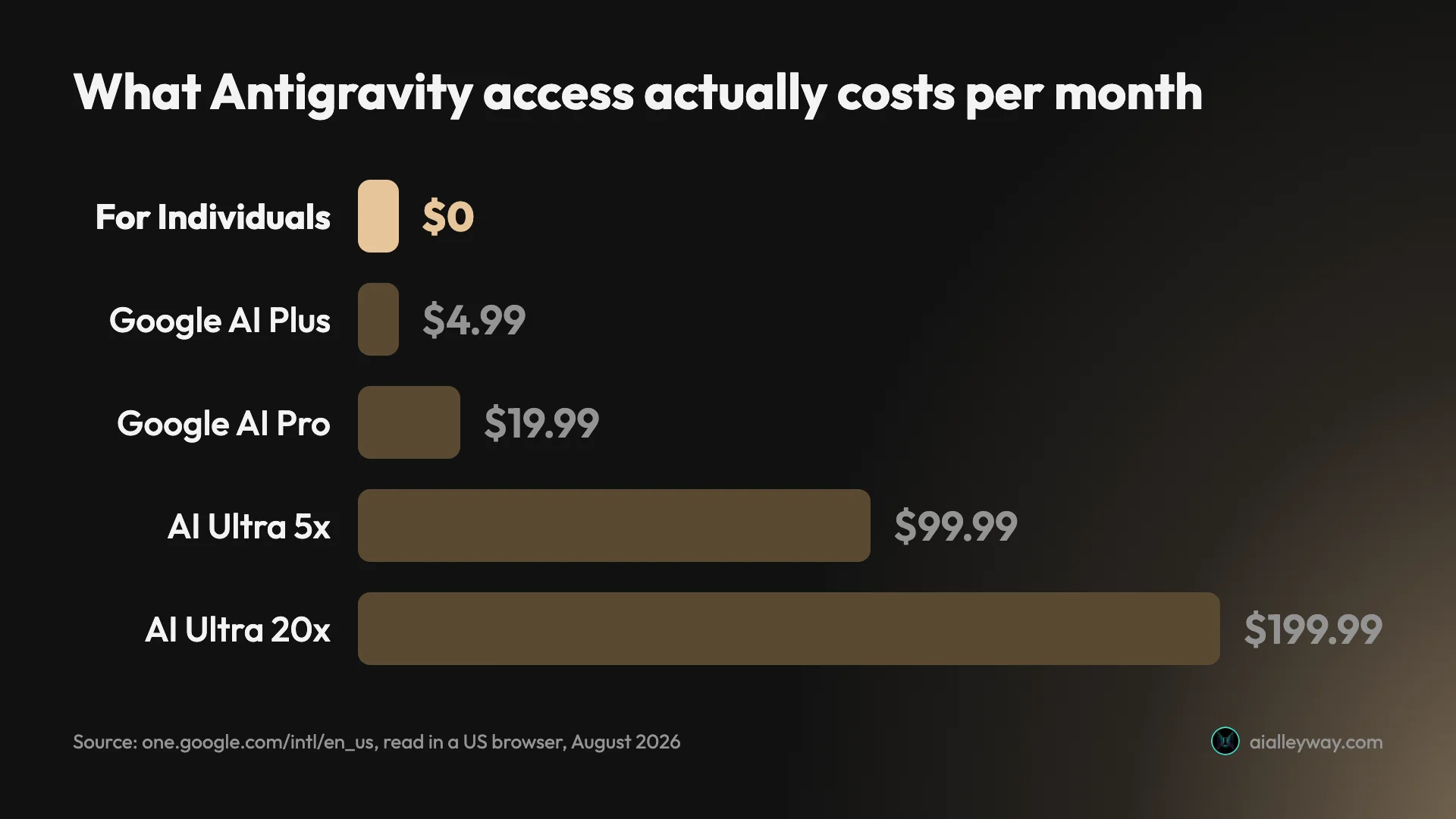
Read there, in a US browser, the actual ladder is this:
| Plan | Price | What Antigravity calls your allowance |
|---|---|---|
| For Individuals | $0/month | ”Basic weekly rate limits” |
| Google AI Plus | $4.99/month | ”Limited” |
| Google AI Pro | $19.99/month | ”Expanded” |
| Google AI Ultra 5x | $99.99/month | ”Higher” |
| Google AI Ultra 20x | $199.99/month | ”Highest” |
| Organization | Via Google Cloud | Consumption-based |
Google’s own announcement rounds those to $20, $100 and $200. Both are accurate; the pennies come from the Google One page and the round numbers from Antigravity’s blog.
The part Google will not tell you
Here is the finding, and it is verifiable in about thirty seconds on Google’s own comparison table.
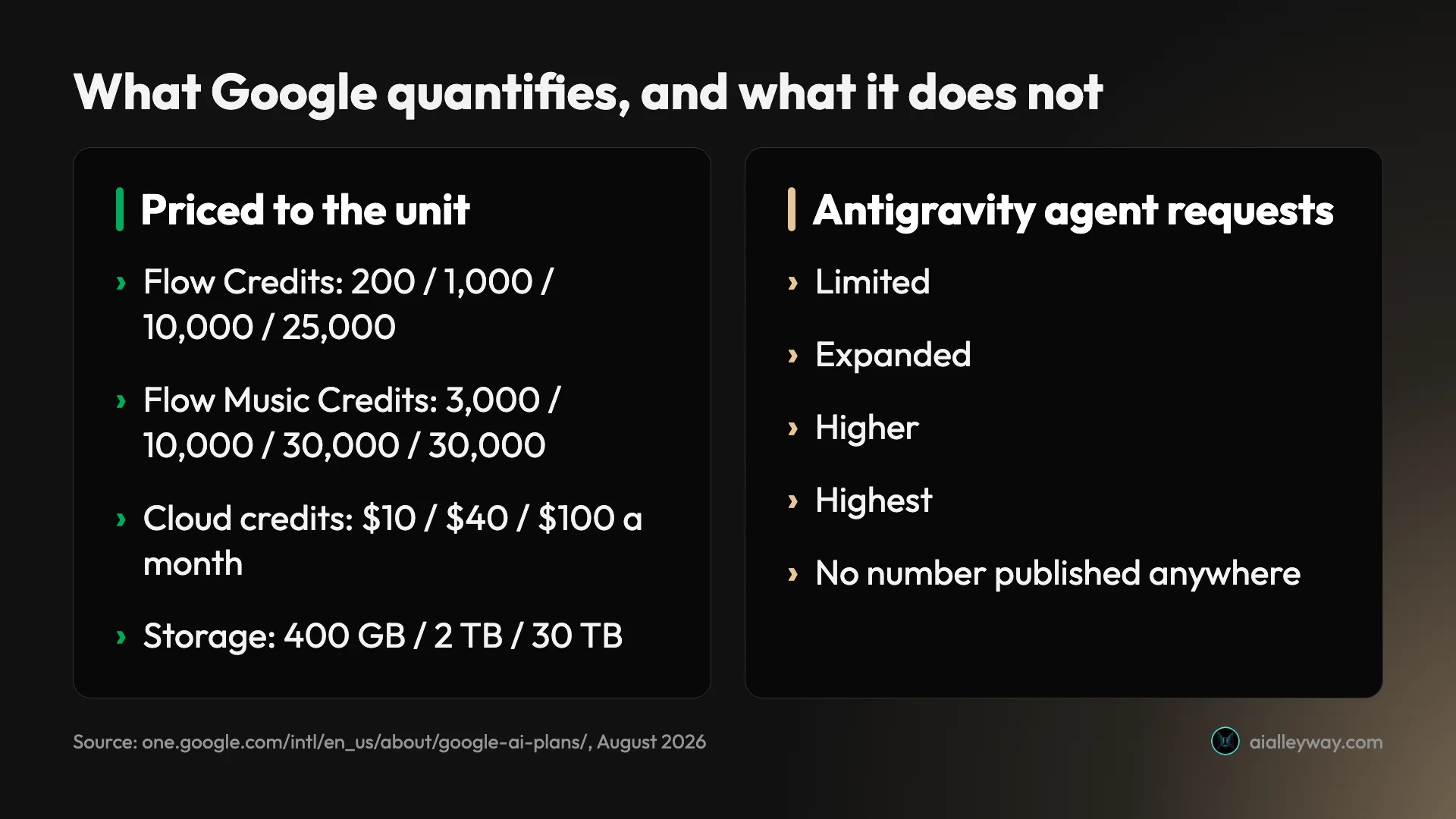
That table quantifies almost everything it sells. Google Flow Credits: 200, 1,000, 10,000 and 25,000 a month across the four tiers. Google Flow Music Credits: 3,000, 10,000, 30,000 and 30,000. Google Cloud credits: $10, $40 and $100 monthly. Exact figures, per tier, no ambiguity.
Then you reach the Antigravity section. It has one row, labelled Agent requests, and its four cells read:
Limited · Expanded · Higher · Highest
Four adjectives. No number anywhere. On the same page, in the same table, where music credits are priced to the individual credit.
Antigravity’s own documentation does the same thing. It describes the quota as “the highest, most generous quota” on Ultra, “high, generous quota” on Pro, and “meaningful quota” on the free tier. The only numeric detail is the refresh interval: paid quotas reset every five hours, the free tier’s resets weekly.
One trap if you go and check this yourself. The row immediately above Antigravity’s is Flow Music Credits, which ends in “30,000/mo”. Read the page as flat text — which is what a scraper or a language model does — and that 30,000 looks like it belongs to Antigravity. It does not. Every figure on this page was extracted from the table’s row structure rather than its reading order, specifically because that adjacency is so easy to get wrong.
The only real number: 5x and 20x
There is exactly one quantified statement about Antigravity’s limits, and it is in Google’s plan-change announcement rather than on any pricing page.
The $100/mo Ultra plan will have a rate limit of 5X worth of tokens compared to the $20/mo Pro plan and the $200/mo Ultra plan will have a rate limit of 20X worth of tokens compared to the $20/mo Pro plan.
That is genuinely useful and also incomplete in a specific way. It tells you the tiers relative to each other. It does not tell you what the $20 tier is, so a multiplier of an unknown is still an unknown. If Pro’s quota suits you, Ultra gives you five times as much of a thing you can measure. If it does not, 5x of “not enough” is not a number you can plan against.
What changed in May 2026
Most of the confusion on this topic dates from one restructure, effective 19 May 2026:
| Before | After | |
|---|---|---|
| Entry paid tier | $20 Pro | $20 Pro, unchanged |
| Middle tier | did not exist | $100 Ultra, 5x Pro’s tokens |
| Top tier | $250 | $200, 20x Pro’s tokens |
| AI credits | Included in base plans | Removed — overage only |
The price cut is the part that got written about. The credits change is the part that matters more: credits stopped being something your subscription includes and became the mechanism that charges you when your quota runs out. Google increased Gemini quotas in exchange, so it is not a straightforward downgrade — but it does mean anything written before May 2026 describes a different product.
That restructure is why published guides currently offer $200, $249.99 and $19.99 as competing answers, along with at least one describing the whole thing as a free public preview. They are not all wrong. They are quoting different moments and mostly not saying which.
What the free tier actually gives you
This is the tier most people should start on, and it is more generous than the marketing implies.
| Free tier includes | |
|---|---|
| Price | $0/month, no card |
| Agent models | Gemini 3.5 Flash, Gemini 3.1 Pro, Gemini 3 Flash, gpt-oss-120b |
| Third-party models | Claude Sonnet and Opus 4.6 |
| Tab completions | Unlimited |
| Command requests | Unlimited |
| Product features | All of them, including Scheduled Tasks and the CLI |
| The catch | ”Basic weekly rate limits”, quantity unstated |
Two things stand out. Claude models on a free Google tier is not what you would predict from either company, and it is on the page. And all product features are included rather than gated — the paid tiers buy throughput, not capability.
I can put one measured data point against it. I gave Antigravity a six-requirement brief and it built a complete working app in about two and a half minutes, on this tier, for nothing — and it wrote and ran its own unit tests while it was at it. The free tier is not decorative. Details are in the Antigravity review.
What I cannot tell you is how many of those you get in a week, because nobody publishes it.
What the rate limits actually mean
Since the quotas are unpublished, the mechanics are the only thing you can plan around. Here is what Antigravity’s documentation does state.
| Free | Pro and Ultra | |
|---|---|---|
| Quota described as | ”Meaningful quota" | "High, generous” / “Highest, most generous” |
| Refresh interval | Weekly | Every five hours |
| Weekly ceiling | Yes | Yes, higher |
| Tab completions | Unlimited, not metered | Unlimited, not metered |
| When you run out | Wait for the reset | Credits, if overages are on |
The refresh interval is the most practically useful fact on this page, and it is easy to miss.
A five-hour refresh changes how you work. On a paid tier, running out at eleven in the morning means you are back before the end of the day. Exhausting a weekly allowance on the free tier on a Monday means Monday was your week. That difference matters more to daily rhythm than the size of the quota does, and it is the clearest argument for the cheapest paid tier over the free one.
Tab completions are free of the meter on every tier. If most of your usage is autocomplete rather than agent runs, your consumption looks nothing like someone driving agents all day, and the free tier will last far longer than any warning suggests.
There is a weekly ceiling above the five-hourly one. So a paid plan is not simply “five-hourly refills forever” — you can still hit a wall that lasts until the week turns. Google does not say where either boundary sits.
Antigravity’s price against the alternatives
The comparison people actually run is against the tools they are already paying for, so here it is with the figures I have verified for each.
| Tool | Free tier | Entry paid | Metered usage on top? | Allowance published? |
|---|---|---|---|---|
| Antigravity | Free indefinitely | $4.99 Plus / $19.99 Pro | Credits, overage only | No |
| Cursor | Hobby, no card | $20 Pro | Yes, in arrears | Yes, $20–$400 by tier |
| Claude Code | None | $20 Claude Pro | Or metered API | Partly |
| Codex | Bundled with ChatGPT | Included | No | Partly |
| Lovable | 5 credits a day | $25 Pro | No, credits expire | Yes, per-action rate card |
| Replit | Daily Agent credits | $20 Core | Checkpoints by effort | No |
Two observations that a straight price row hides.
At the entry tier, four of these cost about the same. Antigravity Pro, Cursor Pro, Claude Pro and Replit Core all sit at $20 give or take a penny. Price is not the differentiator at this level; what you can find out about what you are buying is.
Antigravity and Replit share the same flaw from opposite directions. Replit shows you a percentage of an unstated total running down. Antigravity does not show you a meter at all. Cursor tells you precisely what everything costs and then bills you a month late — which is how I ended up paying $510.70 across eleven months on a plan advertised at $20. Lovable is the only tool in this set that publishes what an action costs before you take it.
So the fair summary is that Antigravity is the cheapest genuine entry point in the category and the least forecastable. Whether that trade works depends entirely on whether your usage is near a boundary you cannot see.
The Organization plan
Worth a short note because it is new and mostly undocumented publicly.
Antigravity now lists an Organization plan via Google Cloud, marked as rolling out to select customers. What the page states is that access falls under Google Cloud Terms of Service, integrates with a Google Cloud project, and uses consumption-based API pricing through the Gemini Enterprise Agent Platform rather than a seat subscription. It is also included in some Gemini Enterprise app subscriptions.
That is a genuinely different commercial model from everything above: metered against a cloud account rather than a flat monthly fee, which for a team is usually more predictable rather than less, because it lands in billing you already monitor.
No pricing is published for it, and I have not used it, so treat this as a pointer rather than a recommendation. If you are evaluating for a team already on Google Cloud, that route is the one to ask your account rep about rather than buying individual AI Ultra seats.
Should you pay for it?
The honest sequence is: start free, and let the ceiling tell you.
Stay on free if you are evaluating, building occasionally, or working on something small. It costs nothing, includes every feature, and completed a real app for me. There is no trial clock to beat.
| Your situation | Tier |
|---|---|
| Evaluating, or building occasionally | Free, costs nothing, every feature included |
| Free is nearly enough | Plus, $4.99, the cheap experiment before the $20 one |
| Daily driver | Pro, $19.99, what Google’s own multipliers measure against |
| You hit Pro’s ceiling routinely | Ultra, $99.99 (5x) or $199.99 (20x) |
| Buying for a team on Google Cloud | Organization, consumption-based, ask your rep |
Google AI Plus at $4.99 is the cheapest way to move up one step, and it is easy to miss because Antigravity’s own materials talk about Pro and Ultra. Plus does include Antigravity — the comparison table gives it “Limited” rather than a blank — so if the free tier is nearly enough, this is a five-dollar experiment before a twenty-dollar one.
AI Pro at $19.99 is the sensible daily-driver tier and the one Google’s own multipliers are measured against. It is also priced identically to Cursor Pro and Claude Pro, which makes the comparison easy on price and impossible on what you get, since the other two publish their allowances and this one does not.
AI Ultra at $99.99 or $199.99 buys 5x or 20x Pro’s tokens. Worth it only once you have hit Pro’s ceiling often enough to know that multiplying it solves your problem.
On a student discount, I have not verified one for Antigravity specifically. Google has historically offered discounted or free AI Pro access to verified students in some countries, and since Antigravity rides on those same Google One plans, any such offer would carry it. I am not going to quote terms I have not read, so check the Google One page from your own account before assuming it applies.
Turn off AI Credit Overages unless you want the bill to be open-ended. Since May 2026 credits exist to charge you past your quota, and the setting controlling that has a “Never” option. It is the only spend control in the product.
Two things worth knowing before you commit
Google has re-tiered a free developer product here before, and recently. Gemini CLI was retired on 18 June 2026 and its users moved to Antigravity CLI, with the free allowance going from roughly a thousand requests a day to roughly twenty. That is not a prediction about Antigravity’s free tier. It is the most relevant precedent available, from the same company, in the same product family, in the same year.
The price you see depends on where you are. Google One’s plan page is served by IP address, and ?hl=en&gl=US does not override it — a request from outside the US returns local currency. That is why a Reddit thread on this topic quotes “$29/month” for Pro: it is Kenyan shillings converted after bank fees. Every dollar figure on this page came from the /intl/en_us/ path specifically to avoid that, and if you are comparing your own bill against this article, check which currency your account is being quoted in first.
The final word
Antigravity’s pricing is genuinely good and its pricing disclosure is the worst of any tool I have looked at this year.
The good part is real: a free tier that runs indefinitely, includes every feature, ships Claude models on a Google plan, and built a working application for me without a credit card. If you want to find out whether agent-first development suits you, this is the cheapest way to do it that exists.
The bad part is that you cannot plan with it. A pricing page with one number on it, two tiers described in identical words, a comparison table that prices music credits to the unit and your agent requests in adjectives, and documentation whose most precise statement is “meaningful”. The only quantified fact anywhere is a multiplier of an unpublished baseline.
So the recommendation is shaped by the disclosure rather than the price. Start on free, because it costs nothing and it works. Move to Plus at $4.99 or Pro at $19.99 when you hit the wall, since hitting the wall is the only way you will ever learn where it is. And set the overage control before you need it, because the one thing Google is precise about is how to charge you when the quota you cannot see runs out.
Antigravity is one of eight tools I have put through the same six-requirement build. The best AI for coding ranks how it did against the rest. Head to head it is Antigravity vs Claude Code if you are weighing it against a paid agent, and Antigravity vs Cursor if you are weighing it against a paid editor.
Frequently asked questions
How much does Google Antigravity cost?
Nothing, on its own. Antigravity's own pricing page contains exactly one number and that number is $0. There is no Antigravity subscription to buy.
Paid access comes through a Google One AI plan instead, and read in a US browser that ladder is $4.99 a month for Google AI Plus, $19.99 for AI Pro, $99.99 for AI Ultra 5x and $199.99 for AI Ultra 20x. Google's own announcement rounds those to $20, $100 and $200. All four tiers include Antigravity, so $4.99 is a genuine entry price rather than a plan that excludes it.
Is Google Antigravity free?
Yes, and unusually so. The free tier is a product rather than a trial with a hidden clock: it is listed as generally available at $0 a month with no card required, and it includes Gemini 3.5 Flash, Gemini 3.1 Pro, Gemini 3 Flash, gpt-oss-120b and — unusually for a Google product — Claude Sonnet and Opus 4.6.
It also includes unlimited Tab completions and unlimited Command requests. I built a complete six-requirement app on it without paying anything. What it does not tell you is where the ceiling sits: the limit is described only as basic weekly rate limits, with no number attached anywhere.
What do you actually get for $20 a month?
Google will not say, and that is the honest answer rather than a dodge. On Antigravity's pricing page the Pro and Ultra cards carry identical wording — both promise more generous rate limits and a flexible AI credit pool, with no figure and no stated difference between them.
On Google's plan comparison the Antigravity row reads Limited, Expanded, Higher, Highest across the four tiers. The only quantified statement anywhere is in Google's own announcement: the $100 Ultra plan has a rate limit worth 5x the tokens of the $20 Pro plan, and the $200 plan 20x. So you can compare the tiers to each other, but nothing tells you what the baseline is.
What changed in Antigravity's pricing?
Google restructured the plans effective 19 May 2026. A $100 Ultra tier was added between Pro and the top plan, and the top Ultra plan was cut from $250 a month to $200.
The more consequential change is quieter: AI credits were removed from the base plans, with Gemini model quotas increased in exchange, so credits now exist purely as an overage mechanism once your quota runs out. That is why articles written before and after May 2026 quote incompatible numbers, and why some still cite $250 or describe credits as something the subscription includes.
What are AI credits and do I need them?
Since the May 2026 restructure they are an overage mechanism, not part of what your plan includes. When your baseline quota is exhausted, credits can cover the difference, and Antigravity exposes a setting called AI Credit Overages that controls whether that happens automatically or never.
That setting is worth finding on the day you subscribe. It is the only spend control in the product, and the difference between a plan that stops when the quota does and one that keeps going onto credits is the difference between a fixed bill and an open one.
Why do pricing articles about Antigravity disagree?
Because they are quoting different things at different times, and often not saying which. One write-up says $200, another says $249.99, a third says $19.99, and a fourth describes the whole product as free in public preview.
Three causes. The May 2026 restructure moved the top tier from $250 to $200 and added a $100 plan. Antigravity's own page shows $0 while the prices live on a different Google domain. And that Google page is served by IP address, so a fetch from outside the US returns local currency rather than dollars — every figure here was read from the /intl/en_us/ path in a US browser for exactly that reason.
Keep reading
Antigravity vs Cursor: I gave both the same brief and paid nothing
Antigravity vs Cursor on one identical build. Cursor was the fastest of seven tools, and its free tier did the whole job. Both cost me nothing.
Antigravity vs Claude Code: I gave both one brief, neither built it
Antigravity vs Claude Code, measured on one identical brief. Both refused to build unattended — the opposite of what page one says. Costs, code and verdict.
Google Antigravity review: it wrote its own tests
Antigravity built my six-requirement app on the free tier and met all six. Then it wrote and ran its own unit tests, which no other builder I have tested does.
Bolt.new alternatives: 8 tools, 7 took the same brief
The best Bolt.new alternatives, ranked by a measured build rather than a feature table. Seven tools took one identical brief. Here is what each build cost.